From Real Exams Quiz
A Level H2 Physics Waves Sound Light Quiz
Free A Level H2 Physics Waves Sound Light quiz, HY3 Exam version, with questions, answers, and A Level-style practice for Singapore students.
These static practice materials are generated from the site's syllabus and paper-generation workflow, with source and model context shown so students and parents can evaluate the material before use.
Questions
A-Level Physics H2 Quiz - Waves Sound Light
Name: ___________________________
Class: ___________________________
Date: ___________________________
Score: _______ / 40
Duration: 60 minutes
Total Marks: 40
Instructions:
- Answer all 20 questions.
- Show your working clearly where calculation is required.
- Use the provided answer spaces.
- Section A: Short structured questions (1–10)
- Section B: Data and diagram interpretation (11–15)
- Section C: Extended reasoning (16–20)
Section A: Short Structured Questions (1–10)
1. State what is meant by the term wavelength of a progressive wave. [1]
2. A sound wave of frequency 440 Hz travels in air at speed 340 m s−1. Calculate its wavelength. [2]
3. Explain why polarisation is observed only for transverse waves and not for longitudinal waves. [2]
4. A string is fixed at both ends and vibrates to form a standing wave with three antinodes. State the number of nodes present including the ends. [1]
5. Two coherent sources produce interference fringes. State the condition for a bright fringe to be observed at a point. [2]
6. Light of wavelength 600 nm passes through a diffraction grating of 5.0×10⁵ lines per metre. Calculate the angle θ for the first-order maximum. [3]
7. A point source emits sound uniformly in all directions with power P=2.0 W. Calculate the intensity at distance r=4.0 m. [2]
8. State Malus’ law for the intensity of plane-polarised light after passing through an analyser. [1]
9. A wave has displacement y=0.02sin(4πt) m. State its amplitude and angular frequency. [2]
10. Explain the difference between diffraction and interference. [2]
Section B: Data and Diagram Interpretation (11–15)
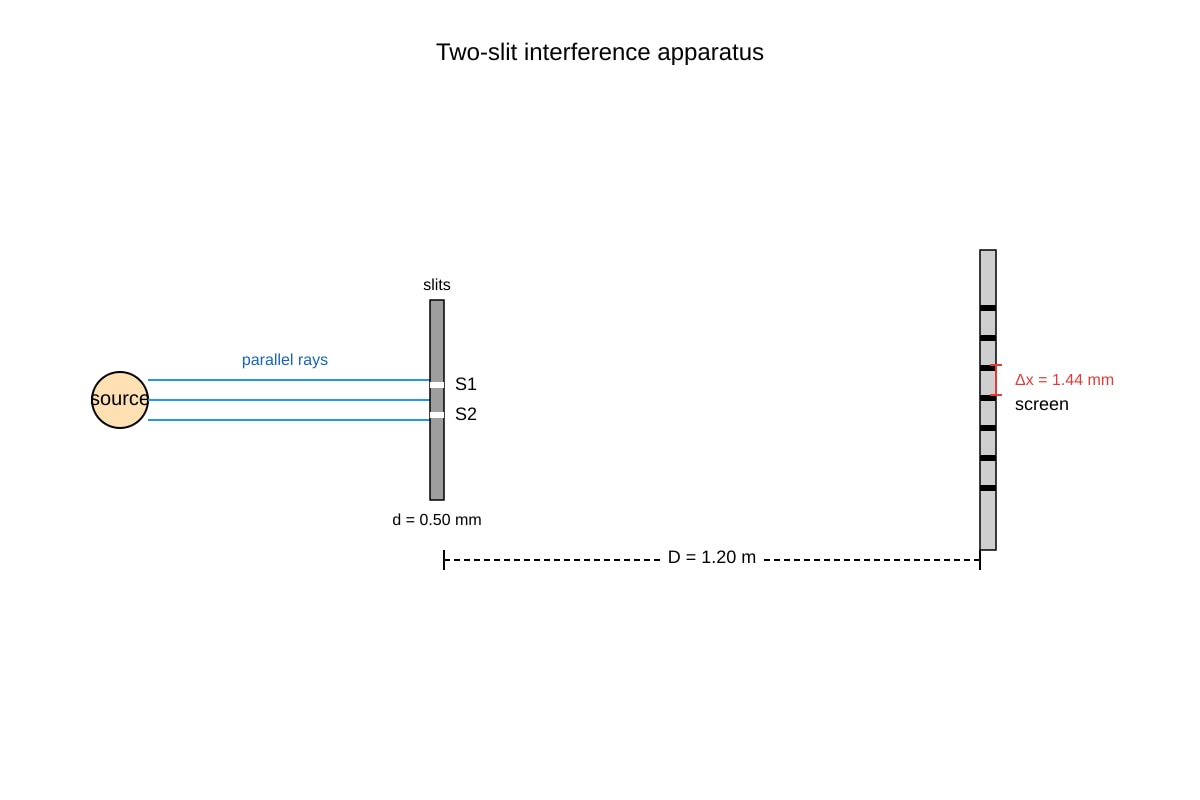
11. The diagram shows a two-slit interference setup. Slit separation d=0.50 mm, screen distance D=1.20 m, and fringe separation Δx=1.44 mm. Calculate the wavelength λ of the light used. [3]
Image pending generation: diagram for Q11.
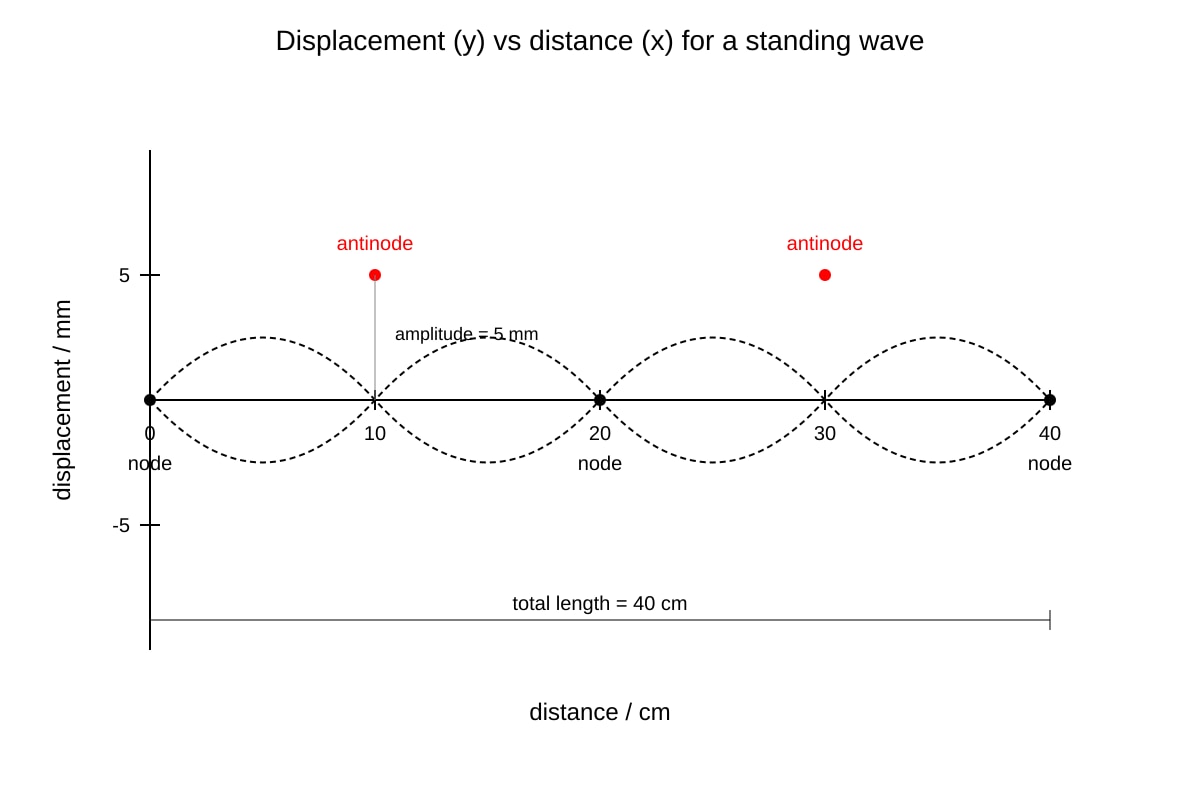
12. The graph shows displacement against distance for a standing wave on a string at an instant.
Image pending generation: graph for Q12.
(a) State the wavelength of the wave. [1]
(b) State the distance between two adjacent nodes. [1]
13. A diffraction grating is used to observe spectra. The table shows angles for different orders for light of unknown wavelength.
| Order n | Angle θ (°) |
|---|---|
| 1 | 18.0 |
| 2 | 37.5 |
Grating has 2.0×10⁵ lines m−1. Determine the wavelength. [3]
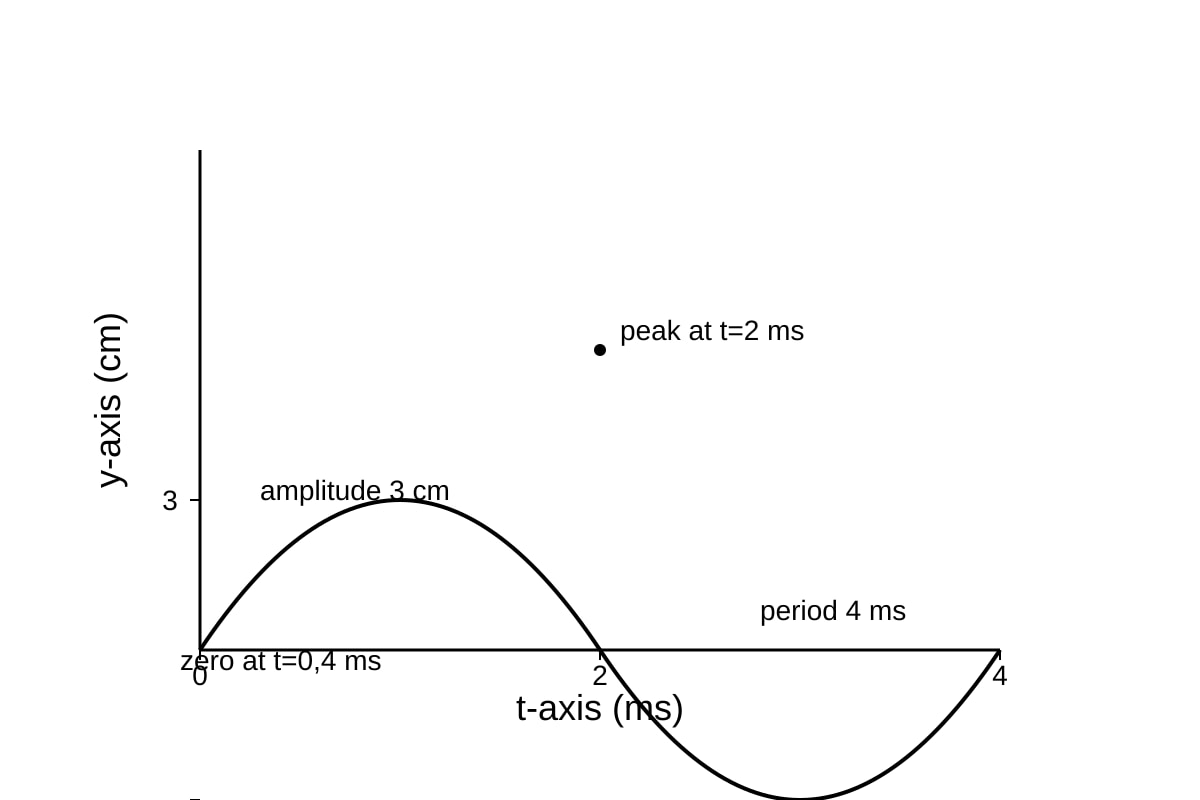
14. The figure shows a transverse wave at time t=0.
Image pending generation: graph for Q14.
(a) State the frequency. [1]
(b) Calculate the wave speed if wavelength is 0.80 m. [2]
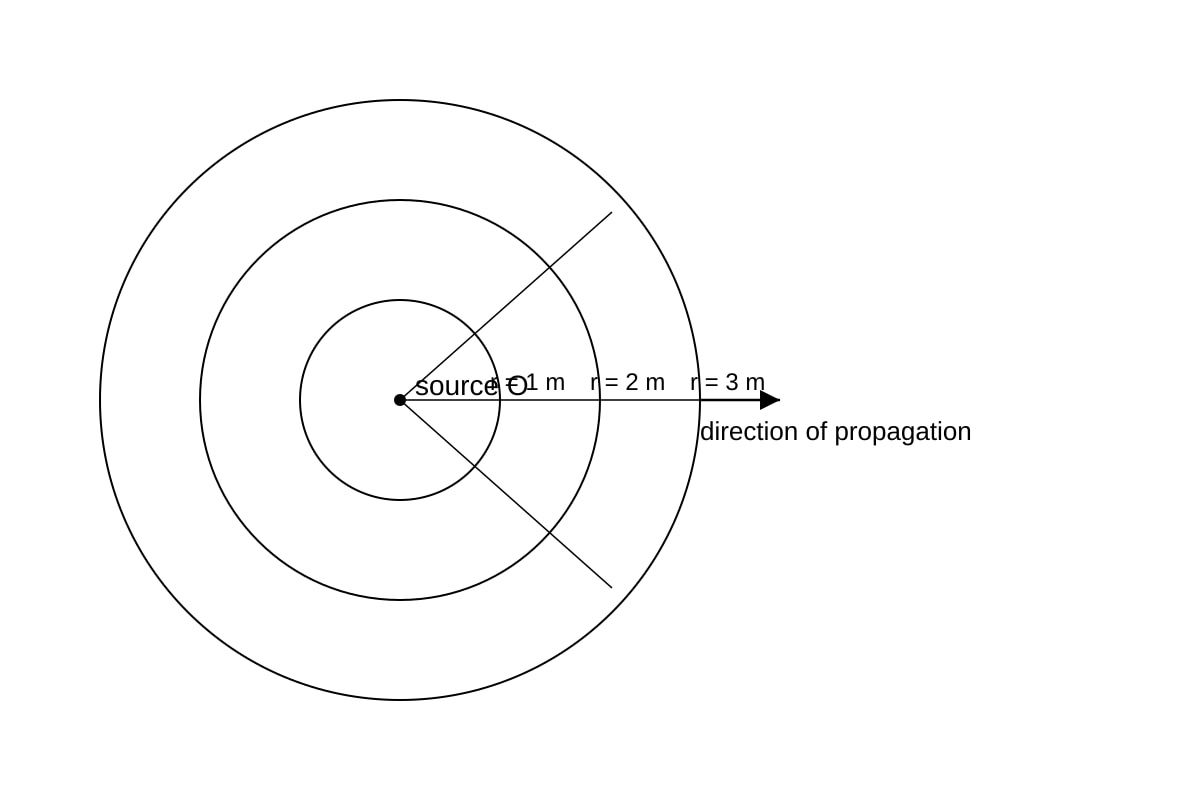
15. A sound wave front diagram is shown.
Image pending generation: diagram for Q15.
State how intensity changes with distance from the source and give the law. [2]
Section C: Extended Reasoning (16–20)
16. A string of length L=0.80 m fixed at both ends has a wave speed v=160 m s−1.
(a) Calculate the fundamental frequency. [2]
(b) State the frequency of the second harmonic. [1]
(c) Explain how standing waves are formed. [2]
17. Describe an experiment to determine the wavelength of laser light using a double-slit. Include apparatus, procedure, and how data is used. [5]
18. A polariser and analyser are used with unpolarised light of intensity I0.
(a) State intensity after polariser. [1]
(b) If analyser is at 30∘ to polariser, calculate transmitted intensity. [2]
(c) Explain the use of polarisation in reducing glare. [2]
19. Explain with the help of superposition how a diffraction grating produces principal maxima and why higher orders are at larger angles. [4]
20. A musical note of 512 Hz is produced in a tube closed at one end. Speed of sound 340 m s−1.
(a) Calculate the fundamental wavelength. [2]
(b) State the length of the tube for fundamental. [1]
(c) Explain why only odd harmonics are present. [2]
Answers
A-Level Physics H2 Quiz - Waves Sound Light (Answer Key)
Total Marks: 40
Topic: Waves, Sound & Light
Section A
1. [1 mark]
Wavelength is the distance between two consecutive points in phase (e.g. two adjacent crests or troughs) of a progressive wave.
Teaching note: Progressive waves transfer energy; wavelength λ is measured in metres.
2. [2 marks]
Use v=fλ⇒λ=v/f.
λ=340/440=0.773 m (3 s.f.).
Marks: 1 for formula, 1 for answer with unit.
3. [2 marks]
Transverse waves have oscillations perpendicular to direction of travel, so a plane of vibration exists and can be filtered by a polariser. Longitudinal waves oscillate parallel to travel, so no unique plane to select.
Marks: 1 for transverse explanation, 1 for longitudinal.
4. [1 mark]
With 3 antinodes on a string fixed at both ends, there are 4 nodes (including the two ends).
5. [2 marks]
Path difference from the two sources = nλ (where n=0,1,2,…) and the waves arrive in phase.
Marks: 1 path diff, 1 in phase.
6. [3 marks]
d=1/(5.0×105)=2.0×10−6 m.
nλ=dsinθ⇒sinθ=λ/d=600×10−9/2.0×10−6=0.300.
θ=sin−1(0.300)=17.5∘.
Marks: 1 grating spacing, 1 substitution, 1 angle.
7. [2 marks]
I=P/(4πr2)=2.0/(4π×4.02)=2.0/201.1=9.95×10−3 W m−2.
Marks: 1 formula, 1 answer.
8. [1 mark]
I=I0cos2θ where I0 is intensity after polariser, θ angle between polariser and analyser.
9. [2 marks]
Compare y=Asin(ωt): A=0.02 m, ω=4π rad s−1.
Marks: 1 each.
10. [2 marks]
Diffraction: spreading of waves past an obstacle/aperture. Interference: superposition of two/more coherent waves to form maxima/minima.
Marks: 1 each.
Section B
11. [3 marks]
λ=dΔx/D=(0.50×10−3×1.44×10−3)/1.20=6.0×10−7 m=600 nm.
Marks: 1 convert units, 1 formula, 1 answer.
12. [2 marks]
(a) Wavelength = 20 cm (two loops over 40 cm → λ/2=20 cm, so λ=40 cm? Wait: 2 complete loops = 2 half-wavelengths? Actually 2 loops = 1 full wavelength if loop = half-wave; 2 loops = λ = 40 cm). From labels: nodes at 0,20,40 → distance between nodes = 20 cm = λ/2, so λ=40 cm. [1]
(b) Adjacent nodes = 20 cm. [1]
13. [3 marks]
d=1/(2.0×105)=5.0×10−6 m.
Using n=1: λ=dsin18∘=5.0×10−6×0.309=1.545×10⁻⁶ m.
Check n=2: 2λ=dsin37.5∘=5.0×10−6×0.609=3.045×10⁻⁶ → λ=1.52×10⁻⁶ m. Avg ≈1.53×10⁻⁶ m.
Marks: 1 spacing, 1 calc, 1 consistency.
14. [3 marks]
(a) T=4 ms⇒f=1/T=250 Hz. [1]
(b) v=fλ=250×0.80=200 m s−1. [2]
15. [2 marks]
Intensity decreases with distance according to inverse square law: I∝1/r2.
Marks: 1 law, 1 statement.
Section C
16. [5 marks]
(a) Fundamental: λ=2L=1.60 m, f=v/λ=160/1.60=100 Hz. [2]
(b) Second harmonic = 2×100=200 Hz. [1]
(c) Incident and reflected waves of same frequency/amplitude superpose, forming nodes (zero displacement) and antinodes. [2]
17. [5 marks]
Apparatus: laser, double slit (d), screen, metre rule.
Procedure: shine laser through slits onto screen, measure fringe separation Δx over several fringes, measure D.
Use λ=dΔx/D. Repeat for accuracy.
Mark descriptors: apparatus (1), procedure (2), formula use (1), reducing error (1).
18. [5 marks]
(a) After polariser: I0/2. [1]
(b) I=(I0/2)cos230∘=0.5I0×0.75=0.375I0. [2]
(c) Glare is horizontally polarised; polarising sunglasses block that plane, reducing reflected light. [2]
19. [4 marks]
Each slit acts as source; waves superpose. Principal maxima when dsinθ=nλ. Larger n → larger sinθ → larger θ.
Marks: superposition (1), condition (1), angle relation (2).
20. [5 marks]
(a) Closed at one end: λ=4L=4×(340/512)=2.66 m. [2]
(b) L=λ/4=0.664 m. [1]
(c) Node at closed end, antinode at open; only quarter-wave odd multiples fit. [2]
Free quiz and exam paper access
Enter your details to view this paper
Your access is remembered on this device.