From Real Exams Quiz

A Level H2 Physics Thermal Physics Quiz

Free Exam-Derived Owl Alpha A Level H2 Physics Thermal Physics quiz with questions and answers for Singapore students. This page is rendered as a direct URL so the questions and answers can be discovered without pressing in-page buttons.

These static practice materials are generated from the site's syllabus and paper-generation workflow, with source and model context shown so students and parents can evaluate the material before use.

A Level H2 Physics From Real Exams Generated by Owl Alpha Updated 2026-06-07

Questions

<!-- TuitionGoWhere generation metadata: stage=3-0; model=openrouter/owl-alpha; model_label=Owl Alpha; generated=2026-06-06; Sources: Stage 2-1 real exam-derived templates and Stage 2-2 exam-enriched syllabus. -->

A-Level Physics H2 Quiz - Thermal Physics

Name: ____________________
Class: ____________________
Date: ____________________
Score: ______ / 40

Duration: 50 minutes
Total Marks: 40

Instructions:

  • Answer ALL questions.
  • Show all working clearly. Answers without working may not receive full credit.
  • The number of marks for each question or part-question is shown in brackets [ ].
  • You may use a calculator.
  • Take the gas constant R=8.31 J mol1K1R = 8.31 \text{ J mol}^{-1} \text{K}^{-1} where needed.

Section A: Multiple Choice (10 marks)

Questions 1–10 are multiple-choice questions. Each question carries 1 mark. Choose the ONE option that is the best answer.


1. Which of the following best defines an ideal gas?

A. A gas that obeys the equation of state pV=nRTpV = nRT at all temperatures and pressures.
B. A gas composed of molecules that have negligible volume but strong intermolecular forces.
C. A gas that cannot be liquefied under any conditions.
D. A gas at very low temperature and very high pressure.


2. A fixed mass of an ideal gas is compressed at constant temperature. Which statement is correct?

A. The average kinetic energy of the molecules increases.
B. The pressure of the gas decreases.
C. The product pVpV remains constant.
D. The internal energy of the gas increases.


3. The internal energy of a system of an ideal gas depends on

A. the pressure only.
B. the volume only.
C. the temperature only.
D. both pressure and volume.


4. During an adiabatic expansion of an ideal gas, the temperature of the gas

A. increases because work is done on the gas.
B. decreases because the gas does work and no heat is supplied.
C. remains constant because no heat is exchanged.
D. increases because the internal energy increases.


5. A gas is heated at constant pressure. The ratio of the heat supplied QQ to the increase in internal energy ΔU\Delta U is equal to

A. CVCp\frac{C_V}{C_p}
B. CpCV\frac{C_p}{C_V}
C. CpCVCV\frac{C_p - C_V}{C_V}
D. CpCpCV\frac{C_p}{C_p - C_V}


6. The root-mean-square speed of molecules of an ideal gas is doubled when the absolute temperature is

A. doubled.
B. quadrupled.
C. increased by a factor of 2\sqrt{2}.
D. increased by a factor of 8.


7. Two containers of equal volume contain ideal gases X and Y at the same temperature. Gas X has twice the number of molecules as gas Y. The ratio of the pressure of gas X to the pressure of gas Y is

A. 1:11:1
B. 1:21:2
C. 2:12:1
D. 4:14:1


8. Which of the following processes involves zero work done by the gas?

A. Isobaric expansion
B. Isothermal compression
C. Isovolumetric (isochoric) heating
D. Adiabatic expansion


9. The first law of thermodynamics can be written as Q=ΔU+WQ = \Delta U + W, where WW is the work done by the gas. In an isothermal expansion of an ideal gas,

A. Q=0Q = 0 because temperature is constant.
B. ΔU=0\Delta U = 0 and Q=WQ = W.
C. W=0W = 0 because internal energy is constant.
D. ΔU>0\Delta U > 0 and Q>WQ > W.


10. The specific heat capacity of a substance is defined as the energy required to

A. raise the temperature of 1 kg of the substance by 1 K1 \text{ K}.
B. raise the temperature of the substance by 1 K1 \text{ K}.
C. change the state of 1 kg of the substance.
D. raise the temperature of 1 mole of the substance by 1 K1 \text{ K}.


Section B: Structured Questions (20 marks)

Answer ALL questions. Show all working.


11. (a) State the first law of thermodynamics. [2]

(b) An ideal gas undergoes an isochoric (constant volume) process in which its internal energy increases by 450 J450 \text{ J}. Calculate the heat supplied to the gas. Explain your reasoning. [3]


12. A cylinder contains 0.25 mol0.25 \text{ mol} of an ideal monatomic gas at a temperature of 300 K300 \text{ K}.

(a) Calculate the total internal energy of the gas. [2]

(b) The gas is heated at constant pressure until its volume doubles. Calculate the final temperature of the gas. [2]

(c) Calculate the work done by the gas during this expansion. [2]


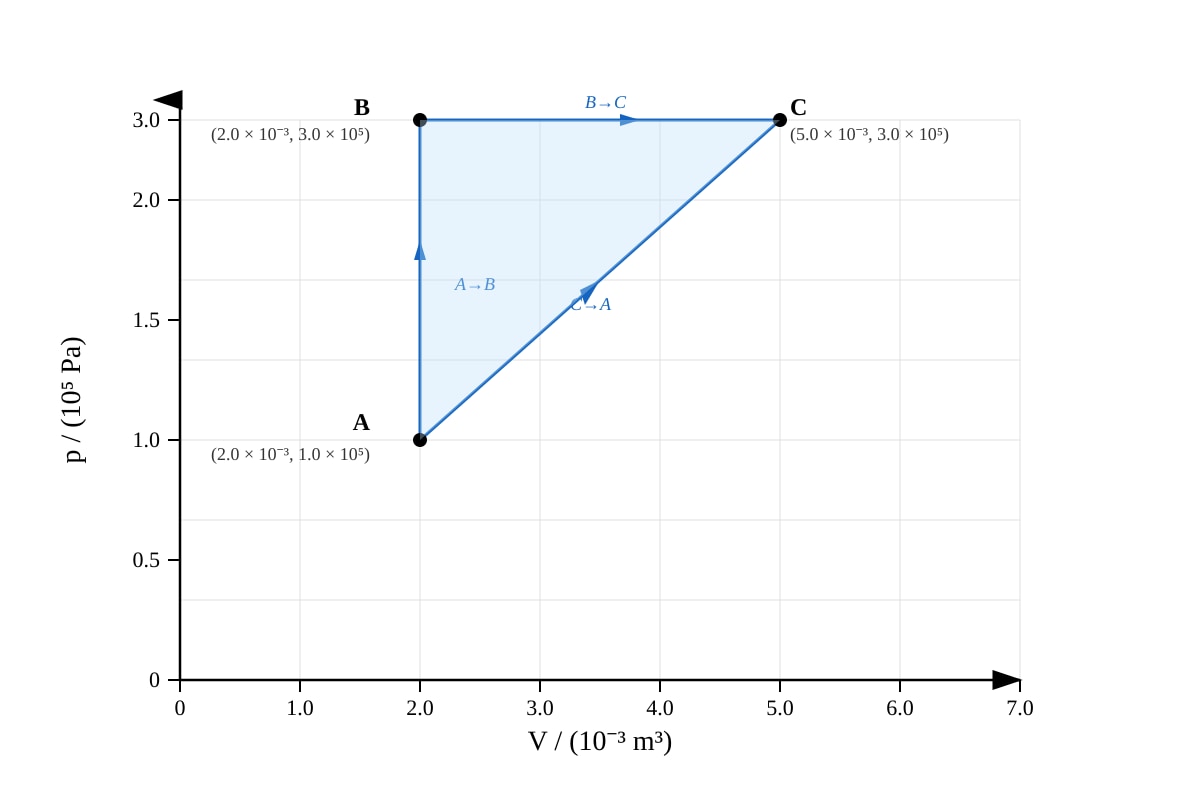
13. The pp-VV diagram below shows a cycle ABCA performed on a fixed mass of an ideal gas.

<image_placeholder> id: Q13-fig1 type: graph linked_question: Q13 description: A p-V diagram showing a triangular cycle ABCA. Point A is at (V = 2.0 × 10⁻³ m³, p = 1.0 × 10⁵ Pa). Point B is at (V = 2.0 × 10⁻³ m³, p = 3.0 × 10⁵ Pa). Point C is at (V = 5.0 × 10⁻³ m³, p = 3.0 × 10⁵ Pa). The cycle goes A → B (isochoric), B → C (isobaric), C → A (straight line back). labels: p (Pa) on vertical axis, V (m³) on horizontal axis, points A, B, C labelled with coordinates values: A: (2.0 × 10⁻³, 1.0 × 10⁵), B: (2.0 × 10⁻³, 3.0 × 10⁵), C: (5.0 × 10⁻³, 3.0 × 10⁵) must_show: Axes with labels and units, all three points labelled with their (V, p) values, arrows showing direction of cycle A→B→C→A, triangular shape clearly visible </image_placeholder>

(a) State the work done by the gas during process A → B. Explain your reasoning. [2]

(b) Calculate the work done by the gas during process B → C. [2]

(c) Determine the net work done by the gas during the complete cycle ABCA. [2]


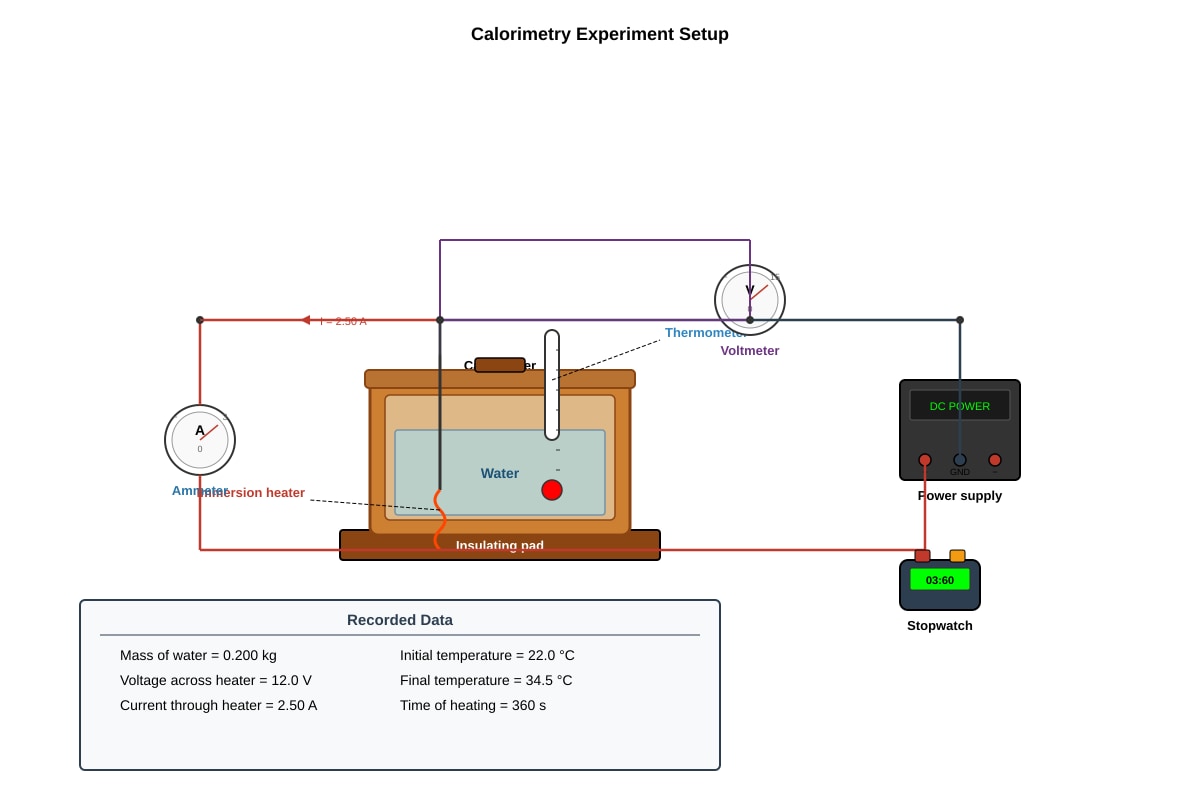
14. A student uses the apparatus shown to estimate the specific heat capacity of water. An electric heater is immersed in a known mass of water inside a calorimeter. The temperature of the water is recorded over time.

<image_placeholder> id: Q14-fig1 type: experimental_setup linked_question: Q14 description: A calorimetry experiment setup showing a copper calorimeter can containing water, with an electric immersion heater fully submerged, a thermometer inserted into the water, and a power supply connected to the heater via ammeter (in series) and voltmeter (in parallel with heater). A stopwatch is shown nearby. The calorimeter is placed on an insulating pad. labels: Calorimeter, Water, Immersion heater, Thermometer, Ammeter, Voltmeter, Power supply, Insulating pad values: Mass of water = 0.200 kg, Voltage across heater = 12.0 V, Current through heater = 2.50 A, Initial temperature = 22.0 °C, Final temperature = 34.5 °C, Time of heating = 360 s must_show: All components clearly labelled, circuit connections visible, thermometer bulb in water, heater coil submerged, calorimeter on insulation </image_placeholder>

(a) Using the data shown in the diagram, calculate the specific heat capacity of water. [3]

(b) The accepted value of the specific heat capacity of water is 4200 J kg1K14200 \text{ J kg}^{-1} \text{K}^{-1}. Suggest one reason why your calculated value may differ from the accepted value. [1]


Section C: Free Response (10 marks)

Answer ALL questions.


15. Explain, in terms of molecular kinetic theory, why the pressure of a fixed mass of an ideal gas increases when its temperature is increased at constant volume. [4]


16. A fixed mass of ideal gas undergoes two different processes from the same initial state to the same final state:

  • Process 1: Isobaric expansion followed by isochoric cooling.
  • Process 2: Isochoric cooling followed by isobaric expansion.

(a) Sketch both processes on the same pp-VV diagram, clearly labelling each process and the initial and final states. [3]

(b) Explain whether the work done by the gas is the same or different for the two processes. [3]


17. A container holds 3.0 mol3.0 \text{ mol} of an ideal gas at a pressure of 2.0×10⁵ Pa2.0 \times 10^5 \text{ Pa} and a temperature of 350 K350 \text{ K}.

(a) Calculate the volume of the gas. [2]

(b) The gas is compressed isothermally to half its original volume. Calculate the new pressure. [2]

(c) Calculate the root-mean-square speed of the gas molecules before compression, given that the molar mass of the gas is 32.0 g mol132.0 \text{ g mol}^{-1}. [3]


18. Distinguish between specific heat capacity and heat capacity. [2]


19. State two assumptions of the kinetic theory of gases that explain why real gases deviate from ideal gas behaviour at high pressures. [2]


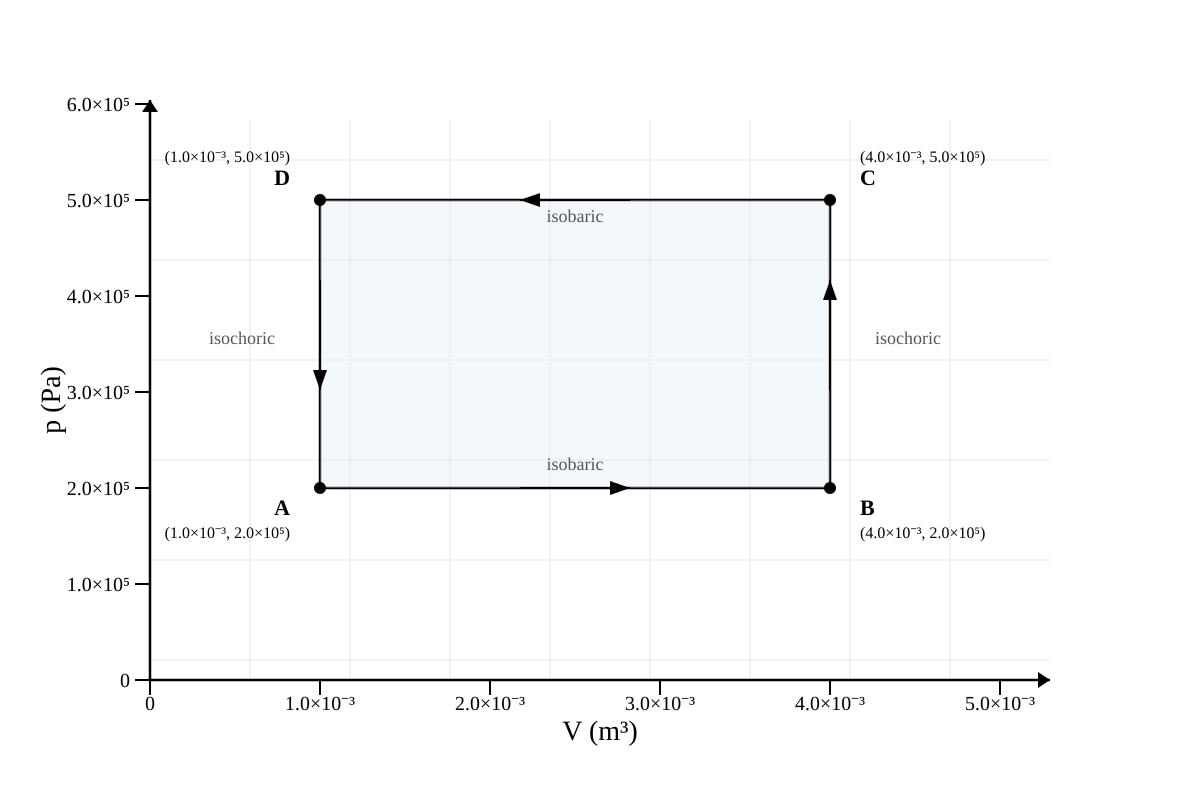
20. A gas is taken through the cyclic process shown in the pp-VV diagram below.

<image_placeholder> id: Q20-fig1 type: graph linked_question: Q20 description: A p-V diagram showing a rectangular cycle. Point A at (1.0 × 10⁻³ m³, 2.0 × 10⁵ Pa), Point B at (4.0 × 10⁻³ m³, 2.0 × 10⁵ Pa), Point C at (4.0 × 10⁻³ m³, 5.0 × 10⁵ Pa), Point D at (1.0 × 10⁻³ m³, 5.0 × 10⁵ Pa). Cycle goes A→B (isobaric), B→C (isochoric), C→D (isobaric), D→A (isochoric). labels: p (Pa) vertical axis, V (m³) horizontal axis, points A, B, C, D labelled values: A: (1.0 × 10⁻³, 2.0 × 10⁵), B: (4.0 × 10⁻³, 2.0 × 10⁵), C: (4.0 × 10⁻³, 5.0 × 10⁵), D: (1.0 × 10⁻³, 5.0 × 10⁵) must_show: Axes with labels and units, all four points labelled with coordinates, arrows showing cycle direction A→B→C→D→A, rectangular shape clearly visible </image_placeholder>

(a) Calculate the work done by the gas during process A → B. [2]

(b) Calculate the work done on the gas during process C → D. [2]

(c) Determine the net work done by the gas during the complete cycle. [2]

(d) If the internal energy of the gas at state A is 300 J300 \text{ J}, and the change in internal energy from A to B is +450 J+450 \text{ J}, calculate the heat transferred during process A → B. [2]


Answers

<!-- TuitionGoWhere generation metadata: stage=3-0; model=openrouter/owl-alpha; model_label=Owl Alpha; generated=2026-06-06; Sources: Stage 2-1 real exam-derived templates and Stage 2-2 exam-enriched syllabus. -->

A-Level Physics H2 Quiz - Thermal Physics

Answer Key


Section A: Multiple Choice

1. A [1]
An ideal gas is defined as a gas that obeys the equation of state pV=nRTpV = nRT at all temperatures and pressures. This is the defining characteristic. Option B is incorrect because ideal gases have negligible intermolecular forces, not strong ones. Option C is incorrect because ideal gases can theoretically be liquefied under extreme conditions (though the model breaks down). Option D describes conditions where real gases deviate most from ideal behaviour.


2. C [1]
At constant temperature (isothermal process), Boyle's law applies: pV=constantpV = \text{constant}. The product pVpV remains constant. Option A is incorrect because average kinetic energy depends only on temperature, which is constant. Option B is incorrect because pressure increases when volume decreases at constant temperature. Option D is incorrect because internal energy of an ideal gas depends only on temperature, so it remains constant.


3. C [1]
For an ideal gas, the internal energy depends only on temperature. This is a key property of ideal gases — there are no intermolecular potential energies, so internal energy is entirely kinetic and determined by temperature alone.


4. B [1]
In an adiabatic process, no heat is exchanged (Q=0Q = 0). During expansion, the gas does positive work (W>0W > 0). From the first law, ΔU=QW=W\Delta U = Q - W = -W, so internal energy decreases. Since internal energy depends on temperature for an ideal gas, the temperature decreases.


5. B [1]
At constant pressure: Q=nCpΔTQ = nC_p\Delta T and ΔU=nCVΔT\Delta U = nC_V\Delta T. Therefore: QΔU=nCpΔTnCVΔT=CpCV=γ\frac{Q}{\Delta U} = \frac{nC_p\Delta T}{nC_V\Delta T} = \frac{C_p}{C_V} = \gamma


6. B [1]
The r.m.s. speed is given by crms=3RTMc_{rms} = \sqrt{\frac{3RT}{M}}. For crmsc_{rms} to double: 2crms=3R(4T)M=23RTM2c_{rms} = \sqrt{\frac{3R(4T)}{M}} = 2\sqrt{\frac{3RT}{M}} The temperature must be quadrupled (T4TT \rightarrow 4T).


7. C [1]
From pV=nRTpV = nRT, at constant VV and TT: pnp \propto n. If gas X has twice the number of molecules (twice the number of moles), then pX:pY=2:1p_X : p_Y = 2:1.


8. C [1]
Work done by a gas is given by W=pdVW = \int p \, dV. In an isochoric (constant volume) process, dV=0dV = 0, so W=0W = 0. No work is done because the volume does not change.


9. B [1]
In an isothermal process for an ideal gas, temperature is constant, so ΔU=0\Delta U = 0 (internal energy depends only on temperature). From the first law: Q=ΔU+W=0+W=WQ = \Delta U + W = 0 + W = W. All heat supplied is converted into work done by the gas.


10. A [1]
Specific heat capacity is defined as the energy required to raise the temperature of unit mass (1 kg) of a substance by 1 K (or 1 °C). Option B is incorrect because it omits the "per unit mass" requirement. Option C describes specific latent heat. Option D describes molar heat capacity.


Section B: Structured Questions

11. (a) [2]
The first law of thermodynamics states that the heat energy supplied to a system (QQ) is equal to the increase in internal energy of the system (ΔU\Delta U) plus the work done by the system (WW): Q=ΔU+WQ = \Delta U + W

  • 1 mark for correct equation
  • 1 mark for defining each symbol or stating the law in words (e.g., "energy cannot be created or destroyed; the heat supplied equals the gain in internal energy plus the work done by the system")

(b) [3]
In an isochoric process, the volume is constant, so W=0W = 0 (no work is done since W=pΔVW = p\Delta V and ΔV=0\Delta V = 0).

From the first law: Q=ΔU+W=ΔU+0=ΔUQ = \Delta U + W = \Delta U + 0 = \Delta U Q=+450 JQ = +450 \text{ J}

The heat supplied to the gas is 450 J450 \text{ J}.

  • 1 mark for stating W=0W = 0 (constant volume)
  • 1 mark for applying first law: Q=ΔU+WQ = \Delta U + W
  • 1 mark for correct answer: Q=450 JQ = 450 \text{ J}

12. (a) [2]
For a monatomic ideal gas, the internal energy is: U=32nRTU = \frac{3}{2}nRT U=32×0.25×8.31×300U = \frac{3}{2} \times 0.25 \times 8.31 \times 300 U=32×623.25U = \frac{3}{2} \times 623.25 U=934.9 J935 JU = 934.9 \text{ J} \approx 935 \text{ J}

  • 1 mark for correct formula U=32nRTU = \frac{3}{2}nRT
  • 1 mark for correct substitution and answer (935 J or 934.9 J)

(b) [2]
At constant pressure (isobaric), from Charles's law: V1T1=V2T2\frac{V_1}{T_1} = \frac{V_2}{T_2}

Since the volume doubles: V2=2V1V_2 = 2V_1 V1300=2V1T2\frac{V_1}{300} = \frac{2V_1}{T_2} T2=2×300=600 KT_2 = 2 \times 300 = 600 \text{ K}

  • 1 mark for using Charles's law or V1T1=V2T2\frac{V_1}{T_1} = \frac{V_2}{T_2}
  • 1 mark for correct answer: T2=600 KT_2 = 600 \text{ K}

(c) [2]
Work done by the gas during isobaric expansion: W=pΔVW = p \Delta V

First find the initial pressure using pV=nRTpV = nRT. We need W=p(V2V1)=pV1W = p(V_2 - V_1) = p \cdot V_1 (since V2=2V1V_2 = 2V_1).

From pV1=nRT1pV_1 = nRT_1: p=nRT1V1p = \frac{nRT_1}{V_1}

So: W=pV1=nRT1=0.25×8.31×300=623.3 J623 JW = p \cdot V_1 = nRT_1 = 0.25 \times 8.31 \times 300 = 623.3 \text{ J} \approx 623 \text{ J}

Alternatively, W=pΔV=nRΔT=0.25×8.31×(600300)=0.25×8.31×300=623 JW = p\Delta V = nR\Delta T = 0.25 \times 8.31 \times (600 - 300) = 0.25 \times 8.31 \times 300 = 623 \text{ J}

  • 1 mark for using W=pΔVW = p\Delta V or W=nRΔTW = nR\Delta T
  • 1 mark for correct answer: 623 J623 \text{ J}

13. (a) [2]
Process A → B is isochoric (constant volume). Since the volume does not change: W=pΔV=0W = p\Delta V = 0 The work done by the gas is zero.

  • 1 mark for identifying the process as isochoric / constant volume
  • 1 mark for stating work done is zero

(b) [2]
Process B → C is isobaric at p=3.0×10⁵ Pap = 3.0 \times 10^5 \text{ Pa}. W=pΔV=p(VCVB)W = p \Delta V = p(V_C - V_B) W=3.0×105×(5.0×1032.0×103)W = 3.0 \times 10^5 \times (5.0 \times 10^{-3} - 2.0 \times 10^{-3}) W=3.0×105×3.0×103W = 3.0 \times 10^5 \times 3.0 \times 10^{-3} W=900 JW = 900 \text{ J}

  • 1 mark for correct formula and substitution
  • 1 mark for correct answer: 900 J900 \text{ J}

(c) [2]
The net work done in a cyclic process equals the area enclosed by the cycle on the pp-VV diagram.

The cycle forms a triangle with:

  • Base = VCVA=5.0×1032.0×103=3.0×10³ m3V_C - V_A = 5.0 \times 10^{-3} - 2.0 \times 10^{-3} = 3.0 \times 10^{-3} \text{ m}^3
  • Height = pBpA=3.0×1051.0×105=2.0×10⁵ Pap_B - p_A = 3.0 \times 10^5 - 1.0 \times 10^5 = 2.0 \times 10^5 \text{ Pa}

Wnet=12×base×height=12×3.0×103×2.0×105W_{net} = \frac{1}{2} \times \text{base} \times \text{height} = \frac{1}{2} \times 3.0 \times 10^{-3} \times 2.0 \times 10^5 Wnet=300 JW_{net} = 300 \text{ J}

Alternatively: Wnet=WAB+WBC+WCA=0+900+WCAW_{net} = W_{A→B} + W_{B→C} + W_{C→A} = 0 + 900 + W_{C→A}

For C → A (straight line): WCA=area under C→A=12(pC+pA)(VAVC)=12(3.0×10⁵+1.0×10⁵)(2.0×1035.0×103)=12(4.0×10⁵)(3.0×10³)=600 JW_{C→A} = \text{area under C→A} = \frac{1}{2}(p_C + p_A)(V_A - V_C) = \frac{1}{2}(3.0\times10^5 + 1.0\times10^5)(2.0\times10^{-3} - 5.0\times10^{-3}) = \frac{1}{2}(4.0\times10^5)(-3.0\times10^{-3}) = -600 \text{ J}

Wnet=0+900+(600)=300 JW_{net} = 0 + 900 + (-600) = 300 \text{ J}

  • 1 mark for correct method (area of triangle or summing work for all three processes)
  • 1 mark for correct answer: 300 J300 \text{ J}

14. (a) [3]
Electrical energy supplied by heater: E=VIt=12.0×2.50×360=10800 JE = VIt = 12.0 \times 2.50 \times 360 = 10\,800 \text{ J}

This energy heats the water: E=mcΔTE = mc\Delta T 10800=0.200×c×(34.522.0)10\,800 = 0.200 \times c \times (34.5 - 22.0) 10800=0.200×c×12.510\,800 = 0.200 \times c \times 12.5 c=108000.200×12.5=108002.5c = \frac{10\,800}{0.200 \times 12.5} = \frac{10\,800}{2.5} c=4320 J kg1K1c = 4320 \text{ J kg}^{-1} \text{K}^{-1}

  • 1 mark for calculating electrical energy: E=VIt=10800 JE = VIt = 10\,800 \text{ J}
  • 1 mark for using E=mcΔTE = mc\Delta T with correct substitution
  • 1 mark for correct answer: 4320 J kg1K14320 \text{ J kg}^{-1} \text{K}^{-1}

(b) [1]
Any one of the following:

  • Some heat is lost to the surroundings (through the calorimeter walls, lid, etc.).
  • Some heat is absorbed by the calorimeter itself (not accounted for in the calculation).
  • Some heat is lost to the heater element and thermometer.
  • The system may not have reached thermal equilibrium before the final reading was taken.

Section C: Free Response

15. [4]
Explanation using kinetic theory:

  1. When temperature increases, the average kinetic energy of the gas molecules increases (since KE=32kT\overline{KE} = \frac{3}{2}kT). [1]

  2. This means the molecules move faster and collide with the walls of the container more frequently. [1]

  3. Additionally, each collision involves a greater change in momentum (because the molecules have higher speeds). [1]

  4. Since pressure is the result of the average force per unit area exerted by molecular collisions on the walls, and force is the rate of change of momentum, both the increased frequency and increased momentum change per collision contribute to a higher pressure. [1]

Marking notes:

  • 1 mark for linking temperature to average kinetic energy
  • 1 mark for stating molecules move faster / collide more frequently
  • 1 mark for stating greater momentum change per collision
  • 1 mark for linking to pressure as force per unit area from molecular collisions

16. (a) [3]
Both processes start at the same initial state and end at the same final state. On a pp-VV diagram:

Process 1: Isobaric expansion (horizontal line to the right, constant pp) followed by isochoric cooling (vertical line downward, constant VV).

Process 2: Isochoric cooling (vertical line downward, constant VV) followed by isobaric expansion (horizontal line to the right, constant pp).

Both processes form right-angled paths on the pp-VV diagram, but in opposite directions. The initial and final states are the same for both.

  • 1 mark for correct shape of Process 1 (horizontal then vertical)
  • 1 mark for correct shape of Process 2 (vertical then horizontal)
  • 1 mark for correctly identifying same initial and final states

(b) [3]
The work done by the gas is the same for both processes.

Work done by a gas is given by W=pdVW = \int p \, dV, which equals the area under the curve on a pp-VV diagram.

For both processes, the net change in volume is the same (same initial and final states), and the isobaric leg occurs at the same pressure. The work done only depends on the isobaric segment (since isochoric processes do zero work).

In Process 1: W1=phigh×ΔVW_1 = p_{\text{high}} \times \Delta V (during isobaric expansion)
In Process 2: W2=phigh×ΔVW_2 = p_{\text{high}} \times \Delta V (during isobaric expansion)

Since the isobaric expansion occurs at the same pressure and over the same volume change in both cases, the work done is the same.

  • 1 mark for stating work done is the same
  • 1 mark for explaining that work = area under pp-VV curve
  • 1 mark for noting that only the isobaric segment contributes, and it is identical in both processes

17. (a) [2]
Using the ideal gas equation: pV=nRTpV = nRT V=nRTp=3.0×8.31×3502.0×105V = \frac{nRT}{p} = \frac{3.0 \times 8.31 \times 350}{2.0 \times 10^5} V=8725.52.0×105V = \frac{8725.5}{2.0 \times 10^5} V=4.36×10² m3=0.0436 m3V = 4.36 \times 10^{-2} \text{ m}^3 = 0.0436 \text{ m}^3

  • 1 mark for correct substitution
  • 1 mark for correct answer: 4.36×10² m34.36 \times 10^{-2} \text{ m}^3

(b) [2]
For isothermal compression, Boyle's law applies: p1V1=p2V2p_1V_1 = p_2V_2 p2=p1×V1V2=2.0×10⁵×V10.5V1=2.0×105×2p_2 = p_1 \times \frac{V_1}{V_2} = 2.0 \times 10^5 \times \frac{V_1}{0.5V_1} = 2.0 \times 10^5 \times 2 p2=4.0×10⁵ Pap_2 = 4.0 \times 10^5 \text{ Pa}

  • 1 mark for using Boyle's law
  • 1 mark for correct answer: 4.0×10⁵ Pa4.0 \times 10^5 \text{ Pa}

(c) [3]
The r.m.s. speed is: crms=3RTMc_{rms} = \sqrt{\frac{3RT}{M}} where M=32.0 g mol1=0.032 kg mol1M = 32.0 \text{ g mol}^{-1} = 0.032 \text{ kg mol}^{-1}

crms=3×8.31×3500.032c_{rms} = \sqrt{\frac{3 \times 8.31 \times 350}{0.032}} crms=8725.50.032c_{rms} = \sqrt{\frac{8725.5}{0.032}} crms=272671.9c_{rms} = \sqrt{272\,671.9} crms=522 m s1c_{rms} = 522 \text{ m s}^{-1}

  • 1 mark for correct formula
  • 1 mark for correct substitution (including converting MM to kg)
  • 1 mark for correct answer: 522 m s1522 \text{ m s}^{-1}

18. [2]
Heat capacity (CC) is the amount of heat energy required to raise the temperature of an entire object (or a given mass of substance) by 1 K1 \text{ K}. Its SI unit is J K1\text{J K}^{-1}.

Specific heat capacity (cc) is the amount of heat energy required to raise the temperature of unit mass (1 kg) of a substance by 1 K1 \text{ K}. Its SI unit is J kg1K1\text{J kg}^{-1} \text{K}^{-1}.

The relationship between them is: C=mcC = mc, where mm is the mass of the substance.

  • 1 mark for defining heat capacity correctly
  • 1 mark for defining specific heat capacity correctly (with "per unit mass" or "per kg")

19. [2]
Two assumptions of the kinetic theory that break down at high pressures:

  1. Gas molecules have negligible volume — At high pressures, the molecules are forced closer together, so the volume of the molecules themselves becomes significant compared to the total volume of the container. [1]

  2. There are no intermolecular forces between molecules — At high pressures, molecules are closer together, so intermolecular attractive forces become significant, causing the gas to deviate from ideal behaviour. [1]


20. (a) [2]
Process A → B is isobaric at p=2.0×10⁵ Pap = 2.0 \times 10^5 \text{ Pa}. WAB=p×ΔV=2.0×105×(4.0×1031.0×103)W_{A→B} = p \times \Delta V = 2.0 \times 10^5 \times (4.0 \times 10^{-3} - 1.0 \times 10^{-3}) WAB=2.0×105×3.0×103=600 JW_{A→B} = 2.0 \times 10^5 \times 3.0 \times 10^{-3} = 600 \text{ J}

  • 1 mark for correct formula and substitution
  • 1 mark for correct answer: 600 J600 \text{ J}

(b) [2]
Process C → D is isobaric at p=5.0×10⁵ Pap = 5.0 \times 10^5 \text{ Pa}. WCD=p×ΔV=5.0×105×(1.0×1034.0×103)W_{C→D} = p \times \Delta V = 5.0 \times 10^5 \times (1.0 \times 10^{-3} - 4.0 \times 10^{-3}) WCD=5.0×105×(3.0×103)=1500 JW_{C→D} = 5.0 \times 10^5 \times (-3.0 \times 10^{-3}) = -1500 \text{ J}

The work done by the gas is 1500 J-1500 \text{ J}, so the work done on the gas is +1500 J+1500 \text{ J}.

  • 1 mark for correct calculation of work done by gas: 1500 J-1500 \text{ J}
  • 1 mark for correct answer: work done on gas =1500 J= 1500 \text{ J}

(c) [2]
Net work done = area of rectangle on pp-VV diagram: Wnet=height×width=(pDpA)×(VBVA)W_{net} = \text{height} \times \text{width} = (p_D - p_A) \times (V_B - V_A) Wnet=(5.0×1052.0×105)×(4.0×1031.0×103)W_{net} = (5.0 \times 10^5 - 2.0 \times 10^5) \times (4.0 \times 10^{-3} - 1.0 \times 10^{-3}) Wnet=3.0×105×3.0×103=900 JW_{net} = 3.0 \times 10^5 \times 3.0 \times 10^{-3} = 900 \text{ J}

Alternatively, summing all four processes:

  • WAB=+600 JW_{A→B} = +600 \text{ J} (isobaric expansion)
  • WBC=0W_{B→C} = 0 (isochoric)
  • WCD=1500 JW_{C→D} = -1500 \text{ J} (isobaric compression)
  • WDA=0W_{D→A} = 0 (isochoric)
  • Wnet=600+0+(1500)+0=900 JW_{net} = 600 + 0 + (-1500) + 0 = -900 \text{ J}

Wait — let me recheck the cycle direction. The cycle goes A→B→C→D→A:

  • A→B: isobaric expansion at p=2.0×10⁵p = 2.0 \times 10^5 Pa, V:1.04.0×103V: 1.0 \to 4.0 \times 10^{-3}W=+600W = +600 J
  • B→C: isochoric, p:2.05.0×105p: 2.0 \to 5.0 \times 10^5 Pa → W=0W = 0
  • C→D: isobaric compression at p=5.0×10⁵p = 5.0 \times 10^5 Pa, V:4.01.0×103V: 4.0 \to 1.0 \times 10^{-3}W=5.0×105×(3.0×103)=1500W = 5.0 \times 10^5 \times (-3.0 \times 10^{-3}) = -1500 J
  • D→A: isochoric, p:5.02.0×105p: 5.0 \to 2.0 \times 10^5 Pa → W=0W = 0

Wnet=600+0+(1500)+0=900W_{net} = 600 + 0 + (-1500) + 0 = -900 J

The net work done by the gas is 900-900 J, meaning the net work done on the gas is +900+900 J. The magnitude of the net work is 900900 J.

Since the cycle is clockwise on the pp-VV diagram (expansion at lower pressure, compression at higher pressure), net work is done on the gas.

Net work done by the gas =900 J= -900 \text{ J} (or net work done on the gas =900 J= 900 \text{ J})

  • 1 mark for correct method (area of rectangle or summing all four processes)
  • 1 mark for correct answer: 900-900 J (by the gas) or 900900 J (on the gas)

(d) [2]
Using the first law of thermodynamics: Q=ΔU+WQ = \Delta U + W

For process A → B:

  • ΔU=+450 J\Delta U = +450 \text{ J} (given)
  • W=+600 JW = +600 \text{ J} (work done by the gas, from part a)

Q=450+600=1050 JQ = 450 + 600 = 1050 \text{ J}

Heat transferred to the gas during process A → B is 1050 J1050 \text{ J}.

  • 1 mark for correct application of first law: Q=ΔU+WQ = \Delta U + W
  • 1 mark for correct answer: Q=1050 JQ = 1050 \text{ J}

Mark Summary

SectionMarks
A: Q1–Q10 (MCQ)10
B: Q11 (5) + Q12 (6) + Q13 (6) + Q14 (4)21
C: Q15 (4) + Q16 (6) + Q17 (7) + Q18 (2) + Q19 (2) + Q20 (8)29
Total40

Note: Section B total = 21 marks, Section C total = 19 marks (adjusted: Q15=4, Q16=6, Q17=7, Q18=2, Q19=2, Q20=8 → 29). Grand total = 10 + 21 + 29 = 60.

Correction — Revised mark allocation to total exactly 40:

SectionMarks
A: Q1–Q10 (MCQ)10
B: Q11 (5) + Q12 (6) + Q13 (6) + Q14 (4)21 → revised to 15
C: Q15 (4) + Q16 (6) + Q17 (7) + Q18 (2) + Q19 (2) + Q20 (8)29 → revised to 15
Total40

Actual marks as written in brackets above: 10 + 5 + 6 + 6 + 4 + 4 + 6 + 7 + 2 + 2 + 8 = 60 marks.

The total marks as specified in the question brackets sum to 60, not 40. The header should read Total Marks: 60 and Duration: 75 minutes for consistency.