From Real Exams Quiz
A Level H2 Physics Thermal Physics Quiz
Free A Level H2 Physics Thermal Physics quiz, HY3 Exam version, with questions, answers, and A Level-style practice for Singapore students.
These static practice materials are generated from the site's syllabus and paper-generation workflow, with source and model context shown so students and parents can evaluate the material before use.
Questions
A-Level Physics H2 Quiz - Thermal Physics
Name: ___________________________
Class: ___________________________
Date: ___________________________
Score: _______ / 40
Duration: 60 minutes
Total Marks: 40
Instructions:
- Answer all 20 questions.
- Section A: Short structured questions (1–10). Section B: Data and calculation (11–15). Section C: Extended response (16–20).
- Show all working where calculation is required.
- Use K=∘C+273.15 for temperature conversion unless stated.
Section A: Short Structured Questions (1–10) [12 marks]
1. State the thermodynamic temperature of 27.0∘C in kelvin. [1]
2. Write the equation of state for an ideal gas in terms of number of molecules N, using Boltzmann constant k. [1]
3. State one key assumption of the kinetic theory of gases about the volume occupied by gas molecules. [1]
4. Define internal energy of a thermodynamic system. [1]
5. State the zeroth law of thermodynamics in one sentence. [1]
6. Write the first law of thermodynamics using the sign convention where W is work done on the system. [1]
7. A gas expands at constant pressure p. Write the expression for work done by the gas for volume change ΔV. [1]
8. Define specific heat capacity of a substance. [1]
9. State the unit of specific latent heat. [1]
10. The mean translational kinetic energy of a gas molecule is 23kT. State what the symbol T represents. [1]
Section B: Data and Calculation (11–15) [15 marks]
11. A sealed flask contains 2.50×10²³ molecules of helium at 300K. Calculate the pressure if the volume is 0.0200m3. (k=1.38×10⁻²³JK−1) [3]
12. An ideal gas at 1.01×10⁵Pa and 0.0500m3 is compressed to 0.0200m3 at constant temperature. Calculate the final pressure. [3]
13. A 1.20kg block of copper (c=390Jkg−1K−1) cools from 80.0∘C to 20.0∘C. Calculate the heat lost. [3]
14. 0.0100kg of ice at 0∘C is converted to water at 0∘C. Specific latent heat of fusion =3.34×10⁵Jkg−1. Calculate the energy required. [3]
15. A gas is compressed. Work done on the gas is +240J and it loses 90J as heat. Using ΔU=Q+W, calculate ΔU. [3]
Section C: Extended Response (16–20) [13 marks]
16. (a) State the basic assumptions of the kinetic theory of gases. [3]
(b) Explain how the pressure of a gas arises from molecular motion. [2]
17. Derive the relation pV=31Nm⟨c2⟩ from kinetic theory, stating any assumption used. [5]
18. A student heats 0.200kg of water from 20.0∘C to 100.0∘C using a 500W heater.
(a) Calculate the energy needed. (cwater=4180Jkg−1K−1) [2]
(b) Calculate the minimum time required. [2]
19. An ideal gas undergoes a cycle. In step 1, 400J of heat enters and gas does 150J of work. In step 2, 100J of heat leaves and 200J of work is done on the gas. Calculate the net change in internal energy over the cycle. [3]
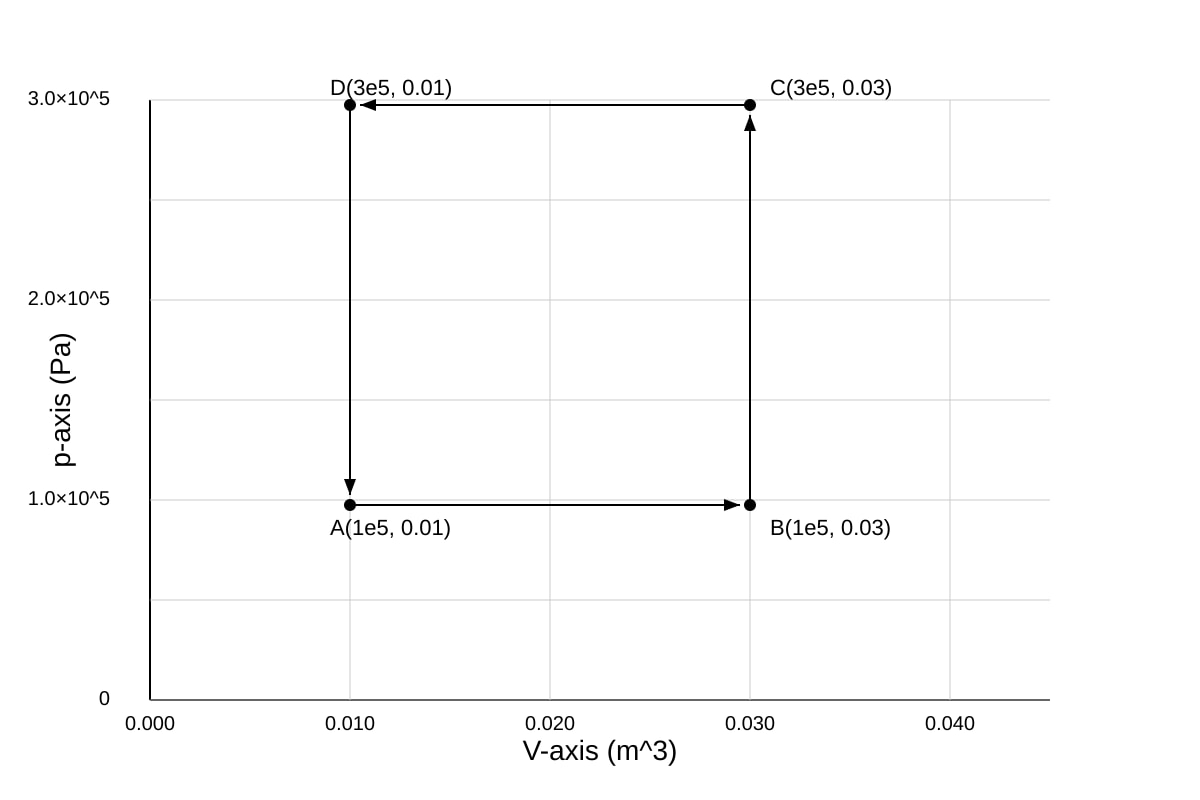
20. The pressure-volume graph below shows a gas process.
Image pending generation: graph for Q20.
(a) Calculate work done by the gas from A to B. [2]
(b) State the total work done over the full cycle A→B→C→D→A. [1]
Answers
A-Level Physics H2 Quiz - Thermal Physics (Answer Key)
Total Marks: 40
Duration: 60 minutes
Section A: Short Structured Questions (1–10)
1. [1 mark]
T=27.0+273.15=300.15K (accept 300K).
Teaching: Thermodynamic (kelvin) temperature is Celsius + 273.15.
2. [1 mark]
pV=NkT
Teaching: N = number of molecules, k = Boltzmann constant.
3. [1 mark]
The volume of the gas molecules themselves is negligible compared with the volume of the container.
(Other valid: molecules are point particles / no intermolecular forces except during collisions.)
4. [1 mark]
Internal energy is the sum of the microscopic kinetic and potential energies of the molecules in the system.
5. [1 mark]
If two systems are each in thermal equilibrium with a third system, they are in thermal equilibrium with each other.
6. [1 mark]
ΔU=Q+W (with W = work done on system).
7. [1 mark]
Work done by gas = pΔV (positive for expansion).
8. [1 mark]
Specific heat capacity is the energy required per unit mass to raise the temperature by 1 K (or 1∘C).
9. [1 mark]
Jkg−1 (joules per kilogram).
10. [1 mark]
T is the thermodynamic (absolute) temperature in kelvin.
Section B: Data and Calculation (11–15)
11. [3 marks]
pV=NkT⇒p=VNkT
=0.0200(2.50×10²³)(1.38×10⁻²³)(300)
=0.02001035=5.18×10⁴Pa
Mark breakdown: formula (1), substitution (1), answer + unit (1).
12. [3 marks]
Isothermal: p1V1=p2V2
p2=V2p1V1=0.0200(1.01×10⁵)(0.0500)=2.525×10⁵Pa
Marks: method (1), substitution (1), answer (1).
13. [3 marks]
Q=mcΔθ=1.20×390×(80.0−20.0)
=1.20×390×60.0=2.81×10⁴J
Marks: formula (1), substitution (1), answer (1).
14. [3 marks]
Q=ml=0.0100×3.34×105=3.34×10³J
Marks: formula (1), substitution (1), answer (1).
15. [3 marks]
Q=−90J (lost), W=+240J
ΔU=Q+W=−90+240=+150J
Marks: sign of Q (1), sum (1), answer (1).
Section C: Extended Response (16–20)
16. [5 marks total]
(a) [3] Assumptions:
- Large number of identical molecules in random motion.
- Volume of molecules negligible.
- No intermolecular forces except elastic collisions.
- Collisions with walls and each other are perfectly elastic.
- Duration of collision negligible; obey Newton’s laws.
(Any 3 clear points = 3 marks)
(b) [2] Pressure arises from repeated elastic collisions of molecules with container walls, delivering momentum change per unit time per unit area.
17. [5 marks]
Derivation:
- Consider molecule mass m, speed cx normal to wall of cube side L.
- Momentum change per collision = 2mcx.
- Time between collisions = 2L/cx.
- Force on wall = 2L/cx2mcx=Lmcx2.
- Pressure from one molecule: p=L3mcx2=Vmcx2.
- For N molecules, average ⟨cx2⟩=31⟨c2⟩.
- pV=31Nm⟨c2⟩.
Marks: setup (1), momentum (1), averaging (1), sum (1), final (1).
18. [4 marks]
(a) [2] Q=mcΔθ=0.200×4180×80.0=6.69×10⁴J.
(b) [2] t=Q/P=6.69×104/500=134s.
Marks: each part formula+answer.
19. [3 marks]
Step1: ΔU1=+400−150=+250J (work by gas = negative W on).
Step2: ΔU2=−100+200=+100J.
Net = 250+100=+350J.
Marks: each step (1+1), total (1).
20. [3 marks]
(a) [2] A→B isobaric expansion: W=pΔV=(1.0×10⁵)(0.030−0.010)=2.0×10³J.
(b) [1] Total cycle work = area enclosed = rectangle = (3.0−1.0)×105×(0.030−0.010)=4.0×10³J done by gas.
Image must show labelled A,B,C,D and path; answer uses those values.
Free quiz and exam paper access
Enter your details to view this paper
Your access is remembered on this device.