From Real Exams Quiz
A Level H2 Physics Modern Physics Quiz
Free A Level H2 Physics Modern Physics quiz, LongCat Exam version, with questions, answers, and A Level-style practice for Singapore students.
These static practice materials are generated from the site's syllabus and paper-generation workflow, with source and model context shown so students and parents can evaluate the material before use.
Questions
Free quiz and exam paper access
Enter your details to view this paper
Your access is remembered on this device.
Answers
A-Level Physics H2 Quiz - Modern Physics
Answer Key and Marking Scheme
Section A: Short Answer Questions (Questions 1–10)
1. State what is meant by the photoelectric effect. [2]
Answer: The photoelectric effect is the emission of electrons from the surface of a metal when electromagnetic radiation (light) of sufficiently high frequency is incident on it.
Marking:
- [1] for mentioning emission of electrons from a metal surface
- [1] for mentioning that electromagnetic radiation/light of sufficiently high frequency is required
Teaching notes: The key idea is that light can knock electrons out of a metal, but only if the light frequency exceeds a certain threshold. This is a quantum phenomenon — the energy comes in discrete packets (photons), not as a continuous wave.
2. A metal surface has a work function of . Calculate the threshold frequency for this metal. [2]
Answer: At the threshold frequency, the photon energy equals the work function:
Marking:
- [1] for correct formula with correct conversion of eV to J ()
- [1] for correct final answer (accept to )
Common mistake: Forgetting to convert eV to joules before dividing by .
3. Monochromatic light of wavelength is incident on a metal surface with work function .
(a) Calculate the energy of a single photon of this light, in eV. [2]
Answer:
Converting to eV:
Marking:
- [1] for correct substitution into
- [1] for correct answer (accept to )
(b) Determine the maximum kinetic energy of the emitted photoelectrons, in eV. [1]
Answer: Using Einstein's photoelectric equation:
Marking:
- [1] for correct answer
Teaching notes: Einstein's photoelectric equation states that the maximum kinetic energy of photoelectrons equals the photon energy minus the work function. The work function is the minimum energy needed to liberate an electron from the metal surface.
4. Explain why the photoelectric effect cannot be explained by the wave theory of light. Your answer should refer to at least two observations that contradict wave theory predictions. [3]
Answer: Wave theory predicts that:
- Electrons should be emitted for any frequency of light, given sufficient intensity, because energy accumulates continuously. However, there is a threshold frequency below which no electrons are emitted regardless of intensity. [1]
- Wave theory predicts a time delay between illumination and emission as electrons accumulate energy, but photoelectrons are emitted almost instantaneously. [1]
- Wave theory predicts that increasing intensity should increase the kinetic energy of emitted electrons, but increasing intensity only increases the number of photoelectrons; the maximum kinetic energy depends only on frequency. [1]
Marking: Award [1] each for any three valid contradictions. Minimum two required for full marks; third serves as a bonus point.
Teaching notes: This question tests understanding of why the photoelectric effect was pivotal in establishing quantum theory. The wave theory fails on multiple counts, and Einstein's photon model resolves all the contradictions.
5. The de Broglie wavelength of an electron is . Calculate the speed of the electron. [3]
Answer: Using the de Broglie relation:
Marking:
- [1] for correct formula rearranged for
- [1] for correct substitution of values
- [1] for correct answer (accept to )
Teaching notes: De Broglie proposed that all matter has wave-like properties. The wavelength is inversely proportional to momentum. This is a fundamental concept in quantum mechanics and is demonstrated experimentally by electron diffraction.
6. State what is meant by nuclear binding energy. [2]
Answer: Nuclear binding energy is the energy required to completely separate all the nucleons (protons and neutrons) in a nucleus. Equivalently, it is the energy released when nucleons combine to form the nucleus.
Marking:
- [1] for stating it is the energy required to separate all nucleons in a nucleus
- [1] for stating equivalently that it is the energy released when the nucleus is formed from its constituent nucleons
Teaching notes: The binding energy arises from the mass defect — the nucleus has less mass than the sum of its individual nucleons. The "missing" mass has been converted to energy via , which holds the nucleus together.
7. State and explain whether energy is released or absorbed in this fission reaction. [3]
Answer: Calculate total mass before:
Calculate total mass after:
Mass defect:
Since the total mass after the reaction is less than the total mass before, mass has been lost. [1] This mass defect is converted to energy according to . [1] Therefore, energy is released in this reaction. [1]
Marking:
- [1] for correct calculation showing mass after < mass before
- [1] for stating that the mass defect is converted to energy via
- [1] for concluding that energy is released
Teaching notes: In nuclear reactions, if the products have less mass than the reactants, the "missing" mass has been converted to kinetic energy of the products. This is the principle behind nuclear power and nuclear weapons.
8. A radioactive sample has an initial activity of . After , the activity has fallen to .
(a) Determine the half-life of the sample. [2]
Answer: The activity drops from 800 → 400 → 200 → 100 Bq, which is 3 half-lives.
Marking:
- [1] for identifying that 3 half-lives have elapsed (800→400→200→100)
- [1] for correct answer:
(b) What will the activity be after a further ? [1]
Answer: A further 30 minutes = 3 more half-lives:
Activity =
Marking:
- [1] for correct answer
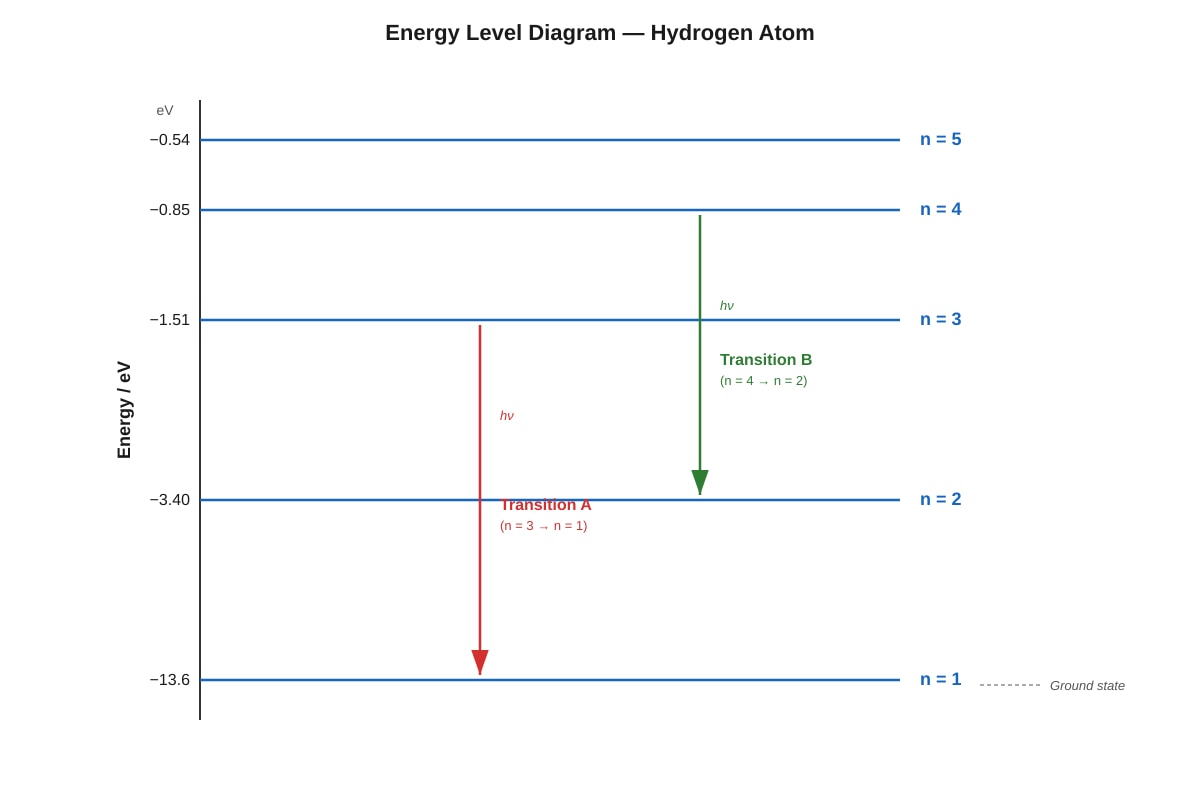
9. Energy level diagram for hydrogen.
(a) Calculate the frequency of the photon emitted in Transition A (). [2]
Answer: Energy of photon:
Converting to joules:
Frequency:
Marking:
- [1] for correct energy difference calculation ( or )
- [1] for correct frequency
(b) Determine which transition, A or B, produces a photon with a longer wavelength. Explain your reasoning. [1]
Answer: Transition B () produces a photon with a longer wavelength. The energy difference for Transition B is , which is smaller than Transition A's . Since , a smaller energy means a lower frequency and therefore a longer wavelength.
Marking:
- [1] for correct answer (Transition B) with valid reasoning linking smaller energy to longer wavelength
Teaching notes: The energy level diagram shows that transitions between lower energy levels release more energetic photons (shorter wavelength). The Balmer series () produces visible light, while the Lyman series () produces ultraviolet.
10. Explain what is meant by wave-particle duality, giving one example of each. [3]
Answer: Wave-particle duality is the concept that all matter and radiation exhibit both wave-like and particle-like properties depending on the experiment being performed. [1]
- Wave nature of matter: Electron diffraction — a beam of electrons passing through a thin crystal produces a diffraction pattern, which is a wave phenomenon. [1]
- Particle nature of light: The photoelectric effect — light behaves as discrete packets of energy (photons), each carrying energy , which explains the threshold frequency and instantaneous emission. [1]
Marking:
- [1] for definition of wave-particle duality
- [1] for a valid example of wave nature of matter
- [1] for a valid example of particle nature of light
Section B: Structured Questions (Questions 11–17)
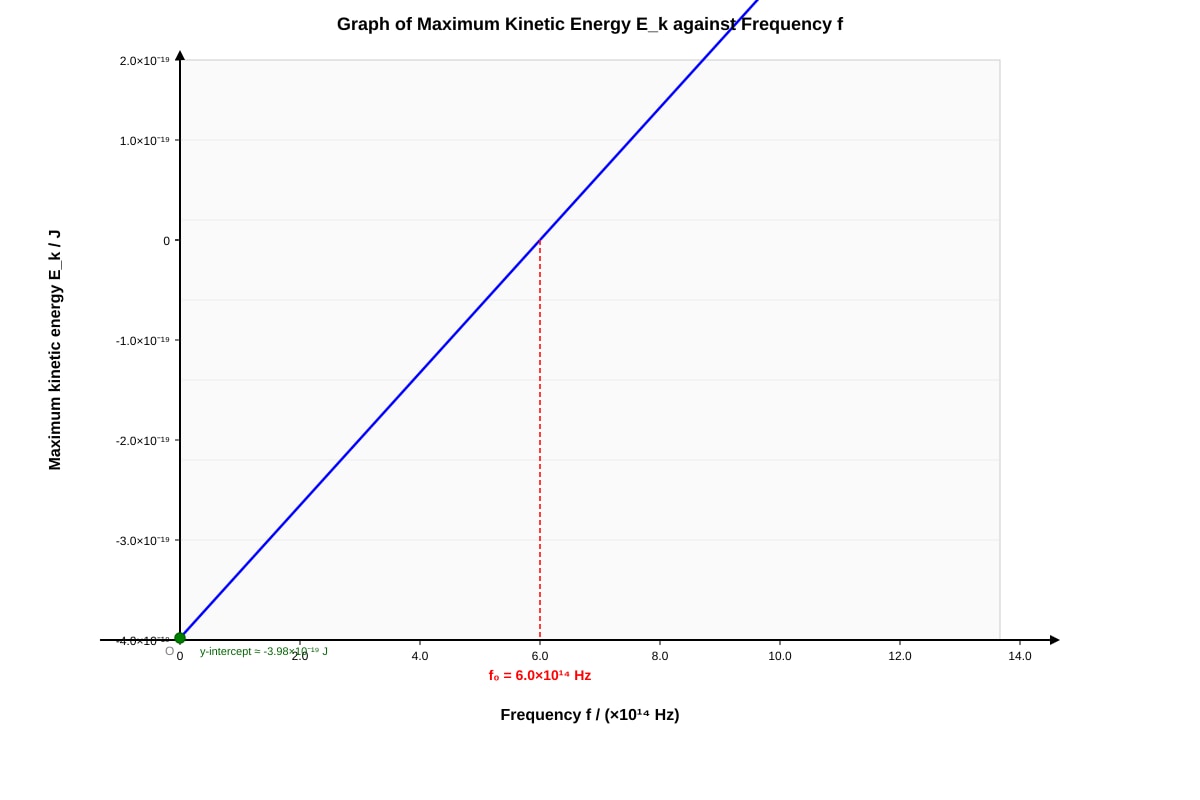
11. Photoelectric effect graph of vs .
(a) Using the graph, determine the threshold frequency of the metal. [1]
Answer: The threshold frequency is where the line intercepts the frequency axis (). From the graph, .
Marking:
- [1] for reading from the graph
(b) Use your answer in (a) and the graph to determine Planck's constant. [3]
Answer: Using Einstein's photoelectric equation: , the gradient of the graph is .
Taking the point and the threshold point :
Marking:
- [1] for identifying that the gradient equals Planck's constant
- [1] for correct calculation of gradient using two points on the line
- [1] for correct answer (accept to )
(c) Determine the work function of the metal in joules. [1]
Answer:
Marking:
- [1] for correct answer (or using the y-intercept magnitude)
12. An electron is accelerated from rest through a potential difference of .
(a) Calculate the kinetic energy gained by the electron, in joules. [2]
Answer:
Marking:
- [1] for correct formula
- [1] for correct answer
(b) Calculate the speed of the electron after being accelerated. [2]
Answer:
Marking:
- [1] for correct substitution into
- [1] for correct answer (accept to )
(c) Calculate the de Broglie wavelength of this electron. [2]
Answer:
Marking:
- [1] for correct substitution into de Broglie equation
- [1] for correct answer
13. Radioactive decay law.
(a) Show that . [2]
Answer: At , :
Taking natural logarithm of both sides:
Marking:
- [1] for substituting and taking natural logarithm
- [1] for correct algebraic manipulation to obtain
(b) Calculate the decay constant in . [2]
Answer:
Marking:
- [1] for correct conversion of 8.0 days to seconds
- [1] for correct answer
(c) Calculate the initial activity in Bq. [2]
Answer:
Marking:
- [1] for correct formula
- [1] for correct answer
14. Cobalt-60 decay.
(a) Write a nuclear equation for the decay of cobalt-60. [2]
Answer:
(or with as antineutrino)
Marking:
- [1] for correct daughter nucleus (conservation of mass number and charge)
- [1] for correct beta particle and antineutrino
(b) Calculate the half-life of cobalt-60 in years. [3]
Answer:
Converting to years:
Marking:
- [1] for correct substitution into
- [1] for correct answer in seconds ()
- [1] for correct conversion to years ( years, accept to )
(c) Explain why the activity decreases over time. [1]
Answer: As time passes, the number of undecayed nuclei decreases. Since activity is proportional to the number of undecayed nuclei (), the activity also decreases.
Marking:
- [1] for linking decreasing number of undecayed nuclei to decreasing activity
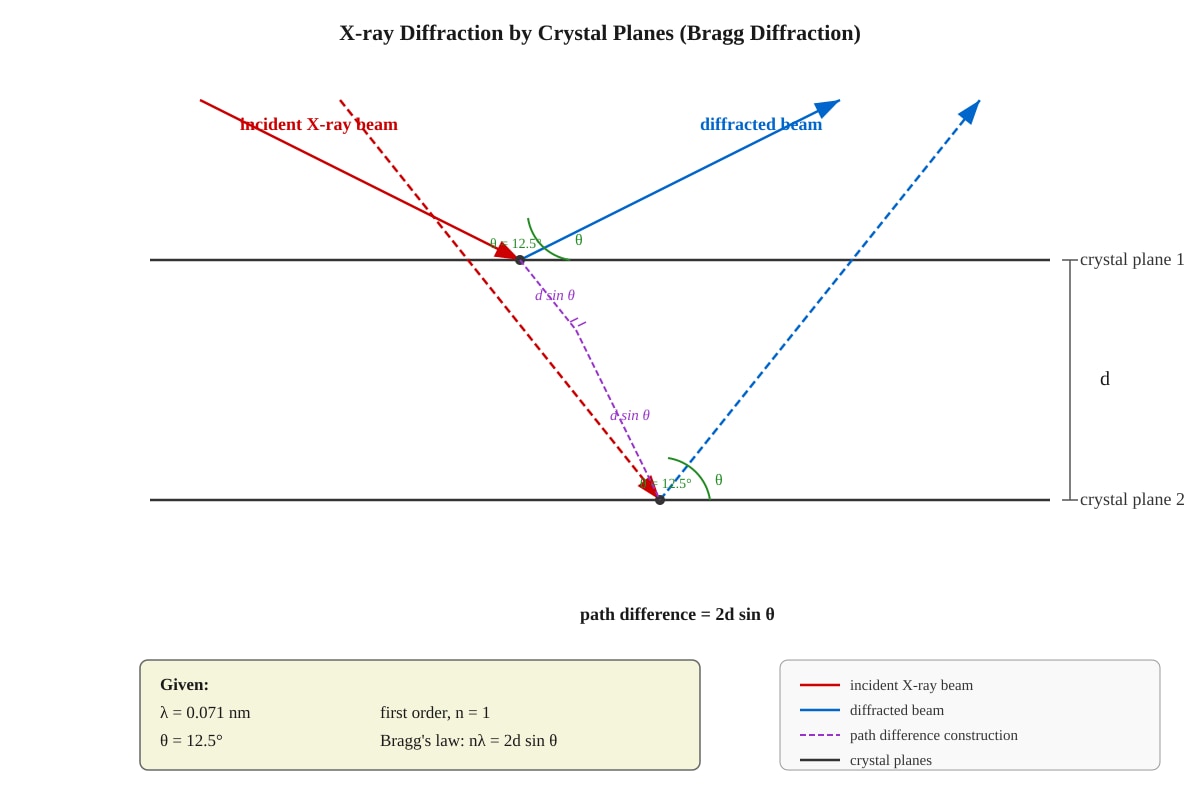
15. X-ray diffraction.
(a) State Bragg's law. [1]
Answer:
where is the order of diffraction, is the wavelength, is the spacing between crystal planes, and is the glancing angle.
Marking:
- [1] for correct equation with all variables defined or clear from context
(b) Calculate the spacing between the crystal planes. [2]
Answer: For first order, :
Marking:
- [1] for correct substitution into Bragg's law
- [1] for correct answer or
(c) Explain why X-rays are used rather than visible light. [2]
Answer: The spacing between crystal planes is of the order of . For diffraction to occur, the wavelength must be comparable to the gap spacing. [1] X-rays have wavelengths of the order of , which is comparable to the interplanar spacing, whereas visible light has wavelengths of the order of , which is much too large to produce significant diffraction from crystal planes. [1]
Marking:
- [1] for stating that wavelength must be comparable to the spacing for diffraction
- [1] for comparing X-ray wavelength ( m) to visible light wavelength ( m)
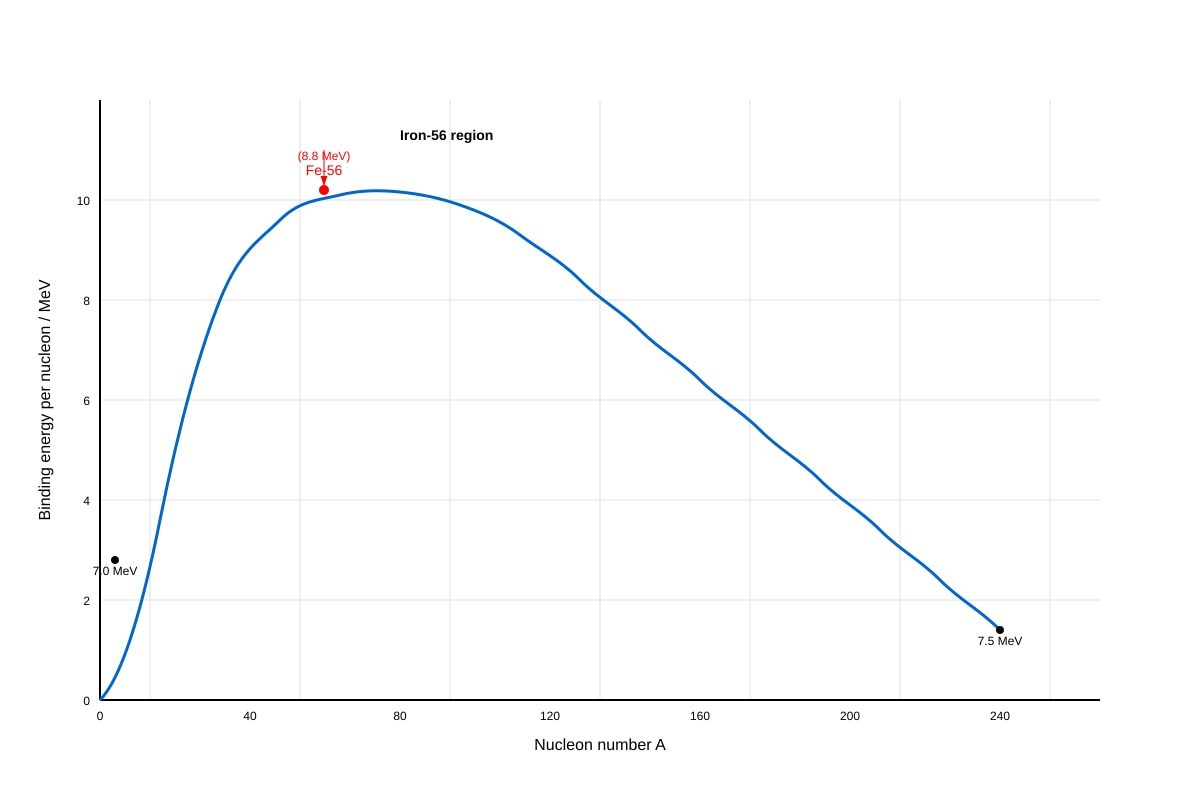
16. Iron-56 binding energy.
(a) Calculate the mass defect. [2]
Answer: Iron-56 has 26 protons and 30 neutrons.
Total mass of constituent nucleons:
Mass defect:
Marking:
- [1] for correct calculation of total nucleon mass
- [1] for correct mass defect
(b) Calculate the binding energy in MeV. [2]
Answer: Using :
Marking:
- [1] for correct conversion factor or using with correct unit conversion
- [1] for correct answer (accept to )
(c) Calculate the binding energy per nucleon. [1]
Answer:
Marking:
- [1] for correct answer (accept to )
(d) Sketch the binding energy per nucleon curve. [1]
Answer: The graph should show:
- A steep rise from to a peak near (iron-56 region) at about per nucleon
- A gradual decline for heavier nuclei, reaching about per nucleon at
- Iron-56 clearly marked at or near the peak
Marking:
- [1] for correct general shape with peak near and Fe-56 indicated
Teaching notes: Iron-56 has one of the highest binding energies per nucleon, making it the most stable nucleus. This is why fusion releases energy for light nuclei (moving toward the peak) and fission releases energy for heavy nuclei (also moving toward the peak).
17. Laser questions.
(a) Calculate the energy of a single photon. [2]
Answer:
Marking:
- [1] for correct substitution
- [1] for correct answer
(b) Calculate the number of photons emitted per second. [2]
Answer: Power =
Marking:
- [1] for correct method: dividing total power by energy per photon
- [1] for correct answer
(c) Explain stimulated emission and why it is essential for laser action. [2]
Answer: Stimulated emission occurs when an incoming photon of the correct energy interacts with an excited atom, causing it to drop to a lower energy level and emit a second photon that is identical to the first (same frequency, phase, direction, and polarisation). [1] This is essential for laser action because it produces coherent, amplified light — each stimulated emission event produces a photon that is in phase with the stimulating photon, leading to a cascade of identical photons that produces the intense, monochromatic, coherent beam characteristic of a laser. [1]
Marking:
- [1] for correct description of stimulated emission
- [1] for explaining that it produces coherent, amplified light essential for laser action
Section C: Data Interpretation and Application (Questions 18–20)
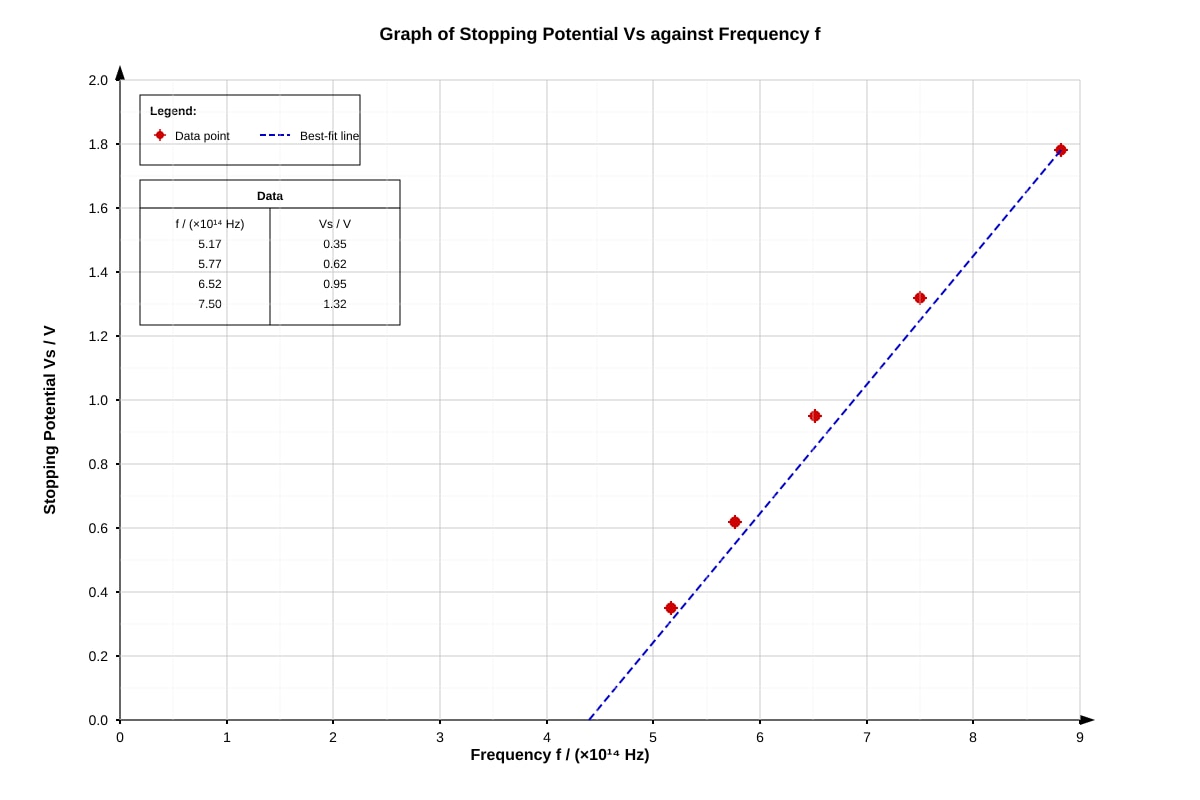
18. Photoelectric experiment with stopping potential data.
(a) Plot a graph of stopping potential against frequency . [3]
Answer: First convert wavelengths to frequencies using :
| / nm | / Hz | / V |
|---|---|---|
| 580 | 5.17 | 0.35 |
| 520 | 5.77 | 0.62 |
| 460 | 6.52 | 0.95 |
| 400 | 7.50 | 1.32 |
| 340 | 8.82 | 1.78 |
Marking:
- [1] for correct calculation of all frequencies
- [1] for correct plotting of all 5 points on the grid
- [1] for best-fit straight line drawn through the points
(b)(i) Determine the threshold frequency. [1]
Answer: The threshold frequency is where the best-fit line intercepts the frequency axis (). From extrapolation: (accept to Hz depending on graph accuracy).
Marking:
- [1] for reasonable value read from their graph
(b)(ii) Determine the work function in eV. [1]
Answer:
(Values will vary depending on the student's graph reading; accept to eV)
Marking:
- [1] for correct calculation using their threshold frequency value
(c) Explain what the same gradient but higher threshold frequency tells us. [1]
Answer: The gradient of the vs graph equals , which is a universal constant. The same gradient confirms that Planck's constant is the same for both materials. The higher threshold frequency means the new cathode material has a larger work function (), so more energy is required to liberate electrons from its surface.
Marking:
- [1] for stating that the new material has a larger work function
19. Nuclear fusion.
(a) Show that the mass defect is . [1]
Answer:
Marking:
- [1] for correct calculation showing
(b) Calculate the energy released in MeV. [2]
Answer:
Marking:
- [1] for correct conversion
- [1] for correct answer (accept to )
(c) Calculate the binding energy per nucleon for tritium. [3]
Answer: Tritium () has 1 proton and 2 neutrons.
Marking:
- [1] for correct calculation of total nucleon mass
- [1] for correct mass defect and binding energy
- [1] for correct binding energy per nucleon
(d) Explain why fusion releases energy. [1]
Answer: Fusion releases energy because light nuclei (with low binding energy per nucleon) combine to form a heavier nucleus with a higher binding energy per nucleon. The increase in binding energy per nucleon means the products are more tightly bound, and the excess energy is released.
Marking:
- [1] for correct explanation referencing the binding energy per nucleon curve (moving up the curve toward the peak)
20. Scanning tunnelling microscope.
(a) Explain what is meant by quantum tunnelling. [2]
Answer: Quantum tunnelling is a quantum mechanical phenomenon in which a particle passes through a potential energy barrier that it classically should not be able to surmount, because its kinetic energy is less than the height of the barrier. [1] According to quantum mechanics, the particle has a non-zero probability of being found on the other side of the barrier due to the wave-like nature of matter — the wavefunction does not drop to zero inside the barrier but decays exponentially, so there is a finite probability of the particle emerging on the other side. [1]
Marking:
- [1] for stating that a particle passes through a classically forbidden barrier
- [1] for explaining this in terms of the wave-like nature of matter / non-zero probability
(b) Calculate the ratio of the final current to the initial current. [3]
Answer:
Marking:
- [1] for correct method: taking the ratio of the two exponential expressions
- [1] for correct calculation of the exponent
- [1] for correct answer (or , meaning the current drops to about of its original value)
(c) Explain why the STM can achieve atomic resolution. [2]
Answer: The tunnelling current depends exponentially on the gap width: . [1] This means that the current is extremely sensitive to tiny changes in distance — a change of just changes the current by approximately one order of magnitude. This extreme sensitivity allows the STM to detect individual atoms on a surface, as the tip height changes by atomic-scale amounts when it passes over surface atoms, producing atomic-resolution images. [1]
Marking:
- [1] for referencing the exponential relationship and its extreme sensitivity
- [1] for linking this sensitivity to the ability to detect individual atoms / achieve atomic resolution
Total Marks: 60
Mark Distribution:
| Section | Questions | Marks |
|---|---|---|
| A: Short Answer | 1–10 | 24 |
| B: Structured | 11–17 | 26 |
| C: Data/Application | 18–20 | 10 (part a: 3, b: 2, c: 1) + 7 + 7 = 10 |
| Total | 60 |