From Real Exams Quiz
A Level H2 Physics Modern Physics Quiz
Free A Level H2 Physics Modern Physics quiz, HY3 Exam version, with questions, answers, and A Level-style practice for Singapore students.
These static practice materials are generated from the site's syllabus and paper-generation workflow, with source and model context shown so students and parents can evaluate the material before use.
Questions
A-Level Physics H2 Quiz - Modern Physics
Name: ___________________________
Class: ___________________________
Date: ___________________________
Score: _______ / 40
Duration: 60 minutes
Total Marks: 40
Topic: Modern Physics (Syllabus 9478)
Instructions:
- Answer all 20 questions.
- Section A: Short structured questions (1–10). Section B: Data and calculation (11–15). Section C: Extended response (16–20).
- Show all working clearly. Use SI units.
- Useful constants: h=6.63×10⁻³⁴ J s, c=3.00×10⁸ m s−1, e=1.60×10⁻¹⁹ C, me=9.11×10⁻³¹ kg, u=1.66×10⁻²⁷ kg.
Section A: Short Structured Questions (1–10)
1. [2 marks] State the photoelectric effect and name one condition required for it to occur.
2. [1 mark] Write the equation relating photon energy E to frequency f.
3. [2 marks] A metal has a work function ϕ=2.0 eV. Calculate the threshold frequency f0 in Hz. (1 eV=1.60×10⁻¹⁹ J, h=6.63×10⁻³⁴ J s)
4. [1 mark] State de Broglie's relation between wavelength λ and momentum p.
5. [2 marks] An electron is accelerated through a potential difference of 100 V. Calculate its de Broglie wavelength. (me=9.11×10⁻³¹ kg, e=1.60×10⁻¹⁹ C, h=6.63×10⁻³⁴ J s)
6. [1 mark] Complete the nuclear decay equation: 92238U→90234Th+?
7. [2 marks] A radioactive sample has half-life T1/2=5.0 h. If initial nuclei N0=8000, calculate the number remaining after 15 h.
8. [1 mark] Define binding energy of a nucleus.
9. [2 marks] Calculate the mass defect of 24He given: mass of 24He=4.00260 u, mp=1.00728 u, mn=1.00867 u. (1 u=1.66×10⁻²⁷ kg)
10. [1 mark] State the energy equivalent of 1 u in MeV. (c=3.00×10⁸ m s−1)
Section B: Data and Calculation (11–15)
11. [3 marks] Light of wavelength 400 nm is incident on a metal of work function 1.5 eV. Calculate the maximum kinetic energy of emitted photoelectrons in eV.
12. [3 marks] A radioactive isotope decays from N0=1200 to N=150 in 24 h. Determine the decay constant λ in h−1 and the half-life.
13. [3 marks] The mass of a 2656Fe nucleus is 55.92066 u. Constituent nucleons total 56.44932 u. Calculate binding energy per nucleon in MeV. (1 u=931.5 MeV/c2)
14. [3 marks] A proton moves with kinetic energy 2.0 MeV. Calculate its de Broglie wavelength. (mp=1.67×10⁻²⁷ kg, 1 eV=1.60×10⁻¹⁹ J, h=6.63×10⁻³⁴ J s)
15. [3 marks] In a fission reaction, 0.20 u of mass is converted to energy. Calculate the energy released in MeV and in joules.
Section C: Extended Response (16–20)
16. [4 marks] Describe the evidence for the wave nature of particles and explain how the de Broglie hypothesis accounts for it.
17. [4 marks] Explain the concept of mass defect and binding energy. A nucleus has binding energy B. Write the relation between mass of separated nucleons Msep, nuclear mass M, and B.
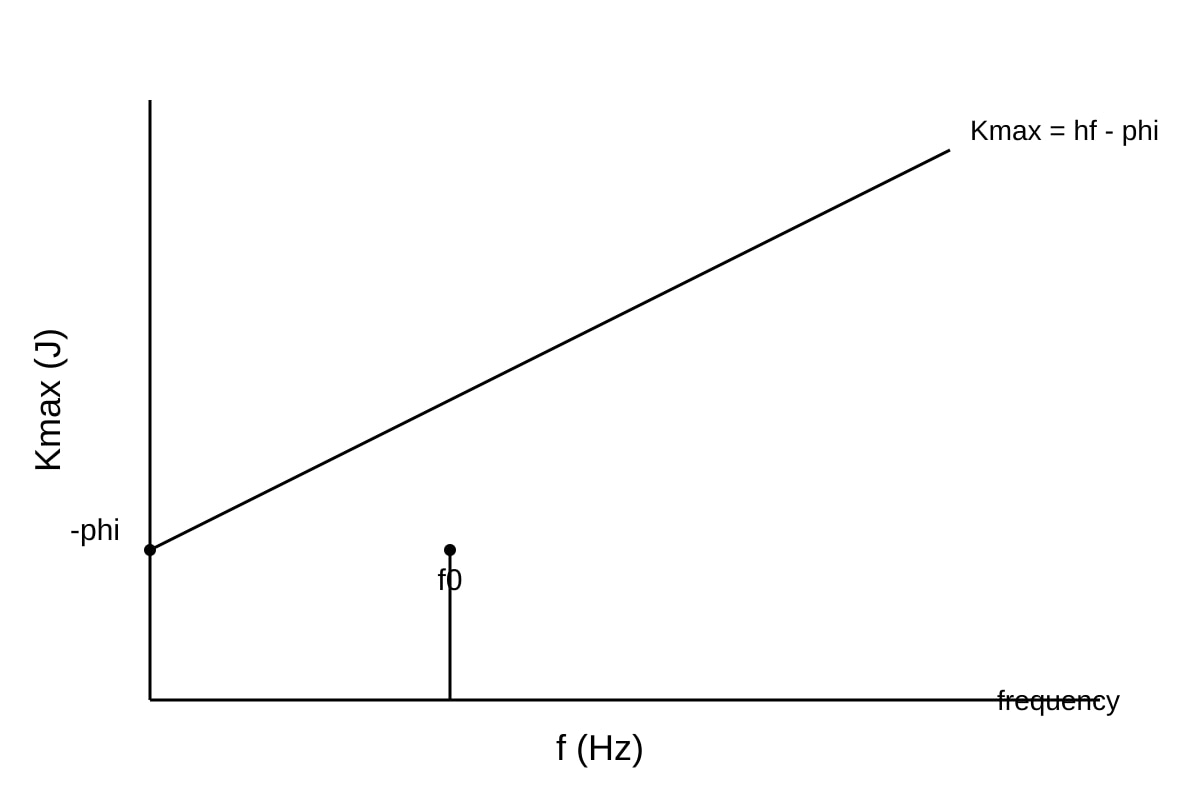
18. [4 marks] A photoelectric cell uses light of frequency f. Sketch the graph of maximum kinetic energy Kmax versus f and state its gradient and intercept.
Image pending generation: graph for Q18.
19. [4 marks] State the law of radioactive decay and derive the relation N=N0e−λt from it.
20. [4 marks] Compare alpha, beta, and gamma emissions in terms of nature, penetration, and ionizing power.
Answers
A-Level Physics H2 Quiz - Modern Physics (Answers)
Total Marks: 40
Topic: Modern Physics
Section A Answers (1–10)
1. [2 marks]
Photoelectric effect: emission of electrons from a metal surface when electromagnetic radiation of sufficient frequency shines on it.
Condition: frequency of incident light must exceed threshold frequency f0 (or photon energy hf>ϕ).
Marking: 1 mark for effect, 1 mark for condition.
2. [1 mark]
E=hf
Marking: correct equation with symbols.
3. [2 marks]
ϕ=2.0×1.60×10−19=3.20×10⁻¹⁹ J
f0=ϕ/h=3.20×10−19/6.63×10−34=4.83×1014 Hz
Marking: 1 mark conversion, 1 mark calculation.
4. [1 mark]
λ=h/p
Marking: correct formula.
5. [2 marks]
K=eV=1.60×10−19×100=1.60×10⁻¹⁷ J
p=2mK=2×9.11×10−31×1.60×10−17=1.71×10⁻²³ kg m s−1
λ=h/p=6.63×10−34/1.71×10−23=3.88×10−11 m
Marking: 1 mark momentum, 1 mark wavelength.
6. [1 mark]
24He (alpha particle)
Marking: correct particle.
7. [2 marks]
n=15/5=3 half-lives
N=N0/23=8000/8=1000
Marking: 1 mark for n, 1 mark for N.
8. [1 mark]
Energy required to separate nucleus into its constituent protons and neutrons.
Marking: clear definition.
9. [2 marks]
Mass of parts = 2(1.00728)+2(1.00867)=4.03190 u
Defect = 4.03190−4.00260=0.02930 u
=0.02930×1.66×10−27=4.86×10⁻²⁹ kg
Marking: 1 mark mass diff, 1 mark kg conversion.
10. [1 mark]
931.5 MeV (from E=mc2 with 1 u)
Marking: correct value.
Section B Answers (11–15)
11. [3 marks]
Ephoton=hc/λ=(6.63×10−34×3.00×108)/(400×10−9)=4.97×10−19 J=3.11 eV
Kmax=3.11−1.5=1.61 eV
Marking: 1 photon energy, 1 conversion, 1 KE.
12. [3 marks]
N=N0e−λt⇒150=1200e−24λ⇒e−24λ=0.125
−24λ=ln0.125=−2.079⇒λ=0.0866 h−1
T1/2=ln2/λ=0.693/0.0866=8.0 h
Marking: 1 eqn, 1 lambda, 1 half-life.
13. [3 marks]
Δm=56.44932−55.92066=0.52866 u
B=0.52866×931.5=492.4 MeV
Per nucleon = 492.4/56=8.79 MeV
Marking: 1 defect, 1 total, 1 per nucleon.
14. [3 marks]
K=2.0×106×1.60×10−19=3.20×10⁻¹³ J
p=2mK=2×1.67×10−27×3.20×10−13=3.27×10⁻²⁰
λ=h/p=6.63×10−34/3.27×10−20=2.03×10−14 m
Marking: 1 K, 1 p, 1 lambda.
15. [3 marks]
E=0.20×931.5=186.3 MeV
In J: 0.20×1.66×10−27×(3.00×108)2=2.98×10⁻¹¹ J
Marking: 1 MeV, 1 J formula, 1 value.
Section C Answers (16–20)
16. [4 marks]
- Evidence: electron diffraction (Davisson-Germer) shows interference pattern (2 marks).
- de Broglie: λ=h/p gives particles wave-like property; explains diffraction (2 marks).
Teaching: connect wavelength to momentum.
17. [4 marks]
Mass defect: difference between mass of separated nucleons and nucleus (2). Binding energy: energy equivalent via E=Δmc2 (1). Relation: B=(Msep−M)c2 (1).
18. [4 marks]
Graph: straight line, gradient h, intercept −ϕ on K axis, x-intercept f0 (2). Explanation: Kmax=hf−ϕ (2).
Image must show labelled axes and intercepts.
19. [4 marks]
Law: rate of decay proportional to N: dN/dt=−λN (2). Integrate: ∫dN/N=−λ∫dt⇒ln(N/N0)=−λt⇒N=N0e−λt (2).
20. [4 marks]
Alpha: He nucleus, low penetration, high ionization (1). Beta: electron, medium penetration, medium ionization (1). Gamma: photon, high penetration, low ionization (2).
Free quiz and exam paper access
Enter your details to view this paper
Your access is remembered on this device.