From Real Exams Quiz

A Level H2 Physics Mechanics Quiz

Free Exam-Derived Owl Alpha A Level H2 Physics Mechanics quiz with questions and answers for Singapore students. This page is rendered as a direct URL so the questions and answers can be discovered without pressing in-page buttons.

These static practice materials are generated from the site's syllabus and paper-generation workflow, with source and model context shown so students and parents can evaluate the material before use.

A Level H2 Physics From Real Exams Generated by Owl Alpha Updated 2026-06-07

Questions

<!-- TuitionGoWhere generation metadata: stage=3-0; model=openrouter/owl-alpha; model_label=Owl Alpha; generated=2026-06-06; Sources: Stage 2-1 real exam-derived templates and Stage 2-2 exam-enriched syllabus. -->

A-Level Physics H2 Quiz - Mechanics

Name: ___________________________
Class: ___________________________
Date: ___________________________
Score: ________ / 60

Duration: 75 minutes

Instructions:

  • Answer ALL questions.
  • Show all working clearly in the spaces provided.
  • The number of marks for each question is shown in brackets [ ].
  • Unless otherwise stated, take g=9.81 m s2g = 9.81 \text{ m s}^{-2}.
  • Non-programmable scientific calculators may be used.
  • Write your answers in the spaces provided or on lined paper if additional space is needed.

Section A: Short-Answer and Conceptual Questions [20 marks]

1. State the principle of conservation of linear momentum.


[2]

2. A car accelerates uniformly from rest to a speed of 28 m s128 \text{ m s}^{-1} in 7.0 s7.0 \text{ s}. Calculate the acceleration of the car.


[2]

3. Define the term impulse and state its SI unit.


[2]

4. State Newton's second law of motion in terms of momentum.


[2]

5. A ball is thrown vertically upwards with an initial speed of 15 m s115 \text{ m s}^{-1}. Calculate the maximum height reached by the ball above its point of projection.


[2]

6. Distinguish between elastic collision and inelastic collision.


[2]

7. A stone of mass 0.50 kg0.50 \text{ kg} is attached to a string and whirled in a horizontal circle of radius 1.2 m1.2 \text{ m} at a constant speed of 4.0 m s14.0 \text{ m s}^{-1}. Calculate the tension in the string.


[3]

8. Explain what is meant by the term equilibrium of a body. State the two conditions required for a body to be in equilibrium.


[3]

9. State the relationship between the gravitational force on an object and the gravitational field strength at a point.


[2]


Section B: Structured and Calculation Questions [25 marks]

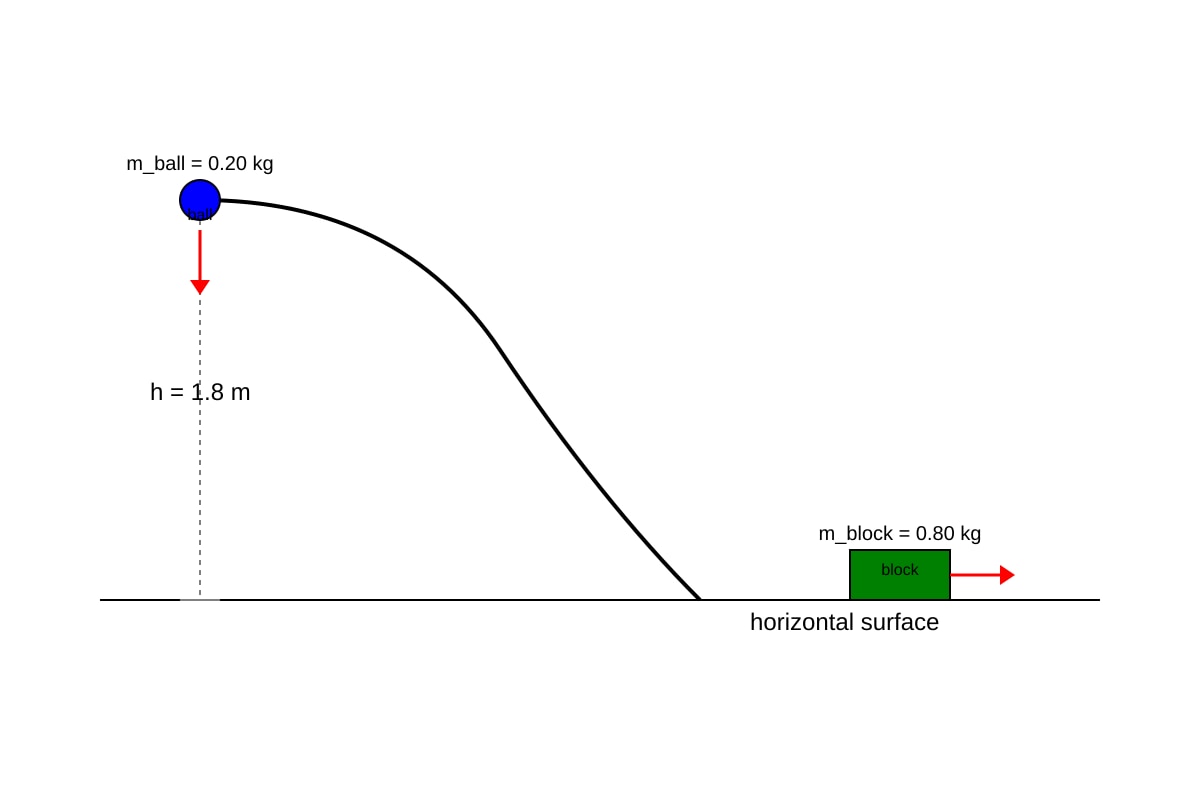
10. A ball of mass 0.20 kg0.20 \text{ kg} is released from rest at the top of a smooth curved track of height h=1.8 mh = 1.8 \text{ m}. It slides down and strikes a stationary block of mass 0.80 kg0.80 \text{ kg} on a horizontal surface. The collision is perfectly inelastic and the ball and block move together after impact.

<image_placeholder> id: Q10-fig1 type: diagram linked_question: Q10 description: A smooth curved track of height 1.8 m with a ball of mass 0.20 kg at the top. At the bottom of the track, a horizontal surface leads to a stationary block of mass 0.80 kg. Arrows indicate direction of motion. labels: h = 1.8 m, m_ball = 0.20 kg, m_block = 0.80 kg, horizontal surface values: h = 1.8, m1 = 0.20, m2 = 0.80 must_show: height label, mass labels, horizontal surface, direction of motion </image_placeholder>

(a) Calculate the speed of the ball just before it strikes the block.


[2]

(b) Determine the common speed of the ball and block immediately after the collision.


[2]

(c) Calculate the kinetic energy lost during the collision.


[2]

(d) Explain why the collision is not elastic.


[1]

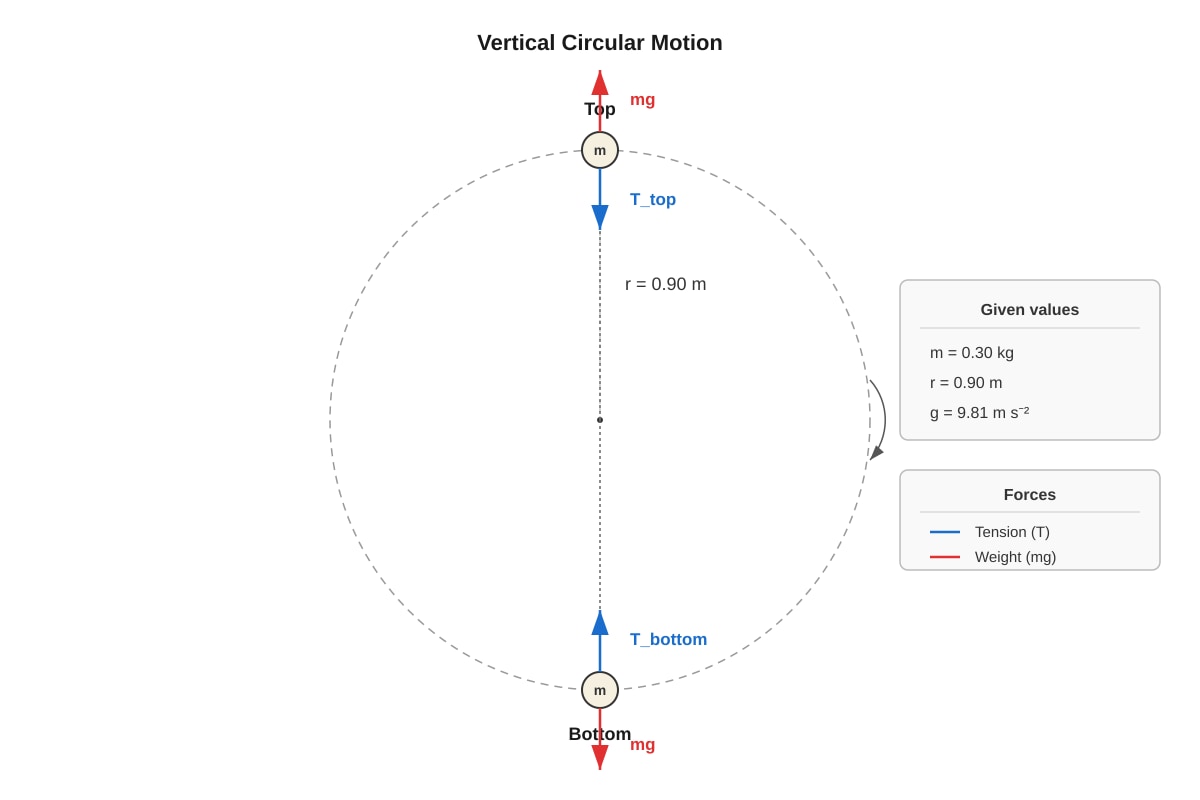
11. A small object of mass 0.30 kg0.30 \text{ kg} is attached to one end of a string of length 0.90 m0.90 \text{ m}. The object is made to move in a vertical circle with constant angular speed.

<image_placeholder> id: Q11-fig1 type: diagram linked_question: Q11 description: A vertical circle of radius 0.90 m with a mass attached to a string. Positions labelled at the top and bottom of the circle. Arrows show direction of motion (clockwise). Tension and weight forces indicated at top and bottom positions. labels: r = 0.90 m, m = 0.30 kg, T_top, T_bottom, mg at both positions values: r = 0.90, m = 0.30, g = 9.81 must_show: vertical circle, top and bottom positions, string, mass, force arrows for tension and weight </image_placeholder>

(a) Calculate the minimum speed at the top of the circle for the object to maintain circular motion.


[2]

(b) If the speed of the object at the bottom of the circle is 6.0 m s16.0 \text{ m s}^{-1}, calculate the tension in the string at this point.


[3]

(c) State the tension in the string when the object is at the top of the circle, moving at the minimum speed calculated in (a). Explain your answer.


[1]

12. A car of mass 1200 kg1200 \text{ kg} travels along a horizontal road. The engine exerts a driving force of 3600 N3600 \text{ N} and the total resistive force acting on the car is 1200 N1200 \text{ N}.

(a) Calculate the acceleration of the car.


[2]

(b) The car starts from rest. Calculate the distance travelled by the car in the first 10.0 s10.0 \text{ s}.


[2]

(c) Calculate the kinetic energy of the car after 10.0 s10.0 \text{ s}.


[2]

(d) The car then ascends a slope inclined at 5.05.0^{\circ} to the horizontal with the same driving force and resistive force. Calculate the new acceleration of the car.


[3]


Section C: Data Interpretation and Multi-Concept Questions [15 marks]

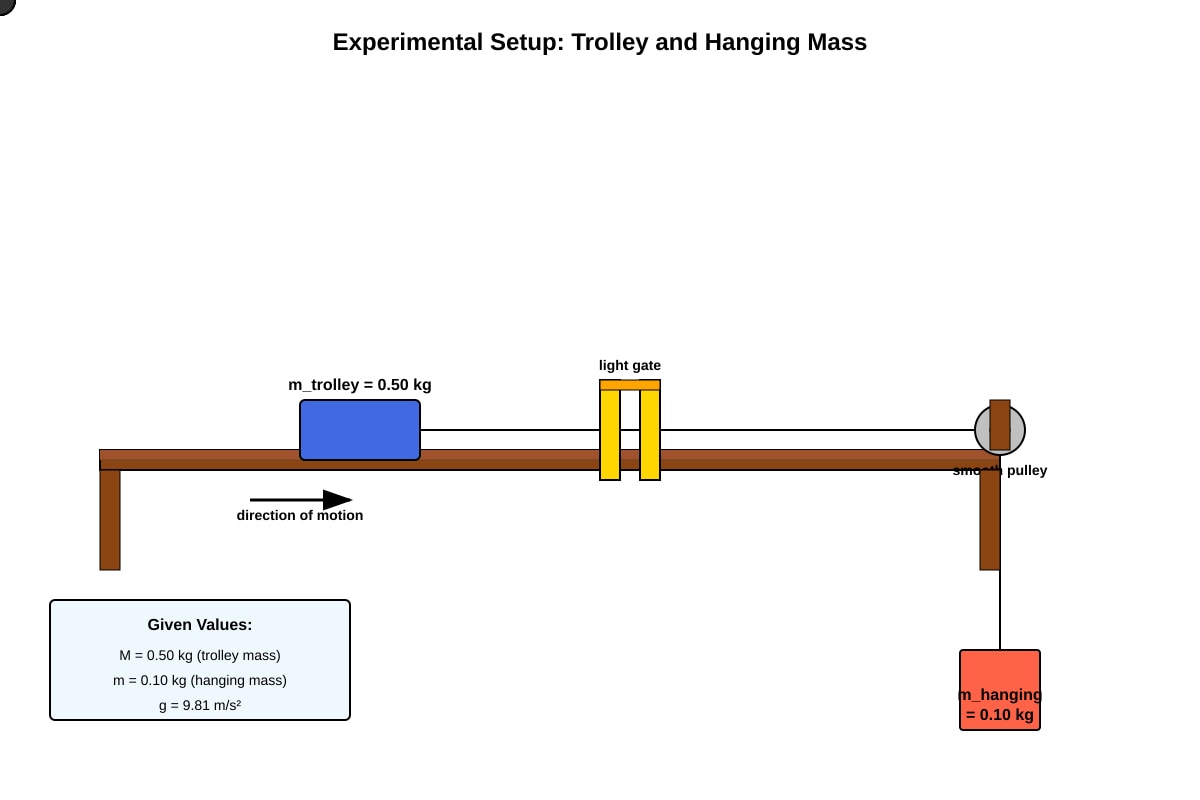
13. A student investigates the motion of a trolley along a horizontal track using a light gate. The trolley, of mass 0.50 kg0.50 \text{ kg}, is attached to a hanging mass of 0.10 kg0.10 \text{ kg} by a string that passes over a smooth pulley at the end of the track.

<image_placeholder> id: Q13-fig1 type: experimental_setup linked_question: Q13 description: A horizontal track with a trolley of mass 0.50 kg. A string attached to the trolley passes over a smooth pulley at the end of the track. A hanging mass of 0.10 kg is suspended vertically from the string. A light gate is positioned on the track to measure the speed of the trolley. Labels show trolley mass, hanging mass, pulley, light gate, and direction of motion. labels: m_trolley = 0.50 kg, m_hanging = 0.10 kg, light gate, smooth pulley, horizontal track values: M = 0.50, m = 0.10, g = 9.81 must_show: trolley on track, string over pulley, hanging mass, light gate position, labels for all masses </image_placeholder>

(a) Calculate the weight of the hanging mass.


[1]

(b) Assuming friction is negligible, calculate the acceleration of the system.


[3]

(c) The student measures the speed of the trolley as it passes through the light gate to be 0.88 m s10.88 \text{ m s}^{-1}. The trolley was released from rest and travels a distance of 0.40 m0.40 \text{ m} before reaching the light gate. Using the measured speed and distance, calculate the experimental acceleration of the trolley.


[2]

(d) Suggest one reason why the experimental acceleration may differ from the theoretical value calculated in (b).


[1]

14. A spacecraft of mass 2.0×10⁴ kg2.0 \times 10^4 \text{ kg} is in a circular orbit around Earth at an altitude where the gravitational field strength is 8.2 N kg18.2 \text{ N kg}^{-1}.

(a) Calculate the gravitational force acting on the spacecraft.


[1]

(b) Explain why the spacecraft is accelerating even though its speed is constant.


[2]

(c) Calculate the work done by the gravitational force on the spacecraft during one complete orbit. Explain your answer.


[2]

15. A ball is projected from the ground at an angle of 3535^{\circ} to the horizontal with an initial speed of 25 m s125 \text{ m s}^{-1}. Air resistance is negligible.

(a) Calculate the horizontal and vertical components of the initial velocity.


[2]

(b) Calculate the time taken for the ball to reach its maximum height.


[2]

(c) Calculate the horizontal range of the ball.


[3]

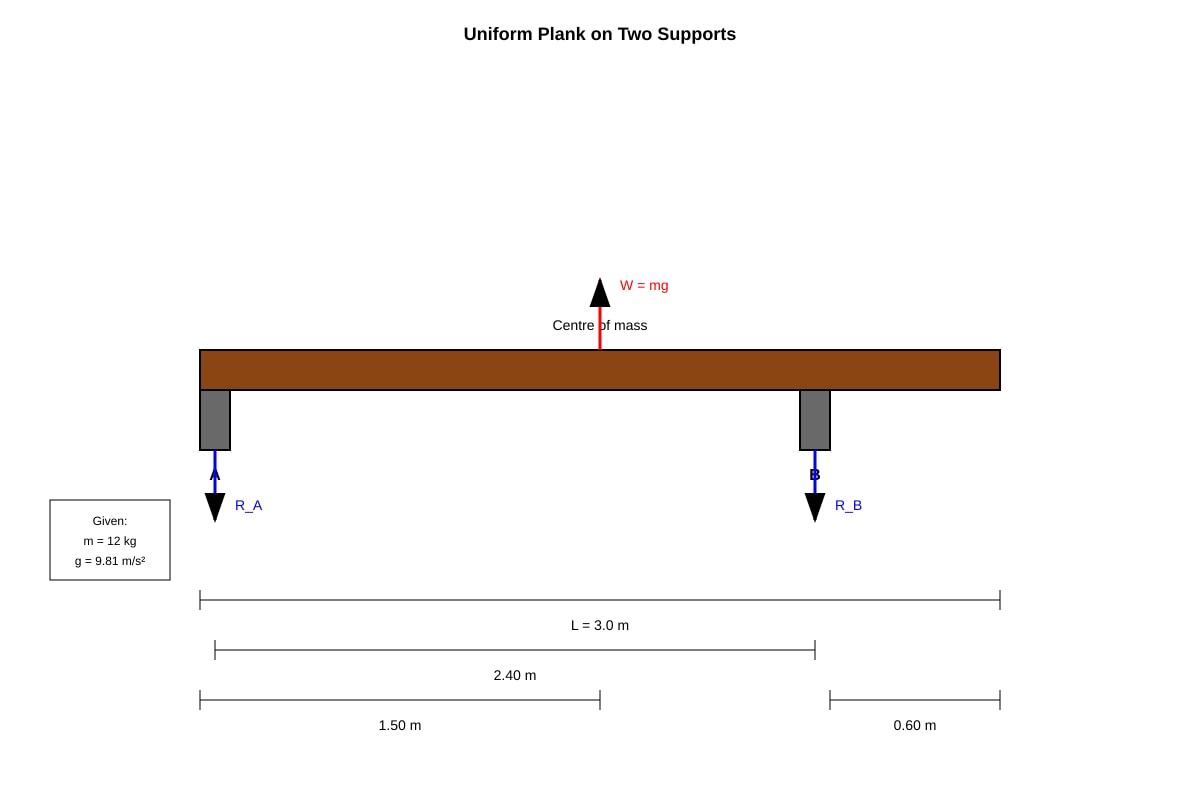
16. A uniform plank of length 3.0 m3.0 \text{ m} and mass 12 kg12 \text{ kg} rests horizontally on two supports, A and B, as shown. Support A is at the left end of the plank and support B is 0.60 m0.60 \text{ m} from the right end.

<image_placeholder> id: Q16-fig1 type: diagram linked_question: Q16 description: A horizontal uniform plank of length 3.0 m resting on two supports. Support A is at the left end. Support B is 0.60 m from the right end (i.e., 2.40 m from the left end). The centre of mass of the plank is at its midpoint (1.50 m from either end). Weight of the plank acts downward at the centre. Normal reaction forces R_A and R_B act upward at supports A and B respectively. labels: L = 3.0 m, m = 12 kg, R_A at left end, R_B at 2.40 m from left, centre of mass at 1.50 m from left, W = mg at centre values: L = 3.0, m = 12, g = 9.81, distance_A_to_B = 2.40, centre = 1.50 must_show: plank, two supports with labels A and B, dimensions, weight arrow at centre, reaction force arrows at supports </image_placeholder>

(a) Calculate the weight of the plank.


[1]

(b) By taking moments about support A, calculate the reaction force at support B.


[3]

(c) Hence, determine the reaction force at support A.


[1]

17. A 70 kg70 \text{ kg} person stands in a lift. The lift accelerates upwards at 1.5 m s21.5 \text{ m s}^{-2}.

(a) Draw a free-body diagram showing all the forces acting on the person. Label the forces clearly.


[1]

(b) Calculate the reaction force (normal force) exerted by the floor of the lift on the person.


[2]

(c) The lift then moves at constant velocity. State the reaction force and explain your answer.


[1]

18. A car of mass 1000 kg1000 \text{ kg} travelling at 20 m s120 \text{ m s}^{-1} collides head-on with a stationary van of mass 3000 kg3000 \text{ kg}. After the collision, the two vehicles move together.

(a) Calculate the total momentum of the system before the collision.


[1]

(b) Determine the common velocity of the car and van after the collision.


[2]

(c) Calculate the total kinetic energy before and after the collision.


[2]

(d) State whether the collision is elastic or inelastic. Justify your answer.


[1]

19. A small sphere of mass 0.050 kg0.050 \text{ kg} is moving with a velocity of (3i+4j) m s1(3\mathbf{i} + 4\mathbf{j}) \text{ m s}^{-1}. It collides with another sphere of mass 0.030 kg0.030 \text{ kg} moving with a velocity of (2i+1j) m s1(-2\mathbf{i} + 1\mathbf{j}) \text{ m s}^{-1}.

(a) Calculate the total momentum of the system before the collision, expressing your answer in terms of the unit vectors i\mathbf{i} and j\mathbf{j}.


[2]

(b) After the collision, the 0.050 kg0.050 \text{ kg} sphere comes to rest. Determine the velocity of the 0.030 kg0.030 \text{ kg} sphere after the collision.


[2]

20. A ball is dropped from a height of 45 m45 \text{ m} above the ground. At the same instant, a second ball is projected vertically upwards from the ground with an initial speed of 30 m s130 \text{ m s}^{-1}. The two balls are in the same vertical line.

(a) Calculate the time after release when the two balls meet.


[3]

(b) Determine the height above the ground at which the two balls meet.


[2]


End of Quiz

Answers

<!-- TuitionGoWhere generation metadata: stage=3-0; model=openrouter/owl-alpha; model_label=Owl Alpha; generated=2026-06-06; Sources: Stage 2-1 real exam-derived templates and Stage 2-2 exam-enriched syllabus. -->

A-Level Physics H2 Quiz - Mechanics: Answer Key


Section A: Short-Answer and Conceptual Questions

1. [2 marks]
The principle of conservation of linear momentum states that the total momentum of a closed system remains constant (is conserved) provided that no net external force acts on the system. Equivalently: in an isolated system, the total momentum before an interaction equals the total momentum after the interaction.

  • 1 mark for stating that total momentum remains constant / is conserved.
  • 1 mark for specifying the condition: no external force / closed (isolated) system.
    Common mistake: Stating only "momentum is conserved" without mentioning the condition of no external force. This is incomplete and would score only 1 mark.

2. [2 marks]
Using a=vuta = \frac{v - u}{t}:
a=2807.0=4.0 m s2a = \frac{28 - 0}{7.0} = 4.0 \text{ m s}^{-2}

  • 1 mark for correct formula or method.
  • 1 mark for correct answer with unit.
    Teaching note: Uniform acceleration means the velocity increases by the same amount each second. The equation a=ΔvΔta = \frac{\Delta v}{\Delta t} is one of the key kinematic equations for constant acceleration.

3. [2 marks]
Impulse is defined as the product of the force acting on an object and the time for which it acts: FΔtF \Delta t. Equivalently, impulse equals the change in momentum of the object: Δp=mvmu\Delta p = mv - mu.
The SI unit of impulse is newton second (N s), which is equivalent to kg m s⁻¹.

  • 1 mark for correct definition.
  • 1 mark for correct SI unit.
    Teaching note: Impulse and change in momentum are equivalent quantities. This is why the impulse-momentum theorem FΔt=ΔpF\Delta t = \Delta p is so useful — it connects force and motion.

4. [2 marks]
Newton's second law states that the net force acting on an object is equal to the rate of change of its momentum:
Fnet=ΔpΔt=mvmuΔtF_{net} = \frac{\Delta p}{\Delta t} = \frac{mv - mu}{\Delta t}
For constant mass, this reduces to Fnet=maF_{net} = ma.

  • 1 mark for stating force equals rate of change of momentum.
  • 1 mark for correct mathematical expression.
    Common mistake: Writing only F=maF = ma without the momentum form. While F=maF = ma is correct for constant mass, the more general statement in terms of momentum is what the question asks for.

5. [2 marks]
At maximum height, the final velocity v=0v = 0. Using v2=u22ghv^2 = u^2 - 2gh:
0=(15)22(9.81)h0 = (15)^2 - 2(9.81)h
h=2252×9.81=22519.62=11.5 mh = \frac{225}{2 \times 9.81} = \frac{225}{19.62} = 11.5 \text{ m}

  • 1 mark for correct substitution.
  • 1 mark for correct answer (accept 11.4–11.5 m depending on gg value used).
    Teaching note: At the highest point, the ball momentarily stops before falling back down. The deceleration is gg throughout the upward motion.

6. [2 marks]

  • Elastic collision: Both total kinetic energy and total momentum of the system are conserved. The objects separate after collision.
  • Inelastic collision: Total momentum is conserved, but total kinetic energy is not conserved (some is converted to other forms such as heat, sound, or deformation energy). In a perfectly inelastic collision, the objects stick together and move with a common velocity after impact.
  • 1 mark for each correct distinction.
    Common mistake: Thinking that momentum is not conserved in inelastic collisions. Momentum is always conserved in collisions (provided no external forces act); it is kinetic energy that is not conserved in inelastic collisions.

7. [3 marks]
The tension in the string provides the centripetal force for circular motion:
T=mv2r=0.50×(4.0)21.2=0.50×161.2=8.01.2=6.7 NT = \frac{mv^2}{r} = \frac{0.50 \times (4.0)^2}{1.2} = \frac{0.50 \times 16}{1.2} = \frac{8.0}{1.2} = 6.7 \text{ N}

  • 1 mark for correct formula T=mv2rT = \frac{mv^2}{r}.
  • 1 mark for correct substitution.
  • 1 mark for correct answer with unit.
    Teaching note: In horizontal circular motion, the tension is the only horizontal force and it provides the centripetal force directed towards the centre of the circle. The weight is balanced by other forces (or is perpendicular to the plane of motion).

8. [3 marks]
A body is in equilibrium when it is at rest or moving with constant velocity (i.e., no acceleration).
The two conditions for equilibrium are:

  1. The net (resultant) force acting on the body is zero (translational equilibrium): F=0\sum F = 0.
  2. The net (resultant) moment about any point is zero (rotational equilibrium): τ=0\sum \tau = 0.
  • 1 mark for definition of equilibrium.
  • 1 mark for condition 1 (net force = 0).
  • 1 mark for condition 2 (net moment = 0).
    Teaching note: Equilibrium does not mean no forces act on the body — it means all forces balance out. A book resting on a table is in equilibrium because its weight is exactly balanced by the normal reaction force.

9. [2 marks]
The gravitational force (weight) on an object is related to the gravitational field strength by:
W=mgW = mg
where WW is the weight (gravitational force), mm is the mass of the object, and gg is the gravitational field strength at that point. The gravitational field strength gg is defined as the gravitational force per unit mass: g=Wmg = \frac{W}{m}.

  • 1 mark for stating W=mgW = mg or equivalent.
  • 1 mark for explaining that gg is force per unit mass.
    Teaching note: Gravitational field strength gg has units of N kg⁻¹, which is equivalent to m s⁻². Near Earth's surface, g9.81 N kg1g \approx 9.81 \text{ N kg}^{-1}.

Section B: Structured and Calculation Questions

10. [7 marks]

(a) [2 marks] Using conservation of energy (the track is smooth, so no energy is lost to friction):
mgh=12mv2mgh = \frac{1}{2}mv^2
v=2gh=2×9.81×1.8=35.316=5.94 m s1v = \sqrt{2gh} = \sqrt{2 \times 9.81 \times 1.8} = \sqrt{35.316} = 5.94 \text{ m s}^{-1}

  • 1 mark for using conservation of energy.
  • 1 mark for correct answer.

(b) [2 marks] Using conservation of linear momentum (perfectly inelastic collision):
m1v1+m2v2=(m1+m2)vfm_1 v_1 + m_2 v_2 = (m_1 + m_2)v_f
0.20×5.94+0.80×0=(0.20+0.80)vf0.20 \times 5.94 + 0.80 \times 0 = (0.20 + 0.80)v_f
vf=1.1881.0=1.19 m s1v_f = \frac{1.188}{1.0} = 1.19 \text{ m s}^{-1}

  • 1 mark for correct momentum conservation equation.
  • 1 mark for correct answer.

(c) [2 marks]
Kinetic energy before collision:
KEbefore=12(0.20)(5.94)2=12(0.20)(35.3)=3.53 JKE_{before} = \frac{1}{2}(0.20)(5.94)^2 = \frac{1}{2}(0.20)(35.3) = 3.53 \text{ J}
Kinetic energy after collision:
KEafter=12(1.0)(1.19)2=12(1.0)(1.416)=0.708 JKE_{after} = \frac{1}{2}(1.0)(1.19)^2 = \frac{1}{2}(1.0)(1.416) = 0.708 \text{ J}
Kinetic energy lost:
ΔKE=3.530.708=2.82 J\Delta KE = 3.53 - 0.708 = 2.82 \text{ J}

  • 1 mark for calculating both KE values.
  • 1 mark for correct energy lost.

(d) [1 mark] The collision is not elastic because kinetic energy is not conserved — a significant amount of kinetic energy (2.82 J2.82 \text{ J}) is lost during the collision, converted into other forms of energy such as heat, sound, and deformation energy. Additionally, the two objects stick together after impact, which is characteristic of a perfectly inelastic collision.


11. [6 marks]

(a) [2 marks] At the top of the circle, the minimum speed occurs when the tension in the string is zero (only weight provides the centripetal force):
mg=mvmin2rmg = \frac{mv_{min}^2}{r}
vmin=gr=9.81×0.90=8.829=2.97 m s1v_{min} = \sqrt{gr} = \sqrt{9.81 \times 0.90} = \sqrt{8.829} = 2.97 \text{ m s}^{-1}

  • 1 mark for setting mg=mv2rmg = \frac{mv^2}{r} (tension = 0 at minimum speed).
  • 1 mark for correct answer.

(b) [3 marks] At the bottom of the circle, both tension and weight act. The net centripetal force (towards the centre, which is upward) is:
Tmg=mv2rT - mg = \frac{mv^2}{r}
T=mg+mv2r=0.30×9.81+0.30×(6.0)20.90T = mg + \frac{mv^2}{r} = 0.30 \times 9.81 + \frac{0.30 \times (6.0)^2}{0.90}
T=2.943+0.30×360.90=2.943+12.0=14.9 NT = 2.943 + \frac{0.30 \times 36}{0.90} = 2.943 + 12.0 = 14.9 \text{ N}

  • 1 mark for correct equation Tmg=mv2rT - mg = \frac{mv^2}{r}.
  • 1 mark for correct substitution.
  • 1 mark for correct answer (accept 14.9 N or 15 N).

(c) [1 mark] The tension at the top is zero. At the minimum speed, the weight of the object alone provides the necessary centripetal force, so the string is just barely taut with no tension. If the speed were any less, the string would go slack and the object would not complete the circular path.


12. [9 marks]

(a) [2 marks] Using Newton's second law:
Fnet=FdrivingFresistive=maF_{net} = F_{driving} - F_{resistive} = ma
36001200=1200a3600 - 1200 = 1200a
a=24001200=2.0 m s2a = \frac{2400}{1200} = 2.0 \text{ m s}^{-2}

  • 1 mark for correct net force.
  • 1 mark for correct answer with unit.

(b) [2 marks] Using s=ut+12at2s = ut + \frac{1}{2}at^2 with u=0u = 0:
s=0+12(2.0)(10.0)2=12(2.0)(100)=100 ms = 0 + \frac{1}{2}(2.0)(10.0)^2 = \frac{1}{2}(2.0)(100) = 100 \text{ m}

  • 1 mark for correct equation.
  • 1 mark for correct answer.

(c) [2 marks] Speed after 10.0 s: v=u+at=0+2.0×10.0=20.0 m s1v = u + at = 0 + 2.0 \times 10.0 = 20.0 \text{ m s}^{-1}
KE=12mv2=12(1200)(20.0)2=600×400=2.4×10⁵ JKE = \frac{1}{2}mv^2 = \frac{1}{2}(1200)(20.0)^2 = 600 \times 400 = 2.4 \times 10^5 \text{ J}

  • 1 mark for finding final speed.
  • 1 mark for correct KE value.

(d) [3 marks] On the slope, the component of weight acting down the slope is mgsinθmg\sin\theta:
Fnet=FdrivingFresistivemgsinθ=maF_{net} = F_{driving} - F_{resistive} - mg\sin\theta = ma'
360012001200×9.81×sin5.0=1200a3600 - 1200 - 1200 \times 9.81 \times \sin 5.0^{\circ} = 1200a'
24001200×9.81×0.0872=1200a2400 - 1200 \times 9.81 \times 0.0872 = 1200a'
24001024.6=1200a2400 - 1024.6 = 1200a'
a=1375.41200=1.15 m s2a' = \frac{1375.4}{1200} = 1.15 \text{ m s}^{-2}

  • 1 mark for including the mgsinθmg\sin\theta component.
  • 1 mark for correct substitution.
  • 1 mark for correct answer (accept 1.1–1.2 m s⁻²).

Section C: Data Interpretation and Multi-Concept Questions

13. [7 marks]

(a) [1 mark]
W=mg=0.10×9.81=0.98 NW = mg = 0.10 \times 9.81 = 0.98 \text{ N}

  • 1 mark for correct answer with unit.

(b) [3 marks] The tension in the string accelerates both the trolley and the hanging mass. For the system:
The net force accelerating the system is the weight of the hanging mass mgmg. The total mass being accelerated is M+mM + m.
a=mgM+m=0.10×9.810.50+0.10=0.9810.60=1.64 m s2a = \frac{mg}{M + m} = \frac{0.10 \times 9.81}{0.50 + 0.10} = \frac{0.981}{0.60} = 1.64 \text{ m s}^{-2}

  • 1 mark for identifying net force = weight of hanging mass.
  • 1 mark for total mass = M+mM + m.
  • 1 mark for correct answer.

(c) [2 marks] Using v2=u2+2asv^2 = u^2 + 2as with u=0u = 0:
a=v22s=(0.88)22×0.40=0.77440.80=0.968 m s2a = \frac{v^2}{2s} = \frac{(0.88)^2}{2 \times 0.40} = \frac{0.7744}{0.80} = 0.968 \text{ m s}^{-2}

  • 1 mark for correct equation.
  • 1 mark for correct answer.

(d) [1 mark] The experimental acceleration is lower than the theoretical value because friction acts on the trolley (between the trolley and the track), which opposes the motion and reduces the net accelerating force. Other acceptable answers: air resistance, the pulley is not perfectly smooth (friction at the pulley), the string has mass.


14. [5 marks]

(a) [1 mark]
F=mgfield=2.0×104×8.2=1.64×10⁵ NF = mg_{field} = 2.0 \times 10^4 \times 8.2 = 1.64 \times 10^5 \text{ N}

  • 1 mark for correct answer with unit.

(b) [2 marks] The spacecraft is accelerating because its direction of motion is continuously changing. Even though the speed (magnitude of velocity) is constant, velocity is a vector quantity. A change in direction constitutes a change in velocity, which means there is acceleration. This acceleration is directed towards the centre of the circular orbit (centripetal acceleration).

  • 1 mark for identifying that direction changes.
  • 1 mark for stating that velocity is a vector / acceleration is towards the centre.

(c) [2 marks] The work done by the gravitational force during one complete orbit is zero. The gravitational force is always directed towards the centre of the orbit (radially inward), while the displacement of the spacecraft at any instant is tangential to the orbit (perpendicular to the radial direction). Since the force is always perpendicular to the displacement, W=Fdcos90°=0W = Fd\cos 90° = 0 at every point along the orbit. Over a complete orbit, the total work done is therefore zero.

  • 1 mark for stating work done = 0.
  • 1 mark for correct explanation (force perpendicular to displacement / tangential motion).

15. [7 marks]

(a) [2 marks]
Horizontal component: vx=25cos35°=25×0.819=20.5 m s1v_x = 25\cos 35° = 25 \times 0.819 = 20.5 \text{ m s}^{-1}
Vertical component: vy=25sin35°=25×0.574=14.3 m s1v_y = 25\sin 35° = 25 \times 0.574 = 14.3 \text{ m s}^{-1}

  • 1 mark for each correct component.

(b) [2 marks] At maximum height, vertical velocity = 0:
vy=uygtv_y = u_y - gt
0=14.39.81t0 = 14.3 - 9.81t
t=14.39.81=1.46 st = \frac{14.3}{9.81} = 1.46 \text{ s}

  • 1 mark for correct equation.
  • 1 mark for correct answer.

(c) [3 marks] Total time of flight = 2t=2×1.46=2.92 s2t = 2 \times 1.46 = 2.92 \text{ s}
Horizontal range:
R=vx×T=20.5×2.92=59.9 mR = v_x \times T = 20.5 \times 2.92 = 59.9 \text{ m}

  • 1 mark for total time of flight.
  • 1 mark for using range = horizontal velocity × time of flight.
  • 1 mark for correct answer (accept 59–60 m).

16. [5 marks]

(a) [1 mark]
W=mg=12×9.81=117.7 N118 NW = mg = 12 \times 9.81 = 117.7 \text{ N} \approx 118 \text{ N}

  • 1 mark for correct answer.

(b) [3 marks] Taking moments about A (clockwise = anticlockwise):
The weight acts at the centre, 1.50 m1.50 \text{ m} from A. Support B is 2.40 m2.40 \text{ m} from A.
RB×2.40=W×1.50R_B \times 2.40 = W \times 1.50
RB=117.7×1.502.40=176.62.40=73.6 NR_B = \frac{117.7 \times 1.50}{2.40} = \frac{176.6}{2.40} = 73.6 \text{ N}

  • 1 mark for correct moment equation.
  • 1 mark for correct distances.
  • 1 mark for correct answer.

(c) [1 mark] Using vertical equilibrium:
RA+RB=WR_A + R_B = W
RA=117.773.6=44.1 NR_A = 117.7 - 73.6 = 44.1 \text{ N}

  • 1 mark for correct answer.

17. [4 marks]

(a) [1 mark] Free-body diagram should show:

  • Weight (W=mgW = mg) acting vertically downward from the centre of mass of the person.
  • Normal reaction force (RR) acting vertically upward from the floor on the person's feet.
  • The reaction force arrow should be longer than the weight arrow (since the lift is accelerating upward, R>mgR > mg).
  • 1 mark for correct diagram with both forces labelled.

(b) [2 marks] Using Newton's second law (upward positive):
Rmg=maR - mg = ma
R=m(g+a)=70(9.81+1.5)=70×11.31=791.7 N792 NR = m(g + a) = 70(9.81 + 1.5) = 70 \times 11.31 = 791.7 \text{ N} \approx 792 \text{ N}

  • 1 mark for correct equation.
  • 1 mark for correct answer.

(c) [1 mark] When the lift moves at constant velocity, acceleration = 0, so:
R=mg=70×9.81=686.7 N687 NR = mg = 70 \times 9.81 = 686.7 \text{ N} \approx 687 \text{ N}
The reaction force equals the person's weight because there is no net force (Newton's first law — constant velocity means zero net force).

  • 1 mark for correct value and explanation.

18. [6 marks]

(a) [1 mark]
ptotal=mcar×vcar+mvan×vvan=1000×20+3000×0=2.0×10⁴ kg m s1p_{total} = m_{car} \times v_{car} + m_{van} \times v_{van} = 1000 \times 20 + 3000 \times 0 = 2.0 \times 10^4 \text{ kg m s}^{-1}

  • 1 mark for correct answer with unit.

(b) [2 marks] Conservation of momentum:
mcarvcar=(mcar+mvan)vfm_{car}v_{car} = (m_{car} + m_{van})v_f
2.0×104=(1000+3000)vf2.0 \times 10^4 = (1000 + 3000)v_f
vf=2.0×1044000=5.0 m s1v_f = \frac{2.0 \times 10^4}{4000} = 5.0 \text{ m s}^{-1}

  • 1 mark for correct equation.
  • 1 mark for correct answer.

(c) [2 marks]
KEbefore=12(1000)(20)2=2.0×10⁵ JKE_{before} = \frac{1}{2}(1000)(20)^2 = 2.0 \times 10^5 \text{ J}
KEafter=12(4000)(5.0)2=5.0×10⁴ JKE_{after} = \frac{1}{2}(4000)(5.0)^2 = 5.0 \times 10^4 \text{ J}

  • 1 mark for each correct KE value.

(d) [1 mark] The collision is inelastic because kinetic energy is not conserved (KEafter<KEbeforeKE_{after} < KE_{before}). Kinetic energy has decreased from 2.0×10⁵ J2.0 \times 10^5 \text{ J} to 5.0×10⁴ J5.0 \times 10^4 \text{ J}, with the difference converted to other forms of energy (deformation, heat, sound).


19. [4 marks]

(a) [2 marks]
ptotal=m1v1+m2v2\vec{p}_{total} = m_1\vec{v}_1 + m_2\vec{v}_2
=0.050(3i+4j)+0.030(2i+1j)= 0.050(3\mathbf{i} + 4\mathbf{j}) + 0.030(-2\mathbf{i} + 1\mathbf{j})
=(0.15i+0.20j)+(0.06i+0.03j)= (0.15\mathbf{i} + 0.20\mathbf{j}) + (-0.06\mathbf{i} + 0.03\mathbf{j})
=0.09i+0.23j kg m s1= 0.09\mathbf{i} + 0.23\mathbf{j} \text{ kg m s}^{-1}

  • 1 mark for correct calculation of each sphere's momentum.
  • 1 mark for correct total.

(b) [2 marks] By conservation of momentum, total momentum after = total momentum before:
0.050×0+0.030×v2=0.09i+0.23j0.050 \times \vec{0} + 0.030 \times \vec{v}_2' = 0.09\mathbf{i} + 0.23\mathbf{j}
v2=0.09i+0.23j0.030=3.0i+7.67j m s1\vec{v}_2' = \frac{0.09\mathbf{i} + 0.23\mathbf{j}}{0.030} = 3.0\mathbf{i} + 7.67\mathbf{j} \text{ m s}^{-1}

  • 1 mark for applying conservation of momentum.
  • 1 mark for correct answer.

20. [5 marks]

Let tt be the time when the two balls meet. Let the meeting height be hh above the ground.

For the dropped ball (Ball 1, from height 45 m):
h1=4512gt2h_1 = 45 - \frac{1}{2}gt^2

For the projected ball (Ball 2, from ground):
h2=30t12gt2h_2 = 30t - \frac{1}{2}gt^2

At the meeting point, h1=h2h_1 = h_2:
4512gt2=30t12gt245 - \frac{1}{2}gt^2 = 30t - \frac{1}{2}gt^2
45=30t45 = 30t
t=1.5 st = 1.5 \text{ s}

  • 2 marks for setting up displacement equations for both balls.
  • 1 mark for solving to get t=1.5t = 1.5 s.

(b) [2 marks] Substituting t=1.5t = 1.5 s into the equation for Ball 2:
h=30(1.5)12(9.81)(1.5)2h = 30(1.5) - \frac{1}{2}(9.81)(1.5)^2
h=4511.04=33.96 m34.0 mh = 45 - 11.04 = 33.96 \text{ m} \approx 34.0 \text{ m}

  • 1 mark for correct substitution.
  • 1 mark for correct answer (accept 33.9–34.0 m).

Teaching note: The 12gt2\frac{1}{2}gt^2 terms cancel because both balls experience the same gravitational acceleration. This means the distance fallen by Ball 1 plus the distance risen by Ball 2 always equals 45 m, making the problem simpler than it first appears.


End of Answer Key