A-Level Physics H2 Quiz - Mechanics
Name: ___________________________
Class: ___________________________
Date: ___________________________
Score: ___________ / 40
Duration: 60 minutes
Total Marks: 40
Topic: Mechanics (Projectile Motion, Collisions, Circular Motion, Gravitational Fields, Oscillations)
Instructions:
- Answer all 20 questions.
- Show all working clearly where calculation is required.
- Use the data sheet values: g=9.81 m s−2, G=6.67×10⁻¹¹ N m2 kg−2, ME=5.97×1024 kg, RE=6.37×10⁶ m.
- Write answers in the spaces provided.
Section A: Foundations of Mechanics (Questions 1–5)
1. State the principle of conservation of linear momentum. [2]
2. A ball of mass 0.20 kg is attached to a spring and oscillates with simple harmonic motion of amplitude 0.040 m and angular frequency 3.14 rad s−1. Calculate the maximum acceleration of the ball. [2]
3. A projectile is launched horizontally from a cliff of height 45 m with speed 20 m s−1. Calculate the time taken to reach the ground. [2]
4. Define centripetal force. [1]
5. A car of mass 1200 kg moves around a circular track of radius 80 m at constant speed 25 m s−1. Calculate the centripetal force acting on the car. [2]
Section B: Motion, Collisions and Circular Motion (Questions 6–10)
6. A body moves with uniformly accelerated motion. Given u=5 m s−1, a=2 m s−2, t=4 s, calculate the final velocity v. [2]
7. Two trolleys collide on a smooth track. Trolley A (mA=1.0 kg) moves at 3.0 m s−1 and trolley B (mB=2.0 kg) is at rest. After collision they stick together. Calculate their common final velocity. [3]
8. State two precautions that improve accuracy in a collision experiment using trolleys and a linear track. [2]
9. A stone is tied to a string of length 0.50 m and whirled in a vertical circle. At the lowest point its speed is 4.0 m s−1. Calculate the centripetal acceleration. [2]
10.
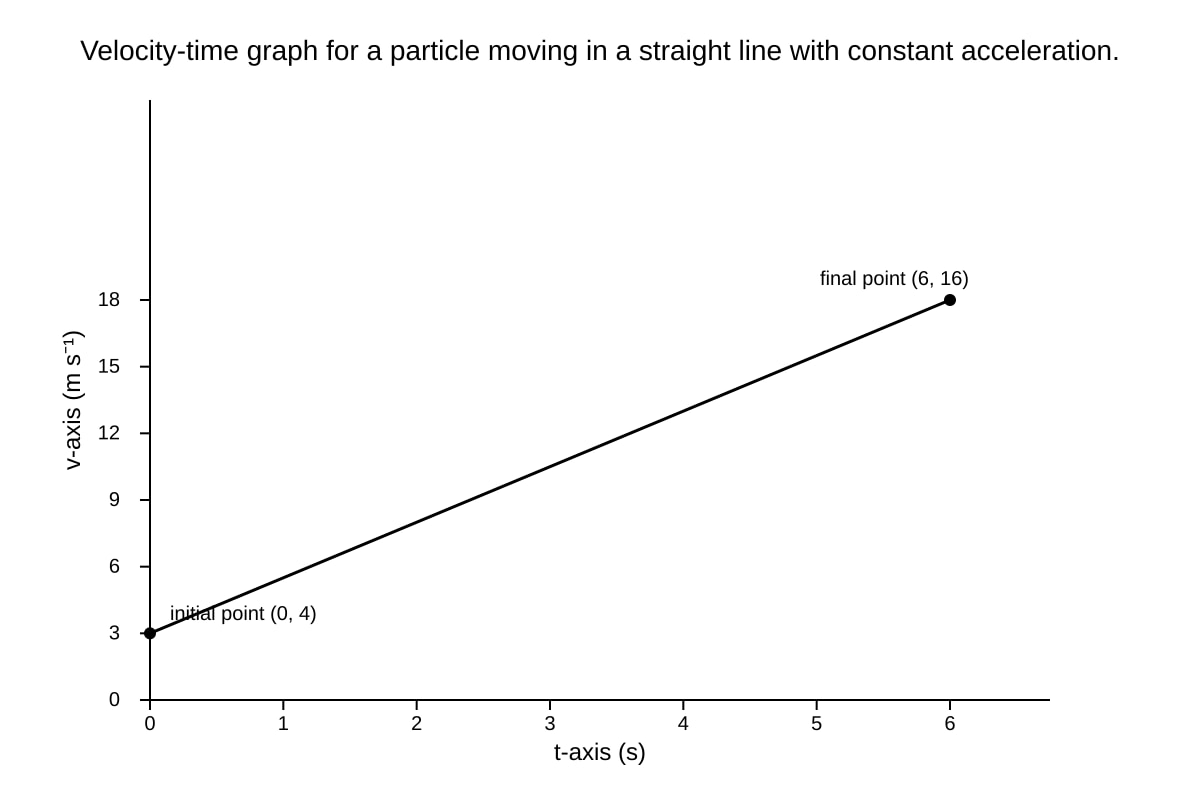
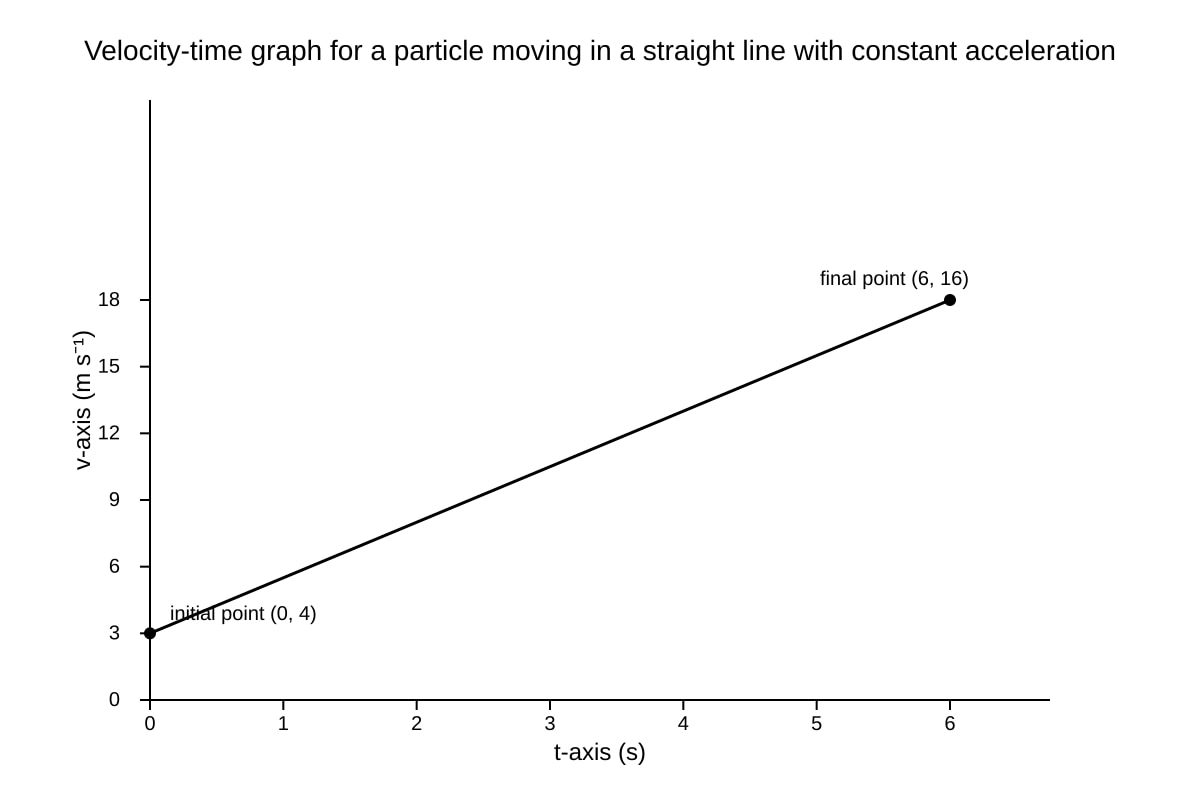
Generated graph for Q10.
Using the graph in Q10-fig1, determine the acceleration of the particle. [2]
Section C: Gravitational Fields and Oscillations (Questions 11–15)
11. Write Newton's law of gravitation in equation form and state the meaning of each symbol. [3]
12. Calculate the gravitational field strength at the surface of Earth using g=R2GM. [2]
13. A satellite orbits Earth at radius 2RE. Calculate the gravitational field strength at this orbit. [2]
14. A mass on a spring performs SHM with period T=1.2 s and amplitude 0.030 m. Calculate the maximum velocity. [3]
15. State the condition for resonance to occur in a forced oscillation system. [1]
Section D: Data Interpretation and Synthesis (Questions 16–20)
16.
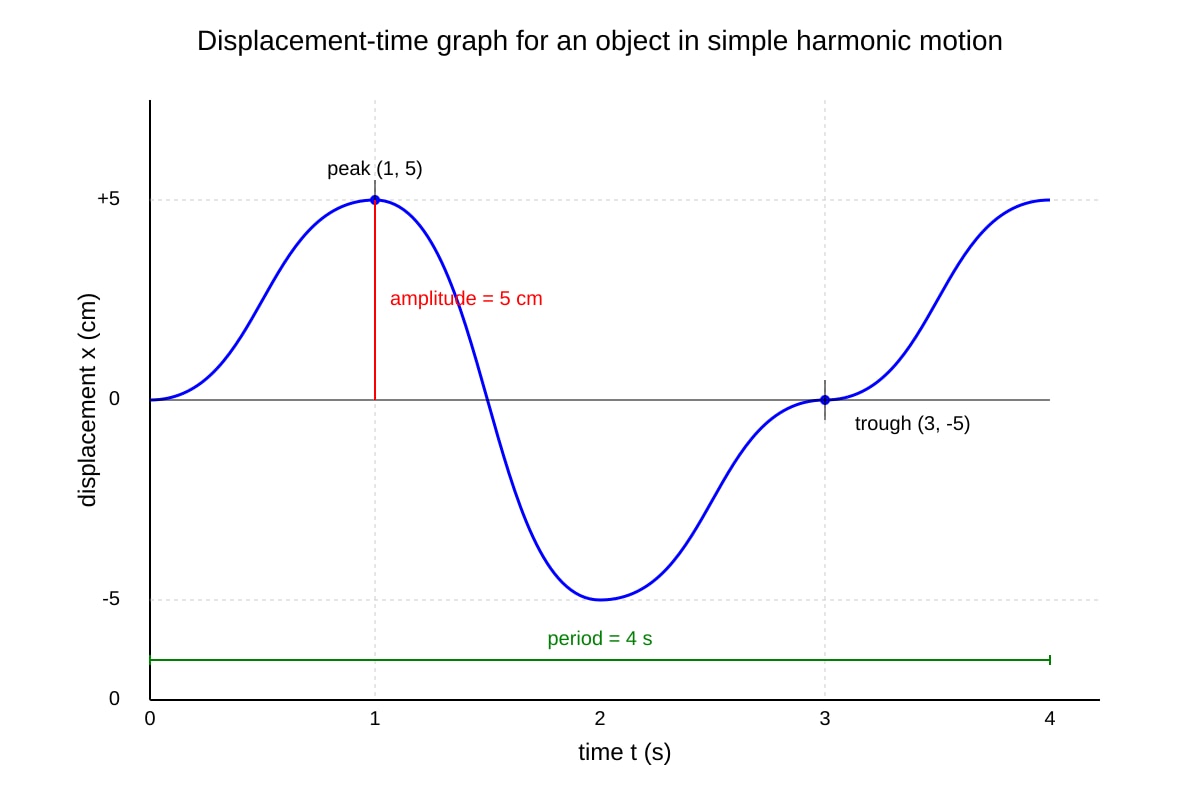
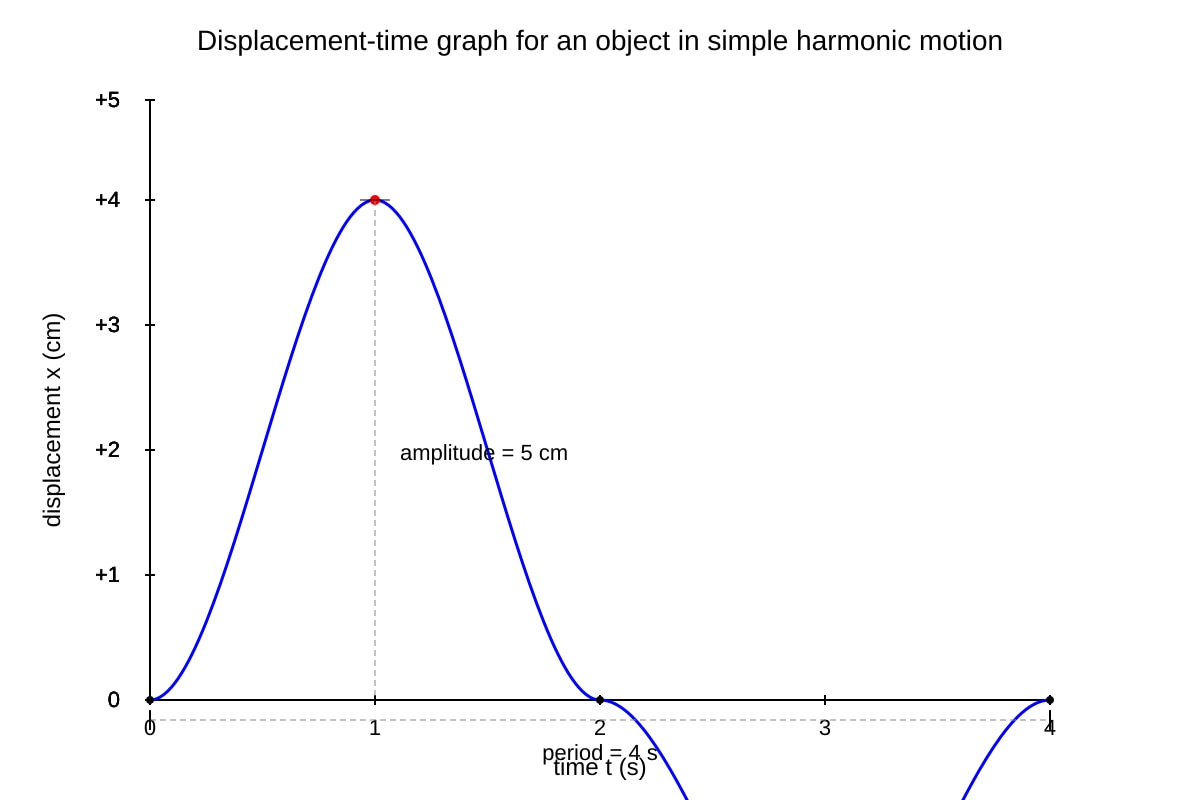
Generated graph for Q16.
From Q16-fig1, determine (a) the amplitude, (b) the period of oscillation. [2]
17. A projectile is fired at 30∘ above horizontal with initial speed 50 m s−1. Calculate the maximum height reached. [3]
18. A ball of mass 0.15 kg falls from rest and hits the ground at 10 m s−1. The impact lasts 0.020 s. Calculate the average force exerted by the ground. [3]
19. Explain why a geostationary satellite must orbit above the Equator. [2]
20. A pendulum of length 1.0 m has a bob of mass 0.50 kg. Calculate the centripetal force at the lowest point if speed there is 2.0 m s−1. [3]
</stage3_quiz_answers_md>
A-Level Physics H2 Quiz - Mechanics: Answer Key
Total Marks: 40
Topic: Mechanics
Section A: Foundations of Mechanics
Q1. [2 marks]
Principle: In a closed (isolated) system, the total linear momentum before an event equals the total linear momentum after the event, provided no net external force acts.
Marking: 1 mark for "total momentum constant / conserved"; 1 mark for condition "no external force / closed system".
Teaching note: Momentum p=mv is conserved vectorially. Do not confuse with energy conservation.
Q2. [2 marks]
For SHM, amax=ω2X0.
Substitute: ω=3.14 rad s−1, X0=0.040 m.
amax=(3.14)2×0.040=9.86×0.040=0.394 m s−2.
Marking: 1 mark for correct formula, 1 mark for answer with unit.
Common mistake: Using a=ωX0 (forgets square).
Q3. [2 marks]
Vertical motion: s=21gt2 (initial vertical velocity = 0).
45=21(9.81)t2⇒t2=9.8190=9.17⇒t=3.03 s.
Marking: 1 mark for use of equation, 1 mark for answer.
Q4. [1 mark]
Centripetal force is the resultant force directed towards the centre of a circular path that keeps a body in circular motion.
Marking: 1 mark for "towards centre" + "maintains circular motion".
Q5. [2 marks]
F=rmv2=801200×252=801200×625=9375 N.
Marking: 1 mark formula, 1 mark answer.
Section B: Motion, Collisions and Circular Motion
Q6. [2 marks]
v=u+at=5+(2)(4)=13 m s−1.
Marking: 1 mark substitution, 1 mark answer.
Q7. [3 marks]
Conservation of momentum: mAuA+mBuB=(mA+mB)v.
1.0×3.0+2.0×0=3.0=3.0v⇒v=1.0 m s−1.
Marking: 1 mark momentum equation, 1 mark substitution, 1 mark answer.
Q8. [2 marks]
Examples: (1) Use a smooth track / lubricate to reduce friction (systematic error). (2) Use light gates / tickertape at eye level to reduce parallax.
Marking: 1 mark each valid precaution linked to accuracy.
Q9. [2 marks]
ac=rv2=0.504.02=0.5016=32 m s−2.
Marking: 1 mark formula, 1 mark answer.
Q10. [2 marks]
From graph: slope = 6−016−4=612=2.0 m s−2.
Marking: 1 mark gradient calculation, 1 mark answer.
Visual needed: straight line through (0,4) and (6,16).
Section C: Gravitational Fields and Oscillations
Q11. [3 marks]
F=r2Gm1m2.
G = gravitational constant, m1,m2 = masses, r = separation.
Marking: 1 mark equation, 2 marks symbol meanings (any 2).
Q12. [2 marks]
g=RE2GME=(6.37×10⁶)2(6.67×10⁻¹¹)(5.97×1024)=4.06×10133.98×1014=9.80 N kg−1.
Marking: 1 mark substitution, 1 mark answer.
Q13. [2 marks]
At r=2RE, g′=(2RE)2GM=41g=49.80=2.45 N kg−1.
Marking: 1 mark factor 1/4, 1 mark answer.
Q14. [3 marks]
vmax=ωX0=T2πX0=1.22π(0.030)=5.24×0.030=0.157 m s−1.
Marking: 1 mark ω, 1 mark formula, 1 mark answer.
Q15. [1 mark]
Resonance occurs when the driving frequency equals the natural frequency of the system.
Marking: 1 mark for equality of frequencies.
Section D: Data Interpretation and Synthesis
Q16. [2 marks]
(a) Amplitude = 5 cm (from peak). (b) Period = 4 s (repeat interval).
Marking: 1 mark each.
Visual: sinusoidal with peak 5 cm, period 4 s.
Q17. [3 marks]
Vertical component uy=50sin30∘=25 m s−1.
At max height vy=0: h=2guy2=2×9.81252=19.62625=31.9 m.
Marking: 1 mark component, 1 mark formula, 1 mark answer.
Q18. [3 marks]
Change in momentum Δp=mv=0.15×10=1.5 kg m s−1.
Average force F=tΔp=0.0201.5=75 N (upward).
Marking: 1 mark Δp, 1 mark division, 1 mark answer.
Q19. [2 marks]
A geostationary satellite has period = Earth's rotation (24 h) and must stay above same point; only above Equator does the centripetal force direction align with gravity to give zero inclination orbit.
Marking: 1 mark period match, 1 mark Equator/alignment reason.
Q20. [3 marks]
Fc=rmv2=1.00.50×2.02=1.00.50×4.0=2.0 N.
Marking: 1 mark identify r = L, 1 mark formula, 1 mark answer.
</stage3_quiz_answers_md>
<stage3_exam_md>
TuitionGoWhere Practice Paper - Physics H2 A-Level
TuitionGoWhere Exam Practice (AI)
Subject: Physics H2
Level: A-Level
Paper: Practice Paper (Mechanics) Version 1
Duration: 60 minutes
Total Marks: 40
Name: ___________________________
Class: ___________________________
Date: ___________________________
Instructions:
- This paper contains 20 questions on Mechanics.
- Answer all questions in the spaces provided.
- Show all working. Use g=9.81 m s−2, G=6.67×10⁻¹¹ N m2 kg−2.
- Section A (Q1–5): 10 marks, Section B (Q6–10): 10 marks, Section C (Q11–15): 10 marks, Section D (Q16–20): 10 marks.
Section A: Foundations (10 marks)
1. State the principle of conservation of linear momentum. [2]
2. A spring oscillator has amplitude 0.050 m, ω=2.00 rad s−1. Find max acceleration. [2]
3. A body dropped from rest falls 20 m. Find time taken. [2]
4. Define centripetal force. [1]
5. Calculate centripetal force for 800 kg car at 20 m s−1 on 50 m radius bend. [3]
Section B: Motion and Collisions (10 marks)
6. Use v=u+at for u=2, a=3, t=5 to find v. [2]
7. Trolley X (1.5 kg, 4 m s−1) hits stationary Y (1.5 kg), they stick. Find v. [3]
8. Give two accuracy precautions for trolley collision exp. [2]
9. 0.40 m string, speed 3 m s−1 at bottom: find ac. [1]
10.
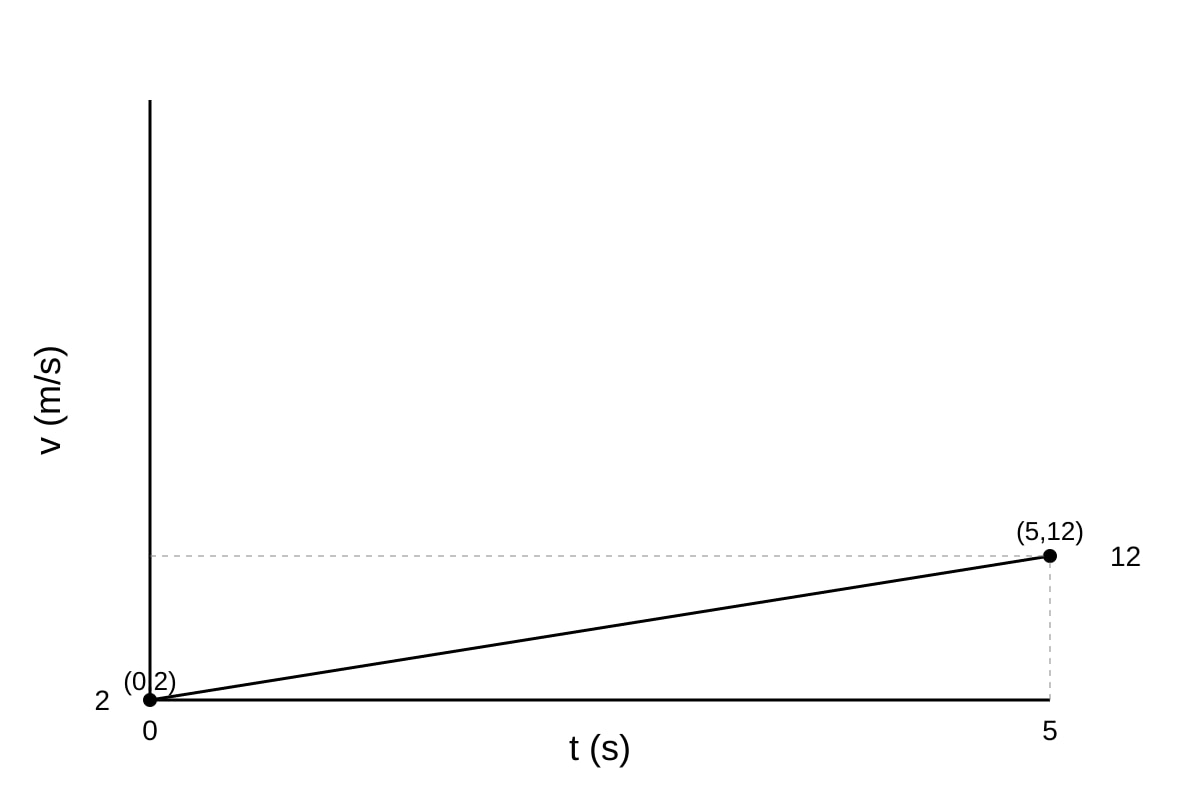
Generated graph for Q10.
Find acceleration from Q10-fig1. [2]
Section C: Gravity and Oscillation (10 marks)
11. State Newton's gravitation law equation and symbols. [3]
12. Compute g at Earth surface. [1]
13. Field strength at 3RE? [2]
14. T=2.0 s, X0=0.10 m: max velocity? [3]
15. Condition for resonance. [1]
Section D: Synthesis (10 marks)
16.
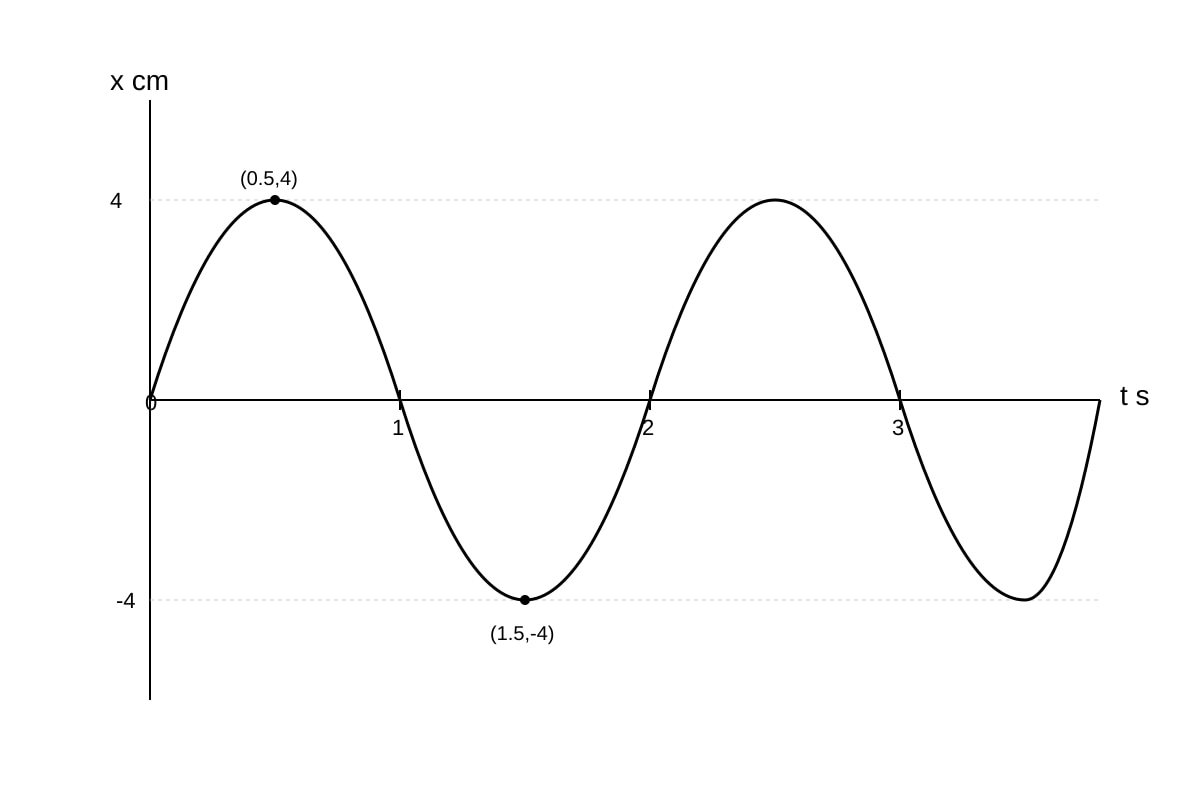
Generated graph for Q16.
From Q16-fig1 give amplitude & period. [2]
17. Launch 40 m s−1 at 45∘: max height. [2]
18. 0.20 kg ball stops from 15 m s−1 in 0.030 s: avg force. [2]
19. Why geostationary satellite above Equator? [2]
20. Pendulum 2.0 m, bob 0.40 kg, speed low point 3 m s−1: Fc. [2]
</stage3_exam_md>
<stage3_exam_answers_md>
TuitionGoWhere Practice Paper - Physics H2 A-Level: Answer Key (Version 1)
Total Marks: 40
Section A (10 marks)
Q1 [2] Total momentum conserved in closed system, no external net force. (1+1)
Q2 [2] amax=ω2X0=4×0.05=0.20 m s−2. (1+1)
Q3 [2] 20=21(9.81)t2⇒t=2.02 s. (1+1)
Q4 [1] Resultant force towards centre for circular motion.
Q5 [3] F=800×202/50=6400 N. (1 formula,2 ans)
Section B (10 marks)
Q6 [2] v=2+3×5=17 m s−1.
Q7 [3] 1.5×4=3v⇒v=2.0 m s−1.
Q8 [2] e.g. smooth track, eye-level reading.
Q9 [1] ac=9/0.4=22.5 m s−2.
Q10 [2] slope=(12−2)/5=2.0 m s−2.
Section C (10 marks)
Q11 [3] F=Gm1m2/r2; G const, m masses, r dist.
Q12 [1] 9.81 N kg−1.
Q13 [2] g/9=1.09 N kg−1.
Q14 [3] vmax=2π/2.0×0.10=0.314 m s−1.
Q15 [1] driving freq = natural freq.
Section D (10 marks)
Q16 [2] amp 4 cm, period 2 s.
Q17 [2] uy=40sin45=28.3, h=28.32/(2×9.81)=40.8 m.
Q18 [2] Δp=0.2×15=3, F=3/0.03=100 N.
Q19 [2] period match + equatorial alignment.
Q20 [2] F=0.4×32/2=1.8 N.
</stage3_exam_answers_md>
<stage3_quiz_md>
A-Level Physics H2 Quiz - Mechanics
Name: ___________________________
Class: ___________________________
Date: ___________________________
Score: ___________ / 40
Duration: 60 minutes
Total Marks: 40
Topic: Mechanics (Projectile Motion, Collisions, Circular Motion, Gravitational Fields, Oscillations)
Instructions:
- Answer all 20 questions.
- Show all working clearly where calculation is required.
- Use the data sheet values: g=9.81 m s−2, G=6.67×10⁻¹¹ N m2 kg−2, ME=5.97×1024 kg, RE=6.37×10⁶ m.
- Write answers in the spaces provided.
Section A: Foundations of Mechanics (Questions 1–5)
1. State the principle of conservation of linear momentum. [2]
2. A ball of mass 0.20 kg is attached to a spring and oscillates with simple harmonic motion of amplitude 0.040 m and angular frequency 3.14 rad s−1. Calculate the maximum acceleration of the ball. [2]
3. A projectile is launched horizontally from a cliff of height 45 m with speed 20 m s−1. Calculate the time taken to reach the ground. [2]
4. Define centripetal force. [1]
5. A car of mass 1200 kg moves around a circular track of radius 80 m at constant speed 25 m s−1. Calculate the centripetal force acting on the car. [2]
Section B: Motion, Collisions and Circular Motion (Questions 6–10)
6. A body moves with uniformly accelerated motion. Given u=5 m s−1, a=2 m s−2, t=4 s, calculate the final velocity v. [2]
7. Two trolleys collide on a smooth track. Trolley A (mA=1.0 kg) moves at 3.0 m s−1 and trolley B (mB=2.0 kg) is at rest. After collision they stick together. Calculate their common final velocity. [3]
8. State two precautions that improve accuracy in a collision experiment using trolleys and a linear track. [2]
9. A stone is tied to a string of length 0.50 m and whirled in a vertical circle. At the lowest point its speed is 4.0 m s−1. Calculate the centripetal acceleration. [2]
10.
Generated graph for Q10.
Using the graph in Q10-fig1, determine the acceleration of the particle. [2]
Section C: Gravitational Fields and Oscillations (Questions 11–15)
11. Write Newton's law of gravitation in equation form and state the meaning of each symbol. [3]
12. Calculate the gravitational field strength at the surface of Earth using g=R2GM. [2]
13. A satellite orbits Earth at radius 2RE. Calculate the gravitational field strength at this orbit. [2]
14. A mass on a spring performs SHM with period T=1.2 s and amplitude 0.030 m. Calculate the maximum velocity. [3]
15. State the condition for resonance to occur in a forced oscillation system. [1]
Section D: Data Interpretation and Synthesis (Questions 16–20)
16.
Generated graph for Q16.
From Q16-fig1, determine (a) the amplitude, (b) the period of oscillation. [2]
17. A projectile is fired at 30∘ above horizontal with initial speed 50 m s−1. Calculate the maximum height reached. [3]
18. A ball of mass 0.15 kg falls from rest and hits the ground at 10 m s−1. The impact lasts 0.020 s. Calculate the average force exerted by the ground. [3]
19. Explain why a geostationary satellite must orbit above the Equator. [2]
20. A pendulum of length 1.0 m has a bob of mass 0.50 kg. Calculate the centripetal force at the lowest point if speed there is 2.0 m s−1. [3]