From Real Exams Quiz
A Level H2 Physics Electricity Magnetism Quiz
Free A Level H2 Physics Electricity Magnetism quiz, HY3 Exam version, with questions, answers, and A Level-style practice for Singapore students.
These static practice materials are generated from the site's syllabus and paper-generation workflow, with source and model context shown so students and parents can evaluate the material before use.
Questions
A-Level Physics H2 Quiz - Electricity Magnetism
Name: ___________________________
Class: ___________________________
Date: ___________________________
Score: _______ / 40
Duration: 60 minutes
Total Marks: 40
Topic: Electricity & Magnetism
Instructions:
- Answer all 20 questions.
- Show your working clearly where calculations are required.
- Use the provided answer spaces.
- Units must be included in final numerical answers.
Section A: Electric Fields and Potential (Questions 1–5)
1. State Coulomb’s law for the force between two point charges. [2]
2. Two point charges Q1=+4.0 nC and Q2=−2.0 nC are separated by a distance of 0.30 m in vacuum. Calculate the magnitude of the electrostatic force between them.
(ε0=8.85×10⁻¹² F m−1) [3]
3. Define electric field strength at a point. [1]
4. An electron is placed at a point where the electric potential is +12 V. Calculate its electric potential energy at that point.
(e=1.60×10⁻¹⁹ C) [2]
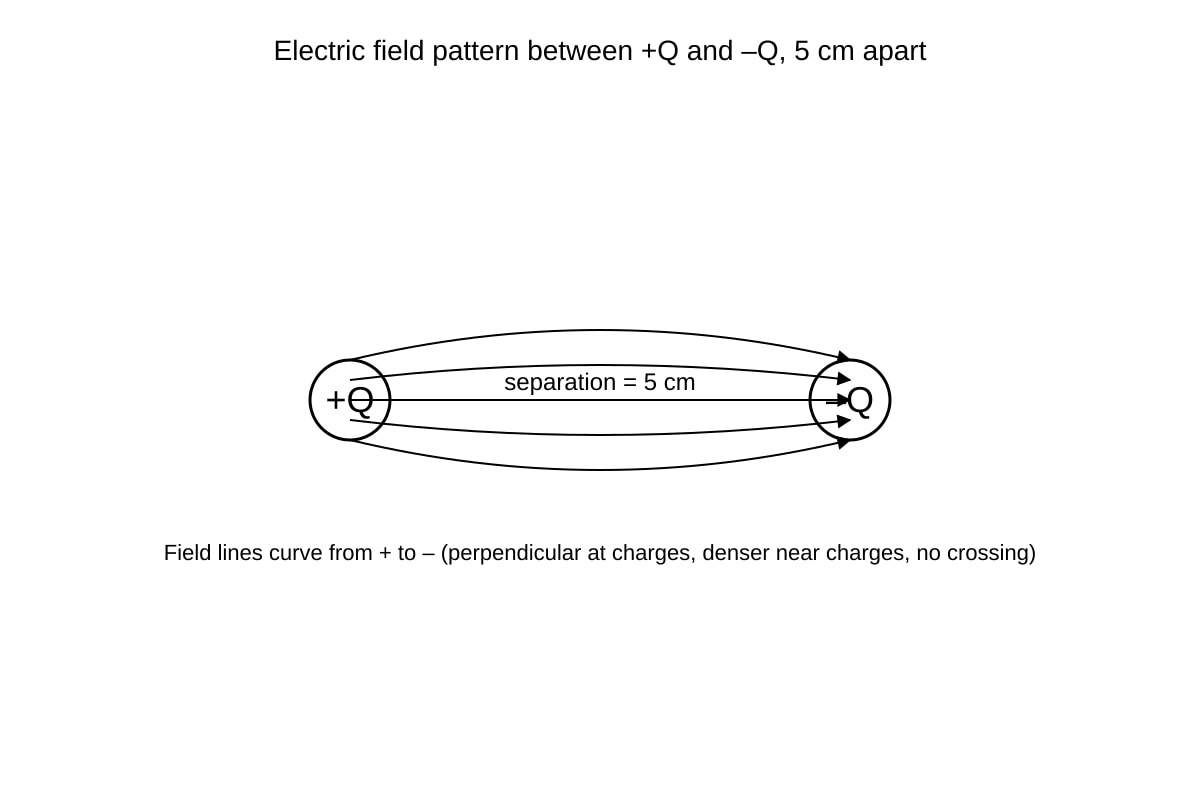
5. Sketch the electric field pattern between a positive point charge and a negative point charge placed 5 cm apart.
Image pending generation: diagram for Q5.
Label the direction of the field lines. [2]
Section B: Circuits and Components (Questions 6–10)
6. State the relationship between current, charge and time. [1]
7. A resistor of 6.0 Ω is connected in series with a 3.0 Ω resistor across a 9.0 V battery. Calculate the current in the circuit. [2]
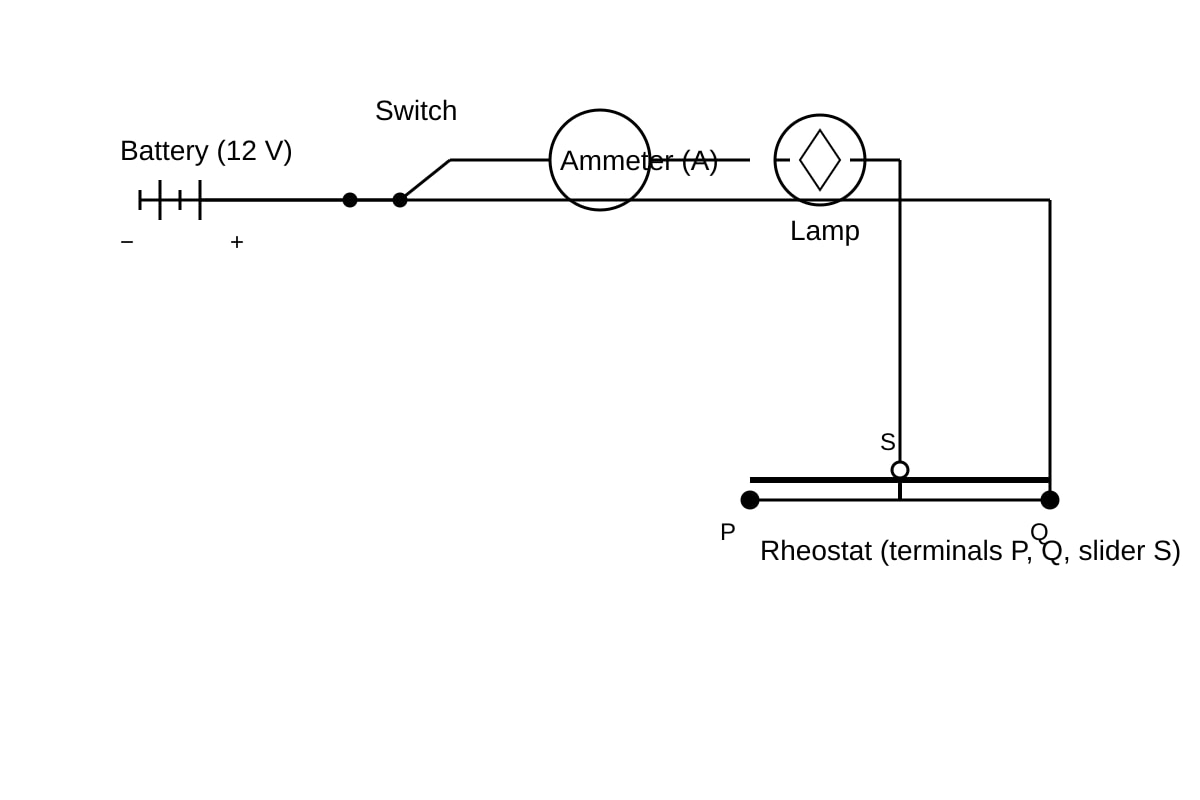
8. The circuit below contains a battery, a switch, an ammeter, a lamp, and a rheostat connected as a potential divider.
Image pending generation: circuit for Q8.
State how the rheostat should be adjusted to increase the brightness of the lamp. [2]
9. A capacitor of capacitance 220 μF is charged through a 10 kΩ resistor from a 6.0 V supply. Calculate the time constant of the circuit. [2]
10. Explain why the ammeter must be connected in series and the voltmeter in parallel in a circuit. [2]
Section C: Magnetism and Induction (Questions 11–15)
11. State the direction of the magnetic field produced by a straight wire carrying current upwards, at a point to the east of the wire. [1]
12. A proton moves horizontally to the north in a uniform magnetic field directed vertically downwards. State the direction of the magnetic force on the proton. [2]
13. A straight wire of length 0.50 m carries a current of 3.0 A perpendicular to a magnetic field of flux density 0.20 T. Calculate the magnetic force on the wire. [2]
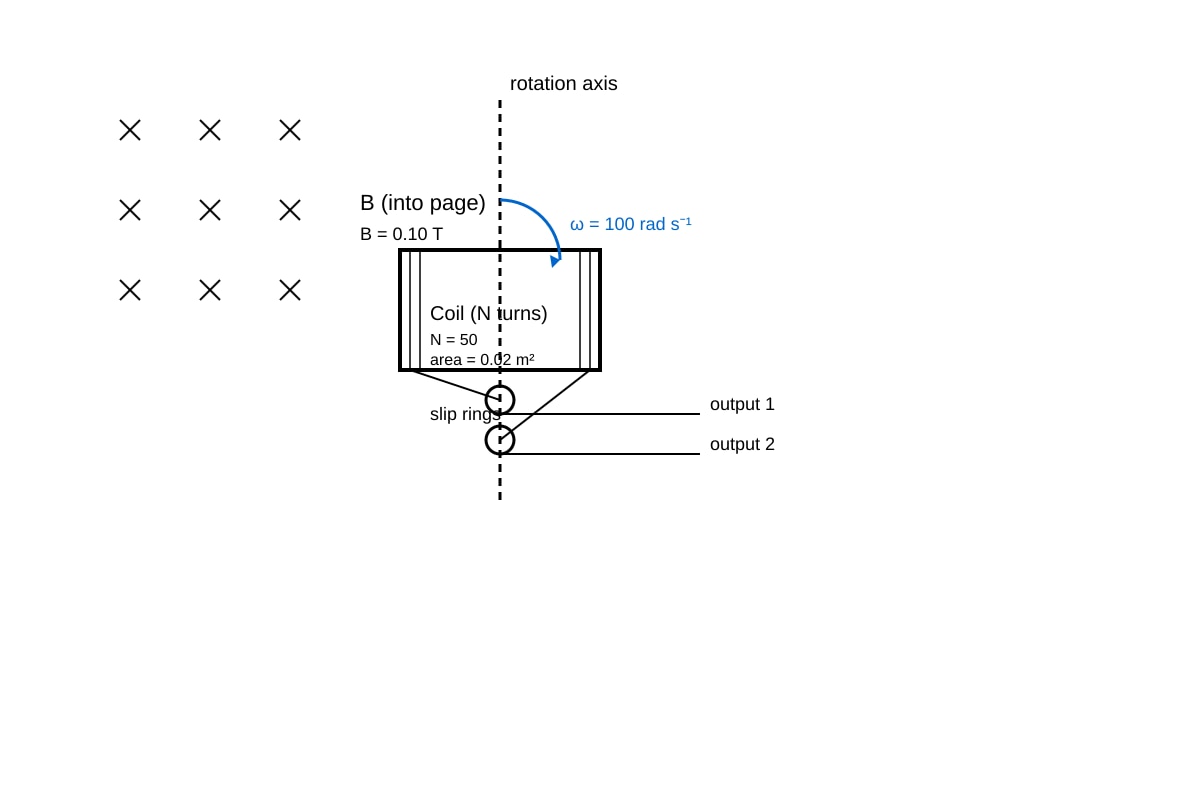
14. The diagram shows a rectangular coil rotating in a uniform magnetic field.
Image pending generation: diagram for Q14.
State Faraday’s law of electromagnetic induction. [2]
15. A transformer has 200 turns on the primary and 600 turns on the secondary. The primary is connected to 230 V a.c. Assuming ideal operation, calculate the secondary voltage. [2]
Section D: Data Interpretation and Synthesis (Questions 16–20)
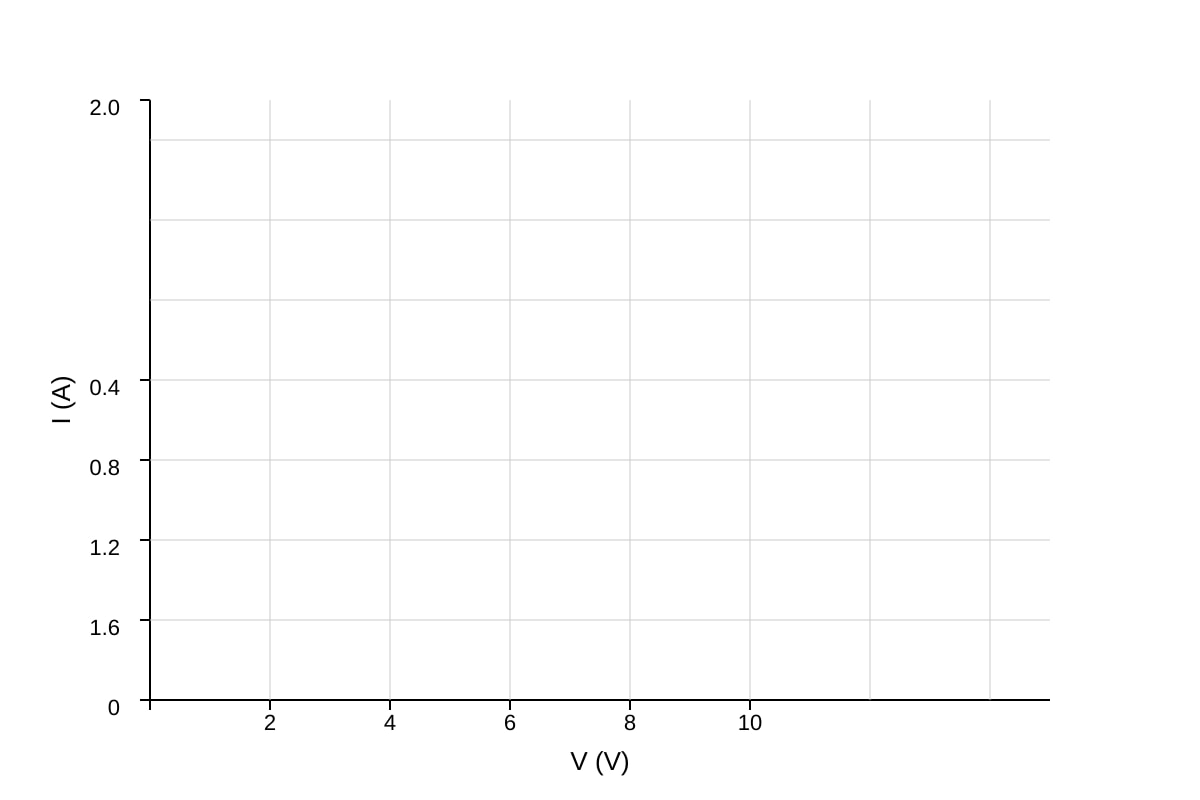
16. The table below shows current I through a resistor for different potential differences V.
| V (V) | 2.0 | 4.0 | 6.0 | 8.0 | 10.0 |
|---|---|---|---|---|---|
| I (A) | 0.40 | 0.80 | 1.20 | 1.60 | 2.00 |
Plot a graph of I against V and determine the resistance from the gradient. [4]
Image pending generation: graph for Q16.
17. A charged particle of mass m and charge q enters a uniform magnetic field B perpendicularly with speed v. Derive an expression for the radius r of its circular path. [3]
18. Explain how electromagnetic induction is used in a bicycle dynamo to produce electricity. [3]
19. A parallel-plate capacitor has plate area A and separation d. Show that its capacitance is given by C=dε0A. [2]
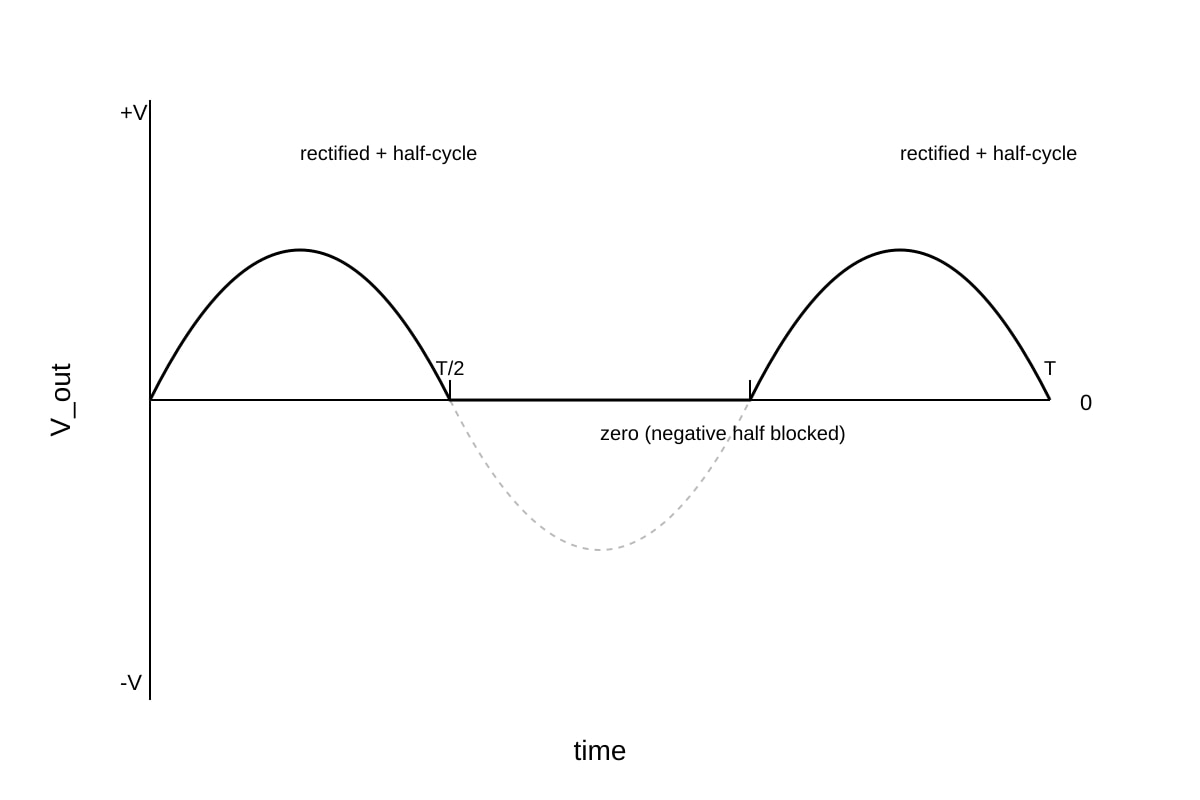
20. A student connects a diode and a resistor in series with an a.c. supply. Sketch the output voltage across the resistor over one cycle.
Image pending generation: graph for Q20.
Label the axes and indicate the rectified portions. [3]
Answers
A-Level Physics H2 Quiz - Electricity Magnetism (Answers)
Total Marks: 40
Topic: Electricity & Magnetism
Section A: Electric Fields and Potential
Q1. [2 marks]
Coulomb’s law: The force F between two point charges Q1 and Q2 is directly proportional to the product of the charges and inversely proportional to the square of the distance r between them:
F=4πε0r2Q1Q2
Marking: 1 mark for proportionality statement, 1 mark for inverse-square / formula.
Teaching note: This is the electric analogue of Newton’s gravitation law but can be attractive or repulsive.
Q2. [3 marks]
F=4πε0r2Q1Q2
=4π(8.85×10⁻¹²)(0.30)2(4.0×10⁻⁹)(2.0×10⁻⁹)
=4π(8.85×10⁻¹²)(0.09)8.0×10−18
=1.00×10−118.0×10−18=8.0×10⁻⁷ N
Marking: 1 formula, 1 substitution, 1 answer with unit.
Common mistake: Forgetting to convert nC to C.
Q3. [1 mark]
Electric field strength is the force per unit positive charge at a point: E=F/q.
Teaching note: It is a vector pointing in direction of force on + charge.
Q4. [2 marks]
U=qV=(−1.60×10⁻¹⁹)(12)=−1.92×10⁻¹⁸ J
Marking: 1 formula, 1 answer with sign and unit.
Note: Electron charge is negative, so energy is negative relative to zero at infinity.
Q5. [2 marks]
Field lines from +Q to –Q, curved, labelled with arrows toward negative.
Marking: 1 for correct pattern, 1 for direction arrows.
Expected visual: Perpendicular start/end, no crossing.
Section B: Circuits and Components
Q6. [1 mark]
I=Q/t (current = charge / time).
Q7. [2 marks]
Rtotal=6.0+3.0=9.0 Ω
I=V/R=9.0/9.0=1.0 A
Marking: 1 for series total, 1 for current.
Q8. [2 marks]
Adjust slider so resistance in lamp branch decreases (or rheostat portion in series with lamp reduced), increasing current.
Marking: 1 for adjustment direction, 1 for reasoning (more current → brighter).
Q9. [2 marks]
τ=RC=(10×103)(220×10−6)=2.2 s
Marking: 1 conversion, 1 answer.
Q10. [2 marks]
Ammeter low resistance → series to measure current without altering it; voltmeter high resistance → parallel to measure p.d. without drawing current.
Marking: 1 each.
Section C: Magnetism and Induction
Q11. [1 mark]
West (using right-hand grip rule: thumb up = current, fingers curl west on east side).
Q12. [2 marks]
Using Fleming’s left-hand rule: force is to the east.
Marking: 1 rule, 1 direction.
Q13. [2 marks]
F=BIL=(0.20)(3.0)(0.50)=0.30 N
Marking: 1 formula, 1 answer.
Q14. [2 marks]
Faraday’s law: induced e.m.f. is proportional to rate of change of magnetic flux linkage: E=−NdtdΦ.
Marking: 1 statement, 1 negative sign / flux linkage.
Q15. [2 marks]
Vs=Vp(Ns/Np)=230×(600/200)=690 V
Marking: 1 ratio, 1 answer.
Section D: Data Interpretation and Synthesis
Q16. [4 marks]
Graph: straight line through origin. Gradient = ΔI/ΔV = 2.0/10.0 = 0.20 A V⁻¹.
R=1/gradient=5.0 Ω.
Marking: 1 plot, 1 gradient, 1 inverse, 1 unit.
Expected visual: Points on line, axes labelled.
Q17. [3 marks]
Magnetic force provides centripetal: qvB=mv2/r → r=mv/(qB).
Marking: 1 force equality, 1 rearrange, 1 final.
Q18. [3 marks]
Dynamo: coil rotates in magnetic field → flux changes → e.m.f. induced (Faraday). Permanent magnet provides B, rotation by wheel.
Marking: 1 rotation, 1 flux change, 1 induction.
Q19. [2 marks]
C=Q/V, E=V/d, Q=σA=ε0EA → C=ε0A/d.
Marking: 1 relation, 1 substitution.
Q20. [3 marks]
Output: positive half-cycles only, zero in negative half. Axes labelled V_out, time.
Marking: 1 shape, 1 labels, 1 rectified indication.
Expected visual: Half-wave rectified sine.
Free quiz and exam paper access
Enter your details to view this paper
Your access is remembered on this device.