TuitionGoWhere Practice Paper - Physics H2 A-Level
TuitionGoWhere Practice Paper (AI) — Version 5
Subject: Physics H2
Level: A-Level
Paper: Practice Paper (Mechanics Focus)
Duration: 1 hour 45 minutes
Total Marks: 75
Name: ________________________
Class: ________________________
Date: ________________________
Instructions:
- Answer all questions in the spaces provided.
- Show all working clearly. Marks are awarded for correct method and reasoning.
- Use the data and formulae sheet if needed.
- This is a syllabus-aligned practice paper generated from inferred templates; it is not derived from official past-year papers.
- Section A: Structured Questions (1–8) — 40 marks
- Section B: Data-Based and Applied Questions (9–12) — 20 marks
- Section C: Extended Reasoning (13–15) — 15 marks
Section A: Structured Questions (40 marks)
1. [3 marks]
(a) State the principle of conservation of linear momentum.
(b) A closed system has two objects. Explain why the total momentum remains unchanged during a collision.
2. [3 marks]
A ball of mass 0.20 kg is attached to a spring of spring constant k=80 N m−1. It oscillates with amplitude 0.050 m.
(a) Calculate the angular frequency ω.
(b) Calculate the maximum acceleration of the ball.
3. [3 marks]
A projectile is launched horizontally from a height of 20 m with initial speed 15 m s−1. Assume g=9.8 m s−2 and neglect air resistance.
(a) Calculate the time taken to reach the ground.
(b) Calculate the horizontal distance travelled.
4. [4 marks]
A car of mass 1200 kg moving at 12 m s−1 collides with a stationary van of mass 1800 kg. After the collision the car moves at 4 m s−1 in the same direction.
(a) Calculate the velocity of the van after collision.
(b) Determine whether the collision is elastic. Show your reasoning.
5. [3 marks]
A mass of 0.50 kg moves in a horizontal circle of radius 0.80 m with constant speed 4.0 m s−1.
(a) Calculate the centripetal acceleration.
(b) Calculate the centripetal force required.
6. [3 marks]
State Newton's law of gravitation and define the gravitational field strength g at a point.
7. [4 marks]
A satellite orbits Earth at a distance r=4.2×10⁷ m from the centre. Given G=6.67×10⁻¹¹ N m2kg−2 and MEarth=6.0×1024 kg:
(a) Calculate the gravitational field strength g at this orbit.
(b) Calculate the orbital speed of the satellite.
8. [4 marks]
A mass on a spring performs simple harmonic motion with displacement x=x0sin(ωt).
(a) Write the expression for velocity v as a function of time.
(b) At what time is the kinetic energy maximum? Explain.
Section B: Data-Based and Applied Questions (20 marks)
9. [5 marks]
The table below shows force F acting on a 0.10 kg object over time t.
(a) Estimate the impulse from t=0 to t=4 s using the area under the graph.
(b) Calculate the final velocity assuming it started from rest.
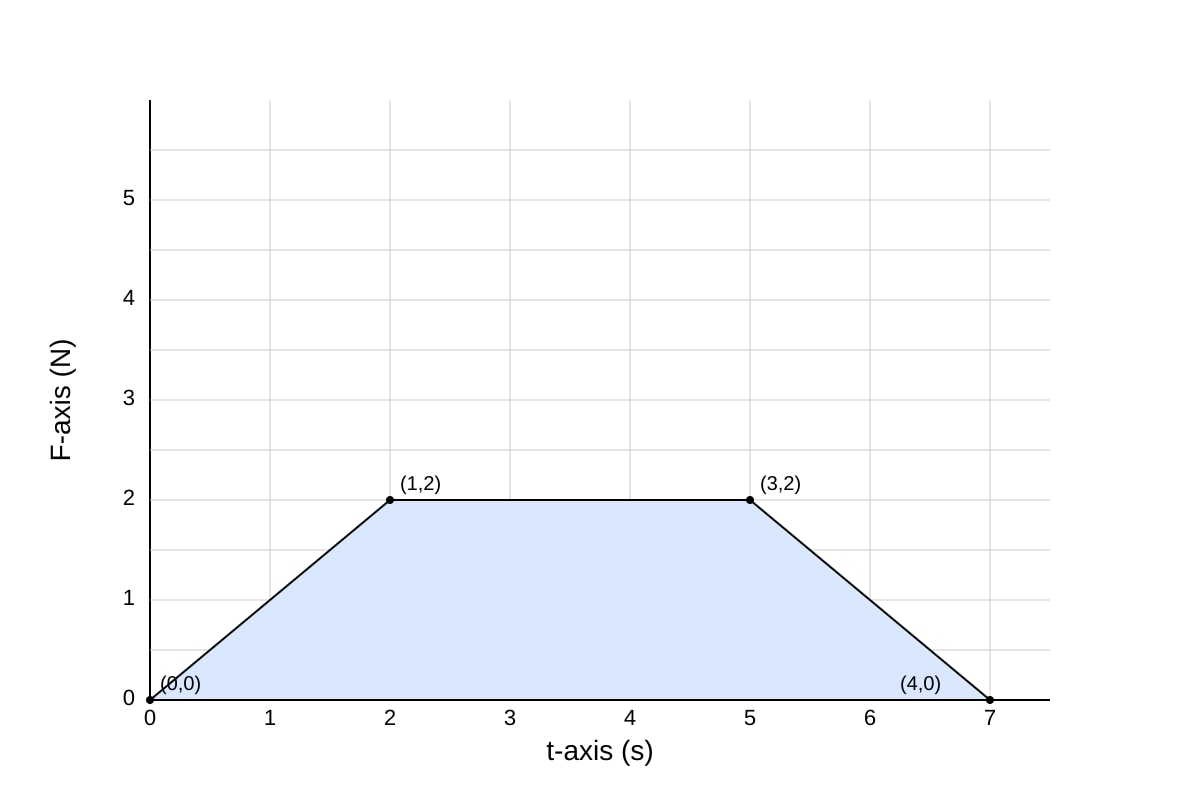
Generated graph for Q9.
10. [5 marks]
A pendulum of length 1.0 m is released from a small angle.
(a) Calculate the period T for small oscillations (g=9.8 m s−2).
(b) If amplitude is 0.10 m, calculate maximum speed.
11. [5 marks]
A ball is thrown at 20 m s−1 at 30∘ above horizontal.
(a) Calculate time to highest point.
(b) Calculate maximum height.
(c) Calculate range (neglect air resistance).
12. [5 marks]
A 2.0 kg block slides down a frictionless incline of height 3.0 m.
(a) Calculate speed at bottom using energy conservation.
(b) If it collides inelastically with identical stationary block, find common speed after.
Section C: Extended Reasoning (15 marks)
13. [5 marks]
Describe the energy interchanges in a lightly damped mass-spring SHM system during one cycle. Include reference to kinetic and potential energy maxima.
14. [5 marks]
A student claims: "Centripetal force is a new kind of force separate from gravity or tension." Evaluate this statement with examples from circular motion.
15. [5 marks]
For a geostationary satellite, explain the conditions on orbital radius and period. State one application and one hazard of resonance in mechanical systems.
End of Practice Paper