TuitionGoWhere Practice Paper - Physics H2 A-Level
TuitionGoWhere Practice Paper (AI) — Version 4 of 5
Subject: Physics H2
Level: A-Level
Paper: Practice Paper (Mechanics Focus)
Duration: 1 hour 30 minutes
Total Marks: 60
Name: ________________________
Class: ________________________
Date: ________________________
Instructions
- Answer all questions in the spaces provided.
- Show all working clearly. Use SI units and appropriate notation.
- For calculation questions, marks are awarded for correct method, substitution, and final answer with units.
- This is a syllabus-first practice paper generated from inferred templates; it is not an official past-year paper.
Section A: Kinematics and Dynamics (Questions 1–5)
Total Marks for Section A: 15
1. [2 marks] A drone accelerates uniformly from rest to a velocity of 12.0 m s−1 in 4.0 s. Calculate its acceleration.
2. [3 marks] A block of mass 2.5 kg is pulled along a horizontal frictionless surface by a constant force of 10.0 N.
(a) Calculate the acceleration of the block.
(b) Calculate the distance moved in 3.0 s from rest.
3. [3 marks] A ball is thrown vertically upward with initial speed 15.0 m s−1. Ignoring air resistance, calculate:
(a) the maximum height reached,
(b) the total time of flight.
4. [3 marks]
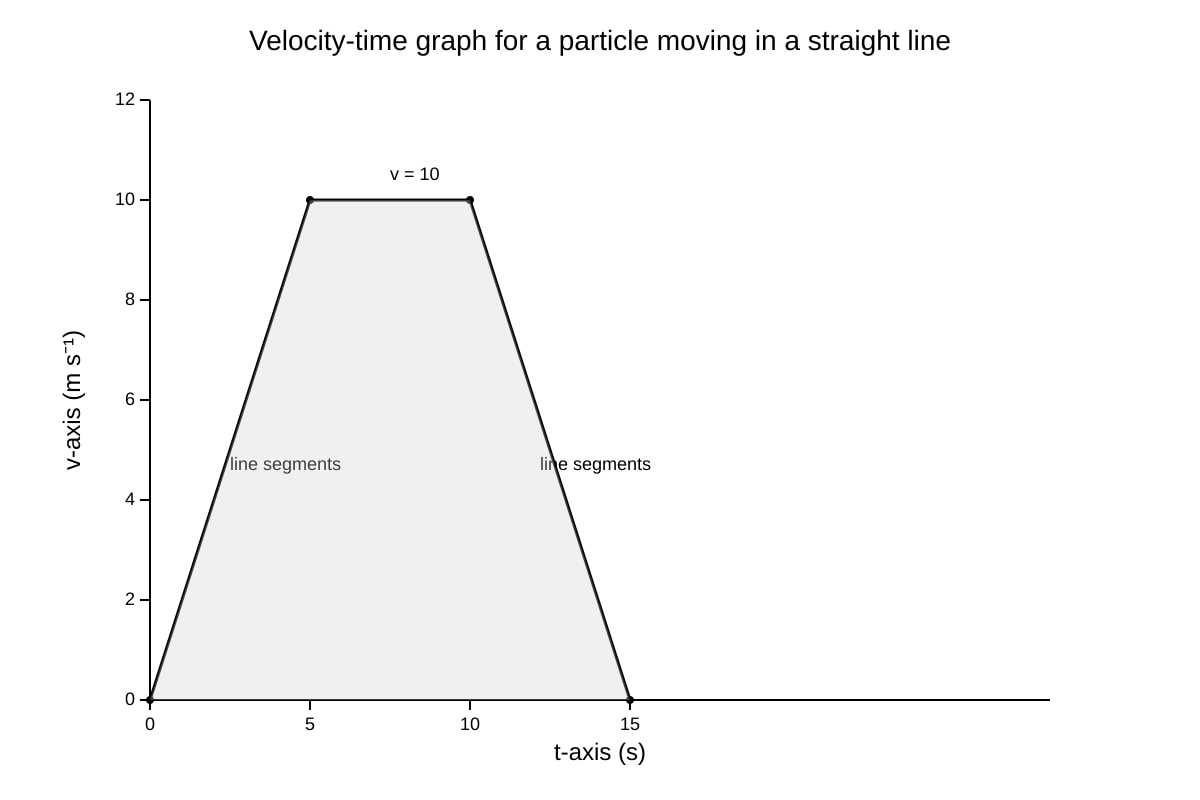
Generated graph for Q4.
Using the graph, determine (a) the acceleration during the first 5 s, and (b) the total distance travelled.
5. [4 marks] State Newton's first law of motion and explain how it applies to a passenger in a car that stops suddenly.
Section B: Momentum, Collisions and Circular Motion (Questions 6–11)
Total Marks for Section B: 18
6. [2 marks] State the principle of conservation of linear momentum.
7. [3 marks] A trolley of mass 1.2 kg moving at 3.0 m s−1 collides with a stationary trolley of mass 1.8 kg. They stick together. Calculate their common velocity after collision.
8. [3 marks] A 0.10 kg ball moving at 5.0 m s−1 collides head-on with a 0.20 kg ball at rest. After an elastic collision, the 0.10 kg ball rebounds at 1.7 m s−1. Calculate the velocity of the 0.20 kg ball after collision.
9. [3 marks] A car of mass 900 kg moves around a circular track of radius 50 m at constant speed 20 m s−1. Calculate the centripetal force required.
10. [3 marks] A stone of mass 0.050 kg is whirled in a horizontal circle of radius 0.80 m on a string. If the tension provides the centripetal force and is 2.5 N, calculate the angular velocity ω.
11. [4 marks] Explain why a rider on a bicycle leaning into a turn is analogous to an object in circular motion, and state the direction of the net force.
Section C: Gravitational Fields, Oscillations and Projectiles (Questions 12–16)
Total Marks for Section C: 15
12. [3 marks] The gravitational field strength at the surface of Earth is g=R2GM. Given G=6.67×10⁻¹¹ N m2kg−2, M=6.0×1024 kg, R=6.4×10⁶ m, calculate g.
13. [3 marks] A mass on a spring executes SHM with amplitude 0.04 m and angular frequency 5.0 rad s−1. Calculate (a) maximum acceleration, (b) maximum velocity.
14. [3 marks] A simple pendulum has length 1.0 m. Using g=9.8 m s−2, calculate its period of oscillation.
15. [3 marks] A projectile is launched horizontally from a cliff 45 m high at 12 m s−1. Calculate (a) time to reach the ground, (b) horizontal range.
16. [3 marks] State two effects of air resistance on a projectile and explain qualitatively.
Section D: Data Interpretation and Structured Reasoning (Questions 17–20)
Total Marks for Section D: 12
17. [3 marks]
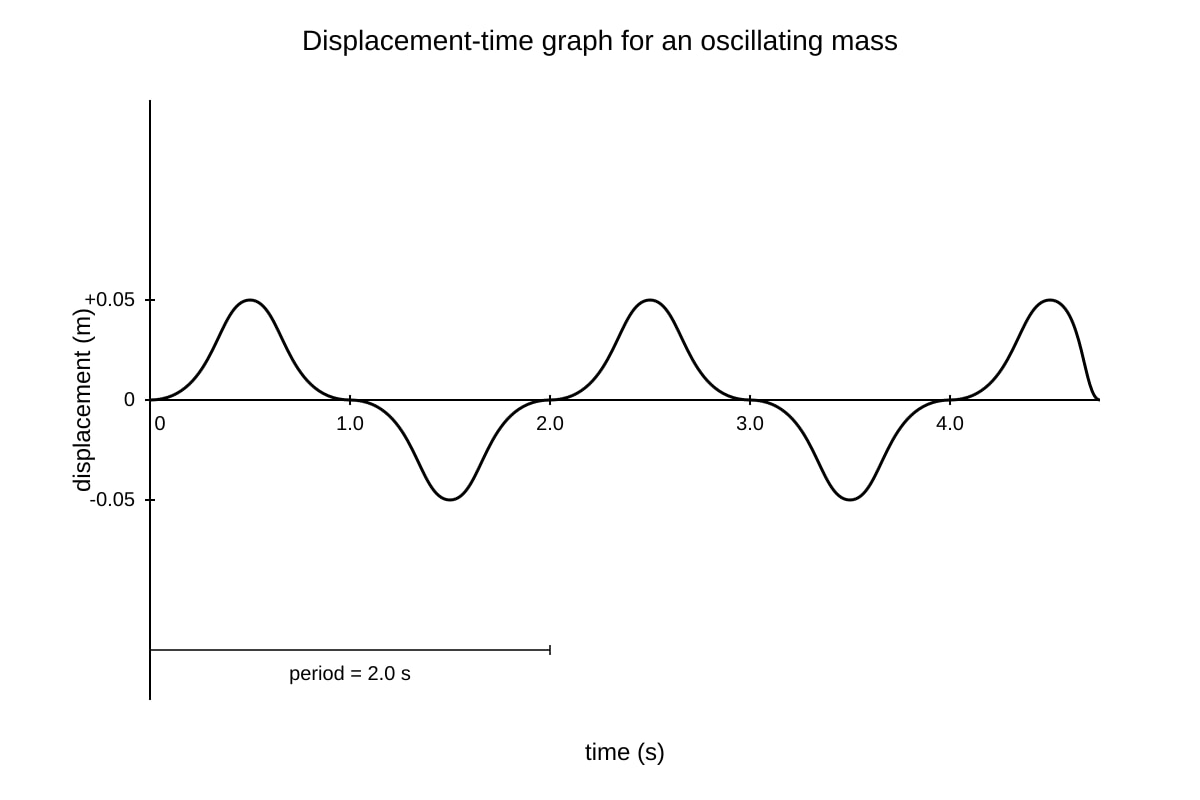
Generated graph for Q17.
From the graph, determine (a) the period, (b) the frequency, (c) the amplitude.
18. [3 marks] A satellite orbits Earth at radius r=2R where R is Earth's radius. Show that gravitational field strength there is g/4, where g is surface value.
19. [3 marks] A 5.0 kg object falls freely from rest for 3.0 s. Calculate (a) its velocity, (b) its kinetic energy at that instant.
20. [3 marks] Describe an experiment to verify the conservation of momentum in a linear collision, listing one precaution for accuracy.
Total Marks: 60