AI Generated Exam Paper
A Level H2 Physics Practice Paper 3
Free A Level H2 Physics Practice Paper 3, LongCat AI version, with questions, answers, and A Level-style practice for Singapore students.
These static practice materials are generated from the site's syllabus and paper-generation workflow, with source and model context shown so students and parents can evaluate the material before use.
Questions
Free quiz and exam paper access
Enter your details to view this paper
Your access is remembered on this device.
Answers
TuitionGoWhere Practice Paper - Physics H2 A-Level
Answer Key and Marking Scheme
Subject: Physics H2
Paper: Practice Paper (Mechanics Focus)
Version: 3 of 5
Total Marks: 80
Section A: Short Answer Questions (20 marks)
1. State the principle of conservation of linear momentum. [2]
Answer:
The total momentum of a system remains constant (or is conserved) provided that no net external force acts on the system. Alternatively: In a closed/isolated system, the total momentum before an event equals the total momentum after the event.
Marking:
- 1 mark for stating that total momentum is conserved/remains constant.
- 1 mark for specifying the condition (no external force / closed/isolated system).
- Common mistake: Stating only "momentum is conserved" without the condition — this scores only 1 mark.
2. A car of mass accelerates uniformly from rest to in .
(a) Calculate the acceleration of the car. [2]
Answer:
Using :
Marking:
- 1 mark for correct formula and substitution.
- 1 mark for correct answer with unit.
(b) Calculate the net force acting on the car. [2]
Answer:
Using :
Marking:
- 1 mark for correct formula and substitution.
- 1 mark for correct answer with unit.
- Allow follow-through from part (a).
3. Distinguish between a scalar quantity and a vector quantity, giving one example of each. [2]
Answer:
A scalar quantity has magnitude only (e.g., mass, speed, energy, time). A vector quantity has both magnitude and direction (e.g., velocity, force, momentum, acceleration).
Marking:
- 1 mark for correct distinction (magnitude only vs. magnitude and direction).
- 1 mark for one correct example of each.
4. A ball is thrown vertically upward with an initial speed of . Calculate the maximum height reached by the ball. [3]
Answer:
At maximum height, final velocity .
Using :
Marking:
- 1 mark for identifying at maximum height.
- 1 mark for correct substitution into kinematic equation.
- 1 mark for correct answer with unit.
- Common mistake: Forgetting that acceleration is negative (opposing motion) — using gives a negative height.
5. Define the term work done by a force. State the SI unit of work. [2]
Answer:
Work done by a force is the product of the force and the displacement in the direction of the force. Alternatively: where is the force, is the displacement, and is the angle between the force and displacement.
SI unit: joule (J), where .
Marking:
- 1 mark for correct definition.
- 1 mark for correct SI unit (joule or N m).
6. A block of mass is pulled along a horizontal surface by a force of at an angle of to the horizontal. The block moves along the surface. Calculate the work done by the applied force. [3]
Answer:
Marking:
- 1 mark for correct formula.
- 1 mark for correct substitution.
- 1 mark for correct answer with unit.
- Common mistake: Using instead of — the horizontal component of force does the work.
7. State Newton's second law of motion in terms of momentum. [2]
Answer:
The net force acting on an object is equal to the rate of change of its momentum. Alternatively: or .
Marking:
- 1 mark for stating force equals rate of change of momentum.
- 1 mark for correct mathematical expression or clear verbal statement.
- Common mistake: Stating only — while equivalent, the question specifically asks for the momentum form.
8. A satellite orbits the Earth at a constant speed in a circular path. Explain why the satellite is accelerating even though its speed is constant. [2]
Answer:
Although the speed is constant, the direction of the velocity is continuously changing as the satellite moves along the circular path. Since velocity is a vector quantity, a change in direction constitutes a change in velocity, which means the satellite is accelerating. The acceleration is directed toward the centre of the circle (centripetal acceleration).
Marking:
- 1 mark for identifying that direction of velocity changes.
- 1 mark for explaining that this constitutes acceleration (or that velocity is a vector).
- Common mistake: Confusing speed with velocity — students may incorrectly state that there is no acceleration because speed is constant.
Section B: Structured Questions (40 marks)
9. A trolley of mass moving at collides with a stationary trolley of mass . After the collision, the two trolleys stick together and move off as one.
(a) State whether this collision is elastic or inelastic. Justify your answer. [2]
Answer:
The collision is inelastic because the two trolleys stick together after the collision. In an elastic collision, kinetic energy is conserved; in an inelastic collision, kinetic energy is not conserved (some is converted to other forms such as thermal energy or sound). Since the objects coalesce, this is a perfectly inelastic collision.
Marking:
- 1 mark for stating "inelastic."
- 1 mark for valid justification (objects stick together / kinetic energy not conserved).
(b) Calculate the common velocity of the two trolleys after the collision. [3]
Answer:
Using conservation of momentum:
Marking:
- 1 mark for correct conservation of momentum equation.
- 1 mark for correct substitution.
- 1 mark for correct answer with unit.
(c) Calculate the kinetic energy lost during the collision. [3]
Answer:
Initial kinetic energy:
Final kinetic energy:
Kinetic energy lost:
Marking:
- 1 mark for correct initial KE calculation.
- 1 mark for correct final KE calculation.
- 1 mark for correct energy lost with unit.
- Allow follow-through from part (b).
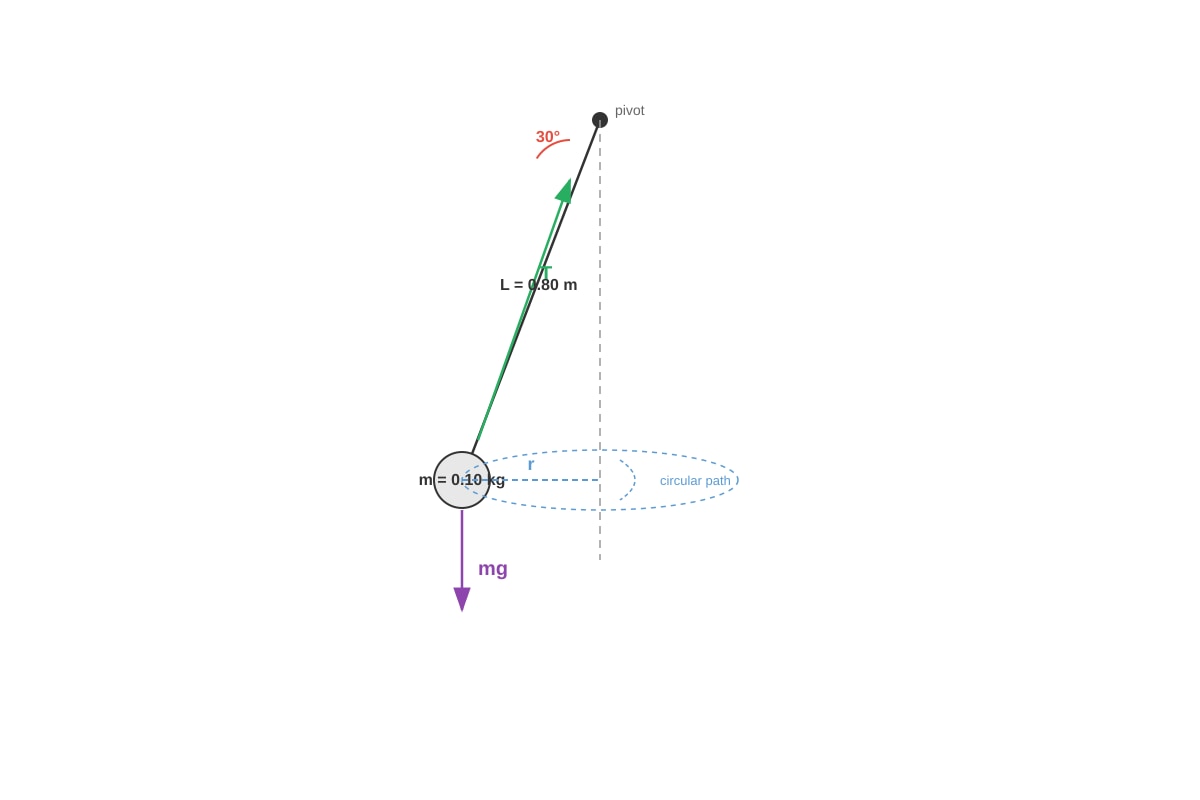
10. A small sphere of mass is attached to a light string of length and moves in a horizontal circle at constant speed. The string makes an angle of with the vertical.
(a) Draw a free-body diagram showing all forces acting on the sphere. [2]
Answer:
The free-body diagram should show:
- Weight () acting vertically downward from the centre of the sphere.
- Tension () acting along the string, upward at to the vertical.
Marking:
- 1 mark for showing weight (mg) downward.
- 1 mark for showing tension (T) along the string at the correct angle.
- Both forces should originate from the centre of the sphere.
(b) Calculate the tension in the string. [3]
Answer:
Resolving vertically (equilibrium in vertical direction):
Marking:
- 1 mark for correct vertical equilibrium equation.
- 1 mark for correct substitution.
- 1 mark for correct answer with unit.
(c) Calculate the speed of the sphere. [3]
Answer:
The radius of the circular path:
Resolving horizontally (provides centripetal force):
Marking:
- 1 mark for correct radius calculation.
- 1 mark for correct horizontal force equation.
- 1 mark for correct answer with unit.
- Allow follow-through from part (b).
11. A ball is projected from ground level with an initial velocity of at an angle of to the horizontal. Air resistance is negligible.
(a) Calculate the horizontal and vertical components of the initial velocity. [2]
Answer:
Horizontal component:
Vertical component:
Marking:
- 1 mark for correct horizontal component.
- 1 mark for correct vertical component.
(b) Calculate the time of flight of the ball. [3]
Answer:
Time to reach maximum height:
Total time of flight:
Alternatively, using with (returns to ground):
or
Marking:
- 1 mark for correct method (using vertical motion).
- 1 mark for correct substitution.
- 1 mark for correct answer with unit.
(c) Calculate the horizontal range of the ball. [3]
Answer:
Marking:
- 1 mark for correct formula.
- 1 mark for correct substitution.
- 1 mark for correct answer with unit.
- Allow follow-through from parts (a) and (b).
(d) State the direction of the acceleration of the ball during its flight. [1]
Answer:
The acceleration is directed vertically downward (toward the centre of the Earth) throughout the flight. Its magnitude is .
Marking:
- 1 mark for stating "vertically downward" or "downward."
- Common mistake: Stating that acceleration is zero at the maximum height — the acceleration is always downward.
12. A crane lifts a load of mass vertically upward at constant speed through a height of in .
(a) Calculate the weight of the load. [1]
Answer:
(or )
Marking:
- 1 mark for correct answer with unit.
(b) Calculate the work done by the crane on the load. [2]
Answer:
Since the load moves at constant speed, the tension in the cable equals the weight.
(or )
Marking:
- 1 mark for using the correct force (equal to weight).
- 1 mark for correct answer with unit.
(c) Calculate the power developed by the crane. [2]
Answer:
(or )
Alternatively:
Marking:
- 1 mark for correct formula.
- 1 mark for correct answer with unit.
(d) Explain why the kinetic energy of the load does not change during this process. [2]
Answer:
The load moves at constant speed, which means its velocity is constant. Since kinetic energy depends on speed (), and the speed does not change, the kinetic energy remains constant throughout the lift.
Marking:
- 1 mark for stating that speed/velocity is constant.
- 1 mark for linking this to kinetic energy being unchanged.
13. A car of mass travels around a horizontal circular track of radius at a constant speed of .
(a) Calculate the centripetal acceleration of the car. [2]
Answer:
Marking:
- 1 mark for correct formula.
- 1 mark for correct answer with unit.
(b) Calculate the centripetal force acting on the car. [2]
Answer:
(or )
Marking:
- 1 mark for correct formula.
- 1 mark for correct answer with unit.
(c) Name the physical force that provides the centripetal force in this situation. [1]
Answer:
Friction (between the tyres and the road surface).
Marking:
- 1 mark for "friction."
- Common mistake: Stating "centripetal force" — this is the name of the net force, not the physical force providing it.
(d) The car now travels at the same speed around a track with a smaller radius. State and explain what happens to the required centripetal force. [2]
Answer:
The required centripetal force increases. Since , for constant speed , the centripetal force is inversely proportional to the radius. A smaller radius means a larger centripetal force is required to maintain the circular motion.
Marking:
- 1 mark for stating the force increases.
- 1 mark for correct explanation (inverse relationship with radius).
Section C: Extended Response (20 marks)
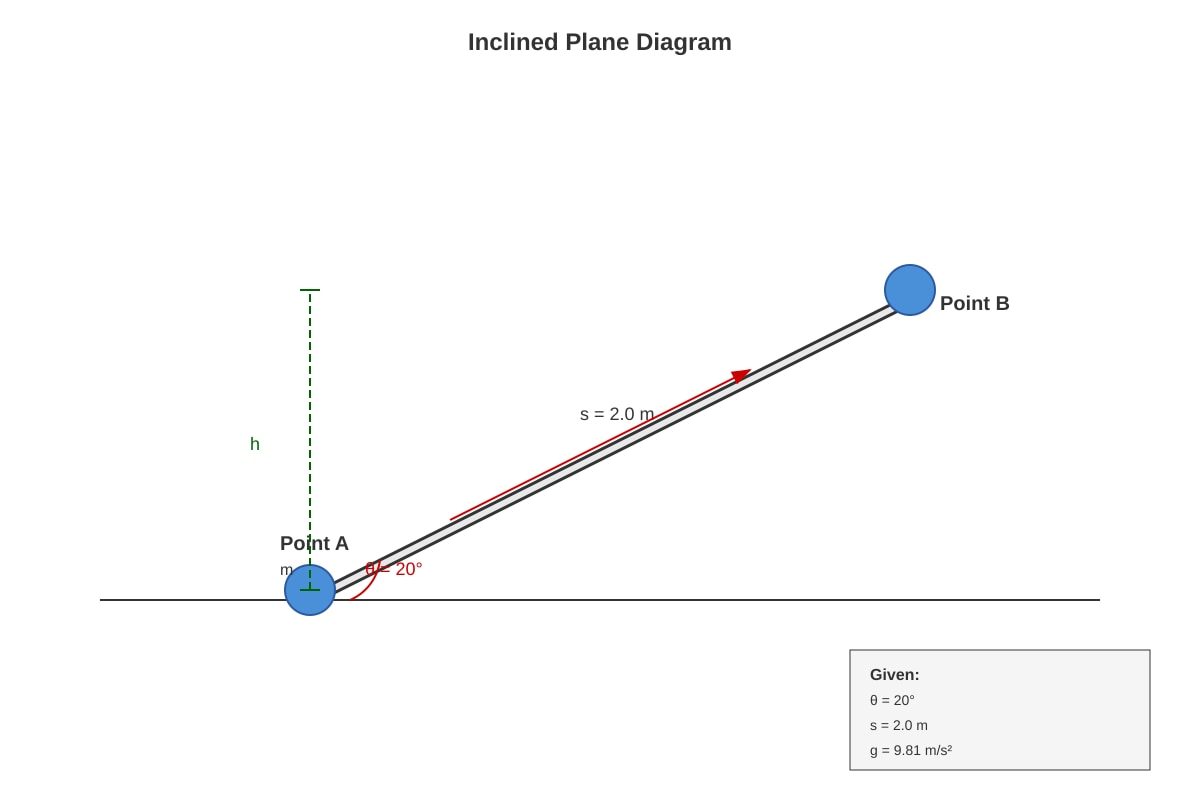
14. A student investigates the motion of a ball rolling down an inclined plane. The ball is released from rest at the top of the incline and travels a distance of along the plane. The angle of inclination is .
(a) Show that the acceleration of the ball along the incline is approximately . [2]
Answer:
The component of weight along the incline:
Using Newton's second law along the incline:
Marking:
- 1 mark for identifying the component of weight along the incline ().
- 1 mark for correct calculation yielding approximately .
(b) Calculate the speed of the ball at the bottom of the incline. [2]
Answer:
Using :
Marking:
- 1 mark for correct substitution.
- 1 mark for correct answer with unit.
(c) The student repeats the experiment with a ball of twice the mass. State and explain whether the speed at the bottom of the incline will be different. [3]
Answer:
The speed at the bottom will be the same. From part (a), the acceleration is independent of mass. Since the acceleration and distance are unchanged, the final speed (given by ) is also unchanged. Alternatively, using energy conservation: , so , which is independent of mass.
Marking:
- 1 mark for stating the speed will be the same.
- 1 mark for explaining that acceleration is independent of mass.
- 1 mark for linking this to the final speed being unchanged (or using energy argument).
(d) The student now increases the angle of inclination to . Without calculation, state and explain how the time taken to reach the bottom will change. [2]
Answer:
The time taken will decrease. A larger angle means a larger component of weight along the incline ( increases), resulting in a greater acceleration. With a greater acceleration over the same distance, the time taken to reach the bottom is reduced.
Marking:
- 1 mark for stating the time decreases.
- 1 mark for correct explanation (larger acceleration due to larger angle).
15. A object is dropped from a height of above the ground. It falls freely under gravity and hits the ground. Upon hitting the ground, it rebounds vertically upward with a speed of .
(a) Calculate the speed of the object just before it hits the ground. [3]
Answer:
Using :
(downward)
Marking:
- 1 mark for correct formula.
- 1 mark for correct substitution.
- 1 mark for correct answer with unit.
(b) Calculate the change in momentum of the object during the collision with the ground. [3]
Answer:
Taking upward as positive:
Initial momentum (just before impact):
Final momentum (just after impact):
Change in momentum:
Marking:
- 1 mark for correct sign convention.
- 1 mark for correct initial and final momentum values.
- 1 mark for correct change in momentum with unit.
- Common mistake: Forgetting the vector nature of momentum and simply subtracting speeds.
(c) The collision with the ground lasts . Calculate the average force exerted by the ground on the object during the collision. [3]
Answer:
Using :
(upward)
Marking:
- 1 mark for correct formula.
- 1 mark for correct substitution.
- 1 mark for correct answer with unit and direction.
- Allow follow-through from part (b).
(d) Explain why the average force calculated in (c) is much greater than the weight of the object. [2]
Answer:
The weight of the object is . The average force during the collision is much larger because the change in momentum occurs over a very short time interval (). Since , a small results in a large force. The ground must not only support the weight but also provide the impulse needed to reverse the object's momentum.
Marking:
- 1 mark for identifying the short time interval as the reason.
- 1 mark for explaining the inverse relationship between force and time for a given momentum change.
(e) Calculate the maximum height reached by the object after the bounce. [2]
Answer:
Using with at maximum height:
Marking:
- 1 mark for correct substitution.
- 1 mark for correct answer with unit.
16. Two particles A and B are moving along the same straight line. Particle A has mass and moves at to the right. Particle B has mass and moves at to the left. The particles collide head-on. After the collision, particle A moves at to the left.
(a) Taking the direction to the right as positive, calculate the total momentum of the system before the collision. [2]
Answer:
Marking:
- 1 mark for correct sign convention (right = positive, left = negative).
- 1 mark for correct total momentum.
(b) Calculate the velocity of particle B after the collision. [3]
Answer:
Using conservation of momentum:
(to the right, since positive)
Marking:
- 1 mark for correct conservation of momentum equation.
- 1 mark for correct substitution.
- 1 mark for correct answer with direction.
(c) Determine whether the collision is elastic or inelastic. Show your working. [4]
Answer:
Initial kinetic energy:
Final kinetic energy:
Since (), the collision is inelastic. Kinetic energy has not been conserved.
Marking:
- 1 mark for correct initial KE calculation.
- 1 mark for correct final KE calculation.
- 1 mark for comparing the two values.
- 1 mark for correct conclusion (inelastic).
- Note: The large loss of KE suggests this may be a partially inelastic collision where significant energy is converted to other forms.
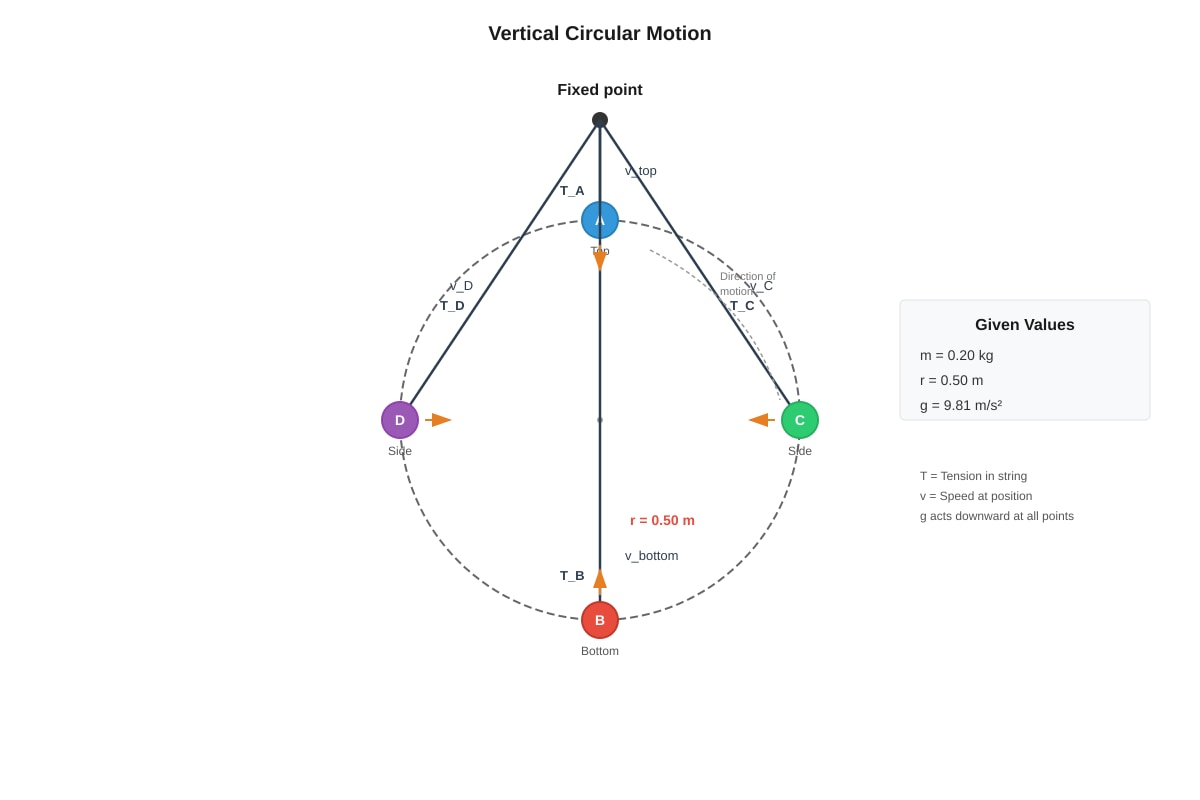
17. A small object of mass is attached to one end of a light inextensible string. The other end of the string is fixed. The object is given a horizontal speed such that it moves in a vertical circle of radius .
(a) Calculate the minimum speed the object must have at the bottom of the circle to just complete the vertical circle. [4]
Answer:
To just complete the vertical circle, the minimum speed at the top is given by:
Using conservation of energy between bottom and top:
Marking:
- 1 mark for correct minimum speed at top ().
- 1 mark for correct energy conservation equation.
- 1 mark for correct substitution.
- 1 mark for correct answer with unit.
(b) If the object has this minimum speed at the bottom, calculate the tension in the string when the object is at the top of the circle. [3]
Answer:
At the top of the circle, both tension and weight act downward (toward the centre):
The tension is zero at the top for the minimum speed condition — this is the critical condition where the string just goes slack.
Marking:
- 1 mark for correct force equation at the top.
- 1 mark for correct substitution.
- 1 mark for correct answer (T = 0 N) with explanation.
(c) Explain what would happen if the object's speed at the bottom were less than the minimum speed calculated in (a). [2]
Answer:
If the speed at the bottom is less than the minimum, the object will not have enough kinetic energy to reach the top of the circle with the required minimum speed. The string will go slack before the object reaches the top, and the object will follow a parabolic projectile path rather than completing the full circular motion. The object will leave the circular path at some point and fall under gravity.
Marking:
- 1 mark for stating the object will not complete the circle.
- 1 mark for explaining that the string goes slack / the object follows a projectile path.
18. A ball is thrown horizontally from the top of a cliff high with an initial horizontal speed of . Air resistance is negligible.
(a) Calculate the time taken for the ball to reach the ground. [3]
Answer:
Vertical motion (initial vertical velocity = 0):
Marking:
- 1 mark for identifying initial vertical velocity is zero.
- 1 mark for correct substitution.
- 1 mark for correct answer with unit.
(b) Calculate the horizontal distance from the base of the cliff where the ball lands. [2]
Answer:
Horizontal motion (constant velocity):
Marking:
- 1 mark for correct formula.
- 1 mark for correct answer with unit.
- Allow follow-through from part (a).
(c) Calculate the speed of the ball just before it hits the ground. [3]
Answer:
Vertical component of velocity just before impact:
Speed:
Marking:
- 1 mark for correct vertical velocity calculation.
- 1 mark for correct use of Pythagorean theorem.
- 1 mark for correct answer with unit.
(d) State the direction of the velocity of the ball just before impact, giving the angle below the horizontal. [2]
Answer:
The velocity is directed at an angle of approximately below the horizontal.
Marking:
- 1 mark for correct use of trigonometry.
- 1 mark for correct angle with unit (degrees) and direction (below horizontal).
19. A spring of spring constant is compressed by and used to launch a block of mass horizontally along a frictionless surface.
(a) Calculate the elastic potential energy stored in the compressed spring. [2]
Answer:
Marking:
- 1 mark for correct formula.
- 1 mark for correct answer with unit.
(b) Calculate the maximum speed of the block after it leaves the spring. [3]
Answer:
By conservation of energy, the elastic potential energy is converted entirely to kinetic energy (surface is frictionless):
Marking:
- 1 mark for correct energy conservation equation.
- 1 mark for correct substitution.
- 1 mark for correct answer with unit.
(c) The block then encounters a rough horizontal surface with a coefficient of kinetic friction of . Calculate the distance the block travels on the rough surface before coming to rest. [4]
Answer:
Frictional force:
Work done by friction = initial kinetic energy:
Alternatively, using work-energy theorem:
Marking:
- 1 mark for correct frictional force calculation.
- 1 mark for correct work-energy equation.
- 1 mark for correct substitution.
- 1 mark for correct answer with unit.
- Allow follow-through from part (b).
20. A car of mass is travelling at when the driver applies the brakes. The car decelerates uniformly and comes to rest in .
(a) Calculate the deceleration of the car. [2]
Answer:
The deceleration is .
Marking:
- 1 mark for correct formula.
- 1 mark for correct answer with unit.
(b) Calculate the braking force acting on the car. [2]
Answer:
(opposite to direction of motion)
Marking:
- 1 mark for correct formula.
- 1 mark for correct answer with unit.
(c) Calculate the distance travelled by the car during braking. [2]
Answer:
Using :
Alternatively, using :
Marking:
- 1 mark for correct formula.
- 1 mark for correct answer with unit.
(d) The kinetic energy of the car is dissipated as thermal energy in the brakes. Calculate the total thermal energy produced. [2]
Answer:
Marking:
- 1 mark for correct formula.
- 1 mark for correct answer with unit.
(e) Explain, in terms of the work-energy principle, why the braking distance would be four times greater if the car were travelling at under the same braking force. [3]
Answer:
The work done by the braking force equals the change in kinetic energy: . Since the braking force is constant, the braking distance is proportional to the kinetic energy, which is proportional to . If the speed doubles from to , the kinetic energy increases by a factor of . Therefore, the braking distance also increases by a factor of 4.
Marking:
- 1 mark for stating the work-energy principle ().
- 1 mark for explaining that KE is proportional to .
- 1 mark for concluding that doubling speed quadruples the braking distance.
End of Answer Key
Mark Summary:
| Section | Marks |
|---|---|
| A: Questions 1–8 | 20 |
| B: Questions 9–13 | 40 |
| C: Questions 14–20 | 20 |
| Total | 80 |