AI Generated Exam Paper

A Level H2 Physics Practice Paper 2

Free AI-Generated Owl Alpha A Level H2 Physics Practice Paper 2 practice paper with questions and answers for Singapore students. This page is rendered as a direct URL so the questions and answers can be discovered without pressing in-page buttons.

These static practice materials are generated from the site's syllabus and paper-generation workflow, with source and model context shown so students and parents can evaluate the material before use.

A Level H2 Physics AI Generated Generated by Owl Alpha Updated 2026-06-07

Questions

<!-- TuitionGoWhere generation metadata: stage=5-2; model=openrouter/owl-alpha; model_label=Owl Alpha; generated=2026-06-06; Sources: Stage 4-0 LLM templates, syllabus context, and Stage 2 evidence where available. -->

TuitionGoWhere Practice Paper - Physics H2 A-Level

TuitionGoWhere Practice Paper (AI)

Subject: Physics H2 (9478) Level: A-Level Paper: Practice Paper — Mechanics Version: 2 of 5 Duration: 1 hour 30 minutes Total Marks: 60

Name: ___________________________ Class: ___________________________ Date: ___________________________


Instructions

  • Answer all questions.
  • The number of marks for each question or part-question is shown in brackets [ ].
  • The total number of marks for this paper is 60.
  • You are advised to spend no more than 1 hour 30 minutes on this paper.
  • Essential working must be shown for full credit in calculation questions.
  • Non-programmable scientific calculators may be used.
  • Take g=9.81 m s2g = 9.81 \text{ m s}^{-2} unless otherwise stated.

Section A: Short-Answer and Structured Questions [20 marks]

Answer all questions 1–10 in the spaces provided.


1. State the principle of conservation of linear momentum. [2]

.............................................................................................................................

.............................................................................................................................

.............................................................................................................................


2. A car accelerates uniformly from rest to 24 m s124 \text{ m s}^{-1} in 8.0 s8.0 \text{ s}. Calculate

    (a) the acceleration of the car, [2]


    (b) the distance travelled during this time. [2]


3. Define impulse and state its SI unit. [2]

.............................................................................................................................

.............................................................................................................................


4. A ball of mass 0.25 kg0.25 \text{ kg} is thrown vertically upwards with an initial speed of 15 m s115 \text{ m s}^{-1}. Calculate the maximum height reached by the ball. Air resistance is negligible. [3]

.............................................................................................................................

.............................................................................................................................

.............................................................................................................................


5. State Newton's second law of motion in terms of momentum. [2]

.............................................................................................................................

.............................................................................................................................


6. A force of 12 N12 \text{ N} acts on an object of mass 4.0 kg4.0 \text{ kg} initially at rest for 3.0 s3.0 \text{ s}. Calculate

    (a) the acceleration of the object, [1]


    (b) the final velocity of the object, [1]


    (c) the impulse delivered to the object. [1]


7. Distinguish between elastic and inelastic collisions. In which type of collision is kinetic energy conserved? [2]

.............................................................................................................................

.............................................................................................................................


8. A stone is dropped from the top of a building. It takes 3.5 s3.5 \text{ s} to reach the ground. Calculate

    (a) the height of the building, [2]


    (b) the speed of the stone just before it hits the ground. [1]


9. State the conditions under which the work done by a force on an object is zero. Give one example. [2]

.............................................................................................................................

.............................................................................................................................


10. A 60 kg60 \text{ kg} student climbs a flight of stairs of vertical height 4.5 m4.5 \text{ m} in 6.0 s6.0 \text{ s}. Calculate

    (a) the gain in gravitational potential energy, [2]


    (b) the average power developed by the student. [2]


Section B: Structured and Multi-Step Problems [25 marks]

Answer all questions 11–15 in the spaces provided.


11. A ball of mass 0.40 \{ kg} moving horizontally at 6.0 m s16.0 \text{ m s}^{-1} strikes a stationary ball of mass 0.60 kg0.60 \text{ kg} on a smooth horizontal surface. After the collision, the 0.40 kg0.40 \text{ kg} ball moves in the opposite direction at 1.2 s11.2 \text{ s}^{-1}.

    (a) Using the principle of conservation of linear momentum, calculate the velocity of the 0.60 kg0.60 \text{ kg} ball after the collision. State its direction. [4]


    (b) Determine whether this collision is elastic or inelastic. Show your reasoning by comparing kinetic energies before and after the collision. [3]


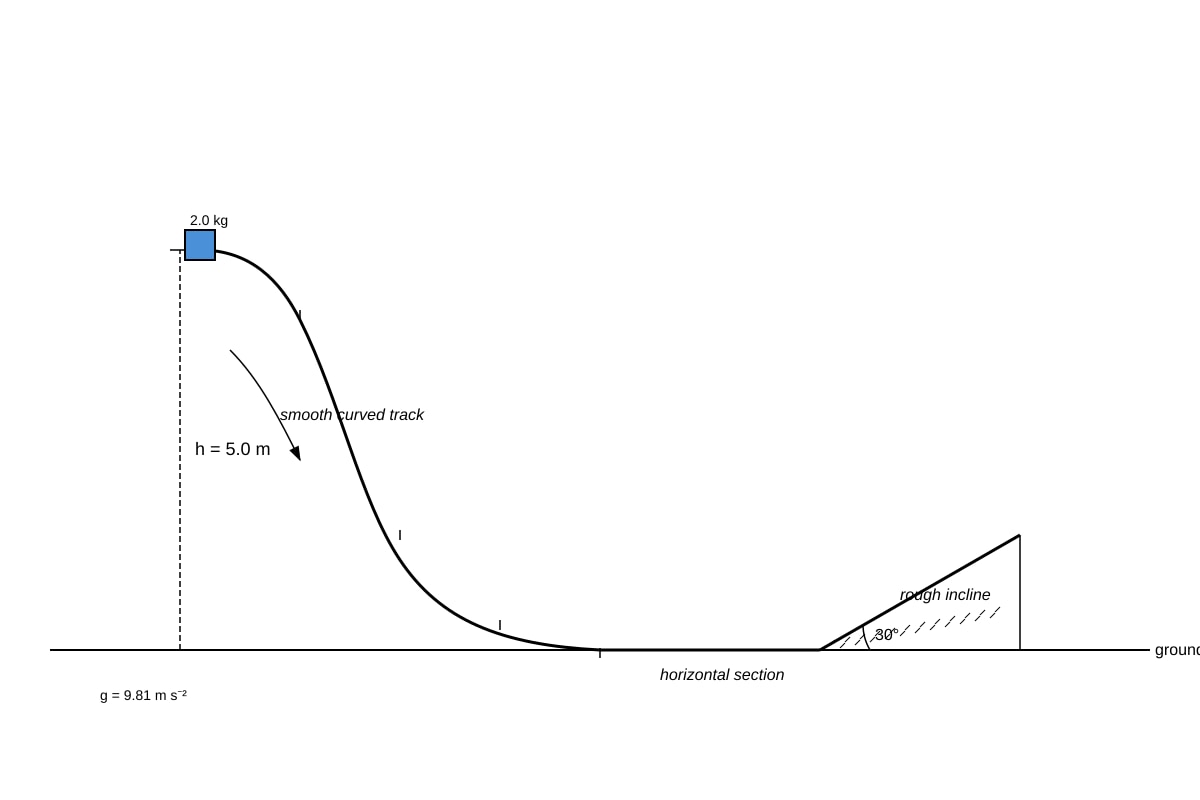
12. A small block of mass 2.0 kg2.0 \text{ kg} is released from rest at the top of a smooth curved track of height 5.0 m5.0 \text{ m} as shown. At the bottom, the block moves horizontally and then ascends a rough incline plane at 3030^{\circ} to the horizontal.

<image_placeholder> id: Q12-fig1 type: diagram linked_question: Q12 description: A smooth curved track starting at height 5.0 m above the horizontal ground level, leading to a horizontal section, then a rough inclined plane at 30° to the horizontal. The block is shown at the top of the track. labels: height h = 5.0 m, horizontal section, rough incline at 30°, block of mass 2.0 kg at top values: h = 5.0 m, m = 2.0 kg, θ = 30°, g = 9.81 m s⁻² must_show: The height label 5.0 m, the 30° angle on the incline, the block at the top, labels for smooth and rough sections clearly marked </image_placeholder>

    (a) Calculate the speed of the block at the bottom of the track. [3]


    (b) The block travels 2.5 m2.5 \text{ m} up the rough incline before coming to rest. Using the principle of conservation of energy, calculate the average frictional force acting on the block along the incline. [4]


13. A car of mass 1.2×10³ kg1.2 \times 10^3 \text{ kg} travels along a straight horizontal road. The engine exerts a driving force of 3.6×10³ N3.6 \times 10^3 \text{ N} and the total resistive force is 1.2×10³ N1.2 \times 10^3 \text{ N}.

    (a) Calculate the acceleration of the car. [2]


    (b) The car starts from rest. Calculate the distance travelled in the first 10.0 s10.0 \text{ s}. [2]


    (c) The car then enters a circular bend of radius 80 m80 \text{ m} at a constant speed of 20 m s120 \text{ m s}^{-1}. Calculate the centripetal force required to keep the car moving in the circle. [2]


    (d) State what provides this centripetal force in the case of the car going around a flat bend. [1]


14. A projectile is launched from ground level with an initial speed of 30 m s130 \text{ m s}^{-1} at an angle of 4040^{\circ} above the horizontal. Air resistance is negligible.

    (a) Calculate the horizontal and vertical components of the initial velocity. [2]


    (b) Calculate the maximum height reached by the projectile. [3]


    (c) Calculate the horizontal range of the projectile. [3]


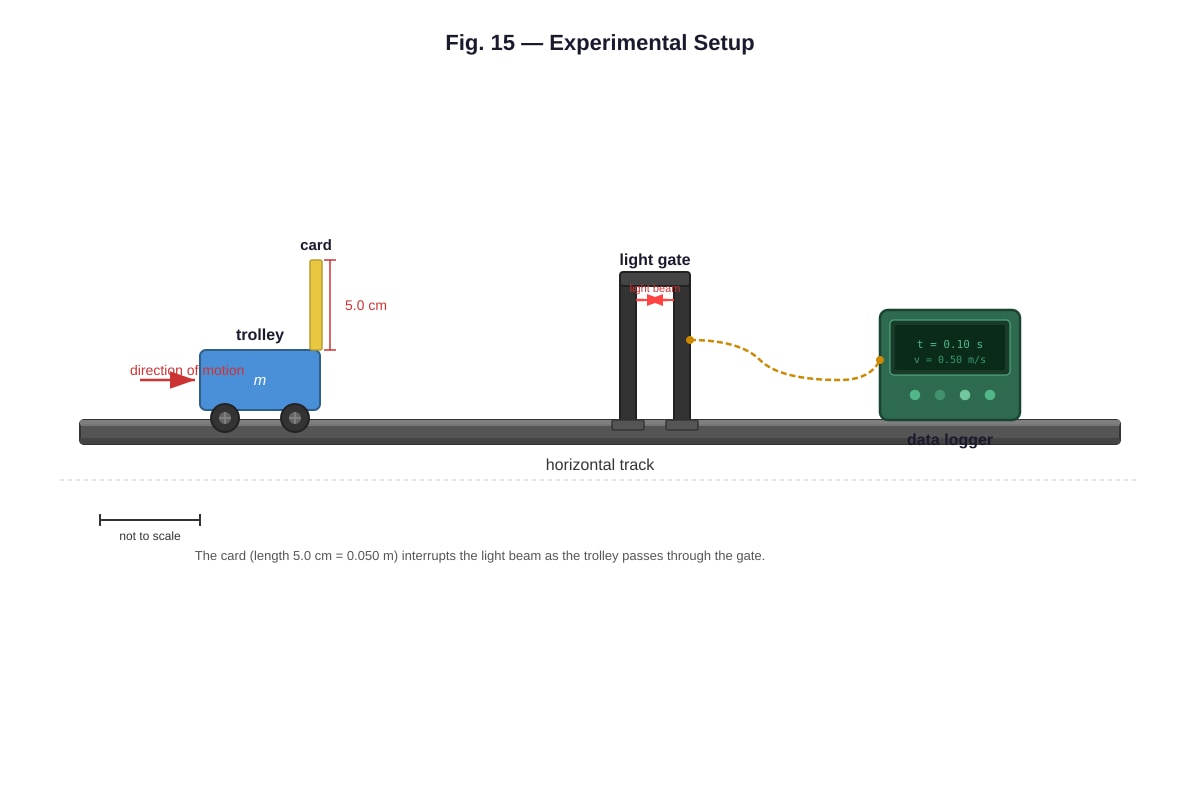
15. A student sets up an experiment to investigate the motion of a trolley along a horizontal track using a light gate. The trolley has a card of length 5.0 cm5.0 \text{ cm} attached to it.

<image_placeholder> id: Q15-fig1 type: experimental_setup linked_question: Q15 description: A horizontal track with a trolley of mass m carrying a card of length 5.0 cm. A light gate is positioned on the track so the card passes through it. A data logger is connected to the light gate. A diagram showing the trolley approaching the light gate, the card interrupting the light beam. labels: trolley, card (length 5.0 cm), light gate, data logger, horizontal track values: card length = 5.0 cm = 0.050 m must_show: The trolley on the track, the card on the trolley, the light gate positioned across the track, the data logger connected, the direction of motion indicated </image_placeholder>

The light gate records that the card takes 0.10 s0.10 \text{ s} to pass through the gate.

    (a) Explain why the time taken for the card to pass through the light gate can be used to determine the speed of the trolley. [2]


    (b) Calculate the speed of the trolley as it passes through the light gate. [2]


    (c) The trolley is now released from rest at the top of a smooth inclined plane of vertical height 0.80 m0.80 \text{ m}. Using conservation of energy, calculate the theoretical speed of the trolley at the bottom of the incline. [3]


    (d) The student finds that the measured speed is less than the theoretical speed. Suggest one reason for this discrepancy. [1]


Section C: Extended Response and Data Analysis [15 marks]

Answer all questions 16–17 in the spaces provided.


16. A spacecraft of mass 2.5×10⁴ kg2.5 \times 10^4 \text{ kg} is travelling in deep space at a constant velocity of 4.0×10³ m s14.0 \times 10^3 \text{ m s}^{-1}. It then fires its engine, exerting a constant thrust of 5.0×10⁴ N5.0 \times 10^4 \text{ N} in the direction of motion for 120 s120 \text{ s}.

    (a) Calculate the acceleration of the spacecraft while the engine is firing. [2]


    (b) Calculate the final velocity of the spacecraft after the engine has fired for 120 s120 \text{ s}. [2]


    (c) Calculate the change in kinetic energy of the spacecraft during this time. [3]


    (d) Calculate the work done by the engine thrust during this time. Show that it is not equal to the change in kinetic energy calculated in (c). Explain why. [4]


    (e) State the work-energy theorem and explain how it applies to this situation. [2]


17. A student investigates the relationship between the force applied to a trolley and its acceleration. The student uses a set of slotted masses hanging from a string over a pulley to pull the trolley along a horizontal track.

<image_placeholder> id: Q17-fig1 type: experimental_setup linked_question: Q17 description: A horizontal track with a trolley connected by a light string over a frictionless pulley at the end of the track to a hanging mass (slotted masses). The total mass of the system (trolley + slotted masses) remains constant by transferring masses from the trolley to the hanger. A light gate or motion sensor is used to measure acceleration. labels: trolley on horizontal track, light string, frictionless pulley, slotted masses hanging vertically, total system mass = M (constant), hanging mass = m, trolley mass = M - m values: Total mass of system = 1.0 kg (example), hanging masses varied from 0.010 kg to 0.080 kg must_show: The trolley on the track, the string over the pulley, the hanging masses, the direction of acceleration, labels for trolley mass and hanging mass </image_placeholder>

The student keeps the total mass of the system constant by transferring masses from the trolley to the hanging mass. The following data is obtained:

Hanging mass mm / kgApplied force F=mgF = mg / NAcceleration aa / m s2\text{m s}^{-2}
0.0100.0980.10
0.0200.1960.20
0.0300.2940.29
0.0400.3920.39
0.0500.4910.49
0.0600.5890.58

    (a) State Newton's second law as it applies to the entire system (trolley + hanging mass). [1]


    (b) Using the data, determine the total mass of the system. Show your working. [3]


    (c) The student notices that the measured acceleration is always slightly less than the theoretical value. Suggest one practical reason for this. [1]


    (d) Sketch a graph of acceleration aa (y-axis) against applied force FF (x-axis). Indicate the expected shape and any key features. [2]


    (e) Explain how this experiment demonstrates the proportionality between net force and acceleration when mass is constant. [2]


End of Paper

Total Marks: 60

Answers

<!-- TuitionGoWhere generation metadata: stage=5-2; model=openrouter/owl-alpha; model_label=Owl Alpha; generated=2026-06-06; Sources: Stage 4-0 LLM templates, syllabus context, and Stage 2 evidence where available. -->

TuitionGoWhere Practice Paper — Physics H2 A-Level

Answer Key and Marking Scheme — Mechanics (Version 2 of 5)


Section A: Short-Answer and Structured Questions [20 marks]


1. State the principle of conservation of linear momentum. [2]

Answer: The total momentum of a system remains constant (or is conserved) provided that no net external force acts on the system.

Marking scheme:

  • [1] for stating that total momentum remains constant / is conserved
  • [1] for stating the condition: no external force / closed/isolated system

Teaching notes: This is a fundamental law in physics. A "closed system" means no mass enters or leaves, and no external forces act. The key phrase examiners look for is the condition — without it, the statement is incomplete. Common error: saying "momentum is conserved" without mentioning the condition of no external force.


2. A car accelerates uniformly from rest to 24 m s124 \text{ m s}^{-1} in 8.0 s8.0 \text{ s}. Calculate

    (a) the acceleration of the car, [2]

Answer: Using a=vuta = \frac{v - u}{t}:

a=2408.0=3.0 m s2a = \frac{24 - 0}{8.0} = 3.0 \text{ m s}^{-2}

Marking scheme:

  • [1] for correct formula or method
  • [1] for correct answer with unit

    (b) the distance travelled during this time. [2]

Answer: Using s=(u+v)2×ts = \frac{(u + v)}{2} \times t:

s=(0+24)2×8.0=96 ms = \frac{(0 + 24)}{2} \times 8.0 = 96 \text{ m}

Alternatively, s=ut+12at2=0+12(3.0)(8.0)2=96 ms = ut + \frac{1}{2}at^2 = 0 + \frac{1}{2}(3.0)(8.0)^2 = 96 \text{ m}

Marking scheme:

  • [1] for correct formula or substitution
  • [1] for correct answer with unit

3. Define impulse and state its SI unit. [2]

Answer: Impulse is defined as the product of the force and the time for which it acts (or equivalently, the change in momentum of an object).

Impulse=FΔt=Δp\text{Impulse} = F \Delta t = \Delta p

SI unit: N s\text{N s} (newton-second) or kg m s1\text{kg m s}^{-1}.

Marking scheme:

  • [1] for correct definition (force × time or change in momentum)
  • [1] for correct SI unit (N s or kg m s⁻¹)

Teaching notes: Impulse and momentum share the same unit. Students should understand that impulse equals the area under a force-time graph.


4. A ball of mass 0.25 kg0.25 \text{ kg} is thrown vertically upwards with an initial speed of 15 m s115 \text{ m s}^{-1}. Calculate the maximum height reached by the ball. Air resistance is negligible. [3]

Answer: Using conservation of energy (or kinematics):

At maximum height, final velocity v=0v = 0.

Using v2=u22ghv^2 = u^2 - 2gh:

0=(15)22(9.81)h0 = (15)^2 - 2(9.81)h

h=22519.62=11.5 mh = \frac{225}{19.62} = 11.5 \text{ m}

Or using energy conservation: 12mv2=mgh    h=u22g=22519.62=11.5 m\frac{1}{2}mv^2 = mgh \implies h = \frac{u^2}{2g} = \frac{225}{19.62} = 11.5 \text{ m}

Marking scheme:

  • [1] for selecting appropriate equation or principle
  • [1] for correct substitution
  • [1] for correct answer (11.5 m or 11 m to 2 s.f.)

Teaching notes: The mass is not needed — it cancels out. This is a common trick in exam questions. Students should recognise that all objects under gravity alone have the same kinematics regardless of mass.


5. State Newton's second law of motion in terms of momentum. [2]

Answer: The net force acting on an object is equal to the rate of change of its momentum.

F=ΔpΔt=mvmuΔtF = \frac{\Delta p}{\Delta t} = \frac{mv - mu}{\Delta t}

Or equivalently: F=dpdtF = \frac{dp}{dt}

Marking scheme:

  • [1] for stating force equals rate of change of momentum
  • [1] for correct mathematical expression

Teaching notes: This is the more general form of Newton's second law. F=maF = ma is a special case when mass is constant. The momentum form is more fundamental and applies even when mass changes (e.g., rocket propulsion).


6. A force of 12 N12 \text{ N} acts on an object of mass 4.0 kg4.0 \text{ kg} initially at rest for 3.0 s3.0 \text{ s}. Calculate

    (a) the acceleration of the object, [1]

Answer: a=Fm=124.0=3.0 m s2a = \frac{F}{m} = \frac{12}{4.0} = 3.0 \text{ m s}^{-2}

    (b) the final velocity of the object, [1]

Answer: v=u+at=0+(3.0)(3.0)=9.0 m s1v = u + at = 0 + (3.0)(3.0) = 9.0 \text{ m s}^{-1}

    (c) the impulse delivered to the object. [1]

Answer: Impulse=F×t=12×3.0=36 N s\text{Impulse} = F \times t = 12 \times 3.0 = 36 \text{ N s}

(Check: impulse = change in momentum = m(vu)=4.0×9.0=36 N sm(v-u) = 4.0 \times 9.0 = 36 \text{ N s} ✓)

Marking scheme: [1] each for correct answer with appropriate unit.


7. Distinguish between elastic and inelastic collisions. In which type of collision is kinetic energy conserved? [2]

Answer:

  • In an elastic collision, both momentum and kinetic energy are conserved.
  • In an inelastic collision, momentum is conserved but kinetic energy is not conserved (some is converted to other forms such as heat, sound, or deformation energy).
  • Kinetic energy is conserved in elastic collisions.

Marking scheme:

  • [1] for correctly describing elastic collision (both momentum and KE conserved)
  • [1] for correctly describing inelastic collision (momentum conserved, KE not conserved)

Teaching notes: In all collisions (assuming no external forces), momentum is conserved. The distinction lies in kinetic energy. In a perfectly inelastic collision, the objects stick together and the maximum kinetic energy is lost.


8. A stone is dropped from the top of a building. It takes 3.5 s3.5 \text{ s} to reach the ground. Calculate

    (a) the height of the building, [2]

Answer: Using s=ut+12gt2s = ut + \frac{1}{2}gt^2 (taking downward as positive):

s=0+12(9.81)(3.5)2=12(9.81)(12.25)=60.1 ms = 0 + \frac{1}{2}(9.81)(3.5)^2 = \frac{1}{2}(9.81)(12.25) = 60.1 \text{ m}

Marking scheme:

  • [1] for correct substitution
  • [1] for correct answer (60 m to 2 s.f. or 60.1 m)

    (b) the speed of the stone just before it hits the ground. [1]

Answer: v=u+gt=0+(9.81)(3.5)=34.3 m s134 m s1v = u + gt = 0 + (9.81)(3.5) = 34.3 \text{ m s}^{-1} \approx 34 \text{ m s}^{-1}

Marking scheme: [1] for correct answer.


9. State the conditions under which the work done by a force on an object is zero. Give one example. [2]

Answer: Work done is zero when:

  • The displacement is zero (force acts but object does not move), OR
  • The force is perpendicular to the direction of displacement.

Example: When an object moves in a horizontal circle at constant speed, the centripetal force (directed towards the centre) is perpendicular to the displacement (tangential), so the centripetal force does zero work.

Marking scheme:

  • [1] for stating one correct condition (zero displacement or force perpendicular to displacement)
  • [1] for a valid example

Teaching notes: Work done W=FscosθW = Fs\cos\theta. Work is zero when θ=90°\theta = 90° (force perpendicular to displacement) or when s=0s = 0.


10. A 60 kg60 \text{ kg} student climbs a flight of stairs of vertical height 4.5 m4.5 \text{ m} in 6.0 s6.0 \text{ s}. Calculate

    (a) the gain in gravitational potential energy, [2]

Answer: ΔEp=mgh=60×9.81×4.5=2648.7 J2.65×103 J\Delta E_p = mgh = 60 \times 9.81 \times 4.5 = 2648.7 \text{ J} \approx 2.65 \times 10^3 \text{ J}

Marking scheme:

  • [1] for correct formula and substitution
  • [1] for correct answer (2650 J or 2.65×1032.65 \times 10^3 J)

    (b) the average power developed by the student. [2]

Answer: P=Wt=2648.76.0=441.5 W440 WP = \frac{W}{t} = \frac{2648.7}{6.0} = 441.5 \text{ W} \approx 440 \text{ W}

Marking scheme:

  • [1] for correct formula or substitution
  • [1] for correct answer (440 W or 442 W)

Section B: Structured and Multi-Step Problems [25 marks]


11. A ball of mass 0.40 kg0.40 \text{ kg} moving horizontally at 6.0 m s16.0 \text{ m s}^{-1} strikes a stationary ball of mass 0.60 kg0.60 \text{ kg} on a smooth horizontal surface. After the collision, the 0.40 kg0.40 \text{ kg} ball moves in the opposite direction at 1.2 m s11.2 \text{ m s}^{-1}.

    (a) Using the principle of conservation of linear momentum, calculate the velocity of the 0.60 kg0.60 \text{ kg} ball after the collision. State its direction. [4]

Answer: Taking the initial direction of the 0.40 kg0.40 \text{ kg} ball as positive.

Conservation of momentum: m1u1+m2u2=m1v1+m2v2m_1 u_1 + m_2 u_2 = m_1 v_1 + m_2 v_2

(0.40)(6.0)+(0.60)(0)=(0.40)(1.2)+(0.60)v2(0.40)(6.0) + (0.60)(0) = (0.40)(-1.2) + (0.60)v_2

2.4=0.48+0.60v22.4 = -0.48 + 0.60 v_2

0.60v2=2.880.60 v_2 = 2.88

v2=4.8 m s1v_2 = 4.8 \text{ m s}^{-1}

Direction: in the original direction of the 0.40 kg0.40 \text{ kg} ball (positive direction).

Marking scheme:

  • [1] for correct statement of conservation of momentum
  • [1] for correct substitution (including correct sign for v1=1.2v_1 = -1.2)
  • [1] for correct algebraic manipulation
  • [1] for correct answer with direction

Common trap: Forgetting that the 0.40 kg0.40 \text{ kg} ball reverses direction, so v1=1.2 m s1v_1 = -1.2 \text{ m s}^{-1} (not +1.2+1.2). This is the most common error.

    (b) Determine whether this collision is elastic or inelastic. Show your reasoning by comparing kinetic energies before and after the collision. [3]

Answer: Kinetic energy before collision: KEbefore=12(0.40)(6.0)2+0=12(0.40)(36)=7.2 JKE_{\text{before}} = \frac{1}{2}(0.40)(6.0)^2 + 0 = \frac{1}{2}(0.40)(36) = 7.2 \text{ J}

Kinetic energy after collision: KEafter=12(0.40)(1.2)2+12(0.60)(4.8)2=12(0.40)(1.44)+12(0.60)(23.04)KE_{\text{after}} = \frac{1}{2}(0.40)(1.2)^2 + \frac{1}{2}(0.60)(4.8)^2 = \frac{1}{2}(0.40)(1.44) + \frac{1}{2}(0.60)(23.04) =0.288+6.912=7.2 J= 0.288 + 6.912 = 7.2 \text{ J}

Since KEbefore=KEafter=7.2 JKE_{\text{before}} = KE_{\text{after}} = 7.2 \text{ J}, kinetic energy is conserved, so the collision is elastic.

Marking scheme:

  • [1] for correct calculation of KE before
  • [1] for correct calculation of KE after
  • [1] for correct conclusion (elastic, because KE is conserved)

12. A small block of mass 2.0 kg2.0 \text{ kg} is released from rest at the top of a smooth curved track of height 5.0 m5.0 \text{ m}. At the bottom, the block moves horizontally and then ascends a rough incline plane at 3030^{\circ} to the horizontal.

    (a) Calculate the speed of the block at the bottom of the track. [3]

Answer: Using conservation of energy (track is smooth, so no friction):

mgh=12mv2mgh = \frac{1}{2}mv^2

v=2gh=2×9.81×5.0=98.1=9.90 m s1v = \sqrt{2gh} = \sqrt{2 \times 9.81 \times 5.0} = \sqrt{98.1} = 9.90 \text{ m s}^{-1}

Marking scheme:

  • [1] for correct energy conservation equation
  • [1] for correct substitution
  • [1] for correct answer (9.90 m s⁻¹ or 9.9 m s⁻¹)

    (b) The block travels 2.5 m2.5 \text{ m} up the rough incline before coming to rest. Using the principle of conservation of energy, calculate the average frictional force acting on the block along the incline. [4]

Answer: Vertical height gained on incline: h=2.5sin30°=2.5×0.5=1.25 mh' = 2.5 \sin 30° = 2.5 \times 0.5 = 1.25 \text{ m}

Energy at bottom of track = KE = 12(2.0)(9.90)2=98.0 J\frac{1}{2}(2.0)(9.90)^2 = 98.0 \text{ J}

Energy at rest on incline = GPE + work done against friction: mgh+Ff×dmgh' + F_f \times d

where FfF_f is the frictional force and d=2.5 md = 2.5 \text{ m}.

Using conservation of energy: 98.0=mgh+Ff×d98.0 = mgh' + F_f \times d

98.0=(2.0)(9.81)(1.25)+Ff×2.598.0 = (2.0)(9.81)(1.25) + F_f \times 2.5

98.0=24.525+2.5Ff98.0 = 24.525 + 2.5 F_f

Ff=98.024.5252.5=73.4752.5=29.4 NF_f = \frac{98.0 - 24.525}{2.5} = \frac{73.475}{2.5} = 29.4 \text{ N}

Marking scheme:

  • [1] for calculating height gained on incline (h=dsinθh' = d\sin\theta)
  • [1] for correct energy conservation equation
  • [1] for correct substitution
  • [1] for correct answer (29 N or 29.4 N)

Teaching notes: The key insight is that the initial kinetic energy at the bottom is converted to both gravitational potential energy and work done against friction. Students must account for both energy sinks.


13. A car of mass 1.2×10³ kg1.2 \times 10^3 \text{ kg} travels along a straight horizontal road. The engine exerts a driving force of 3.6×10³ N3.6 \times 10^3 \text{ N} and the total resistive force is 1.2×10³ N1.2 \times 10^3 \text{ N}.

    (a) Calculate the acceleration of the car. [2]

Answer: Fnet=3.6×1031.2×103=2.4×10³ NF_{\text{net}} = 3.6 \times 10^3 - 1.2 \times 10^3 = 2.4 \times 10^3 \text{ N}

a=Fnetm=2.4×1031.2×103=2.0 m s2a = \frac{F_{\text{net}}}{m} = \frac{2.4 \times 10^3}{1.2 \times 10^3} = 2.0 \text{ m s}^{-2}

Marking scheme:

  • [1] for correct net force
  • [1] for correct acceleration

    (b) The car starts from rest. Calculate the distance travelled in the first 10.0 s10.0 \text{ s}. [2]

Answer: s=ut+12at2=0+12(2.0)(10.0)2=100 ms = ut + \frac{1}{2}at^2 = 0 + \frac{1}{2}(2.0)(10.0)^2 = 100 \text{ m}

Marking scheme:

  • [1] for correct substitution
  • [1] for correct answer

    (c) The car then enters a circular bend of radius 80 m80 \text{ m} at a constant speed of 20 m s120 \text{ m s}^{-1}. Calculate the centripetal force required to keep the car moving in the circle. [2]

Answer: Fc=mv2r=(1.2×10³)(20)280=1.2×103×40080=4.8×10580=6.0×10³ NF_c = \frac{mv^2}{r} = \frac{(1.2 \times 10^3)(20)^2}{80} = \frac{1.2 \times 10^3 \times 400}{80} = \frac{4.8 \times 10^5}{80} = 6.0 \times 10^3 \text{ N}

Marking scheme:

  • [1] for correct formula and substitution
  • [1] for correct answer (6.0×1036.0 \times 10^3 N or 6000 N)

    (d) State what provides this centripetal force in the case of the car going around a flat bend. [1]

Answer: Friction between the tyres and the road surface.

Marking scheme: [1] for friction / static friction between tyres and road.


14. A projectile is launched from ground level with an initial speed of 30 m s130 \text{ m s}^{-1} at an angle of 4040^{\circ} above the horizontal. Air resistance is negligible.

    (a) Calculate the horizontal and vertical components of the initial velocity. [2]

Answer: ux=30cos40°=30×0.7660=23.0 m s1u_x = 30 \cos 40° = 30 \times 0.7660 = 23.0 \text{ m s}^{-1}

uy=30sin40°=30×0.6428=19.3 m s1u_y = 30 \sin 40° = 30 \times 0.6428 = 19.3 \text{ m s}^{-1}

Marking scheme:

  • [1] for correct horizontal component (23.0 m s⁻¹)
  • [1] for correct vertical component (19.3 m s⁻¹)

    (b) Calculate the maximum height reached by the projectile. [3]

Answer: At maximum height, vy=0v_y = 0:

vy2=uy22ghmaxv_y^2 = u_y^2 - 2gh_{\max}

0=(19.3)22(9.81)hmax0 = (19.3)^2 - 2(9.81)h_{\max}

hmax=(19.3)22×9.81=372.4919.62=19.0 mh_{\max} = \frac{(19.3)^2}{2 \times 9.81} = \frac{372.49}{19.62} = 19.0 \text{ m}

Marking scheme:

  • [1] for correct kinematic equation
  • [1] for correct substitution
  • [1] for correct answer (19.0 m or 19 m)

    (c) Calculate the horizontal range of the projectile. [3]

Answer: Time of flight: time to reach max height: tup=uyg=19.39.81=1.967 st_{\text{up}} = \frac{u_y}{g} = \frac{19.3}{9.81} = 1.967 \text{ s}

Total time of flight: T=2×1.967=3.935 sT = 2 \times 1.967 = 3.935 \text{ s}

Range: R=ux×T=23.0×3.935=90.5 mR = u_x \times T = 23.0 \times 3.935 = 90.5 \text{ m}

Alternatively, using the range formula: R=u2sin2θg=(30)2sin80°9.81=900×0.98489.81=886.39.81=90.4 mR = \frac{u^2 \sin 2\theta}{g} = \frac{(30)^2 \sin 80°}{9.81} = \frac{900 \times 0.9848}{9.81} = \frac{886.3}{9.81} = 90.4 \text{ m}

Marking scheme:

  • [1] for finding time of flight (or using range formula)
  • [1] for correct substitution
  • [1] for correct answer (90 m or 90.4–90.5 m)

15. A student sets up an experiment to investigate the motion of a trolley along a horizontal track using a light gate. The trolley has a card of length 5.0 cm5.0 \text{ cm} attached to it.

The light gate records that the card takes 0.10 s0.10 \text{ s} to pass through the gate.

    (a) Explain why the time taken for the card to pass through the light gate can be used to determine the speed of the trolley. [2]

Answer: The speed of the trolley can be found using v=dtv = \frac{d}{t}, where dd is the length of the card and tt is the time taken for the card to pass through the gate. Since the card is rigidly attached to the trolley, the speed of the card equals the speed of the trolley. The time interval is short enough that the speed can be approximated as the instantaneous speed (or the average speed over the short distance is a good approximation of the instantaneous speed).

Marking scheme:

  • [1] for stating v=card length/timev = \text{card length} / \text{time}
  • [1] for explaining that this gives the trolley's speed (card moves with trolley, or short time interval approximation)

    (b) Calculate the speed of the trolley as it passes through the light gate. [2]

Answer: v=dt=0.0500.10=0.50 m s1v = \frac{d}{t} = \frac{0.050}{0.10} = 0.50 \text{ m s}^{-1}

Marking scheme:

  • [1] for correct substitution (converting cm to m)
  • [1] for correct answer (0.50 m s⁻¹)

    (c) The trolley is now released from rest at the top of a smooth inclined plane of vertical height 0.80 m0.80 \text{ m}. Using conservation of energy, calculate the theoretical speed of the trolley at the bottom of the incline. [3]

Answer: mgh=12mv2mgh = \frac{1}{2}mv^2

v=2gh=2×9.81×0.80=15.696=3.96 m s1v = \sqrt{2gh} = \sqrt{2 \times 9.81 \times 0.80} = \sqrt{15.696} = 3.96 \text{ m s}^{-1}

Marking scheme:

  • [1] for correct energy conservation equation
  • [1] for correct substitution
  • [1] for correct answer (3.96 m s⁻¹ or 4.0 m s⁻¹)

    (d) The student finds that the measured speed is less than the theoretical speed. Suggest one reason for this discrepancy. [1]

Answer: Friction between the trolley and the track / air resistance acting on the trolley / the track is not perfectly smooth, so some energy is lost to thermal energy due to friction.

Marking scheme: [1] for any valid reason (friction, air resistance, energy loss).


Section C: Extended Response and Data Analysis [15 marks]


16. A spacecraft of mass 2.5×10⁴ kg2.5 \times 10^4 \text{ kg} is travelling in deep space at a constant velocity of 4.0×10³ m s14.0 \times 10^3 \text{ m s}^{-1}. It then fires its engine, exerting a constant thrust of 5.0×10⁴ N5.0 \times 10^4 \text{ N} in the direction of motion for 120 s120 \text{ s}.

    (a) Calculate the acceleration of the spacecraft while the engine is firing. [2]

Answer: a=Fm=5.0×1042.5×104=2.0 m s2a = \frac{F}{m} = \frac{5.0 \times 10^4}{2.5 \times 10^4} = 2.0 \text{ m s}^{-2}

Marking scheme:

  • [1] for correct formula/substitution
  • [1] for correct answer

    (b) Calculate the final velocity of the spacecraft after the engine has fired for 120 s120 \text{ s}. [2]

Answer: v=u+at=4.0×10³+(2.0)(120)=4000+240=4240 m s1v = u + at = 4.0 \times 10^3 + (2.0)(120) = 4000 + 240 = 4240 \text{ m s}^{-1}

Marking scheme:

  • [1] for correct substitution
  • [1] for correct answer (4240 m s⁻¹)

    (c) Calculate the change in kinetic energy of the spacecraft during this time. [3]

Answer: ΔKE=12mv212mu2=12m(v2u2)\Delta KE = \frac{1}{2}mv^2 - \frac{1}{2}mu^2 = \frac{1}{2}m(v^2 - u^2)

=12(2.5×10⁴)[(4240)2(4000)2]= \frac{1}{2}(2.5 \times 10^4)\left[(4240)^2 - (4000)^2\right]

=1.25×10⁴[1.7978×1071.6×107]= 1.25 \times 10^4 \left[1.7978 \times 10^7 - 1.6 \times 10^7\right]

=1.25×104×1.978×106= 1.25 \times 10^4 \times 1.978 \times 10^6

=2.472×10¹⁰ J2.47×1010 J= 2.472 \times 10^{10} \text{ J} \approx 2.47 \times 10^{10} \text{ J}

Marking scheme:

  • [1] for correct formula (12m(v2u2)\frac{1}{2}m(v^2 - u^2))
  • [1] for correct substitution
  • [1] for correct answer (2.47×10102.47 \times 10^{10} J)

    (d) Calculate the work done by the engine thrust during this time. Show that it is not equal to the change in kinetic energy calculated in (c). Explain why. [4]

Answer: Distance travelled during the 120 s: s=ut+12at2=(4000)(120)+12(2.0)(120)2s = ut + \frac{1}{2}at^2 = (4000)(120) + \frac{1}{2}(2.0)(120)^2 =480000+14400=494400 m= 480000 + 14400 = 494400 \text{ m}

Work done by thrust: W=F×s=(5.0×10⁴)(494400)=2.472×10¹⁰ JW = F \times s = (5.0 \times 10^4)(494400) = 2.472 \times 10^{10} \text{ J}

Wait — let me re-check. Actually, the work done by the net force equals the change in kinetic energy (work-energy theorem). Since the spacecraft is in deep space with no resistive forces, the thrust IS the net force, so the work done by the thrust should equal the change in KE.

Let me recalculate: Wthrust=F×s=5.0×104×494400=2.472×10¹⁰ JW_{\text{thrust}} = F \times s = 5.0 \times 10^4 \times 494400 = 2.472 \times 10^{10} \text{ J}

ΔKE=2.472×10¹⁰ J\Delta KE = 2.472 \times 10^{10} \text{ J}

They are equal, as expected from the work-energy theorem. The question asks students to verify this.

Revised answer: s=ut+12at2=(4000)(120)+12(2.0)(120)2=480000+14400=4.944×10⁵ ms = ut + \frac{1}{2}at^2 = (4000)(120) + \frac{1}{2}(2.0)(120)^2 = 480000 + 14400 = 4.944 \times 10^5 \text{ m}

W=Fs=(5.0×10⁴)(4.944×10⁵)=2.472×10¹⁰ JW = Fs = (5.0 \times 10^4)(4.944 \times 10^5) = 2.472 \times 10^{10} \text{ J}

This is equal to the change in kinetic energy calculated in (c). This is consistent with the work-energy theorem, which states that the work done by the net force on an object equals the change in its kinetic energy. Since the thrust is the only force acting (deep space, no resistance), the work done by the thrust equals the change in KE.

Marking scheme:

  • [1] for calculating displacement ss
  • [1] for calculating work done W=FsW = Fs
  • [1] for showing W=ΔKEW = \Delta KE (or noting they are equal)
  • [1] for explaining using the work-energy theorem

Teaching notes: This question tests understanding of the work-energy theorem. In deep space with no resistive forces, the thrust is the net force, so work done by thrust = change in KE. If students find they are not equal, they should check their arithmetic.

    (e) State the work-energy theorem and explain how it applies to this situation. [2]

Answer: The work-energy theorem states that the net work done on an object is equal to the change in its kinetic energy:

Wnet=ΔKE=12mv212mu2W_{\text{net}} = \Delta KE = \frac{1}{2}mv^2 - \frac{1}{2}mu^2

In this situation, the only force acting on the spacecraft is the engine thrust (since it is in deep space with no resistive forces). Therefore, the work done by the thrust equals the net work, which equals the change in kinetic energy of the spacecraft.

Marking scheme:

  • [1] for correct statement of work-energy theorem
  • [1] for correct application to this situation

17. A student investigates the relationship between the force applied to a trolley and its acceleration. The student keeps the total mass of the system constant by transferring masses from the trolley to the hanging mass.

Hanging mass mm / kgApplied force F=mgF = mg / NAcceleration aa / m s2\text{m s}^{-2}
0.0100.0980.10
0.0200.1960.20
0.0300.2940.29
0.0400.3920.39
0.0500.4910.49
0.0600.5890.58

    (a) State Newton's second law as it applies to the entire system (trolley + hanging mass). [1]

Answer: The net force on the system equals the total mass of the system multiplied by the acceleration of the system:

F=(Mtotal)×aF = (M_{\text{total}}) \times a

where F=mgF = mg (the weight of the hanging mass, which provides the driving force for the entire system) and MtotalM_{\text{total}} is the combined mass of the trolley and all slotted masses.

Marking scheme: [1] for F=Mtotal×aF = M_{\text{total}} \times a or equivalent statement.

    (b) Using the data, determine the total mass of the system. Show your working. [3]

Answer: From Newton's second law applied to the system:

mg=Mtotal×amg = M_{\text{total}} \times a

Mtotal=mga=FaM_{\text{total}} = \frac{mg}{a} = \frac{F}{a}

Using the first data point: Mtotal=0.0980.10=0.98 kgM_{\text{total}} = \frac{0.098}{0.10} = 0.98 \text{ kg}

Using the last data point: Mtotal=0.5890.58=1.016 kg1.0 kgM_{\text{total}} = \frac{0.589}{0.58} = 1.016 \text{ kg} \approx 1.0 \text{ kg}

Using the second data point: Mtotal=0.1960.20=0.98 kgM_{\text{total}} = \frac{0.196}{0.20} = 0.98 \text{ kg}

The total mass of the system is approximately 1.0 kg1.0 \text{ kg} (or 0.980.981.01.0 kg).

Marking scheme:

  • [1] for correct equation (M=F/aM = F/a)
  • [1] for correct substitution using data from the table
  • [1] for correct answer (approximately 1.0 kg)

    (c) The student notices that the measured acceleration is always slightly less than the theoretical value. Suggest one practical reason for this. [1]

Answer: Friction at the pulley / friction between the trolley and the track / air resistance. These resistive forces reduce the net force on the system, resulting in a lower measured acceleration than the theoretical value (which assumes no friction).

Marking scheme: [1] for any valid practical reason (friction at pulley, friction on track, air resistance).

    (d) Sketch a graph of acceleration aa (y-axis) against applied force FF (x-axis). Indicate the expected shape and any key features. [2]

Answer: The graph should be a straight line passing through the origin with a positive slope.

  • The slope of the line is 1Mtotal\frac{1}{M_{\text{total}}} (since a=FMtotala = \frac{F}{M_{\text{total}}}).
  • The line should pass through (or very close to) the origin.
  • Key feature: The gradient = 1/Mtotal1.0 kg11/M_{\text{total}} \approx 1.0 \text{ kg}^{-1}.

<image_placeholder> id: Q17-fig2 type: graph linked_question: Q17d description: A graph with acceleration a (m s⁻²) on the y-axis and applied force F (N) on the x-axis. A straight line passing through the origin with positive slope. The line should pass through or near the data points from the table. labels: y-axis: Acceleration a / m s⁻², x-axis: Applied force F / N, straight line through origin values: slope ≈ 1.0 kg⁻¹, line passes through (0, 0), (0.589, 0.58) must_show: Straight line through origin, labelled axes with units, positive gradient, data points approximately on the line </image_placeholder>

Marking scheme:

  • [1] for correct shape (straight line through origin)
  • [1] for correct axes labels with units

    (e) Explain how this experiment demonstrates the proportionality between net force and acceleration when mass is constant. [2]

Answer: When the total mass of the system is kept constant, Newton's second law predicts that a=F/Ma = F/M, so acceleration is directly proportional to the applied (net) force. The data in the table shows that as the applied force doubles (e.g., from 0.098 N to 0.196 N), the acceleration also doubles (from 0.10 m s⁻² to 0.20 m s⁻²). This linear relationship, confirmed by the straight-line graph through the origin, demonstrates that acceleration is directly proportional to the net force when mass is constant.

Marking scheme:

  • [1] for stating that the graph is a straight line through the origin, indicating direct proportionality
  • [1] for referencing the data to support the conclusion (e.g., doubling force doubles acceleration)

End of Answer Key

Total Marks: 60

SectionMarks
A: Q1–Q1020
B: Q11–Q1525
C: Q16–Q1715
Total60