AI Generated Exam Paper
A Level H2 Physics Practice Paper 2
Free A Level H2 Physics Practice Paper 2, HY3 AI version, with questions, answers, and A Level-style practice for Singapore students.
These static practice materials are generated from the site's syllabus and paper-generation workflow, with source and model context shown so students and parents can evaluate the material before use.
Questions
TuitionGoWhere Practice Paper - Physics H2 A-Level
TuitionGoWhere Practice Paper (AI) — Version 2
Subject: Physics H2
Level: A-Level
Paper: Practice Paper (Mechanics Topic Set)
Duration: 1 hour 15 minutes
Total Marks: 60
Name: ________________________
Class: ____________
Date: ____________
Instructions
- This practice paper contains 20 questions on the topic of Mechanics.
- Section A: Short Structured Questions (Q1–Q8, 2 marks each, total 16 marks)
- Section B: Calculation and Application (Q9–Q15, 4 marks each, total 28 marks)
- Section C: Extended Reasoning (Q16–Q20, 3–4 marks each, total 16 marks)
- Show all working clearly. Use SI units.
- The total marks (16 + 28 + 16) = 60 as stated.
Section A: Short Structured Questions (16 marks)
1. State the principle of conservation of linear momentum. [2]
2. A projectile is launched horizontally from a cliff. State the direction of its acceleration during flight, ignoring air resistance. [2]
3. Define centripetal force in the context of circular motion. [2]
4. For a body undergoing simple harmonic motion, write the equation linking acceleration a and displacement x. [2]
5. State Newton's second law of motion in terms of force and momentum. [2]
6. A mass is attached to a spring obeying Hooke's law. State the formula for the elastic potential energy stored when extended by x. [2]
7. Define gravitational field strength at a point. [2]
8. In a perfectly inelastic collision, what quantity is conserved but kinetic energy is not? [2]
Section B: Calculation and Application (28 marks)
9. A trolley of mass 1.2 kg moving at 4.0 m s−1 collides with a stationary trolley of mass 1.8 kg. After collision, the first trolley moves at 1.0 m s−1 in the same direction. Calculate the velocity of the second trolley. [4]
10. A mass of 0.50 kg is attached to a spring of spring constant 200 N m−1 and oscillates with amplitude 0.080 m. Calculate (a) the angular frequency ω, (b) the maximum acceleration. [4]
11. A stone is thrown horizontally from a height of 20 m with speed 15 m s−1. Calculate the time taken to reach the ground and the horizontal distance travelled. (g=9.8 m s−2) [4]
12. A car of mass 1000 kg moves around a circular track of radius 50 m at constant speed 20 m s−1. Calculate the centripetal force required. [4]
13. A satellite orbits Earth at a distance of 7.0×10⁶ m from the centre. Given G=6.67×10⁻¹¹ N m2kg−2 and M=6.0×1024 kg, calculate the gravitational field strength g at that point. [4]
14. A pendulum has period 2.0 s. Calculate its length assuming g=9.8 m s−2 and T=2πl/g. [4]
15. A ball of mass 0.20 kg is dropped from rest and hits the ground after 2.0 s. Calculate the impulse exerted by the ground if it rebounds at 5.0 m s−1 upward. (g=9.8 m s−2) [4]
Section C: Extended Reasoning (16 marks)
16. Explain why a rider on a bicycle leaning into a turn is an application of centripetal force. [3]
17. Describe the energy changes that occur during one cycle of undamped simple harmonic motion. [3]
18. A student claims that in a collision between two ice hockey pucks on frictionless ice, both momentum and kinetic energy are always conserved. Evaluate this claim. [4]
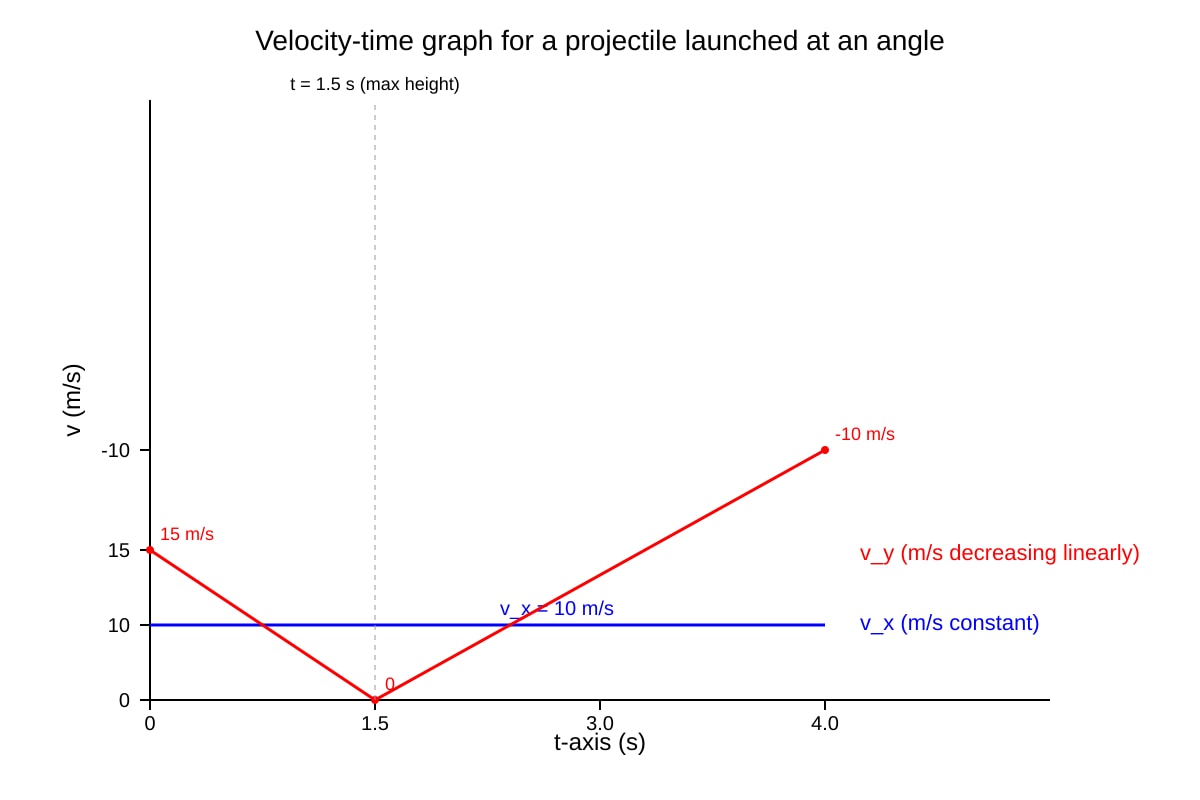
19. The diagram below shows a velocity-time graph for a projectile.
Image pending generation: graph for Q19.
Using the graph, explain how you would determine the time to reach maximum height and the horizontal range. [3]
20. A geostationary satellite remains above the same point on Earth's equator. State two conditions necessary for this orbit and explain one application. [3]
Answers
TuitionGoWhere Practice Paper - Physics H2 A-Level (Answers)
Version 2 — Mechanics Topic Set
Total Marks: 60
Section A: Short Structured Questions
1. [2 marks] Principle: In a closed (isolated) system, total momentum before an event equals total momentum after, provided no net external force acts.
- 1 mark: system / closed system stated
- 1 mark: before = after / constancy with no external force
2. [2 marks] Direction: Vertically downward (due to gravity).
- 1 mark: downward
- 1 mark: due to gravity / g
3. [2 marks] Centripetal force is the resultant force acting toward the centre of the circular path, causing centripetal acceleration.
- 1 mark: toward centre
- 1 mark: resultant / net force causing circular motion
4. [2 marks] a=−ω2x
- 1 mark: negative sign
- 1 mark: ω2x form
5. [2 marks] F=dtdp (rate of change of momentum)
- 1 mark: force = rate of change
- 1 mark: of momentum
6. [2 marks] E=21kx2
- 1 mark: 21kx2
- 1 mark: identifies k as spring constant
7. [2 marks] Gravitational field strength is force per unit mass at a point: g=F/m.
- 1 mark: force per unit mass
- 1 mark: g=F/m
8. [2 marks] Linear momentum is conserved; kinetic energy is not (converted to heat/sound/deformation).
- 1 mark: momentum
- 1 mark: KE not conserved stated
Section B: Calculation and Application
9. [4 marks] Conservation of momentum: m1u1+m2u2=m1v1+m2v2 (1.2)(4.0)+(1.8)(0)=(1.2)(1.0)+(1.8)v2 4.8=1.2+1.8v2⇒1.8v2=3.6⇒v2=2.0 m s−1
- 1 mark: equation
- 1 mark: substitution
- 1 mark: correct algebra
- 1 mark: 2.0 m s−1
10. [4 marks] (a) ω=k/m=200/0.50=400=20 rad s−1 (b) amax=ω2A=(20)2(0.080)=400×0.080=32 m s−2
- 1 mark: (a) formula
- 1 mark: (a) value 20
- 1 mark: (b) formula
- 1 mark: (b) 32 m/s²
11. [4 marks] Vertical: h=21gt2⇒20=0.5(9.8)t2⇒t2=4.08⇒t=2.02 s Horizontal: d=vt=15×2.02=30.3 m
- 1 mark: vertical eqn
- 1 mark: t = 2.02 s
- 1 mark: horizontal eqn
- 1 mark: 30.3 m
12. [4 marks] F=mv2/r=(1000)(20)2/50=1000×400/50=8000 N
- 1 mark: formula
- 1 mark: substitution
- 2 marks: 8000 N
13. [4 marks] g=GM/r2=(6.67×10−11)(6.0×1024)/(7.0×106)2 =(4.002×10¹⁴)/(4.9×1013)=8.17 N kg−1 (or m s⁻²)
- 1 mark: formula
- 1 mark: substitution
- 2 marks: 8.2 N/kg
14. [4 marks] T=2πl/g⇒l=g(T/2π)2=9.8×(2.0/6.283)2=9.8×0.101=0.99 m
- 1 mark: rearrange
- 1 mark: sub
- 2 marks: 0.99 m
15. [4 marks] Impact speed: v=gt=9.8×2=19.6 m s−1 downward. Momentum before: 0.20×(−19.6)=−3.92 kg m s−1 After: 0.20×5.0=+1.0 Impulse = Δp=1.0−(−3.92)=4.92 N s
- 1 mark: speed calc
- 1 mark: momenta
- 2 marks: 4.9 N s
Section C: Extended Reasoning
16. [3 marks] Leaning shifts the normal force from ground so its horizontal component provides centripetal force toward turn centre; friction also acts. Without lean, bike would slip outward.
- 1 mark: centripetal needed
- 1 mark: lean provides component
- 1 mark: stability explanation
17. [3 marks] KE max at equilibrium, PE max at extremes; total E constant. Energy interchanges continuously: KE↔PE↔KE.
- 1 mark: KE at centre
- 1 mark: PE at extremes
- 1 mark: interchange constant total
18. [4 marks] Momentum conserved (frictionless). KE conserved only if elastic. If pucks stick or deform, KE lost. Claim false for inelastic.
- 1 mark: momentum yes
- 1 mark: KE only elastic
- 2 marks: evaluation with example
19. [3 marks] Max height when vy=0 → read t from graph (~1.5 s). Range = vx× total t = 10 × 4 = 40 m.
- 1 mark: t from v_y=0
- 1 mark: use v_x constant
- 1 mark: multiply for range
20. [3 marks] Conditions: (1) period = 24 h, (2) above equator / circular. Application: weather/satellite comms.
- 1 mark: period
- 1 mark: equatorial
- 1 mark: application
Free quiz and exam paper access
Enter your details to view this paper
Your access is remembered on this device.