TuitionGoWhere Practice Paper - Physics H2 A-Level
TuitionGoWhere Practice Paper (AI)
Subject: Physics H2
Level: A-Level
Paper: Practice Paper — Mechanics
Duration: 1 hour 30 minutes
Total Marks: 60
Name: ___________________________
Class: ___________________________
Date: ___________________________
Instructions
- Answer all questions in the spaces provided.
- The number of marks for each question is shown in brackets [ ].
- Unless otherwise stated, numerical answers should be given to 2 or 3 significant figures.
- The use of an approved scientific calculator is expected where appropriate.
- You may lose marks if you do not show your working, if you do not use appropriate units, or if you do not give your final answer to a suitable degree of precision.
- Take the gravitational field strength g=9.81 m s−2 unless otherwise stated.
Section A: Multiple Choice [15 marks]
Questions 1–15: Each question is worth 1 mark. Choose the one best answer.
1. A ball is thrown vertically upwards with an initial speed of 20 m s−1. Ignoring air resistance, what is the maximum height reached by the ball?
A. 10.2 m
B. 20.4 m
C. 40.8 m
D. 20.0 m
2. Which of the following is a vector quantity?
A. Kinetic energy
B. Power
C. Momentum
D. Work done
3. A car accelerates uniformly from rest to 30 m s−1 in 6.0 s. What is the distance travelled by the car during this time?
A. 90 m
B. 180 m
C. 60 m
D. 45 m
4. A force of 12 N acts on an object of mass 3.0 kg on a frictionless surface. What is the acceleration of the object?
A. 0.25 m s−2
B. 4.0 m s−2
C. 36 m s−2
D. 15 m s−2
5. An object moves in a horizontal circle of radius 2.0 m at a constant speed of 4.0 m s−1. What is the centripetal acceleration of the object?
A. 2.0 m s−2
B. 4.0 m s−2
C. 8.0 m s−2
D. 16.0 m s−2
6. A stone is released from rest and falls freely under gravity. What is the ratio of the distance fallen in the first second to the distance fallen in the third second?
A. 1:3
B. 1:5
C. 1:9
D. 1:7
7. A 2.0 kg object moving at 6.0 m s−1 collides with a stationary 4.0 kg object. After the collision, the two objects stick together. What is their common velocity after the collision?
A. 1.0 m s−1
B. 2.0 m s−1
C. 3.0 m s−1
D. 4.0 m s−1
8. A uniform plank of length 4.0 m and weight 200 N is supported at both ends. A child of weight 400 N stands 1.0 m from the left end. What is the reaction force at the right support?
A. 150 N
B. 200 N
C. 250 N
D. 300 N
9. A satellite orbits the Earth at a height where the gravitational field strength is 2.45 N kg−1. If the radius of the Earth is 6.37×10⁶ m, what is the orbital radius of the satellite?
A. 1.27×10⁷ m
B. 2.55×10⁷ m
C. 6.37×10⁶ m
D. 1.91×10⁷ m
10. A projectile is launched at an angle of 30° above the horizontal with an initial speed of 40 m s−1. What is the horizontal range of the projectile? (Ignore air resistance.)
A. 80.0 m
B. 141 m
C. 70.7 m
D. 122 m
11. A spring of spring constant 50 N m−1 is compressed by 0.10 m. What is the elastic potential energy stored in the spring?
A. 0.25 J
B. 0.50 J
C. 2.5 J
D. 5.0 J
12. An object of mass 5.0 kg is lifted vertically at constant speed through a height of 3.0 m. What is the work done against gravity?
A. 15 J
B. 49 J
C. 147 J
D. 441 J
13. A car of mass 1000 kg travels around a flat circular bend of radius 50 m at a constant speed of 20 m s−1. What is the minimum coefficient of static friction between the tyres and the road?
A. 0.41
B. 0.82
C. 0.20
D. 1.63
14. A ball is dropped from a height of 20 m. Just before it hits the ground, what fraction of its total energy is kinetic? (Ignore air resistance.)
A. 25%
B. 50%
C. 75%
D. 100%
15. Two forces of magnitudes 8.0 N and 6.0 N act at right angles to each other. What is the magnitude of the resultant force?
A. 2.0 N
B. 10.0 N
C. 14.0 N
D. 7.0 N
Section B: Structured Questions [25 marks]
Answer all questions. Show your working clearly.
16. [4 marks]
A car of mass 1200 kg is travelling along a straight horizontal road. The engine exerts a driving force of 3600 N and the total resistive force acting on the car is 1200 N.
(a) Calculate the acceleration of the car. [2 marks]
..................................................................................................................................
..................................................................................................................................
..................................................................................................................................
(b) The car starts from rest. Calculate the speed of the car after 8.0 s. [2 marks]
..................................................................................................................................
..................................................................................................................................
..................................................................................................................................
17. [5 marks]
A small ball of mass 0.20 kg is projected horizontally from the top of a cliff with a speed of 15 m s−1. The ball hits the ground 3.0 s later.
(a) Calculate the horizontal distance from the base of the cliff where the ball lands. [2 marks]
..................................................................................................................................
..................................................................................................................................
..................................................................................................................................
(b) Calculate the vertical component of the velocity of the ball just before it hits the ground. [2 marks]
..................................................................................................................................
..................................................................................................................................
..................................................................................................................................
(c) Hence determine the speed of the ball just before impact. [1 mark]
..................................................................................................................................
..................................................................................................................................
18. [6 marks]
A trolley of mass 0.80 kg moving at 2.5 m s−1 on a frictionless horizontal track collides with a stationary trolley of mass 1.2 kg. After the collision, the two trolleys stick together and move as one.
(a) State the principle of conservation of linear momentum. [1 mark]
..................................................................................................................................
..................................................................................................................................
(b) Calculate the velocity of the combined trolleys immediately after the collision. [3 marks]
..................................................................................................................................
..................................................................................................................................
..................................................................................................................................
..................................................................................................................................
(c) Determine whether kinetic energy is conserved in this collision. Show your working and state the type of collision. [2 marks]
..................................................................................................................................
..................................................................................................................................
..................................................................................................................................
19. [5 marks]
A uniform beam of weight 400 N and length 5.0 m is hinged at a wall and supported by a cable attached to the far end of the beam, as shown in the diagram. The cable makes an angle of 30° with the horizontal. The beam is horizontal and in equilibrium.
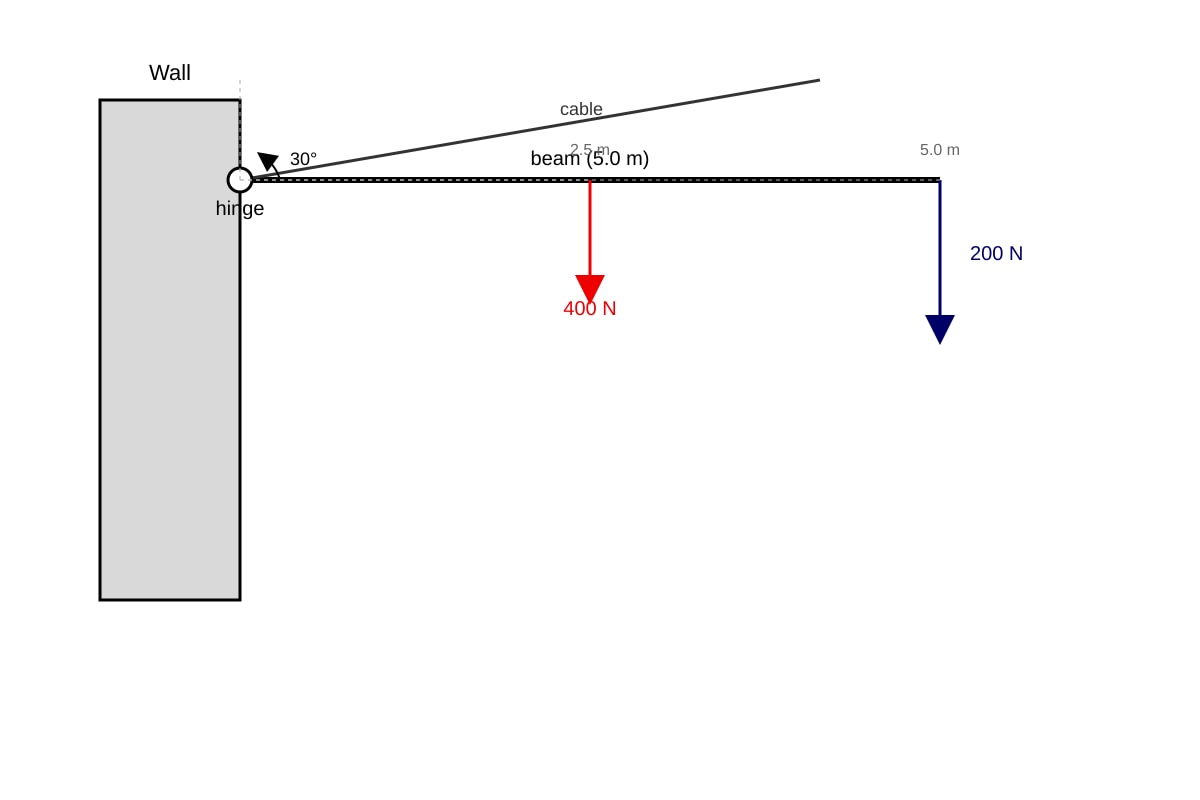
Generated diagram for Q19.
(a) By taking moments about the hinge, calculate the tension T in the cable. [3 marks]
..................................................................................................................................
..................................................................................................................................
..................................................................................................................................
..................................................................................................................................
(b) Calculate the magnitude of the reaction force at the hinge. [2 marks]
..................................................................................................................................
..................................................................................................................................
..................................................................................................................................
20. [5 marks]
A small object of mass 0.50 kg is attached to one end of a string of length 1.2 m. The other end of the string is fixed, and the object moves in a horizontal circle at constant speed, so that the string makes an angle of 25° with the vertical.
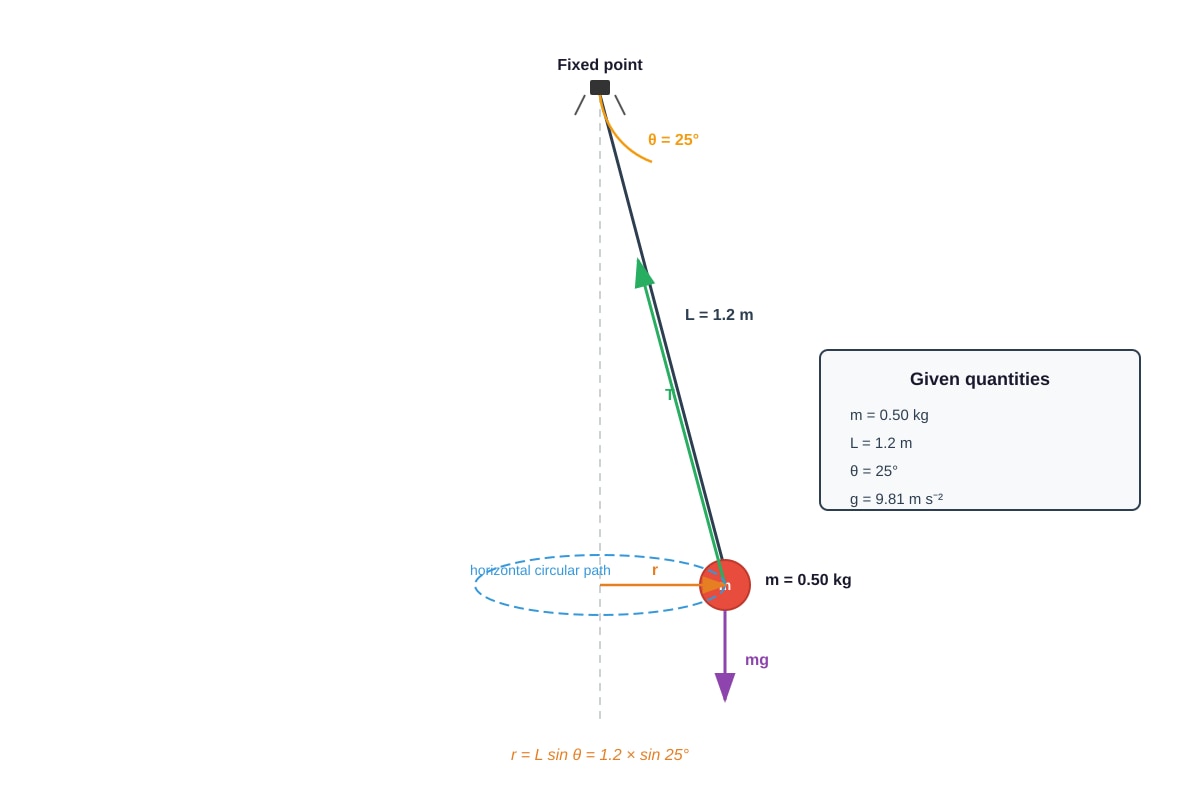
Generated diagram for Q20.
(a) Calculate the tension in the string. [2 marks]
..................................................................................................................................
..................................................................................................................................
..................................................................................................................................
(b) Calculate the speed of the object. [3 marks]
..................................................................................................................................
..................................................................................................................................
..................................................................................................................................
..................................................................................................................................
Section C: Long Structured Questions [20 marks]
Answer all questions. Show your working clearly.
21. [10 marks]
A ball of mass 0.40 kg is dropped from a height of 5.0 m above the ground. After hitting the ground, the ball rebounds to a height of 3.2 m. Assume air resistance is negligible throughout.
(a) Calculate the speed of the ball just before it hits the ground. [2 marks]
..................................................................................................................................
..................................................................................................................................
..................................................................................................................................
(b) Calculate the speed of the ball just after it leaves the ground. [2 marks]
..................................................................................................................................
..................................................................................................................................
..................................................................................................................................
(c) Calculate the change in momentum of the ball during the collision with the ground. [3 marks]
..................................................................................................................................
..................................................................................................................................
..................................................................................................................................
..................................................................................................................................
(d) The ball is in contact with the ground for 0.020 s. Calculate the average force exerted by the ground on the ball. [2 marks]
..................................................................................................................................
..................................................................................................................................
..................................................................................................................................
(e) State whether the collision is elastic or inelastic. Justify your answer. [1 mark]
..................................................................................................................................
..................................................................................................................................
22. [10 marks]
A spacecraft of mass 2.0×10⁴ kg is in a circular orbit around the Earth at an altitude of 400 km above the Earth's surface.
Data:
- Mass of Earth M=5.97×1024 kg
- Radius of Earth R=6.37×10⁶ m
- Gravitational constant G=6.67×10⁻¹¹ N m2 kg−2
(a) Show that the orbital speed of the spacecraft is approximately 7.7×10³ m s−1. [3 marks]
..................................................................................................................................
..................................................................................................................................
..................................................................................................................................
..................................................................................................................................
(b) Calculate the kinetic energy of the spacecraft. [2 marks]
..................................................................................................................................
..................................................................................................................................
..................................................................................................................................
(c) Calculate the gravitational potential energy of the spacecraft at this altitude. [3 marks]
..................................................................................................................................
..................................................................................................................................
..................................................................................................................................
..................................................................................................................................
(d) The spacecraft fires its engines to move to a higher orbit. State and explain what happens to the total mechanical energy of the spacecraft. [2 marks]
..................................................................................................................................
..................................................................................................................................
..................................................................................................................................