AI Generated Exam Paper
A Level H2 Physics Practice Paper 1
Free A Level H2 Physics Practice Paper 1, HY3 AI version, with questions, answers, and A Level-style practice for Singapore students.
These static practice materials are generated from the site's syllabus and paper-generation workflow, with source and model context shown so students and parents can evaluate the material before use.
Questions
TuitionGoWhere Practice Paper - Physics H2 A-Level
TuitionGoWhere Practice Paper (AI) — Version 1 of 5
Subject: Physics H2
Level: A-Level
Paper: Practice Paper (Mechanics Topic Set)
Duration: 1 hour 15 minutes
Total Marks: 60
Name: ___________________________
Class: ______________
Date: ______________
Instructions
- This practice paper contains 20 questions on the topic of Mechanics (A-Level H2 syllabus 9478, Section II).
- Answer all questions in the spaces provided.
- Show all working clearly. Use SI units and appropriate notation.
- Marks for each question are shown in brackets.
- Section marks and question marks sum exactly to 60.
Section A: Foundations of Mechanics (Questions 1–5) [15 marks]
- State the principle of conservation of linear momentum. [2]
- A ball of mass 0.20 kg is thrown vertically upward with initial speed 12 m s−1. Calculate the maximum height reached, ignoring air resistance. [3]
- A force of 8.0 N acts on a 2.0 kg block at rest on a smooth horizontal surface. Calculate the acceleration and the velocity after 4.0 s. [3]
- Define centripetal force and state the direction in which it acts for an object in uniform circular motion. [2]
- A spring of constant k=50 N m−1 is stretched by 0.10 m. Calculate the elastic potential energy stored. [2]
- (Note: Section A contains Q1–5 only; Q6 begins Section B.)
Section B: Motion, Collisions and Circular Motion (Questions 6–13) [24 marks]
- A car of mass 1200 kg moving at 15 m s−1 collides with a stationary truck of mass 2400 kg. After collision the car moves at 3.0 m s−1 in the same direction. Calculate the velocity of the truck. [3]
- A 0.50 kg mass oscillates on a spring (k=200 N m−1) with amplitude 0.080 m. Calculate (a) the period, (b) the maximum acceleration, (c) the speed when displacement is 0.050 m. [5]
- A stone is tied to a string of length 0.80 m and whirled in a horizontal circle at 2.0 revolutions per second. Calculate the centripetal acceleration. [3]
- A projectile is launched horizontally from a cliff of height 45 m with speed 20 m s−1. Calculate the time to reach the ground and the horizontal distance travelled. [4]
- State two differences between an elastic and an inelastic collision. [2]
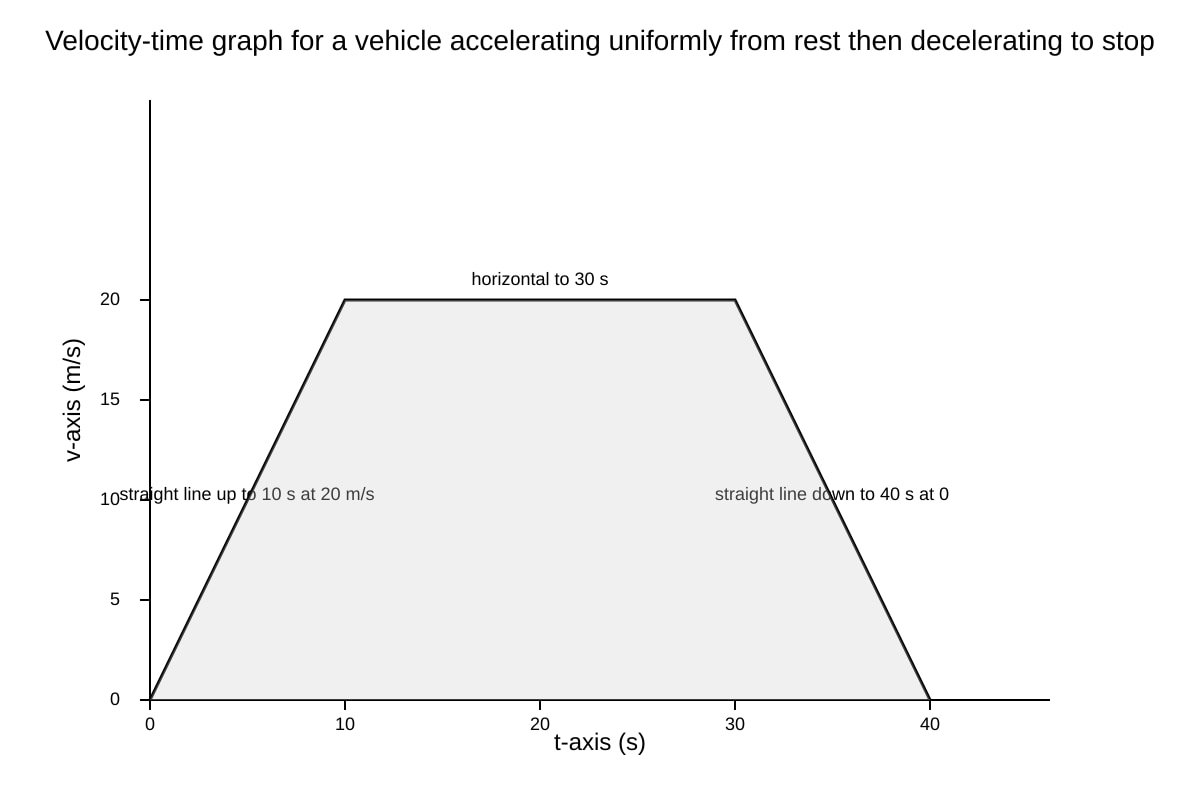
Image pending generation: graph for Q11.
Using the graph in Q11-fig1, calculate the total distance travelled by the vehicle. [3]
12. A disc rotates with angular velocity ω=4.0 rad s−1. A point on the rim at radius 0.15 m has what linear speed and centripetal acceleration? [2]
13. Explain why a passenger feels pushed outward in a turning car, with reference to Newton's laws. [2]
Section C: Gravitational Fields and Oscillations (Questions 14–20) [21 marks]
- State Newton's law of gravitation in words. [2]
- Calculate the gravitational field strength at the surface of Earth (M=6.0×1024 kg, R=6.4×10⁶ m, G=6.67×10⁻¹¹ N m2kg−2). [3]
- A satellite orbits Earth at radius 2.0×10⁷ m. Calculate its orbital speed. (Use GM=4.0×10¹⁴ N m2kg−1.) [3]
- For a simple harmonic oscillator, displacement is x=x0sin(ωt). Show that acceleration a=−ω2x. [3]
- A pendulum of length 1.0 m has small oscillations. Calculate its period. (g=9.8 m s−2.) [2]
- Describe the energy interchange in SHM between kinetic and potential stores, with reference to displacement. [3]
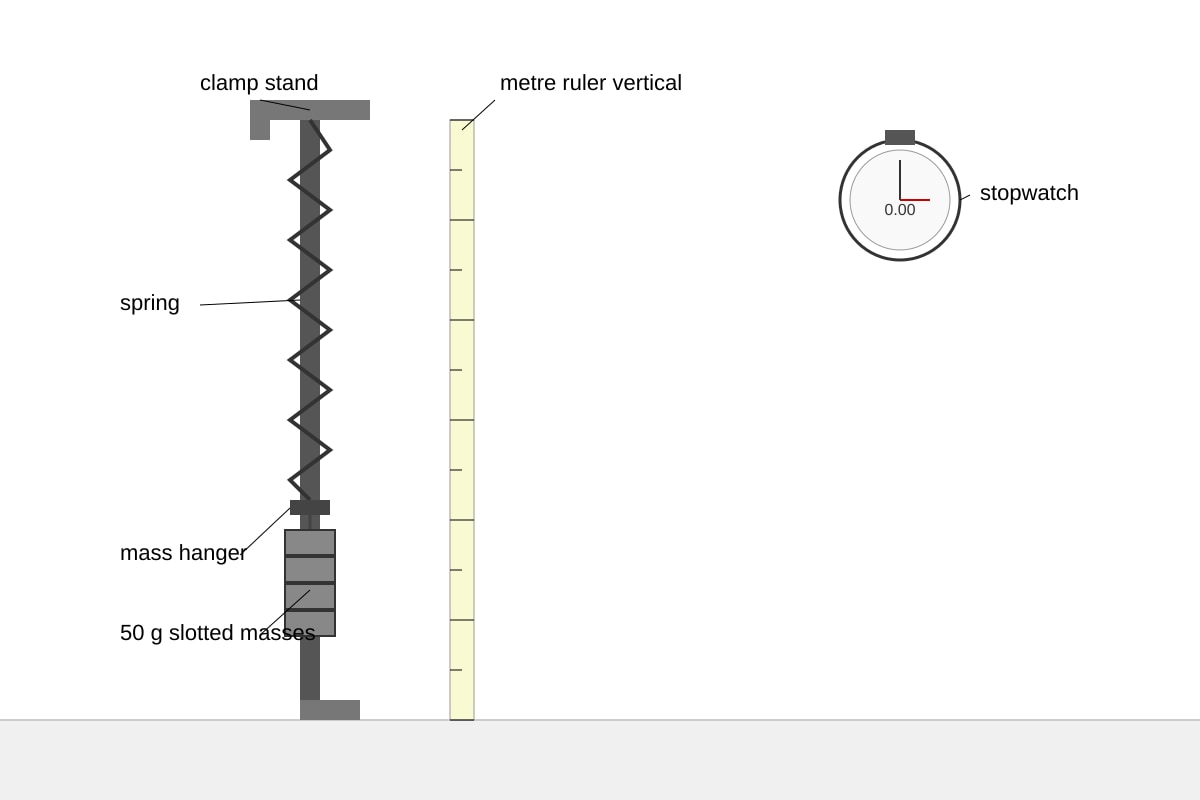
Image pending generation: experimental_setup for Q20.
State two precautions to improve accuracy in the experiment shown in Q20-fig1. [2]
End of Paper — Total Marks: 60
Answers
TuitionGoWhere Practice Paper — Answer Key (Version 1)
Subject: Physics H2 A-Level
Topic: Mechanics
Total Marks: 60
Section A (Q1–5) — 15 marks
Q1 [2 marks]
Principle: In a closed (isolated) system, total momentum before an event equals total momentum after, provided no net external force acts.
Marking: 1 mark for system/condition, 1 mark for before=after.
Q2 [3 marks]
Use v2=u2+2as, at top v=0, a=−g=−9.8 m s−2:
0=122+2(−9.8)s⇒s=144/19.6=7.35 m.
Marks: 1 formula, 1 substitution, 1 answer.
Q3 [3 marks]
a=F/m=8.0/2.0=4.0 m s−2.
v=u+at=0+4.0×4.0=16 m s−1.
Marks: 1 acc, 1 vel, 1 units.
Q4 [2 marks]
Centripetal force is the resultant force causing circular motion, directed toward centre.
Marks: 1 def, 1 direction.
Q5 [2 marks]
Ep=21kx2=0.5×50×0.102=0.25 J.
Marks: 1 formula, 1 answer.
Section B (Q6–13) — 24 marks
Q6 [3 marks]
Conservation: mcuc+mtut=mcvc+mtvt
1200(15)+0=1200(3)+2400vt⇒18000=3600+2400vt
vt=6.0 m s−1.
Marks: 1 eq, 1 calc, 1 ans.
Q7 [5 marks]
(a) T=2πm/k=2π0.5/200=0.314 s (2)
(b) amax=ω2A=(k/m)A=(200/0.5)(0.080)=32 m s−2 (1)
(c) ω=k/m=20 rad s−1, v=ωA2−x2=200.082−0.052=12.6 m s−1 (2)
Q8 [3 marks]
f=2.0 Hz,ω=2πf=12.57 rad s−1
ac=rω2=0.80×(12.57)2=126 m s−2.
Marks: 1 ω, 1 calc, 1 ans.
Q9 [4 marks]
Vertical: s=45=21gt2⇒t=90/9.8=3.03 s (2)
Horizontal: d=vt=20×3.03=60.6 m (2)
Q10 [2 marks]
Elastic: KE conserved, relative speed of separation = approach. Inelastic: KE not conserved, objects may stick.
1 mark each.
Q11 [3 marks]
Graph areas: accelerate triangle 0.5×10×20=100 m; constant 20×20=400 m; decel triangle 0.5×10×20=100 m. Total =600 m.
Marks: 1 each segment or 3 for total with working.
Q12 [2 marks]
v=rω=0.15×4.0=0.60 m s−1; a=v2/r=0.36/0.15=2.4 m s−2.
1 each.
Q13 [2 marks]
Passenger tends to continue straight (Newton 1); seat provides inward force; feeling of outward push is fictitious (from accelerating frame).
1 each point.
Section C (Q14–20) — 21 marks
Q14 [2 marks]
Force between two point masses ∝ product of masses / square of separation, attractive along line joining.
1 prop, 1 direction.
Q15 [3 marks]
g=GM/R2=(6.67×10−11×6.0×1024)/(6.4×106)2=9.8 N kg−1.
1 formula, 1 sub, 1 ans.
Q16 [3 marks]
v=GM/r=4.0×1014/2.0×107=2.0×107=4470 m s−1.
1 eq, 1 calc, 1 ans.
Q17 [3 marks]
x=x0sinωt; v=dx/dt=x0ωcosωt; a=dv/dt=−x0ω2sinωt=−ω2x.
1 diff, 1 diff, 1 sub.
Q18 [2 marks]
T=2πL/g=2π1.0/9.8=2.01 s.
1 formula, 1 ans.
Q19 [3 marks]
At extremes displacement max → PE max, KE zero; at centre x=0 → KE max, PE min; continuous interchange, total constant.
1 extreme, 1 centre, 1 total.
Q20 [2 marks]
Precautions: (1) measure amplitude from equilibrium with eye level to avoid parallax; (2) use small oscillations to approximate SHM.
1 each.
Total: 60 marks.
Free quiz and exam paper access
Enter your details to view this paper
Your access is remembered on this device.