AI Generated Exam Paper
A Level H2 Physics Practice Paper 1
Free A Level H2 Physics Practice Paper 1, DeepSeek AI version, with questions, answers, and A Level-style practice for Singapore students.
These static practice materials are generated from the site's syllabus and paper-generation workflow, with source and model context shown so students and parents can evaluate the material before use.
Questions
Free quiz and exam paper access
Enter your details to view this paper
Your access is remembered on this device.
Answers
TuitionGoWhere Practice Paper - Physics H2 A-Level
Answer Key and Marking Scheme
Paper: Practice Paper 1 (Mechanics) Version: 1 of 5 Total Marks: 60
Section A: Structured Questions (20 marks)
1. State the principle of conservation of linear momentum.
Answer: The total momentum of a closed system (or isolated system) remains constant provided no external resultant force acts on the system. [2 marks]
Marking notes:
- 1 mark for "total momentum remains constant" or "total momentum before = total momentum after"
- 1 mark for "closed system" or "no external resultant force" or "isolated system"
- Accept: "In the absence of external forces, the total momentum of a system is conserved."
2. (a) Calculate the acceleration of the car.
Answer: a = (v - u)/t = (25 - 0)/8.0 = 3.125 m s⁻² ≈ 3.1 m s⁻² [2 marks]
Marking notes:
- 1 mark for correct formula/substitution
- 1 mark for correct answer with units
- Accept 3.13 m s⁻²
(b) Calculate the resultant force acting on the car.
Answer: F = ma = 1200 × 3.125 = 3750 N ≈ 3.8 × 10³ N [1 mark]
Marking notes:
- 1 mark for correct answer with units
- Accept 3750 N or 3.75 kN
3. (a) Calculate the maximum height reached above the ground.
Answer: v² = u² + 2as → 0 = 15² + 2(-9.81)s → s = 15²/(2 × 9.81) = 11.47 m Maximum height above ground = 11.47 + 2.0 = 13.5 m [2 marks]
Marking notes:
- 1 mark for correct calculation of height above launch point
- 1 mark for adding initial height (2.0 m) to get height above ground
(b) Calculate the time taken for the ball to reach the ground from the instant it is thrown.
Answer: Using s = ut + ½at² with s = -2.0 m (displacement from launch to ground): -2.0 = 15t - 4.905t² 4.905t² - 15t - 2.0 = 0 t = [15 ± √(225 + 39.24)]/9.81 = [15 ± √264.24]/9.81 = [15 ± 16.26]/9.81 t = 3.19 s (positive root) [3 marks]
Marking notes:
- 1 mark for correct equation with sign convention
- 1 mark for correct quadratic formula application
- 1 mark for correct answer with units (reject negative root)
4. (a) Calculate the angular velocity of the particle.
Answer: ω = 2πf = 2π × 3.0 = 18.8 rad s⁻¹ [1 mark]
Marking notes:
- 1 mark for correct answer with units (accept 6π or 18.85 rad s⁻¹)
(b) Calculate the tension in the string.
Answer: T = mrω² = 0.50 × 0.80 × (18.85)² = 0.50 × 0.80 × 355.3 = 142 N [2 marks]
Marking notes:
- 1 mark for correct formula T = mrω² or T = mv²/r
- 1 mark for correct answer with units (accept 140-145 N depending on rounding)
(c) Explain whether the hanging mass will remain stationary, rise, or fall.
Answer: Weight of hanging mass = mg = 2.0 × 9.81 = 19.6 N. Tension in string = 142 N. Since tension (142 N) is much greater than the weight (19.6 N), the hanging mass will accelerate upwards (rise). [2 marks]
Marking notes:
- 1 mark for comparing tension with weight
- 1 mark for correct conclusion with reasoning
5. Calculate the work done by the force on the particle.
Answer: W = F·s = (3.0)(2.0) + (4.0)(-1.0) = 6.0 - 4.0 = 2.0 J [2 marks]
Marking notes:
- 1 mark for using dot product or correct component multiplication
- 1 mark for correct answer with units
6. Define the term impulse and state its SI unit.
Answer: Impulse is the product of the average force acting on an object and the time interval over which it acts (or impulse = change in momentum). SI unit: N s (or kg m s⁻¹). [2 marks]
Marking notes:
- 1 mark for correct definition (accept "impulse = FΔt" or "impulse = Δp")
- 1 mark for correct SI unit
7. (a) Calculate the gravitational force acting on the satellite.
Answer: F = GMm/r² = (6.67 × 10⁻¹¹ × 6.0 × 10²⁴ × 500)/(7.0 × 10⁶)² = (2.001 × 10¹⁷)/(4.9 × 10¹³) = 4084 N ≈ 4.1 × 10³ N [2 marks]
Marking notes:
- 1 mark for correct formula and substitution
- 1 mark for correct answer with units
(b) Calculate the orbital speed of the satellite.
Answer: F = mv²/r → v = √(Fr/m) = √(4084 × 7.0 × 10⁶/500) = √(5.718 × 10⁷) = 7560 m s⁻¹ ≈ 7.6 × 10³ m s⁻¹ Alternatively: v = √(GM/r) = √(6.67 × 10⁻¹¹ × 6.0 × 10²⁴/7.0 × 10⁶) = 7560 m s⁻¹ [2 marks]
Marking notes:
- 1 mark for correct formula
- 1 mark for correct answer with units
Section B: Calculation and Application (20 marks)
8. (a) Draw a free-body diagram showing all forces acting on the block.
Answer: Diagram should show:
- Weight (mg) acting vertically downwards
- Normal reaction (N) perpendicular to incline
- Applied force (F = 40 N) parallel to incline upwards
- Friction force (f) parallel to incline downwards [2 marks]
Marking notes:
- 1 mark for correctly showing all four forces
- 1 mark for correct directions and labels
(b) Calculate the normal reaction force on the block.
Answer: N = mg cos 25° = 3.0 × 9.81 × cos 25° = 29.43 × 0.9063 = 26.7 N [2 marks]
Marking notes:
- 1 mark for correct formula N = mg cos θ
- 1 mark for correct answer with units
(c) Calculate the acceleration of the block up the incline.
Answer: f = μN = 0.25 × 26.7 = 6.67 N Component of weight down incline = mg sin 25° = 3.0 × 9.81 × sin 25° = 29.43 × 0.4226 = 12.44 N Resultant force up incline = F - f - mg sin θ = 40 - 6.67 - 12.44 = 20.89 N a = F_res/m = 20.89/3.0 = 6.96 m s⁻² ≈ 7.0 m s⁻² [3 marks]
Marking notes:
- 1 mark for correct friction force
- 1 mark for correct resultant force calculation
- 1 mark for correct acceleration with units
9. (a) Calculate the elastic potential energy stored in the compressed spring.
Answer: EPE = ½kx² = ½ × 200 × (0.15)² = ½ × 200 × 0.0225 = 2.25 J [1 mark]
Marking notes:
- 1 mark for correct answer with units
(b) Calculate the speed of the ball when it leaves the spring.
Answer: EPE → KE: ½mv² = 2.25 → v = √(2 × 2.25/0.050) = √90 = 9.49 m s⁻¹ ≈ 9.5 m s⁻¹ [2 marks]
Marking notes:
- 1 mark for energy conservation equation
- 1 mark for correct answer with units
(c) Calculate the maximum vertical height reached by the ball.
Answer: KE → GPE: mgh = 2.25 → h = 2.25/(0.050 × 9.81) = 2.25/0.4905 = 4.59 m ≈ 4.6 m [2 marks]
Marking notes:
- 1 mark for energy conservation equation
- 1 mark for correct answer with units
10. (a) Calculate the friction force acting on particle A.
Answer: f = μN = μmg = 0.30 × 2.0 × 9.81 = 5.886 N ≈ 5.9 N [2 marks]
Marking notes:
- 1 mark for correct formula
- 1 mark for correct answer with units
(b) Calculate the acceleration of the system and the tension in the string.
Answer: For particle A: T - f = m_A a → T - 5.886 = 2.0a ... (1) For particle B: m_B g - T = m_B a → 3.0 × 9.81 - T = 3.0a → 29.43 - T = 3.0a ... (2) Adding (1) and (2): 29.43 - 5.886 = 5.0a → 23.544 = 5.0a → a = 4.71 m s⁻² From (1): T = 2.0 × 4.71 + 5.886 = 9.42 + 5.886 = 15.3 N [4 marks]
Marking notes:
- 1 mark for correct equation for particle A
- 1 mark for correct equation for particle B
- 1 mark for correct acceleration
- 1 mark for correct tension
(c) Calculate the speed of particle B after it has descended 1.5 m.
Answer: v² = u² + 2as = 0 + 2 × 4.71 × 1.5 = 14.13 → v = 3.76 m s⁻¹ ≈ 3.8 m s⁻¹ [2 marks]
Marking notes:
- 1 mark for correct formula
- 1 mark for correct answer with units
Section C: Data Analysis and Extended Response (20 marks)
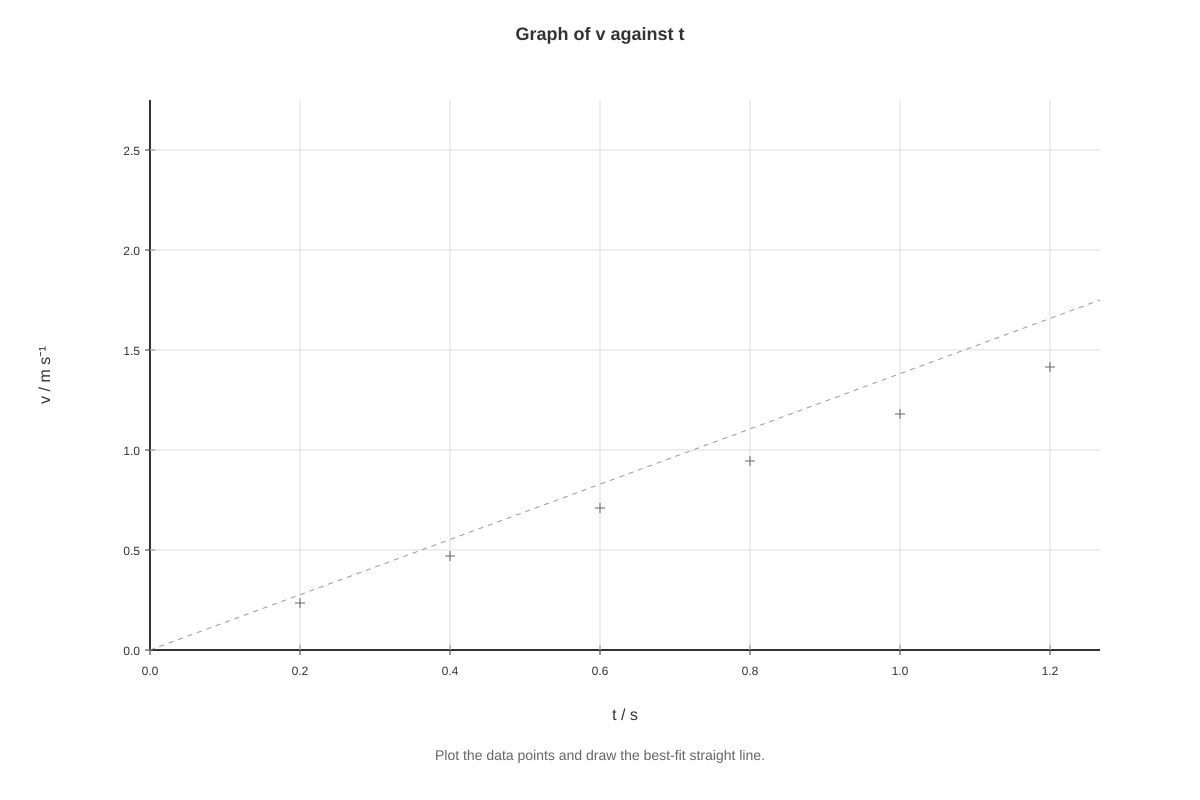
11. (a) Plot a graph of v against t. Draw the best-fit straight line.
Answer: Graph should show:
- Axes labelled: v/m s⁻¹ (y-axis), t/s (x-axis)
- Appropriate scales
- All 6 points plotted correctly
- Best-fit straight line passing through or near points
- Points: (0.20, 0.39), (0.40, 0.78), (0.60, 1.18), (0.80, 1.57), (1.00, 1.96), (1.20, 2.35) [4 marks]
Marking notes:
- 1 mark for correct axes with labels and units
- 1 mark for appropriate scales
- 1 mark for correct plotting of all points
- 1 mark for best-fit straight line
(b) Use your graph to determine the acceleration of the trolley. Explain your method.
Answer: Acceleration = gradient of v-t graph. Gradient = Δv/Δt = (2.35 - 0.39)/(1.20 - 0.20) = 1.96/1.00 = 1.96 m s⁻² ≈ 2.0 m s⁻² Method: Choose two points on the best-fit line (not necessarily data points), calculate change in velocity divided by change in time. [3 marks]
Marking notes:
- 1 mark for stating gradient method
- 1 mark for correct calculation using points from line
- 1 mark for correct answer with units (accept 1.95-2.00 m s⁻²)
(c) Calculate the resultant force acting on the trolley.
Answer: F = ma = 0.85 × 1.96 = 1.67 N ≈ 1.7 N [1 mark]
Marking notes:
- 1 mark for correct answer with units
(d) Calculate the frictional force acting on the trolley.
Answer: Component of weight down incline = mg sin 12° = 0.85 × 9.81 × sin 12° = 8.3385 × 0.2079 = 1.734 N Resultant force = mg sin θ - f → f = mg sin θ - F_res = 1.734 - 1.67 = 0.064 N ≈ 0.06 N [3 marks]
Marking notes:
- 1 mark for correct weight component calculation
- 1 mark for correct force balance equation
- 1 mark for correct answer with units
12. (a) Calculate the vertical height through which the bob rises from its lowest point to the release point.
Answer: h = L - L cos θ = L(1 - cos θ) = 1.2(1 - cos 35°) = 1.2(1 - 0.8192) = 1.2 × 0.1808 = 0.217 m ≈ 0.22 m [2 marks]
Marking notes:
- 1 mark for correct formula
- 1 mark for correct answer with units
(b) Calculate the speed of the bob at the lowest point of its swing.
Answer: mgh = ½mv² → v = √(2gh) = √(2 × 9.81 × 0.217) = √4.258 = 2.06 m s⁻¹ ≈ 2.1 m s⁻¹ [2 marks]
Marking notes:
- 1 mark for energy conservation equation
- 1 mark for correct answer with units
(c) Calculate the tension in the string when the bob is at the lowest point.
Answer: At lowest point: T - mg = mv²/L T = mg + mv²/L = 0.20 × 9.81 + 0.20 × (2.06)²/1.2 = 1.962 + 0.20 × 4.244/1.2 = 1.962 + 0.707 = 2.67 N ≈ 2.7 N [2 marks]
Marking notes:
- 1 mark for correct force equation
- 1 mark for correct answer with units
(d) State and explain one assumption made in your calculations that may affect the accuracy of your results.
Answer: Assumption: No air resistance. Explanation: Air resistance would dissipate energy, reducing the speed at the lowest point and thus the tension. OR Assumption: The string is massless/light. Explanation: A massive string would have its own kinetic energy, reducing the energy available to the bob. [2 marks]
Marking notes:
- 1 mark for valid assumption
- 1 mark for clear explanation of effect on results
13. (a) Calculate the speed of the ball just before it hits the surface.
Answer: v² = u² + 2gh = 0 + 2 × 9.81 × 2.5 = 49.05 → v = 7.00 m s⁻¹ ≈ 7.0 m s⁻¹ [2 marks]
Marking notes:
- 1 mark for correct formula
- 1 mark for correct answer with units
(b) Calculate the speed of the ball just after it leaves the surface.
Answer: v² = 2gh = 2 × 9.81 × 1.8 = 35.316 → v = 5.94 m s⁻¹ ≈ 5.9 m s⁻¹ [2 marks]
Marking notes:
- 1 mark for correct formula
- 1 mark for correct answer with units
(c) Calculate the average force exerted by the surface on the ball during the impact.
Answer: Taking upward as positive: Δp = m(v_f - v_i) = 0.15(5.94 - (-7.00)) = 0.15 × 12.94 = 1.941 kg m s⁻¹ F_avg = Δp/Δt = 1.941/0.080 = 24.3 N ≈ 24 N (upwards) [3 marks]
Marking notes:
- 1 mark for correct change in momentum (with sign convention)
- 1 mark for correct formula F = Δp/Δt
- 1 mark for correct answer with units and direction
(d) Explain why the ball does not rebound to its original height, referring to energy transformations.
Answer: During the collision, some kinetic energy is converted to other forms of energy (thermal energy/sound/internal energy of the ball and surface). The collision is inelastic, so kinetic energy is not conserved. The ball leaves with less kinetic energy, so it reaches a lower height. [2 marks]
Marking notes:
- 1 mark for identifying energy conversion/loss
- 1 mark for linking energy loss to reduced rebound height
14. (a) Draw a diagram showing the forces acting on the car when it is travelling at the design speed.
Answer: Diagram should show:
- Weight (mg) acting vertically downwards
- Normal reaction (N) perpendicular to the banked surface
- No friction force (at design speed)
- Both forces resolved into horizontal and vertical components [2 marks]
Marking notes:
- 1 mark for correct forces with labels
- 1 mark for correct directions and no friction shown
(b) By resolving forces, derive an expression for the design speed.
Answer: Vertically: N cos θ = mg ... (1) Horizontally: N sin θ = mv²/r ... (2) Dividing (2) by (1): tan θ = v²/(rg) Therefore: v = √(rg tan θ) [3 marks]
Marking notes:
- 1 mark for correct vertical resolution
- 1 mark for correct horizontal resolution (centripetal force)
- 1 mark for correct final expression
(c) Calculate the design speed for this track.
Answer: v = √(rg tan θ) = √(60 × 9.81 × tan 20°) = √(588.6 × 0.3640) = √214.2 = 14.6 m s⁻¹ ≈ 15 m s⁻¹ [2 marks]
Marking notes:
- 1 mark for correct substitution
- 1 mark for correct answer with units
(d) Explain what would happen if the car travels at a speed greater than the design speed, and how friction would act.
Answer: At higher speed, a greater centripetal force is required. The horizontal component of the normal reaction alone is insufficient. The car would tend to slide up the banked track. Friction acts down the slope (towards the centre of the circle) to provide the additional centripetal force needed. [2 marks]
Marking notes:
- 1 mark for describing tendency to slide up
- 1 mark for correct direction of friction and its role
15. (a) Explain, using Newton's laws, why a rocket can accelerate in the vacuum of space.
Answer: According to Newton's third law, when the rocket expels exhaust gases backwards, the gases exert an equal and opposite force on the rocket forwards (thrust). According to Newton's second law, this net force causes the rocket to accelerate (F = ma). No external medium is required; the rocket and exhaust gases form an interacting system. [2 marks]
Marking notes:
- 1 mark for Newton's third law (action-reaction)
- 1 mark for Newton's second law (force causes acceleration)
(b) Calculate the initial acceleration of the rocket at the moment of launch.
Answer: Weight = mg = 5000 × 9.81 = 49,050 N Resultant force = Thrust - Weight = 125,000 - 49,050 = 75,950 N a = F_res/m = 75,950/5000 = 15.2 m s⁻² [3 marks]
Marking notes:
- 1 mark for correct weight calculation
- 1 mark for correct resultant force
- 1 mark for correct acceleration with units
(c) State and explain how the acceleration of the rocket changes as the fuel is consumed.
Answer: The acceleration increases. As fuel is consumed, the mass of the rocket decreases. Since F = ma and the thrust remains constant, a = F/m, so as m decreases, a increases. Additionally, the weight decreases, further increasing the resultant force and acceleration. [2 marks]
Marking notes:
- 1 mark for stating acceleration increases
- 1 mark for explanation linking decreasing mass to increasing acceleration
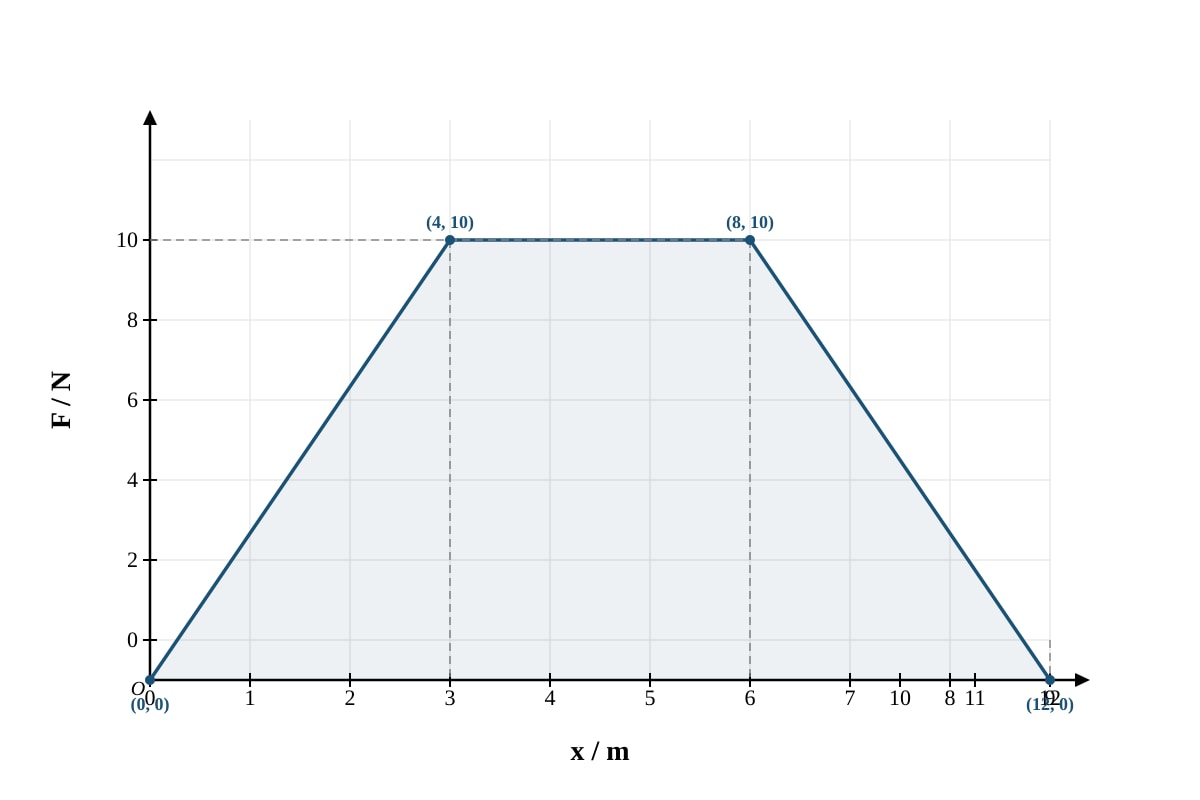
16. (a) Explain how the work done by the force can be determined from the graph.
Answer: The work done by the force equals the area under the force-displacement graph. [1 mark]
Marking notes:
- 1 mark for "area under the graph"
(b) Calculate the total work done by the force as the particle moves from x = 0 to x = 12 m.
Answer: Area = Area of triangle (0 to 4 m) + Area of rectangle (4 to 8 m) + Area of triangle (8 to 12 m) = ½ × 4 × 10 + 4 × 10 + ½ × 4 × 10 = 20 + 40 + 20 = 80 J [3 marks]
Marking notes:
- 1 mark for identifying three areas
- 1 mark for correct calculation of areas
- 1 mark for correct total with units
(c) Calculate the speed of the particle at x = 12 m.
Answer: Work done = change in KE = ½mv² - 0 80 = ½ × 2.0 × v² → v² = 80 → v = 8.94 m s⁻¹ ≈ 8.9 m s⁻¹ [2 marks]
Marking notes:
- 1 mark for work-energy theorem equation
- 1 mark for correct answer with units
17. (a) Draw a diagram showing all the forces acting on the rod.
Answer: Diagram should show:
- Weight of rod (50 N) acting at centre (1.0 m from A)
- Load (30 N) acting at B (2.0 m from A)
- Tension (T) in string acting upwards at 0.50 m from A
- Reaction force (R) at pivot A (upwards) [2 marks]
Marking notes:
- 1 mark for all forces shown with correct points of application
- 1 mark for correct directions
(b) By taking moments about A, calculate the tension in the string.
Answer: Taking moments about A (clockwise positive): Clockwise moments = (50 × 1.0) + (30 × 2.0) = 50 + 60 = 110 N m Anticlockwise moment = T × 0.50 For equilibrium: T × 0.50 = 110 → T = 220 N [3 marks]
Marking notes:
- 1 mark for correct moment equation
- 1 mark for correct substitution
- 1 mark for correct answer with units
(c) Calculate the magnitude and direction of the force exerted by the pivot on the rod at A.
Answer: Vertically: R + T = 50 + 30 → R + 220 = 80 → R = 80 - 220 = -140 N The negative sign indicates R acts downwards. Magnitude = 140 N, direction = downwards [2 marks]
Marking notes:
- 1 mark for correct force balance equation
- 1 mark for correct magnitude and direction
18. (a) Calculate the angular frequency of the motion.
Answer: ω = √(k/m) = √(80/0.30) = √266.7 = 16.3 rad s⁻¹ [2 marks]
Marking notes:
- 1 mark for correct formula
- 1 mark for correct answer with units
(b) Calculate the maximum speed of the particle.
Answer: v_max = ωA = 16.33 × 0.080 = 1.31 m s⁻¹ ≈ 1.3 m s⁻¹ [1 mark]
Marking notes:
- 1 mark for correct answer with units
(c) Calculate the maximum acceleration of the particle.
Answer: a_max = ω²A = (16.33)² × 0.080 = 266.7 × 0.080 = 21.3 m s⁻² ≈ 21 m s⁻² [1 mark]
Marking notes:
- 1 mark for correct answer with units
(d) Determine the length of the spring when the particle is at the lowest point of its motion.
Answer: At equilibrium: mg = ke → e = mg/k = 0.30 × 9.81/80 = 2.943/80 = 0.0368 m Equilibrium length = natural length + e = 0.50 + 0.0368 = 0.5368 m At lowest point: displacement = -A = -0.080 m (below equilibrium) Length = equilibrium length + A = 0.5368 + 0.080 = 0.617 m ≈ 0.62 m [3 marks]
Marking notes:
- 1 mark for correct equilibrium extension
- 1 mark for correct equilibrium length
- 1 mark for adding amplitude to get length at lowest point
19. (a) State the total momentum of the system before the push.
Answer: Total momentum = 0 (both skaters initially at rest). [1 mark]
Marking notes:
- 1 mark for zero or "0 kg m s⁻¹"
(b) Calculate the speed of skater B after the push.
Answer: By conservation of momentum: 0 = m_A v_A + m_B v_B 0 = 60 × 2.5 + 80 × v_B → v_B = -150/80 = -1.875 m s⁻¹ Speed = 1.88 m s⁻¹ ≈ 1.9 m s⁻¹ (in opposite direction to A) [2 marks]
Marking notes:
- 1 mark for correct conservation equation
- 1 mark for correct speed with units
(c) Calculate the total kinetic energy of the system after the push.
Answer: KE_total = ½m_A v_A² + ½m_B v_B² = ½ × 60 × (2.5)² + ½ × 80 × (1.875)² = 30 × 6.25 + 40 × 3.516 = 187.5 + 140.6 = 328.1 J ≈ 330 J [2 marks]
Marking notes:
- 1 mark for correct formula
- 1 mark for correct answer with units
(d) Explain where this kinetic energy came from.
Answer: The kinetic energy came from the chemical energy stored in skater A's muscles, which was converted to mechanical work during the push. [1 mark]
Marking notes:
- 1 mark for identifying source (chemical energy/muscular work/internal energy)
20. (a) Calculate the centripetal acceleration of the stone.
Answer: a_c = v²/r = (5.0)²/0.90 = 25/0.90 = 27.8 m s⁻² ≈ 28 m s⁻² [2 marks]
Marking notes:
- 1 mark for correct formula
- 1 mark for correct answer with units
(b) Calculate the tension in the string when the stone is at the highest point of the circle.
Answer: At highest point: T + mg = mv²/r T = mv²/r - mg = 0.40 × (5.0)²/0.90 - 0.40 × 9.81 = 0.40 × 27.78 - 3.924 = 11.11 - 3.924 = 7.19 N ≈ 7.2 N [3 marks]
Marking notes:
- 1 mark for correct force equation at highest point
- 1 mark for correct substitution
- 1 mark for correct answer with units
(c) Calculate the minimum speed the stone must have at the highest point for the string to remain taut.
Answer: At minimum speed, T = 0: mg = mv²/r → v_min = √(gr) = √(9.81 × 0.90) = √8.829 = 2.97 m s⁻¹ ≈ 3.0 m s⁻¹ [2 marks]
Marking notes:
- 1 mark for setting T = 0
- 1 mark for correct answer with units
END OF ANSWER KEY