From Real Exams Exam Paper
A Level H2 Physics Practice Paper 5
Free A Level H2 Physics Practice Paper 5, HY3 Exam version, with questions, answers, and A Level-style practice for Singapore students.
These static practice materials are generated from the site's syllabus and paper-generation workflow, with source and model context shown so students and parents can evaluate the material before use.
Questions
TuitionGoWhere Exam Practice (AI) — Physics H2 A-Level
Practice Paper: Mechanics (Version 5 of 5)
School: TuitionGoWhere Exam Practice (AI)
Subject: Physics H2
Level: A-Level
Paper: Practice Paper (Mechanics Topic Set, Version 5)
Duration: 75 minutes
Total Marks: 60
Name: ___________________________
Class: ___________________________
Date: ___________________________
Instructions:
- Answer all questions.
- Use a calculator where necessary.
- Show all working clearly.
- Use SI units unless stated otherwise.
- Marks allocated are shown in brackets [ ].
Section A: Foundations of Mechanics (Questions 1–5) [15 marks]
1. State the principle of conservation of linear momentum. [2]
2. A block of mass 2.0 kg is pulled along a horizontal frictionless surface by a constant force of 6.0 N. Calculate the acceleration of the block. [2]
3. A velocity-time graph shows a straight line from (0 s,0 m s−1) to (4 s,12 m s−1). Determine the acceleration. [2]
4. Resolve a force of 10 N acting at 30∘ above the horizontal into horizontal and vertical components. [3]
5. A spring of original length 0.20 m is stretched to 0.26 m by a load of 3.0 N. Calculate the spring constant k using Hooke’s law. [3]
Section B: Motion, Collisions and Circular Motion (Questions 6–13) [24 marks]
6. A ball is thrown horizontally from a cliff of height 45 m with speed 20 m s−1. Calculate the time taken to reach the ground. (Use g=9.8 m s−2.) [2]
7. In the above question, calculate the horizontal distance travelled before impact. [2]
8. Two trolleys collide on a straight track. Trolley A (mA=1.5 kg) moves at 4.0 m s−1 and trolley B (mB=1.0 kg) is stationary. After collision they stick together. Calculate their common final speed. [3]
9. State one condition for a collision to be elastic. [1]
10. A car of mass 900 kg moves around a circular track of radius 50 m at constant speed 20 m s−1. Calculate the centripetal force required. [3]
11. A point on a rotating disc has angular velocity ω=4.0 rad s−1 and radius 0.30 m. Calculate its linear speed v. [2]
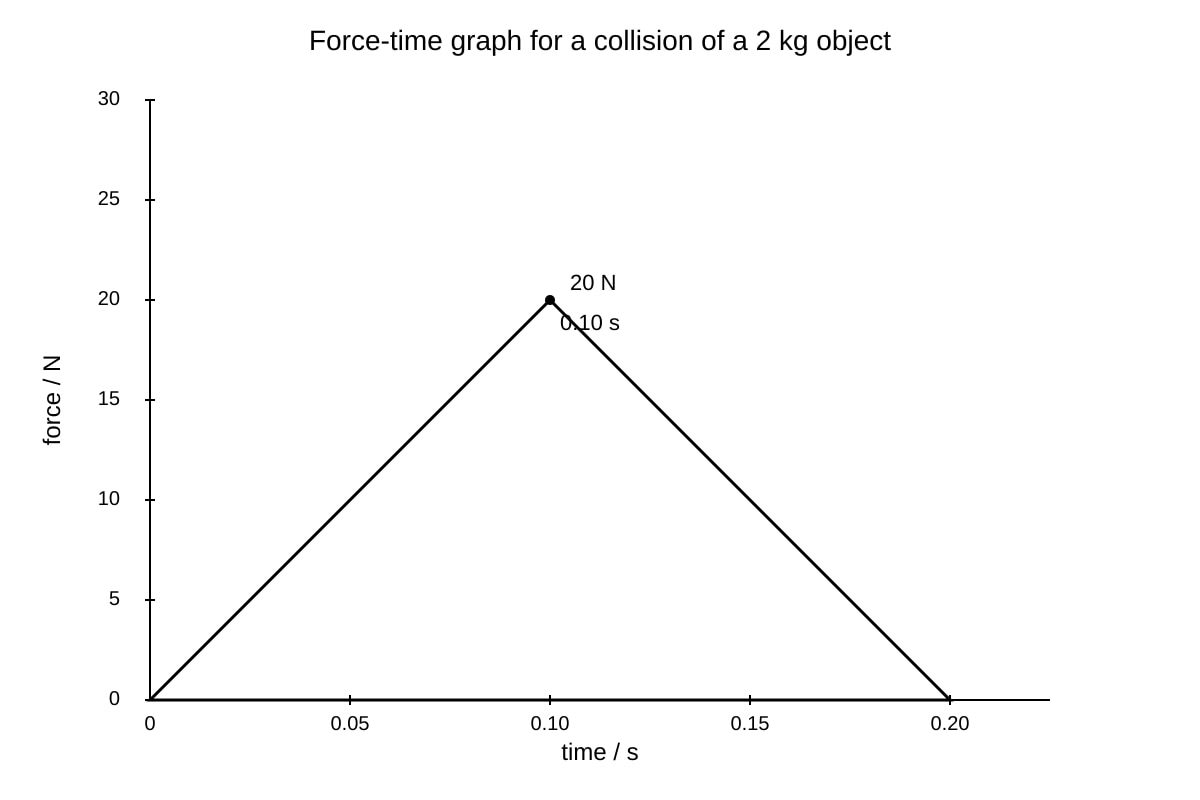
12.
Image pending generation: graph for Q12.
Using the graph in Q12-fig1, calculate the impulse acting on the object. [3]
13. A mass undergoes simple harmonic motion with amplitude 0.04 m and angular frequency 5.0 rad s−1. Calculate its maximum acceleration. [3]
Section C: Gravitation, Oscillations and Data Interpretation (Questions 14–20) [21 marks]
14. State Newton’s law of gravitation in words. [2]
15. Two masses m1=5.0 kg and m2=10.0 kg are separated by 2.0 m. Calculate the gravitational force between them. (Use G=6.67×10⁻¹¹ N m2 kg−2.) [3]
16. A satellite orbits Earth at radius r=7.0×10⁶ m. Given Earth mass M=6.0×1024 kg and G=6.67×10⁻¹¹, calculate gravitational field strength g at that orbit. [3]
17. A mass-spring system oscillates with period T=1.2 s. Calculate its angular frequency ω. [2]
18. For the same system, if amplitude is 0.05 m, calculate the maximum kinetic energy when mass is 0.20 kg. [3]
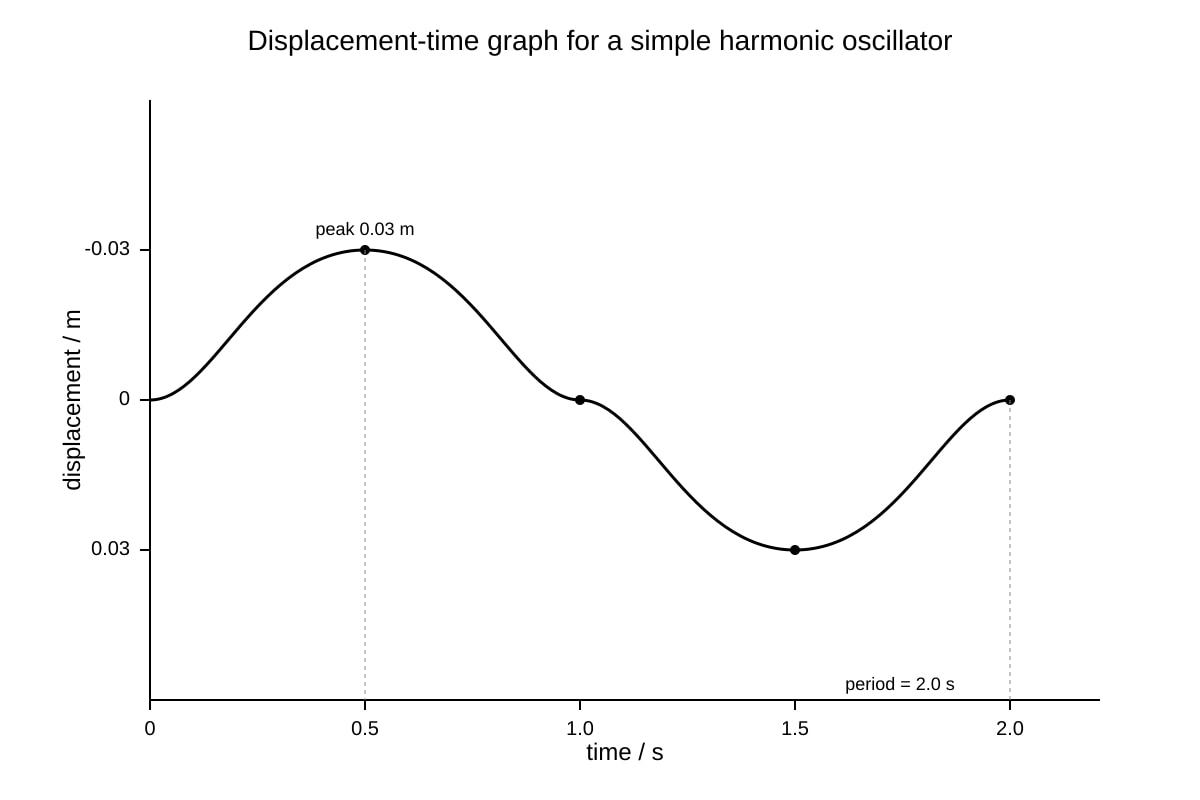
19.
Image pending generation: graph for Q19.
From Q19-fig1, state the amplitude and period of oscillation. [2]
20. A pendulum of length 1.0 m is released from small angle. Using g=9.8 m s−2, calculate the period of oscillation. [3]
Answers
TuitionGoWhere Exam Practice (AI) — Physics H2 A-Level
Practice Paper: Mechanics (Version 5 of 5) — Answer Key
Total Marks: 60
Duration: 75 minutes
Section A: Foundations of Mechanics (Q1–5)
Q1 [2 marks]
Teaching note: The principle applies to isolated systems.
Answer: In a closed (isolated) system, the total linear momentum before an event equals the total linear momentum after the event, provided no net external force acts.
Marking: 1 mark for closed/isolated system condition, 1 mark for equality before/after.
Q2 [2 marks]
Method: F=ma⇒a=F/m=6.0/2.0=3.0 m s−2.
Answer: 3.0 m s−2.
Common mistake: Using wrong mass or forgetting units.
Q3 [2 marks]
Method: a=Δv/Δt=(12−0)/(4−0)=3.0 m s−2.
Answer: 3.0 m s−2.
Q4 [3 marks]
Method: Fx=10cos30∘=8.66 N; Fy=10sin30∘=5.0 N.
Answer: Horizontal 8.7 N, vertical 5.0 N.
Marking: 1 mark each component, 1 mark units/accuracy.
Q5 [3 marks]
Method: Extension x=0.26−0.20=0.06 m. F=kx⇒k=3.0/0.06=50 N m−1.
Answer: 50 N m−1.
Section B: Motion, Collisions and Circular Motion (Q6–13)
Q6 [2 marks]
Method: h=21gt2⇒45=0.5×9.8×t2⇒t=45/4.9=3.03 s.
Answer: 3.0 s (or 3.03 s).
Q7 [2 marks]
Method: d=vxt=20×3.03=60.6 m.
Answer: 61 m (or 60.6 m).
Q8 [3 marks]
Method: Conservation of momentum: mAuA+mBuB=(mA+mB)v.
1.5×4.0+1.0×0=2.5v⇒v=6.0/2.5=2.4 m s−1.
Answer: 2.4 m s−1.
Q9 [1 mark]
Answer: Kinetic energy is conserved (or relative speed of approach = relative speed of separation).
Q10 [3 marks]
Method: Fc=mv2/r=900×202/50=7200 N.
Answer: 7.2×10³ N.
Q11 [2 marks]
Method: v=rω=0.30×4.0=1.2 m s−1.
Answer: 1.2 m s−1.
Q12 [3 marks]
Visual needed: Triangular force-time pulse, base 0.20 s, height 20 N.
Method: Impulse = area under graph = 21×0.20×20=2.0 N s.
Answer: 2.0 N s (or 2.0 kg m s−1).
Q13 [3 marks]
Method: amax=ω2x0=(5.0)2×0.04=1.0 m s−2.
Answer: 1.0 m s−2.
Common mistake: Using a=ωx0 without squaring.
Section C: Gravitation, Oscillations and Data Interpretation (Q14–20)
Q14 [2 marks]
Answer: Any two point masses attract each other with a force proportional to product of masses and inversely proportional to square of distance between them.
Marking: 1 mark product of masses, 1 mark inverse square distance.
Q15 [3 marks]
Method: F=Gm1m2/r2=(6.67×10−11×5.0×10.0)/2.02=8.34×10−10 N.
Answer: 8.3×10⁻¹⁰ N.
Q16 [3 marks]
Method: g=GM/r2=(6.67×10−11×6.0×1024)/(7.0×106)2=8.18 m s−2.
Answer: 8.2 m s−2.
Q17 [2 marks]
Method: ω=2π/T=2π/1.2=5.24 rad s−1.
Answer: 5.2 rad s−1.
Q18 [3 marks]
Method: Max KE = 21mω2x02=0.5×0.20×(5.24)2×(0.05)2=0.0137 J.
Answer: 1.4×10⁻² J.
Q19 [2 marks]
Visual needed: Sine wave amplitude 0.03 m, period 2.0 s.
Answer: Amplitude 0.03 m, period 2.0 s.
Marking: 1 mark each.
Q20 [3 marks]
Method: T=2πl/g=2π1.0/9.8=2.01 s.
Answer: 2.0 s.
Free quiz and exam paper access
Enter your details to view this paper
Your access is remembered on this device.