From Real Exams Exam Paper

A Level H2 Physics Practice Paper 4

Free Exam-Derived Owl Alpha A Level H2 Physics Practice Paper 4 practice paper with questions and answers for Singapore students. This page is rendered as a direct URL so the questions and answers can be discovered without pressing in-page buttons.

These static practice materials are generated from the site's syllabus and paper-generation workflow, with source and model context shown so students and parents can evaluate the material before use.

A Level H2 Physics From Real Exams Generated by Owl Alpha Updated 2026-06-07

Questions

<!-- TuitionGoWhere generation metadata: stage=3-1; model=openrouter/owl-alpha; model_label=Owl Alpha; generated=2026-06-06; Sources: Stage 2-1 real exam-derived templates and Stage 2-2 exam-enriched syllabus. -->

TuitionGoWhere Practice Paper - Physics H2 A-Level

School: TuitionGoWhere Secondary School (AI) Subject: Physics Level: A-Level H2 Paper: Practice Paper — Mechanics Version: 4 of 5 Duration: 1 hour 30 minutes Total Marks: 70

Name: ___________________________ Class: ___________________________ Date: ___________________________


Instructions

  • Answer ALL questions.
  • Write your answers in the spaces provided.
  • The number of marks for each question or part-question is shown in brackets [ ].
  • Assume g = 9.81 m s⁻² unless otherwise stated.
  • Unless otherwise stated, all numerical answers should be given to an appropriate number of significant figures.
  • Essential working must be shown for calculation questions. Answers without working may not receive full credit.
  • A list of formulae is provided on the last page of this paper.

Section A: Multiple Choice [15 marks]

Questions 1–15: Each question is worth 1 mark. Choose the ONE correct answer.


1. A ball is thrown vertically upwards with an initial speed of 20 m s⁻¹. Ignoring air resistance, what is the maximum height reached by the ball?

A. 10.2 m B. 20.4 m C. 40.8 m D. 81.6 m

Answer: _______________


2. Which of the following is a vector quantity?

A. Energy B. Power C. Speed D. Momentum

Answer: _______________


3. A car accelerates uniformly from rest at 3.0 m s⁻² for 8.0 s. What distance does it travel in this time?

A. 12 m B. 24 m C. 96 m D. 192 m

Answer: _______________


4. A 2.0 kg object moving at 5.0 m s⁻¹ collides with a stationary 3.0 kg object. After the collision, the two objects stick together. What is their common velocity after the collision?

A. 1.0 m s⁻¹ B. 2.0 m s⁻¹ C. 3.0 m s⁻¹ D. 5.0 m s⁻¹

Answer: _______________


5. A satellite orbits the Earth in a circular orbit of radius r with speed v. If the orbital radius is doubled, what happens to the orbital speed?

A. It becomes v2\frac{v}{2} B. It becomes v2\frac{v}{\sqrt{2}} C. It becomes v2v\sqrt{2} D. It becomes 2v2v

Answer: _______________


6. A force of 15 N acts on a body of mass 5.0 kg for 3.0 s. What is the change in momentum of the body?

A. 5.0 kg m s⁻¹ B. 15 kg m s⁻¹ C. 45 kg m s⁻¹ D. 75 kg m s⁻¹

Answer: _______________


7. A stone is whirled in a vertical circle at constant speed. At the highest point of the circle, the tension in the string is T. Which expression correctly gives the net centripetal force on the stone at this point? (m = mass of stone, g = gravitational acceleration)

A. T+mgT + mg B. TmgT - mg C. mgTmg - T D. TT

Answer: _______________


8. A uniform plank of length 4.0 m and weight 200 N is supported at both ends. A load of 300 N is placed 1.0 m from the left end. What is the reaction force at the right support?

A. 175 N B. 200 N C. 225 N D. 275 N

Answer: _______________


9. A projectile is launched horizontally from a cliff at 15 m s⁻¹. It takes 3.0 s to reach the ground. What is the horizontal range of the projectile?

A. 15 m B. 30 m C. 45 m D. 60 m

Answer: _______________


10. Which statement correctly describes the Principle of Conservation of Linear Momentum?

A. The total momentum of a system is always increasing. B. The total momentum of a system remains constant provided no external resultant force acts on the system. C. The total momentum of a system is conserved only during elastic collisions. D. The total momentum of a system is conserved only when energy is also conserved.

Answer: _______________


11. A car of mass 1200 kg travels around a horizontal circular bend of radius 50 m at a constant speed of 20 m s⁻¹. What is the magnitude of the centripetal force acting on the car?

A. 480 N B. 9600 N C. 24000 N D. 48000 N

Answer: _______________


12. A spring with spring constant 400 N m⁻¹ is compressed by 0.10 m. What is the elastic potential energy stored in the spring?

A. 2.0 J B. 4.0 J C. 20 J D. 40 J

Answer: _______________


13. An object of mass 0.50 kg is moving in a horizontal circle of radius 2.0 m at a frequency of 0.50 Hz. What is the centripetal acceleration of the object?

A. π2\pi^2 m s⁻² B. 2π22\pi^2 m s⁻² C. 4π24\pi^2 m s⁻² D. 8π28\pi^2 m s⁻²

Answer: _______________


14. A 4.0 kg block slides down a rough inclined plane at constant velocity. The plane is inclined at 30° to the horizontal. What is the magnitude of the frictional force acting on the block?

A. 9.8 N B. 19.6 N C. 33.9 N D. 39.2 N

Answer: _______________


15. A ball is dropped from a height of 80 m above the ground. What is its speed just before it hits the ground? (Ignore air resistance.)

A. 28.0 m s⁻¹ B. 39.6 m s⁻¹ C. 44.3 m s⁻¹ D. 56.0 m s⁻¹

Answer: _______________


Section B: Structured Questions [35 marks]


16. [6 marks]

(a) State Newton's Second Law of Motion. [2]


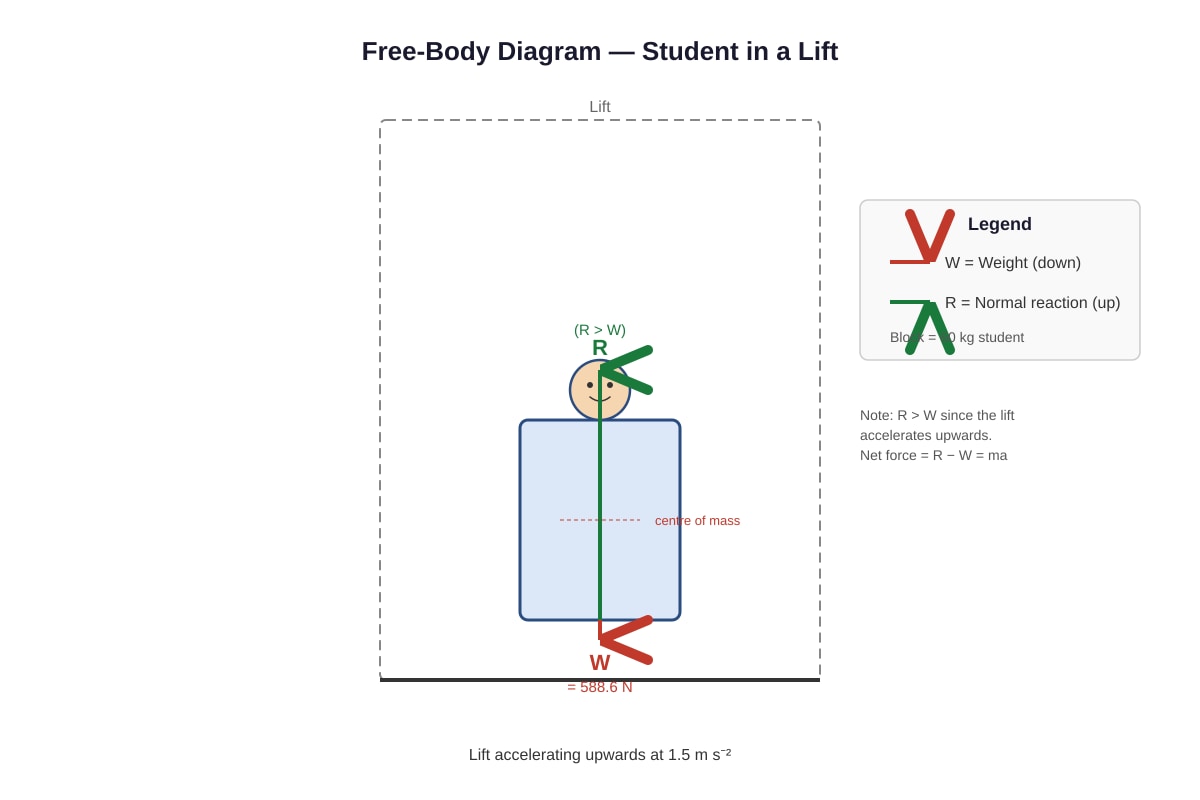
(b) A 60 kg student stands in a lift. The lift accelerates upwards at 1.5 m s⁻².

    (i) Draw a free-body diagram showing all the forces acting on the student. Label the forces clearly. [1]

<image_placeholder> id = Q16b-fig1 type = diagram linked_question = Q16(b)(i) description = Free-body diagram of a student in a lift. Show the student as a rectangular block with two forces: weight (W) acting vertically downward from the centre of the block, and normal reaction force (R or N) acting vertically upward from the bottom of the block. The upward force arrow should be longer than the downward force arrow to indicate upward acceleration. Both forces should be clearly labelled. labels = W (weight, downward), R (normal reaction, upward) values = W = mg = 60 × 9.81 = 588.6 N, R > W must_show = Two clearly labelled force arrows, upward arrow longer than downward arrow, student represented as a block

</image_placeholder>

    (ii) Calculate the normal reaction force exerted by the lift floor on the student. [3]

Working:


Answer: ___________________________


17. [7 marks]

A 0.80 kg trolley A moves to the right at 3.0 m s⁻¹ on a frictionless horizontal track. It collides with a stationary trolley B of mass 1.2 kg. After the collision, trolley A moves to the left at 0.60 m s⁻¹.

(a) State the principle of conservation of linear momentum. [1]


(b) Calculate the velocity of trolley B immediately after the collision. Show your working. [4]

Working:


Answer: ___________________________

(c) Determine whether the collision is elastic or inelastic. Show your reasoning. [2]


18. [6 marks]

A small ball of mass 0.25 kg is attached to a light inextensible string of length 0.80 m and is made to move in a vertical circle.

(a) Calculate the minimum speed the ball must have at the top of the circle for it to just maintain circular motion. [3]

Working:


Answer: ___________________________

(b) If the speed of the ball at the bottom of the circle is 6.0 m s⁻¹, calculate the tension in the string at the bottom. [3]

Working:


Answer: ___________________________


19. [8 marks]

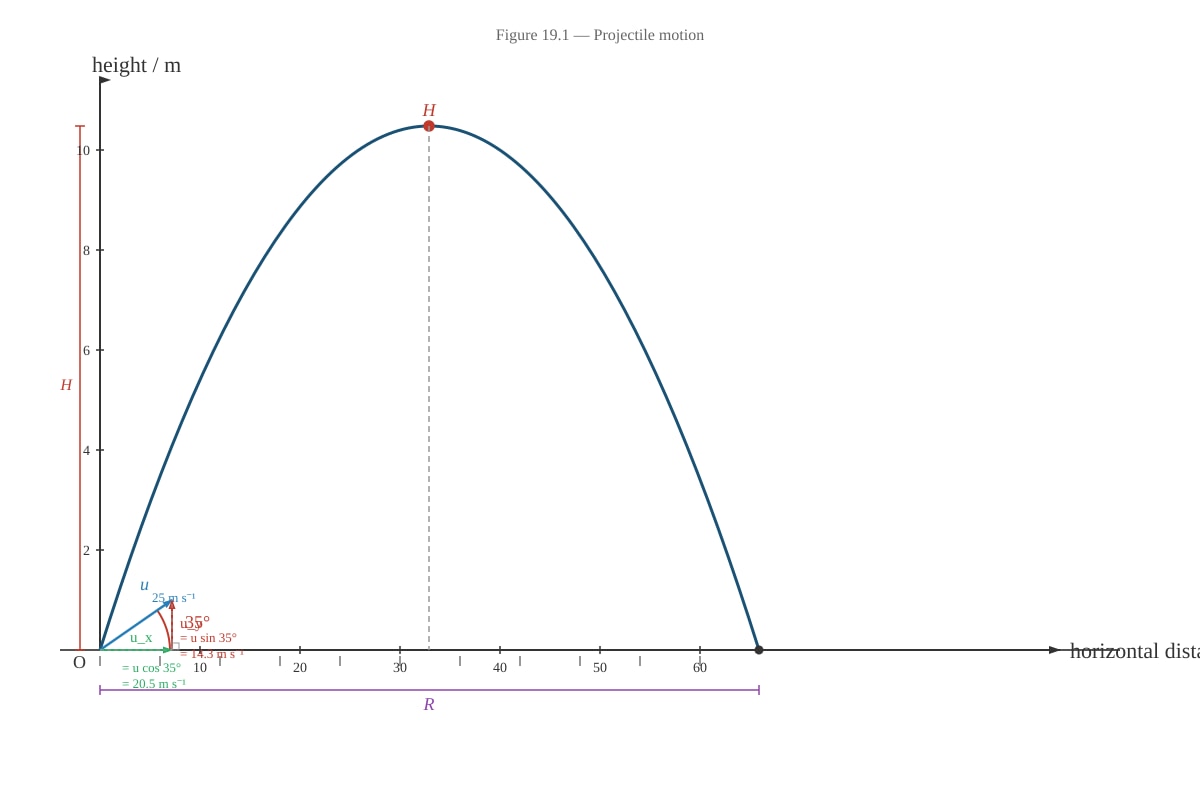
A projectile is launched from ground level at an angle of 35° above the horizontal with an initial speed of 25 m s⁻¹. Assume air resistance is negligible.

<image_placeholder> id = Q19-fig1 type = graph linked_question = Q19 description = Trajectory diagram of a projectile launched from ground level at an angle. Show the parabolic path starting from origin (0,0), rising to a maximum height, and landing back on the horizontal ground. Label the launch angle of 35° at the origin between the initial velocity vector and the horizontal. Mark the maximum height point and the range on the horizontal axis. Show the initial velocity vector decomposed into horizontal and vertical components. labels = Launch angle = 35°, Initial speed u = 25 m s⁻¹, Maximum height H, Range R, Horizontal component u_x = u cos(35°), Vertical component u_y = u sin(35°) values = u = 25 m s⁻¹, θ = 35°, u_x = 25 cos(35°) = 20.5 m s⁻¹, u_y = 25 sin(35°) = 14.3 m s⁻¹ must_show = Parabolic trajectory, launch angle labelled, initial velocity components, maximum height, range, axes labelled with distance

</image_placeholder>

(a) Calculate the horizontal and vertical components of the initial velocity. [2]

Working:


Answer: Horizontal component: ___________________________ Answer: Vertical component: ___________________________

(b) Calculate the maximum height reached by the projectile. [3]

Working:


Answer: ___________________________

(c) Calculate the horizontal range of the projectile. [3]

Working:


Answer: ___________________________


20. [8 marks]

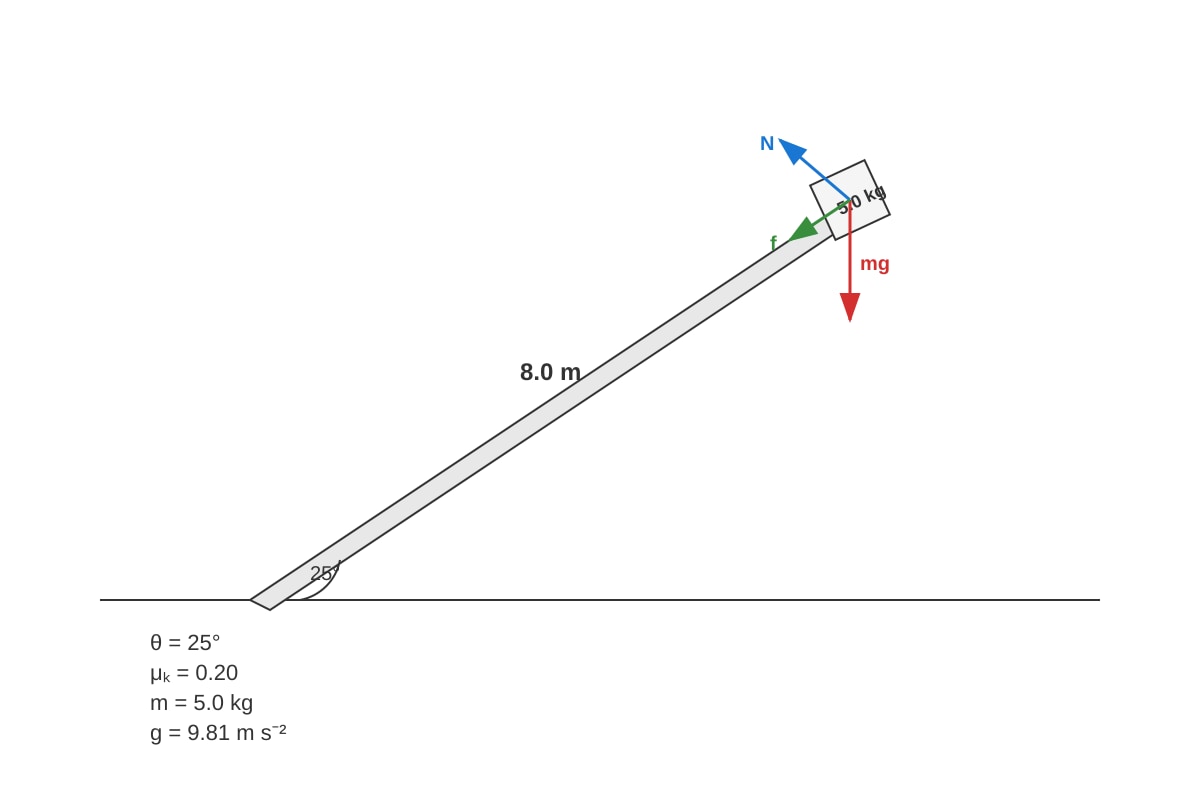
A 5.0 kg block is released from rest at the top of a rough inclined plane of length 8.0 m, inclined at 25° to the horizontal. The coefficient of kinetic friction between the block and the plane is 0.20.

<image_placeholder> id = Q20-fig1 type = diagram linked_question = Q20 description = Diagram of a block on an inclined plane. Show the inclined plane at angle 25° to the horizontal. The block is at the top of the incline. Label the length of the incline as 8.0 m. Show all forces acting on the block: weight (mg) acting vertically downward, normal reaction (N) perpendicular to the surface, and frictional force (f) acting up the slope (opposing motion). Show the angle 25° between the incline and the horizontal. labels = θ = 25°, length = 8.0 m, mass = 5.0 kg, μ_k = 0.20, mg (weight, vertically down), N (normal reaction, perpendicular to surface), f (friction, up the slope) values = m = 5.0 kg, g = 9.81 m s⁻², θ = 25°, μ_k = 0.20, length = 8.0 m must_show = Inclined plane at 25°, block at top, all three forces labelled, angle marked, length labelled

</image_placeholder>

(a) Calculate the component of the weight acting parallel to the inclined plane. [2]

Working:


Answer: ___________________________

(b) Calculate the frictional force acting on the block. [2]

Working:


Answer: ___________________________

(c) Using the work-energy principle, calculate the speed of the block at the bottom of the inclined plane. [4]

Working:


Answer: ___________________________


Section C: Long Structured Question [20 marks]


21. [20 marks]

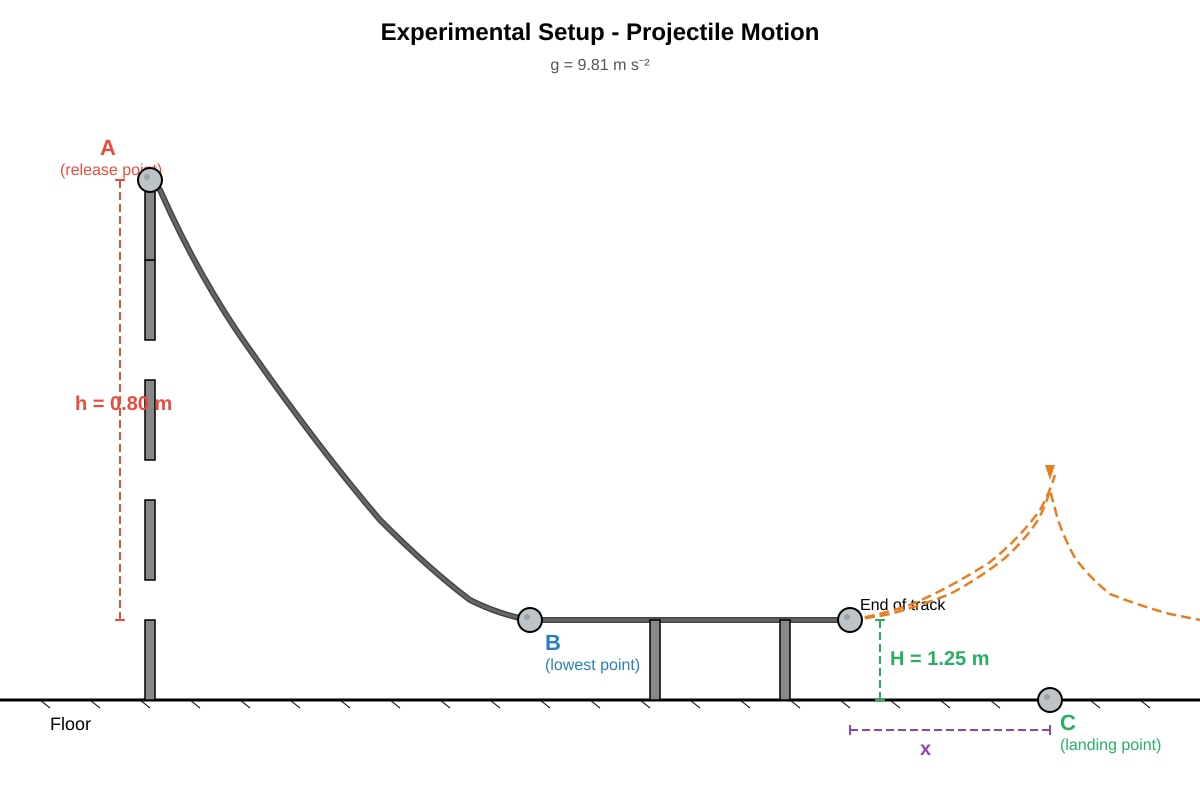
A physics experiment is set up to investigate the motion of a ball bearing on a curved track. The ball bearing is released from rest at point A at a height h = 0.80 m above the lowest point of the track, point B. After passing point B, the ball bearing enters a horizontal section of track and then becomes a projectile, landing on the floor at point C. The horizontal distance from the end of the track to point C is x. The vertical height from the end of the track to the floor is H = 1.25 m.

<image_placeholder> id = Q21-fig1 type = experimental_setup linked_question = Q21 description = Side-view diagram of the experimental setup. Show a curved track starting at point A at height h = 0.80 m above point B (the lowest point of the track). The track becomes horizontal after point B. The end of the horizontal track is at height H = 1.25 m above the floor. Show the parabolic projectile path from the end of the track to point C on the floor. Label all key points: A (release point), B (lowest point), end of track, C (landing point). Label heights h and H, and horizontal distance x. labels = A (release point, height h = 0.80 m above B), B (lowest point of track), End of track (height H = 1.25 m above floor), C (landing point on floor), h = 0.80 m, H = 1.25 m, x (horizontal range) values = h = 0.80 m, H = 1.25 m, g = 9.81 m s⁻² must_show = Curved track, horizontal section, projectile path, all labelled points and distances, vertical heights clearly marked

</image_placeholder>

(a) State the principle of conservation of energy. [1]


(b) Assuming the track is frictionless, calculate the speed of the ball bearing at point B. [3]

Working:


Answer: ___________________________

(c) Calculate the speed of the ball bearing as it leaves the horizontal section of the track (at the end of the track). State any assumption you make. [2]


Answer: ___________________________

(d) Calculate the time taken for the ball bearing to travel from the end of the track to point C. [2]

Working:


Answer: ___________________________

(e) Hence, calculate the horizontal distance x. [2]

Working:


Answer: ___________________________

(f) In a real experiment, the measured value of x is found to be less than the calculated value. Suggest a reason for this discrepancy. [1]


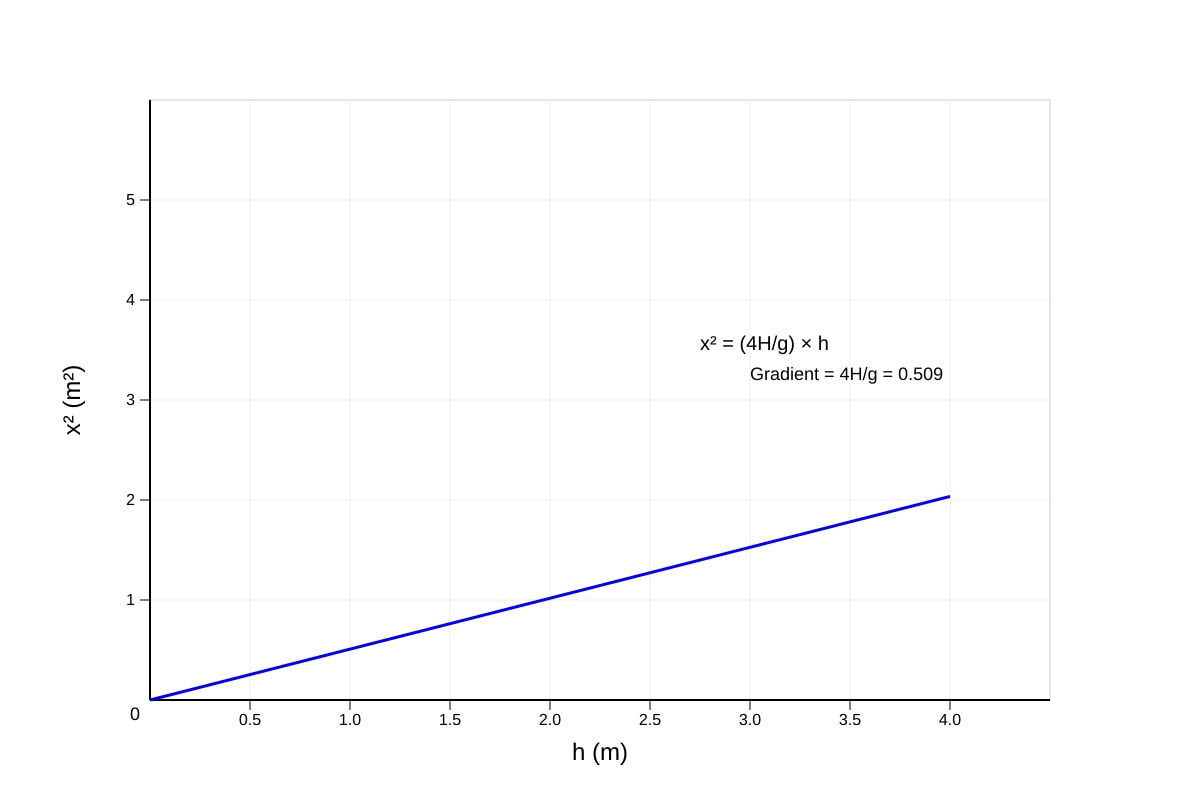
(g) The experiment is repeated with the ball bearing released from different heights h. The results are plotted as x² on the y-axis against h on the x-axis.

    (i) Using your answers from parts (b) to (e), derive an expression for x² in terms of h. [4]

Working:


Answer: ___________________________

    (ii) State the expected shape of the graph of x² against h and explain how the gradient of this graph can be used to determine the value of g. [3]


    (iii) Sketch the expected graph of x² against h on the axes below. [2]

<image_placeholder> id = Q21g-fig2 type = graph linked_question = Q21(g)(iii) description = Sketch graph with x² on the vertical axis and h on the horizontal axis. The graph should be a straight line passing through the origin with a positive gradient. The line should be labelled as the expected relationship x² = (4H/g) × h. Axes should be clearly labelled with quantities and units. labels = x-axis: h (m), y-axis: x² (m²), straight line through origin values = Gradient = 4H/g = 4(1.25)/9.81 = 0.509 m must_show = Straight line through origin, positive gradient, axes labelled with quantities, line clearly drawn

</image_placeholder>


Formulae Sheet

QuantityFormula
Kinematics (constant a)v=u+atv = u + at, s=ut+12at2s = ut + \frac{1}{2}at^2, v2=u2+2asv^2 = u^2 + 2as
Newton's Second LawF=maF = ma
Momentump=mvp = mv
ImpulseFΔt=ΔpF\Delta t = \Delta p
Kinetic energyKE=12mv2KE = \frac{1}{2}mv^2
Gravitational potential energyGPE=mghGPE = mgh
Work doneW=FscosθW = Fs\cos\theta
PowerP=Fv=WtP = Fv = \frac{W}{t}
Centripetal accelerationac=v2r=ω2ra_c = \frac{v^2}{r} = \omega^2 r
Centripetal forceFc=mv2rF_c = \frac{mv^2}{r}
Gravitational forceF=GMmr2F = \frac{GMm}{r^2}
Orbital speedv=GMrv = \sqrt{\frac{GM}{r}}
Frictionf=μNf = \mu N
Elastic potential energyE=12kx2E = \frac{1}{2}kx^2

END OF PAPER

Section A: 15 marks | Section B: 35 marks | Section C: 20 marks | Total: 70 marks

Answers

<!-- TuitionGoWhere generation metadata: stage=3-1; model=openrouter/owl-alpha; model_label=Owl Alpha; generated=2026-06-06; Sources: Stage 2-1 real exam-derived templates and Stage 2-2 exam-enriched syllabus. -->

TuitionGoWhere Practice Paper - Physics H2 A-Level

Answer Key — Mechanics (Version 4 of 5)


Section A: Multiple Choice [15 marks]

1. B [1]

Teaching note: At maximum height, the final velocity is zero. Using v2=u22ghv^2 = u^2 - 2gh with v=0v = 0: h=u22g=2022×9.81=40019.62=20.4h = \frac{u^2}{2g} = \frac{20^2}{2 \times 9.81} = \frac{400}{19.62} = 20.4 m. This uses the kinematic equation for constant acceleration (gravity), where the only force acting is weight.


2. D [1]

Teaching note: Momentum (p=mvp = mv) has both magnitude and direction, making it a vector. Energy, power, and speed are all scalar quantities — they have magnitude only. A common mistake is confusing speed (scalar) with velocity (vector).


3. C [1]

Teaching note: Using s=ut+12at2s = ut + \frac{1}{2}at^2 with u=0u = 0: s=0+12(3.0)(8.0)2=12(3.0)(64)=96s = 0 + \frac{1}{2}(3.0)(8.0)^2 = \frac{1}{2}(3.0)(64) = 96 m. This is a direct application of the kinematic equation for uniform acceleration from rest.


4. B [1]

Teaching note: By conservation of momentum: m1u1+m2u2=(m1+m2)vm_1 u_1 + m_2 u_2 = (m_1 + m_2)v. So (2.0)(5.0)+(3.0)(0)=(2.0+3.0)v(2.0)(5.0) + (3.0)(0) = (2.0 + 3.0)v, giving 10=5.0v10 = 5.0v, so v=2.0v = 2.0 m s⁻¹. This is a perfectly inelastic collision (objects stick together), so kinetic energy is NOT conserved, but momentum always is (in the absence of external forces).


5. B [1]

Teaching note: For a satellite in circular orbit, GMmr2=mv2r\frac{GMm}{r^2} = \frac{mv^2}{r}, so v=GMrv = \sqrt{\frac{GM}{r}}. If rr doubles, vv becomes v2\frac{v}{\sqrt{2}}. The orbital speed decreases with increasing radius. A common trap is to assume vrv \propto r or v1rv \propto \frac{1}{r} instead of v1rv \propto \frac{1}{\sqrt{r}}.


6. C [1]

Teaching note: Impulse = change in momentum = FΔt=15×3.0=45F \Delta t = 15 \times 3.0 = 45 kg m s⁻¹. This follows directly from the impulse-momentum theorem: the impulse delivered by a force equals the change in momentum of the object.


7. A [1]

Teaching note: At the top of the vertical circle, both the tension TT (acting downward toward the centre) and the weight mgmg (also downward) contribute to the centripetal force. The net centripetal force is T+mg=mv2rT + mg = \frac{mv^2}{r}. A common mistake is subtracting the forces — at the top, both point toward the centre (downward).


8. A [1]

Teaching note: Taking moments about the left support: The 200 N weight acts at the centre (2.0 m from left), and the 300 N load acts 1.0 m from the left. Let RRR_R be the right reaction. RR×4.0=200×2.0+300×1.0=400+300=700R_R \times 4.0 = 200 \times 2.0 + 300 \times 1.0 = 400 + 300 = 700. So RR=175R_R = 175 N. This uses the principle of moments: for equilibrium, the sum of clockwise moments equals the sum of anticlockwise moments.


9. C [1]

Teaching note: For a horizontally launched projectile, horizontal motion has constant velocity: x=vx×t=15×3.0=45x = v_x \times t = 15 \times 3.0 = 45 m. The vertical fall time is independent of the horizontal speed. Students sometimes mistakenly use the vertical motion equation for horizontal distance.


10. B [1]

Teaching note: The Principle of Conservation of Linear Momentum states that the total momentum of a system remains constant provided no external resultant force acts on the system. Key conditions: (1) it applies to a system of objects, (2) the condition is "no external resultant force" (not just "no forces"), and (3) it applies to ALL types of collisions, not just elastic ones.


11. B [1]

Teaching note: Centripetal force Fc=mv2r=1200×20250=1200×40050=48000050=9600F_c = \frac{mv^2}{r} = \frac{1200 \times 20^2}{50} = \frac{1200 \times 400}{50} = \frac{480000}{50} = 9600 N. This is provided by friction between the tyres and the road. A common error is forgetting to square the velocity.


12. A [1]

Teaching note: Elastic potential energy E=12kx2=12(400)(0.10)2=12(400)(0.01)=2.0E = \frac{1}{2}kx^2 = \frac{1}{2}(400)(0.10)^2 = \frac{1}{2}(400)(0.01) = 2.0 J. Note that the energy depends on x2x^2, not just xx. Students sometimes forget to square the extension or omit the factor of 12\frac{1}{2}.


13. A [1]

Teaching note: Centripetal acceleration ac=ω2ra_c = \omega^2 r. Angular velocity ω=2πf=2π(0.50)=π\omega = 2\pi f = 2\pi(0.50) = \pi rad s⁻¹. So ac=π2×2.0=2π2a_c = \pi^2 \times 2.0 = 2\pi^2... Wait, let me recalculate: ac=ω2r=π2×2.0=2π2a_c = \omega^2 r = \pi^2 \times 2.0 = 2\pi^2 m s⁻². The answer is B.

Correction: B [1]

ac=(2πf)2×r=(2π×0.50)2×2.0=π2×2.0=2π2a_c = (2\pi f)^2 \times r = (2\pi \times 0.50)^2 \times 2.0 = \pi^2 \times 2.0 = 2\pi^2 m s⁻².


14. B [1]

Teaching note: At constant velocity, the net force along the incline is zero. The component of weight down the incline is mgsinθ=4.0×9.81×sin(30°)=4.0×9.81×0.5=19.6mg\sin\theta = 4.0 \times 9.81 \times \sin(30°) = 4.0 \times 9.81 \times 0.5 = 19.6 N. This must equal the frictional force (which acts up the slope to balance the motion). The frictional force is 19.6 N.


15. B [1]

Teaching note: Using v2=u2+2ghv^2 = u^2 + 2gh with u=0u = 0: v=2gh=2×9.81×80=1569.6=39.6v = \sqrt{2gh} = \sqrt{2 \times 9.81 \times 80} = \sqrt{1569.6} = 39.6 m s⁻¹. Alternatively, using conservation of energy: mgh=12mv2mgh = \frac{1}{2}mv^2, so v=2ghv = \sqrt{2gh}. A common error is using v=gtv = gt without first finding tt, or using h=12gt2h = \frac{1}{2}gt^2 and then v=gtv = gt (which also works but takes longer).


Section B: Structured Questions [35 marks]


16. [6 marks]

(a) [2]

Newton's Second Law: The rate of change of momentum of an object is directly proportional to the resultant force acting on it and takes place in the direction of the resultant force. [1]

OR equivalently: The resultant force acting on an object is equal to the product of its mass and acceleration (F=maF = ma). [1]

Marking: Award 1 mark for the proportionality statement and 1 mark for the direction statement (or the F=maF = ma form).

(b)(i) [1]

The free-body diagram should show:

  • Weight (W=mgW = mg) acting vertically downward from the centre of mass
  • Normal reaction force (RR) acting vertically upward from the floor of the lift
  • The upward arrow (R) must be longer than the downward arrow (W) since the net force is upward (upward acceleration)

Marking: 1 mark for both forces correctly shown and labelled, with the correct relative sizes.

(b)(ii) [3]

Applying Newton's Second Law (upward positive): Rmg=maR - mg = ma R=m(g+a)R = m(g + a) R=60(9.81+1.5)R = 60(9.81 + 1.5) R=60×11.31R = 60 \times 11.31 R=678.6 N679 N\boxed{R = 678.6 \text{ N} \approx 679 \text{ N}}

Marking:

  • [1] for correct equation: Rmg=maR - mg = ma or equivalent
  • [1] for correct substitution
  • [1] for correct answer with unit

Common mistake: Students may write R=mgR = mg (ignoring the acceleration) or R=maR = ma (ignoring the weight).


17. [7 marks]

(a) [1]

The principle of conservation of linear momentum states that the total momentum of a system remains constant provided no external resultant force acts on the system.

Marking: Award 1 mark for a complete statement including the condition (no external force / closed system).

(b) [4]

Taking right as positive:

Conservation of momentum: mAuA+mBuB=mAvA+mBvBm_A u_A + m_B u_B = m_A v_A + m_B v_B (0.80)(3.0)+(1.2)(0)=(0.80)(0.60)+(1.2)(vB)(0.80)(3.0) + (1.2)(0) = (0.80)(-0.60) + (1.2)(v_B) 2.4=0.48+1.2vB2.4 = -0.48 + 1.2 v_B 2.88=1.2vB2.88 = 1.2 v_B vB=2.4 m s1 (to the right)\boxed{v_B = 2.4 \text{ m s}^{-1} \text{ (to the right)}}

Marking:

  • [1] for correct equation with correct signs
  • [1] for correct substitution of values
  • [1] for correct algebraic manipulation
  • [1] for correct answer with direction

Common mistake: Forgetting that trolley A moves to the LEFT after the collision, so vA=0.60v_A = -0.60 m s⁻¹. Using +0.60+0.60 gives vB=1.6v_B = 1.6 m s⁻¹ (wrong).

(c) [2]

Calculate total kinetic energy before and after:

Before: KEi=12(0.80)(3.0)2+0=3.6KE_i = \frac{1}{2}(0.80)(3.0)^2 + 0 = 3.6 J

After: KEf=12(0.80)(0.60)2+12(1.2)(2.4)2=0.144+3.456=3.6KE_f = \frac{1}{2}(0.80)(0.60)^2 + \frac{1}{2}(1.2)(2.4)^2 = 0.144 + 3.456 = 3.6 J

Since KEi=KEfKE_i = KE_f, the collision is elastic.

Marking:

  • [1] for calculating both kinetic energies correctly
  • [1] for correct conclusion

Note: If the kinetic energies were not equal, the collision would be inelastic. In all real collisions, momentum is conserved, but kinetic energy is only conserved in elastic collisions.


18. [6 marks]

(a) [3]

At the top of the circle, the minimum speed occurs when the tension in the string is zero (the string is just about to go slack). At this point, the weight alone provides the centripetal force:

mg=mv2rmg = \frac{mv^2}{r} v2=grv^2 = gr v=gr=9.81×0.80=7.848v = \sqrt{gr} = \sqrt{9.81 \times 0.80} = \sqrt{7.848} v=2.80 m s1\boxed{v = 2.80 \text{ m s}^{-1}}

Marking:

  • [1] for setting mg=mv2rmg = \frac{mv^2}{r} (recognising tension = 0 at minimum speed)
  • [1] for correct substitution
  • [1] for correct answer

Common mistake: Students may include tension in the equation, but at the minimum speed, tension is zero.

(b) [3]

At the bottom of the circle, both tension (upward, toward centre) and weight (downward, away from centre) act. The net centripetal force (toward centre, upward) is:

Tmg=mv2rT - mg = \frac{mv^2}{r} T=mg+mv2rT = mg + \frac{mv^2}{r} T=0.25×9.81+0.25×6.020.80T = 0.25 \times 9.81 + \frac{0.25 \times 6.0^2}{0.80} T=2.4525+0.25×360.80T = 2.4525 + \frac{0.25 \times 36}{0.80} T=2.4525+11.25T = 2.4525 + 11.25 T=13.8 N (to 3 s.f.)\boxed{T = 13.8 \text{ N} \text{ (to 3 s.f.)}}

Marking:

  • [1] for correct equation: Tmg=mv2rT - mg = \frac{mv^2}{r}
  • [1] for correct substitution
  • [1] for correct answer with unit

Common mistake: Writing T+mg=mv2rT + mg = \frac{mv^2}{r} (wrong direction for weight at the bottom) or T=mv2rT = \frac{mv^2}{r} (forgetting weight entirely).


19. [8 marks]

(a) [2]

Horizontal component: ux=ucosθ=25cos(35°)=25×0.8192u_x = u\cos\theta = 25\cos(35°) = 25 \times 0.8192 ux=20.5 m s1\boxed{u_x = 20.5 \text{ m s}^{-1}}

Vertical component: uy=usinθ=25sin(35°)=25×0.5736u_y = u\sin\theta = 25\sin(35°) = 25 \times 0.5736 uy=14.3 m s1\boxed{u_y = 14.3 \text{ m s}^{-1}}

Marking: [1] each for correct horizontal and vertical components.

(b) [3]

At maximum height, vertical velocity vy=0v_y = 0: vy2=uy22gHv_y^2 = u_y^2 - 2gH 0=(14.3)22(9.81)H0 = (14.3)^2 - 2(9.81)H H=(14.3)22×9.81=204.4919.62H = \frac{(14.3)^2}{2 \times 9.81} = \frac{204.49}{19.62} H=10.4 m\boxed{H = 10.4 \text{ m}}

Marking:

  • [1] for correct equation
  • [1] for correct substitution
  • [1] for correct answer

(c) [3]

Time of flight: The total time is found from the vertical motion. Using s=uyt12gt2s = u_yt - \frac{1}{2}gt^2 with s=0s = 0 (returns to ground level): 0=uyt12gt20 = u_yt - \frac{1}{2}gt^2 t(uy12gt)=0t(u_y - \frac{1}{2}gt) = 0 t=0t = 0 (launch) or t=2uyg=2×14.39.81=2.915t = \frac{2u_y}{g} = \frac{2 \times 14.3}{9.81} = 2.915 s

Horizontal range: R=ux×t=20.5×2.915R = u_x \times t = 20.5 \times 2.915 R=59.8 m\boxed{R = 59.8 \text{ m}}

Marking:

  • [1] for correct time of flight calculation
  • [1] for using horizontal velocity × time
  • [1] for correct answer

Alternative: Using R=u2sin(2θ)g=625×sin(70°)9.81=625×0.93979.81=59.8R = \frac{u^2 \sin(2\theta)}{g} = \frac{625 \times \sin(70°)}{9.81} = \frac{625 \times 0.9397}{9.81} = 59.8 m.


20. [8 marks]

(a) [2]

Component of weight parallel to the incline: F=mgsinθ=5.0×9.81×sin(25°)F_{\parallel} = mg\sin\theta = 5.0 \times 9.81 \times \sin(25°) F=5.0×9.81×0.4226F_{\parallel} = 5.0 \times 9.81 \times 0.4226 F=20.7 N\boxed{F_{\parallel} = 20.7 \text{ N}}

Marking:

  • [1] for correct formula mgsinθmg\sin\theta
  • [1] for correct answer

(b) [2]

Normal reaction: N=mgcosθ=5.0×9.81×cos(25°)=5.0×9.81×0.9063=44.45N = mg\cos\theta = 5.0 \times 9.81 \times \cos(25°) = 5.0 \times 9.81 \times 0.9063 = 44.45 N

Frictional force: f=μkN=0.20×44.45f = \mu_k N = 0.20 \times 44.45 f=8.89 N\boxed{f = 8.89 \text{ N}}

Marking:

  • [1] for finding normal reaction correctly
  • [1] for correct frictional force

(c) [4]

Using the work-energy principle. The net work done on the block equals the change in change in kinetic energy:

Work done by gravity (parallel component): Wg=mgsinθ×s=20.7×8.0=165.6W_g = mg\sin\theta \times s = 20.7 \times 8.0 = 165.6 J

Work done against friction: Wf=f×s=8.89×8.0=71.1W_f = -f \times s = -8.89 \times 8.0 = -71.1 J

Net work done: Wnet=165.671.1=94.5W_{net} = 165.6 - 71.1 = 94.5 J

This equals the gain in kinetic energy: 12mv2=94.5\frac{1}{2}mv^2 = 94.5 v=2×94.55.0=37.8v = \sqrt{\frac{2 \times 94.5}{5.0}} = \sqrt{37.8} v=6.15 m s1\boxed{v = 6.15 \text{ m s}^{-1}}

Marking:

  • [1] for correct work done by gravity along the slope
  • [1] for correct work done against friction
  • [1] for applying work-energy principle correctly
  • [1] for correct final answer

Alternative approach: Using Newton's Second Law to find acceleration, then kinematics: a=gsinθμkgcosθ=9.81(0.4226)0.20×9.81(0.9063)=4.1461.778=2.368a = g\sin\theta - \mu_k g\cos\theta = 9.81(0.4226) - 0.20 \times 9.81(0.9063) = 4.146 - 1.778 = 2.368 m s⁻² v2=2as=2(2.368)(8.0)=37.89v^2 = 2as = 2(2.368)(8.0) = 37.89, so v=6.16v = 6.16 m s⁻¹ ✓


Section C: Long Structured Question [20 marks]


21. [20 marks]

(a) [1]

The principle of conservation of energy states that energy cannot be created or destroyed, only converted from one form to another (or transferred from one body to another). The total energy of an isolated system remains constant.

Marking: Award 1 mark for a complete statement.

(b) [3]

Using conservation of energy from A to B: mgh=12mvB2mgh = \frac{1}{2}mv_B^2 vB=2gh=2×9.81×0.80=15.696v_B = \sqrt{2gh} = \sqrt{2 \times 9.81 \times 0.80} = \sqrt{15.696} vB=3.96 m s1\boxed{v_B = 3.96 \text{ m s}^{-1}}

Marking:

  • [1] for correct energy conservation equation
  • [1] for correct substitution
  • [1] for correct answer

(c) [2]

Assuming the horizontal section of the track is at the same height as point B (i.e., the track is level after B), there is no further change in height, so by conservation of energy, the speed at the end of the track equals the speed at point B.

v=3.96 m s1\boxed{v = 3.96 \text{ m s}^{-1}}

Assumption: The horizontal section is at the same vertical height as point B (no further change in gravitational potential energy).

Marking:

  • [1] for correct answer
  • [1] for stating the assumption

(d) [2]

For the projectile motion (vertical): Using H=12gt2H = \frac{1}{2}gt^2 (initial vertical velocity = 0): 1.25=12(9.81)t21.25 = \frac{1}{2}(9.81)t^2 t2=2×1.259.81=2.509.81=0.2548t^2 = \frac{2 \times 1.25}{9.81} = \frac{2.50}{9.81} = 0.2548 t=0.505 s\boxed{t = 0.505 \text{ s}}

Marking:

  • [1] for correct equation
  • [1] for correct answer

(e) [2]

x=v×t=3.96×0.505x = v \times t = 3.96 \times 0.505 x=2.00 m\boxed{x = 2.00 \text{ m}}

Marking:

  • [1] for using horizontal velocity × time
  • [1] for correct answer

(f) [1]

The measured value of xx is less than the calculated value because friction/air resistance acts on the ball bearing along the track, reducing its speed at the end of the track (and hence reducing the horizontal range).

Acceptable answers:

  • Friction between the ball bearing and the track
  • Air resistance
  • Energy lost to sound/heat during the motion

Marking: Award 1 mark for any valid reason that would reduce the speed.

(g)(i) [4]

From the derivation:

  • Speed at B: vB=2ghv_B = \sqrt{2gh}
  • Speed at end of track (assuming horizontal section at same height): v=2ghv = \sqrt{2gh}
  • Time of fall: t=2Hgt = \sqrt{\frac{2H}{g}}
  • Horizontal distance: x=v×t=2gh×2Hgx = v \times t = \sqrt{2gh} \times \sqrt{\frac{2H}{g}}

Therefore: x2=2gh×2Hg=4Hhx^2 = 2gh \times \frac{2H}{g} = 4Hh x2=4Hh\boxed{x^2 = 4Hh}

Marking:

  • [1] for v=2ghv = \sqrt{2gh}
  • [1] for t=2Hgt = \sqrt{\frac{2H}{g}}
  • [1] for combining to get x=2gh×2Hgx = \sqrt{2gh} \times \sqrt{\frac{2H}{g}}
  • [1] for final expression x2=4Hhx^2 = 4Hh

(g)(ii) [3]

The graph of x2x^2 against hh is a straight line through the origin with gradient =4H= 4H.

Since x2=4Hhx^2 = 4Hh, comparing with y=mx+cy = mx + c: the gradient =4H= 4H.

Therefore: gg is NOT directly determined from this gradient (since gg cancels out in the derivation). However, if the question intends for students to find HH from the gradient:

gradient=4H\text{gradient} = 4H H=gradient4H = \frac{\text{gradient}}{4}

Note: In this particular setup, gg cancels out in the expression for x2x^2, so the gradient gives HH, not gg. If the track had a different configuration where gg did not cancel, the gradient could be used to find gg.

Marking:

  • [1] for stating the graph is a straight line through the origin
  • [1] for stating gradient = 4H4H
  • [1] for explaining how to use the gradient

(g)(iii) [2]

The sketch should show:

  • A straight line passing through the origin
  • Positive gradient
  • x2x^2 on the vertical axis, hh on the horizontal axis
  • The line should be labelled or the gradient indicated

Marking:

  • [1] for straight line through origin
  • [1] for correct axes labels

Mark Summary

SectionMarks
A: Q1–Q15 (Multiple Choice)15
B: Q166
B: Q177
B: Q186
B: Q198
B: Q208
C: Q2120
Total70

Common Mistakes Summary

  1. Sign errors in momentum problems — Always define a positive direction and stick to it. Velocities in the opposite direction must be negative.

  2. Forgetting the condition in conservation of momentum — The principle only applies when no external resultant force acts on the system.

  3. Confusing vertical circle top and bottom — At the top, both tension and weight point toward the centre (downward). At the bottom, tension points toward the centre (upward) and weight points away (downward).

  4. Projectile motion independence — Horizontal and vertical motions are independent. The time of flight is determined entirely by the vertical motion.

  5. Work-energy vs. kinematics — Both methods are valid for the inclined plane problem. The work-energy method is often simpler when only initial and final speeds are needed.

  6. Friction on inclined planes — The normal reaction on an incline is mgcosθmg\cos\theta, NOT mgmg. The frictional force is μmgcosθ\mu mg\cos\theta.