From Real Exams Exam Paper
A Level H2 Physics Practice Paper 4
Free A Level H2 Physics Practice Paper 4, HY3 Exam version, with questions, answers, and A Level-style practice for Singapore students.
These static practice materials are generated from the site's syllabus and paper-generation workflow, with source and model context shown so students and parents can evaluate the material before use.
Questions
TuitionGoWhere Exam Practice (AI) — Physics H2 A-Level
Mechanics Practice Paper (Version 4 of 5)
School: TuitionGoWhere Exam Practice (AI)
Subject: Physics H2
Level: A-Level
Paper: Practice Paper — Mechanics (Version 4)
Duration: 1 hour 30 minutes
Total Marks: 70
Name: ________________________
Class: ________________________
Date: ________________________
Instructions:
- Answer all questions.
- Use the data and formulae sheet provided if needed.
- Show all working clearly.
- Use SI units unless otherwise stated.
- Marks for each question are shown in brackets [ ].
Section A: Foundations of Mechanics (Questions 1–5) [15 marks]
1. A block of mass 2.0 kg rests on a horizontal surface. A horizontal force of 6.0 N is applied and the frictional force is 2.0 N. Calculate the acceleration of the block. [2]
2. State the principle of conservation of linear momentum. [2]
3. A force F=(3i^+4j^) N acts on an object. Calculate the magnitude of the force. [1]
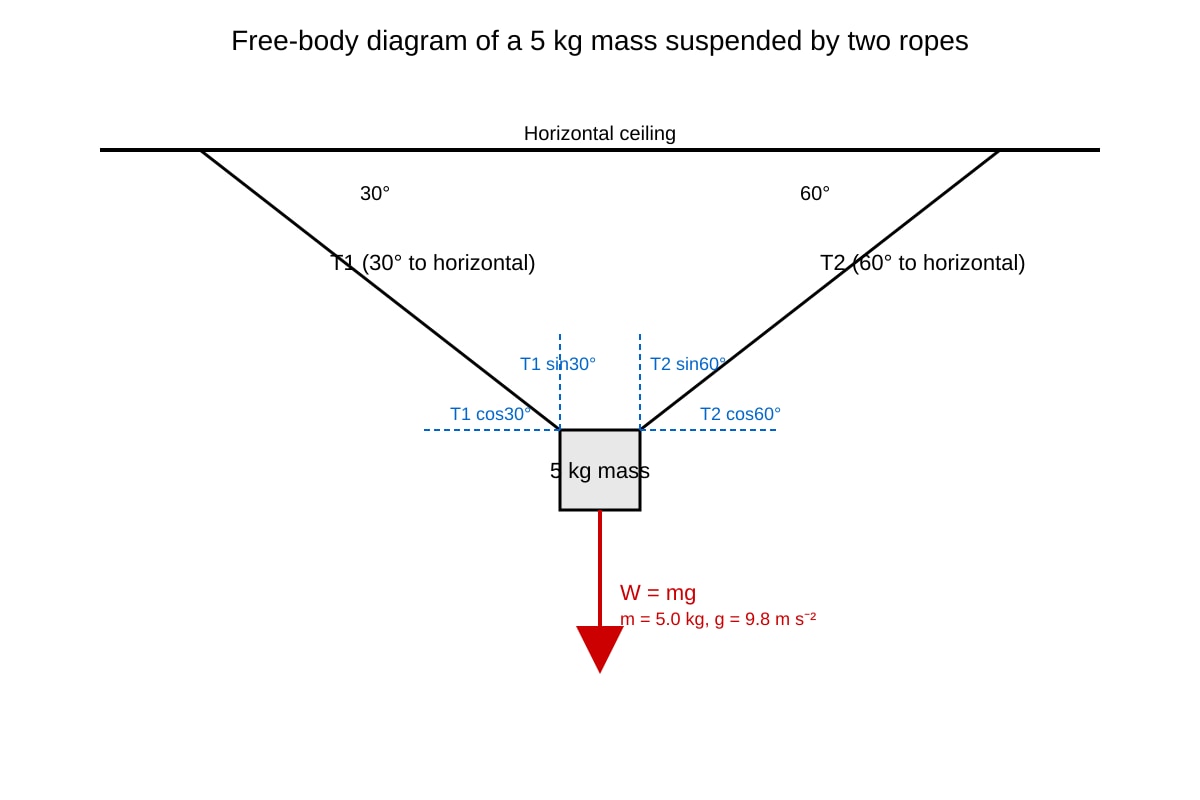
4.
Image pending generation: diagram for Q4.
By resolving forces vertically, determine the tension T1 in the left rope. [3]
5. A spring obeys Hooke’s law and extends by 0.04 m when a load of 10 N is applied. Calculate the spring constant k. [2]
Section B: Motion, Collisions and Circular Motion (Questions 6–13) [27 marks]
6. A car accelerates uniformly from rest to 20 m s−1 in 10 s. Calculate the distance travelled. [2]
7. A ball is thrown horizontally from a cliff of height 45 m with speed 15 m s−1. Calculate the time taken to reach the ground. (Use g=9.8 m s−2.) [2]
8. A projectile is launched at 30∘ above the horizontal with initial speed 40 m s−1. Calculate the maximum height reached. [3]
9. Two objects of masses 3.0 kg and 2.0 kg move towards each other with speeds 4.0 m s−1 and 3.0 m s−1 respectively. After collision they stick together. Calculate their common final velocity. [3]
10. State one condition for an elastic collision and one for a perfectly inelastic collision. [2]
11. A particle moves in a circle of radius 0.50 m with angular velocity 4.0 rad s−1. Calculate the centripetal acceleration. [2]
12. A car of mass 1000 kg travels around a bend of radius 80 m at 20 m s−1. Calculate the centripetal force required. [2]
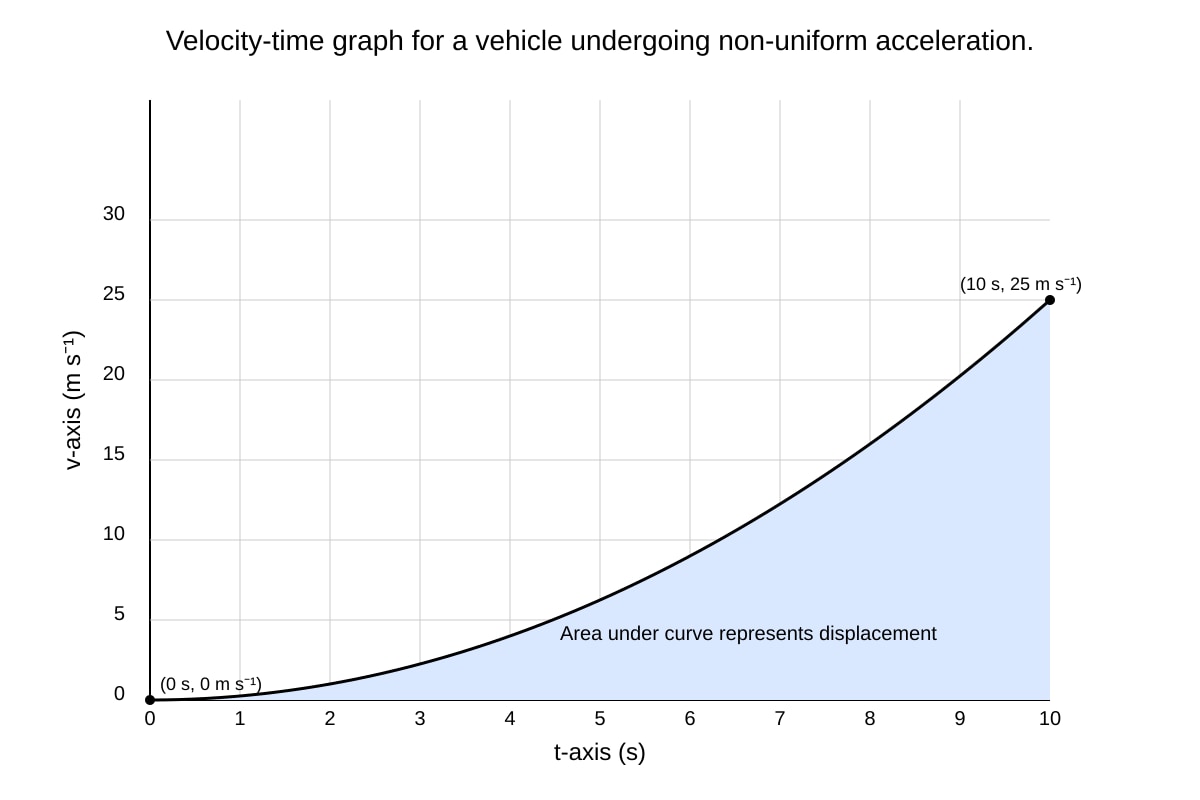
13.
Image pending generation: graph for Q13.
Estimate the displacement of the vehicle from t=0 to t=10 s using the graph. [3]
Section C: Gravitation, Oscillations and Extended Response (Questions 14–20) [28 marks]
14. State Newton’s law of gravitation in words. [2]
15. Two point masses m1=4.0×10³ kg and m2=6.0×10³ kg are separated by 2.0 m. Calculate the gravitational force between them. (G=6.67×10⁻¹¹ N m2 kg−2) [3]
16. A satellite orbits Earth at radius r with speed v. Derive an expression for the gravitational field strength g at that orbit in terms of v and r. [3]
17. A mass on a spring performs simple harmonic motion with amplitude 0.05 m and angular frequency 2.0 rad s−1. Calculate the maximum acceleration. [2]
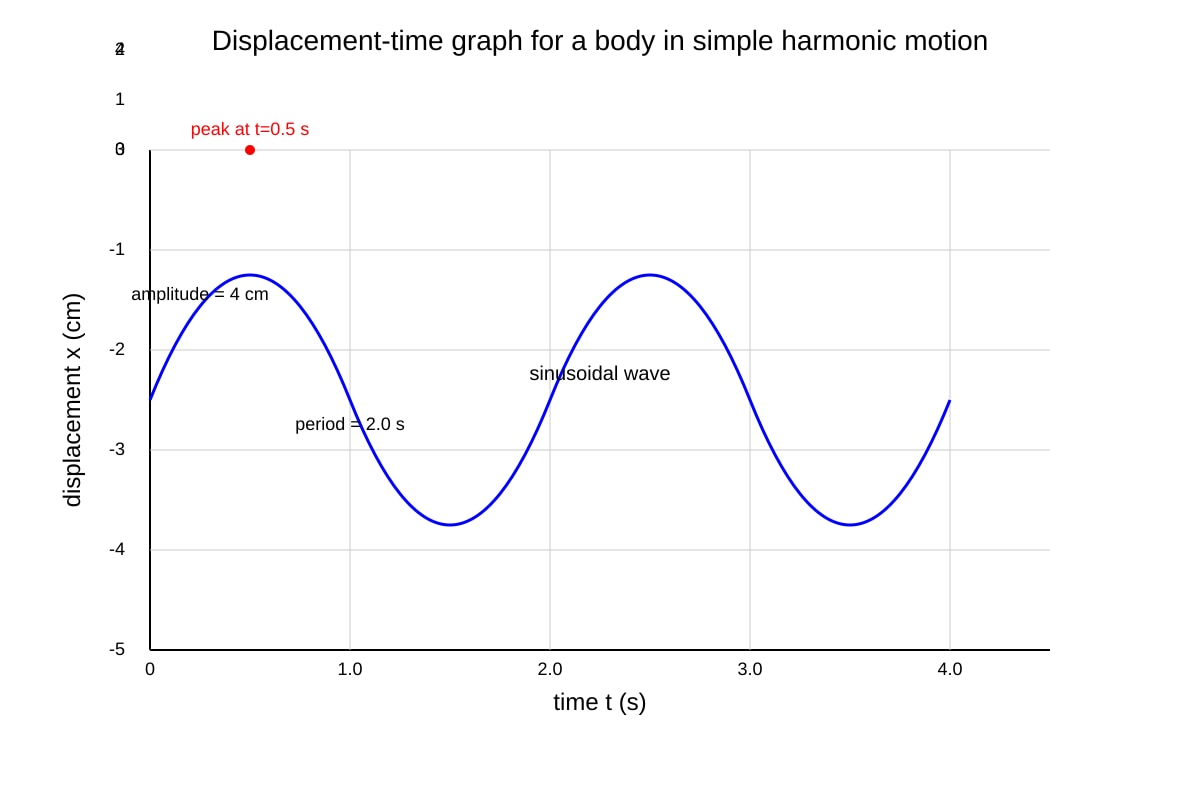
18.
Image pending generation: graph for Q18.
From the graph, state the amplitude and period, and write the equation for displacement x in the form x=x0sinωt. [3]
19. A pendulum of length 1.0 m is released from a small angle and oscillates with damping. Describe the effect of light damping on the amplitude and period. [3]
20. A student investigates collisions using a trolley track. State two precautions to improve accuracy and safety of the experiment. [5]
End of Paper
Answers
TuitionGoWhere Exam Practice (AI) — Physics H2 A-Level
Mechanics Practice Paper (Version 4) — Answer Key
Total Marks: 70
Section A: Foundations of Mechanics (Q1–5)
Q1 [2 marks]
- Net force: Fnet=6.0−2.0=4.0 N
- Using F=ma: a=2.04.0=2.0 m s−2
- Answer: 2.0 m s−2
- Marking: 1 for net force, 1 for correct acceleration.
Q2 [2 marks]
- Principle: In a closed/isolated system, total momentum before an event equals total momentum after, provided no external net force acts.
- Marking: 1 for system condition, 1 for before=after statement.
Q3 [1 mark]
- Magnitude: ∣F∣=32+42=5.0 N
- Answer: 5.0 N
Q4 [3 marks]
- Weight W=mg=5.0×9.8=49 N
- Vertical equilibrium: T1sin30∘+T2sin60∘=49
- Horizontal equilibrium: T1cos30∘=T2cos60∘⇒T2=T1cos60∘cos30∘=T13
- Substitute: T1(0.5)+(T13)(0.866)=49⇒0.5T1+1.5T1=49⇒2T1=49⇒T1=24.5 N
- Answer: 24.5 N
- Marking: 1 weight, 1 horizontal eqn, 1 final value.
Q5 [2 marks]
- Hooke’s law: F=kx⇒k=0.0410=250 N m−1
- Answer: 250 N m−1
Section B: Motion, Collisions and Circular Motion (Q6–13)
Q6 [2 marks]
- s=21(u+v)t=21(0+20)(10)=100 m
- Answer: 100 m
Q7 [2 marks]
- Vertical: s=21gt2⇒45=0.5×9.8×t2⇒t2=9.18⇒t=3.03 s
- Answer: 3.0 s (2 s.f.)
Q8 [3 marks]
- Vertical component: uy=40sin30∘=20 m s−1
- vy2=uy2−2ghmax⇒0=400−2(9.8)h⇒h=20.4 m
- Answer: 20.4 m
Q9 [3 marks]
- Take right as positive: pinitial=3(4)+2(−3)=12−6=6 kg m s−1
- Final mass 5 kg: v=6/5=1.2 m s−1 right
- Answer: 1.2 m s−1 to the right
Q10 [2 marks]
- Elastic: kinetic energy conserved (or relative speed of separation = approach)
- Perfectly inelastic: objects stick together after collision (max KE loss)
Q11 [2 marks]
- a=rω2=0.50×(4.0)2=8.0 m s−2
Q12 [2 marks]
- F=rmv2=801000×202=5000 N
Q13 [3 marks]
- Displacement = area under v-t graph ≈ trapezoidal estimate: 21(0+25)×10=125 m (concave down gives slightly less; accept 110–125 m)
- Marking: 1 axes read, 2 area method.
Section C: Gravitation, Oscillations and Extended Response (Q14–20)
Q14 [2 marks]
- Newton’s law: Force between two point masses is proportional to product of masses and inversely proportional to square of distance, directed along line joining them.
Q15 [3 marks]
- F=Gr2m1m2=6.67×10−11×2.024.0×103×6.0×103
- =6.67×10−11×424×106=6.67×10−11×6×106=4.00×10⁻⁴ N
Q16 [3 marks]
- Centripetal: rmv2=mg⇒g=rv2
- Derivation shown.
Q17 [2 marks]
- amax=ω2x0=(2.0)2×0.05=0.20 m s−2
Q18 [3 marks]
- Amplitude x0=4 cm, period T=2.0 s, ω=T2π=π rad s−1
- Equation: x=4sin(πt) cm
Q19 [3 marks]
- Light damping: amplitude decreases gradually over time; period remains approximately constant (unchanged for small damping).
Q20 [5 marks]
- Precaution 1 (accuracy): Use a straight, level track and minimise friction by cleaning wheels — reduces systematic error in velocity measurement.
- Precaution 2 (safety): Secure trolleys and buffers to table edge; wear closed shoes — prevents falling apparatus/injury.
- (Accept other valid: use light gates for timing, avoid overloading trolley, etc. 2.5 marks each.)
End of Answer Key
Free quiz and exam paper access
Enter your details to view this paper
Your access is remembered on this device.