From Real Exams Exam Paper
A Level H2 Physics Practice Paper 3
Free A Level H2 Physics Practice Paper 3, HY3 Exam version, with questions, answers, and A Level-style practice for Singapore students.
These static practice materials are generated from the site's syllabus and paper-generation workflow, with source and model context shown so students and parents can evaluate the material before use.
Questions
TuitionGoWhere Exam Practice (AI) — Physics H2 A-Level
Mechanics Practice Paper (Version 3 of 5)
School: TuitionGoWhere Exam Practice (AI)
Subject: Physics H2
Level: A-Level
Paper: Practice Paper — Mechanics (Version 3)
Duration: 75 minutes
Total Marks: 60
Name: ________________________
Class: ________________________
Date: ________________________
Instructions:
- Answer all questions.
- Show your working clearly where calculation is required.
- Use the data and formulae sheet if needed.
- Marks for each question are shown in brackets.
- Section marks sum to the total of 60 marks.
Section A: Foundations of Mechanics (Questions 1–5) [12 marks]
1. State the principle of conservation of linear momentum. [2]
2. A block of mass 2.0 kg is pulled along a horizontal frictionless surface by a constant force of 6.0 N. Calculate the acceleration of the block. [2]
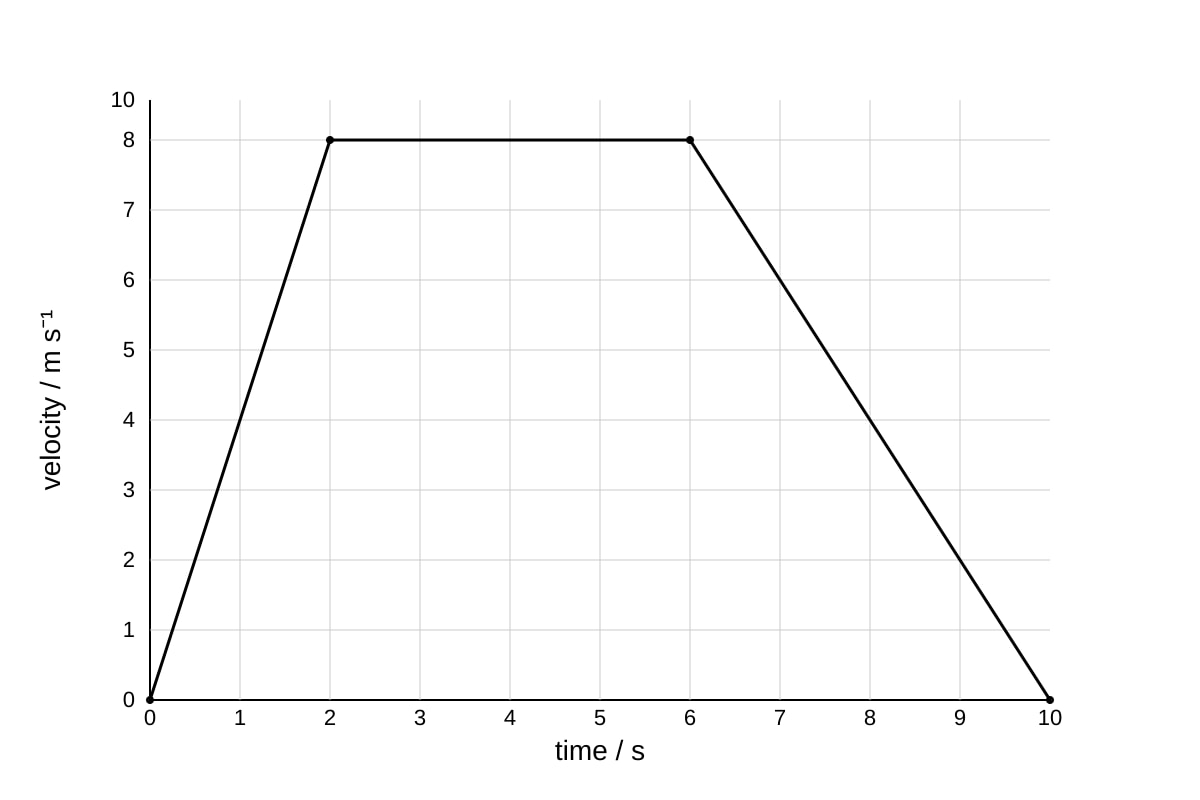
3. A car travels along a straight road. The velocity-time graph of its motion is shown below.
Image pending generation: graph for Q3.
Determine the total distance travelled by the car in 10 s. [2]
4. Resolve a force of 10 N acting at 30∘ above the horizontal into horizontal and vertical components. [2]
5. State Newton’s first law of motion. [2]
Section B: Motion, Collisions and Circular Motion (Questions 6–13) [24 marks]
6. A ball is thrown vertically upward with initial speed 15 m s−1. Calculate the maximum height reached. (Take g=9.8 m s−2.) [2]
7. A projectile is launched horizontally from a cliff of height 20 m with speed 10 m s−1. Calculate the time taken to reach the ground. [2]
8. Two carts of masses 1.0 kg and 2.0 kg move towards each other on a frictionless track with speeds 3.0 m s−1 and 2.0 m s−1 respectively. After collision they stick together. Find the common final velocity. [3]
9. A mass of 0.50 kg rotates in a horizontal circle of radius 0.80 m at 4.0 rev s−1. Calculate the centripetal force acting on it. [3]
10. (a) Define angular velocity. [1]
(b) A wheel of radius 0.30 m has a rim speed of 6.0 m s−1. Find its angular velocity. [2]
11. A ball of mass 0.20 kg moving at 5.0 m s−1 collides head-on with a stationary ball of mass 0.30 kg. The collision is perfectly elastic. Find the velocity of the 0.20 kg ball after collision. [3]
12. A stone is tied to a string and whirled in a vertical circle of radius 0.50 m. At the lowest point its speed is 4.0 m s−1 and mass is 0.10 kg. Calculate the tension in the string. (g=9.8 m s−2.) [3]
13. A particle moves with simple harmonic motion of amplitude 0.04 m and period 0.50 s. Calculate its maximum acceleration. [3]
Section C: Gravitation and Oscillations (Questions 14–20) [24 marks]
14. State Newton’s law of gravitation in words. [2]
15. Two point masses 5.0 kg and 10.0 kg are separated by 2.0 m. Calculate the gravitational force between them. (G=6.67×10⁻¹¹ N m2 kg−2.) [2]
16. A satellite orbits Earth at radius 7.0×10⁶ m. Given Earth mass 6.0×1024 kg and G=6.67×10⁻¹¹ N m2 kg−2, calculate the gravitational field strength at that orbit. [2]
17. (a) Define gravitational potential at a point. [2]
(b) Calculate the gravitational potential at distance 6.4×10⁶ m from Earth’s centre (M=6.0×1024 kg). [2]
18. A mass-spring system oscillates with SHM of amplitude 0.05 m and angular frequency 2.0 rad s−1.
(a) Write the displacement equation if initial displacement is zero. [2]
(b) Calculate the maximum kinetic energy if mass is 0.10 kg. [2]
19. A simple pendulum has length 1.0 m. Calculate its period of oscillation. (g=9.8 m s−2.) [2]
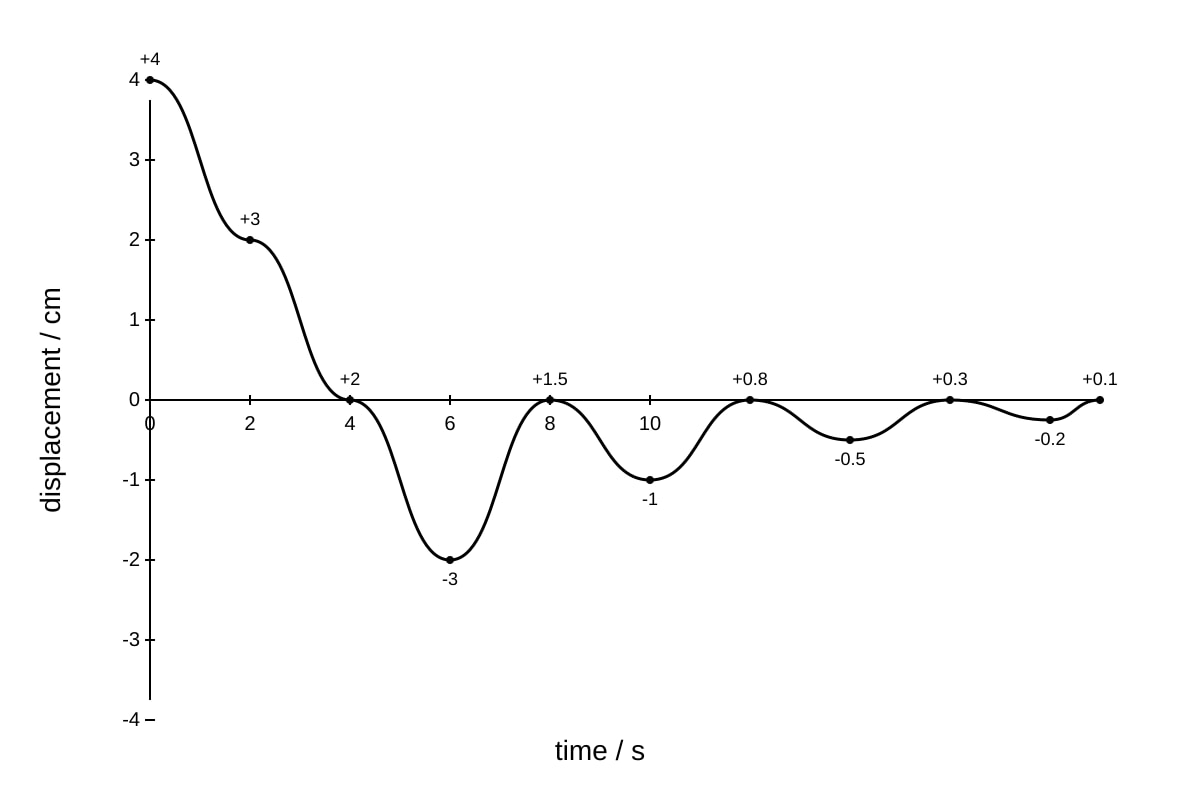
20. The displacement-time graph of an oscillating system is shown.
Image pending generation: graph for Q20.
Describe the type of damping shown and state one practical hazard of resonance in structures. [4]
Answers
TuitionGoWhere Exam Practice (AI) — Physics H2 A-Level
Mechanics Practice Paper (Version 3) — Answer Key
Total Marks: 60
Section A (12 marks)
Q1 [2 marks]
Principle of conservation of linear momentum: In a closed/isolated system, the total momentum before an event equals the total momentum after the event, provided no net external force acts.
Marking: 1 mark for "total momentum constant / before = after"; 1 mark for condition "no external force / closed system".
Teaching note: Momentum is a vector; this principle applies to collisions and explosions where external impulses are negligible.
Q2 [2 marks]
a=F/m=6.0/2.0=3.0 m s−2.
Working: Newton’s second law F=ma⇒a=F/m.
Marks: 1 for correct formula, 1 for answer with unit.
Q3 [2 marks]
Distance = area under v–t graph = triangle (0–2 s) + rectangle (2–6 s) + triangle (6–10 s)
= 21(2)(8)+(4)(8)+21(4)(8)=8+32+16=56 m.
Marks: 1 for using area method, 1 for correct total.
Note: From placeholder, graph segments give areas as computed.
Q4 [2 marks]
Fx=10cos30∘=8.66 N; Fy=10sin30∘=5.0 N.
Marks: 1 each component.
Q5 [2 marks]
Newton’s first law: A body remains at rest or in uniform motion in a straight line unless acted upon by a net external force.
Marks: 1 for rest/uniform motion, 1 for condition of net force.
Section B (24 marks)
Q6 [2 marks]
v2=u2+2as⇒0=152−2(9.8)h⇒h=225/19.6=11.5 m.
Marks: 1 formula/substitution, 1 answer.
Q7 [2 marks]
Vertical motion: s=21gt2⇒20=0.5(9.8)t2⇒t=40/9.8=2.02 s.
Marks: 1 for vertical equation, 1 answer.
Q8 [3 marks]
Take right as positive: pi=(1.0)(3.0)+(2.0)(−2.0)=3−4=−1.0 kg m s−1.
pf=(3.0)v⇒v=−1/3=−0.33 m s−1 (left).
Marks: 1 momentum init, 1 conservation, 1 answer with direction.
Q9 [3 marks]
ω=2πf=2π(4.0)=25.13 rad s−1.
F=mrω2=0.50×0.80×(25.13)2=252 N.
Marks: 1 ω, 1 formula, 1 answer.
Q10 [3 marks]
(a) Angular velocity is rate of change of angular displacement. [1]
(b) ω=v/r=6.0/0.30=20 rad s−1. [2: 1 formula, 1 ans]
Q11 [3 marks]
Elastic 1-D: v1=m1+m2m1−m2u1=0.500.20−0.30(5.0)=−1.0 m s−1.
Marks: 1 identify elastic formula, 1 sub, 1 ans (negative = rebound).
Q12 [3 marks]
At lowest point: T−mg=mv2/r⇒T=m(g+v2/r)=0.10(9.8+16/0.5)=0.10(9.8+32)=4.18 N.
Marks: 1 equation, 1 calc, 1 ans.
Q13 [3 marks]
ω=2π/T=2π/0.50=12.57 rad s−1.
amax=ω2x0=(12.57)2(0.04)=6.32 m s−2.
Marks: 1 ω, 1 formula, 1 ans.
Section C (24 marks)
Q14 [2 marks]
Newton’s law of gravitation: Force between two point masses is proportional to product of masses and inversely proportional to square of separation.
Marks: 1 proportion, 1 inverse square.
Q15 [2 marks]
F=Gm1m2/r2=(6.67×10−11)(5)(10)/(22)=8.34×10−10 N.
Marks: 1 formula, 1 ans.
Q16 [2 marks]
g=GM/r2=(6.67×10−11)(6.0×1024)/(7.0×106)2=8.18 N kg−1.
Marks: 1 sub, 1 ans.
Q17 [4 marks]
(a) Gravitational potential = work done per unit mass to bring test mass from infinity to point. [2]
(b) ϕ=−GM/r=−(6.67×10−11)(6.0×1024)/(6.4×106)=−6.25×107 J kg−1. [2]
Q18 [4 marks]
(a) x=x0sin(ωt)=0.05sin(2.0t) m. [2]
(b) Ek,max=21mω2x02=0.5(0.10)(4)(0.0025)=5.0×10⁻⁴ J. [2]
Q19 [2 marks]
T=2πl/g=2π1.0/9.8=2.01 s.
Marks: 1 formula, 1 ans.
Q20 [4 marks]
Type: light damping (amplitude decays gradually, period approx constant). [2]
Hazard: resonance can cause structural failure (e.g., bridge collapse, building sway). [2]
From placeholder: graph shows decreasing peaks => light damping.
Free quiz and exam paper access
Enter your details to view this paper
Your access is remembered on this device.