From Real Exams Exam Paper

A Level H2 Physics Practice Paper 2

Free Exam-Derived Owl Alpha A Level H2 Physics Practice Paper 2 practice paper with questions and answers for Singapore students. This page is rendered as a direct URL so the questions and answers can be discovered without pressing in-page buttons.

These static practice materials are generated from the site's syllabus and paper-generation workflow, with source and model context shown so students and parents can evaluate the material before use.

A Level H2 Physics From Real Exams Generated by Owl Alpha Updated 2026-06-07

Questions

<!-- TuitionGoWhere generation metadata: stage=3-1; model=openrouter/owl-alpha; model_label=Owl Alpha; generated=2026-06-06; Sources: Stage 2-1 real exam-derived templates and Stage 2-2 exam-enriched syllabus. -->

TuitionGoWhere Practice Paper - Physics H2 A-Level

TuitionGoWhere Secondary School (AI)


Subject:Physics H2
Level:A-Level
Paper:Practice Paper — Mechanics (Version 2 of 5)
Duration:1 hour 15 minutes
Total Marks:60
Name:______________________________
Class:______________________________
Date:______________________________

Instructions

  • Answer all questions in the spaces provided.
  • Show all working clearly. Credit will be given for correct reasoning even if the final answer is incorrect.
  • The number of marks for each question or part question is shown in brackets [ ].
  • Where appropriate, give answers to 3 significant figures and include appropriate units.
  • Data and formulae are provided on the Data Sheet (not reproduced here; assume standard H2 Physics data sheet is available).

Section A: Multiple Choice [10 marks]

Questions 1–5: Each question is worth 2 marks. Choose the one best answer.


1. A ball is thrown vertically upwards with an initial speed of 20 m s120 \text{ m s}^{-1}. Ignoring air resistance, what is the maximum height reached by the ball? (Take g=9.81 m s2g = 9.81 \text{ m s}^{-2}.)

(a) 10.2 m10.2 \text{ m} (b) 20.4 m20.4 \text{ m} (c) 40.8 m40.8 \text{ m} (d) 81.6 m81.6 \text{ m}

Answer: ______________


2. Two objects of masses 2.0 kg2.0 \text{ kg} and 3.0 kg3.0 \text{ kg} collide head-on and stick together. Before the collision, the 2.0 kg2.0 \text{ kg} object moves at 4.0 s14.0 \text{ s}^{-1} and the 3.0 kg3.0 \text{ kg} object is at rest. What is their common velocity after the collision?

(a) 1.6 m s11.6 \text{ m s}^{-1} (b) 2.0 m s12.0 \text{ m s}^{-1} (c) 2.4 m s12.4 \text{ m s}^{-1} (d) 4.0 m s14.0 \text{ m s}^{-1}

Answer: ______________


3. A car travels around a horizontal circular track of radius 50 m50 \text{ m} at a constant speed of 20 m s120 \text{ m s}^{-1}. What is the magnitude of the centripetal acceleration of the car?

(a) 0.4 m s20.4 \text{ m s}^{-2} (b) 4.0 m s24.0 \text{ m s}^{-2} (c) 8.0 m s28.0 \text{ m s}^{-2} (d) 10.0 m s210.0 \text{ m s}^{-2}

Answer: ______________


4. A force FF acts on an object of mass mm for a time tt, causing the object's velocity to change from uu to vv. Which expression correctly represents the impulse delivered by the force?

(a) FtFt (b) m(vu)m(v - u) (c) Both FtFt and m(vu)m(v - u) (d) 12m(v2u2)\frac{1}{2}m(v^2 - u^2)

Answer: ______________


5. A uniform rod of length 2.0 m2.0 \text{ m} and mass 5.0 kg5.0 \text{ kg} is pivoted at its centre. A 10 N10 \text{ N} force is applied perpendicularly at one end. What is the torque about the pivot?

(a) 5.0 N m5.0 \text{ N m} (b) 10 N m10 \text{ N m} (c) 20 N m20 \text{ N m} (d) 40 N m40 \text{ N m}

Answer: ______________


Section B: Structured Questions [30 marks]

Answer all questions. Show all working.


6. (a) State the principle of conservation of linear momentum. [2]


(b) A 0.50 kg0.50 \text{ kg} trolley A moves at 0.80 m s10.80 \text{ m s}^{-1} on a frictionless horizontal track and collides with a stationary 0.30 kg0.30 \text{ kg} trolley B. After the collision, trolley A continues to move in the same direction at 0.20 m s10.20 \text{ m s}^{-1}.

    (i) Calculate the velocity of trolley B immediately after the collision. [3]


    (ii) Determine whether the collision is elastic or inelastic. Show your reasoning. [2]


7. A small ball is projected horizontally from the top of a cliff 45 m45 \text{ m} above level ground with a horizontal speed of 15 m s115 \text{ m s}^{-1}. Air resistance is negligible. (Take g=9.81 m s1g = 9.81 \text{ m s}^{-1}.)

(a) Calculate the time taken for the ball to reach the ground. [2]


(b) Calculate the horizontal distance from the base of the cliff where the ball lands. [2]


(c) Determine the speed of the ball just before it hits the ground. [3]


8. A 70 kg70 \text{ kg} student stands on a weighing scale inside a lift.

(a) State and explain what the scale reads when the lift is: [2]

    (i) moving upwards at constant velocity


    (ii) accelerating upwards at 2.0 m s22.0 \text{ m s}^{-2}


(b) The lift now accelerates downwards at 3.0 m s23.0 \text{ m s}^{-2}. Calculate the reading on the scale. Take g=9.81 m s2g = 9.81 \text{ m s}^{-2}. [2]


9. A car of mass 1200 kg1200 \text{ kg} travels along a straight horizontal road. The engine provides a constant driving force of 3600 N3600 \text{ N} and the total resistive force is 1200 N1200 \text{ N}.

(a) Calculate the acceleration of the car. [2]


(b) The car starts from rest. Calculate the kinetic energy of the car after it has travelled 200 m200 \text{ m}. [3]


(c) Calculate the power developed by the engine at the instant when the car's speed is 30 m s130 \text{ m s}^{-1}. [2]


10. A small object of mass 0.20 kg0.20 \text{ kg} is attached to a light inextensible string of length 0.80 m0.80 \text{ m} and made to move in a vertical circle. The object passes through the lowest point of the circle with a speed of 6.0 m s16.0 \text{ m s}^{-1}. Take g=9.81 m s2g = 9.81 \text{ m s}^{-2}.

(a) Calculate the tension in the string when the object is at the lowest point. [3]


(b) Calculate the minimum speed the object must have at the lowest point in order to just complete the vertical circle. [3]


Section C: Longer Structured Questions [20 marks]

Answer all questions. Show all working clearly.


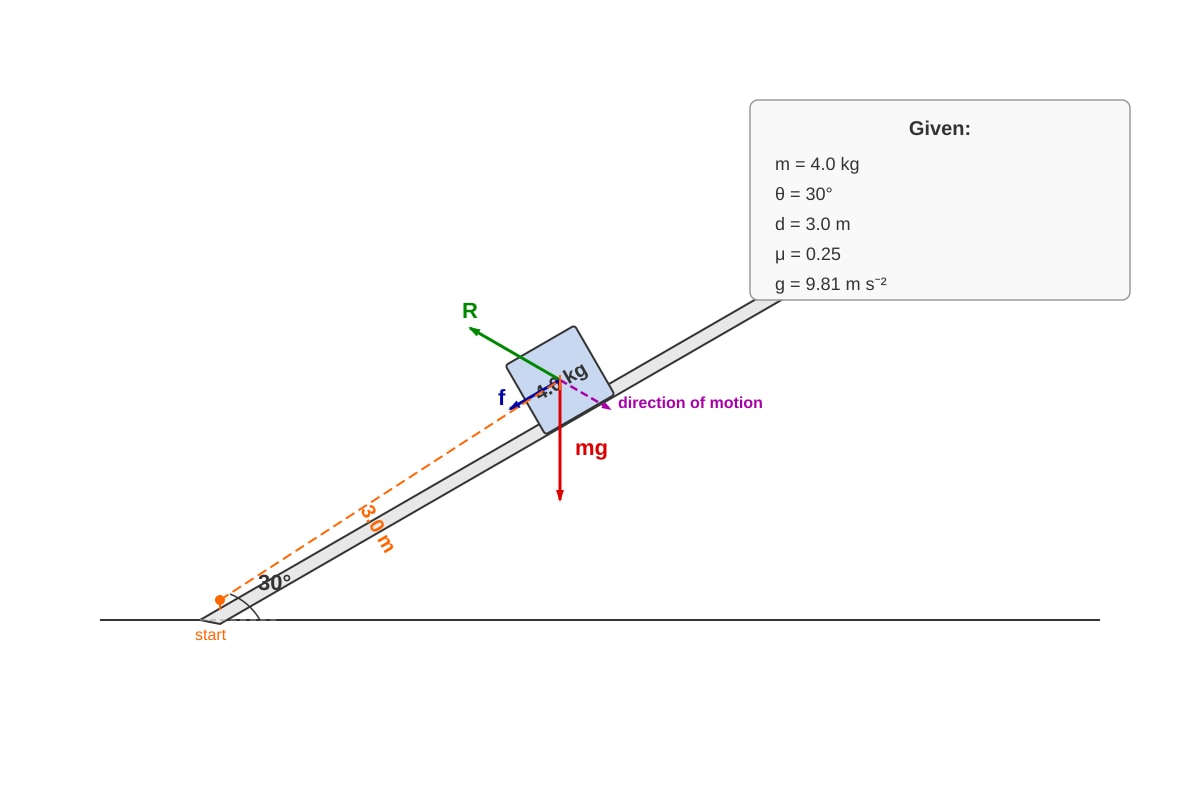
11. A 4.0 kg4.0 \text{ kg} block is released from rest on a rough inclined plane that makes an angle of 30°30° with the horizontal. The coefficient of kinetic friction between the block and the plane is 0.250.25. The block slides a distance of 3.0 m3.0 \text{ m} down the slope. Take g=9.81 m s2g = 9.81 \text{ m s}^{-2}.

<image_placeholder> id: Q11-fig1 type: diagram linked_question: Q11 description: A block on an inclined plane at 30° to the horizontal. The block is shown partway down the slope with distance 3.0 m marked along the slope from the starting point. Weight mg acts vertically downward, normal reaction R acts perpendicular to the slope, and frictional force f acts up the slope (opposing motion). labels: Block labelled "4.0 kg", angle 30°, distance along slope = 3.0 m, weight mg (downward), normal reaction R (perpendicular to slope), friction f (up the slope), direction of motion (down the slope) values: mass = 4.0 kg, angle = 30°, distance = 3.0 m, μ_k = 0.25, g = 9.81 m s^-2 must_show: Inclined plane at 30°, block with forces labelled, angle clearly marked, distance along slope indicated

</image_placeholder>

(a) Draw a free-body diagram showing all the forces acting on the block. Label each force clearly. [2]


(b) Calculate the component of the weight acting parallel to the slope. [1]


(c) Calculate the normal reaction force. [1]


(d) Calculate the frictional force acting on the block. [2]


(e) Use the work-energy principle to calculate the speed of the block after sliding 3.0 m3.0 \text{ m} down the slope. [4]


12. A geostationary satellite orbits the Earth at an altitude of approximately 35800 km35\,800 \text{ km} above the Earth's surface. The radius of the Earth is 6.37×10⁶ m6.37 \times 10^6 \text{ m} and the mass of the Earth is 5.97×1024 kg5.97 \times 10^{24} \text{ kg}. The gravitational constant G=6.67×10¹¹ N m2 kg2G = 6.67 \times 10^{-11} \text{ N m}^2 \text{ kg}^{-2}.

(a) Explain what is meant by a geostationary orbit. [2]


(b) Show that the orbital radius of the satellite is approximately 4.22×10⁷ m4.22 \times 10^7 \text{ m}. [1]


(c) Calculate the orbital speed of the satellite. [3]


(d) A student claims that the satellite is in equilibrium because it remains above the same point on the Earth's surface. Explain whether this claim is correct. [2]


End of Paper


Summary of Marks

SectionMarks
A: Multiple Choice (Q1–Q5)10
B: Structured Questions (Q6–Q10)30
C: Longer Structured Questions (Q11–Q12)20
Total60

Answers

<!-- TuitionGoWhere generation metadata: stage=3-1; model=openrouter/owl-alpha; model_label=Owl Alpha; generated=2026-06-06; Sources: Stage 2-1 real exam-derived templates and Stage 2-2 exam-enriched syllabus. -->

TuitionGoWhere Practice Paper — Physics H2 A-Level

Answer Key — Mechanics (Version 2 of 5)


Section A: Multiple Choice

1. (b) 20.4 m20.4 \text{ m} [2 marks]

Working: At maximum height, final velocity v=0v = 0. Using v2=u22ghv^2 = u^2 - 2gh: 0=(20)22(9.81)h0 = (20)^2 - 2(9.81)h h=4002×9.81=40019.62=20.4 mh = \frac{400}{2 \times 9.81} = \frac{400}{19.62} = 20.4 \text{ m}

Teaching note: This uses the kinematic equation for constant acceleration. The key insight is that at the highest point, the vertical velocity is zero. We use v2=u2+2asv^2 = u^2 + 2as with a=ga = -g (deceleration due to gravity). Common mistake: forgetting that v=0v = 0 at the top, or using g=10g = 10 when the question specifies 9.819.81.


2. (a) 1.6 m s11.6 \text{ m s}^{-1} [2 marks]

Working: By conservation of linear momentum: m1u1+m2u2=(m1+m2)vm_1 u_1 + m_2 u_2 = (m_1 + m_2)v (2.0)(4.0)+(3.0)(0)=(2.0+3.0)v(2.0)(4.0) + (3.0)(0) = (2.0 + 3.0)v 8.0=5.0v8.0 = 5.0v v=1.6 m s1v = 1.6 \text{ m s}^{-1}

Teaching note: Since the objects stick together, this is a perfectly inelastic collision. The total momentum before equals the total momentum after. The stationary object contributes zero initial momentum. Common mistake: dividing by only one of the masses instead of the total mass.


3. (c) 8.0 m s28.0 \text{ m s}^{-2} [2 marks]

Working: Centripetal acceleration: ac=v2r=(20)250=40050=8.0 m s2a_c = \frac{v^2}{r} = \frac{(20)^2}{50} = \frac{400}{50} = 8.0 \text{ m s}^{-2}

Teaching note: Centripetal acceleration is always directed towards the centre of the circular path. The formula ac=v2/ra_c = v^2/r applies for uniform circular motion. Common mistake: confusing centripetal acceleration with angular velocity or using a=v/ra = v/r instead of v2/rv^2/r.


4. (c) Both FtFt and m(vu)m(v - u) [2 marks]

Working: Impulse is defined as the product of force and time: I=FtI = Ft. By Newton's second law in momentum form, the impulse also equals the change in momentum: I=Δp=m(vu)I = \Delta p = m(v - u). Both expressions are equivalent and correct.

Teaching note: Impulse is a vector quantity. The impulse-momentum theorem states that the impulse delivered to an object equals the change in its momentum. Both FtFt and m(vu)m(v-u) represent the same physical quantity. Common mistake: choosing only one expression when both are valid definitions.


5. (b) 10 N m10 \text{ N m} [2 marks]

Working: Torque = force × perpendicular distance from pivot: τ=F×d=10×2.02=10×1.0=10 N m\tau = F \times d = 10 \times \frac{2.0}{2} = 10 \times 1.0 = 10 \text{ N m}

Teaching note: The pivot is at the centre of the rod, so the perpendicular distance from the pivot to the point of application of the force is half the length of the rod (1.0 m1.0 \text{ m}). Torque (moment of a force) measures the turning effect. Common mistake: using the full length 2.0 m2.0 \text{ m} instead of the distance from the pivot.


Section B: Structured Questions

6. (a) [2 marks]

Answer: The principle of conservation of linear momentum states that the total momentum of a closed system remains constant (is conserved) provided that no net external force acts on the system. Equivalently: in an isolated system, the total momentum before a collision equals the total momentum after the collision.

Marking:

  • [1] for stating that total momentum is conserved/remains constant
  • [1] for specifying the condition (no external forces / closed/isolated system)

Common mistake: Simply saying "momentum is conserved" without mentioning the condition of no external forces. The condition is essential for full marks.


6. (b)(i) [3 marks]

Working: Using conservation of linear momentum: mAuA+mBuB=mAvA+mBvBm_A u_A + m_B u_B = m_A v_A + m_B v_B (0.50)(0.80)+(0.30)(0)=(0.50)(0.20)+(0.30)vB(0.50)(0.80) + (0.30)(0) = (0.50)(0.20) + (0.30)v_B 0.40=0.10+0.30vB0.40 = 0.10 + 0.30v_B 0.30=0.30vB0.30 = 0.30v_B vB=1.0 m s1v_B = 1.0 \text{ m s}^{-1}

Marking:

  • [1] for correct substitution into conservation of momentum equation
  • [1] for correct algebraic manipulation
  • [1] for correct final answer with unit (1.0 m s11.0 \text{ m s}^{-1})

6. (b)(ii) [2 marks]

Working: Calculate total kinetic energy before and after.

Before: KEbefore=12(0.50)(0.80)2+0=0.16 JKE_{\text{before}} = \frac{1}{2}(0.50)(0.80)^2 + 0 = 0.16 \text{ J}

After: KEafter=12(0.50)(0.20)2+12(0.30)(1.0)2=0.01+0.15=0.16 JKE_{\text{after}} = \frac{1}{2}(0.50)(0.20)^2 + \frac{1}{2}(0.30)(1.0)^2 = 0.01 + 0.15 = 0.16 \text{ J}

Since KEbefore=KEafterKE_{\text{before}} = KE_{\text{after}}, kinetic energy is conserved, so the collision is elastic.

Marking:

  • [1] for calculating KE before and after (or showing the comparison)
  • [1] for correct conclusion that the collision is elastic

Note: In this specific case, the KE values happen to be equal, making it elastic. In most "stick together" problems, the collision is inelastic, but here the objects separate after collision.


7. (a) [2 marks]

Working: Vertical motion: s=12gt2s = \frac{1}{2}gt^2 (initial vertical velocity = 0) 45=12(9.81)t245 = \frac{1}{2}(9.81)t^2 t2=909.81=9.174t^2 = \frac{90}{9.81} = 9.174 t=3.03 st = 3.03 \text{ s}

Marking:

  • [1] for correct substitution
  • [1] for correct answer (3.03 s3.03 \text{ s} or 3.0 s3.0 \text{ s} to 2 s.f.)

7. (b) [2 marks]

Working: Horizontal distance: x=vx×t=15×3.03=45.4 mx = v_x \times t = 15 \times 3.03 = 45.4 \text{ m}

Marking:

  • [1] for using horizontal velocity × time
  • [1] for correct answer (45.4 m45.4 \text{ m} or 45 m45 \text{ m} to 2 s.f.)

7. (c) [3 marks]

Working: Vertical component of velocity just before impact: vy=gt=9.81×3.03=29.7 m s1v_y = gt = 9.81 \times 3.03 = 29.7 \text{ m s}^{-1}

Resultant speed: v=vx2+vy2=152+29.72=225+882.1=1107.1=33.3 m s1v = \sqrt{v_x^2 + v_y^2} = \sqrt{15^2 + 29.7^2} = \sqrt{225 + 882.1} = \sqrt{1107.1} = 33.3 \text{ m s}^{-1}

Marking:

  • [1] for calculating vertical component vyv_y
  • [1] for using Pythagoras to find resultant
  • [1] for correct final answer (33.3 m s133.3 \text{ m s}^{-1})

Teaching note: In projectile motion, horizontal and vertical motions are independent. The horizontal velocity remains constant (no horizontal acceleration), while the vertical velocity increases due to gravity. The final speed is the vector sum of the two components.


8. (a)(i) [1 mark]

Answer: The scale reads 687 N687 \text{ N} (or 70g=687 N70g = 687 \text{ N}). When the lift moves at constant velocity, acceleration is zero, so the net force is zero. The normal force (scale reading) equals the weight: N=mg=70×9.81=687 NN = mg = 70 \times 9.81 = 687 \text{ N}.

Marking:

  • [1] for stating scale reads mgmg (weight) with explanation that acceleration is zero

8. (a)(ii) [1 mark]

Answer: The scale reads more than the student's weight. The scale reading is N=m(g+a)=70(9.81+2.0)=70×11.81=827 NN = m(g + a) = 70(9.81 + 2.0) = 70 \times 11.81 = 827 \text{ N}. The student feels heavier because the normal force must exceed the weight to provide upward acceleration.

Marking:

  • [1] for correct explanation and calculation showing increased reading

8. (b) [2 marks]

Working: Taking downward as positive for the acceleration: mgN=mamg - N = ma N=m(ga)=70(9.813.0)=70×6.81=477 NN = m(g - a) = 70(9.81 - 3.0) = 70 \times 6.81 = 477 \text{ N}

Marking:

  • [1] for correct equation setup
  • [1] for correct answer (477 N477 \text{ N})

Teaching note: When the lift accelerates downward, the apparent weight decreases. If a=ga = g (free fall), the scale would read zero — this is the weightlessness condition. Common mistake: adding instead of subtracting when the acceleration is downward.


9. (a) [2 marks]

Working: Net force: Fnet=36001200=2400 NF_{\text{net}} = 3600 - 1200 = 2400 \text{ N}

Acceleration: a=Fnetm=24001200=2.0 m s2a = \frac{F_{\text{net}}}{m} = \frac{2400}{1200} = 2.0 \text{ m s}^{-2}

Marking:

  • [1] for calculating net force
  • [1] for correct acceleration (2.0 m s22.0 \text{ m s}^{-2})

9. (b) [3 marks]

Working: Using the work-energy principle: Work done by net force = change in kinetic energy Fnet×s=12mv20F_{\text{net}} \times s = \frac{1}{2}mv^2 - 0 2400×200=12(1200)v22400 \times 200 = \frac{1}{2}(1200)v^2 480000=600v2480\,000 = 600v^2 v2=800v^2 = 800 KE=12(1200)(800)=480000 J=480 kJKE = \frac{1}{2}(1200)(800) = 480\,000 \text{ J} = 480 \text{ kJ}

Alternatively, directly: KE=Fnet×s=2400×200=480000 JKE = F_{\text{net}} \times s = 2400 \times 200 = 480\,000 \text{ J}

Marking:

  • [1] for using work-energy principle or kinematic approach
  • [1] for correct substitution
  • [1] for correct answer (480 kJ480 \text{ kJ} or 4.80×10⁵ J4.80 \times 10^5 \text{ J})

9. (c) [2 marks]

Working: Power = driving force × velocity: P=F×v=3600×30=108000 W=108 kWP = F \times v = 3600 \times 30 = 108\,000 \text{ W} = 108 \text{ kW}

Marking:

  • [1] for using P=FvP = Fv
  • [1] for correct answer (108 kW108 \text{ kW})

Teaching note: The power is calculated using the driving force, not the net force. P=FvP = Fv gives the instantaneous power when FF is the force in the direction of velocity. Common mistake: using net force instead of driving force.


10. (a) [3 marks]

Working: At the lowest point, the tension and weight both act along the radial direction. The net force towards the centre (upward) provides the centripetal force: Tmg=mv2rT - mg = \frac{mv^2}{r} T=mg+mv2r=0.20×9.81+0.20×(6.0)20.80T = mg + \frac{mv^2}{r} = 0.20 \times 9.81 + \frac{0.20 \times (6.0)^2}{0.80} T=1.962+0.20×360.80=1.962+9.0=10.96 N11.0 NT = 1.962 + \frac{0.20 \times 36}{0.80} = 1.962 + 9.0 = 10.96 \text{ N} \approx 11.0 \text{ N}

Marking:

  • [1] for correct equation Tmg=mv2/rT - mg = mv^2/r
  • [1] for correct substitution
  • [1] for correct answer (11.0 N11.0 \text{ N} to 3 s.f.)

10. (b) [3 marks]

Working: To just complete the vertical circle, the minimum speed at the top of the circle is when tension is zero at the top: mvtop2r=mg    vtop2=gr\frac{mv_{\text{top}}^2}{r} = mg \implies v_{\text{top}}^2 = gr

Using conservation of energy from bottom to top (height difference = 2r2r): 12mvbottom2=12mvtop2+mg(2r)\frac{1}{2}mv_{\text{bottom}}^2 = \frac{1}{2}mv_{\text{top}}^2 + mg(2r) 12vbottom2=12(gr)+2gr=52gr\frac{1}{2}v_{\text{bottom}}^2 = \frac{1}{2}(gr) + 2gr = \frac{5}{2}gr vbottom2=5gr=5×9.81×0.80=39.24v_{\text{bottom}}^2 = 5gr = 5 \times 9.81 \times 0.80 = 39.24 vbottom=39.24=6.26 m s1v_{\text{bottom}} = \sqrt{39.24} = 6.26 \text{ m s}^{-1}

Marking:

  • [1] for minimum speed at top: vtop2=grv_{\text{top}}^2 = gr
  • [1] for applying energy conservation between bottom and top
  • [1] for correct answer (6.26 m s16.26 \text{ m s}^{-1} to 3 s.f.)

Teaching note: The critical condition for completing a vertical circle is that the speed at the top must be at least gr\sqrt{gr} (when tension/ normal force just reaches zero). The minimum speed at the bottom is then 5gr\sqrt{5gr} by energy conservation. This is a standard result worth remembering.


Section C: Longer Structured Questions

11. (a) [2 marks]

Answer: The free-body diagram should show:

  • Weight (mgmg) acting vertically downward from the centre of the block
  • Normal reaction (RR) acting perpendicular to the slope, away from the surface
  • Frictional force (ff) acting up the slope (opposing the motion down the slope)

Marking:

  • [1] for all three forces present and correctly directed
  • [1] for clear labels on all forces

Common mistake: Drawing friction in the wrong direction (down the slope instead of up), or drawing the normal force vertically instead of perpendicular to the surface.


11. (b) [1 mark]

Working: W=mgsinθ=4.0×9.81×sin30°=4.0×9.81×0.5=19.6 NW_{\parallel} = mg\sin\theta = 4.0 \times 9.81 \times \sin 30° = 4.0 \times 9.81 \times 0.5 = 19.6 \text{ N}

Marking:

  • [1] for correct answer (19.6 N19.6 \text{ N})

11. (c) [1 mark]

Working: R=mgcosθ=4.0×9.81×cos30°=4.0×9.81×0.866=34.0 NR = mg\cos\theta = 4.0 \times 9.81 \times \cos 30° = 4.0 \times 9.81 \times 0.866 = 34.0 \text{ N}

Marking:

  • [1] for correct answer (34.0 N34.0 \text{ N} to 3 s.f.)

11. (d) [2 marks]

Working: f=μk×R=0.25×34.0=8.50 Nf = \mu_k \times R = 0.25 \times 34.0 = 8.50 \text{ N}

Marking:

  • [1] for using f=μkRf = \mu_k R
  • [1] for correct answer (8.50 N8.50 \text{ N})

11. (e) [4 marks]

Working: Using the work-energy principle: Net work done=ΔKE\text{Net work done} = \Delta KE

Work done by the parallel component of gravity (positive, down the slope): Wg=mgsinθ×d=19.6×3.0=58.8 JW_g = mg\sin\theta \times d = 19.6 \times 3.0 = 58.8 \text{ J}

Work done by friction (negative, opposing motion): Wf=f×d=8.50×3.0=25.5 JW_f = -f \times d = -8.50 \times 3.0 = -25.5 \text{ J}

Net work: Wnet=58.825.5=33.3 JW_{\text{net}} = 58.8 - 25.5 = 33.3 \text{ J}

This equals the change in kinetic energy (starting from rest): 33.3=12mv20=12(4.0)v233.3 = \frac{1}{2}mv^2 - 0 = \frac{1}{2}(4.0)v^2 v2=33.3×24.0=16.65v^2 = \frac{33.3 \times 2}{4.0} = 16.65 v=4.08 m s1v = 4.08 \text{ m s}^{-1}

Marking:

  • [1] for calculating work done by the component of weight along the slope
  • [1] for calculating work done by friction (with correct sign)
  • [1] for applying work-energy principle correctly
  • [1] for correct final answer (4.08 m s14.08 \text{ m s}^{-1} to 3 s.f.)

Teaching note: The work-energy principle states that the net work done on an object equals its change in kinetic energy. Friction does negative work because it opposes motion. An alternative approach using Newton's second law and kinematics (v2=u2+2asv^2 = u^2 + 2as) would also be valid and yield the same result.


12. (a) [2 marks]

Answer: A geostationary orbit is one in which the satellite:

  • Orbits above the Earth's equator in the same direction as the Earth's rotation
  • Has an orbital period equal to the Earth's rotational period (24 hours)
  • Therefore remains stationary relative to a fixed point on the Earth's surface

Marking:

  • [1] for stating the period is 24 hours (same as Earth's rotation)
  • [1] for stating the satellite remains above the same point on Earth's surface (or orbits above the equator)

12. (b) [1 mark]

Working: r=RE+h=6.37×10⁶+35800×103=6.37×10⁶+3.58×10⁷r = R_E + h = 6.37 \times 10^6 + 35\,800 \times 10^3 = 6.37 \times 10^6 + 3.58 \times 10^7 r=4.217×10⁷ m4.22×107 mr = 4.217 \times 10^7 \text{ m} \approx 4.22 \times 10^7 \text{ m} \quad \checkmark

Marking:

  • [1] for correct addition and answer

12. (c) [3 marks]

Working: For a satellite in circular orbit, gravitational force provides centripetal force: GMmr2=mv2r\frac{GMm}{r^2} = \frac{mv^2}{r} v=GMr=6.67×1011×5.97×10244.22×107v = \sqrt{\frac{GM}{r}} = \sqrt{\frac{6.67 \times 10^{-11} \times 5.97 \times 10^{24}}{4.22 \times 10^7}} v=3.983×10144.22×107=9.438×106=3072 m s13.07×103 m s1v = \sqrt{\frac{3.983 \times 10^{14}}{4.22 \times 10^7}} = \sqrt{9.438 \times 10^6} = 3072 \text{ m s}^{-1} \approx 3.07 \times 10^3 \text{ m s}^{-1}

Marking:

  • [1] for equating gravitational force to centripetal force
  • [1] for correct substitution
  • [1] for correct answer (3.07×10³ m s13.07 \times 10^3 \text{ m s}^{-1} to 3 s.f.)

12. (d) [2 marks]

Answer: The student's claim is incorrect. The satellite is not in equilibrium.

  • For an object to be in equilibrium, the net force acting on it must be zero.
  • The satellite is in circular motion, so it has a centripetal acceleration directed towards the centre of the Earth.
  • The gravitational force provides the centripetal force, so there is a non-zero net force acting on the satellite.
  • The satellite remains above the same point on Earth not because forces are balanced, but because its orbital period matches the Earth's rotational period.

Marking:

  • [1] for stating the claim is incorrect with a valid reason (non-zero net force / centripetal acceleration exists)
  • [1] for explaining that gravitational force provides the centripetal force (not balanced by another force)

Common mistake: Confusing "appears stationary" with "in equilibrium." An object can appear stationary relative to a rotating reference frame while still experiencing a net force. Equilibrium requires zero net force, which is not the case for circular motion.


Mark Summary

QuestionMarks
12
22
32
42
52
6(a)2
6(b)(i)3
6(b)(ii)2
7(a)2
7(b)2
7(c)3
8(a)(i)1
8(a)(ii)1
8(b)2
9(a)2
9(b)3
9(c)2
10(a)3
10(b)3
11(a)2
11(b)1
11(c)1
11(d)2
11(e)4
12(a)2
12(b)1
12(c)3
12(d)2
Total60