TuitionGoWhere Exam Practice (AI) — Physics H2 A-Level
Practice Paper: Mechanics (Version 2 of 5)
School: TuitionGoWhere Exam Practice (AI)
Subject: Physics H2
Level: A-Level
Paper: Practice Paper 2 (Mechanics Topic Set)
Version: 2 of 5
Duration: 75 minutes
Total Marks: 80
Name: ___________________________
Class: ___________________________
Date: ___________________________
Instructions:
- Answer all questions in the spaces provided.
- Show all working clearly. Use SI units and appropriate significant figures.
- Diagrams are not drawn to scale unless stated.
- A data sheet is NOT provided; use standard constants where needed (g=9.81 m s−2).
Section A: Foundations of Mechanics (Questions 1–5) — [20 marks]
1. State the principle of conservation of linear momentum. [2]
2. A block of mass 4.0 kg is pulled along a horizontal frictionless surface by a constant force of 12 N acting at 30∘ above the horizontal.
(a) Resolve the force into horizontal and vertical components. [2]
(b) Calculate the acceleration of the block. [2]
3. A car travels along a straight road. The variation of its velocity with time is shown below.
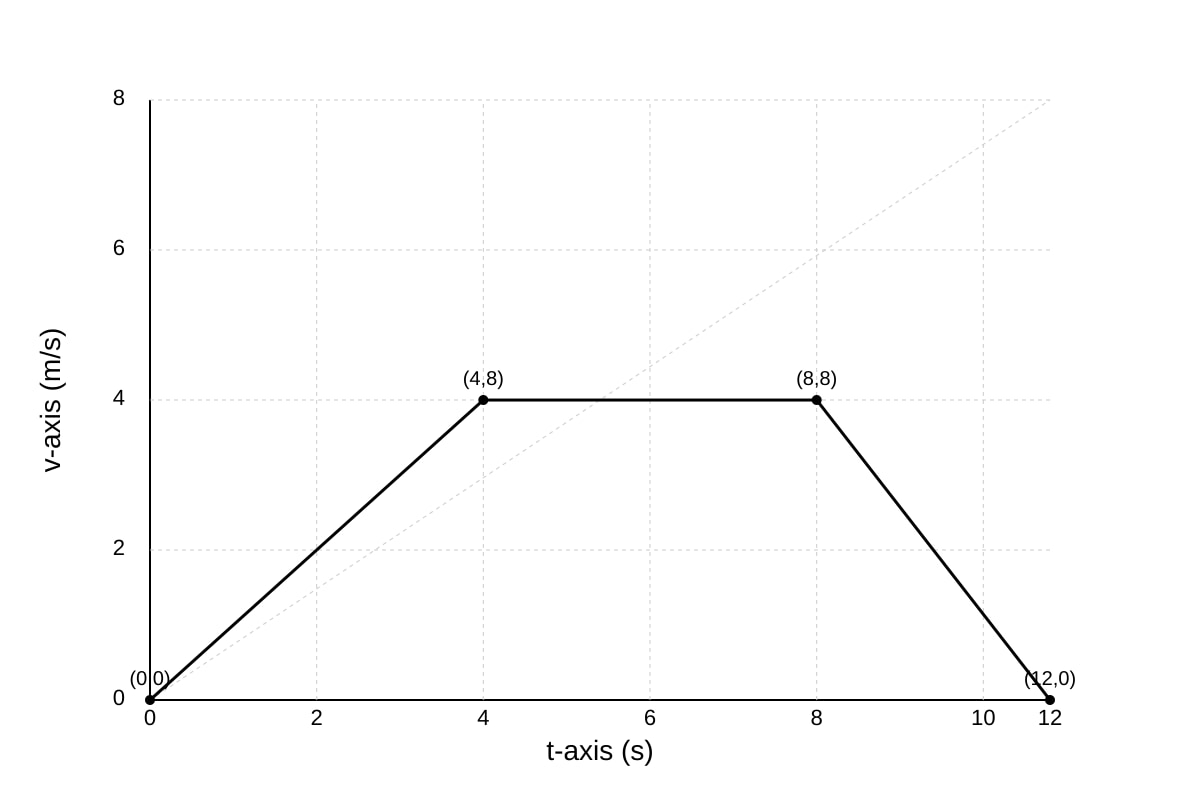
Generated graph for Q3.
(a) Calculate the total distance travelled by the car. [2]
(b) Determine the average acceleration during the first 4 s. [1]
4. A uniform rod of length 1.2 m and weight 20 N is pivoted at one end. A force of 15 N is applied vertically upward at the other end.
Calculate the net moment about the pivot. [2]
5. Explain why the weight of an object is considered a vector quantity but mass is a scalar. [2]
Section B: Motion, Collisions and Circular Motion (Questions 6–13) — [32 marks]
6. A projectile is launched from level ground with initial speed 25 m s−1 at an angle of 40∘ to the horizontal.
(a) Calculate the initial horizontal and vertical components of velocity. [2]
(b) Find the maximum height reached. [2]
(c) Calculate the horizontal range. [2]
7. A ball of mass 0.20 kg moving at 3.0 m s−1 collides head-on with a stationary ball of mass 0.30 kg. After the collision the 0.20 kg ball moves at 1.0 m s−1 in the same direction.
(a) State the principle of conservation of momentum as applied here. [1]
(b) Calculate the velocity of the 0.30 kg ball after collision. [3]
(c) Determine whether the collision is elastic. Show your reasoning. [3]
8. A particle moves in a horizontal circle of radius 0.50 m with constant speed 4.0 m s−1.
(a) Calculate the angular velocity. [1]
(b) Calculate the centripetal acceleration. [2]
(c) State the direction of the centripetal force. [1]
9. A stone of mass 0.050 kg is tied to a string of length 0.80 m and whirled in a vertical circle. At the lowest point its speed is 5.0 m s−1.
Calculate the tension in the string at this point. [3]
10. The graph shows the force acting on a 0.10 kg object over a time interval.
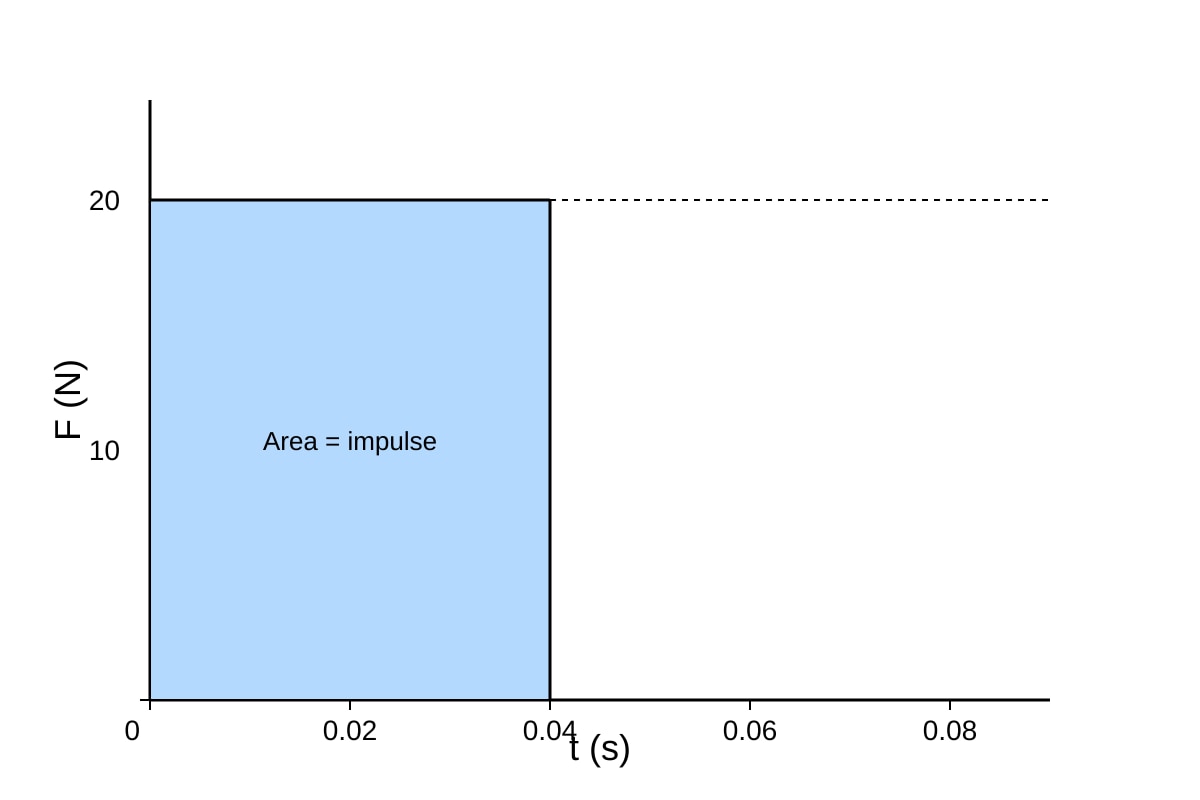
Generated graph for Q10.
Calculate the impulse on the object and its final velocity assuming it starts from rest. [3]
11. A satellite orbits Earth at a height where gravitational field strength is 6.0 N kg−1. The satellite has mass 500 kg.
(a) Calculate the gravitational force on it. [1]
(b) State one condition for a stable circular orbit. [1]
12. A disc rotates with angular velocity 8.0 rad s−1. A point on its rim is 0.10 m from the centre.
Calculate the linear speed and the centripetal acceleration of the point. [3]
13. A 2.0 kg mass is dropped from rest and falls freely. After 3.0 s, calculate:
(a) its velocity, [1]
(b) the distance fallen, [2]
(c) its kinetic energy at that instant. [2]
Section C: Oscillations and Gravitation (Questions 14–20) — [28 marks]
14. A mass on a spring performs simple harmonic motion with amplitude 0.040 m and period 1.2 s.
(a) Calculate the angular frequency. [1]
(b) Calculate the maximum acceleration. [2]
(c) State the phase difference between displacement and velocity. [1]
15. The displacement of an oscillator is given by x=0.05sin(10t) where x is in metres and t in seconds.
(a) State the amplitude. [1]
(b) Calculate the maximum velocity. [2]
(c) Write the expression for acceleration a in terms of x. [2]
16. A pendulum of length 1.0 m performs s.h.m. with small amplitude.
(a) Calculate its period. (g=9.81 m s−2) [2]
(b) Explain why the motion is simple harmonic for small angles. [2]
17. Two masses m1=4.0×10³ kg and m2=6.0×10³ kg are separated by 2.0 m.
Calculate the gravitational force between them. (G=6.67×10⁻¹¹ N m2kg−2) [3]
18. A planet has mass M=6.0×1024 kg and radius R=6.4×10⁶ m.
(a) Calculate the gravitational field strength at its surface. [2]
(b) Calculate the gravitational potential at the surface. [2]
19. A geostationary satellite orbits Earth at radius 4.2×10⁷ m from the centre.
(a) State one characteristic of a geostationary orbit. [1]
(b) Calculate its orbital speed if its period is 24 h. [3]
20. A 0.10 kg mass on a spring oscillates with x=0.02cos(5t).
(a) State the initial displacement. [1]
(b) Calculate the maximum kinetic energy. [3]
(c) Sketch a graph of kinetic energy against time for one cycle. [2]
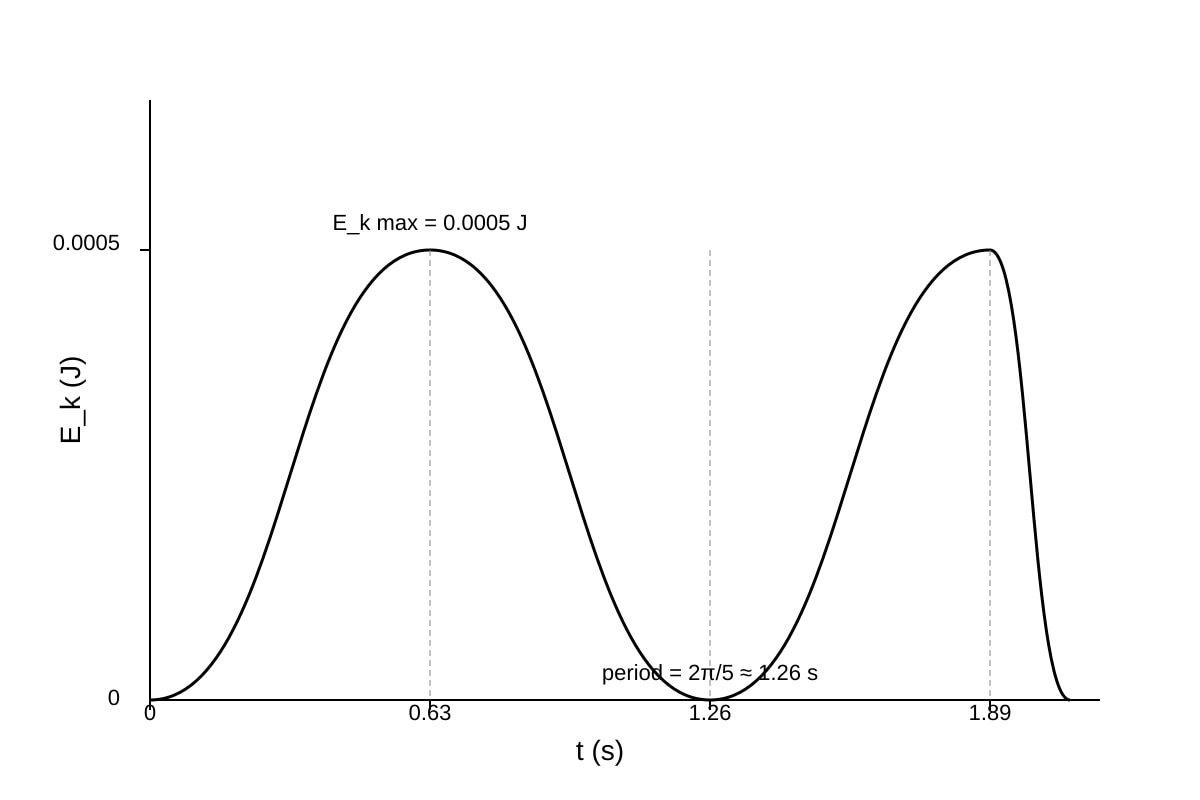
Generated graph for Q20.
End of Paper