From Real Exams Exam Paper
A Level H2 Physics Practice Paper 1
Free A Level H2 Physics Practice Paper 1, LongCat Exam version, with questions, answers, and A Level-style practice for Singapore students.
These static practice materials are generated from the site's syllabus and paper-generation workflow, with source and model context shown so students and parents can evaluate the material before use.
Questions
Free quiz and exam paper access
Enter your details to view this paper
Your access is remembered on this device.
Answers
TuitionGoWhere Practice Paper - Physics H2 A-Level
Answer Key — Practice Paper: Mechanics (Version 1 of 5)
Section A: Short Answer Questions [20 marks]
1. [2]
The principle of conservation of linear momentum states that:
In a closed system (or isolated system), the total momentum before an interaction equals the total momentum after the interaction, provided no external resultant force acts on the system.
Marking:
- 1 mark for stating that total momentum remains constant / is conserved.
- 1 mark for specifying the condition: no external resultant force / closed/isolated system.
Common mistakes:
- Simply writing "momentum is conserved" without mentioning the condition of no external force — this only scores 1 mark.
- Confusing with conservation of energy.
2. [2]
Using :
Marking:
- 1 mark for correct formula or method.
- 1 mark for correct answer with unit.
Answer:
3. [2]
Definition: Work done by a force is the product of the force and the displacement in the direction of the force.
where is the force, is the displacement, and is the angle between the force and displacement.
SI unit: joule (J), where .
Marking:
- 1 mark for correct definition (force × displacement in direction of force).
- 1 mark for correct SI unit (joule or N m).
4. [2]
At maximum height, final velocity .
Using :
Marking:
- 1 mark for correct substitution into appropriate kinematic equation.
- 1 mark for correct answer (accept 11.4–11.5 m depending on used).
Answer: (or if used)
5. [2]
Newton's first law of motion states:
An object remains at rest or continues to move at a constant velocity unless acted upon by a resultant external force.
Marking:
- 1 mark for stating constant velocity / rest condition.
- 1 mark for stating the condition of no resultant external force.
Common mistakes:
- Omitting "resultant" force.
- Only stating "object at rest stays at rest" without mentioning constant velocity motion.
6. [2]
Using Newton's second law, :
Marking:
- 1 mark for correct formula.
- 1 mark for correct answer with unit.
Answer:
7. [2]
| Scalar | Vector | |
|---|---|---|
| Definition | A quantity with magnitude only | A quantity with magnitude and direction |
| Example | Speed, mass, energy, time | Velocity, force, momentum, displacement |
Marking:
- 1 mark for correct distinction (magnitude only vs. magnitude and direction).
- 1 mark for one correct example of each.
8. [2]
Marking:
- 1 mark for correct formula and substitution.
- 1 mark for correct answer.
Answer:
9. [2]
An object is in translational equilibrium when the resultant (net) force acting on it is zero.
This means:
The object may be at rest or moving with constant velocity.
Marking:
- 2 marks for stating that the resultant/net force is zero.
- Accept: "vector sum of all forces is zero" or "sum of forces in any direction is zero."
10. [2]
Using where :
Marking:
- 1 mark for correct substitution.
- 1 mark for correct answer (accept 44.1 m or 45 m if used).
Answer:
Section B: Structured Questions [25 marks]
11. (a) [3]
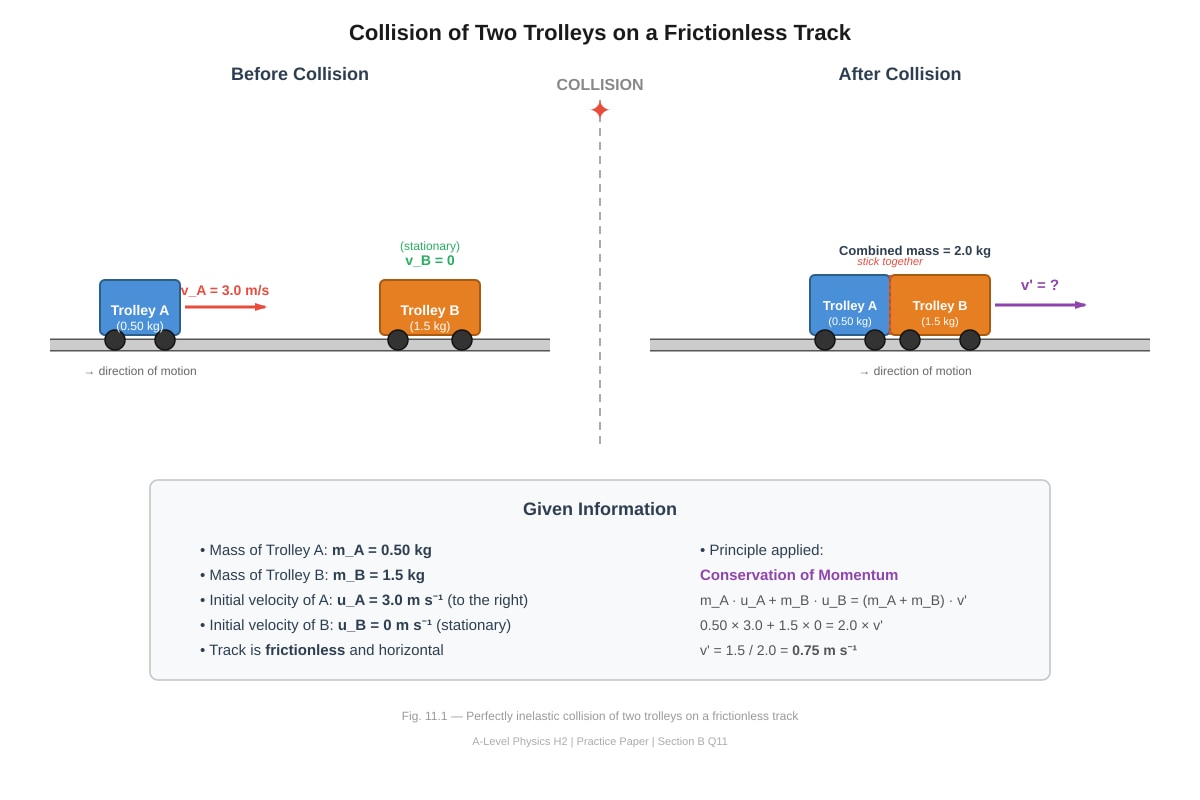
By conservation of linear momentum:
Marking:
- 1 mark for stating/using conservation of momentum.
- 1 mark for correct substitution.
- 1 mark for correct answer with unit.
Answer: in the original direction of motion of trolley A.
(b) [3]
Kinetic energy before collision:
Kinetic energy after collision:
Since , kinetic energy is not conserved.
This is a perfectly inelastic collision (the objects stick together).
Marking:
- 1 mark for calculating KE before.
- 1 mark for calculating KE after and comparing.
- 1 mark for stating it is not conserved and identifying the collision type.
(c) [2]
By Newton's third law, when trolley A exerts a force on trolley B during the collision, trolley B exerts an equal and opposite force on trolley A. The two forces are equal in magnitude, opposite in direction, act on different bodies, and are of the same type (contact force).
Marking:
- 1 mark for stating equal and opposite forces (action-reaction pair).
- 1 mark for noting they act on different bodies / same type of force.
12. (a) [2]
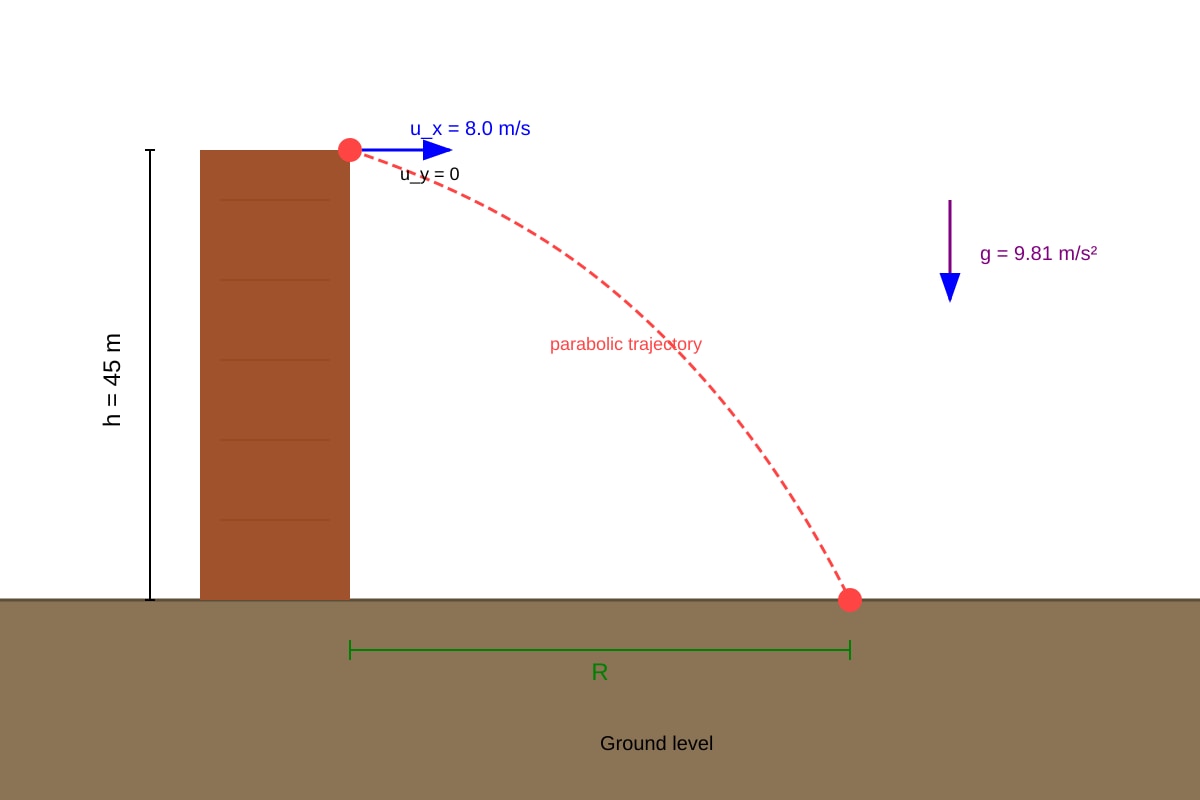
Vertical motion: (since )
Marking:
- 1 mark for correct equation.
- 1 mark for correct answer.
Answer:
(b) [2]
Horizontal motion (constant velocity):
Marking:
- 1 mark for using horizontal velocity × time.
- 1 mark for correct answer.
Answer:
(c) [3]
Vertical component of velocity just before hitting ground:
Horizontal component remains constant:
Resultant speed:
Marking:
- 1 mark for calculating .
- 1 mark for using Pythagoras' theorem to find resultant.
- 1 mark for correct final answer.
Answer:
13. (a) [3]
Taking upward as positive. Using Newton's second law:
Marking:
- 1 mark for correct free-body diagram or equation setup.
- 1 mark for correct substitution.
- 1 mark for correct answer.
Answer: (upward)
(b) [2]
When the lift moves at constant velocity, acceleration .
Explanation: By Newton's first law, when the lift moves at constant velocity, the resultant force on the student is zero. Therefore, the reaction force equals the weight.
Marking:
- 1 mark for correct value.
- 1 mark for explanation referencing Newton's first law / zero acceleration.
(c) [2]
The lift is decelerating while moving upward, so acceleration is downward: .
Marking:
- 1 mark for correct equation with reduced effective g.
- 1 mark for correct answer.
Answer:
14. (a) [1]
Answer:
(b) [2]
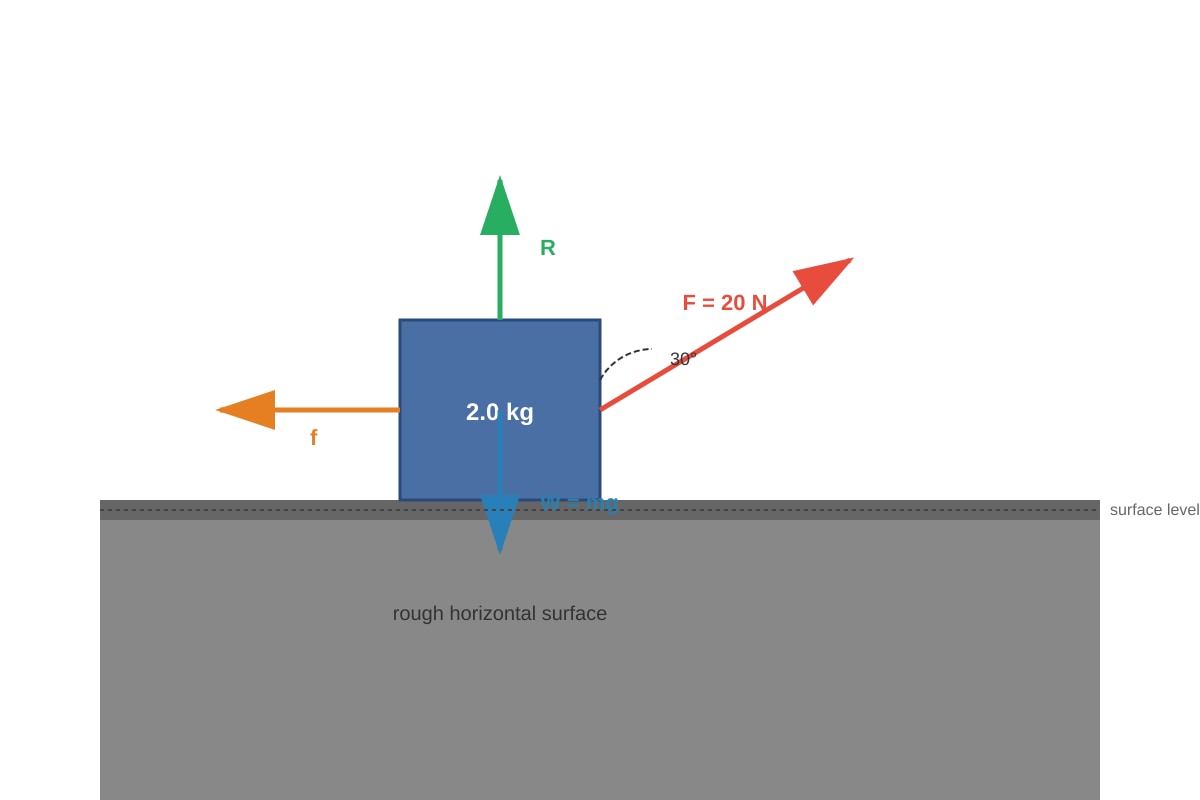
Resolving vertically (no vertical acceleration):
Marking:
- 1 mark for correct vertical force balance equation.
- 1 mark for correct answer.
Answer:
(c) [3]
Friction force:
Applying Newton's second law horizontally:
Marking:
- 1 mark for calculating friction force.
- 1 mark for applying Newton's second law horizontally.
- 1 mark for correct answer.
Answer:
15. (a) [3]
Taking the initial direction of motion as positive:
Initial momentum:
Final momentum: (rebound is opposite direction)
Change in momentum:
Magnitude of change: in the direction away from the wall.
Marking:
- 1 mark for correct initial and final momentum values with signs.
- 1 mark for correct subtraction.
- 1 mark for correct magnitude and direction.
Answer: directed away from the wall.
(b) [2]
Using the impulse-momentum theorem:
Marking:
- 1 mark for using .
- 1 mark for correct answer.
Answer:
Section C: Extended Response [15 marks]
16. (a) [2]
At rest, , so
Resultant force:
Marking:
- 1 mark for calculating resistive force at .
- 1 mark for correct acceleration.
Answer:
(b) [3]
As the speed increases, the resistive force increases (since it depends on ).
The driving force remains constant at , so the resultant force:
decreases as increases.
By Newton's second law (), if the resultant force decreases while mass stays constant, the acceleration must decrease.
Marking:
- 1 mark for explaining that resistive force increases with speed.
- 1 mark for stating that resultant force therefore decreases.
- 1 mark for linking to Newton's second law to conclude acceleration decreases.
(c) [3]
At maximum speed, acceleration is zero, so resultant force is zero:
Marking:
- 1 mark for setting driving force = resistive force.
- 1 mark for correct algebraic manipulation.
- 1 mark for correct answer.
Answer:
17. (a) [3]
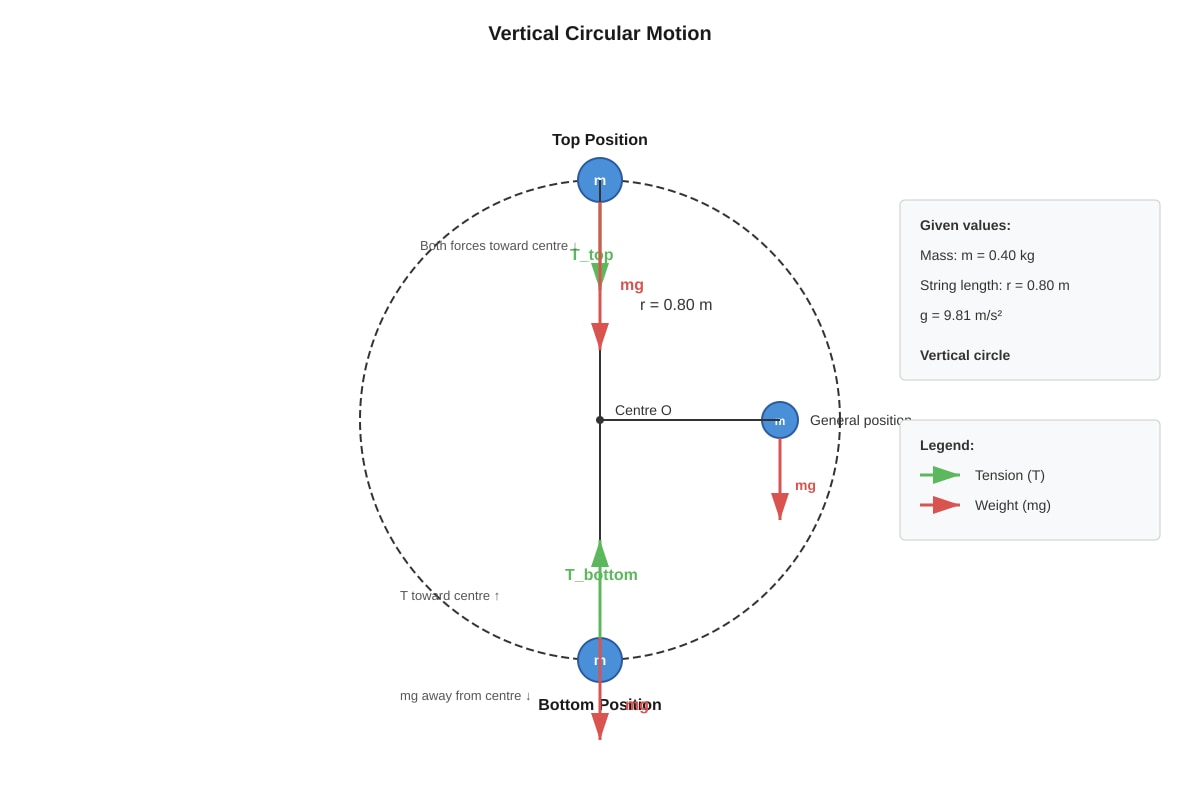
At the top of the circle, both the tension and weight act toward the centre (downward). For minimum speed, tension is zero at the top, so weight alone provides the centripetal force:
Marking:
- 1 mark for setting weight = centripetal force (T = 0 at minimum speed).
- 1 mark for correct substitution.
- 1 mark for correct answer.
Answer:
(b) [3]
At the bottom of the circle, tension acts toward the centre (upward) and weight acts away from the centre (downward):
Marking:
- 1 mark for correct equation (T − mg = mv²/r).
- 1 mark for correct substitution.
- 1 mark for correct answer.
Answer:
(c) [2]
At the bottom of the circle, the tension must support the weight of the object AND provide the centripetal force. The tension is therefore greatest at the bottom:
At the top, the weight contributes toward the centripetal force, so the tension is less:
Since tension is maximum at the bottom, the string is most likely to break there.
Marking:
- 1 mark for explaining that tension is greatest at the bottom.
- 1 mark for comparing with tension at the top (weight assists at top, opposes at bottom).
18. (a) [3]
Forces along the slope (taking down the slope as positive):
Component of weight down the slope:
Friction up the slope:
Applying Newton's second law along the slope:
Marking:
- 1 mark for correct identification of forces along the slope.
- 1 mark for including friction correctly.
- 1 mark for deriving the expression for acceleration.
(b) [2]
Using with :
Marking:
- 1 mark for correct substitution into acceleration expression.
- 1 mark for correct final speed.
Answer:
(c) [3]
Using conservation of energy:
Loss in gravitational PE = Gain in KE + Work done against friction
where
and
This agrees with the answer from part (b), verifying the result.
Marking:
- 1 mark for correct energy conservation equation.
- 1 mark for correct calculation of height and friction work.
- 1 mark for correct final answer matching part (b).
Answer: ✓ (verified)
End of Answer Key
Total: 60 marks