AI Generated Quiz
A Level H1 Physics Waves Sound Light Quiz
Free A Level H1 Physics Waves Sound Light quiz, LongCat AI version, with questions, answers, and A Level-style practice for Singapore students.
These static practice materials are generated from the site's syllabus and paper-generation workflow, with source and model context shown so students and parents can evaluate the material before use.
Questions

Free quiz and exam paper access
Enter your details to view this paper
Your access is remembered on this device.
Answers
A-Level Physics H1 Quiz - Waves Sound Light
Answer Key and Teaching Notes
Section A: Multiple Choice
1. Answer: B [2]
Teaching Notes: In a transverse wave, the displacement of particles is perpendicular to the direction of wave propagation. For a wave on a string, the string moves up and down (or side to side) while the wave travels horizontally along the string. Option A describes longitudinal waves. Option C is incorrect because particles do oscillate. Option D describes circular/elliptical motion, which is not typical for a simple transverse wave on a string.
2. Answer: C [2]
Working: Using the wave equation :
Teaching Notes: This is a direct application of the fundamental wave equation. Students should always check units — frequency in Hz and wavelength in metres gives speed in m s⁻¹. The value 340 m s⁻¹ is also the approximate speed of sound in air at room temperature, which is a useful reference value to remember.
3. Answer: B [2]
Teaching Notes: Longitudinal waves consist of compressions (regions of high pressure/particle density) and rarefactions (regions of low pressure/particle density). Option A is incorrect because only transverse waves can be polarised. Option C is incorrect because only electromagnetic (transverse) waves travel at the speed of light in a vacuum. Option D is incorrect because both transverse and longitudinal waves can undergo diffraction.
4. Answer: B [2]
Teaching Notes: Destructive interference occurs when the path difference is an odd multiple of half-wavelengths: where . Here, corresponds to , so destructive interference occurs and a dark fringe is formed. Constructive interference occurs when the path difference is a whole number of wavelengths ().
5. Answer: A [2]
Working: The diffraction grating equation is .
Slit spacing:
For the first-order maximum ():
Teaching Notes: Students must convert units carefully — lines per mm to slit spacing in metres, and nm to metres. The grating equation is fundamental. Common errors include forgetting to convert units or using the wrong order .
Section B: Structured Questions
6. (a) Amplitude is the maximum displacement of a particle from its equilibrium (mean) position. [1]
(b) Frequency is the number of complete oscillations (cycles) per unit time, measured in hertz (Hz). [1]
(c) The wave equation: [1]
Teaching Notes: These are fundamental definitions. Amplitude relates to the energy carried by the wave (energy amplitude²). Frequency is determined by the source and does not change when the wave moves from one medium to another.
7. (a) Comparing with the general form :
Amplitude m [1]
(b) Angular frequency rad s⁻¹. Since : [1]
(c) Wave number rad m⁻¹. Since : [1]
(d) Wave speed: m s⁻¹ [1]
Teaching Notes: Students must be able to extract , , and from the wave equation and relate them to physical quantities. The general form represents a wave travelling in the direction. Common errors include confusing with or with .
8. (a) The principle of superposition states that when two or more waves meet at a point, the resultant displacement is the vector sum of the individual displacements of the waves at that point. [2]
(b) When the path difference is exactly one wavelength (), the two waves arrive in phase at that point. By the principle of superposition, the displacements of the two waves add constructively, producing a resultant wave with amplitude equal to the sum of the individual amplitudes. This is constructive interference and a bright fringe (maximum) is observed. [2]
Teaching Notes: Superposition is a fundamental principle. Students should understand that it applies to displacement, not intensity. When waves are in phase, they reinforce; when out of phase by half a wavelength, they cancel.
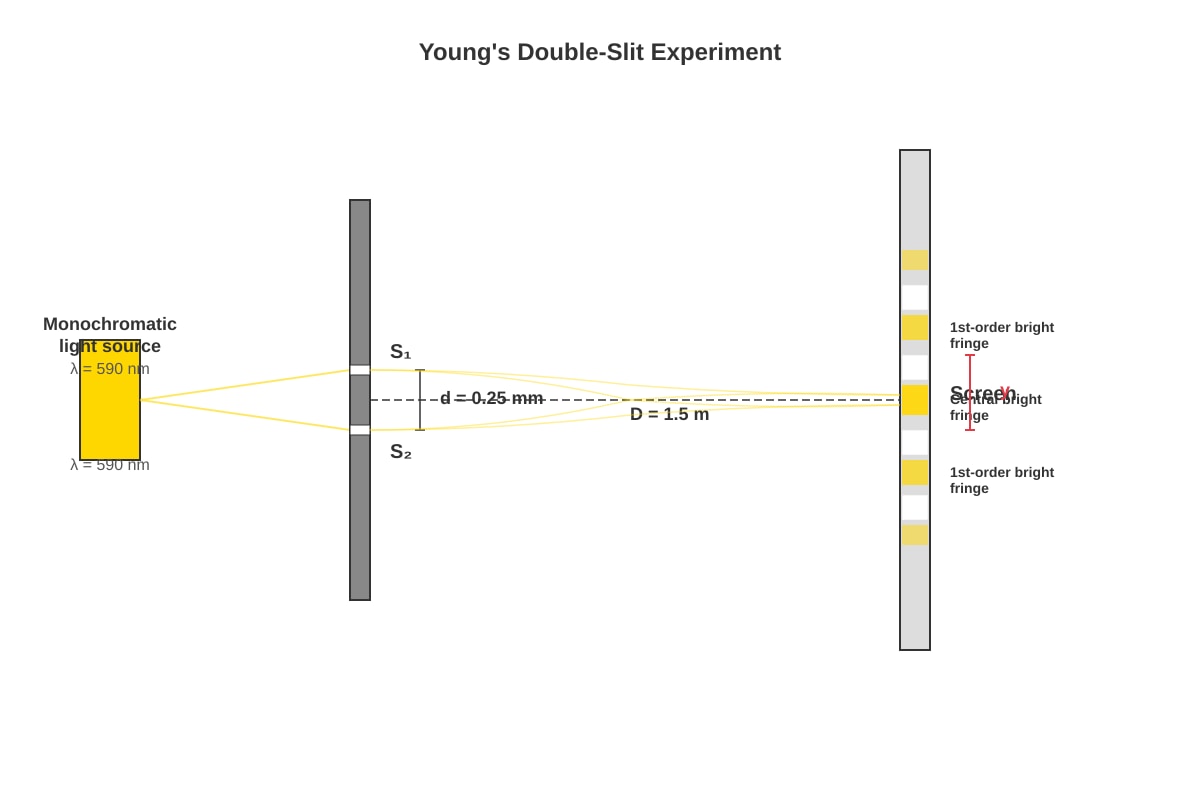
9. (a) Using the fringe separation formula for Young's double-slit experiment:
Substituting values: [3]
[1 mark for correct formula, 1 mark for correct substitution, 1 mark for correct answer with unit]
(b) From , if the slit separation is increased, the fringe separation decreases. The fringes become closer together. [2]
[1 mark for stating fringe separation decreases, 1 mark for explanation referencing the formula]
Teaching Notes: The fringe separation formula is derived from the geometry of the setup. Students should understand that — increasing slit separation compresses the pattern. This is a standard H1 question type.
10. (a) Polarisation is the process by which the oscillations of a wave are restricted to a single plane (or direction) perpendicular to the direction of propagation. [2]
(b) Only transverse waves can be polarised. [1] This is because the oscillations in a transverse wave are perpendicular to the direction of propagation, so it is possible to restrict them to a particular direction using a polarising filter. Longitudinal waves cannot be polarised because their oscillations are parallel to the direction of propagation — there is no preferred transverse direction to restrict. [1]
Teaching Notes: Polarisation is a key distinguishing property of transverse waves. Electromagnetic waves (light) are transverse and can be polarised; sound waves are longitudinal and cannot. Students often confuse polarisation with other wave phenomena.
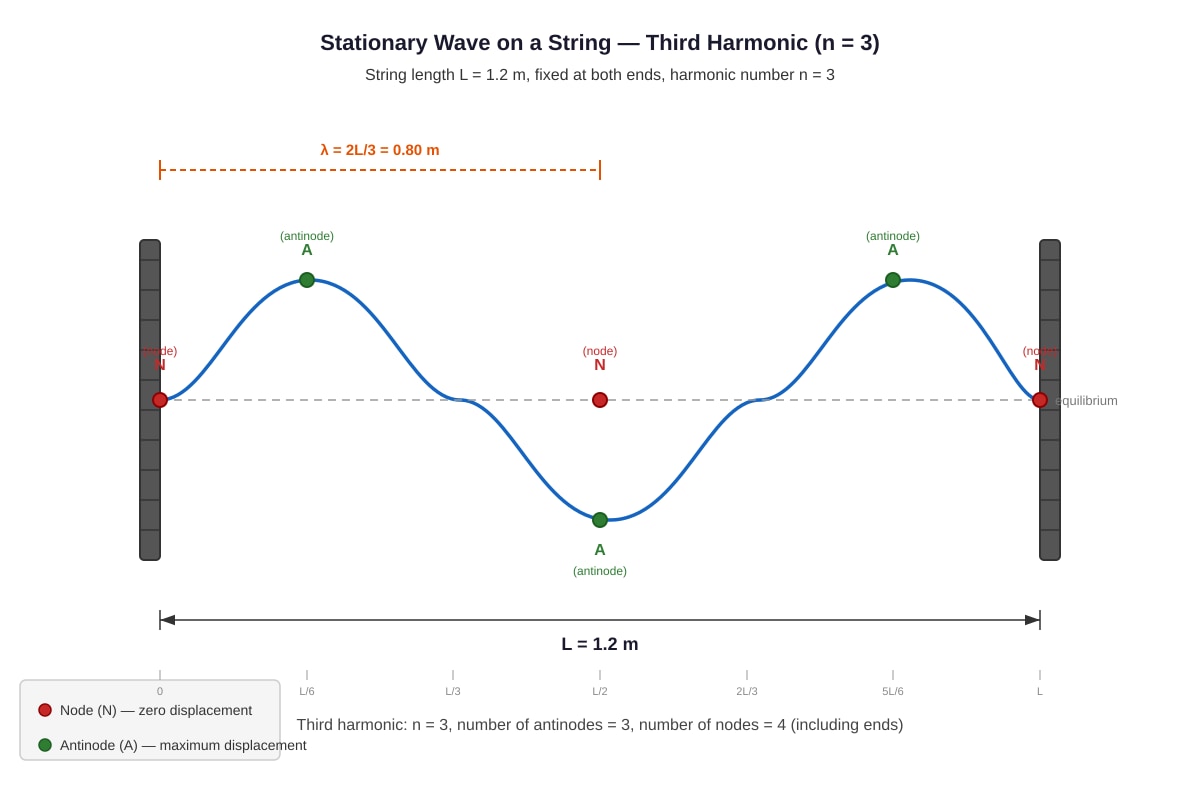
11. (a) Nodes (N) at both ends and at the centre (0.60 m). Antinodes (A) at 0.20 m, 0.60 m is a node, and 1.00 m — wait, for the third harmonic on a string fixed at both ends: nodes at 0, 0.60, and 1.20 m; antinodes at 0.30, 0.60...
[Correction for the answer key:] For the third harmonic on a string fixed at both ends, there are 3 half-wavelengths fitting into length . Nodes at i.e., at 0, 0.40, 0.80, and 1.20 m. Antinodes at i.e., at 0.20, 0.60, and 1.00 m. [1]
[The image_placeholder should show: nodes at both ends and two equally spaced nodes between them; antinodes between each pair of adjacent nodes]
(b) For the third harmonic: , so: [2]
[1 mark for correct relationship, 1 mark for correct answer]
(c) Using : [2]
[1 mark for correct formula, 1 mark for correct answer]
Teaching Notes: For a string fixed at both ends, the harmonic number relates to wavelength by , so . The third harmonic has . Students should be able to draw and label the standing wave pattern for any harmonic.
12. (a) Using : [2]
[1 mark for formula, 1 mark for answer with unit]
(b) Using the Doppler effect formula for a source moving towards a stationary observer:
where m s⁻¹, m s⁻¹, Hz: [3]
[1 mark for correct formula, 1 mark for correct substitution, 1 mark for correct answer]
Teaching Notes: The Doppler effect formula depends on whether the source or observer is moving. For a source moving towards a stationary observer, the observed frequency increases. The denominator is because the source is approaching. Common errors include using the wrong sign or confusing source/observer motion formulas.
13. (a) Two conditions for coherence: [2]
- The waves must have the same frequency (or wavelength).
- They must have a constant phase difference (i.e., the phase relationship does not change with time).
(b) Coherent sources are necessary because if the phase difference between the two sources varies randomly with time, the positions of constructive and destructive interference would change rapidly. The interference pattern would shift back and forth and average out, making it impossible to observe a stable (stationary) pattern. With a constant phase difference, the positions of maxima and minima remain fixed, allowing a clear pattern to be observed. [2]
Teaching Notes: Coherence is essential for observable interference. Students should understand that "constant phase difference" is the key requirement — two sources can have the same frequency but if their phase difference drifts, no stable pattern forms.
14. (a) The slit spacing is the reciprocal of the number of lines per metre: [2]
[1 mark for conversion, 1 mark for answer]
(b) Using the grating equation : [2]
[1 mark for formula, 1 mark for answer]
(c) The maximum order occurs when :
Since must be an integer, the highest order is . [2]
[1 mark for setting sin θ = 1, 1 mark for correct integer answer]
Teaching Notes: The maximum order is found by setting (the maximum possible value). Any non-integer result is rounded down to the nearest whole number. Students should be careful with unit conversions (lines per mm to lines per metre).
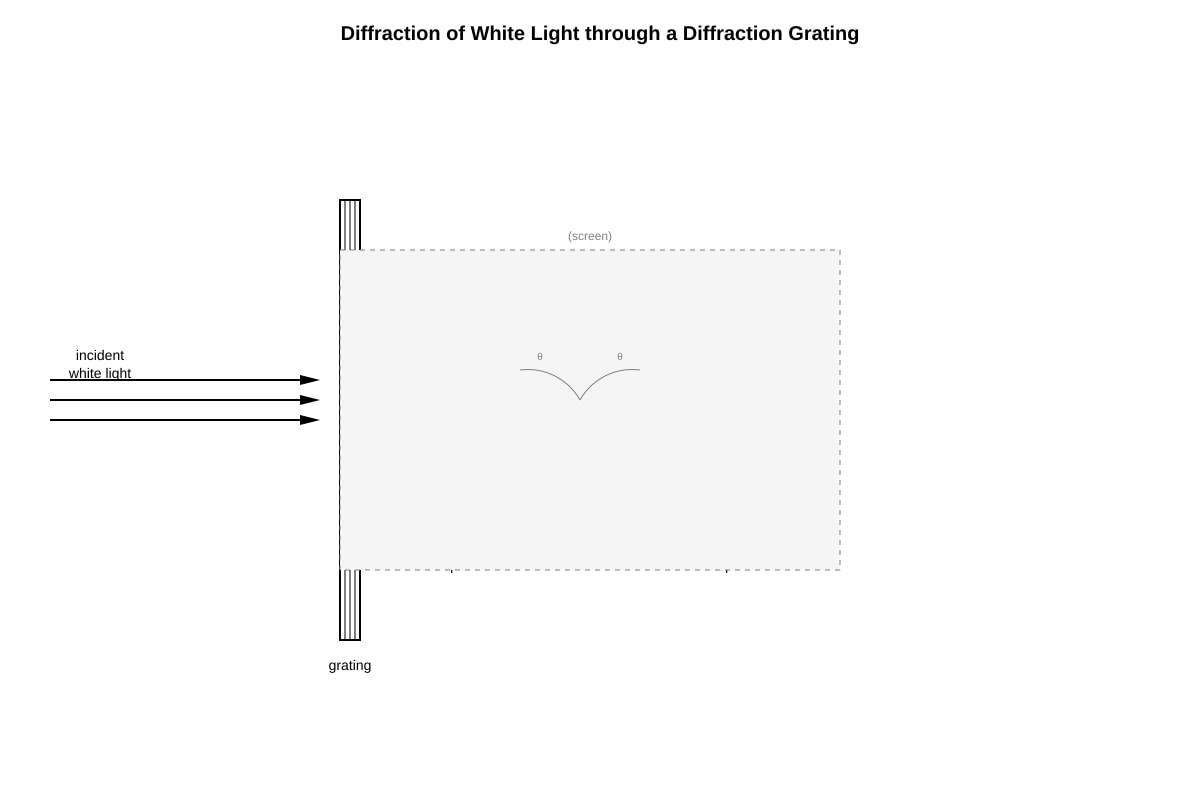
15. (a) At the central maximum (), the path difference between waves from all parts of the grating is zero for all wavelengths. Therefore, all colours (wavelengths) undergo constructive interference at the same point, and they combine to produce white light. [2]
(b) The diffraction grating equation is . For a given order and slit spacing , the angle is proportional to the wavelength . Red light has a longer wavelength than violet light, so red light is diffracted through a larger angle. This is why red appears on the outer edge of the spectrum and violet on the inner edge. [2]
Teaching Notes: Dispersion by a grating separates colours because the diffraction angle depends on wavelength. Red (~700 nm) diffracts more than violet (~400 nm). This is the opposite of what happens in a prism, where violet is refracted more — students sometimes confuse these.
Section C: Free Response
16. (a) Comparing with :
rad s⁻¹, rad m⁻¹
Wave speed: m s⁻¹ ✓ [2]
[1 mark for identifying ω and k, 1 mark for correct calculation]
(b) The maximum particle speed is given by :
m s⁻¹ [2]
[1 mark for formula, 1 mark for correct answer]
[Note: particle speed is different from wave speed. The particle oscillates with SHM, and its maximum speed is ωA.]
(c) Phase difference
First find : , so m
mm m
rad rad [3]
[1 mark for correct formula, 1 mark for finding λ, 1 mark for correct answer]
Teaching Notes: This question tests understanding of the wave equation in detail. Students must distinguish between wave speed () and maximum particle speed (). The phase difference between two points depends on their separation relative to the wavelength.
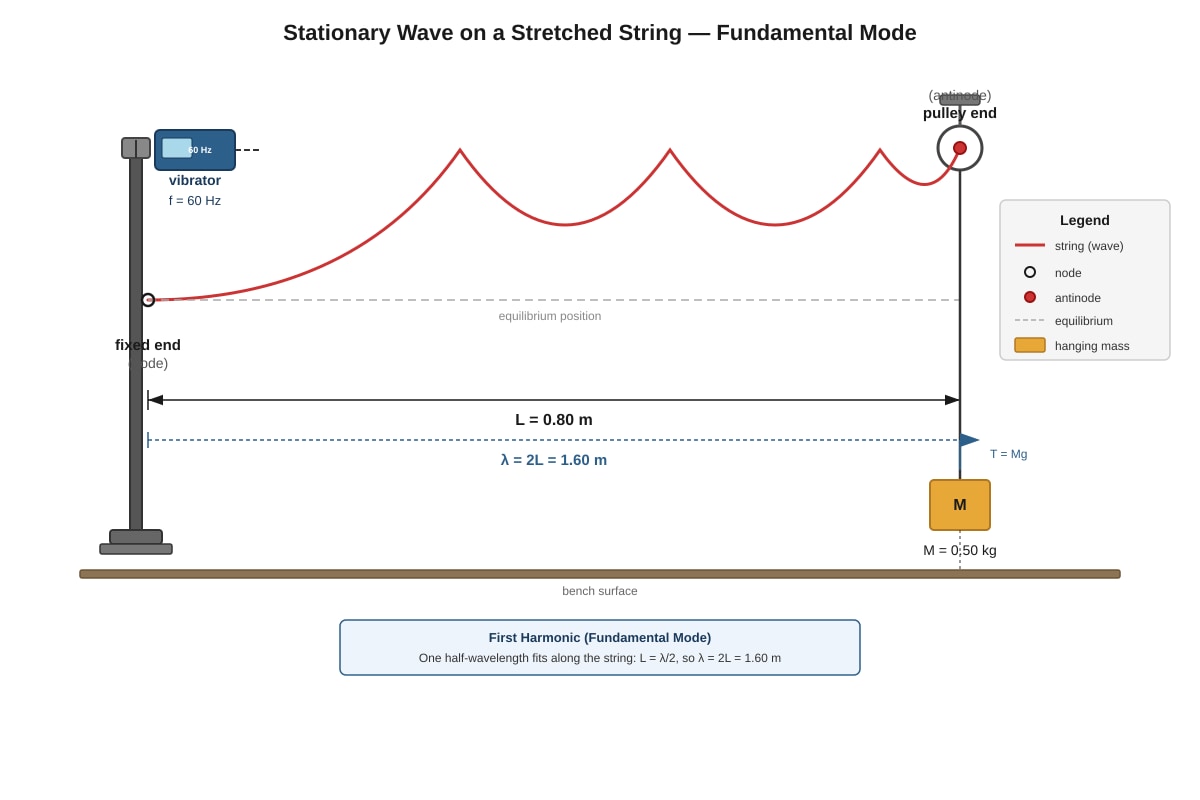
17. (a) At the fixed end, the string cannot move, so the displacement is always zero — this is a node. At the pulley end, the string is free to vibrate vertically (the pulley allows transverse motion), so this end is free to oscillate with maximum amplitude — this is an antinode. [2]
(b) For the fundamental mode with a node at one end and an antinode at the other, the length of the string is one-quarter of a wavelength: [2]
[1 mark for correct relationship, 1 mark for answer]
(c) Wave speed: m s⁻¹ [2]
[1 mark for formula, 1 mark for answer]
(d) The speed of a wave on a string is given by , where is tension and is linear mass density.
Tension: N
From : [3]
[1 mark for tension calculation, 1 mark for correct formula, 1 mark for answer]
Teaching Notes: This is a multi-part question combining several concepts. The fundamental mode for a string fixed at one end and free at the other has (not as for both ends fixed). Students must be careful to identify the correct boundary conditions. The wave-on-a-string formula is essential.
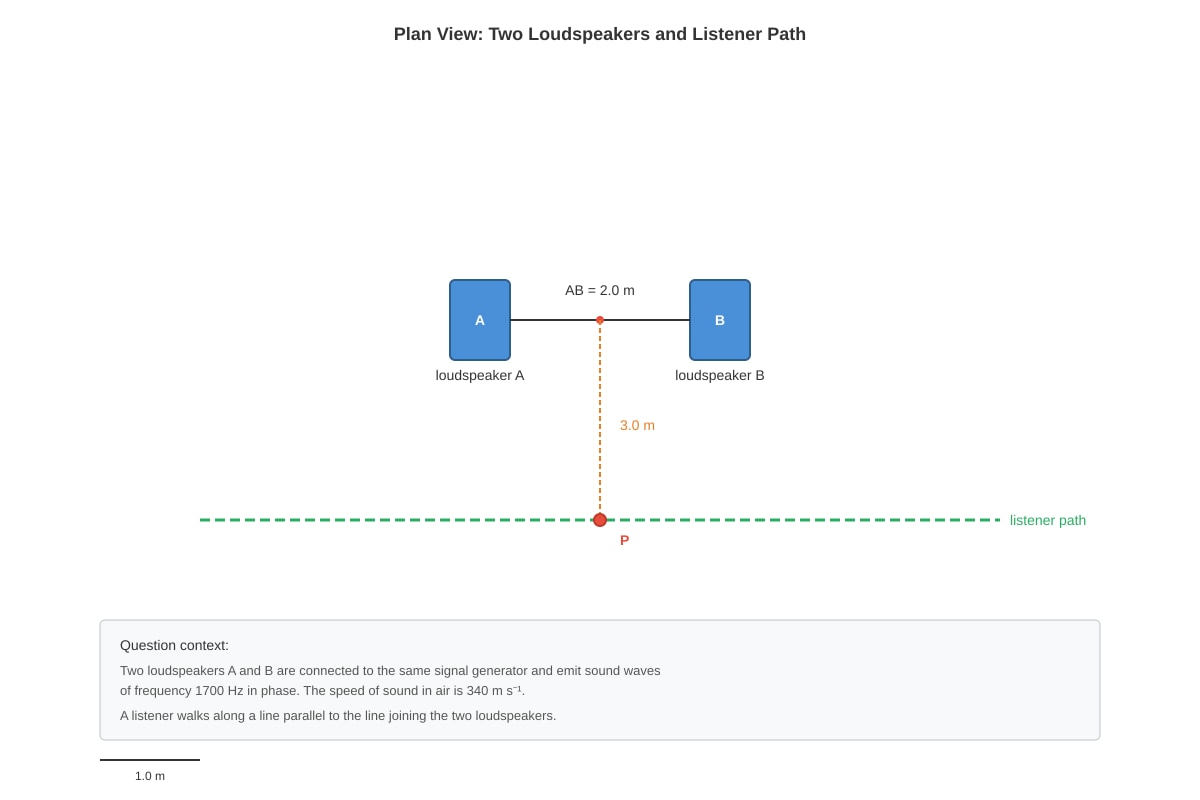
18. (a) m [1]
(b) At point P, the listener is equidistant from both loudspeakers. The path difference is zero, so the two waves arrive in phase. Constructive interference occurs, producing a loud sound. [2]
(c) For the first minimum (destructive interference), the path difference must be m.
Let the listener be at a distance from P along the path. The distances from A and B to the listener are:
For the first minimum: m
By symmetry, for small near P, we can use the approximation for the path difference in a two-source interference setup. The path difference at a point at distance from the central axis is approximately:
where m (separation) and m (perpendicular distance).
For the first minimum: m
Since is small compared to , m:
[4]
[1 mark for identifying path difference = λ/2, 1 mark for setting up geometry, 1 mark for approximation, 1 mark for answer]
Teaching Notes: This is a challenging two-source interference problem. The key insight is that at the first minimum, the path difference equals half a wavelength. The small-angle approximation simplifies the calculation. Students should be comfortable with the geometry of the two-source setup.
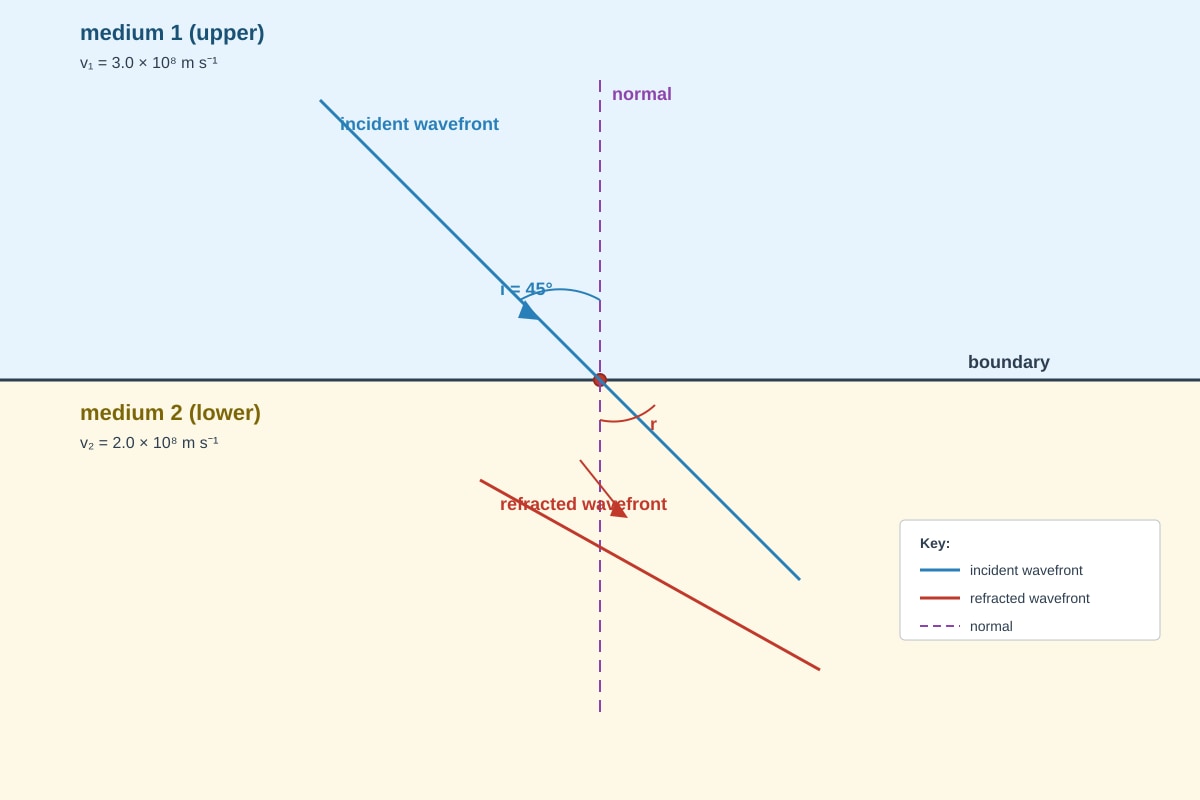
19. (a) Refraction is the change in direction (and speed) of a wave when it passes from one medium to another, due to the change in wave speed in the different media. [2]
(b)(i) The refractive index of medium 2 relative to medium 1: [2]
[1 mark for correct formula, 1 mark for answer]
(ii) Using Snell's law:
Since : [2]
[1 mark for applying Snell's law, 1 mark for correct answer]
Teaching Notes: Refraction occurs because the wave speed changes between media. The refractive index . When entering a slower medium (), the wave bends towards the normal (). Students should be able to use both the wave-speed ratio and Snell's law.
20. (a) At the surface of the metal plate, the incident and reflected microwaves superpose. The metal plate acts as a reflector and the electric field of the electromagnetic wave must be zero at the surface (the free electrons in the metal rearrange to cancel the field). This means the incident and reflected waves must cancel at the surface, forming a node (point of zero amplitude). [2]
(b) In a stationary wave, adjacent nodes (or adjacent minima) are separated by . The detector records successive minima separated by 1.5 cm, which equals .
Therefore: cm, so cm. This is consistent with the given wavelength of 3.0 cm. [3]
[1 mark for identifying node separation = λ/2, 1 mark for calculation, 1 mark for consistency check]
(c) As the transmitter moves towards the plate, the distance between the transmitter and plate decreases. The stationary wave pattern changes — the number of nodes and antinodes between the transmitter and plate decreases. The detector will pass through alternating maxima and minima, but the spacing between successive minima remains cm (since the wavelength doesn't change). The signal at the detector will oscillate between maximum and minimum as the pattern shifts. [2]
[1 mark for describing changing pattern, 1 mark for explaining why]
Teaching Notes: This question tests understanding of stationary waves formed by reflection. The node at the metal plate is a boundary condition. The distance between adjacent nodes is always . Students should understand that changing the distance between source and reflector changes the number of nodes/antinodes but not their spacing.