AI Generated Quiz
A Level H1 Physics Waves Sound Light Quiz
Free A Level H1 Physics Waves Sound Light quiz, HY3 AI version, with questions, answers, and A Level-style practice for Singapore students.
These static practice materials are generated from the site's syllabus and paper-generation workflow, with source and model context shown so students and parents can evaluate the material before use.
Questions
A-Level Physics H1 Quiz - Waves Sound Light
Name: ___________________________
Class: ___________________________
Date: ___________________________
Score: _______ / 40
Duration: 50 minutes
Total Marks: 40
Instructions:
- Answer all 20 questions.
- Show your working clearly for calculation questions.
- Use the spaces provided.
- This quiz is syllabus-first practice content generated from LLM-inferred templates. It is not derived from past-year exam papers.
Section A: Waves and Sound (Questions 1–10)
1. State what is meant by the wavelength of a progressive wave. [1]
2. A sound wave of frequency 440 Hz travels in air at speed 340 m s−1. Calculate its wavelength. [2]
3. Describe the difference between a transverse wave and a longitudinal wave, giving one example of each. [3]
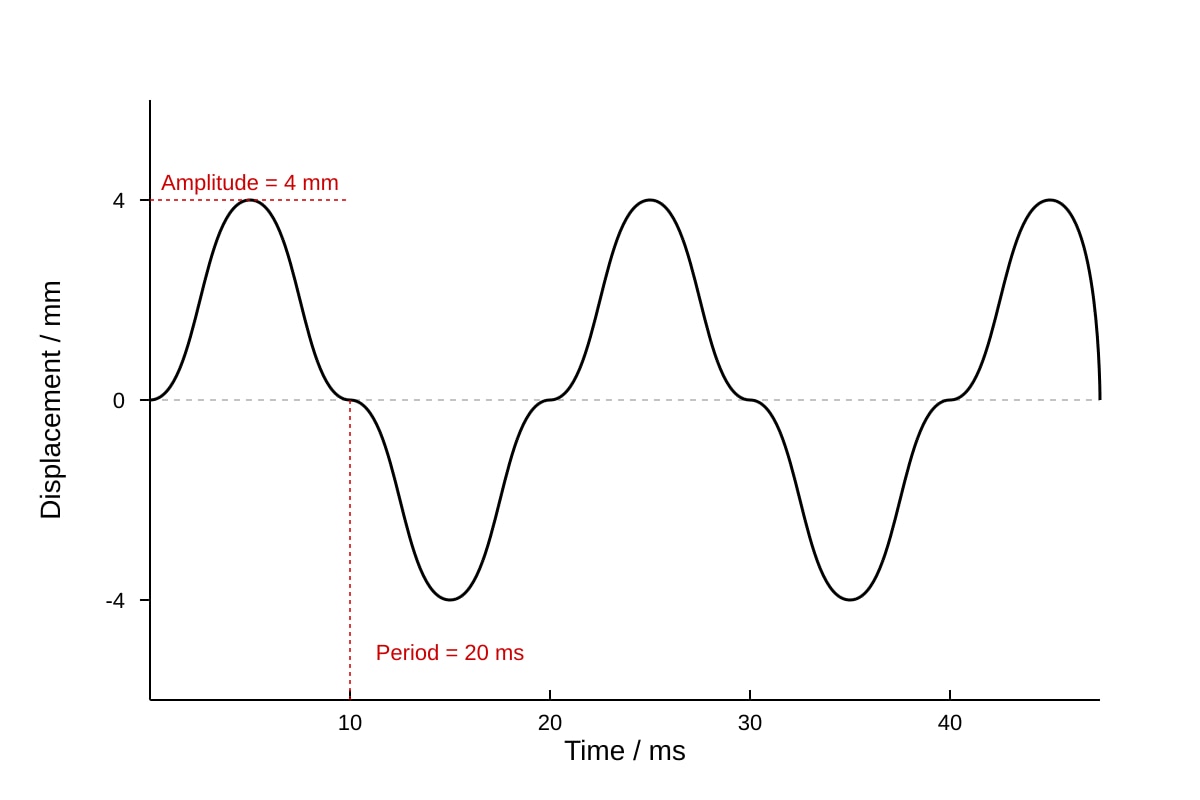
4. The displacement-time graph below shows the motion of a particle in a medium through which a wave passes.
Image pending generation: graph for Q4.
From the graph, determine (a) the period and (b) the frequency of the wave. [2]
5. Explain how diffraction of a sound wave at a doorway allows a person in an adjacent room to hear the sound even when not in direct line of sight. [2]
6. Two coherent sound sources emit waves of wavelength 0.50 m. A point P is 3.00 m from source A and 3.75 m from source B. Determine whether constructive or destructive interference occurs at P. [3]
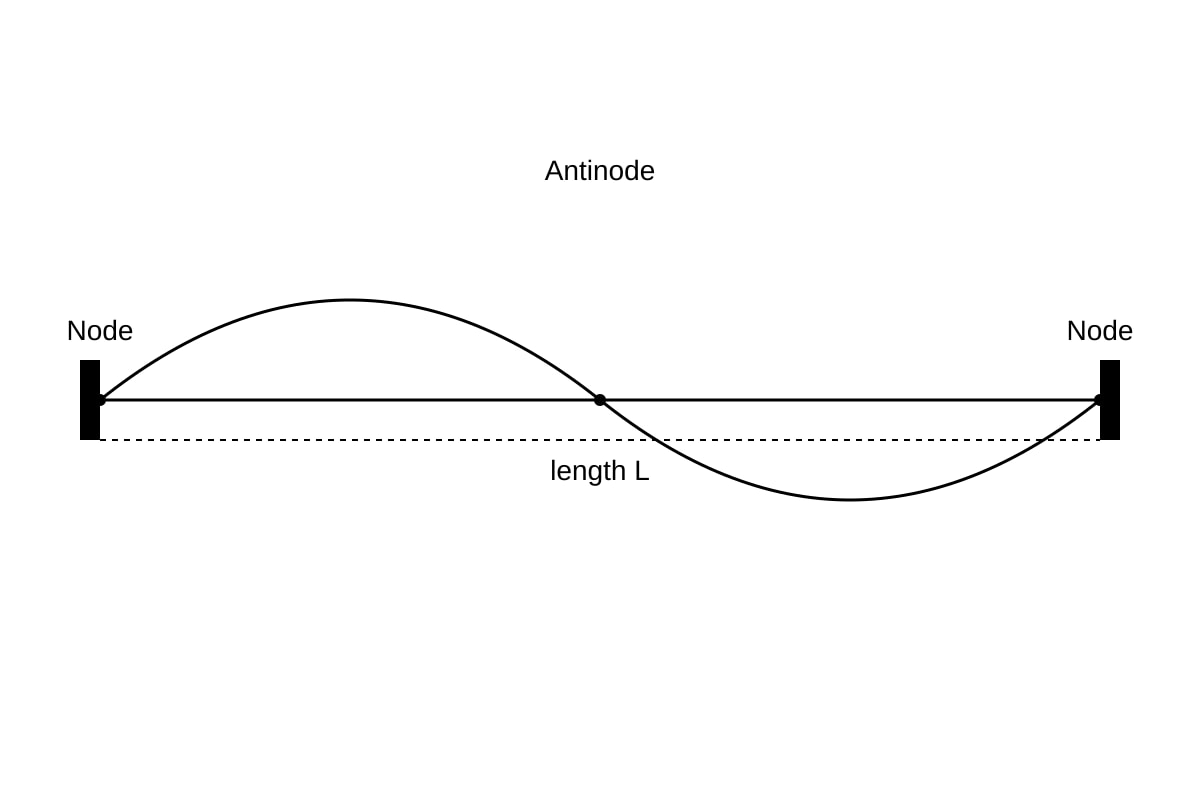
7. A string is fixed at both ends and vibrates at its fundamental frequency. Sketch the stationary wave pattern, indicating nodes and antinodes. [2]
Image pending generation: diagram for Q7.
8. Define the intensity of a sound wave. [1]
9. The intensity level β in decibels is given by β=10log10(I0I) where I0=1.0×10⁻¹² W m−2. Calculate β for I=1.0×10⁻⁶ W m−2. [2]
10. A bat emits a ultrasonic pulse of frequency 40 kHz. It reflects from a stationary insect and returns to the bat. State and explain whether the frequency received by the bat is higher, lower, or the same as emitted. [2]
Section B: Light and Optics (Questions 11–20)
11. State Snell’s law of refraction. [1]
12. Light travels from air (n=1.00) into glass of refractive index 1.50 with angle of incidence 30∘. Calculate the angle of refraction. [2]
13. Define total internal reflection and state the condition required for it to occur. [2]
14. A converging lens has focal length 10 cm. An object is placed 15 cm from the lens. Using the lens equation f1=u1+v1, calculate the image distance v. [3]
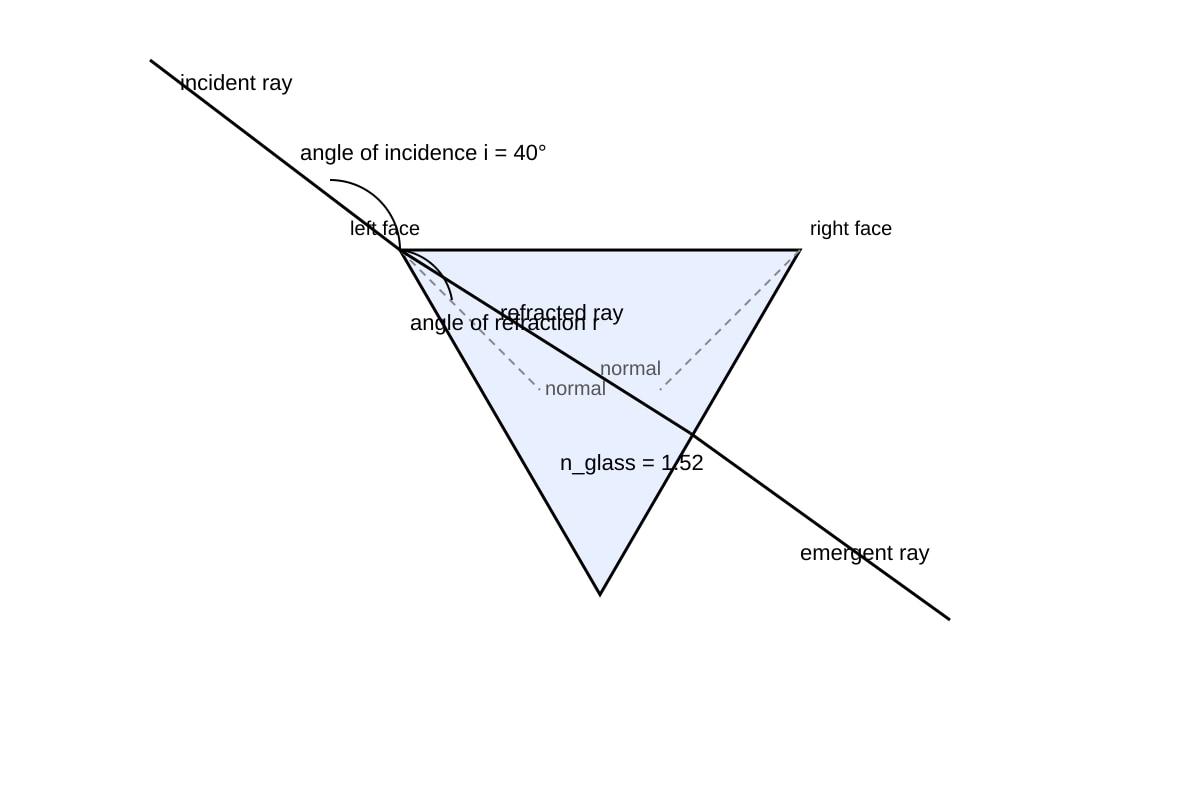
15. The diagram shows a ray of monochromatic light incident on a glass prism.
Image pending generation: diagram for Q15.
Calculate the angle of refraction at the first surface. [2]
16. Explain how a diffraction grating produces a spectrum from white light. [3]
17. A double-slit experiment uses wavelength 600 nm, slit separation 0.30 mm, and screen distance 2.0 m. Calculate the fringe separation Δy=aλD. [3]
18. Describe the phenomenon of polarisation and explain why it shows that light is a transverse wave. [3]
19. A soap film appears coloured in white light. Explain this observation using the concept of interference. [3]
20. An object is placed at 2f from a converging lens of focal length f. State the nature, position, and magnification of the image formed. [2]
Answers
A-Level Physics H1 Quiz - Waves Sound Light (Answer Key)
Total Marks: 40
Topic: Waves, Sound & Light (syllabus-first practice; not past-year derived)
Section A: Waves and Sound
Q1. [1 mark]
Wavelength is the distance between two consecutive points in phase (e.g. two successive crests or compressions).
Teaching note: "In phase" means oscillating together. For transverse waves, measure crest-to-crest; for longitudinal, compression-to-compression.
Q2. [2 marks]
v=fλ⇒λ=fv=440340=0.773 m (3 s.f.)
[M1 for correct formula, M1 for correct substitution and answer with unit]
Common mistake: Forgetting units or using f=vλ.
Q3. [3 marks]
- Transverse: displacement perpendicular to direction of propagation (e.g. water wave). [1]
- Longitudinal: displacement parallel to direction of propagation (e.g. sound wave). [1]
- Clear example each. [1]
Teaching note: In transverse, particles move up/down while wave moves forward; in longitudinal, particles oscillate along the same line as wave travel.
Q4. [2 marks]
(a) Period T=20 ms=0.020 s [1]
(b) f=T1=0.0201=50 Hz [1]
From graph: one full cycle spans 20 ms on x-axis.
Q5. [2 marks]
Sound waves diffract (spread) around the edges of the doorway because the wavelength of sound is comparable to the doorway width [1]. This bending allows waves to reach the adjacent room outside the straight path [1].
Q6. [3 marks]
Path difference =3.75−3.00=0.75 m [1]
Number of wavelengths =0.500.75=1.5 [1]
Odd half-wavelength → destructive interference [1].
Q7. [2 marks]
Sketch: string with nodes at both ends, single antinode at centre. [2 total: 1 for nodes at ends, 1 for antinode at centre]
Teaching note: Fundamental mode has λ/2=L.
Q8. [1 mark]
Intensity is power per unit area: I=AP, unit W m−2.
Q9. [2 marks]
β=10log10(10−1210−6)=10log10(106)=10×6=60 dB [M1 formula, M1 answer]
Q10. [2 marks]
Same frequency [1] because insect is stationary, so no Doppler shift in reflected frequency relative to bat emitter [1]. (The bat is receiver of its own emitted pulse reflected from stationary object.)
Section B: Light and Optics
Q11. [1 mark]
n1sinθ1=n2sinθ2 (Snell’s law).
Q12. [2 marks]
1.00sin30∘=1.50sinr
sinr=1.50.5=0.333
r=sin−1(0.333)=19.5∘ [M1, M1]
Q13. [2 marks]
Total internal reflection: complete reflection of light at boundary when incident from denser to less dense medium [1]. Condition: angle of incidence > critical angle [1].
Q14. [3 marks]
101=151+v1
v1=101−151=303−2=301
v=30 cm [M1 eq, M1 calc, M1 answer]
Q15. [2 marks]
sinr=1.52sin40∘=1.520.643=0.423
r=25.0∘ [M1, M1]
Q16. [3 marks]
Grating has many slits causing diffraction [1]; different wavelengths diffract by different angles since dsinθ=nλ [1]; separation produces spectrum [1].
Q17. [3 marks]
Δy=0.30×10⁻³(600×10−9)(2.0)=3.0×10−41.2×10−6=4.0×10⁻³ m=4.0 mm [M1, M1, M1]
Q18. [3 marks]
Polarisation: restricting wave vibrations to one plane [1]. Only transverse waves can be polarised because longitudinal have no perpendicular plane to filter [2].
Q19. [3 marks]
Thin film: reflection from top and bottom surfaces have path difference [1]; constructive/destructive interference for different λ [1]; colours seen due to selective reinforcement [1].
Q20. [2 marks]
Image at 2f on opposite side [1], real inverted same size (magnification 1) [1].
Free quiz and exam paper access
Enter your details to view this paper
Your access is remembered on this device.