AI Generated Quiz
A Level H1 Physics Thermal Physics Quiz
Free A Level H1 Physics Thermal Physics quiz, LongCat AI version, with questions, answers, and A Level-style practice for Singapore students.
These static practice materials are generated from the site's syllabus and paper-generation workflow, with source and model context shown so students and parents can evaluate the material before use.
Questions
Free quiz and exam paper access
Enter your details to view this paper
Your access is remembered on this device.
Answers
A-Level Physics H1 Quiz - Thermal Physics
Answer Key and Teaching Notes
Question 1 [2 marks]
Answer:
The zeroth law of thermodynamics states that if two systems are each in thermal equilibrium with a third system, then they are in thermal equilibrium with each other.
Marking:
- [B1] for stating that if A is in thermal equilibrium with C, and B is in thermal equilibrium with C,
- [B1] for concluding that A is in thermal equilibrium with B.
Teaching Notes:
The zeroth law is the foundation for the concept of temperature. It establishes that temperature is a meaningful, transitive property — if two objects are at the same temperature as a third object, they are at the same temperature as each other. This is why we can use thermometers (the "third system") to compare temperatures of different objects. Without this law, temperature measurement would not be consistent.
Question 2 [2 marks]
Answer:
Specific heat capacity is the amount of thermal energy required to raise the temperature of 1 kg of a substance by 1 °C (or 1 K).
Marking:
- [B1] for "thermal energy required" (or "heat needed"),
- [B1] for "per unit mass per unit temperature rise" (i.e., per kg per °C or per K).
Teaching Notes:
Specific heat capacity, , is a property of the material. The formula is , where is thermal energy, is mass, and is the temperature change. Water has a high specific heat capacity (4200 J kg⁻¹ °C⁻¹), meaning it takes a lot of energy to change its temperature — this is why water is used as a coolant. Common mistake: confusing specific heat capacity with heat capacity (which is for the entire object, not per kg).
Question 3 [3 marks]
Answer:
J
J (to 3 s.f.)
Marking:
- [M1] for correct formula ,
- [M1] for correct substitution of values,
- [A1] for correct answer with unit (J).
Teaching Notes:
This is a direct application of the specific heat capacity equation. The temperature change °C. Note that a change in °C is numerically equal to a change in K, so no conversion is needed. Always check that the unit of energy is joules (J) when using SI units throughout.
Question 4 [2 marks]
Answer:
Two objects are in thermal equilibrium when they are at the same temperature, so there is no net transfer of thermal energy between them.
Marking:
- [B1] for "same temperature",
- [B1] for "no net thermal energy transfer" (or "no net heat flow").
Teaching Notes:
Thermal equilibrium does not mean no energy is being exchanged — at the molecular level, energy is constantly being transferred in both directions. However, the net transfer is zero because the objects are at the same temperature. This is a dynamic equilibrium. The concept is central to the zeroth law and to how thermometers work.
Question 5 [2 marks]
Answer:
- Heat is the thermal energy transferred from one body to another due to a temperature difference. It is energy in transit, measured in joules (J).
- Temperature is a measure of the average kinetic energy of the molecules in a substance. It determines the direction of thermal energy flow and is measured in kelvin (K) or degrees Celsius (°C).
Marking:
- [B1] for correctly describing heat as energy transfer due to temperature difference,
- [B1] for correctly describing temperature as related to average molecular kinetic energy (or "hotness").
Teaching Notes:
This is a common source of confusion. Heat is a process quantity (energy being transferred), while temperature is a state variable (a property of the object at a given moment). An object does not "contain" heat — it contains internal energy. Heat flows from high temperature to low temperature. A spark from a fire has a very high temperature but very little thermal energy because its mass is tiny.
Question 6 [2 marks]
Answer:
(a) The volume of the gas molecules themselves is negligible compared to the volume of the container (or the molecules are point masses).
(b) There are no intermolecular forces between the molecules (except during collisions) / collisions are perfectly elastic.
Marking:
- [B1] for each correct assumption (any two valid assumptions).
Teaching Notes:
Other acceptable assumptions include: the gas consists of a very large number of molecules; molecules move in random directions with a range of speeds; collisions with the walls and between molecules are perfectly elastic; the duration of a collision is negligible compared to the time between collisions. These assumptions allow us to derive the ideal gas equation from kinetic theory. Real gases approximate ideal gas behaviour at high temperatures and low pressures.
Question 7 [3 marks]
Answer:
When the gas is compressed at constant temperature, the volume decreases. The molecules are confined to a smaller space, so they collide with the walls of the container more frequently. Since the temperature is constant, the average kinetic energy (and hence the average speed) of the molecules remains the same, so the force per collision is unchanged. However, the increased frequency of collisions results in a greater rate of change of momentum per unit area, so the pressure increases.
Marking:
- [B1] for stating that the pressure increases,
- [B1] for explaining that molecules collide with the walls more frequently (due to smaller volume),
- [B1] for linking increased collision frequency to increased pressure (or linking to Boyle's law).
Teaching Notes:
This is an application of Boyle's law ( at constant ) explained at the molecular level. The key insight is that temperature being constant means the average molecular speed doesn't change — only the number of collisions per unit time changes. This is a common exam question that tests whether students can connect macroscopic gas laws to microscopic molecular behaviour.
Question 8 [2 marks]
Answer:
Specific latent heat of fusion is the amount of thermal energy required to change 1 kg of a substance from solid to liquid at its melting point, without a change in temperature.
Marking:
- [B1] for "thermal energy required" (or "heat needed"),
- [B1] for "per unit mass at constant temperature during melting" (or equivalent).
Teaching Notes:
The word "latent" means "hidden" — the energy goes into breaking intermolecular bonds rather than increasing temperature. The formula is , where is the specific latent heat of fusion. During melting, the temperature stays constant at the melting point until all the solid has melted. This is why heating curves show a flat plateau during phase changes.
Question 9 [6 marks]
(a) [2 marks]
J
Marking:
- [M1] for correct formula and substitution,
- [A1] for correct answer: J.
(b) [2 marks]
J ≈ J
Marking:
- [M1] for correct formula and substitution,
- [A1] for correct answer: J.
(c) [2 marks]
The energy released by the water cooling to 0 °C ( J) is greater than the energy needed to melt the ice ( J). Therefore, all the ice melts, and the final temperature will be above 0 °C.
Marking:
- [B1] for comparing the two energy values correctly,
- [B1] for concluding that all the ice melts (with justification).
Teaching Notes:
This is a thermal equilibrium problem. The key principle is conservation of energy: thermal energy lost by the warm water = thermal energy gained by the ice (to melt + to warm up). In part (c), since the energy available from cooling the water to 0 °C exceeds the energy needed to melt all the ice, the ice will fully melt and the resulting mixture will be above 0 °C. If the energy from cooling had been less than the melting energy, only partial melting would occur and the final temperature would be 0 °C.
Question 10 [6 marks]
(a) [3 marks]
- = pressure of the gas (Pa or N m⁻²)
- = volume of the gas (m³)
- = number of moles of the gas (mol)
- = molar gas constant (J mol⁻¹ K⁻¹)
- = absolute temperature of the gas (K)
Marking:
- [B1] for each correct pair (quantity and unit), up to 3 marks. Award marks for any 3 correct pairs.
(b) [3 marks]
m³
Marking:
- [M1] for correct rearrangement of the ideal gas equation,
- [M1] for correct substitution,
- [A1] for correct answer: m³.
Teaching Notes:
The ideal gas equation applies to ideal gases. Temperature must always be in kelvin (K). The gas constant J mol⁻¹ K⁻¹. Common mistakes include using temperature in °C instead of K, or forgetting to convert volume units. Note that .
Question 11 [8 marks]
(a) [1 mark]
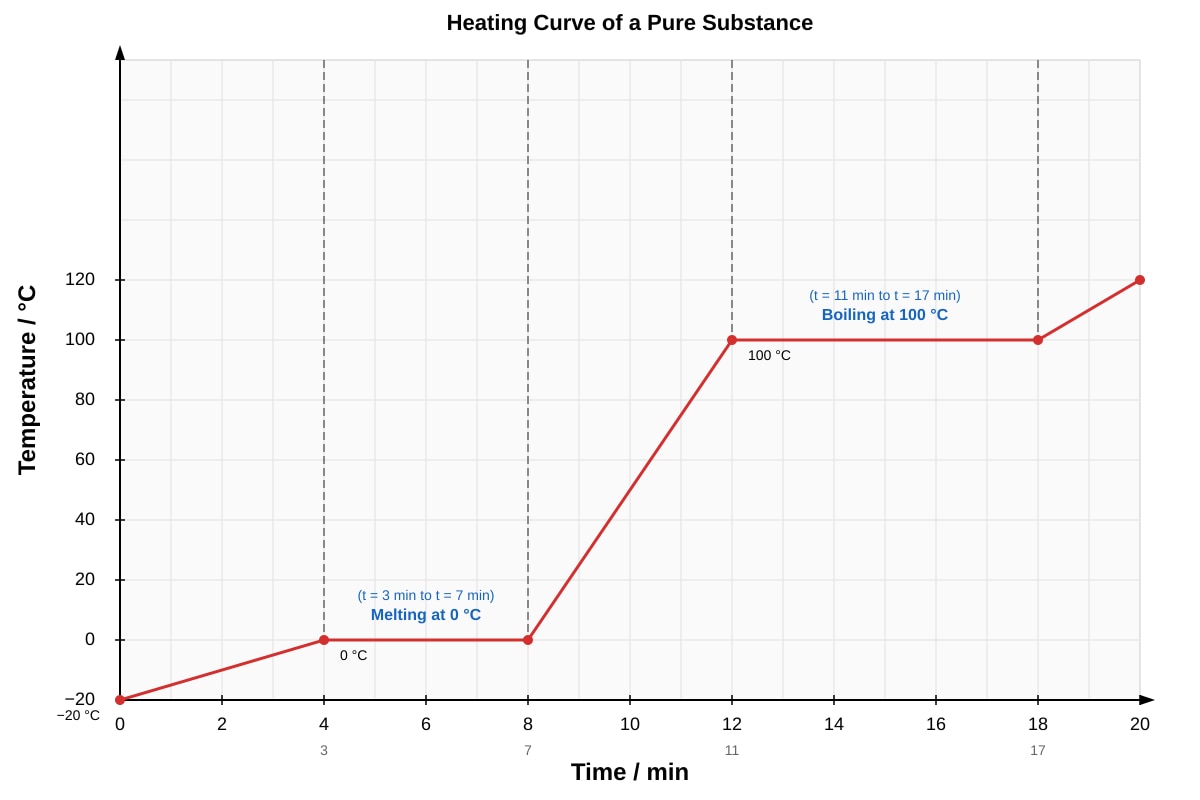
Melting point = 0 °C
(b) [1 mark]
Boiling point = 100 °C
(c) [3 marks]
During melting, the thermal energy supplied is used to break the intermolecular bonds between molecules, allowing them to move from fixed lattice positions to a more mobile liquid state. This energy increases the potential energy of the molecules rather than their kinetic energy. Since temperature is a measure of the average kinetic energy of the molecules, and the kinetic energy does not change during melting, the temperature remains constant.
Marking:
- [B1] for stating that energy is used to break intermolecular bonds,
- [B1] for stating that potential energy increases (not kinetic energy),
- [B1] for linking constant kinetic energy to constant temperature.
(d) [3 marks]
Time for boiling = 6 min = 360 s
Power = 200 W
Energy supplied during boiling = J
J kg⁻¹
Marking:
- [M1] for calculating energy supplied during boiling (),
- [M1] for using to find ,
- [A1] for correct answer: J kg⁻¹.
Teaching Notes:
Heating curves are a standard exam topic. The flat plateaus represent phase changes where temperature is constant. During the rising sections, the substance is in a single phase and the energy increases kinetic energy (temperature rises). During the plateaus, the energy increases potential energy (breaking bonds). The specific latent heat can be found from the duration of the plateau if the heating rate is known.
Question 12 [5 marks]
(a) [2 marks]
The mean kinetic energy of the gas molecules increases. Since the gas is heated, its temperature rises. The mean kinetic energy of gas molecules is directly proportional to the absolute temperature (), so as temperature increases, the mean kinetic energy increases.
Marking:
- [B1] for stating that mean kinetic energy increases,
- [B1] for linking this to the increase in temperature (or referencing ).
(b) [3 marks]
As the temperature increases, the molecules move faster, so each collision with the wall exerts a greater force (greater rate of change of momentum per collision). This would tend to increase the pressure. However, as the gas expands, the volume increases, so the molecules are more spread out and collide with the walls less frequently. These two effects exactly cancel at constant pressure: the increased force per collision is offset by the decreased collision frequency per unit area, so the pressure remains constant.
Marking:
- [B1] for explaining that faster molecules exert more force per collision,
- [B1] for explaining that larger volume means fewer collisions per unit area per unit time,
- [B1] for stating that these two effects balance, keeping pressure constant.
Teaching Notes:
This question tests the ability to explain macroscopic gas behaviour using kinetic theory. It is essentially an explanation of Charles's law ( at constant ) at the molecular level. The key is understanding that pressure depends on both the force per collision AND the frequency of collisions.
Question 13 [5 marks]
(a) [2 marks]
J ≈ J
Marking:
- [M1] for correct formula and substitution,
- [A1] for correct answer: J.
(b) [3 marks]
By conservation of energy (no heat lost to surroundings):
Thermal energy lost by aluminium = Thermal energy gained by water
J kg⁻¹ °C⁻¹ ≈ J kg⁻¹ °C⁻¹
Marking:
- [M1] for applying conservation of energy (heat lost = heat gained),
- [M1] for correct substitution into the equation,
- [A1] for correct answer: approximately 386 J kg⁻¹ °C⁻¹ (accept 380–390).
Teaching Notes:
This is a calorimetry experiment. The principle is that thermal energy lost by the hot object equals thermal energy gained by the cold object (assuming no losses). The accepted value for the specific heat capacity of aluminium is approximately 900 J kg⁻¹ °C⁻¹, so the student's result has a significant error — this could be due to heat losses to the surroundings, the polystyrene cup, or incomplete thermal equilibrium. In an exam, students might be asked to suggest sources of error.
Question 14 [6 marks]
(a) [3 marks]
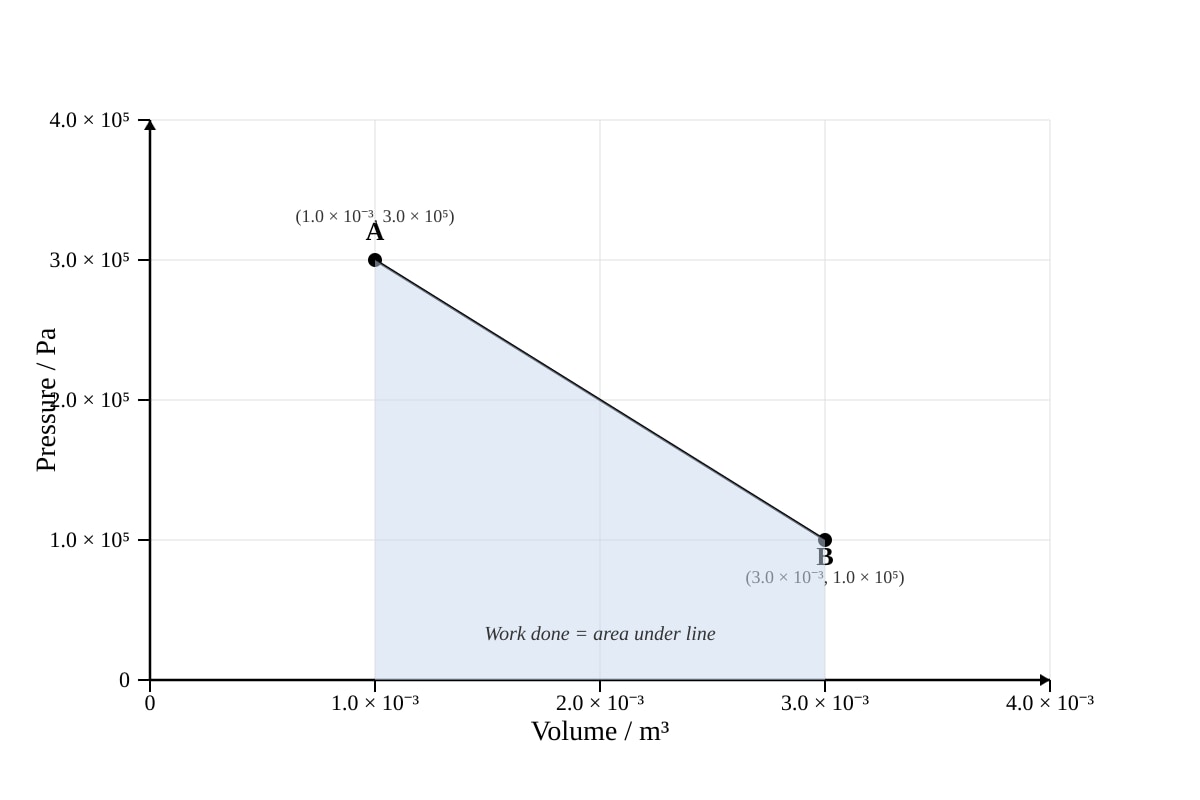
The work done by the gas is the area under the p-V graph (trapezium/triangle + rectangle).
Using the trapezium area formula:
J
Marking:
- [M1] for identifying the area under the graph as work done,
- [M1] for correct method (trapezium area or rectangle + triangle),
- [A1] for correct answer: 400 J.
(b) [3 marks]
First law of thermodynamics:
where = change in internal energy, = thermal energy transferred to the gas, = work done by the gas.
J (decreases), J
J
Since is positive, 250 J of thermal energy is transferred to the gas.
Marking:
- [M1] for correct statement or application of the first law of thermodynamics,
- [M1] for correct substitution,
- [A1] for correct answer: 250 J transferred to the gas.
Teaching Notes:
The sign convention is important. In the form , is work done by the gas. If the gas expands, it does positive work. If internal energy decreases, is negative. The first law is a statement of conservation of energy applied to thermodynamic systems. Common mistake: getting the sign convention wrong.
Question 15 [6 marks]
(a) [3 marks]
Using Gay-Lussac's law at constant volume:
K
Pa
K
Marking:
- [M1] for converting temperature to kelvin,
- [M1] for correct application of Gay-Lussac's law,
- [A1] for correct answer: 600 K.
(b) [3 marks]
When the temperature rises, the average kinetic energy of the gas molecules increases, so they move faster. At constant volume, the molecules collide with the walls more frequently and each collision involves a greater change of momentum (because the molecules are moving faster). Both effects — more frequent collisions and greater impulse per collision — result in a greater average force per unit area on the walls, so the pressure increases.
Marking:
- [B1] for stating that molecules move faster (higher kinetic energy),
- [B1] for stating that collisions are more frequent and/or more forceful,
- [B1] for linking this to increased pressure.
Teaching Notes:
Gay-Lussac's law ( at constant ) is being explained here. The molecular explanation requires two points: (1) faster molecules → greater impulse per collision, and (2) faster molecules → more frequent collisions. Both contribute to increased pressure. Temperature must always be in kelvin for gas law calculations.
Question 16 [2 marks]
Answer:
The vacuum between the walls reduces thermal energy transfer by conduction and convection. Conduction requires a medium (material) for energy to be transferred through molecular collisions, and convection requires the bulk movement of a fluid. Since a vacuum contains no particles, neither conduction nor convection can occur through the vacuum gap.
Marking:
- [B1] for identifying conduction (and/or convection),
- [B1] for explaining that a vacuum has no particles/medium to carry the energy.
Teaching Notes:
This is a classic application question. Conduction needs a material medium; convection needs a fluid that can move; radiation needs no medium. The vacuum eliminates conduction and convection, leaving radiation as the main remaining pathway — which is why the surfaces are silvered.
Question 17 [2 marks]
Answer:
Silvered (shiny) surfaces have low emissivity and low absorptivity for thermal radiation. They reflect thermal radiation back into the flask rather than absorbing it or emitting it. This reduces the net rate of thermal energy loss by radiation from the hot liquid to the surroundings.
Marking:
- [B1] for stating that silvered surfaces reflect radiation (or have low emissivity),
- [B1] for explaining that this reduces thermal energy loss.
Teaching Notes:
Dark, matt surfaces are good emitters and absorbers of thermal radiation. Shiny, silvered surfaces are poor emitters and poor absorbers — they reflect radiation. This is why the inside of a thermos flask is silvered, and why hot water tanks are often painted with reflective coatings.
Question 18 [3 marks]
Answer:
Thermal energy lost by coffee:
J
Time = 3 hours = s
Average rate of energy loss = W ≈ W
Marking:
- [M1] for calculating thermal energy lost correctly,
- [M1] for converting time to seconds and calculating rate,
- [A1] for correct answer: approximately 2.2 W.
Teaching Notes:
The rate of energy loss is power, measured in watts (W = J/s). The thermos flask is effective because the rate of energy loss is very small — only about 2.2 W. This is why the coffee stays hot for hours. In practice, the rate of loss would decrease as the temperature difference between the coffee and surroundings decreases.
Question 19 [3 marks]
Answer:
Using Boyle's law (constant temperature):
Pa,
Pa, m³
m³
Marking:
- [M1] for correct application of Boyle's law,
- [M1] for correct substitution,
- [A1] for correct answer: m³.
Teaching Notes:
Boyle's law applies when temperature and mass of gas are constant. The gas originally in the cylinder expands to fill the balloon at lower pressure. The volume calculated is the volume the gas occupied in the cylinder before being released. Common mistake: not ensuring that the same mass of gas is being considered on both sides of the equation.
Question 20 [4 marks]
(a) [2 marks]
From the ideal gas equation: . Since , , and are the same for both containers, . Container X has twice the volume of container Y, so the pressure in X is half the pressure in Y.
Ratio
Marking:
- [B1] for stating the ratio is 1:2,
- [B1] for explaining using (or using the ideal gas equation).
(b) [2 marks]
The internal energy of an ideal gas depends only on its temperature and the number of moles: (for a monatomic gas). Since the temperature is the same but container X has twice the volume, and from with and , we get . So container X has twice the number of moles, and therefore twice the internal energy.
Ratio
Marking:
- [B1] for stating the ratio is 2:1,
- [B1] for explaining that X has twice the number of moles (or linking internal energy to number of moles at the same temperature).
Teaching Notes:
Part (a) is a direct application of Boyle's law. For part (b), students need to recognise that internal energy of an ideal gas depends on both temperature AND the amount of gas (number of moles). Since and , and , we get ... Wait, let me recalculate: and . Since is the same: . So and the internal energy ratio is 1:1.
Correction for (b):
Since and , and is the same:
So , meaning both containers have the same number of moles. Since internal energy and and are the same, the internal energies are equal.
Ratio
Corrected Marking for (b):
- [B1] for stating the ratio is 1:1,
- [B1] for explaining that both containers have the same number of moles (since is the same for both at the same ), so internal energies are equal.
Teaching Notes:
This is a subtle question. Although container X has twice the volume, it also has half the pressure, so the product is the same for both. From , this means is the same. Internal energy of an ideal gas depends on and , not on or individually. So both containers have the same internal energy. This is a good test of whether students understand that internal energy is a state function dependent on temperature and amount of substance, not on pressure or volume separately.