AI Generated Quiz
A Level H1 Physics Thermal Physics Quiz
Free A Level H1 Physics Thermal Physics quiz, HY3 AI version, with questions, answers, and A Level-style practice for Singapore students.
These static practice materials are generated from the site's syllabus and paper-generation workflow, with source and model context shown so students and parents can evaluate the material before use.
Questions
A-Level Physics H1 Quiz - Thermal Physics
Name: ___________________________
Class: ___________________________
Date: ___________________________
Score: _______ / 40
Duration: 50 minutes
Total Marks: 40
Instructions:
- Answer all 20 questions.
- Show your working clearly for calculation questions.
- Use the provided space below each question for your answers.
- This quiz is syllabus-first practice content generated from LLM-inferred templates. It is not derived from past-year exam papers.
Section A: Definitions and Concepts (Questions 1–5)
1. [2 marks] Define specific heat capacity.
2. [2 marks] State the principle of conservation of energy as applied to thermal processes.
3. [2 marks] What is meant by latent heat of vaporisation?
4. [2 marks] Describe how the internal energy of an ideal gas changes when it is heated at constant volume.
5. [2 marks] State the equation relating the average kinetic energy of a molecule of an ideal gas to absolute temperature T.
Section B: Calculations (Questions 6–13)
6. [3 marks] A 2.0 kg block of copper (specific heat capacity c=390 J kg−1K−1) is heated from 20∘C to 70∘C. Calculate the thermal energy supplied.
7. [3 marks] A liquid of mass 0.50 kg receives 1.65×10⁵ J of energy to boil completely at its boiling point. Determine its specific latent heat of vaporisation.
8. [3 marks] 0.20 kg of ice at 0∘C is changed to water at 0∘C (latent heat of fusion Lf=3.34×10⁵ J kg−1). Calculate the energy required.
9. [3 marks] A 1.5 kg aluminium object (c=900 J kg−1K−1) cools from 100∘C to 25∘C. Find the heat lost.
10. [4 marks] 0.10 kg of water at 90∘C is mixed with 0.20 kg of water at 20∘C in a container of negligible heat capacity. Calculate the final equilibrium temperature. (Specific heat capacity of water c=4180 J kg−1K−1)
11. [3 marks] An ideal gas at 300 K has an average molecular kinetic energy given by 23kT where k=1.38×10⁻²³ J K−1. Calculate this energy.
12. [3 marks] A heater of power 500 W is used to raise the temperature of 1.0 kg of oil (c=2000 J kg−1K−1) by 10 K. Assuming no heat loss, calculate the time needed.
13. [3 marks] A metal block of mass 0.80 kg is heated using 2400 J and its temperature rises by 6.0 K. Determine its specific heat capacity.
Section C: Data Interpretation and Reasoning (Questions 14–20)
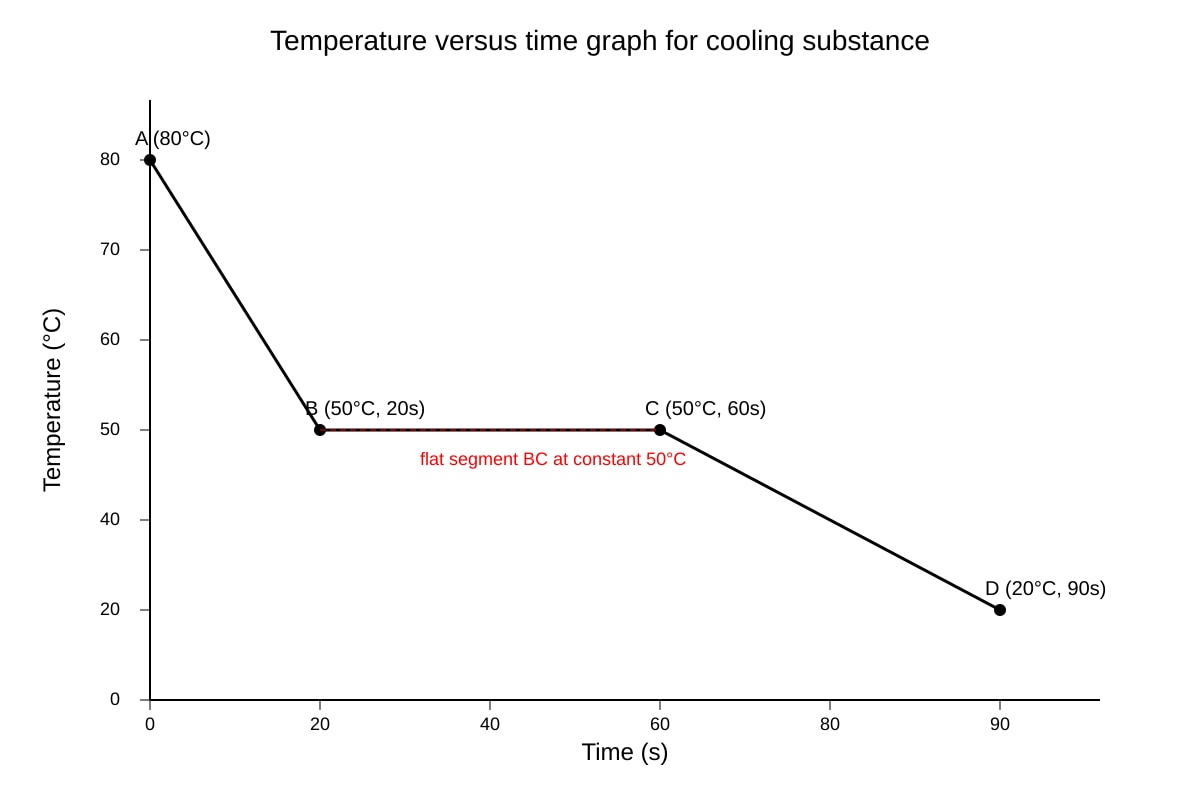
14. [2 marks] The graph below shows temperature against time for a substance cooled at constant rate. Explain what occurs during the flat portion BC.
Image pending generation: graph for Q14.
15. [2 marks] Suggest why a desert climate experiences large day–night temperature swings compared with a coastal climate.
16. [3 marks] A student claims: "When water boils, its temperature rises further if heating continues." Using your knowledge of latent heat, explain why this is incorrect.
17. [2 marks] State one assumption of the ideal gas model that simplifies the relation between molecular kinetic energy and temperature.
18. [3 marks] An insulated cup contains 0.15 kg of coffee at 80∘C. 0.05 kg of milk at 10∘C is added (ccoffee=cmilk=4180 J kg−1K−1). Calculate the final temperature.
19. [2 marks] Describe how you would use an electrical heater and thermometer to determine the specific heat capacity of a solid block in the laboratory.
20. [3 marks] The pressure of an ideal gas in a fixed volume is directly proportional to absolute temperature. If the temperature changes from 300 K to 450 K and initial pressure is 1.0×10⁵ Pa, calculate the new pressure.
Answers
A-Level Physics H1 Quiz - Thermal Physics (Answer Key)
Total Marks: 40
Note: Syllabus-first generated content; not from past-year papers.
Section A: Definitions and Concepts
1. [2 marks] Define specific heat capacity.
Answer: Specific heat capacity is the amount of thermal energy required to raise the temperature of 1 kg of a substance by 1 K (or 1 °C).
Teaching note: Formula c=Q/(mΔT). Award [B1] for "energy per unit mass per unit temp change", [B1] for correct unit or 1 kg / 1 K stated.
2. [2 marks] State the principle of conservation of energy as applied to thermal processes.
Answer: Energy cannot be created or destroyed; in thermal processes, heat lost by one part equals heat gained by another (if insulated).
Teaching note: [B1] conservation statement, [B1] thermal context (heat transfer balance).
3. [2 marks] What is meant by latent heat of vaporisation?
Answer: The thermal energy required to change 1 kg of a liquid at its boiling point into vapour without change in temperature.
Teaching note: [B1] definition, [B1] mention "no temperature change / at boiling point".
4. [2 marks] Describe how internal energy of an ideal gas changes when heated at constant volume.
Answer: Internal energy increases because energy goes into increasing molecular kinetic energy; no work is done (ΔW = 0).
Teaching note: [B1] increases, [B1] reason (KE increase / no work).
5. [2 marks] State equation for average kinetic energy of ideal gas molecule.
Answer: ⟨Ek⟩=23kT where k is Boltzmann constant.
Teaching note: [B1] 23kT, [B1] identifies k or T.
Section B: Calculations
6. [3 marks] m=2.0 kg, c=390, ΔT=50 K.
Q=mcΔT=2.0×390×50=39000 J.
Marking: [M1] correct formula, [M1] substitution, [A1] 3.9×10⁴ J.
Note: Common error: using °C difference incorrectly (same as K here).
7. [3 marks] m=0.50 kg, Q=1.65×10⁵ J.
L=Q/m=1.65×105/0.50=3.30×105 J kg−1.
Marking: [M1] formula, [M1] sub, [A1] answer.
8. [3 marks] Q=mLf=0.20×3.34×105=6.68×10⁴ J.
Marking: [M1] formula, [M1] sub, [A1] 6.68×10⁴ J.
9. [3 marks] ΔT=75 K, Q=mcΔT=1.5×900×75=101250 J≈1.01×10⁵ J.
Marking: [M1] ΔT, [M1] formula/sub, [A1] value.
10. [4 marks] Heat lost = heat gained:
0.10×4180×(90−T)=0.20×4180×(T−20)
Cancel 4180: 0.10(90−T)=0.20(T−20)
9−0.1T=0.2T−4
13=0.3T⇒T=43.3∘C.
Marking: [M1] equating, [M1] simplify, [M1] solve, [A1] 43°C (or 43.3).
11. [3 marks] E=1.5×1.38×10−23×300=6.21×10⁻²¹ J.
Marking: [M1] formula, [M1] sub, [A1] value.
12. [3 marks] E=mcΔT=1.0×2000×10=20000 J.
t=E/P=20000/500=40 s.
Marking: [M1] energy, [M1] time, [A1] 40 s.
13. [3 marks] c=Q/(mΔT)=2400/(0.80×6.0)=500 J kg−1K−1.
Marking: [M1] formula, [M1] sub, [A1] 500.
Section C: Data Interpretation and Reasoning
14. [2 marks] During BC, substance is undergoing a phase change (e.g. freezing) at constant temperature; latent heat released.
Image needed: flat segment at 50°C confirms phase change.
Marking: [B1] phase change stated, [B1] constant temp / latent heat.
15. [2 marks] Sand/soil has low specific heat capacity so heats/cools fast; water high c moderates coastal temp.
Marking: [B1] low c land, [B1] high c water effect.
16. [3 marks] At boiling, added energy is latent heat used to break intermolecular bonds; temperature stays at boiling point until all liquid vaporised.
Marking: [B1] latent heat, [B1] no temp rise, [B1] until phase complete.
17. [2 marks] Molecules occupy negligible volume / no intermolecular forces.
Marking: [B1] any one ideal gas assumption.
18. [3 marks] 0.15×4180×(80−T)=0.05×4180×(T−10)
0.15(80−T)=0.05(T−10)
12−0.15T=0.05T−0.5
12.5=0.20T⇒T=62.5∘C.
Marking: [M1] equate, [M1] solve, [A1] 62.5.
19. [2 marks] Measure mass, initial T; supply known electrical energy Pt, record final T; use c=Pt/(mΔT).
Marking: [B1] method, [B1] formula use.
20. [3 marks] P∝T⇒P2/P1=T2/T1.
P2=1.0×105×450/300=1.5×105 Pa.
Marking: [M1] proportionality, [M1] sub, [A1] 1.5×10⁵ Pa.
Free quiz and exam paper access
Enter your details to view this paper
Your access is remembered on this device.