AI Generated Quiz

A Level H1 Physics Modern Physics Quiz

Free AI-Generated Owl Alpha A Level H1 Physics Modern Physics quiz with questions and answers for Singapore students. This page is rendered as a direct URL so the questions and answers can be discovered without pressing in-page buttons.

These static practice materials are generated from the site's syllabus and paper-generation workflow, with source and model context shown so students and parents can evaluate the material before use.

A Level H1 Physics AI Generated Generated by Owl Alpha Updated 2026-06-07

Questions

<!-- TuitionGoWhere generation metadata: stage=5-1; model=openrouter/owl-alpha; model_label=Owl Alpha; generated=2026-06-06; Sources: Stage 4-0 LLM templates, syllabus context, and Stage 2 evidence where available. -->

A-Level Physics H1 Quiz - Modern Physics

Name: ___________________________
Class: ___________________________
Date: ___________________________
Score: ________ / 50

Duration: 60 minutes
Total Marks: 50


Instructions:

  • Answer ALL questions.
  • Show all working clearly for calculation questions. Marks are awarded for correct method even if the final answer is incorrect.
  • Include appropriate units in your final answers.
  • The number of marks for each question or part-question is shown in brackets [ ].
  • A data sheet with useful constants is provided at the end of this quiz.

Useful Constants and Data:

ConstantValue
Speed of light in vacuum, cc3.00×108 m s13.00 \times 10^8 \text{ m s}^{-1}
Planck's constant, hh6.63×1034 J s6.63 \times 10^{-34} \text{ J s}
Charge of electron, ee1.60×1019 C1.60 \times 10^{-19} \text{ C}
Mass of electron, mem_e9.11×1031 kg9.11 \times 10^{-31} \text{ kg}
Mass of proton, mpm_p1.67×1027 kg1.67 \times 10^{-27} \text{ kg}
Avogadro's number, NAN_A6.02×1023 mol16.02 \times 10^{23} \text{ mol}^{-1}
Unified atomic mass unit, uu1.66×1027 kg1.66 \times 10^{-27} \text{ kg}

Section A: Multiple Choice (Questions 1–5) [10 marks]

Each question is worth 2 marks. Choose the ONE best answer.


1. A radioactive sample has a half-life of 8.0 hours. What fraction of the original sample remains after 24 hours?

A. 12\frac{1}{2}
B. 14\frac{1}{4}
C. 18\frac{1}{8}
D. 116\frac{1}{16}


2. In a photoelectric experiment, light of wavelength 400 nm is incident on a metal surface with a work function of 2.0 eV. What is the maximum kinetic energy of the emitted photoelectrons?

A. 0.5 eV
B. 1.1 eV
C. 2.0 eV
D. 3.1 eV


3. Which of the following statements about nuclear binding energy is correct?

A. Binding energy is the energy required to remove one proton from the nucleus.
B. The greater the binding energy per nucleon, the more stable the nucleus.
C. Binding energy per nucleon decreases uniformly with increasing mass number.
D. Nuclear fission increases the total binding energy of the system by splitting heavy nuclei into lighter fragments with lower binding energy per nucleon.


4. A nucleus of uranium-238 (92238U^{238}_{92}\text{U}) decays by alpha emission. What is the resulting nucleus?

A. 90234Th^{234}_{90}\text{Th}
B. 92234U^{234}_{92}\text{U}
C. 90236Th^{236}_{90}\text{Th}
D. 90238Th^{238}_{90}\text{Th}


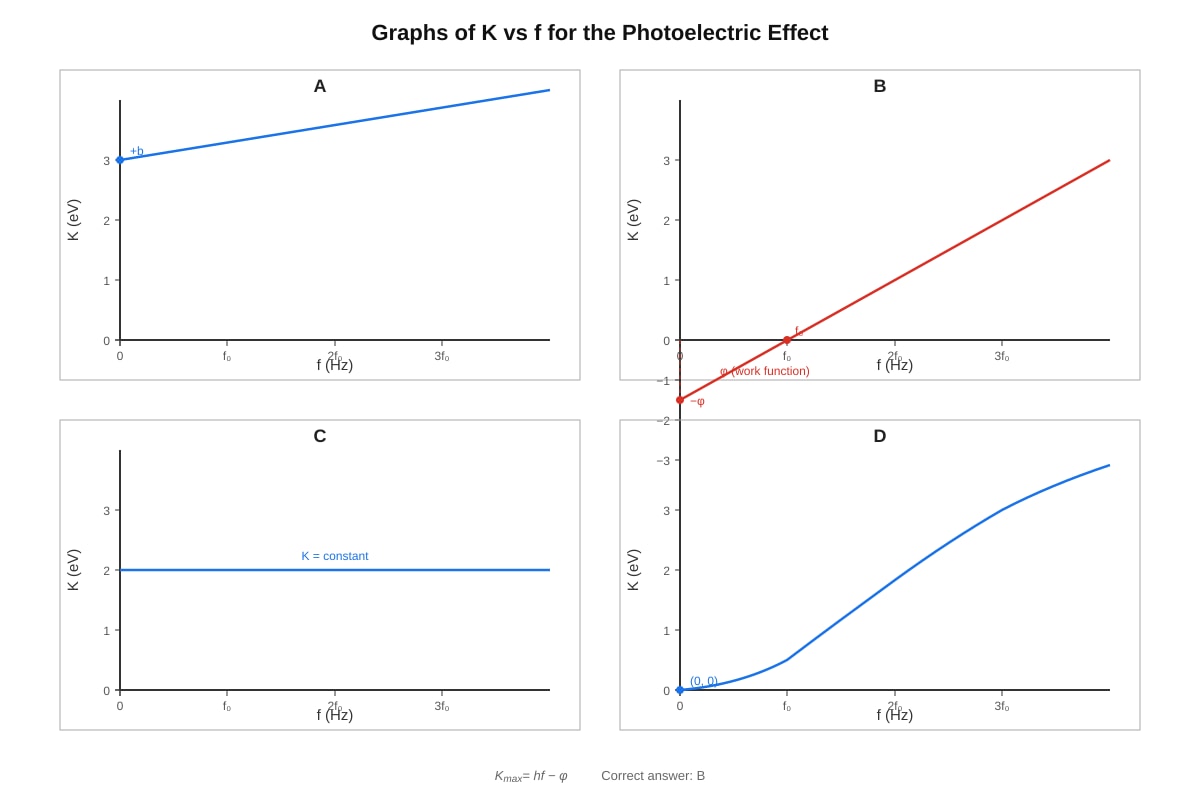
5. In the photoelectric effect, which graph best represents the relationship between the maximum kinetic energy KmaxK_{\text{max}} of photoelectrons and the frequency ff of incident light?

<image_placeholder> id: Q5-fig1 type: graph linked_question: Q5 description: Four graphs (A, B, D options) showing K_max on the y-axis and frequency f on the x-axis. Graph A: straight line with positive gradient, positive y-intercept. Graph B: straight line with positive gradient, negative y-intercept crossing the f-axis at a positive value. Graph C: horizontal line. Graph D: curve starting from origin increasing. labels: y-axis: K_max (eV), x-axis: f (Hz), threshold frequency f_0 marked on x-axis values: Line passes through (f_0, 0) with positive gradient; y-intercept at -phi where phi is the work function must_show: Straight line with positive gradient; x-intercept at threshold frequency f_0; negative y-intercept; clearly labelled axes with units </image_placeholder>


Section B: Short Answer and Structured Questions (Questions 6–15) [25 marks]


6. State the observations from Rutherford's alpha-particle scattering experiment that led to the nuclear model of the atom. [3]


7. (a) Define the term work function of a metal. [1]


(b) Explain what is meant by the threshold frequency in the context of the photoelectric effect. [2]


8. A photon of wavelength 2.48×10¹² m2.48 \times 10^{-12} \text{ m} is produced when a nucleus releases energy during a nuclear reaction.

(a) Calculate the energy of this photon in joules. [2]


(b) Express this energy in MeV. [1]


9. The isotope carbon-14 (614C^{14}_{6}\text{C}) undergoes beta-minus (β\beta^-) decay.

(a) Write the nuclear equation for this decay. [2]


(b) State TWO properties of beta particles. [2]


10. A radioactive source has an initial activity of 3.2×10¹⁰ Bq3.2 \times 10^{10} \text{ Bq} and a half-life of 5.3 years.

(a) Calculate the decay constant of the source in s1\text{s}^{-1}. [2]


(b) Determine the activity of the source after 15.9 years. [2]


11. Explain why the photoelectric effect cannot be explained by the wave theory of light. In your answer, refer to the effect of changing (i) the intensity and (ii) the frequency of the incident light. [4]


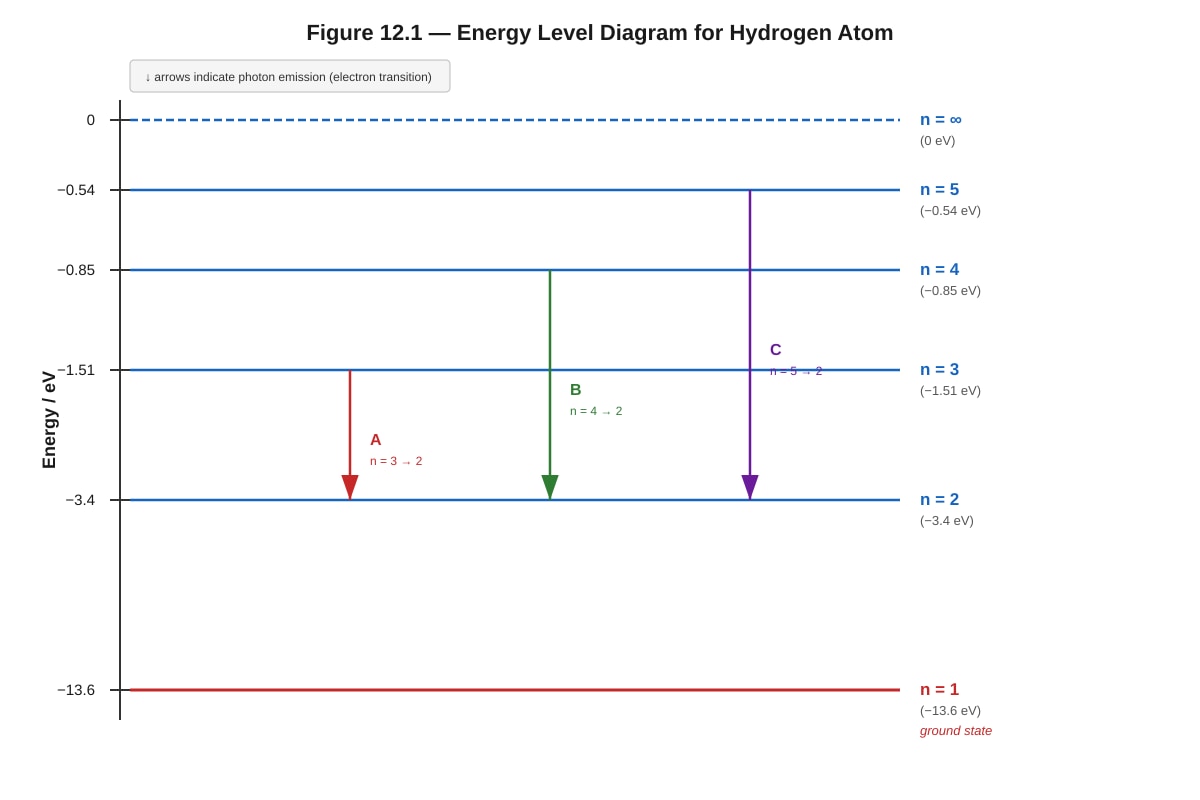
12. Figure 12.1 shows a simplified energy level diagram for a hydrogen atom.

<image_placeholder> id: Q12-fig1 type: diagram linked_question: Q12 description: Energy level diagram for hydrogen atom showing energy levels n=1 to n=5 and infinity. n=1 (ground state) at bottom at -13.6 eV. n=2 at -3.4 eV. n=3 at -1.51 eV. n=4 at -0.85 eV. n=5 at -0.54 eV. n=infinity at 0 eV. Arrows showing transitions: one arrow from n=3 to n=2 (labelled A), one arrow from n=4 to n=2 (labelled B), one arrow from n=5 to n=2 (labelled C). labels: Energy (eV) on vertical axis; energy levels n=1, n=2, n=3, n=4, n=5, n=infinity clearly labelled; transitions A (n=3→2), B (n=4→2), C (n=5→2) labelled values: E_1 = -13.6 eV, E_2 = -3.4 eV, E_3 = -1.51 eV, E_4 = -0.85 eV, E_5 = -0.54 eV, E_inf = 0 eV must_show: All five energy levels and infinity level with correct values; three downward transition arrows A, B, C clearly labelled; energy scale on vertical axis </image_placeholder>

(a) Calculate the energy of the photon emitted when an electron transitions from n=3n = 3 to n=2n = 2 (transition A). [2]


(b) Determine the wavelength of the photon emitted in transition B (n=4n=2n = 4 \rightarrow n = 2). [2]


(c) State which transition (A, B, or C) produces the photon with the highest frequency. Explain your answer. [2]


13. A sample of radioactive iodine-131 (53131I^{131}_{53}\text{I}) has a half-life of 8.0 days. A hospital receives a sample with an initial activity of 4.0×10⁹ Bq4.0 \times 10^9 \text{ Bq}.

(a) Calculate the number of iodine-131 nuclei present in the sample initially. [3]


(b) The sample is considered safe for disposal when its activity falls below 2.5×10⁷ Bq2.5 \times 10^7 \text{ Bq}. Calculate how many days must pass before the sample is safe for disposal. [3]


14. Figure 14.1 shows a graph of binding energy per nucleon against mass number for stable nuclei.

<image_placeholder> id: Q14-fig1 type: graph linked_question: Q14 description: Graph of binding energy per nucleon (MeV) on y-axis from 0 to 9, against mass number A on x-axis from 0 to 250. Curve rises steeply from A=0 to a peak near A=56 (iron-56) at about 8.8 MeV, then gradually decreases to about 7.5 MeV at A=240. Peak clearly labelled near A=56. Region around A=235 (uranium) marked on the curve. labels: y-axis: Binding energy per nucleon (MeV), x-axis: Mass number A; peak near A=56 labelled; uranium-235 region indicated values: Peak value approximately 8.8 MeV at A≈56; value at A=235 approximately 7.6 MeV; value at A=4 approximately 7.1 MeV must_show: Complete curve from low A to high A; peak near A=56 clearly shown; uranium region indicated; both axes labelled with units </image_placeholder>

(a) From the graph, state the approximate binding energy per nucleon for a uranium-235 nucleus. [1]


(b) Explain, with reference to the graph, why energy is released when a uranium-235 nucleus undergoes fission. [3]


(c) Explain, with reference to the graph, why energy is released when two very light nuclei undergo fusion. [2]


15. In a photoelectric experiment, ultraviolet light of wavelength 250 nm is incident on a clean metal surface. The stopping potential is measured to be 2.75 V.

(a) Calculate the energy of an incident photon in eV. [2]


(b) Calculate the work function of the metal in eV. [2]


(c) State and explain what happens to the stopping potential if the wavelength of the incident light is decreased to 200 nm. [2]


Section C: Free Response (Questions 16–20) [15 marks]


16. Einstein's photoelectric equation is given by:

Kmax=hfϕK_{\text{max}} = hf - \phi

where KmaxK_{\text{max}} is the maximum kinetic energy of the emitted photoelectrons, hh is Planck's constant, ff is the frequency of the incident light, and ϕ\phi is the work function of the metal.

(a) Using the equation, explain why there is a threshold frequency below which no photoelectrons are emitted, regardless of the intensity of the light. [2]


(b) A student claims that increasing the intensity of light of frequency below the threshold frequency will eventually cause photoelectron emission. Explain why this claim is incorrect. [2]


(c) Light of frequency 8.0×10¹⁴ Hz8.0 \times 10^{14} \text{ Hz} is incident on a metal with a work function of 2.5 eV. Calculate the maximum speed of the emitted photoelectrons. [3]


17. A nucleus of radium-226 (88226Ra^{226}_{88}\text{Ra}) decays to radon-222 (86222Rn^{222}_{86}\text{Rn}) by emitting an alpha particle.

(a) Write the balanced nuclear equation for this decay. [2]


(b) The mass of 88226Ra^{226}_{88}\text{Ra} is 226.0254 u226.0254 \text{ u}, the mass of 86222Rn^{222}_{86}\text{Rn} is 222.0176 u222.0176 \text{ u}, and the mass of an alpha particle (24He^4_2\text{He}) is 4.0026 u4.0026 \text{ u}.

(i) Calculate the mass defect in this decay. [1]


(ii) Calculate the energy released in this decay in MeV. [2]


(iii) Using the conservation of momentum, explain why the alpha particle carries away most of the kinetic energy released. [2]


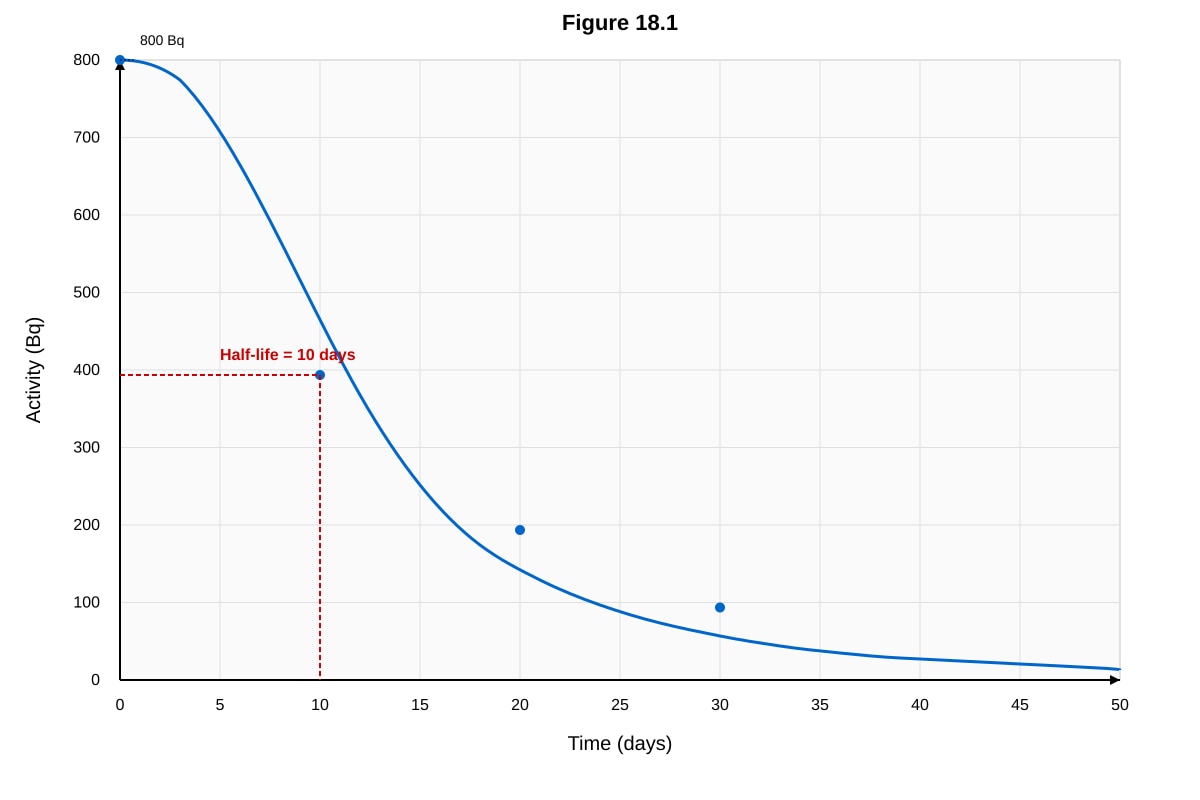
18. Figure 18.1 shows the variation of activity of a radioactive sample with time.

<image_placeholder> id: Q18-fig1 type: graph linked_question: Q18 description: Graph of activity (Bq) on y-axis against time (days) on x-axis. Exponential decay curve starting at 800 Bq at t=0. Curve passes through approximately 400 Bq at t=10 days, approximately 200 Bq at t=20 days, approximately 100 Bq at t=30 days. x-axis from 0 to 50 days, y-axis from 0 to 900 Bq. labels: y-axis: Activity (Bq), x-axis: Time (days); initial activity 800 Bq marked at t=0; half-life indicated as 10 days values: A_0 = 800 Bq at t=0; A = 400 Bq at t=10 days; A = 200 Bq at t=20 days; A = 100 Bq at t=30 days must_show: Smooth exponential decay curve; initial activity clearly marked; half-life of 10 days clearly shown on graph; both axes labelled with units </image_placeholder>

(a) Use the graph to determine the half-life of the sample. Show clearly how you obtain your answer. [2]


(b) Calculate the decay constant of the radioactive sample. [2]


(c) Determine the activity of the sample at t=35t = 35 days. Show your method. [2]


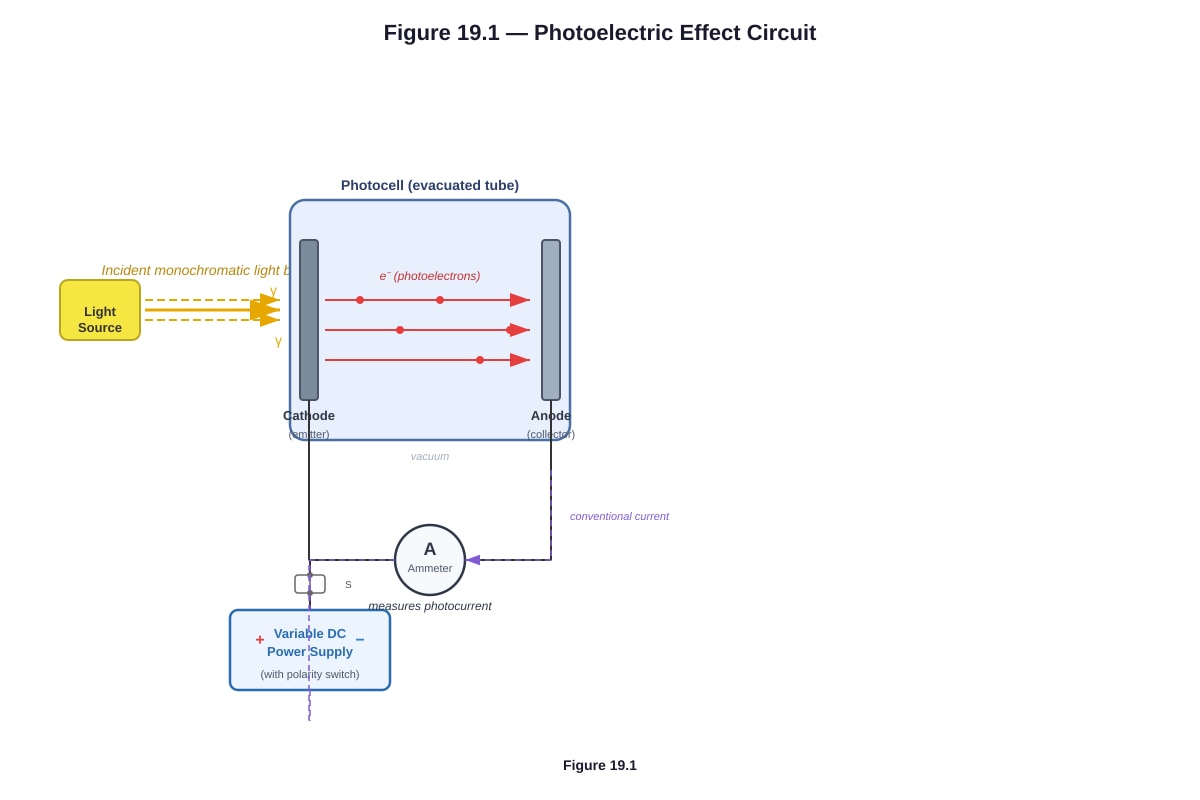
19. A beam of monochromatic light is incident on a metal surface in a photocell. The circuit shown in Figure 19.1 is used to investigate the photoelectric effect.

<image_placeholder> id: Q19-fig1 type: experimental_setup linked_question: Q19 description: Photoelectric effect circuit diagram. A photocell (vacuum tube with metal cathode and anode) connected to a variable DC power supply and a sensitive ammeter in series. The power supply polarity can be reversed. Light source shines on the cathode. Arrow showing light incident on cathode surface. Electrons emitted from cathode travel to anode. Ammeter measures photocurrent. Labels: cathode (metal surface), anode (collector plate), variable DC supply, ammeter, incident light. labels: Cathode (emitter), Anode (collector), Variable DC power supply (with polarity switch), Ammeter, Incident monochromatic light beam values: No specific numerical values needed for the diagram; general circuit layout must be clear must_show: Complete circuit with photocell, variable supply, ammeter; light incident on cathode; direction of electron flow shown; polarity of supply clearly indicated </image_placeholder>

(a) Explain how the circuit can be used to measure the maximum kinetic energy of the photoelectrons. [3]


(b) When the frequency of the incident light is increased while keeping the intensity constant, state and explain what happens to:

(i) the maximum kinetic energy of the photoelectrons. [1]


(ii) the photocurrent. [1]


20. Nuclear fusion is considered a potential future energy source.

(a) State the conditions required for nuclear fusion to occur. [2]


(b) Write a nuclear equation for the fusion of two deuterium nuclei (12H^2_1\text{H}) to form helium-3 (23He^3_2\text{He}) and one other particle. Identify the other particle. [2]


(c) Explain why fusion reactions release energy, making reference to the binding energy per nucleon curve. [2]


END OF QUIZ

Check your answers carefully before submitting.

Answers

<!-- TuitionGoWhere generation metadata: stage=5-1; model=openrouter/owl-alpha; model_label=Owl Alpha; generated=2026-06-06; Sources: Stage 4-0 LLM templates, syllabus context, and Stage 2 evidence where available. -->

A-Level Physics H1 Quiz - Modern Physics

Answer Key and Teaching Notes


Teaching Note: This answer key provides full step-by-step solutions, marking notes, and explanations suitable for students new to each concept. Common errors and marking descriptors are included where relevant.


Section A: Multiple Choice

1. C — 18\frac{1}{8} [2 marks]

Explanation:
The half-life is the time taken for half of the radioactive nuclei to decay. After each half-life, the remaining fraction is halved:

  • After 1 half-life (8 h): 12\frac{1}{2} remains
  • After 2 half-lives (16 h): 14\frac{1}{4} remains
  • After 3 half-lives (24 h): 18\frac{1}{8} remains

Number of half-lives: n=248=3n = \frac{24}{8} = 3.
Fraction remaining = (12)3=18\left(\frac{1}{2}\right)^3 = \frac{1}{8}.

Common mistake: Students sometimes divide 124/8=13\frac{1}{24/8} = \frac{1}{3} instead of computing (12)3\left(\frac{1}{2}\right)^3.


2. B — 1.1 eV [2 marks]

Explanation:
Using the photoelectric equation: Ephoton=hf=hcλE_{\text{photon}} = hf = \frac{hc}{\lambda}

E=(6.63×1034)(3.00×10⁸)400×109=4.97×10¹⁹ JE = \frac{(6.63 \times 10^{-34})(3.00 \times 10^8)}{400 \times 10^{-9}} = 4.97 \times 10^{-19} \text{ J}

Converting to eV: E=4.97×10191.60×1019=3.11 eVE = \frac{4.97 \times 10^{-19}}{1.60 \times 10^{-19}} = 3.11 \text{ eV}

Maximum kinetic energy: Kmax=Eϕ=3.112.0=1.1 eVK_{\text{max}} = E - \phi = 3.11 - 2.0 = 1.1 \text{ eV}

Common mistake: Forgetting to convert from joules to eV, or subtracting the work function the wrong way.


3. B — The greater the binding energy per nucleon, the more stable the nucleus. [2 marks]

Explanation:
Binding energy per nucleon is a measure of nuclear stability. A higher binding energy per nucleon means more energy is required to remove a nucleon from the nucleus, indicating greater stability.

  • Option A is incorrect: binding energy refers to the total energy needed to completely separate all nucleons, not just one proton.
  • Option C is incorrect: the binding energy per nucleon curve rises to a peak near iron-56 and then decreases — it does not decrease uniformly.
  • Option D is incorrect: fission releases energy because the products have a higher binding energy per nucleon than the original heavy nucleus.

4. A — 90234Th^{234}_{90}\text{Th} [2 marks]

Explanation:
Alpha decay emits a 24He^4_2\text{He} nucleus. Conservation of mass number and atomic number gives:

92238UZAX+24He^{238}_{92}\text{U} \rightarrow ^{A}_{Z}\text{X} + ^{4}_{2}\text{He}

Mass number: 238=A+4238 = A + 4, so A=234A = 234
Atomic number: 92=Z+292 = Z + 2, so Z=90Z = 90

Element with Z=90Z = 90 is thorium (Th). The product is 90234Th^{234}_{90}\text{Th}.

Common mistake: Forgetting to subtract the alpha particle's atomic number from the parent's atomic number.


5. B [2 marks]

Explanation:
From Einstein's photoelectric equation: Kmax=hfϕK_{\text{max}} = hf - \phi

This is a straight line with:

  • Gradient = hh (positive)
  • y-intercept = ϕ-\phi (negative, since work function ϕ>0\phi > 0)
  • x-intercept = threshold frequency f0=ϕ/hf_0 = \phi/h (where Kmax=0K_{\text{max}} = 0)

Graph B correctly shows a straight line with positive gradient, negative y-intercept, and positive x-intercept at the threshold frequency.

Note on image: The graph should show a straight line with positive gradient crossing the frequency axis at the threshold frequency f0f_0 and the KmaxK_{\text{max}} axis at ϕ-\phi.


Section B: Short Answer and Structured Questions

6. [3 marks]

Answer:
[B1] Most alpha particles passed through the gold foil undeflected (or with very small deflections).
[B1] A small number of alpha particles were deflected through large angles (greater than 90°).
[B1] A very small number of alpha particles were deflected backwards (nearly 180°).

Teaching Notes:
These observations led Rutherford to conclude that:

  • The atom is mostly empty space (most alphas pass through).
  • The nucleus is very small, dense, and positively charged (large deflections occur when alphas pass close to the nucleus).
  • The nucleus contains most of the mass of the atom.

Common mistake: Students sometimes state the conclusions (nuclear model) rather than the observations from the experiment. The question asks for observations.


7. (a) [1 mark]

Answer:
The work function of a metal is the minimum energy required to remove an electron from the surface of the metal.

Teaching Note: The work function is a property of the material. It represents the energy barrier that binds electrons to the metal surface. Symbol: ϕ\phi (phi). Units: joules (J) or electron-volts (eV).

(b) [2 marks]

Answer:
[B1] The threshold frequency is the minimum frequency of incident light that can cause photoelectron emission from a metal surface.
[B1] Below this frequency, no photoelectrons are emitted regardless of the intensity of the light.

Teaching Note: The threshold frequency f0f_0 is related to the work function by ϕ=hf0\phi = hf_0. This is a key concept that distinguishes the particle (photon) model from the wave model of light.


8. (a) [2 marks]

Answer:
Using E=hcλE = \frac{hc}{\lambda}:

E=(6.63×1034)(3.00×10⁸)2.48×10¹²E = \frac{(6.63 \times 10^{-34})(3.00 \times 10^8)}{2.48 \times 10^{-12}}

E=1.989×10252.48×1012=8.02×10¹⁴ JE = \frac{1.989 \times 10^{-25}}{2.48 \times 10^{-12}} = 8.02 \times 10^{-14} \text{ J}

[M1] for correct substitution; [A1] for correct answer.

(b) [1 mark]

Answer:
E=8.02×10141.60×1019=5.01×10⁵ eV=0.501 MeVE = \frac{8.02 \times 10^{-14}}{1.60 \times 10^{-19}} = 5.01 \times 10^5 \text{ eV} = 0.501 \text{ MeV}

Or using E=hcλE = \frac{hc}{\lambda} with hc=1240 eV⋅nmhc = 1240 \text{ eV·nm} and λ=2.48×10³ nm\lambda = 2.48 \times 10^{-3} \text{ nm}:

E=12402.48×103=5.0×10⁵ eV0.50 MeVE = \frac{1240}{2.48 \times 10^{-3}} = 5.0 \times 10^5 \text{ eV} \approx 0.50 \text{ MeV}

[A1] for correct answer (accept 0.50 MeV or 0.501 MeV).

Teaching Note: This photon is a gamma ray, consistent with the very short wavelength (2.48×10122.48 \times 10^{-12} m is in the gamma-ray range).


9. (a) [2 marks]

Answer:
614C714N+10e+νˉe^{14}_{6}\text{C} \rightarrow ^{14}_{7}\text{N} + ^{0}_{-1}e + \bar{\nu}_e

[M1] for correct mass number and atomic number conservation; [A1] for complete correct equation including antineutrino (or electron antineutrino).

Teaching Note: In beta-minus decay, a neutron converts to a proton, an electron, and an electron antineutrino. The mass number stays the same (14), and the atomic number increases by 1 (6 → 7), producing nitrogen-14.

(b) [2 marks]

Answer: Any TWO of the following [1 mark each]:

  • Beta particles are high-speed electrons.
  • They have a charge of 1.60×10¹⁹-1.60 \times 10^{-19} C (or e-e).
  • They have a range of penetration in matter (can penetrate a few mm of aluminium).
  • They are deflected by electric and magnetic fields.
  • They have a continuous energy spectrum (unlike alpha particles which are monoenergetic).

10. (a) [2 marks]

Answer:
The decay constant λ\lambda is related to half-life by:

λ=ln2t1/2\lambda = \frac{\ln 2}{t_{1/2}}

Converting half-life to seconds: t1/2=5.3×365.25×24×3600=1.67×108 st_{1/2} = 5.3 \times 365.25 \times 24 \times 3600 = 1.67 \times 10^8 \text{ s}

λ=0.6931.67×108=4.15×10⁹ s1\lambda = \frac{0.693}{1.67 \times 10^8} = 4.15 \times 10^{-9} \text{ s}^{-1}

[M1] for correct formula and conversion; [A1] for correct answer.

(b) [2 marks]

Answer:
Number of half-lives: n=15.95.3=3n = \frac{15.9}{5.3} = 3

Activity after 3 half-lives: A=A0×(12)3=3.2×1010×18=4.0×10⁹ BqA = A_0 \times \left(\frac{1}{2}\right)^3 = 3.2 \times 10^{10} \times \frac{1}{8} = 4.0 \times 10^9 \text{ Bq}

[M1] for correct method; [A1] for correct answer.

Alternative method using A=A0eλtA = A_0 e^{-\lambda t} also accepted.


11. [4 marks]

Answer:
[B1] Wave theory predicts that light of any frequency should eventually cause photoelectron emission if the intensity is high enough, because energy accumulates over time. However, the photoelectric effect shows that no electrons are emitted below the threshold frequency, regardless of intensity.

[B1] Wave theory predicts that increasing the intensity of light should increase the kinetic energy of emitted electrons (more energy delivered). However, experiments show that increasing intensity only increases the number of photoelectrons (photocurrent), not their maximum kinetic energy.

[B1] Wave theory predicts a time delay between illumination and electron emission at low intensities, as energy needs to accumulate. However, photoelectron emission is instantaneous (within 109\sim 10^{-9} s).

[B1] The maximum kinetic energy of photoelectrons depends on the frequency of the light, not the intensity, which is consistent with the photon model Kmax=hfϕK_{\text{max}} = hf - \phi.

Teaching Note: This is a classic A-Level question testing understanding of why the wave model fails and the photon model succeeds. Students should address both intensity and frequency aspects.


12. (a) [2 marks]

Answer:
ΔE=E3E2=(1.51)(3.40)=1.89 eV\Delta E = E_3 - E_2 = (-1.51) - (-3.40) = 1.89 \text{ eV}

The energy of the emitted photon is 1.89 eV.

[M1] for correct energy difference; [A1] for correct answer.

(b) [2 marks]

Answer:
ΔE=E4E2=(0.85)(3.40)=2.55 eV\Delta E = E_4 - E_2 = (-0.85) - (-3.40) = 2.55 \text{ eV}

Converting to joules: E=2.55×1.60×1019=4.08×10¹⁹ JE = 2.55 \times 1.60 \times 10^{-19} = 4.08 \times 10^{-19} \text{ J}

λ=hcE=(6.63×1034)(3.00×10⁸)4.08×1019=4.87×10⁷ m=487 nm\lambda = \frac{hc}{E} = \frac{(6.63 \times 10^{-34})(3.00 \times 10^8)}{4.08 \times 10^{-19}} = 4.87 \times 10^{-7} \text{ m} = 487 \text{ nm}

[M1] for correct energy and wavelength calculation; [A1] for correct answer (accept 486–487 nm).

Teaching Note: This wavelength (487 nm) is in the visible spectrum (blue-green), part of the Balmer series (transitions to n=2n = 2).

(c) [2 marks]

Answer:
[B1] Transition C (n=5n=2n = 5 \rightarrow n = 2) produces the photon with the highest frequency.
[B1] This is because the energy difference is greatest for transition C (E5E2=2.86E_5 - E_2 = 2.86 eV, compared to 1.89 eV for A and 2.55 eV for B), and since E=hfE = hf, the largest energy corresponds to the highest frequency.

Teaching Note: Students should calculate or compare the energy differences to justify their answer.


13. (a) [3 marks]

Answer:
Using A=λNA = \lambda N, so N=AλN = \frac{A}{\lambda}.

First, find the decay constant:

λ=ln2t1/2=0.6938.0×24×3600=0.6936.912×105=1.00×106 s1\lambda = \frac{\ln 2}{t_{1/2}} = \frac{0.693}{8.0 \times 24 \times 3600} = \frac{0.693}{6.912 \times 10^5} = 1.00 \times 10^{-6} \text{ s}^{-1}

Now calculate NN:

N=4.0×1091.00×106=4.0×10¹⁵ nucleiN = \frac{4.0 \times 10^9}{1.00 \times 10^{-6}} = 4.0 \times 10^{15} \text{ nuclei}

[M1] for correct decay constant; [M1] for using N=A/λN = A/\lambda; [A1] for correct answer.

(b) [3 marks]

Answer:
Using A=A0(12)nA = A_0 \left(\frac{1}{2}\right)^n where A=2.5×10⁷A = 2.5 \times 10^7 Bq and A0=4.0×10⁹A_0 = 4.0 \times 10^9 Bq:

AA0=2.5×1074.0×109=6.25×10³\frac{A}{A_0} = \frac{2.5 \times 10^7}{4.0 \times 10^9} = 6.25 \times 10^{-3}

(12)n=6.25×10³\left(\frac{1}{2}\right)^n = 6.25 \times 10^{-3}

Taking logarithms: nln(0.5)=ln(6.25×10³)n \ln(0.5) = \ln(6.25 \times 10^{-3})

n=ln(6.25×10³)ln(0.5)=5.0750.693=7.32n = \frac{\ln(6.25 \times 10^{-3})}{\ln(0.5)} = \frac{-5.075}{-0.693} = 7.32

Time: t=n×t1/2=7.32×8.0=58.6t = n \times t_{1/2} = 7.32 \times 8.0 = 58.6 days 59\approx 59 days

[M1] for correct ratio and logarithmic method; [M1] for correct calculation of nn; [A1] for correct answer (accept 58–59 days).

Alternative: Using A=A0eλtA = A_0 e^{-\lambda t} and solving for tt is also acceptable.


14. (a) [1 mark]

Answer:
From the graph, the binding energy per nucleon for uranium-235 (A=235A = 235) is approximately 7.6 MeV.

[A1] for value in range 7.5–7.7 MeV.

(b) [3 marks]

Answer:
[B1] When uranium-235 undergoes fission, it splits into two (or more) lighter nuclei (fission fragments) with mass numbers typically in the range 80–160.
[B1] From the graph, these lighter fragments have a higher binding energy per nucleon (approximately 8.5 MeV) than the original uranium-235 nucleus (approximately 7.6 MeV).
[B1] The increase in binding energy per nucleon means that energy is released (the products are more tightly bound), in accordance with the mass-energy equivalence E=Δmc2E = \Delta m c^2.

Teaching Note: The energy released per nucleon is approximately 8.57.6=0.98.5 - 7.6 = 0.9 MeV, and for 235 nucleons, the total energy released is approximately 0.9×2352100.9 \times 235 \approx 210 MeV per fission event.

(c) [2 marks]

Answer:
[B1] When two very light nuclei (e.g., hydrogen isotopes) undergo fusion, they combine to form a heavier nucleus.
[B1] From the graph, the product nucleus has a higher binding energy per nucleon than the original light nuclei (the curve rises steeply from low mass numbers toward the peak near A=56A = 56), so energy is released.

Teaching Note: Fusion of light nuclei releases energy because the products are more tightly bound per nucleon. This is the energy source of stars, including our Sun.


15. (a) [2 marks]

Answer:
E=hcλ=(6.63×1034)(3.00×10⁸)250×109=7.956×10¹⁹ JE = \frac{hc}{\lambda} = \frac{(6.63 \times 10^{-34})(3.00 \times 10^8)}{250 \times 10^{-9}} = 7.956 \times 10^{-19} \text{ J}

E=7.956×10191.60×1019=4.97 eV5.0 eVE = \frac{7.956 \times 10^{-19}}{1.60 \times 10^{-19}} = 4.97 \text{ eV} \approx 5.0 \text{ eV}

[M1] for correct calculation; [A1] for correct answer (accept 4.97 eV or 5.0 eV).

(b) [2 marks]

Answer:
Using Kmax=eVsK_{\text{max}} = eV_s where VsV_s is the stopping potential:

Kmax=2.75 eVK_{\text{max}} = 2.75 \text{ eV}

ϕ=EKmax=4.972.75=2.22 eV2.2 eV\phi = E - K_{\text{max}} = 4.97 - 2.75 = 2.22 \text{ eV} \approx 2.2 \text{ eV}

[M1] for using photoelectric equation; [A1] for correct answer (accept 2.2 eV or 2.22 eV).

(c) [2 marks]

Answer:
[B1] The stopping potential will increase.
[B1] Decreasing the wavelength increases the frequency and hence the photon energy (E=hc/λE = hc/\lambda). From Kmax=hfϕK_{\text{max}} = hf - \phi, the maximum kinetic energy increases, so a larger stopping potential is required to halt the fastest photoelectrons.

Teaching Note: The stopping potential is directly proportional to the maximum kinetic energy: eVs=KmaxeV_s = K_{\text{max}}.


Section C: Free Response

16. (a) [2 marks]

Answer:
[B1] From Kmax=hfϕK_{\text{max}} = hf - \phi, photoelectrons are only emitted when Kmax>0K_{\text{max}} > 0, i.e., when hf>ϕhf > \phi.
[B1] This gives a minimum (threshold) frequency f0=ϕ/hf_0 = \phi/h. Below this frequency, hf<ϕhf < \phi and KmaxK_{\text{max}} would be negative, which is physically impossible, so no photoelectrons are emitted regardless of intensity.

(b) [2 marks]

Answer:
[B1] The student's claim is incorrect because the photoelectric effect is a single-photon process — each electron absorbs one photon.
[B1] If the frequency is below threshold, each individual photon has insufficient energy (hf<ϕhf < \phi) to liberate an electron, so no amount of intensity (number of photons) can cause emission. Increasing intensity only increases the number of photons, not the energy of each photon.

(c) [3 marks]

Answer:
Photon energy: E=hf=(6.63×1034)(8.0×10¹⁴)=5.304×10¹⁹ JE = hf = (6.63 \times 10^{-34})(8.0 \times 10^{14}) = 5.304 \times 10^{-19} \text{ J}

Converting to eV: E=5.304×10191.60×1019=3.315 eVE = \frac{5.304 \times 10^{-19}}{1.60 \times 10^{-19}} = 3.315 \text{ eV}

Maximum kinetic energy: Kmax=3.3152.5=0.815 eV=1.304×10¹⁹ JK_{\text{max}} = 3.315 - 2.5 = 0.815 \text{ eV} = 1.304 \times 10^{-19} \text{ J}

Using Kmax=12mev2K_{\text{max}} = \frac{1}{2}m_e v^2:

v=2Kmaxme=2×1.304×10199.11×1031=2.86×1011=5.35×10⁵ m s1v = \sqrt{\frac{2K_{\text{max}}}{m_e}} = \sqrt{\frac{2 \times 1.304 \times 10^{-19}}{9.11 \times 10^{-31}}} = \sqrt{2.86 \times 10^{11}} = 5.35 \times 10^5 \text{ m s}^{-1}

[M1] for correct photon energy and kinetic energy; [M1] for using kinetic energy formula; [A1] for correct answer (accept 5.3×1055.3 \times 10^5 to 5.4×1055.4 \times 10^5 m/s).


17. (a) [2 marks]

Answer:
88226Ra86222Rn+24He^{226}_{88}\text{Ra} \rightarrow ^{222}_{86}\text{Rn} + ^{4}_{2}\text{He}

[M1] for correct mass and atomic number conservation; [A1] for complete correct equation.

(b) (i) [1 mark]

Answer:
Δm=mRa(mRn+mα)=226.0254(222.0176+4.0026)=226.0254226.0202=0.0052 u\Delta m = m_{\text{Ra}} - (m_{\text{Rn}} + m_{\alpha}) = 226.0254 - (222.0176 + 4.0026) = 226.0254 - 226.0202 = 0.0052 \text{ u}

[A1] for correct answer: Δm=0.0052\Delta m = 0.0052 u.

(ii) [2 marks]

Answer:
Using 1 u=931.5 MeV/c21 \text{ u} = 931.5 \text{ MeV}/c^2:

E=0.0052×931.5=4.84 MeVE = 0.0052 \times 931.5 = 4.84 \text{ MeV}

[M1] for correct conversion; [A1] for correct answer (accept 4.8–4.9 MeV).

(iii) [2 marks]

Answer:
[B1] By conservation of momentum, the total momentum before decay is zero (the radium nucleus is at rest), so the momenta of the alpha particle and the radon nucleus must be equal in magnitude and opposite in direction: mαvα=mRnvRnm_\alpha v_\alpha = m_{\text{Rn}} v_{\text{Rn}}.
[B1] Since kinetic energy K=p22mK = \frac{p^2}{2m}, for equal momentum, the lighter particle (alpha particle, mass ~4 u) has much more kinetic energy than the heavier particle (radon, mass ~222 u). Specifically, KαKRn=mRnmα=222455.5\frac{K_\alpha}{K_{\text{Rn}}} = \frac{m_{\text{Rn}}}{m_\alpha} = \frac{222}{4} \approx 55.5, so the alpha particle carries about 98% of the kinetic energy.

Teaching Note: This is an important concept in nuclear physics — the lighter decay product carries most of the kinetic energy.


18. (a) [2 marks]

Answer:
[M1] From the graph, the activity decreases from 800 Bq to 400 Bq in 10 days.
[A1] Therefore, the half-life is 10 days.

Method: The half-life is the time for the activity to fall to half its initial value. From the graph, at t=0t = 0, A=800A = 800 Bq; at t=10t = 10 days, A=400A = 400 Bq = 12×800\frac{1}{2} \times 800 Bq. Hence t1/2=10t_{1/2} = 10 days.

(b) [2 marks]

Answer:
λ=ln2t1/2=0.69310×24×3600=0.6938.64×105=8.02×107 s1\lambda = \frac{\ln 2}{t_{1/2}} = \frac{0.693}{10 \times 24 \times 3600} = \frac{0.693}{8.64 \times 10^5} = 8.02 \times 10^{-7} \text{ s}^{-1}

Or in day1^{-1}: λ=0.69310=0.0693 day1\lambda = \frac{0.693}{10} = 0.0693 \text{ day}^{-1}

[M1] for correct formula; [A1] for correct answer.

(c) [2 marks]

Answer:
Number of half-lives in 35 days: n=3510=3.5n = \frac{35}{10} = 3.5

A=A0(12)3.5=800×(12)3.5=800×0.0884=70.7 BqA = A_0 \left(\frac{1}{2}\right)^{3.5} = 800 \times \left(\frac{1}{2}\right)^{3.5} = 800 \times 0.0884 = 70.7 \text{ Bq}

Or using A=800×e0.0693×35=800×e2.426=800×0.0884=70.7A = 800 \times e^{-0.0693 \times 35} = 800 \times e^{-2.426} = 800 \times 0.0884 = 70.7 Bq

[M1] for correct method; [A1] for correct answer (accept 70–71 Bq).


19. (a) [3 marks]

Answer:
[B1] The variable power supply is connected with the polarity reversed (anode negative with respect to cathode) so that it creates a retarding potential that opposes the motion of photoelectrons.
[B1] The voltage is gradually increased until the photocurrent falls to zero. This voltage is the stopping potential VsV_s.
[B1] At this point, the maximum kinetic energy of the photoelectrons equals the work done by the retarding field: Kmax=eVsK_{\text{max}} = eV_s, so KmaxK_{\text{max}} can be determined.

Teaching Note: The stopping potential is the minimum potential needed to stop the fastest photoelectrons from reaching the anode. It is independent of the intensity of the light.

(b) (i) [1 mark]

Answer:
The maximum kinetic energy increases. From Kmax=hfϕK_{\text{max}} = hf - \phi, increasing the frequency ff increases KmaxK_{\text{max}}.

(ii) [1 mark]

Answer:
The photocurrent remains the same. The intensity (number of photons per second) is constant, so the number of photoelectrons emitted per second is unchanged, and hence the current is unchanged.

Teaching Note: This distinction — frequency affects kinetic energy, intensity affects photocurrent — is a key concept in the photoelectric effect.


20. (a) [2 marks]

Answer:
[B1] Extremely high temperatures (on the order of 10710^7 to 10810^8 K) are required so that the nuclei have sufficient kinetic energy to overcome the electrostatic (Coulomb) repulsion between them.
[B1] A high density (or high pressure) of the reacting nuclei is needed to ensure a sufficient collision rate for the fusion reactions to be sustained.

Teaching Note: These conditions are found in the cores of stars. On Earth, achieving these conditions in a controlled manner is a major engineering challenge (e.g., tokamak magnetic confinement or inertial confinement).

(b) [2 marks]

Answer:
12H+12H23He+01n^2_1\text{H} + ^2_1\text{H} \rightarrow ^3_2\text{He} + ^1_0\text{n}

[M1] for correct mass and atomic number conservation; [A1] for identifying the other particle as a neutron (01n^1_0\text{n}).

Teaching Note: This is one of the deuterium-deuterium (D-D) fusion reactions. The other possible D-D reaction produces tritium and a proton: 12H+12H13H+11p^2_1\text{H} + ^2_1\text{H} \rightarrow ^3_1\text{H} + ^1_1\text{p}.

(c) [2 marks]

Answer:
[B1] From the binding energy per nucleon curve, light nuclei (such as deuterium, with A=2A = 2) have a low binding energy per nucleon (approximately 1.1 MeV), while the product helium-3 (A=3A = 3) has a higher binding energy per nucleon (approximately 2.6 MeV).
[B1] The increase in binding energy per nucleon means the product nucleus is more tightly bound, and the mass defect is converted to energy according to E=Δmc2E = \Delta m c^2. Hence, energy is released in the fusion reaction.

Teaching Note: Fusion releases energy for nuclei lighter than iron-56 (the peak of the binding energy curve). This is why fusion of light elements and fission of heavy elements both release energy — they both move toward more tightly bound nuclei.


END OF ANSWER KEY