AI Generated Quiz
A Level H1 Physics Modern Physics Quiz
Free A Level H1 Physics Modern Physics quiz, HY3 AI version, with questions, answers, and A Level-style practice for Singapore students.
These static practice materials are generated from the site's syllabus and paper-generation workflow, with source and model context shown so students and parents can evaluate the material before use.
Questions
A-Level Physics H1 Quiz - Modern Physics
Name: ___________________________
Class: ___________________________
Date: ___________________________
Score: _______ / 40
Duration: 50 minutes
Total Marks: 40
Topic: Modern Physics (Nuclear Physics – Syllabus 8867 Topic 11)
Instructions:
- Answer all 20 questions.
- Show your working clearly for calculation questions.
- Use the provided data sheet values where needed:
Speed of light c=3.00×10⁸ m s−1
1 u=931.5 MeV/c2
ln2=0.693 - Section A: Short recall and concepts (1–7)
Section B: Calculations (8–14)
Section C: Data interpretation and structured response (15–20)
Section A: Concepts and Recall (14 marks)
1. State what is meant by the term nuclide. [1]
2. Define mass defect of a nucleus. [2]
3. The following nuclear equation represents alpha decay:
92238U→ZAX+24α
State the values of A and Z. [2]
A= _________
Z= _________
4. Explain why beta-minus (β−) decay results in the atomic number increasing by 1 but the mass number staying the same. [2]
5. A radioactive sample has a half-life of 4.0 hours. State what is meant by half-life. [1]
6. Write the nuclear equation for the beta-plus (β+) decay of 1122Na. [2]
7. State one safety precaution when handling radioactive sources in a school laboratory. [1]
Section B: Calculations (14 marks)
8. A nucleus 612C has a mass of 12.0000 u. The total mass of its 6 protons and 6 neutrons is 12.0984 u. Calculate the mass defect in atomic mass units (u). [2]
9. Using your answer from Q8 and 1 u=931.5 MeV/c2, calculate the binding energy of 612C in MeV. [2]
10. A radioactive isotope has a decay constant λ=0.050 h−1. Calculate its half-life in hours. [2]
11. A sample initially contains N0=800 nuclei of a radioactive isotope. After 12 days, 100 nuclei remain. Determine the half-life of the isotope in days. [2]
12. In a fission reaction, the mass lost is 0.200 u. Given 1 u=1.66×10⁻²⁷ kg and c=3.00×10⁸ m s−1, calculate the energy released in joules. [3]
13. 88226Ra decays by alpha emission to 86222Rn. Write the balanced nuclear equation and calculate the kinetic energy released if the mass difference is 0.0053 u, in MeV. [3]
14. A radioactive source has activity A=2.4×10⁶ Bq and decay constant λ=1.2×10⁻⁶ s−1. Calculate the number of undecayed nuclei present. [2]
Section C: Data Interpretation and Structured Response (12 marks)
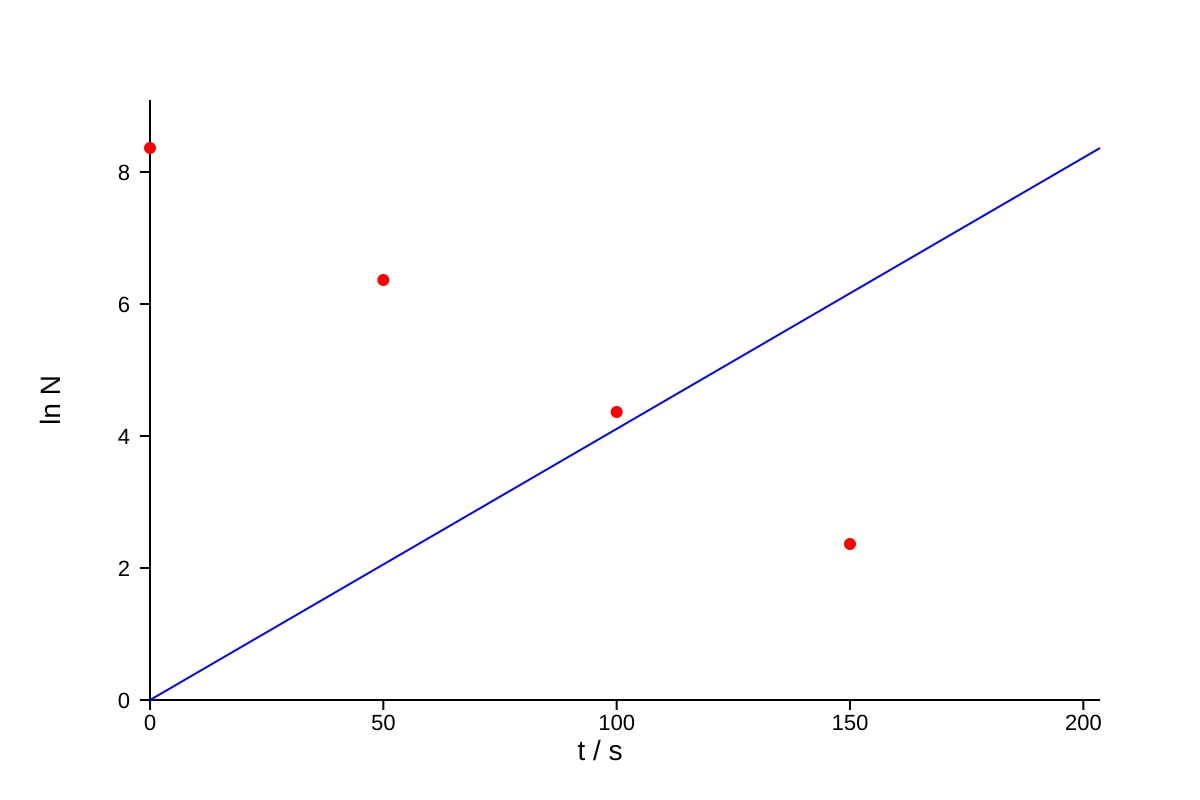
15. The graph shows the decay of a radioactive sample.
Image pending generation: graph for Q15.
Using the graph, determine the decay constant λ from the gradient. [2]
16. From the decay constant in Q15, calculate the half-life of the sample in seconds. [1]
17. Explain why the binding energy per nucleon versus mass number curve peaks near iron (56Fe) and state the significance for nuclear fusion and fission. [3]
18. A detector measures background count rate of 20 s−1. With a source present the count rate is 80 s−1. Calculate the corrected count rate due to the source. [1]
19. Suggest why radioactive dating using carbon-14 is limited to samples less than about 50 000 years old. [2]
20. Describe how a Geiger-Müller tube detects ionizing radiation, and state one limitation of this detector. [3]
Answers
A-Level Physics H1 Quiz - Modern Physics (Answer Key)
Topic: Modern Physics (Syllabus 8867 Topic 11)
Total Marks: 40
Note: Content generated from syllabus-first LLM templates; not claimed as past-year derived.
Section A: Concepts and Recall
1. [1 mark]
A nuclide is a species of atom characterised by the number of protons and neutrons in its nucleus (i.e. a specific combination of Z and A).
Teaching note: "Nuclide" refers to the nucleus type, not the element alone. Isotopes are nuclides with same Z but different A.
2. [2 marks]
Mass defect is the difference between the sum of the masses of the separate nucleons (protons and neutrons) and the actual mass of the bound nucleus.
[1] for "difference in mass"
[1] for "free nucleons vs bound nucleus"
Common mistake: Confusing with binding energy (energy equivalent).
3. [2 marks]
Conservation of nucleon number: 238=A+4⇒A=234
Conservation of charge: 92=Z+2⇒Z=90
A=234, Z=90 [1 each]
4. [2 marks]
In β− decay, a neutron transforms into a proton and an electron (and antineutrino): n→p+e−+νˉe.
The proton stays in nucleus so Z increases by 1; the electron is emitted, mass number (nucleon count) unchanged.
[1] for neutron→proton explanation, [1] for mass number unchanged.
5. [1 mark]
Half-life is the time taken for half of the radioactive nuclei in a sample to decay (or activity to halve).
6. [2 marks]
1122Na→1022Ne++10e (or β+)
[1] for daughter Ne with Z=10, A=22; [1] for positron emitted.
7. [1 mark]
Any one: use tongs/remote handling; store in lead container; limit exposure time; wear badge dosimeter.
Section B: Calculations
8. [2 marks]
Mass defect Δm=12.0984−12.0000=0.0984 u
[2] for correct subtraction and unit.
9. [2 marks]
Eb=0.0984×931.5=91.7 MeV
[1] method, [1] answer to 3 s.f.
10. [2 marks]
t1/2=λln2=0.0500.693=13.9 h
[1] formula, [1] answer.
11. [2 marks]
100=800×(1/2)12/T
1/8=(1/2)12/T⇒3=12/T⇒T=4.0 days
[1] use of halving, [1] answer.
12. [3 marks]
Δm=0.200×1.66×10−27=3.32×10⁻²⁸ kg
E=Δmc2=3.32×10−28×(3.00×108)2=2.99×10⁻¹¹ J
[1] mass in kg, [1] use E=mc2, [1] answer.
13. [3 marks]
Equation: 88226Ra→86222Rn+24α [1]
E=0.0053×931.5=4.94 MeV [2]
14. [2 marks]
A=λN⇒N=A/λ=2.4×106/1.2×10−6=2.0×1012
[1] formula, [1] answer.
Section C: Data Interpretation
15. [2 marks]
Gradient =(2.7−6.9)/(150−0)=−4.2/150=−0.028 s−1
λ=−gradient=0.028 s−1
[1] gradient, [1] lambda positive.
16. [1 mark]
t1/2=0.693/0.028=24.8 s
17. [3 marks]
Curve peaks near Fe because nuclei are most tightly bound there. [1]
Fusion of light nuclei moves toward peak, releasing energy. [1]
Fission of heavy nuclei also moves toward peak, releasing energy. [1]
18. [1 mark]
Corrected rate =80−20=60 s−1
19. [2 marks]
After ~50k years, C-14 remaining is too small to measure accurately (less than ~0.1% left). [1]
Background and contamination dominate. [1]
20. [3 marks]
GM tube: ionizing radiation enters, ionizes gas, pulse counted. [2]
Limitation: cannot distinguish radiation types or measure energy. [1]
Free quiz and exam paper access
Enter your details to view this paper
Your access is remembered on this device.