AI Generated Quiz

A Level H1 Physics Mechanics Quiz

Free AI-Generated Owl Alpha A Level H1 Physics Mechanics quiz with questions and answers for Singapore students. This page is rendered as a direct URL so the questions and answers can be discovered without pressing in-page buttons.

These static practice materials are generated from the site's syllabus and paper-generation workflow, with source and model context shown so students and parents can evaluate the material before use.

A Level H1 Physics AI Generated Generated by Owl Alpha Updated 2026-06-07

Questions

<!-- TuitionGoWhere generation metadata: stage=5-1; model=openrouter/owl-alpha; model_label=Owl Alpha; generated=2026-06-06; Sources: Stage 4-0 LLM templates, syllabus context, and Stage 2 evidence where available. -->

A-Level Physics H1 Quiz - Mechanics

Name: ___________________________
Class: ___________________________
Date: ___________________________
Score: ________ / 60

Duration: 70 minutes
Total Marks: 60


Instructions

  • Answer all questions in the spaces provided.
  • Show all working for calculation questions. Answers without working may not receive full marks.
  • Use g=9.81 m s2g = 9.81 \text{ m s}^{-2} where required.
  • Unless otherwise stated, give answers to an appropriate number of significant figures.
  • The number of marks for each question is shown in brackets [ ].

Section A: Kinematics and Dynamics (Questions 1–5)

1. State the principle of conservation of linear momentum.


[2]

2. A ball is thrown vertically upward with an initial speed of 15.0 m s115.0 \text{ m s}^{-1}. Ignoring air resistance, calculate the maximum height reached by the ball.


[3]

3. Distinguish between a scalar quantity and a vector quantity. Give one example of each.


[2]

4. A car accelerates uniformly from rest to a speed of 24.0 m s124.0 \text{ m s}^{-1} in 8.0 s8.0 \text{ s}.
(a) Calculate the acceleration of the car.


[2]

(b) Calculate the distance travelled by the car during this time.


[2]

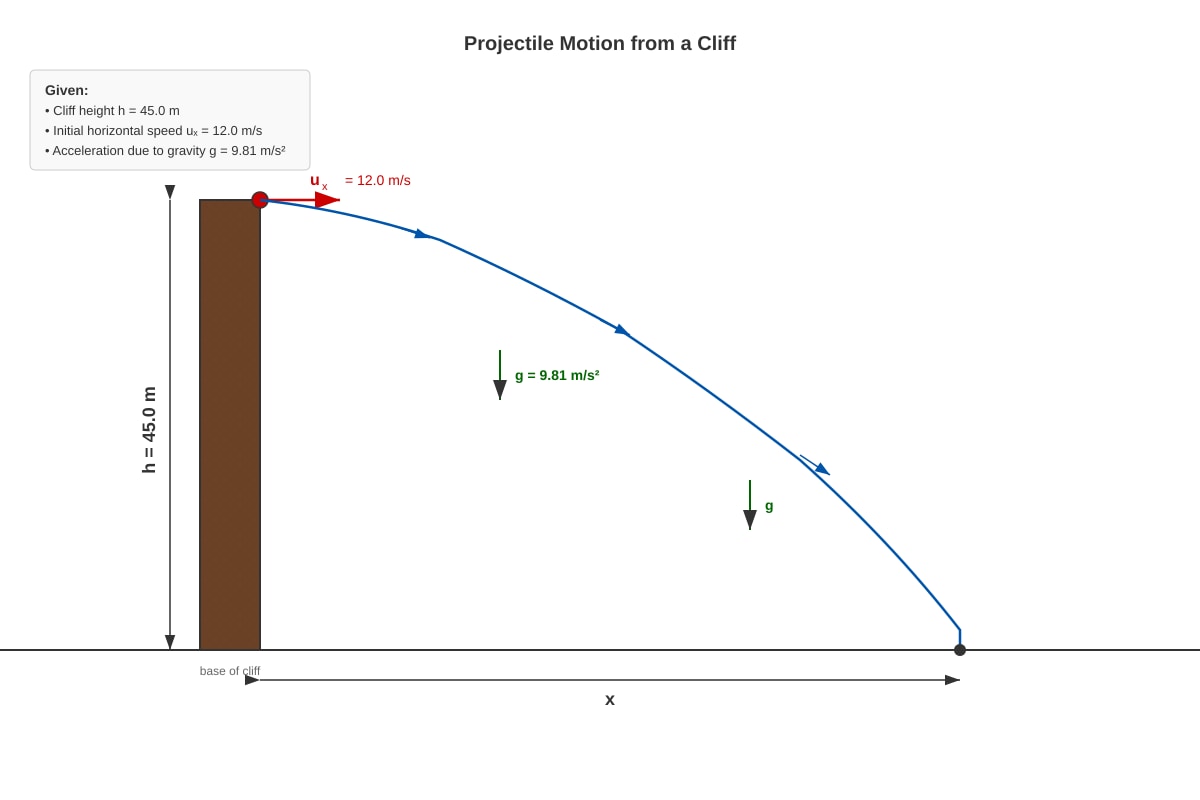
5. A projectile is launched horizontally from a cliff 45.0 m45.0 \text{ m} high with a horizontal speed of 12.0 m s112.0 \text{ m s}^{-1}.
<image_placeholder> id: Q5-fig1 type: diagram linked_question: Q5 description: A cliff of height 45.0 m with a projectile launched horizontally from the top at 12.0 m/s. The parabolic trajectory curves downward to the ground. Horizontal distance x is marked from the base of the cliff to the landing point. labels: Cliff height h = 45.0 m, initial horizontal speed u_x = 12.0 m/s, horizontal distance x, parabolic trajectory values: h = 45.0 m, u_x = 12.0 m/s, g = 9.81 m/s² must_show: Cliff with labelled height, horizontal launch direction, parabolic path, horizontal distance x to landing point, downward acceleration g </image_placeholder>

(a) Calculate the time taken for the projectile to reach the ground.


[3]

(b) Calculate the horizontal distance from the base of the cliff where the projectile lands.


[2]


Section B: Forces and Newton's Laws (Questions 6–10)

6. State Newton's second law of motion.


[2]

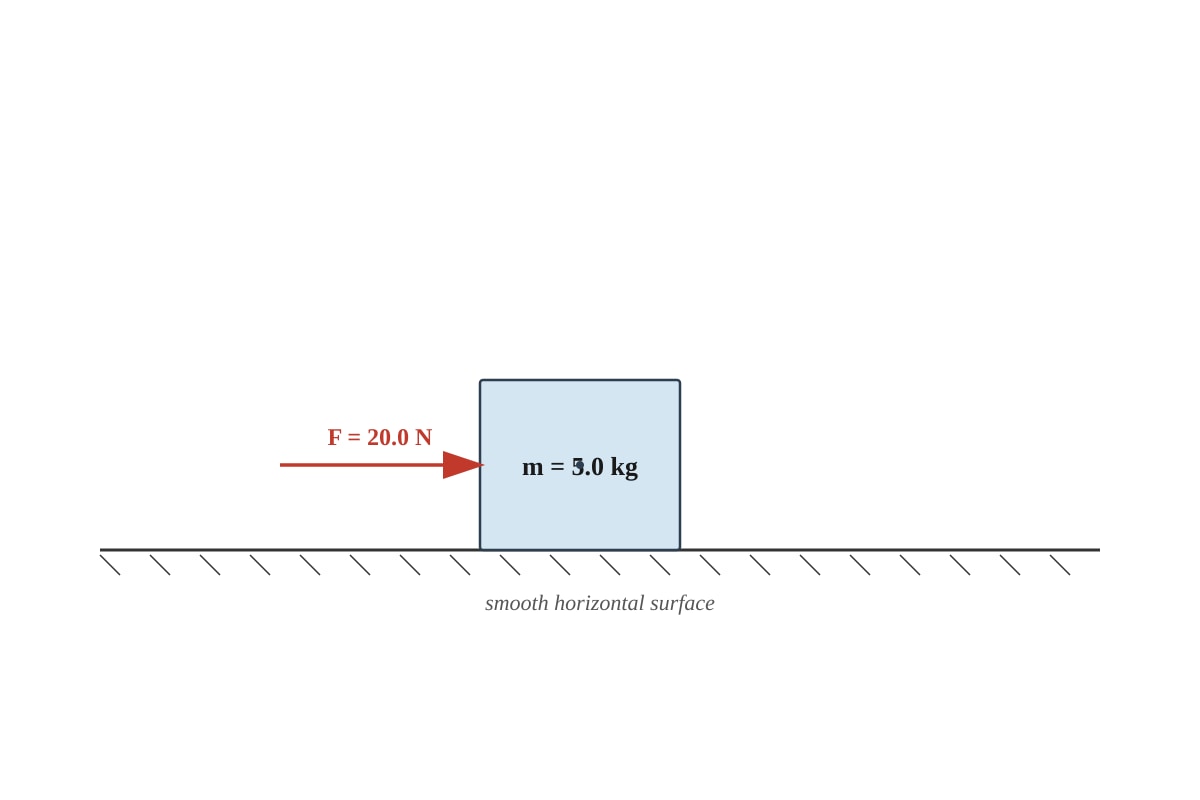
7. A block of mass 5.0 kg5.0 \text{ kg} rests on a smooth horizontal surface. A horizontal force of 20.0 N20.0 \text{ N} is applied to the block.
<image_placeholder> id: Q7-fig1 type: diagram linked_question: Q7 description: A rectangular block of mass 5.0 kg on a smooth horizontal surface. A horizontal force F = 20.0 N is applied to the right side of the block. No friction force shown (smooth surface). labels: Block mass m = 5.0 kg, applied force F = 20.0 N (right), smooth horizontal surface values: m = 5.0 kg, F = 20.0 N must_show: Block on horizontal surface, force arrow labelled F = 20.0 N pointing right, mass label m = 5.0 kg, no friction arrow </image_placeholder>

(a) Calculate the acceleration of the block.


[2]

(b) If the block starts from rest, calculate its velocity after 3.0 s3.0 \text{ s}.


[2]

8. A 2.0 kg2.0 \text{ kg} object is suspended by two strings as shown in the diagram below. String A makes an angle of 3030^\circ with the vertical and String B makes an angle of 6060^\circ with the vertical.
<image_placeholder> id: Q8-fig1 type: diagram linked_question: Q8 description: A 2.0 kg mass suspended from a fixed point by two strings. String A goes up and left at 30° to the vertical. String B goes up and right at 60° to the vertical. The mass hangs at the junction of the two strings. Weight mg acts downward from the mass. labels: Mass m = 2.0 kg, String A at 30° to vertical (left), String B at 60° to vertical (right), tension T_A in String A, tension T_B in String B, weight mg downward values: m = 2.0 kg, angle A = 30°, angle B = 60°, g = 9.81 m/s² must_show: Fixed support point above, two strings at labelled angles, mass at junction, weight arrow downward labelled mg, tension arrows along each string </image_placeholder>

(a) Draw a free-body diagram showing all forces acting on the object.


[2]

(b) Calculate the tension in String A.


[3]

9. Explain what is meant by the term equilibrium of a body. State the two conditions required for a body to be in equilibrium.


[3]

10. A 10.0 kg10.0 \text{ kg} box is pulled along a rough horizontal surface by a force of 50.0 N50.0 \text{ N} applied at an angle of 3030^\circ above the horizontal. The coefficient of kinetic friction between the box and the surface is 0.250.25.
<image_placeholder> id: Q10-fig1 type: diagram linked_question: Q10 description: A box of mass 10.0 kg on a rough horizontal surface. A force F = 50.0 N is applied at 30° above the horizontal to the right. Friction force f acts to the left. Normal reaction R acts upward. Weight mg acts downward. labels: Box mass m = 10.0 kg, applied force F = 50.0 N at 30° above horizontal, friction force f (left), normal reaction R (up), weight mg (down), coefficient of friction μ = 0.25 values: m = 10.0 kg, F = 50.0 N, angle = 30°, μ = 0.25, g = 9.81 m/s² must_show: Box on horizontal surface, force arrow at 30° labelled F = 50.0 N, friction arrow left, normal reaction arrow up, weight arrow down, angle 30° marked </image_placeholder>

(a) Calculate the normal reaction force acting on the box.


[3]

(b) Calculate the acceleration of the box.


[3]


Section C: Work, Energy, and Power (Questions 11–15)

11. Define the term work done by a force. State the SI unit of work.


[2]

12. A 0.50 kg0.50 \text{ kg} ball is dropped from a height of 10.0 m10.0 \text{ m}. Calculate the kinetic energy of the ball just before it hits the ground.


[3]

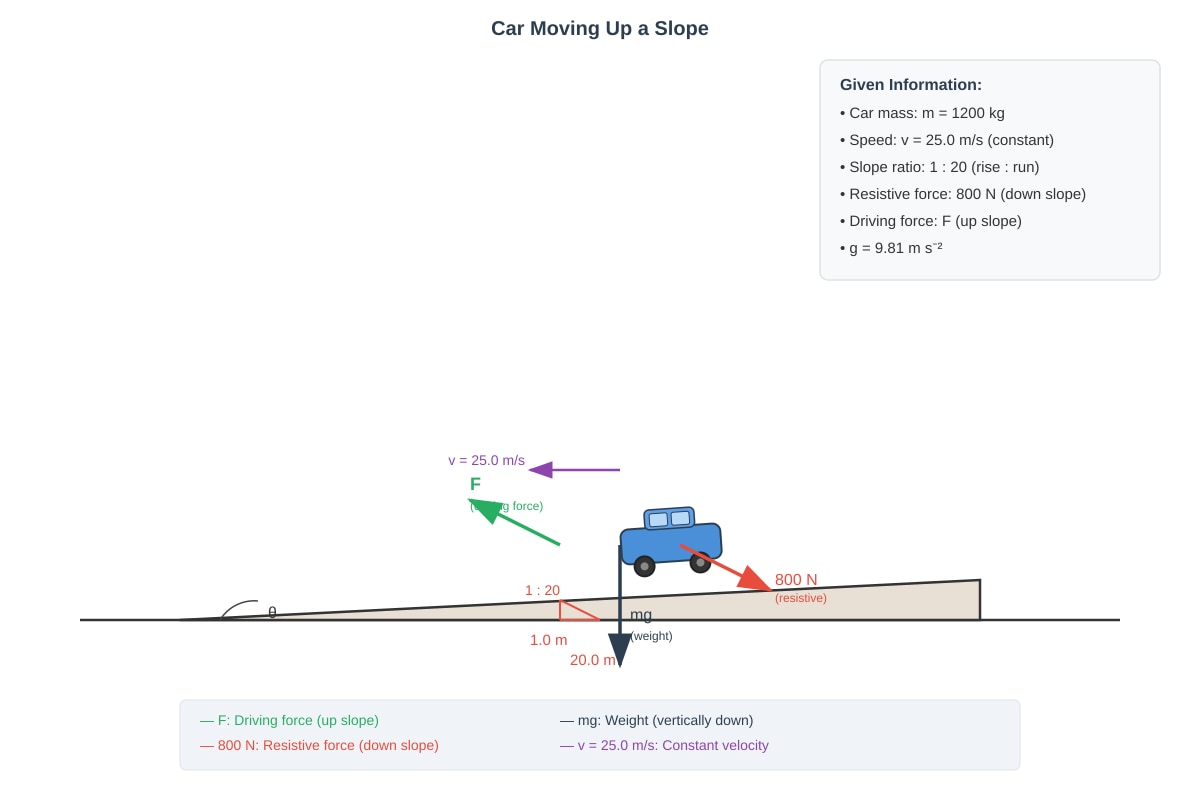
13. A 1200 kg1200 \text{ kg} car travels at a constant speed of 25.0 m s125.0 \text{ m s}^{-1} up a hill that rises 1.0 m1.0 \text{ m} for every 20.0 m20.0 \text{ m} along the slope. The total resistive forces acting on the car are 800 N800 \text{ N}.
<image_placeholder> id: Q13-fig1 type: diagram linked_question: Q13 description: A car moving up a slope. The slope rises 1.0 m vertically for every 20.0 m along the slope. The car has mass 1200 kg and moves at constant speed 25.0 m/s. Resistive force of 800 N acts down the slope. The driving force F acts up the slope. labels: Car mass m = 1200 kg, speed v = 25.0 m/s (constant), slope ratio 1:20 (rise:run), resistive force = 800 N down slope, driving force F up slope values: m = 1200 kg, v = 25.0 m/s, slope = 1:20, resistive force = 800 N, g = 9.81 m/s² must_show: Inclined slope with 1:20 ratio marked, car on slope, driving force up slope, resistive force down slope, weight mg downward </image_placeholder>

(a) Calculate the component of the car's weight acting down the slope.


[3]

(b) Calculate the driving force required to maintain this constant speed.


[2]

(c) Calculate the power developed by the car's engine.


[2]

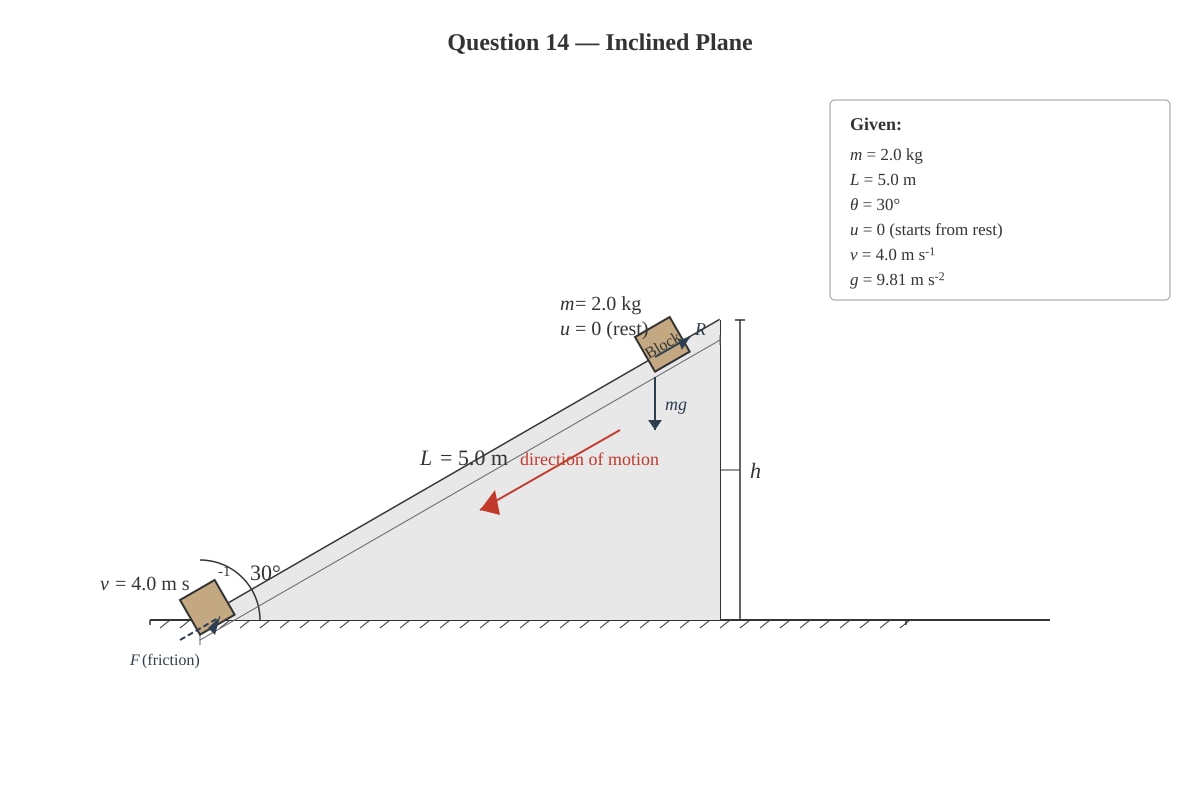
14. A 2.0 kg2.0 \text{ kg} block slides down a rough inclined plane from rest. The plane is 5.0 m5.0 \text{ m} long and makes an angle of 3030^\circ with the horizontal. The block reaches the bottom with a speed of 4.0 m s14.0 \text{ m s}^{-1}.
<image_placeholder> id: Q14-fig1 type: diagram linked_question: Q14 description: An inclined plane of length 5.0 m at 30° to the horizontal. A block of mass 2.0 kg starts from rest at the top and slides down. The vertical height h is marked. The block reaches the bottom with speed 4.0 m/s. labels: Block mass m = 2.0 kg, plane length L = 5.0 m, angle θ = 30°, initial speed u = 0, final speed v = 4.0 m/s, vertical height h values: m = 2.0 kg, L = 5.0 m, θ = 30°, u = 0, v = 4.0 m/s, g = 9.81 m/s² must_show: Inclined plane at 30°, block at top (rest) and bottom (speed 4.0 m/s), length 5.0 m marked, height h marked vertically </image_placeholder>

(a) Calculate the loss in gravitational potential energy of the block.


[3]

(b) Calculate the work done against friction.


[3]

15. Define the term power. State the SI unit of power.


[2]


Section D: Momentum and Collisions (Questions 16–20)

16. A 3.0 kg3.0 \text{ kg} trolley moving at 4.0 m s14.0 \text{ m s}^{-1} collides head-on with a stationary 2.0 kg2.0 \text{ kg} trolley. After the collision, the two trolleys stick together.
<image_placeholder> id: Q16-fig1 type: diagram linked_question: Q16 description: Two stages of a collision. Before: Trolley A (3.0 kg) moves right at 4.0 m/s toward Trolley B (2.0 kg) at rest. After: Combined trolley (5.0 kg) moves right at common velocity v. labels: Before: m_A = 3.0 kg, u_A = 4.0 m/s (right), m_B = 2.0 kg, u_B = 0. After: combined mass = 5.0 kg, common velocity v (right). values: m_A = 3.0 kg, u_A = 4.0 m/s, m_B = 2.0 kg, u_B = 0 must_show: Before-collision diagram with two separate trolleys and velocities, after-collision diagram with combined trolley and unknown velocity v </image_placeholder>

(a) Calculate the common velocity of the trolleys after the collision.


[3]

(b) State whether this collision is elastic or inelastic. Justify your answer.


[2]

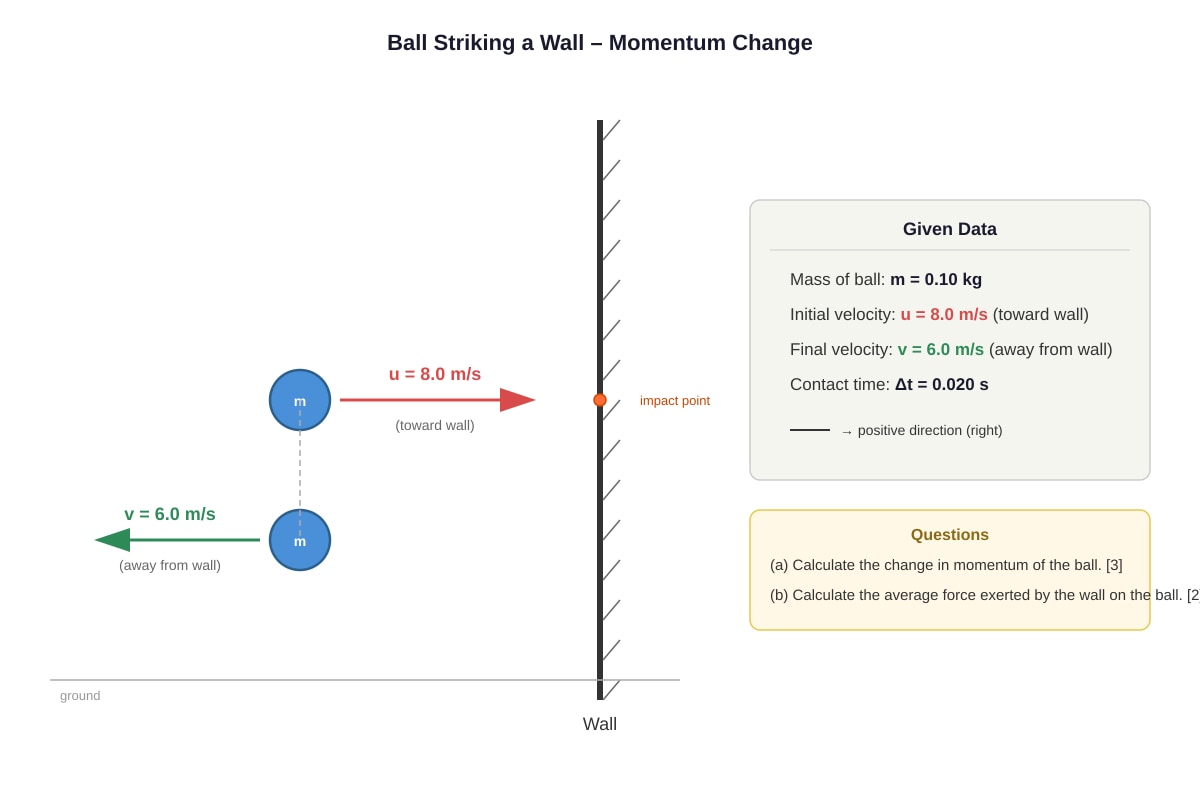
17. A 0.10 kg0.10 \text{ kg} ball strikes a wall horizontally at 8.0 m s18.0 \text{ m s}^{-1} and rebounds at 6.0 m s16.0 \text{ m s}^{-1}. The ball is in contact with the wall for 0.020 s0.020 \text{ s}.
<image_placeholder> id: Q17-fig1 type: diagram linked_question: Q17 description: A ball approaching a wall from the left at 8.0 m/s and rebounding to the left at 6.0 m/s. The wall is shown as a vertical line. Arrows indicate direction of motion before and after impact. labels: Ball mass m = 0.10 kg, initial velocity u = 8.0 m/s (toward wall), final velocity v = 6.0 m/s (away from wall), contact time Δt = 0.020 s values: m = 0.10 kg, u = 8.0 m/s, v = 6.0 m/s, Δt = 0.020 s must_show: Wall as vertical line, ball before impact moving right at 8.0 m/s, ball after impact moving left at 6.0 m/s, contact time noted </image_placeholder>

(a) Calculate the change in momentum of the ball.


[3]

(b) Calculate the average force exerted by the wall on the ball.


[2]

18. Explain the difference between an elastic collision and an inelastic collision. In which type of collision is kinetic energy conserved?


[3]

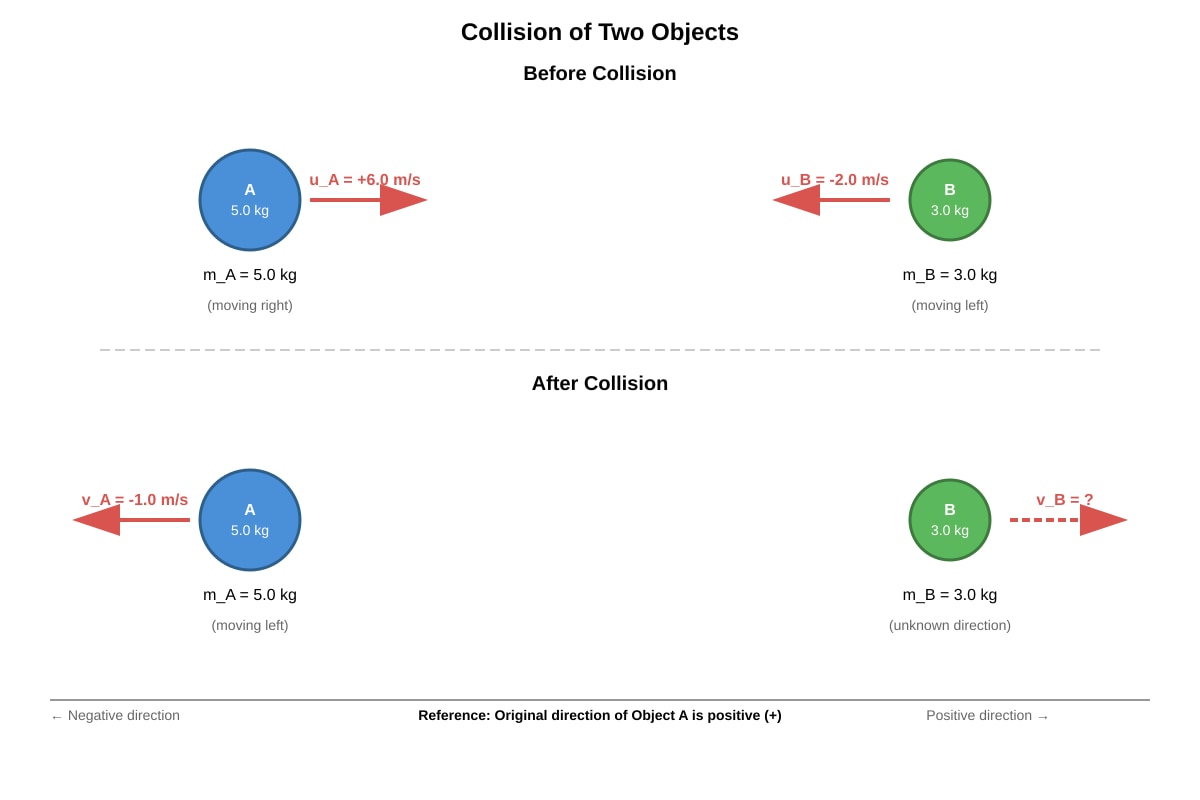
19. A 5.0 kg5.0 \text{ kg} object moving at 6.0 m s16.0 \text{ m s}^{-1} collides with a 3.0 kg3.0 \text{ kg} object moving in the opposite direction at 2.0 m s12.0 \text{ m s}^{-1}. After the collision, the 5.0 kg5.0 \text{ kg} object moves in the opposite direction at 1.0 m s11.0 \text{ m s}^{-1}.
<image_placeholder> id: Q19-fig1 type: diagram linked_question: Q19 description: Two stages of a collision. Before: Object A (5.0 kg) moves right at 6.0 m/s, Object B (3.0 kg) moves left at 2.0 m/s. After: Object A (5.0 kg) moves left at 1.0 m/s, Object B (3.0 kg) moves with unknown velocity v_B. labels: Before: m_A = 5.0 kg, u_A = +6.0 m/s (right), m_B = 3.0 kg, u_B = -2.0 m/s (left). After: m_A = 5.0 kg, v_A = -1.0 m/s (left), m_B = 3.0 kg, v_B = ? values: m_A = 5.0 kg, u_A = 6.0 m/s, m_B = 3.0 kg, u_B = 2.0 m/s, v_A = 1.0 m/s must_show: Before-collision diagram with two objects approaching each other, after-collision diagram with Object A moving left and Object B with unknown velocity </image_placeholder>

(a) Taking the original direction of the 5.0 kg5.0 \text{ kg} object as positive, calculate the velocity of the 3.0 kg3.0 \text{ kg} object after the collision.


[3]

(b) Determine whether this collision is elastic or inelastic. Show your working.


[3]

20. A firework of mass 0.80 kg0.80 \text{ kg} is initially at rest. It explodes into two fragments. One fragment has mass 0.30 kg0.30 \text{ kg} and moves with a speed of 20.0 m s120.0 \text{ m s}^{-1} to the right.
<image_placeholder> id: Q20-fig1 type: diagram linked_question: Q20 description: Two stages of an explosion. Before: A single firework of mass 0.80 kg at rest. After: Two fragments — Fragment A (0.30 kg) moving right at 20.0 m/s, Fragment B (0.50 kg) moving left at unknown speed v. labels: Before: firework mass = 0.80 kg, at rest. After: Fragment A: m_A = 0.30 kg, v_A = 20.0 m/s (right). Fragment B: m_B = 0.50 kg, v_B = ? (left). values: Total mass = 0.80 kg, m_A = 0.30 kg, v_A = 20.0 m/s, m_B = 0.50 kg must_show: Before: single firework at rest. After: two fragments moving in opposite directions, Fragment A labelled with mass and velocity, Fragment B labelled with mass and unknown velocity </image_placeholder>

(a) Calculate the speed of the second fragment.


[3]

(b) Calculate the total kinetic energy produced in the explosion.


[2]


End of Quiz

Answers

<!-- TuitionGoWhere generation metadata: stage=5-1; model=openrouter/owl-alpha; model_label=Owl Alpha; generated=2026-06-06; Sources: Stage 4-0 LLM templates, syllabus context, and Stage 2 evidence where available. -->

A-Level Physics H1 Quiz - Mechanics

Answer Key and Teaching Notes


Question 1 [2 marks]

Answer:
The principle of conservation of linear momentum states that the total momentum of a closed (isolated) system remains constant, provided no external forces act on the system.

Marking:

  • [B1] Total momentum of a system remains constant / momentum before = momentum after
  • [B1] Provided no external forces act / in a closed/isolated system

Teaching Notes:
A "closed system" or "isolated system" means no external forces act on the objects within the system. Internal forces between objects in the system do not change the total momentum. This is a fundamental law derived from Newton's third law. Students often forget to mention the "no external forces" condition — this is essential because external forces would change the total momentum.


Question 2 [3 marks]

Answer:
Using v2=u2+2asv^2 = u^2 + 2as (or conservation of energy):
At maximum height, final velocity v=0v = 0.
0=(15.0)2+2(9.81)h0 = (15.0)^2 + 2(-9.81)h
0=22519.62h0 = 225 - 19.62h
h=22519.62=11.5 mh = \frac{225}{19.62} = 11.5 \text{ m}

Marking:

  • [M1] Correct equation selected: v2=u2+2asv^2 = u^2 + 2as or mgh=12mu2mgh = \frac{1}{2}mu^2
  • [M1] Correct substitution with v=0v = 0 and a=ga = -g (or equivalent energy method)
  • [A1] Final answer: h=11.5 mh = 11.5 \text{ m} (accept 11.4–11.5 m depending on gg used)

Teaching Notes:
At the maximum height, the ball momentarily stops before falling back down, so v=0v = 0. The acceleration is g-g because gravity acts downward while the initial velocity is upward. Alternatively, using energy conservation: initial kinetic energy = gain in gravitational potential energy, so 12mu2=mgh\frac{1}{2}mu^2 = mgh, giving h=u22g=22519.62=11.5h = \frac{u^2}{2g} = \frac{225}{19.62} = 11.5 m. The mass cancels out, so all objects reach the same height regardless of mass (ignoring air resistance).


Question 3 [2 marks]

Answer:

  • A scalar quantity has magnitude (size) only. Example: speed, mass, energy, time, distance.
  • A vector quantity has both magnitude and direction. Example: velocity, force, acceleration, momentum, displacement.

Marking:

  • [B1] Correct definition of scalar (magnitude only) with a valid example
  • [B1] Correct definition of vector (magnitude and direction) with a valid example

Teaching Notes:
The key distinction is direction. Scalars like speed tell you "how fast" but not "which way." Vectors like velocity tell you both. Common pairs: distance (scalar) vs displacement (vector); speed (scalar) vs velocity (vector). Students sometimes confuse these — remind them that adding vectors requires considering direction (e.g., using vector addition), while scalars add arithmetically.


Question 4 [4 marks total]

(a) [2 marks]
Answer:
a=vut=24.008.0=3.0 m s2a = \frac{v - u}{t} = \frac{24.0 - 0}{8.0} = 3.0 \text{ m s}^{-2}

Marking:

  • [M1] Correct use of a=vuta = \frac{v-u}{t}
  • [A1] Answer: 3.0 m s23.0 \text{ m s}^{-2}

(b) [2 marks]
Answer:
s=ut+12at2=0+12(3.0)(8.0)2=12(3.0)(64)=96.0 ms = ut + \frac{1}{2}at^2 = 0 + \frac{1}{2}(3.0)(8.0)^2 = \frac{1}{2}(3.0)(64) = 96.0 \text{ m}
(Alternatively: s=(u+v)2×t=(0+24.0)2×8.0=96.0 ms = \frac{(u+v)}{2} \times t = \frac{(0+24.0)}{2} \times 8.0 = 96.0 \text{ m})

Marking:

  • [M1] Correct equation and substitution
  • [A1] Answer: 96.0 m96.0 \text{ m}

Teaching Notes:
This is a standard uniform acceleration problem. Since the car starts from rest, u=0u = 0, which simplifies calculations. Students should be comfortable selecting from the four equations of motion. A common mistake is using the wrong equation or forgetting that u=0u = 0. The average velocity method (u+v)2×t\frac{(u+v)}{2} \times t is often quicker when acceleration is uniform.


Question 5 [5 marks total]

(a) [3 marks]
Answer:
For vertical motion (taking downward as positive):
h=12gt2h = \frac{1}{2}gt^2 (since initial vertical velocity = 0)
45.0=12(9.81)t245.0 = \frac{1}{2}(9.81)t^2
t2=90.09.81=9.174t^2 = \frac{90.0}{9.81} = 9.174
t=3.03 st = 3.03 \text{ s}

Marking:

  • [M1] Recognition that initial vertical velocity is zero and vertical motion determines time
  • [M1] Correct substitution into h=12gt2h = \frac{1}{2}gt^2
  • [A1] Answer: t=3.03 st = 3.03 \text{ s} (accept 3.0–3.03 s)

(b) [2 marks]
Answer:
Horizontal distance: x=ux×t=12.0×3.03=36.4 mx = u_x \times t = 12.0 \times 3.03 = 36.4 \text{ m}

Marking:

  • [M1] Use of x=ux×tx = u_x \times t (horizontal velocity is constant)
  • [A1] Answer: 36.4 m36.4 \text{ m} (accept 36–36.4 m)

Teaching Notes:
This is a classic projectile motion problem. The key insight is that horizontal and vertical motions are independent. The time of flight is determined entirely by the vertical motion (how long it takes to fall 45.0 m). Since there is no horizontal acceleration (ignoring air resistance), the horizontal velocity remains constant at 12.0 m s112.0 \text{ m s}^{-1}. Students often try to combine horizontal and vertical components incorrectly — remind them to treat each direction separately.


Question 6 [2 marks]

Answer:
Newton's second law states that the net force acting on an object is equal to the rate of change of its linear momentum. For constant mass, this reduces to F=maF = ma, where FF is the net force, mm is the mass, and aa is the acceleration.

Marking:

  • [B1] Force equals rate of change of momentum: F=ΔpΔtF = \frac{\Delta p}{\Delta t}
  • [B1] Or for constant mass: F=maF = ma (force proportional to acceleration, with mass as constant of proportionality)

Teaching Notes:
The most general form is F=dpdtF = \frac{dp}{dt} (force equals rate of change of momentum). When mass is constant, this becomes F=mdvdt=maF = m\frac{dv}{dt} = ma. Students should understand that the direction of acceleration is always in the direction of the net force. Common errors: forgetting that FF is the net (resultant) force, not just any single force.


Question 7 [4 marks total]

(a) [2 marks]
Answer:
Using Newton's second law: F=maF = ma
a=Fm=20.05.0=4.0 m s2a = \frac{F}{m} = \frac{20.0}{5.0} = 4.0 \text{ m s}^{-2}

Marking:

  • [M1] Use of F=maF = ma
  • [A1] Answer: 4.0 m s24.0 \text{ m s}^{-2}

(b) [2 marks]
Answer:
v=u+at=0+(4.0)(3.0)=12.0 m s1v = u + at = 0 + (4.0)(3.0) = 12.0 \text{ m s}^{-1}

Marking:

  • [M1] Use of v=u+atv = u + at with correct values
  • [A1] Answer: 12.0 m s112.0 \text{ m s}^{-1}

Teaching Notes:
Since the surface is smooth, there is no friction. The only horizontal force is the applied force of 20.0 N, so this is the net force. Students sometimes incorrectly include friction even when told the surface is "smooth." The block starts from rest (u=0u = 0), making the calculation straightforward.


Question 8 [5 marks total]

(a) [2 marks]
Answer:
The free-body diagram should show three forces acting on the object:

  • Weight mgmg acting vertically downward
  • Tension TAT_A in String A, acting along the string at 3030^\circ to the vertical (up and left)
  • Tension TBT_B in String B, acting along the string at 6060^\circ to the vertical (up and right)

Marking:

  • [B1] All three forces shown with correct directions
  • [B1] Forces drawn from a single point (the object) with correct angles

(b) [3 marks]
Answer:
For equilibrium, resolving vertically:
TAcos30+TBcos60=mgT_A \cos 30^\circ + T_B \cos 60^\circ = mg
Resolving horizontally:
TAsin30=TBsin60T_A \sin 30^\circ = T_B \sin 60^\circ

From horizontal equilibrium: TA(0.5)=TB(0.866)T_A(0.5) = T_B(0.866), so TB=0.50.866TA=0.577TAT_B = \frac{0.5}{0.866}T_A = 0.577T_A

Substituting into vertical equation:
TA(0.866)+(0.577TA)(0.5)=(2.0)(9.81)T_A(0.866) + (0.577T_A)(0.5) = (2.0)(9.81)
0.866TA+0.289TA=19.620.866T_A + 0.289T_A = 19.62
1.155TA=19.621.155T_A = 19.62
TA=17.0 NT_A = 17.0 \text{ N}

Marking:

  • [M1] Correct resolution of forces (horizontal and vertical components)
  • [M1] Correct substitution and algebraic manipulation
  • [A1] Answer: TA=17.0 NT_A = 17.0 \text{ N} (accept 16.9–17.0 N)

Teaching Notes:
For equilibrium problems, the key strategy is to resolve all forces into perpendicular components (usually horizontal and vertical). Since the object is in equilibrium, the sum of forces in each direction equals zero. Students should draw a clear free-body diagram first. A common error is mixing up sine and cosine — remind them that the component adjacent to the angle uses cosine, and the component opposite the angle uses sine.


Question 9 [3 marks]

Answer:
A body is in equilibrium when it is either at rest or moving with constant velocity (no acceleration).

The two conditions for equilibrium are:

  1. Translational equilibrium: The vector sum of all forces acting on the body is zero (F=0\sum F = 0).
  2. Rotational equilibrium: The sum of all moments (torques) about any point is zero (τ=0\sum \tau = 0).

Marking:

  • [B1] Definition: body at rest or moving with constant velocity / no acceleration
  • [B1] First condition: resultant force is zero
  • [B1] Second condition: resultant moment/torque is zero

Teaching Notes:
Equilibrium does not necessarily mean the object is stationary — it can be moving at constant velocity (Newton's first law). For H1 Physics, the focus is mainly on translational equilibrium (F=0\sum F = 0). The rotational condition becomes more important in H2 Physics. Students sometimes think equilibrium means "no forces act" — clarify that forces do act, but they balance out to give zero resultant.


Question 10 [6 marks total]

(a) [3 marks]
Answer:
Resolving vertically (taking upward as positive):
R+Fsin30=mgR + F\sin 30^\circ = mg
R=mgFsin30R = mg - F\sin 30^\circ
R=(10.0)(9.81)(50.0)(0.5)R = (10.0)(9.81) - (50.0)(0.5)
R=98.125.0=73.1 NR = 98.1 - 25.0 = 73.1 \text{ N}

Marking:

  • [M1] Correct vertical force balance equation
  • [M1] Correct substitution
  • [A1] Answer: R=73.1 NR = 73.1 \text{ N}

(b) [3 marks]
Answer:
Friction force: f=μR=0.25×73.1=18.3 Nf = \mu R = 0.25 \times 73.1 = 18.3 \text{ N}
Net horizontal force: Fnet=Fcos30f=(50.0)(0.866)18.3=43.318.3=25.0 NF_{\text{net}} = F\cos 30^\circ - f = (50.0)(0.866) - 18.3 = 43.3 - 18.3 = 25.0 \text{ N}
Acceleration: a=Fnetm=25.010.0=2.50 m s2a = \frac{F_{\text{net}}}{m} = \frac{25.0}{10.0} = 2.50 \text{ m s}^{-2}

Marking:

  • [M1] Calculation of friction force using f=μRf = \mu R
  • [M1] Calculation of net horizontal force
  • [A1] Answer: a=2.50 m s2a = 2.50 \text{ m s}^{-2}

Teaching Notes:
This is a comprehensive problem combining force resolution, friction, and Newton's second law. The key steps are: (1) find the normal reaction by considering vertical equilibrium (note that the upward component of the applied force reduces the normal reaction), (2) calculate friction using f=μRf = \mu R, (3) find the net horizontal force, and (4) apply F=maF = ma. A very common mistake is using R=mgR = mg without accounting for the vertical component of the applied force.


Question 11 [2 marks]

Answer:
Work done by a force is defined as the product of the force and the displacement in the direction of the force: W=FscosθW = F \cdot s \cdot \cos\theta, where θ\theta is the angle between the force and displacement.
The SI unit of work is the joule (J), where 1 J=1 N m1 \text{ J} = 1 \text{ N m}.

Marking:

  • [B1] Correct definition: force × displacement in direction of force (or W=FscosθW = Fs\cos\theta)
  • [B1] SI unit: joule (J)

Teaching Notes:
Work is done only when a force causes displacement. If the force is perpendicular to the displacement, no work is done (cos90=0\cos 90^\circ = 0). Work is a scalar quantity. Students sometimes confuse work with force — emphasize that work requires both force and movement in the direction of the force.


Question 12 [3 marks]

Answer:
Using conservation of energy:
Loss in gravitational potential energy = Gain in kinetic energy
mgh=12mv2mgh = \frac{1}{2}mv^2
KE=mgh=(0.50)(9.81)(10.0)=49.1 JKE = mgh = (0.50)(9.81)(10.0) = 49.1 \text{ J}

Alternatively, find the speed first:
v2=u2+2gh=0+2(9.81)(10.0)=196.2v^2 = u^2 + 2gh = 0 + 2(9.81)(10.0) = 196.2
v=14.0 m s1v = 14.0 \text{ m s}^{-1}
KE=12mv2=12(0.50)(196.2)=49.1 JKE = \frac{1}{2}mv^2 = \frac{1}{2}(0.50)(196.2) = 49.1 \text{ J}

Marking:

  • [M1] Use of energy conservation or kinematic equation
  • [M1] Correct substitution
  • [A1] Answer: KE=49.1 JKE = 49.1 \text{ J} (accept 49.0–49.1 J)

Teaching Notes:
The energy method is more direct — the gravitational potential energy lost equals the kinetic energy gained. The mass cancels in the equation mgh=12mv2mgh = \frac{1}{2}mv^2, so the speed just before impact is independent of mass. This is a powerful principle: in the absence of air resistance, all objects fall at the same rate regardless of mass.


Question 13 [7 marks total]

(a) [3 marks]
Answer:
The slope rises 1.0 m1.0 \text{ m} for every 20.0 m20.0 \text{ m} along the slope, so sinθ=1.020.0=0.050\sin\theta = \frac{1.0}{20.0} = 0.050.
Component of weight down the slope: mgsinθ=(1200)(9.81)(0.050)=589 Nmg\sin\theta = (1200)(9.81)(0.050) = 589 \text{ N}

Marking:

  • [M1] Correct identification of sinθ=120\sin\theta = \frac{1}{20}
  • [M1] Use of mgsinθmg\sin\theta
  • [A1] Answer: 589 N589 \text{ N} (accept 588–589 N)

(b) [2 marks]
Answer:
At constant speed, net force = 0, so:
Driving force = Component of weight down slope + Resistive force
F=589+800=1389 N1390 NF = 589 + 800 = 1389 \text{ N} \approx 1390 \text{ N}

Marking:

  • [M1] Correct force balance (driving force = weight component + resistance)
  • [A1] Answer: 1390 N1390 \text{ N}

(c) [2 marks]
Answer:
Power: P=F×v=1389×25.0=34725 W34.7 kWP = F \times v = 1389 \times 25.0 = 34725 \text{ W} \approx 34.7 \text{ kW}

Marking:

  • [M1] Use of P=FvP = Fv
  • [A1] Answer: 34.7 kW34.7 \text{ kW} (accept 34.7–34.8 kW)

Teaching Notes:
This problem combines several concepts: resolving weight on a slope, equilibrium at constant speed, and power. Since the car moves at constant speed, the net force is zero — the driving force must balance both the component of gravity down the slope and the resistive forces. Power is the rate of doing work, and when force and velocity are in the same direction, P=FvP = Fv. Students often forget to include both the weight component and resistive force when calculating the driving force.


Question 14 [6 marks total]

(a) [3 marks]
Answer:
Vertical height: h=Lsinθ=5.0×sin30=5.0×0.5=2.5 mh = L\sin\theta = 5.0 \times \sin 30^\circ = 5.0 \times 0.5 = 2.5 \text{ m}
Loss in gravitational potential energy: ΔPE=mgh=(2.0)(9.81)(2.5)=49.1 J\Delta PE = mgh = (2.0)(9.81)(2.5) = 49.1 \text{ J}

Marking:

  • [M1] Calculation of vertical height h=Lsin30h = L\sin 30^\circ
  • [M1] Use of ΔPE=mgh\Delta PE = mgh
  • [A1] Answer: 49.1 J49.1 \text{ J} (accept 49.0–49.1 J)

(b) [3 marks]
Answer:
Kinetic energy at bottom: KE=12mv2=12(2.0)(4.0)2=16.0 JKE = \frac{1}{2}mv^2 = \frac{1}{2}(2.0)(4.0)^2 = 16.0 \text{ J}
By conservation of energy:
Loss in PE = Gain in KE + Work done against friction
49.1=16.0+Wfriction49.1 = 16.0 + W_{\text{friction}}
Wfriction=49.116.0=33.1 JW_{\text{friction}} = 49.1 - 16.0 = 33.1 \text{ J}

Marking:

  • [M1] Calculation of kinetic energy at bottom
  • [M1] Use of energy conservation: ΔPE=KE+Wfriction\Delta PE = KE + W_{\text{friction}}
  • [A1] Answer: 33.1 J33.1 \text{ J} (accept 33.0–33.1 J)

Teaching Notes:
This is an energy conservation problem with friction. Not all the gravitational potential energy converts to kinetic energy — some is lost as work done against friction (which becomes thermal energy). The "missing" energy (49.116.0=33.149.1 - 16.0 = 33.1 J) is the work done against friction. Students sometimes assume all PE converts to KE, forgetting the energy lost to friction. This is why the block's speed at the bottom (4.0 m/s4.0 \text{ m/s}) is less than it would be on a smooth slope.


Question 15 [2 marks]

Answer:
Power is defined as the rate of doing work (or rate of energy transfer): P=Wt=ΔEtP = \frac{W}{t} = \frac{\Delta E}{t}.
The SI unit of power is the watt (W), where 1 W=1 J s11 \text{ W} = 1 \text{ J s}^{-1}.

Marking:

  • [B1] Correct definition: rate of doing work / rate of energy transfer
  • [B1] SI unit: watt (W)

Teaching Notes:
Power measures how quickly work is done or energy is transferred. A more powerful machine does the same amount of work in less time. The relationship P=FvP = Fv (power = force × velocity) is useful when an object moves at constant speed under a constant force. Students sometimes confuse power with energy — power is energy per unit time.


Question 16 [5 marks total]

(a) [3 marks]
Answer:
Using conservation of momentum:
mAuA+mBuB=(mA+mB)vm_A u_A + m_B u_B = (m_A + m_B)v
(3.0)(4.0)+(2.0)(0)=(3.0+2.0)v(3.0)(4.0) + (2.0)(0) = (3.0 + 2.0)v
12.0=5.0v12.0 = 5.0v
v=2.4 m s1v = 2.4 \text{ m s}^{-1}

Marking:

  • [M1] Correct use of conservation of momentum equation
  • [M1] Correct substitution
  • [A1] Answer: v=2.4 m s1v = 2.4 \text{ m s}^{-1} in the original direction of the 3.0 kg trolley

(b) [2 marks]
Answer:
This is an inelastic collision because the two trolleys stick together after the collision. Kinetic energy is not conserved (some is converted to other forms such as heat and sound). In fact, this is a perfectly inelastic collision because the objects stick together.

Marking:

  • [B1] Correct identification: inelastic
  • [B1] Valid justification: objects stick together / kinetic energy is not conserved

Teaching Notes:
In any collision where objects stick together, the collision is perfectly inelastic. Momentum is always conserved in collisions (assuming no external forces), but kinetic energy is only conserved in elastic collisions. In this case, the "lost" kinetic energy is converted to thermal energy, sound, and deformation energy. Students should always check both momentum and kinetic energy when classifying collisions.


Question 17 [5 marks total]

(a) [3 marks]
Answer:
Taking the direction toward the wall as positive:
Initial momentum: pi=mu=(0.10)(8.0)=0.80 kg m s1p_i = mu = (0.10)(8.0) = 0.80 \text{ kg m s}^{-1}
Final momentum: pf=mv=(0.10)(6.0)=0.60 kg m s1p_f = mv = (0.10)(-6.0) = -0.60 \text{ kg m s}^{-1} (negative because direction reversed)
Change in momentum: Δp=pfpi=0.600.80=1.40 kg m s1\Delta p = p_f - p_i = -0.60 - 0.80 = -1.40 \text{ kg m s}^{-1}
Magnitude of change: Δp=1.40 kg m s1|\Delta p| = 1.40 \text{ kg m s}^{-1}

Marking:

  • [M1] Correct assignment of signs/directions
  • [M1] Correct calculation of initial and final momentum
  • [A1] Answer: Δp=1.40 kg m s1\Delta p = 1.40 \text{ kg m s}^{-1} (magnitude) or 1.40 kg m s1-1.40 \text{ kg m s}^{-1} (with direction)

(b) [2 marks]
Answer:
Using the impulse-momentum theorem: FΔt=ΔpF\Delta t = \Delta p
F=ΔpΔt=1.400.020=70.0 NF = \frac{\Delta p}{\Delta t} = \frac{1.40}{0.020} = 70.0 \text{ N}

Marking:

  • [M1] Use of F=ΔpΔtF = \frac{\Delta p}{\Delta t}
  • [A1] Answer: F=70.0 NF = 70.0 \text{ N}

Teaching Notes:
The change in momentum (impulse) is crucial here. Since the ball reverses direction, the velocity changes from +8.0+8.0 to 6.0-6.0 m/s, giving a total change of 14.014.0 m/s in velocity terms. The negative sign in the change of momentum indicates the direction of the impulse is away from the wall. The force calculated is the average force during the contact time. Students often make sign errors — emphasize the importance of choosing a positive direction and sticking to it.


Question 18 [3 marks]

Answer:

  • In an elastic collision, both momentum and kinetic energy are conserved. The objects bounce apart, and no kinetic energy is converted to other forms.
  • In an inelastic collision, momentum is conserved but kinetic energy is not conserved. Some kinetic energy is converted to other forms (heat, sound, deformation).
  • In a perfectly inelastic collision, the objects stick together after the collision, and the maximum amount of kinetic energy is lost (while momentum is still conserved).
  • Kinetic energy is conserved only in elastic collisions.

Marking:

  • [B1] Elastic collision: both momentum and KE conserved
  • [B1] Inelastic collision: momentum conserved but KE not conserved
  • [B1] KE conserved only in elastic collisions

Teaching Notes:
Momentum is conserved in ALL collisions (as long as no external forces act). The distinction between elastic and inelastic is about kinetic energy. In real-world collisions, some kinetic energy is always lost, so perfectly elastic collisions are idealisations. However, collisions between atomic and subatomic particles can be very nearly elastic. Students should remember: momentum conservation is universal; kinetic energy conservation is the special case.


Question 19 [6 marks total]

(a) [3 marks]
Answer:
Taking the original direction of the 5.0 kg5.0 \text{ kg} object as positive:
Conservation of momentum:
mAuA+mBuB=mAvA+mBvBm_A u_A + m_B u_B = m_A v_A + m_B v_B
(5.0)(6.0)+(3.0)(2.0)=(5.0)(1.0)+(3.0)vB(5.0)(6.0) + (3.0)(-2.0) = (5.0)(-1.0) + (3.0)v_B
30.06.0=5.0+3.0vB30.0 - 6.0 = -5.0 + 3.0v_B
24.0=5.0+3.0vB24.0 = -5.0 + 3.0v_B
29.0=3.0vB29.0 = 3.0v_B
vB=9.67 m s1v_B = 9.67 \text{ m s}^{-1} (in the original direction of the 5.0 kg5.0 \text{ kg} object, i.e., positive direction)

Marking:

  • [M1] Correct use of conservation of momentum with correct signs
  • [M1] Correct substitution and algebraic manipulation
  • [A1] Answer: vB=9.67 m s1v_B = 9.67 \text{ m s}^{-1} (accept 9.6–9.7 m s⁻¹)

(b) [3 marks]
Answer:
Initial kinetic energy:
KEi=12(5.0)(6.0)2+12(3.0)(2.0)2=90.0+6.0=96.0 JKE_i = \frac{1}{2}(5.0)(6.0)^2 + \frac{1}{2}(3.0)(2.0)^2 = 90.0 + 6.0 = 96.0 \text{ J}

Final kinetic energy:
KEf=12(5.0)(1.0)2+12(3.0)(9.67)2=2.5+140.3=142.8 JKE_f = \frac{1}{2}(5.0)(1.0)^2 + \frac{1}{2}(3.0)(9.67)^2 = 2.5 + 140.3 = 142.8 \text{ J}

Since KEf>KEiKE_f > KE_i (142.8 J > 96.0 J), kinetic energy has increased. This means the collision is not elastic — in fact, additional energy must have been supplied (e.g., from an explosion or stored energy). If we assume no external energy input, this would be classified as a superelastic collision, but in standard A-Level terms, since KE is not conserved, it is not elastic.

Note: If the numbers were such that KEf<KEiKE_f < KE_i, it would be inelastic. If KEf=KEiKE_f = KE_i, it would be elastic.

Marking:

  • [M1] Calculation of initial kinetic energy
  • [M1] Calculation of final kinetic energy
  • [A1] Correct conclusion with justification

Teaching Notes:
This problem tests whether students can apply conservation of momentum in two-object collisions and then verify energy conservation. The key skill is consistent sign convention. The result that KE increases suggests energy was added to the system (perhaps from a spring or explosive charge). In standard exam problems, if KE decreases, the collision is inelastic; if KE is the same, it's elastic. Students should always show the KE calculations to justify their classification.


Question 20 [5 marks total]

(a) [3 marks]
Answer:
Initially, the firework is at rest, so total initial momentum = 0.
By conservation of momentum:
mAvA+mBvB=0m_A v_A + m_B v_B = 0 (taking right as positive)
(0.30)(20.0)+(0.50)vB=0(0.30)(20.0) + (0.50)v_B = 0
6.0+0.50vB=06.0 + 0.50v_B = 0
vB=12.0 m s1v_B = -12.0 \text{ m s}^{-1}

The speed of the second fragment is 12.0 m s112.0 \text{ m s}^{-1} (the negative sign indicates it moves to the left).

Marking:

  • [M1] Recognition that initial momentum is zero
  • [M1] Correct use of conservation of momentum
  • [A1] Answer: speed = 12.0 m s112.0 \text{ m s}^{-1} (direction: opposite to first fragment)

(b) [2 marks]
Answer:
Total kinetic energy produced:
KE=12mAvA2+12mBvB2KE = \frac{1}{2}m_A v_A^2 + \frac{1}{2}m_B v_B^2
KE=12(0.30)(20.0)2+12(0.50)(12.0)2KE = \frac{1}{2}(0.30)(20.0)^2 + \frac{1}{2}(0.50)(12.0)^2
KE=60.0+36.0=96.0 JKE = 60.0 + 36.0 = 96.0 \text{ J}

Marking:

  • [M1] Correct calculation of KE for both fragments
  • [A1] Answer: KE=96.0 JKE = 96.0 \text{ J}

Teaching Notes:
This is an explosion problem — the reverse of a collision. The key insight is that the initial momentum is zero (firework at rest), so the total final momentum must also be zero. This means the two fragments must move in opposite directions with momenta of equal magnitude. The kinetic energy comes from the chemical energy stored in the firework. This is why KE is not conserved in explosions — chemical energy is converted to kinetic energy. Students sometimes forget that the initial momentum is zero in explosion problems.


Total: 60 marks