AI Generated Quiz
A Level H1 Physics Energy Power Quiz
Free A Level H1 Physics Energy Power quiz, LongCat AI version, with questions, answers, and A Level-style practice for Singapore students.
These static practice materials are generated from the site's syllabus and paper-generation workflow, with source and model context shown so students and parents can evaluate the material before use.
Questions


Free quiz and exam paper access
Enter your details to view this paper
Your access is remembered on this device.
Answers
A-Level Physics H1 Quiz - Energy Power
Answer Key and Teaching Notes
Question 1 [2 marks]
Answer:
Work done is defined as the product of the force and the displacement in the direction of the force. For a constant force: , where is the magnitude of the force, is the displacement, and is the angle between the force and displacement vectors.
The SI unit of work is the joule (J), where .
Marking:
- [B1] Correct definition (force × displacement in direction of force, or equivalent)
- [B1] Correct unit: joule (J)
Teaching Note: Work is a scalar quantity. It measures the energy transferred by a force acting through a distance. If the force is perpendicular to the displacement, no work is done by that force.
Question 2 [6 marks]
(a) [2 marks]
Work done by applied force:
Marking:
- [B1] Correct formula or method
- [B1] Correct answer: 120 J
(b) [2 marks]
Work done against friction:
Marking:
- [B1] Correct method
- [B1] Correct answer: 40 J
(c) [2 marks]
By the work-energy theorem, the net work done on the box equals the change in kinetic energy:
Physics principle: The work-energy theorem (or principle of conservation of energy).
Marking:
- [B1] Correct method (net work = work by applied force − work against friction)
- [B1] Correct answer: 80 J and correct principle named
Common Mistake: Students may forget to subtract the work done against friction, giving 120 J instead of 80 J.
Question 3 [2 marks]
Answer:
The work-energy theorem states that the net work done on an object is equal to the change in its kinetic energy.
Marking:
- [B1] Net work = change in kinetic energy (or equivalent wording)
- [B1] Correct mathematical expression or clear explanation
Question 4 [5 marks]
(a) [2 marks]
Answer: 28.8 J (or 29 J to 2 s.f.)
Marking:
- [B1] Correct substitution
- [B1] Correct answer with unit
(b) [3 marks]
At maximum height, all kinetic energy is converted to gravitational potential energy (by conservation of energy):
Answer: 7.3 m (to 2 s.f.)
Marking:
- [B1] Correct principle (conservation of energy)
- [B1] Correct substitution
- [B1] Correct answer: 7.3 m
Common Mistake: Students may try to use with but forget that the final velocity is zero at the top. Both methods are valid.
Question 5 [3 marks]
Answer:
-
Gravitational potential energy (GPE) is the energy stored in an object due to its position in a gravitational field. It depends on the object's mass, the gravitational field strength, and its height above a reference level: . Example: A book on a high shelf has gravitational potential energy.
-
Elastic potential energy (EPE) is the energy stored in an object when it is stretched or compressed (deformed elastically). For a spring: , where is the spring constant and is the extension. Example: A compressed spring in a toy car stores elastic potential energy.
Marking:
- [B1] Correct definition of GPE
- [B1] Correct definition of EPE
- [B1] One valid example for each (or clear distinction shown)
Question 6 [5 marks]
(a) [2 marks]
Answer: 59 J (to 2 s.f.)
Marking:
- [B1] Correct substitution into
- [B1] Correct answer: 59 J
(b) [2 marks]
Answer: 49 J
Marking:
- [B1] Correct substitution into
- [B1] Correct answer: 49 J
(c) [1 mark]
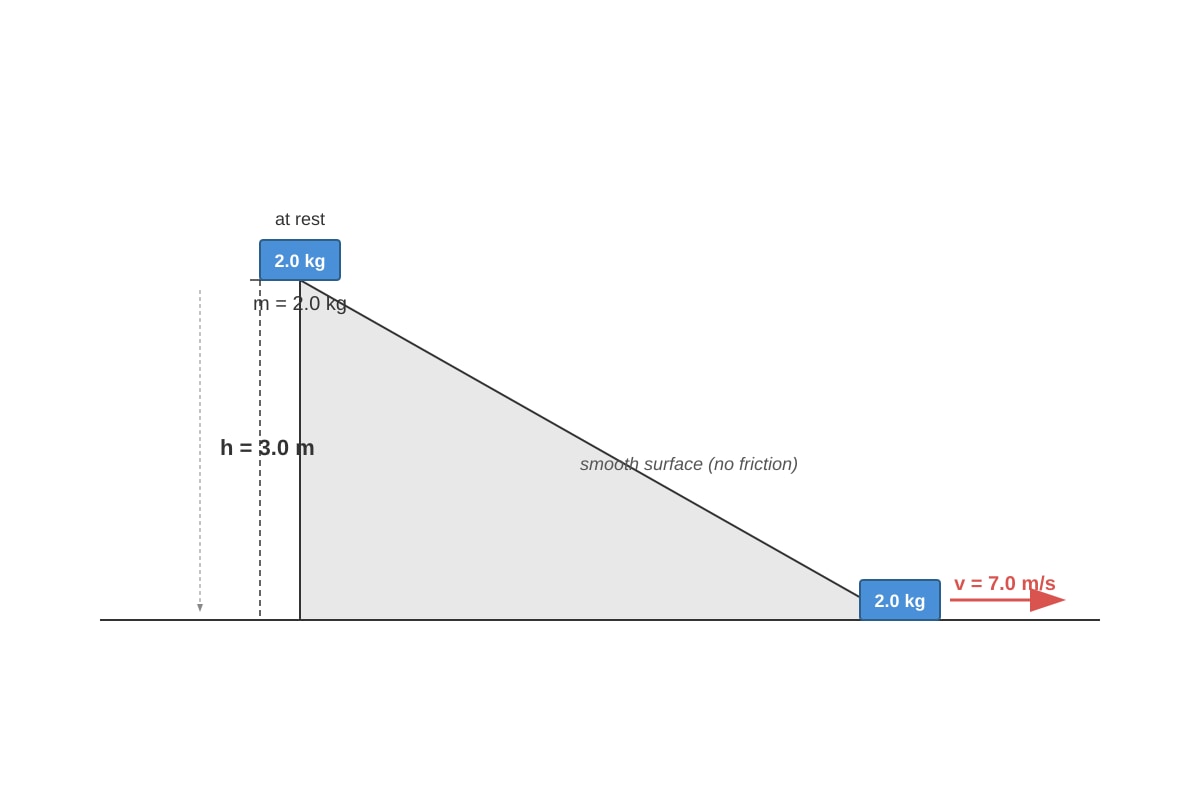
The GPE lost (59 J) is greater than the KE gained (49 J). The difference (~10 J) is likely due to work done against friction (the surface may not be perfectly smooth in reality) or air resistance, which converts some mechanical energy to thermal energy.
Marking:
- [B1] Valid reason: friction/air resistance/energy converted to heat
Teaching Note: Even though the question says "smooth," the data is deliberately inconsistent to test whether students can identify energy dissipation. In real experiments, no surface is perfectly frictionless.
Question 7 [2 marks]
Answer:
The principle of conservation of energy states that energy cannot be created or destroyed; it can only be transferred from one form to another or transformed between different types. The total energy of an isolated system remains constant.
Marking:
- [B1] Energy cannot be created or destroyed
- [B1] Total energy remains constant (or equivalent)
Question 8 [2 marks]
Answer:
Power is defined as the rate of doing work (or rate of energy transfer).
The SI unit of power is the watt (W), where .
Marking:
- [B1] Correct definition: rate of doing work / rate of energy transfer
- [B1] Correct unit: watt (W)
Question 9 [3 marks]
(a) [1 mark]
Answer: 1960 N (or 2.0 × 10³ N to 2 s.f.)
Marking:
- [B1] Correct answer with unit
(b) [2 marks]
At constant speed, the tension in the cable equals the weight. The useful output power is:
Answer: 980 W (or 981 W)
Marking:
- [B1] Correct method ( or )
- [B1] Correct answer: 980 W
Question 10 [3 marks]
(a) [2 marks]
Answer: 75%
Marking:
- [B1] Correct formula
- [B1] Correct answer: 75%
(b) [1 mark]
The wasted energy (300 W) is converted mainly to thermal energy (heat) due to friction in the motor's moving parts and electrical resistance in the coils.
Marking:
- [B1] Thermal energy / heat (or equivalent)
Question 11 [5 marks]
(a) [2 marks]
Answer: 8800 J (or 8.8 × 10³ J)
Marking:
- [B1] Correct substitution
- [B1] Correct answer: 8800 J
(b) [2 marks]
Answer: 736 W (or 740 W to 2 s.f.)
Marking:
- [B1] Correct method
- [B1] Correct answer: 736 W
(c) [1 mark]
The actual power output is greater because the student also gains kinetic energy (she is moving, not just gaining height) and because the human body is not 100% efficient — additional energy is used for internal body processes (muscle contraction, heat generation, etc.) that do not contribute to the useful GPE gain.
Marking:
- [B1] Valid reason: kinetic energy gain / body inefficiency / energy lost as heat
Question 12 [4 marks]
(a) [2 marks]
Answer: 830 N (to 2 s.f.)
Marking:
- [B1] Correct rearrangement:
- [B1] Correct answer: 830 N
(b) [2 marks]
At constant speed, the net force is zero, meaning the driving force equals the resistive forces (air resistance, friction). The engine must produce a driving force to balance these resistive forces and maintain constant velocity. Without a driving force, the resistive forces would decelerate the car.
Marking:
- [B1] Driving force balances resistive/friction forces
- [B1] Without driving force, car would slow down (or equivalent explanation)
Question 13 [5 marks]
(a) [3 marks]
Mass per second:
Answer: 650 W (to 2 s.f.)
Marking:
- [B1] Correct mass flow rate (500/60 kg/s)
- [B1] Correct formula: power = (mass flow rate) × g × h
- [B1] Correct answer: 650 W
(b) [2 marks]
Answer: 930 W (to 2 s.f.)
Marking:
- [B1] Correct rearrangement
- [B1] Correct answer: 930 W
Question 14 [2 marks]
Answer:
No machine can be 100% efficient because some input energy is always wasted — typically converted to thermal energy due to friction between moving parts, air resistance, or electrical resistance in circuits. This wasted energy is dissipated to the surroundings and cannot be recovered for useful work.
Marking:
- [B1] Some energy is always wasted/lost
- [B1] Identifies the form: thermal energy / heat due to friction (or equivalent)
Question 15 [8 marks]
(a) [1 mark]
From the speed data, the speed becomes constant at 3.0 s (it stops increasing after t = 2.0 s and remains at 0.80 m/s from t = 3.0 s onwards; the transition occurs at approximately t = 2.5 s).
Answer: 2.5 s (accept 2.0–3.0 s with reasoning)
Marking:
- [B1] Correct time: 2.5 s (or 2.0 s if referring to when speed first reaches 0.80 m/s)
(b) [2 marks]
Answer: 0.40 m/s²
Marking:
- [B1] Correct method
- [B1] Correct answer: 0.40 m/s²
(c) [3 marks]
During acceleration, applying Newton's second law vertically:
Answer: 5.1 N (to 2 s.f.)
Marking:
- [B1] Correct equation:
- [B1] Correct substitution
- [B1] Correct answer: 5.1 N
(d) [2 marks]
At constant speed, tension equals weight:
Answer: 3.9 W (to 2 s.f.)
Marking:
- [B1] Correct tension at constant speed (= mg)
- [B1] Correct answer: 3.9 W
Question 16 [5 marks]
(a) [2 marks]
Gravitational potential energy lost per second:
Answer: 1.96 × 10⁷ J/s (or 19.6 MW)
Marking:
- [B1] Correct formula
- [B1] Correct answer: 1.96 × 10⁷ W (or 19.6 MW)
(b) [2 marks]
Answer: 1.28 × 10⁷ W (or 12.8 MW)
Marking:
- [B1] Correct method (multiply by 0.65)
- [B1] Correct answer: 12.8 MW
(c) [1 mark]
Energy is lost due to friction in the turbines, turbulence in the water flow, electrical resistance in the generators, or sound energy. Any one valid reason.
Marking:
- [B1] Valid reason
Question 17 [6 marks]
(a) [2 marks]
Answer: 109 N (or 110 N to 2 s.f.)
Marking:
- [B1] Correct use of cosine component
- [B1] Correct answer: 109 N
(b) [2 marks]
The crate moves at constant velocity, so the net horizontal force is zero. The friction force equals only the horizontal component of the applied force (109 N), not the full 120 N. The vertical component of the applied force (120 sin 25°) lifts the crate slightly, reducing the normal reaction and hence the friction, but the friction force itself balances only the horizontal component.
Marking:
- [B1] Friction equals horizontal component only
- [B1] Explanation that vertical component affects normal force / only horizontal component opposes friction
(c) [2 marks]
Work done by the applied force:
Answer: 650 J (to 2 s.f.)
Marking:
- [B1] Correct formula with cosine
- [B1] Correct answer: 650 J
Question 18 [8 marks]
(a) [3 marks]
By conservation of energy:
Answer: 3.1 m/s (to 2 s.f.)
Marking:
- [B1] Correct energy conservation equation
- [B1] Correct substitution
- [B1] Correct answer: 3.1 m/s
(b) [3 marks]
Using conservation of momentum for the inelastic collision:
Answer: 1.25 m/s (or 1.3 m/s to 2 s.f.)
Marking:
- [B1] Correct momentum conservation equation
- [B1] Correct substitution
- [B1] Correct answer: 1.25 m/s
(c) [2 marks]
Initial KE (just before collision):
Final KE (after collision):
Fraction lost:
Answer: 0.60 (or 60%)
Marking:
- [B1] Correct calculation of both KE values
- [B1] Correct fraction: 0.60 (or 60%)
Question 19 [6 marks]
(a) [1 mark]
Answer: 8800 N (or 8.8 × 10³ N)
Marking:
- [B1] Correct answer: 8800 N
(b) [3 marks]
At maximum power and constant speed:
Answer: 1.7 m/s (to 2 s.f.)
Marking:
- [B1] Correct equation:
- [B1] Correct substitution
- [B1] Correct answer: 1.7 m/s
(c) [2 marks]
If more passengers enter, the total weight increases. Since the maximum power is fixed (), a larger force (weight) means the velocity must decrease (). The motor cannot produce more power, so it must move more slowly to balance the increased gravitational force.
Marking:
- [B1] Weight/downward force increases
- [B1] Since and is constant, must decrease
Question 20 [7 marks]
(a) [2 marks]
Answer: 196 J (or 200 J to 2 s.f.)
Marking:
- [B1] Correct substitution
- [B1] Correct answer: 196 J
(b) [2 marks]
Answer: 260 J
Marking:
- [B1] Correct method
- [B1] Correct answer: 260 J
(c) [2 marks]
Answer: 75% (or 75.5%)
Marking:
- [B1] Correct formula
- [B1] Correct answer: 75%
(d) [1 mark]
Use a lighter pulley (reduce the mass of the pulley system), lubricate the axle to reduce friction, or use thinner/lighter rope.
Marking:
- [B1] Valid suggestion
End of Answer Key