AI Generated Quiz
A Level H1 Physics Energy Power Quiz
Free A Level H1 Physics Energy Power quiz, HY3 AI version, with questions, answers, and A Level-style practice for Singapore students.
These static practice materials are generated from the site's syllabus and paper-generation workflow, with source and model context shown so students and parents can evaluate the material before use.
Questions
A-Level Physics H1 Quiz - Energy Power
Name: ______________________
Class: ______________________
Date: ______________________
Score: _______ / 40
Duration: 50 minutes
Total Marks: 40
Topic: Energy & Power (energy-power)
Instructions:
- Answer all 20 questions.
- Show your working clearly for calculation questions.
- Use the spaces provided.
- Section A: Short Answer (1–7), Section B: Structured Calculations (8–14), Section C: Data & Concept Interpretation (15–20).
Section A: Short Answer (1–7)
1. State the principle of conservation of energy. [1]
2. Define power in terms of energy transfer. [1]
3. Write down the equation for kinetic energy of a mass m moving at speed v. [1]
4. A device transfers 200 J of energy in 10 s. State its average power. [1]
5. Define efficiency of an energy transfer process. [1]
6. The elastic potential energy stored in a spring is given by the area under a force-extension graph. State the formula for elastic potential energy when a spring of constant k is extended by x. [1]
7. A crane lifts a load. State the type of energy increase of the load. [1]
Section B: Structured Calculations (8–14)
8. A block of mass 4.0 kg slides down a frictionless slope from rest, dropping through a vertical height of 3.0 m.
(a) Calculate the loss in gravitational potential energy. [2]
(b) Hence determine the speed of the block at the bottom. [2]
9. A car engine produces 90 kW of power and moves the car at a constant speed of 30 m s−1. Calculate the driving force provided by the engine. [3]
10. A 1.5 kW electric heater is used for 20 minutes.
(a) Calculate the electrical energy consumed in joules. [2]
(b) If the heater is 80% efficient at transferring heat to the room, calculate the heat energy delivered. [2]
11. A student claims: "A 100 W bulb is more efficient than a 60 W bulb because it is more powerful." Explain why this statement is not necessarily correct. [3]
12. A wind turbine has an input power from wind of 500 kW and outputs 150 kW of electrical power.
(a) Calculate its efficiency as a percentage. [2]
(b) State one reason why the remaining energy is not converted. [1]
13. A spring of spring constant k=200 N m−1 is compressed by 0.10 m. Calculate the elastic potential energy stored. [2]
14. A pump lifts 500 kg of water per minute through a height of 12 m. Calculate the minimum power of the pump. (g=9.8 m s−2) [3]
Section C: Data & Concept Interpretation (15–20)
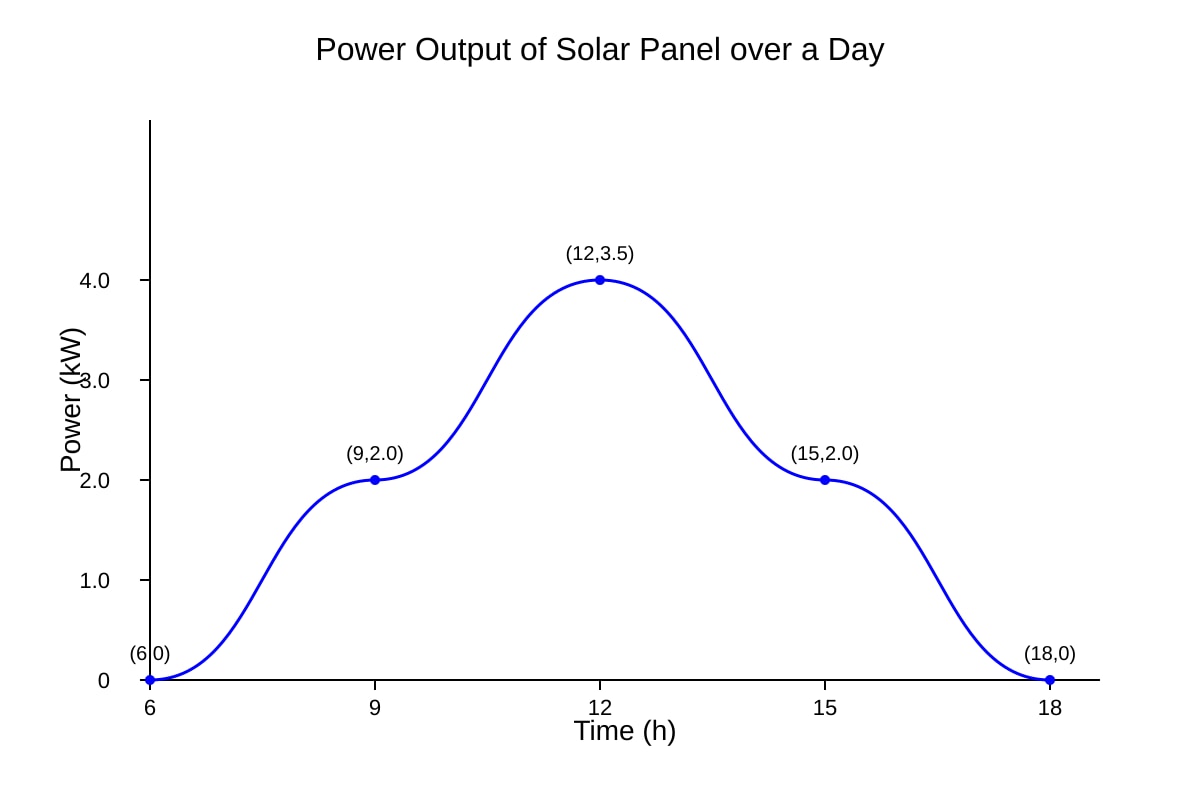
15. The graph below shows power output of a solar panel over a day.
Image pending generation: graph for Q15.
Estimate the total energy generated between 06:00 and 18:00. Show your method. [3]
16. Describe the energy transfers that occur when a mobile phone is charged from a solar power bank. [3]
17. A pendulum is released from a height h and swings without air resistance.
(a) State the form of energy at the highest point. [1]
(b) State the form of energy at the lowest point. [1]
(c) Explain how the principle of conservation of energy applies. [2]
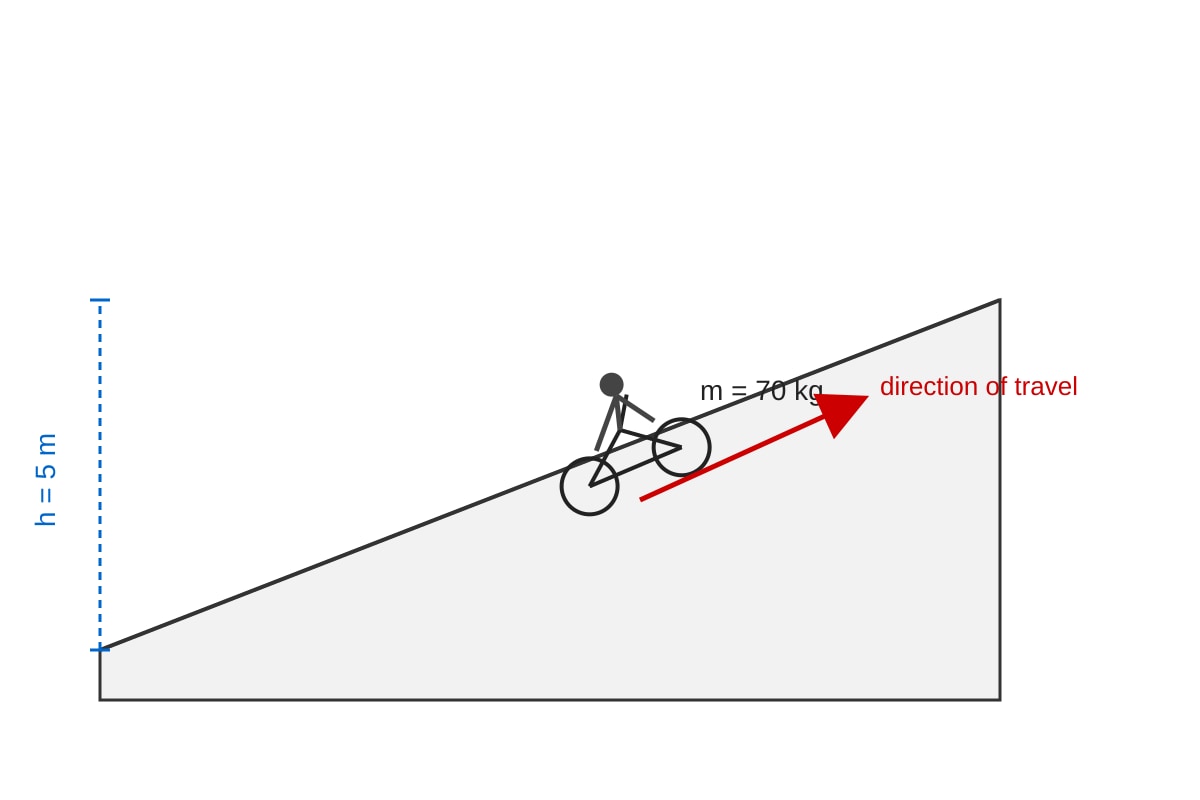
18. The diagram shows a downhill cyclist.
Image pending generation: diagram for Q18.
Ignoring friction, calculate the speed at the bottom of the slope. (g=9.8 m s−2) [3]
19. Compare the advantages of using a high-efficiency motor versus a low-efficiency motor in a factory. [3]
20. A battery of EMF 12 V and internal resistance 0.5 Ω supplies a 5.5 Ω resistor.
(a) Calculate the current. [2]
(b) Calculate the power dissipated in the external resistor. [2]
Answers
A-Level Physics H1 Quiz - Energy Power (Answer Key)
Topic: Energy & Power
Total Marks: 40
Section A: Short Answer
1. [1] The total energy of an isolated system is constant; energy cannot be created or destroyed, only transferred or transformed.
Teaching note: This is the core principle. "Isolated" means no external energy input/output.
2. [1] Power is the rate of energy transfer (or rate of doing work), P=tE.
Teaching note: Unit is watt (W) = J s⁻¹.
3. [1] Ek=21mv2
Teaching note: Do not forget the 21.
4. [1] P=10200=20 W
Teaching note: Direct substitution.
5. [1] Efficiency = total input energyuseful output energy×100% (or fraction).
Teaching note: Always less than 100% in real devices.
6. [1] E=21kx2
Teaching note: Area under F-x graph = 21×base×height=21kx⋅x.
7. [1] Gravitational potential energy.
Teaching note: Height increases → G.P.E. increases.
Section B: Structured Calculations
8. [4]
(a) ΔEp=mgh=4.0×9.8×3.0=118 J [2]
(b) By conservation: 21mv2=118 → v=4.02×118=7.7 m s−1 [2]
Marking: [2] for (a) correct sub and ans; [2] for (b) method and ans.
9. [3]
P=Fv → F=vP=3090000=3000 N [3]
Note: Convert kW to W: 90 kW=90000 W.
10. [4]
(a) t=20×60=1200 s; E=Pt=1500×1200=1.8×10⁶ J [2]
(b) Eheat=0.80×1.8×106=1.44×10⁶ J [2]
11. [3]
Efficiency depends on useful output per input, not absolute power [1]. A 100 W bulb may give more light but could waste more energy as heat than a 60 W bulb [1]. Without knowing lumen output or input, power alone does not show efficiency [1].
12. [3]
(a) η=500150×100%=30% [2]
(b) Energy lost to sound, heat, or motion of air [1].
13. [2]
E=21kx2=0.5×200×(0.10)2=1.0 J [2]
14. [3]
m=500 kg per min → per sec: 500/60=8.33 kg s−1
P=tmgh=(8.33)×9.8×12=980 W [3]
Alternative: E=mgh=500×9.8×12=58800 J per 60 s → P=980 W.
Section C: Data & Concept Interpretation
15. [3]
Energy = area under P-t graph ≈ trapezium/triangle: approx 21×12 h×3.5 kW=21 kWh [2]; convert if needed: 21×3.6×106=7.56×10⁷ J [1].
Image needed: curve as described; area = estimate.
16. [3]
Solar → chemical (power bank) [1]; chemical → electrical (phone battery) [1]; electrical → chemical (phone storage) + heat [1].
17. [4]
(a) Gravitational potential energy [1]
(b) Kinetic energy [1]
(c) At top all energy is G.P.E.; at bottom it is K.E.; total constant if no air resistance [2].
18. [3]
mgh=21mv2 → v=2gh=2×9.8×5=9.9 m s−1 [3]
Image: slope with h and m labels as given.
19. [3]
High-efficiency: less energy wasted as heat [1], lower running cost [1], less environmental impact [1]. Compare directly with low-efficiency opposite points.
20. [4]
(a) Rtotal=0.5+5.5=6.0 Ω; I=6.012=2.0 A [2]
(b) P=I2R=(2.0)2×5.5=22 W [2]
Free quiz and exam paper access
Enter your details to view this paper
Your access is remembered on this device.