From Real Exams Quiz

A Level H1 Physics Waves Sound Light Quiz

Free Exam-Derived Owl Alpha A Level H1 Physics Waves Sound Light quiz with questions and answers for Singapore students. This page is rendered as a direct URL so the questions and answers can be discovered without pressing in-page buttons.

These static practice materials are generated from the site's syllabus and paper-generation workflow, with source and model context shown so students and parents can evaluate the material before use.

A Level H1 Physics From Real Exams Generated by Owl Alpha Updated 2026-06-07

Questions

<!-- TuitionGoWhere generation metadata: stage=3-0; model=openrouter/owl-alpha; model_label=Owl Alpha; generated=2026-06-06; Sources: Stage 2-1 real exam-derived templates and Stage 2-2 exam-enriched syllabus. -->

A-Level Physics H1 Quiz - Waves Sound Light

Name: ________________________________________
Class: ________________________________________
Date: ________________________________________
Score: ______ / 50

Duration: 60 minutes
Total Marks: 50

Instructions:

  • Answer ALL questions.
  • Show all working clearly for calculation questions. Marks are awarded for correct method even if the final answer is incorrect.
  • Include units in your final answers where appropriate.
  • The number of marks for each question or part-question is shown in brackets [ ].
  • You may use a calculator.

Section A: Short Answer Questions (Questions 1–10)

1. State one difference between a transverse wave and a longitudinal wave.
[2 marks]

..................................................................................................................................

..................................................................................................................................


2. Define the period of a wave.
[1 mark]

..................................................................................................................................


3. A wave has a frequency of 250 Hz and a wavelength of 1.36 m. Calculate the speed of the wave.
[2 marks]

..................................................................................................................................

..................................................................................................................................

..................................................................................................................................


4. State the principle of superposition of waves.
[2 marks]

..................................................................................................................................

..................................................................................................................................


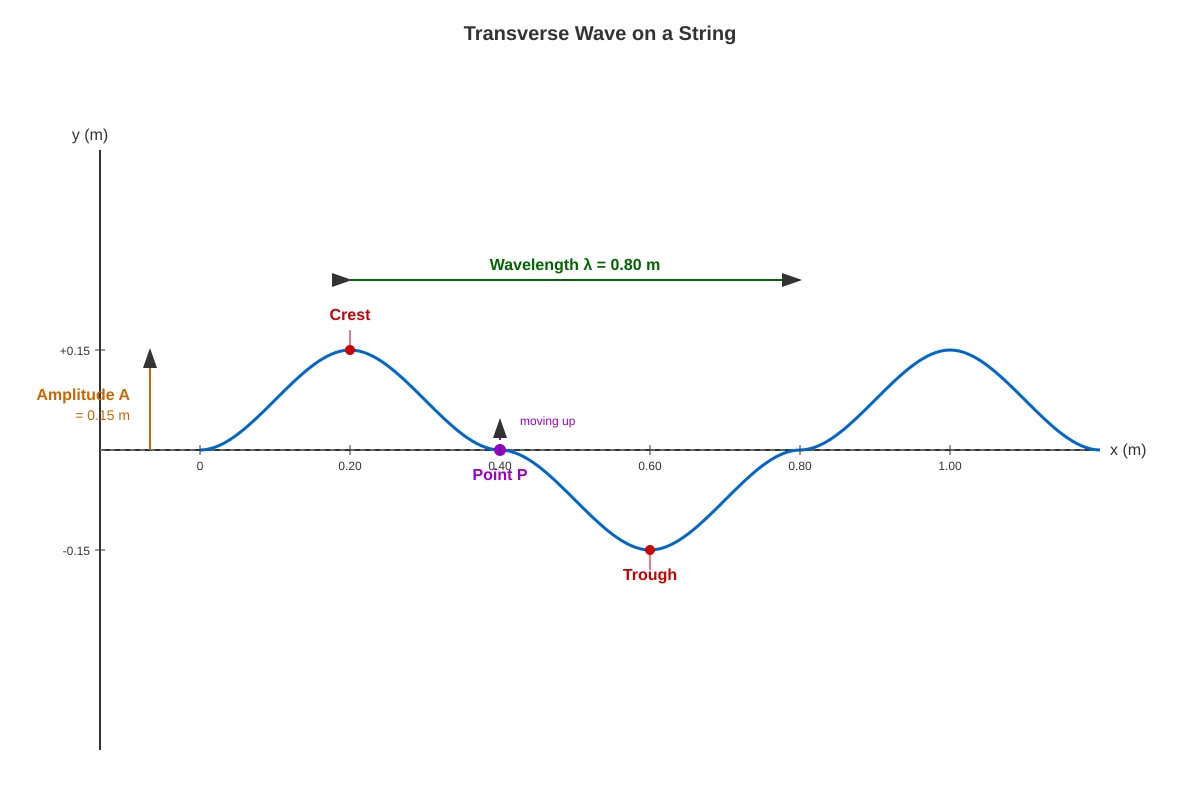
5. The diagram below shows a transverse wave on a string at a particular instant.

<image_placeholder> id: Q5-fig1 type: diagram linked_question: Q5 description: A snapshot of a transverse wave on a string showing one complete wavelength. The horizontal axis is displacement position (x) and the vertical axis is displacement (y). The wave is sinusoidal. Label a crest, a trough, and indicate the wavelength λ as the distance between two consecutive crests. The amplitude A is the maximum displacement from equilibrium. Mark a point P at the equilibrium position moving upward. labels: Crest, Trough, Wavelength λ, Amplitude A, Point P at equilibrium values: λ = 0.80 m, A = 0.15 m must_show: sinusoidal wave shape, one full wavelength, crest and trough clearly labelled, wavelength arrow spanning one cycle, amplitude arrow from equilibrium to crest, point P at equilibrium position </image_placeholder>

(a) On the diagram, label the amplitude of the wave.
[1 mark]

(b) What is the displacement of the particle at point P at this instant?
[1 mark]

..................................................................................................................................


6. Explain what is meant by polarisation of a wave. Which type of wave can be polarised?
[2 marks]

..................................................................................................................................

..................................................................................................................................


7. A student observes that a sound wave travels faster in steel than in air. Explain this observation in terms of the properties of the medium.
[2 marks]

..................................................................................................................................

..................................................................................................................................


8. State two conditions necessary for the formation of a stationary wave.
[2 marks]

..................................................................................................................................

..................................................................................................................................


9. A progressive wave is described by the equation:

y=0.03sin(4.5×10³t12.5x)y = 0.03 \sin(4.5 \times 10^3 t - 12.5x)

where yy is in metres and tt is in seconds. Determine the frequency of the wave.
[2 marks]

..................................................................................................................................

..................................................................................................................................

..................................................................................................................................


10. Light of wavelength 6.0×1076.0 \times 10^{-7} m passes through a single slit and produces a diffraction pattern on a screen. The first minimum occurs at an angle of 2.02.0^\circ from the central maximum. Calculate the width of the slit.
[3 marks]

..................................................................................................................................................................................

..................................................................................................................................

..................................................................................................................................

..................................................................................................................................


Section B: Structured Questions (Questions 11–17)

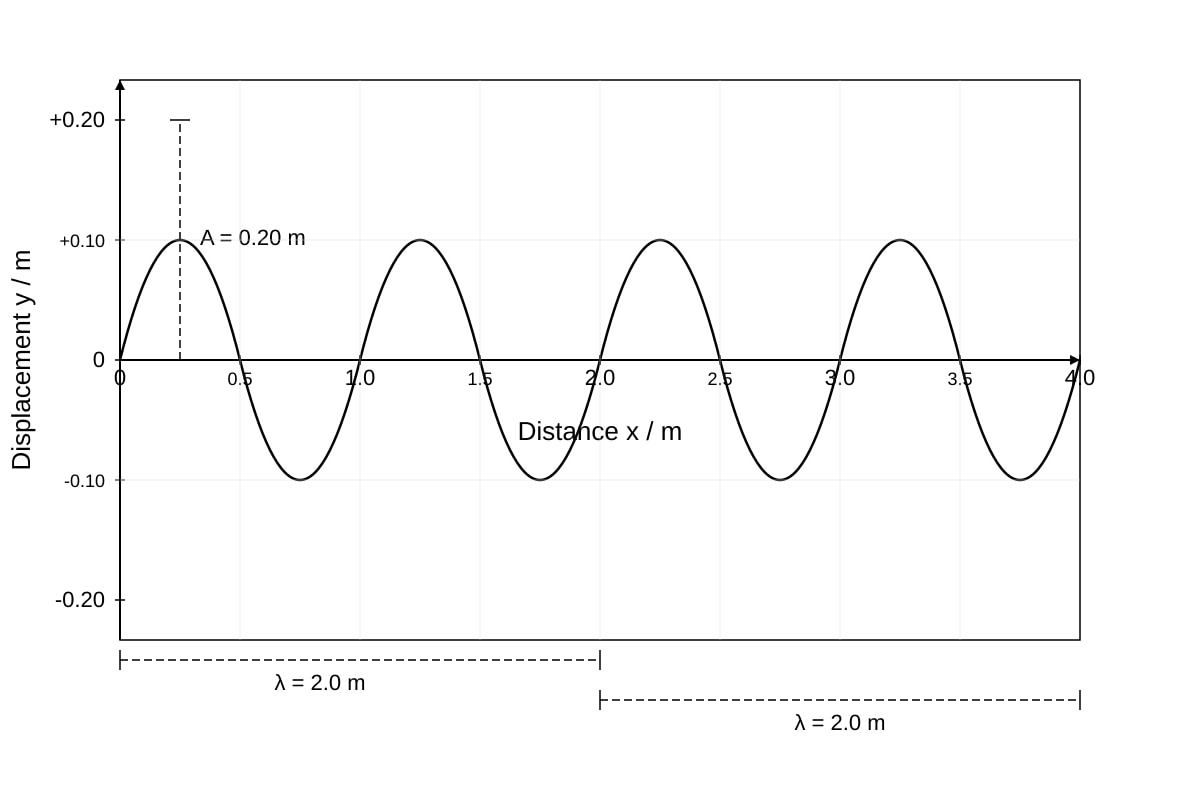
11. The diagram shows a displacement–distance graph for a transverse wave travelling along a rope.

<image_placeholder> id: Q11-fig1 type: graph linked_question: Q11 description: A displacement-distance graph for a transverse wave. The x-axis is distance along the rope (x) in metres, ranging from 0 to 4.0 m. The y-axis is displacement (y) in metres, ranging from -0.20 to +0.20 m. The wave is sinusoidal with two complete wavelengths shown. The amplitude is 0.20 m. The wavelength is 2.0 m. labels: x-axis: Distance x / m, y-axis: Displacement y / m, amplitude A = 0.20 m, wavelength λ = 2.0 m values: A = 0.20 m, λ = 2.0 m, wave completes 2 cycles over 4.0 m must_show: sinusoidal curve, two full wavelengths, amplitude marked as 0.20 m, wavelength marked as 2.0 m, axes clearly labelled with units </image_placeholder>

(a) From the graph, state the amplitude of the wave.
[1 mark]

..................................................................................................................................

(b) From the graph, state the wavelength of the wave.
[1 mark]

..................................................................................................................................

(c) The wave is travelling at a speed of 8.0 m/s. Calculate the frequency of the wave.
[2 marks]

..................................................................................................................................

..................................................................................................................................

(d) On the diagram, mark with a letter N the position of a node if this wave were to form a stationary wave by superposition with an identical wave travelling in the opposite direction.
[1 mark]


12. A source of sound emits waves of frequency 512 Hz. The speed of sound in air is 340 m/s.

(a) Calculate the wavelength of the sound wave.
[2 marks]

..................................................................................................................................

..................................................................................................................................

(b) The sound wave passes from air into water, where its speed increases to 1500 m/s. State whether the frequency, the wavelength, both, or neither changes. Explain your answer.
[2 marks]

..................................................................................................................................

..................................................................................................................................

..................................................................................................................................


13. Two coherent sources S₁ and S₂ emit waves of wavelength 0.50 m. The sources are separated by 2.0 m. A detector is moved along a line parallel to the line joining the sources, at a distance of 5.0 m from the sources.

<image_placeholder> id: Q13-fig1 type: diagram linked_question: Q13 description: A plan view diagram showing two coherent sources S₁ and S₂ separated by 2.0 m. A detection line is drawn parallel to the line joining S₁ and S₂, at a perpendicular distance of 5.0 m. The midpoint between S₁ and S₂ is marked. The path difference from each source to a general point P on the detection line is shown with dashed lines. The central maximum is at the midpoint. labels: S₁, S₂ (sources), separation d = 2.0 m, detection line at D = 5.0 m, central maximum at midpoint, point P on detection line values: d = 2.0 m, D = 5.0 m, λ = 0.50 m must_show: two sources labelled S₁ and S₂, separation distance, detection line parallel to source line, perpendicular distance D, central maximum position, a general point P with path lines from S₁ and S₂ </image_placeholder>

(a) Explain what is meant by coherent sources.
[1 mark]

..................................................................................................................................

(b) Calculate the path difference at the first-order maximum (constructive interference) adjacent to the central maximum.
[1 mark]

..................................................................................................................................

(c) Explain why the intensity of the interference pattern decreases for maxima further from the centre.
[2 marks]

..................................................................................................................................

..................................................................................................................................


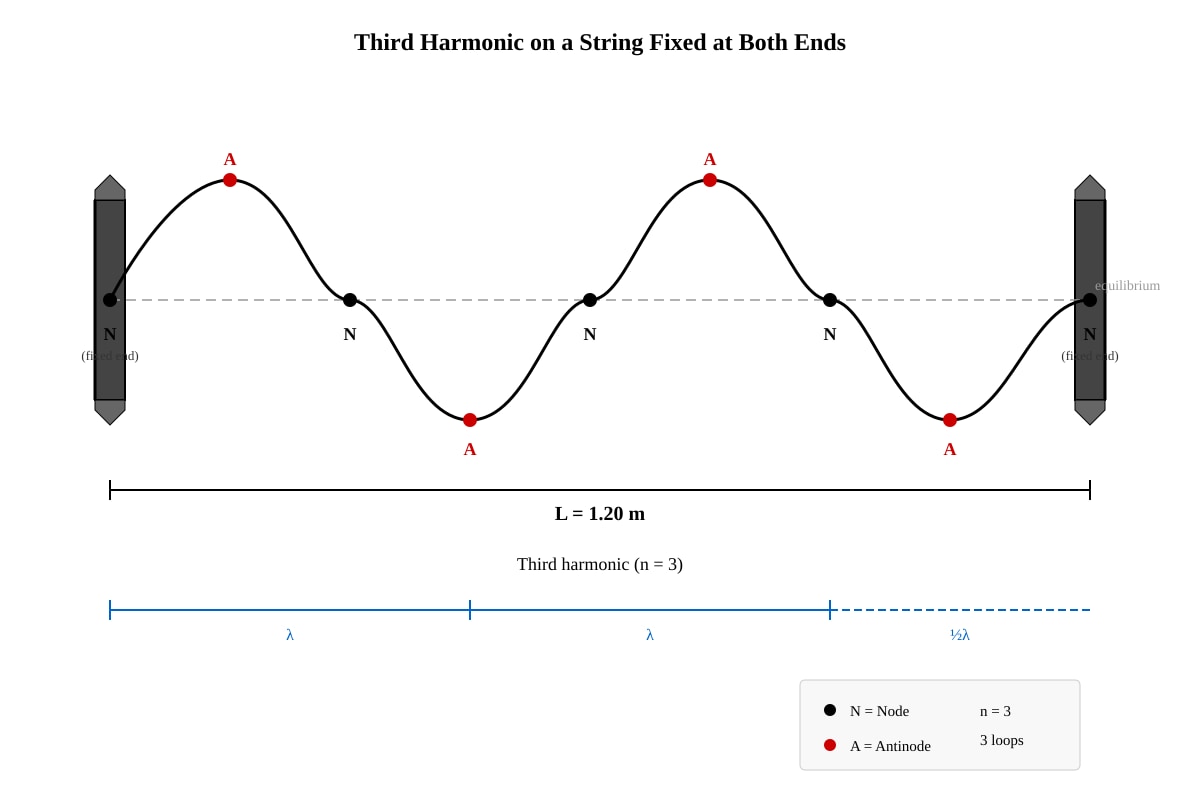
14. A string of length 1.20 m is fixed at both ends. It vibrates in its third harmonic mode as shown.

<image_placeholder> id: Q14-fig1 type: diagram linked_question: Q14 description: A diagram of a string fixed at both ends vibrating in its third harmonic. The string shows three half-wavelengths (three loops). Nodes are at each fixed end and at two intermediate points. Antinodes are at the centre of each loop. The total string length L = 1.20 m is shown. labels: Fixed ends (nodes), antinodes at centre of each loop, string length L = 1.20 m, third harmonic (n = 3), nodes marked N, antinodes marked A values: L = 1.20 m, n = 3 (third harmonic) must_show: string fixed at both ends, three half-wavelengths clearly shown, nodes at ends and two interior points, antinodes at three loop centres, length labelled </image_placeholder>

(a) State the number of nodes and antinodes shown in the third harmonic.
[2 marks]

..................................................................................................................................

..................................................................................................................................

(b) Calculate the wavelength of the wave on the string.
[2 marks]

..................................................................................................................................

..................................................................................................................................

(c) The speed of the wave on the string is 240 m/s. Calculate the frequency of vibration.
[2 marks]

..................................................................................................................................

..................................................................................................................................


15. A beam of monochromatic light of wavelength 5.5×1075.5 \times 10^{-7} m is incident normally on a diffraction grating with 400 lines per millimetre.

(a) Calculate the spacing dd between adjacent slits of the grating.
[2 marks]

..................................................................................................................................

..................................................................................................................................

(b) Determine the angle θ\theta at which the second-order maximum occurs.
[3 marks]

..................................................................................................................................

..................................................................................................................................

..................................................................................................................................

(c) State the highest order of diffraction maximum that can be observed with this grating and this wavelength. Explain your reasoning.
[2 marks]

..................................................................................................................................

..................................................................................................................................


16. The diagram shows a ray of light passing from air into a glass block.

<image_placeholder> id: Q16-fig1 type: diagram linked_question: Q16 description: A rectangular glass block on a flat surface. A ray of light is incident on the top surface at an angle of incidence i = 50° from the normal. The refracted ray inside the glass bends toward the normal at an angle of refraction r = 31°. The normal line is shown as a dashed line perpendicular to the surface at the point of incidence. The glass block is outlined. The emergent ray exits the bottom surface parallel to the incident ray but laterally displaced. labels: Incident ray, refracted ray, normal (dashed line), angle of incidence i = 50°, angle of refraction r = 31°, glass block outline, air above and below values: i = 50°, r = 31° must_show: rectangular glass block, incident ray with arrow, refracted ray with arrow, normal line, angles i and r clearly marked, air-glass boundary </image_placeholder>

(a) Calculate the refractive index of the glass.
[2 marks]

..................................................................................................................................

..................................................................................................................................

(b) The speed of light in air is 3.0×1083.0 \times 10^8 m/s. Calculate the speed of light in the glass.
[2 marks]

..................................................................................................................................

..................................................................................................................................

(c) Explain why the emergent ray is parallel to the incident ray.
[1 mark]

..................................................................................................................................


17. A student sets up a demonstration to observe the interference pattern from a double-slit experiment using red light of wavelength 650 nm. The slit separation is 0.25 mm and the screen is placed 1.5 m from the slits.

(a) Calculate the fringe spacing (distance between adjacent bright fringes) on the screen.
[3 marks]

..................................................................................................................................

..................................................................................................................................

..................................................................................................................................

(b) The student replaces the red light with blue light of wavelength 450 nm. State and explain what happens to the fringe spacing.
[2 marks]

..................................................................................................................................

..................................................................................................................................

(c) State one change the student could make to increase the fringe spacing.
[1 mark]

..................................................................................................................................


Section C: Data Interpretation and Extended Response (Questions 18–20)

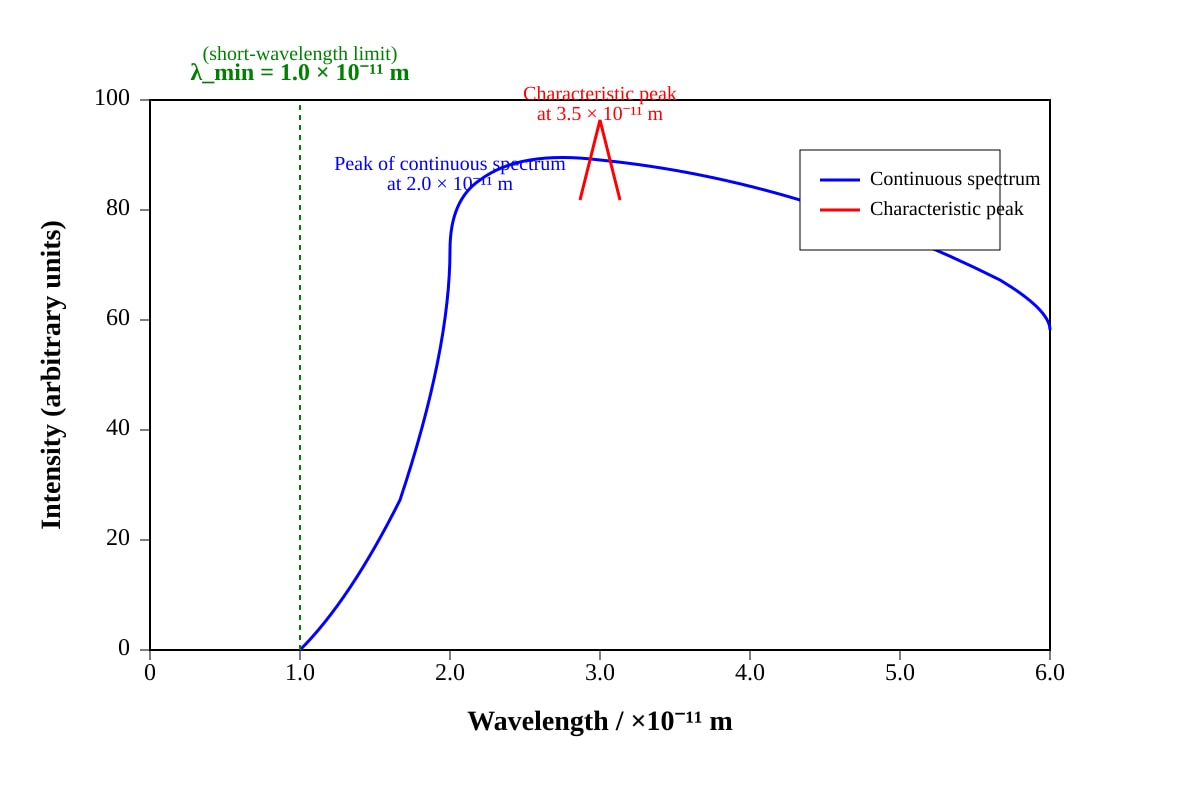
18. The graph below shows how the intensity of X-rays produced by an X-ray tube varies with wavelength.

<image_placeholder> id: Q18-fig1 type: graph linked_question: Q18 description: A graph of intensity (arbitrary units) versus wavelength (×10⁻¹¹ m) for X-rays from an X-ray tube. The x-axis ranges from 0 to 6.0 × 10⁻¹¹ m. The y-axis is intensity. The graph shows a continuous spectrum starting at a minimum wavelength λ_min = 1.0 × 10⁻¹¹ m, rising to a peak at about 2.0 × 10⁻¹¹ m, then decreasing gradually. A sharp characteristic peak appears at 3.5 × 10⁻¹¹ m. The minimum wavelength (short-wavelength limit) is clearly marked. labels: x-axis: Wavelength / ×10⁻¹¹ m, y-axis: Intensity (arbitrary units), λ_min = 1.0 × 10⁻¹¹ m (short-wavelength limit), continuous spectrum curve, characteristic peak at 3.5 × 10⁻¹¹ m values: λ_min = 1.0 × 10⁻¹¹ m, peak of continuous spectrum at 2.0 × 10⁻¹¹ m, characteristic peak at 3.5 × 10⁻¹¹ m must_show: continuous spectrum with short-wavelength limit, peak intensity, characteristic sharp peak, axes labelled with units </image_placeholder>

(a) Explain the physical process that produces the continuous spectrum of X-rays.
[2 marks]

..................................................................................................................................

..................................................................................................................................

(b) The X-ray tube is operated at an accelerating voltage of 1.24×1051.24 \times 10^5 V. Calculate the minimum wavelength of the X-rays produced. (Use h=6.63×1034h = 6.63 \times 10^{-34} J s, e=1.6×10¹⁹e = 1.6 \times 10^{-19} C, c=3.0×10⁸c = 3.0 \times 10^8 m/s.)
[3 marks]

..................................................................................................................................

..................................................................................................................................

..................................................................................................................................

..................................................................................................................................

(c) Explain the origin of the sharp characteristic peak on the graph.
[2 marks]

..................................................................................................................................

..................................................................................................................................


19. A police car with its siren emitting a frequency of 800 Hz is moving at 25 m/s towards a stationary observer. The speed of sound in air is 340 m/s.

(a) Calculate the frequency heard by the observer.
[3 marks]

..................................................................................................................................

..................................................................................................................................

..................................................................................................................................

(b) The police car passes the observer and moves away at the same speed. Calculate the new frequency heard by the observer.
[2 marks]

..................................................................................................................................

..................................................................................................................................

(c) Explain, in terms of the Doppler effect, why there is a sudden change in the observed frequency as the car passes the observer.
[2 marks]

..................................................................................................................................

..................................................................................................................................


20. A student investigates the relationship between the frequency of a standing wave on a string and its tension. The student keeps the length of the string and the mass per unit length constant, and varies the tension by hanging different masses. The results are shown in the table below.

Tension TT / NFrequency ff / Hzf2f^2 / Hz²
1025625
2035.41250
3043.31875
4050.02500
5055.93125

(a) Complete the last column of the table by calculating f2f^2 for the last two rows. The first three rows have been completed for you.
[1 mark]

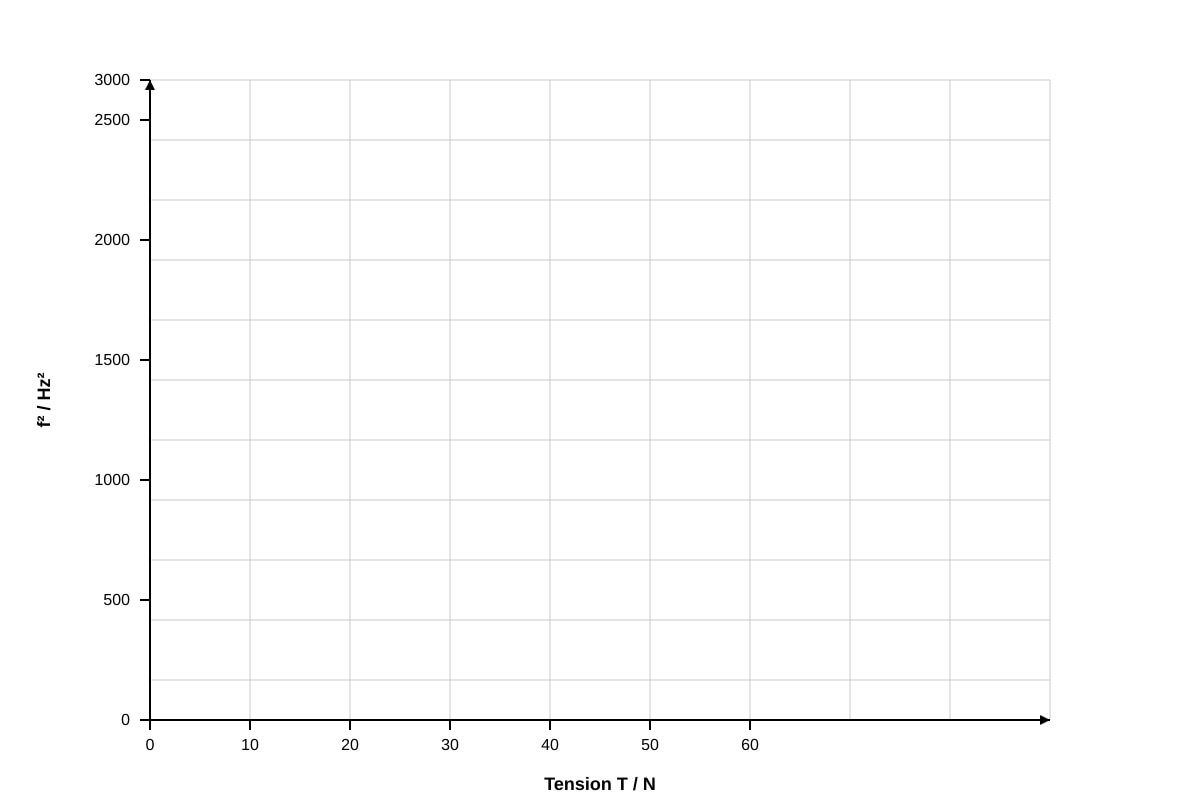
(b) On the grid provided, plot a graph of f2f^2 (y-axis) against TT (x-axis).

<image_placeholder> id: Q20-fig1 type: graph linked_question: Q20 description: A blank graph grid for plotting f² versus T. The x-axis is Tension T / N, ranging from 0 to 60 N. The y-axis is f² / Hz², ranging from 0 to 3500 Hz². Grid lines are shown at regular intervals. Axes are labelled with units. labels: x-axis: Tension T / N, y-axis: f² / Hz² values: x-axis range 0–60 N, y-axis range 0–3500 Hz² must_show: blank grid with labelled axes and units, regular grid lines, appropriate scale </image_placeholder>

[3 marks]

(c) Determine the gradient of the graph.
[2 marks]

..................................................................................................................................

.................................................................................................................................................................................

..................................................................................................................................

(d) The relationship between ff and TT is given by:

f=12LTμf = \frac{1}{2L} \sqrt{\frac{T}{\mu}}

where LL is the length of the string and μ\mu is the mass per unit length. Use your gradient to determine the value of μ\mu if L=0.80L = 0.80 m.
[3 marks]

..................................................................................................................................

..................................................................................................................................

..................................................................................................................................

..................................................................................................................................


END OF QUIZ

Answers

<!-- TuitionGoWhere generation metadata: stage=3-0; model=openrouter/owl-alpha; model_label=Owl Alpha; generated=2026-06-06; Sources: Stage 2-1 real exam-derived templates and Stage 2-2 exam-enriched syllabus. -->

A-Level Physics H1 Quiz - Waves Sound Light: Answer Key


Section A: Short Answer Questions

1. [2 marks]

A transverse wave has oscillations perpendicular to the direction of energy transfer, whereas a longitudinal wave has oscillations parallel to the direction of energy transfer.

[B1] Correct identification of the oscillation direction for transverse waves (perpendicular to direction of propagation).
[B1] Correct identification of the oscillation direction for longitudinal waves (parallel to direction of propagation).

Teaching note: The key distinction is the orientation of particle displacement relative to the direction the wave travels. Electromagnetic waves (transverse) oscillate perpendicular to propagation; sound waves in air (longitudinal) oscillate along the direction of propagation.


2. [1 mark]

The period of a wave is the time taken for one complete oscillation (or one complete cycle) of the wave.

[B1] Correct definition: time for one complete oscillation/cycle.

Teaching note: Period TT is measured in seconds and is related to frequency by T=1/fT = 1/f.


3. [2 marks]

Using v=fλv = f\lambda:

v=250×1.36=340 m/sv = 250 \times 1.36 = 340 \text{ m/s}

[B1] Correct substitution into v=fλv = f\lambda.
[B1] Correct answer with unit: 340 m/s.

Teaching note: The wave equation v=fλv = f\lambda relates speed, frequency, and wavelength. Always check that frequency is in Hz and wavelength is in metres to obtain speed in m/s.


4. [2 marks]

When two or more waves meet at a point, the resultant displacement is equal to the vector sum of the individual displacements of each wave at that point.

[B1] Reference to two/more waves meeting/overlapping at a point.
[B1] Resultant displacement equals the sum (vector sum) of individual displacements.

Teaching note: Superposition is the fundamental principle underlying interference and stationary wave formation. It applies to all types of waves.


5. [2 marks total]

(a) [1 mark] Amplitude is the maximum displacement from the equilibrium position — the arrow should extend vertically from the equilibrium line to the crest (or trough), labelled A=0.15A = 0.15 m.

(b) [1 mark] Zero (or 0 m). Point P is at the equilibrium position, so its displacement at this instant is zero.

Teaching note: At the equilibrium position, displacement is zero but the particle has maximum velocity. Displacement is measured from the equilibrium (rest) position, not from the crest or trough.


6. [2 marks]

Polarisation is the process by which the oscillations of a wave are restricted to a single plane (or direction). Only transverse waves can be polarised.

[B1] Correct description of polarisation (restriction of oscillations to one plane/direction).
[B1] Identification that only transverse waves can be polarised.

Teaching note: Longitudinal waves cannot be polarised because their oscillations are already along one direction (the direction of propagation). Polarisation is evidence of the transverse nature of electromagnetic waves.


7. [2 marks]

Sound travels as a longitudinal wave through a medium by successive compressions and rarefactions. Steel is much stiffer (has a higher Young's modulus / elastic modulus) than air, so the restoring forces between particles are much greater. This allows the wave energy to be transmitted more rapidly, resulting in a higher wave speed.

[B1] Reference to the stiffness/elastic modulus of the medium being greater in steel.
[B1] Linking greater stiffness to faster transmission of disturbances/higher wave speed.

Teaching note: The speed of sound in a solid depends on v=Y/ρv = \sqrt{Y/\rho} where YY is Young's modulus and ρ\rho is density. Although steel is denser than air, its Young's modulus is enormously larger, so the speed is much higher.


8. [2 marks]

Two conditions for the formation of a stationary wave:

  1. Two waves of the same frequency (and hence same wavelength) must travel in opposite directions along the same line.
  2. The two waves must have approximately the same amplitude.

[B1] Same frequency/wavelength travelling in opposite directions.
[B1] Same (or similar) amplitude.

Teaching note: Stationary waves are formed by superposition of two identical waves travelling in opposite directions. This commonly occurs when a wave reflects back from a boundary and interferes with the incoming wave.


9. [2 marks]

The general wave equation is y=Asin(ωtkx)y = A \sin(\omega t - kx), where ω=2πf\omega = 2\pi f.

From the given equation: ω=4.5×10³\omega = 4.5 \times 10^3 rad/s.

f=ω2π=4.5×1032π=45006.283716 Hzf = \frac{\omega}{2\pi} = \frac{4.5 \times 10^3}{2\pi} = \frac{4500}{6.283} \approx 716 \text{ Hz}

[B1] Correct identification that ω=4.5×10³\omega = 4.5 \times 10^3 rad/s.
[B1] Correct calculation: 716 Hz (or 720 Hz to 2 s.f.).

Teaching note: In the wave equation y=Asin(ωtkx)y = A \sin(\omega t - kx), the coefficient of tt is the angular frequency ω\omega, and the coefficient of xx is the wave number k=2π/λk = 2\pi/\lambda.


10. [3 marks]

For a single-slit diffraction pattern, the condition for the first minimum is:

asinθ=λa \sin\theta = \lambda

where aa is the slit width and θ\theta is the angle to the first minimum.

a=λsinθ=6.0×10⁷sin2.0°a = \frac{\lambda}{\sin\theta} = \frac{6.0 \times 10^{-7}}{\sin 2.0°}

sin2.0°=0.03490\sin 2.0° = 0.03490

a=6.0×1070.03490=1.72×10⁵ ma = \frac{6.0 \times 10^{-7}}{0.03490} = 1.72 \times 10^{-5} \text{ m}

[B1] Correct formula: asinθ=λa \sin\theta = \lambda (first minimum condition).
[B1] Correct substitution of values.
[B1] Correct answer: 1.7×1051.7 \times 10^{-5} m (or 17 μm).

Teaching note: The single-slit diffraction formula for minima is asinθ=nλa \sin\theta = n\lambda where n=1,2,3,...n = 1, 2, 3, ... For the first minimum, n=1n = 1. The small angle approximation is not needed here since sinθ\sin\theta can be evaluated directly.


Section B: Structured Questions

11. [5 marks total]

(a) [1 mark] Amplitude A=0.20A = 0.20 m.
[B1] Read directly from the graph (maximum displacement from equilibrium).

(b) [1 mark] Wavelength λ=2.0\lambda = 2.0 m.
[B1] Read directly from the graph (distance between two consecutive crests or troughs).

(c) [2 marks]

v=fλ    f=vλ=8.02.0=4.0 Hzv = f\lambda \implies f = \frac{v}{\lambda} = \frac{8.0}{2.0} = 4.0 \text{ Hz}

[B1] Correct substitution into f=v/λf = v/\lambda.
[B1] Correct answer: 4.0 Hz.

(d) [1 mark] A node (N) should be marked at positions of zero displacement that remain zero at all times — these occur at x=0x = 0, x=1.0x = 1.0 m, x=2.0x = 2.0 m, x=3.0x = 3.0 m, and x=4.0x = 4.0 m (every half-wavelength). Any one of these positions marked with N is acceptable.

[B1] Node correctly marked at a position corresponding to zero displacement in the stationary wave (at intervals of λ/2=1.0\lambda/2 = 1.0 m from either end).

Teaching note: In a stationary wave, nodes are points of zero displacement and antinodes are points of maximum displacement. Nodes occur every half-wavelength.


12. [4 marks total]

(a) [2 marks]

v=fλ    λ=vf=340512=0.664 mv = f\lambda \implies \lambda = \frac{v}{f} = \frac{340}{512} = 0.664 \text{ m}

[B1] Correct substitution.
[B1] Correct answer: 0.66 m (or 0.664 m).

(b) [2 marks]

The frequency does not change when the wave moves from one medium to another — it is determined by the source. The wavelength increases because the speed increases (v=fλv = f\lambda, and ff is constant, so λ\lambda must increase proportionally with vv).

[B1] Frequency remains unchanged (determined by the source).
[B1] Wavelength increases because speed increases while frequency stays constant.

Teaching note: When a wave crosses a boundary between media, the frequency is always conserved because it is a property of the source. The speed and wavelength change according to the properties of the new medium.


13. [4 marks total]

(a) [1 mark] Coherent sources are sources that have the same frequency and a constant phase difference (i.e., they maintain a fixed phase relationship).

[B1] Same frequency AND constant phase difference.

(b) [1 mark] At the first-order maximum, the path difference equals one wavelength: 0.50 m.

[B1] Path difference = λ=0.50\lambda = 0.50 m.

(c) [2 marks]

The intensity decreases for maxima further from the centre because the path difference increases, meaning the waves arriving at the detector from each source have travelled different distances. As the angle increases, the waves spread out more and the amplitude of each wave at the detector decreases. Additionally, for finite slit widths, the diffraction envelope modulates the intensity, reducing the intensity of higher-order maxima.

[B1] Reference to waves spreading out / amplitude decreasing with distance/angle.
[B1] Reference to the diffraction envelope effect or reduced amplitude at larger angles.

Teaching note: In a real double-slit experiment, each slit has finite width, so the interference pattern is modulated by the single-slit diffraction envelope. This causes the intensity of higher-order maxima to decrease.


14. [6 marks total]

(a) [2 marks]

Third harmonic on a string fixed at both ends: 4 nodes (2 at the fixed ends + 2 intermediate) and 3 antinodes.

[B1] 4 nodes.
[B1] 3 antinodes.

Teaching note: For the nnth harmonic on a string fixed at both ends, there are (n+1)(n+1) nodes and nn antinodes. The third harmonic (n=3n = 3) has 4 nodes and 3 antinodes.

(b) [2 marks]

In the third harmonic, the string length contains 3 half-wavelengths:

L=3λ2    λ=2L3=2×1.203=0.80 mL = \frac{3\lambda}{2} \implies \lambda = \frac{2L}{3} = \frac{2 \times 1.20}{3} = 0.80 \text{ m}

[B1] Correct relationship L=3λ/2L = 3\lambda/2 (or equivalent).
[B1] Correct answer: 0.80 m.

(c) [2 marks]

v=fλ    f=vλ=2400.80=300 Hzv = f\lambda \implies f = \frac{v}{\lambda} = \frac{240}{0.80} = 300 \text{ Hz}

[B1] Correct substitution.
[B1] Correct answer: 300 Hz.


15. [7 marks total]

(a) [2 marks]

400 lines per mm means:

d=1400 mm=1×103400 m=2.5×10⁶ md = \frac{1}{400} \text{ mm} = \frac{1 \times 10^{-3}}{400} \text{ m} = 2.5 \times 10^{-6} \text{ m}

[B1] Correct conversion (1/400 mm).
[B1] Correct answer: 2.5×1062.5 \times 10^{-6} m (or 2.5 μm).

(b) [3 marks]

The diffraction grating equation is:

dsinθ=nλd \sin\theta = n\lambda

For the second-order maximum (n=2n = 2):

sinθ=nλd=2×5.5×1072.5×106=1.10×1062.5×106=0.440\sin\theta = \frac{n\lambda}{d} = \frac{2 \times 5.5 \times 10^{-7}}{2.5 \times 10^{-6}} = \frac{1.10 \times 10^{-6}}{2.5 \times 10^{-6}} = 0.440

θ=sin1(0.440)=26.1°\theta = \sin^{-1}(0.440) = 26.1°

[B1] Correct formula dsinθ=nλd\sin\theta = n\lambda.
[B1] Correct substitution with n=2n = 2.
[B1] Correct answer: 26° (or 26.1°).

(c) [2 marks]

The maximum possible order occurs when sinθ=1\sin\theta = 1:

nmax=dλ=2.5×1065.5×107=4.55n_{\max} = \frac{d}{\lambda} = \frac{2.5 \times 10^{-6}}{5.5 \times 10^{-7}} = 4.55

Since nn must be an integer, the highest observable order is n=4n = 4.

[B1] Calculation of nmax=d/λ=4.55n_{\max} = d/\lambda = 4.55.
[B1] Correct conclusion: highest order is 4 (must round down since nn must be an integer and sinθ\sin\theta cannot exceed 1).

Teaching note: The condition sinθ1\sin\theta \leq 1 sets an upper limit on the diffraction order. Always round down to the nearest integer.


16. [5 marks total]

(a) [2 marks]

Using Snell's law:

n=sinisinr=sin50°sin31°=0.76600.5150=1.49n = \frac{\sin i}{\sin r} = \frac{\sin 50°}{\sin 31°} = \frac{0.7660}{0.5150} = 1.49

[B1] Correct application of Snell's law.
[B1] Correct answer: 1.49 (or 1.5 to 2 s.f.).

(b) [2 marks]

n=cv    v=cn=3.0×1081.49=2.01×10⁸ m/sn = \frac{c}{v} \implies v = \frac{c}{n} = \frac{3.0 \times 10^8}{1.49} = 2.01 \times 10^8 \text{ m/s}

[B1] Correct formula v=c/nv = c/n.
[B1] Correct answer: 2.0×1082.0 \times 10^8 m/s.

(c) [1 mark]

The emergent ray is parallel to the incident ray because the two refracting surfaces of the glass block are parallel. The refraction at the entry surface (bending towards the normal) is exactly reversed at the exit surface (bending away from the normal by the same angle), so the emergent ray is parallel to the incident ray but laterally displaced.

[B1] Correct explanation involving parallel surfaces and equal but opposite refraction at each surface.


17. [6 marks total]

(a) [3 marks]

The fringe spacing formula for double-slit interference:

Δy=λDd\Delta y = \frac{\lambda D}{d}

Δy=650×109×1.50.25×103=9.75×1072.5×104=3.9×10³ m=3.9 mm\Delta y = \frac{650 \times 10^{-9} \times 1.5}{0.25 \times 10^{-3}} = \frac{9.75 \times 10^{-7}}{2.5 \times 10^{-4}} = 3.9 \times 10^{-3} \text{ m} = 3.9 \text{ mm}

[B1] Correct formula Δy=λD/d\Delta y = \lambda D/d.
[B1] Correct substitution with all quantities in SI units.
[B1] Correct answer: 3.9 mm.

(b) [2 marks]

The fringe spacing decreases. Since Δy=λD/d\Delta y = \lambda D/d and blue light has a shorter wavelength (450 nm < 650 nm), the fringe spacing is directly proportional to wavelength. A smaller wavelength means smaller fringe spacing.

[B1] Fringe spacing decreases.
[B1] Explanation linking shorter wavelength to smaller fringe spacing via Δyλ\Delta y \propto \lambda.

(c) [1 mark]

Any one of:

  • Increase the distance DD between the slits and the screen.
  • Decrease the slit separation dd.
  • Use light of longer wavelength.

[B1] Any one valid change.


Section C: Data Interpretation and Extended Response

18. [7 marks total]

(a) [2 marks]

The continuous spectrum (bremsstrahlung / braking radiation) is produced when high-speed electrons from the cathode are decelerated upon striking the anode target. As the electrons decelerate, they lose kinetic energy, which is emitted as X-ray photons. Because different electrons lose different amounts of energy (some lose all their energy in one collision, others lose it gradually), a continuous range of wavelengths is produced.

[B1] Reference to deceleration/braking of electrons at the anode.
[B1] Different electrons lose different amounts of energy, producing a continuous range of wavelengths.

(b) [3 marks]

The maximum energy of an X-ray photon equals the kinetic energy of the electron:

eV=hfmax=hcλmineV = hf_{\max} = \frac{hc}{\lambda_{\min}}

λmin=hceV=6.63×1034×3.0×1081.6×1019×1.24×105\lambda_{\min} = \frac{hc}{eV} = \frac{6.63 \times 10^{-34} \times 3.0 \times 10^8}{1.6 \times 10^{-19} \times 1.24 \times 10^5}

λmin=1.989×10251.984×1014=1.00×10¹¹ m\lambda_{\min} = \frac{1.989 \times 10^{-25}}{1.984 \times 10^{-14}} = 1.00 \times 10^{-11} \text{ m}

[B1] Correct formula λmin=hc/(eV)\lambda_{\min} = hc/(eV).
[B1] Correct substitution.
[B1] Correct answer: 1.0×10111.0 \times 10^{-11} m.

(c) [2 marks]

The sharp characteristic peak is produced when high-energy electrons from the cathode knock out inner-shell electrons from the anode atoms. Outer-shell electrons then fall into the inner-shell vacancies, emitting X-ray photons with specific energies (and hence specific wavelengths) that are characteristic of the anode material.

[B1] Reference to inner-shell electron being ejected from anode atoms.
[B1] Outer-shell electron fills the vacancy, emitting a photon of specific energy/wavelength characteristic of the target material.


19. [7 marks total]

(a) [3 marks]

Using the Doppler effect formula for a source moving towards a stationary observer:

f=vvvs×ff' = \frac{v}{v - v_s} \times f

f=34034025×800=340315×800=1.0794×800=863.5 Hzf' = \frac{340}{340 - 25} \times 800 = \frac{340}{315} \times 800 = 1.0794 \times 800 = 863.5 \text{ Hz}

[B1] Correct Doppler formula for source approaching observer.
[B1] Correct substitution.
[B1] Correct answer: 864 Hz (or 860 Hz to 2 s.f.).

(b) [2 marks]

For a source moving away from the observer:

f=vv+vs×f=340340+25×800=340365×800=0.9315×800=745.2 Hzf'' = \frac{v}{v + v_s} \times f = \frac{340}{340 + 25} \times 800 = \frac{340}{365} \times 800 = 0.9315 \times 800 = 745.2 \text{ Hz}

[B1] Correct formula for source receding.
[B1] Correct answer: 745 Hz (or 750 Hz to 2 s.f.).

(c) [2 marks]

As the car approaches, the sound waves are compressed (shorter wavelength, higher frequency) in front of the car. As the car recedes, the waves are stretched (longer wavelength, lower frequency) behind the car. At the instant the car passes the observer, the relative motion changes from approaching to receding, causing an abrupt switch from the higher observed frequency to the lower observed frequency.

[B1] Explanation of wave compression (higher frequency) when approaching.
[B1] Explanation of wave stretching (lower frequency) when receding, and the sudden change at the point of passing.


20. [9 marks total]

(a) [1 mark]

f2f^2 for T=40T = 40 N: 50.02=250050.0^2 = 2500 Hz² ✓ (already given)
f2f^2 for T=50T = 50 N: 55.92=3124.81312555.9^2 = 3124.81 \approx 3125 Hz² ✓ (already given)

Both values are already completed in the table. [B1] Table is complete as shown.

(b) [3 marks]

The graph of f2f^2 against TT should be a straight line through the origin.

[B1] All points correctly plotted (within half a small square).
[B1] Appropriate scale chosen for both axes.
[B1] Best-fit straight line drawn through the origin.

Teaching note: The data shows that f2f^2 is directly proportional to TT, which is consistent with the equation f=12LT/μf = \frac{1}{2L}\sqrt{T/\mu}, giving f2=T/(4L2μ)f^2 = T/(4L^2\mu).

(c) [2 marks]

Using two points on the best-fit line, e.g., (0,0)(0, 0) and (50,3125)(50, 3125):

gradient=Δf2ΔT=31250500=62.5 Hz2/N\text{gradient} = \frac{\Delta f^2}{\Delta T} = \frac{3125 - 0}{50 - 0} = 62.5 \text{ Hz}^2/\text{N}

[B1] Correct method (rise over run using two points on the line).
[B1] Correct answer: 62.5 Hz²/N (accept 62–63 depending on graph reading).

(d) [3 marks]

From the equation:

f2=T4L2μf^2 = \frac{T}{4L^2\mu}

So a graph of f2f^2 against TT has gradient =14L2μ= \frac{1}{4L^2\mu}.

gradient=14L2μ\text{gradient} = \frac{1}{4L^2\mu}

μ=14L2×gradient=14×(0.80)2×62.5\mu = \frac{1}{4L^2 \times \text{gradient}} = \frac{1}{4 \times (0.80)^2 \times 62.5}

μ=14×0.64×62.5=1160=6.25×10³ kg/m\mu = \frac{1}{4 \times 0.64 \times 62.5} = \frac{1}{160} = 6.25 \times 10^{-3} \text{ kg/m}

[B1] Correct relationship: gradient =1/(4L2μ)= 1/(4L^2\mu).
[B1] Correct substitution of L=0.80L = 0.80 m and gradient value.
[B1] Correct answer: 6.25×1036.25 \times 10^{-3} kg/m (or 6.25 g/m).

Teaching note: This question tests the ability to relate a theoretical equation to a linear graph and extract physical constants from the gradient. The key step is squaring the frequency equation to obtain a linear relationship.


Mark Summary:

SectionMarks
A (Q1–10)19
B (Q11–17)24
C (Q18–20)23
Total50

Note: Individual question marks sum to 50. Section totals are approximate groupings.