From Real Exams Quiz
A Level H1 Physics Waves Sound Light Quiz
Free A Level H1 Physics Waves Sound Light quiz, HY3 Exam version, with questions, answers, and A Level-style practice for Singapore students.
These static practice materials are generated from the site's syllabus and paper-generation workflow, with source and model context shown so students and parents can evaluate the material before use.
Questions
A-Level Physics H1 Quiz - Waves Sound Light
Name: ___________________________
Class: ___________________________
Date: ___________________________
Score: _______ / 40
Duration: 60 minutes
Total Marks: 40
Topic: Waves, Sound & Light (waves-sound-light)
Instructions:
- Answer all 20 questions.
- Show your working clearly for calculation questions.
- Use the provided spaces to write your answers.
- Section A: Short Answer (Q1–5), Section B: Structured Response (Q6–13), Section C: Data & Diagram Interpretation (Q14–20).
Section A: Short Answer (1–5)
1. State what is meant by a longitudinal wave. [1]
2. Write down the wave equation linking speed v, frequency f, and wavelength λ. [1]
3. State the approximate speed of sound in air at room temperature. [1]
4. Define the term "refractive index" n of a medium. [1]
5. State one condition for total internal reflection to occur. [1]
Section B: Structured Response (6–13)
6. A sound wave of frequency 512 Hz travels in air at 340 m s−1.
(a) Calculate its wavelength. [2]
(b) State whether this is in the audible range for humans. [1]
7. Explain, with reference to particle motion, how a sound wave is transmitted through air. [2]
8. A rope is fixed at one end and shaken at the other to produce a transverse wave.
(a) State the direction of particle displacement relative to wave propagation. [1]
(b) Describe what happens to the wavelength if the frequency is doubled but speed remains constant. [2]
9. Light travels from air (n=1.00) into glass (n=1.50) at an angle of incidence 30∘.
(a) Calculate the angle of refraction. [2]
(b) State whether the light bends towards or away from the normal. [1]
10. A stationary wave is formed on a string.
(a) State the meaning of a node. [1]
(b) Explain how a node is produced. [2]
11. Two loudspeakers produce coherent sound waves. A student walking parallel to them hears alternating loud and soft sounds.
(a) Name this phenomenon. [1]
(b) Explain why soft sounds are heard at certain positions. [2]
12. A water wave has a frequency of 2.0 Hz and wavelength 0.40 m.
(a) Calculate the wave speed. [2]
(b) If the frequency increases to 4.0 Hz and speed stays the same, calculate the new wavelength. [1]
13. Describe how diffraction of light differs from diffraction of sound in everyday observation. [2]
Section C: Data & Diagram Interpretation (14–20)
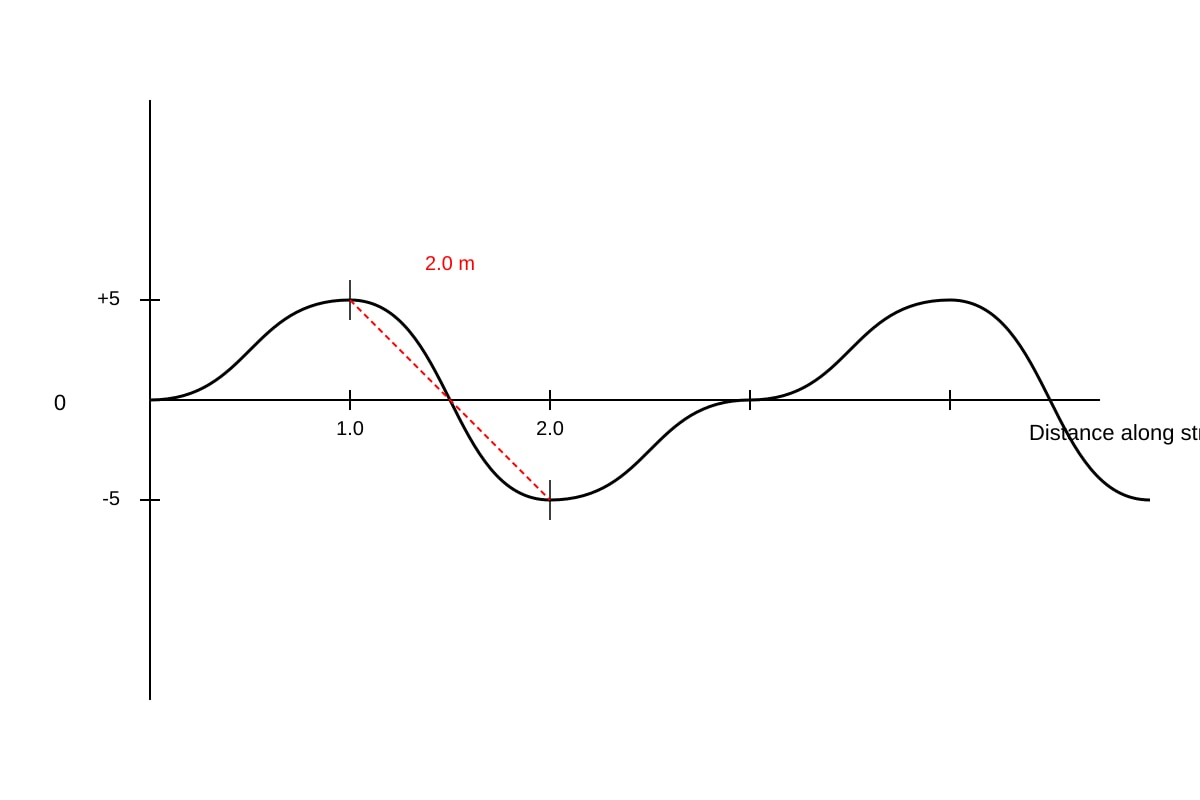
14. The diagram shows a wave on a string at a particular instant.
Image pending generation: graph for Q14.
(a) Determine the amplitude from the graph. [1]
(b) Determine the wavelength from the graph. [1]
15. A student measures the time for 10 complete oscillations of a wave trace as 4.0 s.
(a) Calculate the period. [1]
(b) Calculate the frequency. [1]
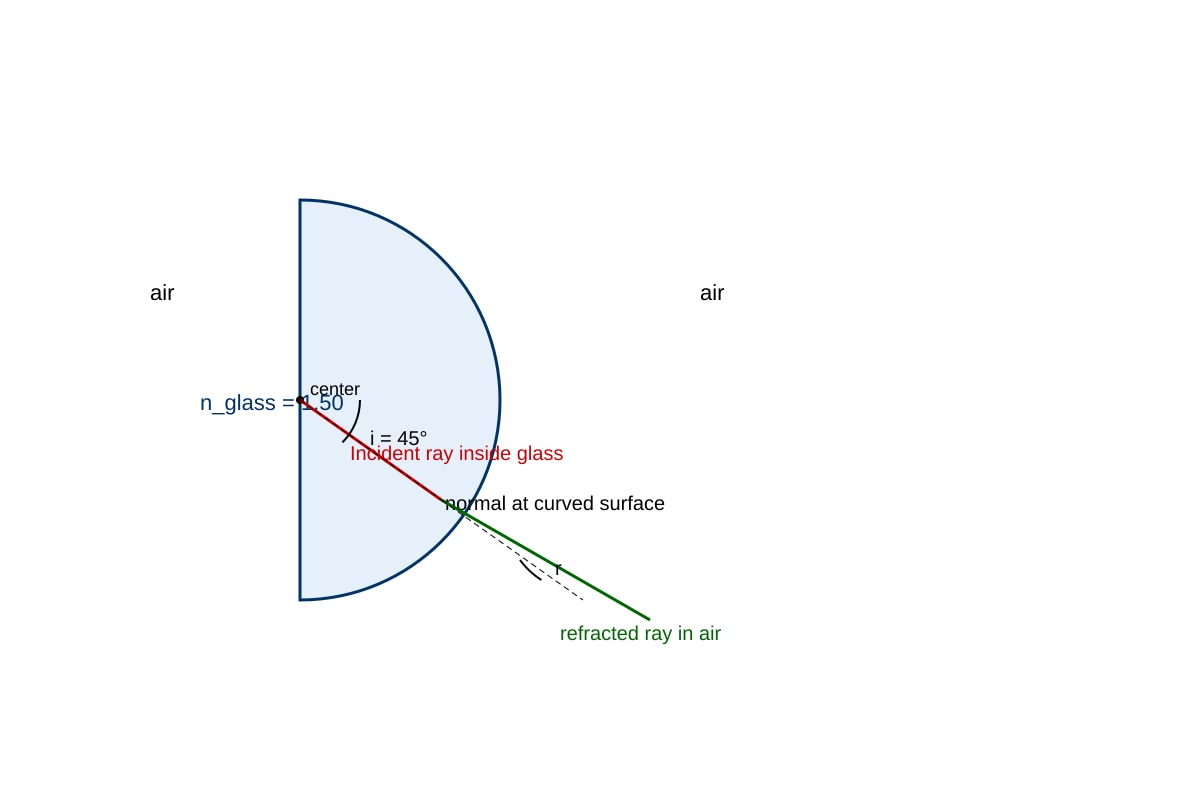
16. The diagram shows a ray of light entering a semicircular glass block.
Image pending generation: diagram for Q16.
(a) State why the ray enters the flat side without bending. [1]
(b) Calculate the angle of refraction r in air. [2]
17. Two slits separated by 0.50 mm are illuminated by light of wavelength 600 nm. The screen is 2.0 m away.
(a) Calculate the fringe separation Δx. [2]
(b) State what happens to fringe separation if slit distance is reduced. [1]
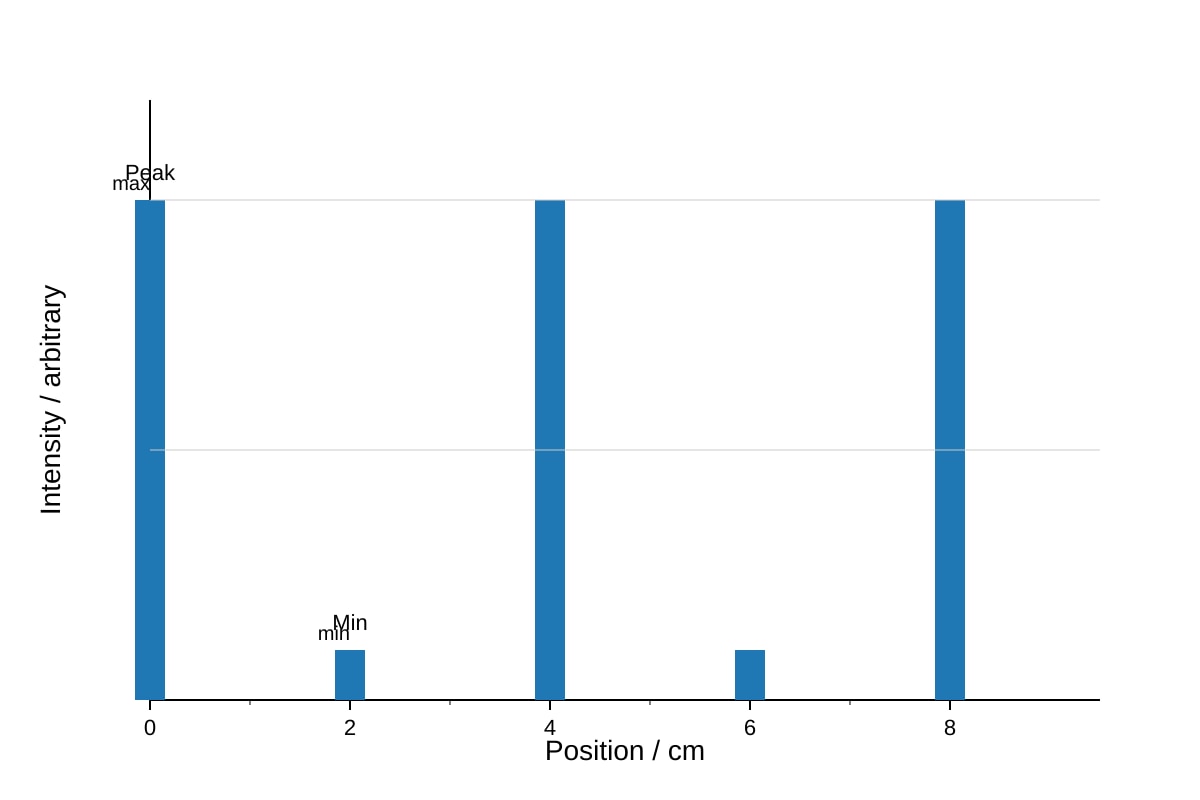
18. The graph shows intensity vs position for a two-source interference pattern.
Image pending generation: graph for Q18.
(a) Determine the fringe spacing from the graph. [1]
(b) State whether the sources are coherent. [1]
19. A bat emits a sound pulse of frequency 40 kHz and receives the echo 0.020 s later from a wall. Speed of sound = 340 m s−1.
(a) Calculate the distance to the wall. [2]
(b) State one reason bats use ultrasound rather than audible sound. [1]
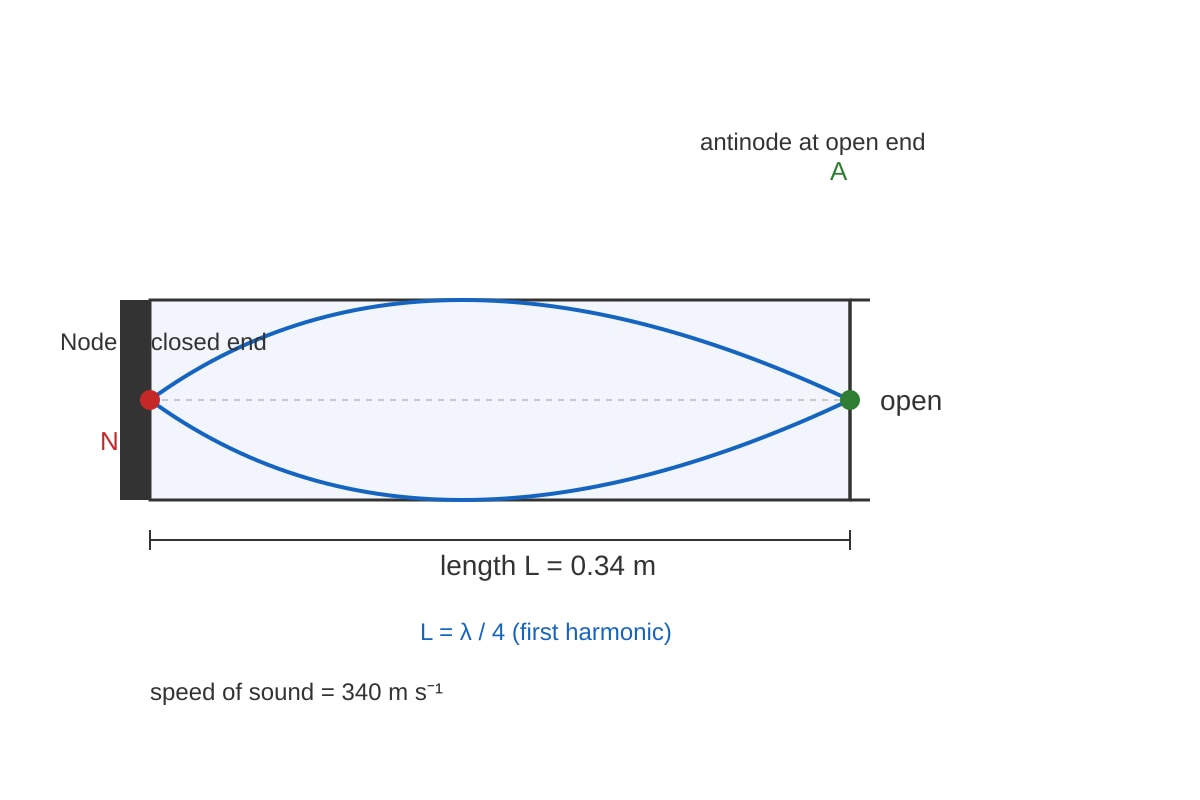
20. The diagram shows a pipe closed at one end with a standing wave.
Image pending generation: diagram for Q20.
(a) State the relationship between pipe length L and wavelength λ for the first harmonic. [1]
(b) Calculate the frequency of the first harmonic. [2]
Answers
A-Level Physics H1 Quiz - Waves Sound Light (Answer Key)
Total Marks: 40
Topic: Waves, Sound & Light
Section A: Short Answer
1. [1 mark]
Answer: A longitudinal wave is one in which the particle displacement is parallel to the direction of wave propagation.
Teaching note: Contrast with transverse waves where displacement is perpendicular. Common mistake: saying particles move with the wave (they oscillate about fixed positions).
2. [1 mark]
Answer: v=fλ
Teaching note: Speed equals frequency times wavelength. This is the fundamental wave relation.
3. [1 mark]
Answer: Approximately 340 m s−1 (or 330–343 m s−1).
Teaching note: At 20∘C, 343 m s−1 is typical; 340 is acceptable.
4. [1 mark]
Answer: Refractive index n=vc where c is speed in vacuum and v is speed in medium; or n=sinrsini.
Teaching note: It measures how much light slows in a medium.
5. [1 mark]
Answer: Light must travel from a denser to a rarer medium (higher n to lower n), and angle of incidence > critical angle.
Teaching note: State both conditions for full credit in exams; one condition sufficient for this short answer.
Section B: Structured Response
6. [3 marks]
(a) [2] λ=fv=512340=0.664 m (allow 0.66 m).
(b) [1] Yes, audible range is 20 Hz–20 kHz; 512 Hz is within.
Teaching note: Use wave equation; check units.
7. [2 marks]
Answer: Air particles vibrate parallel to direction of travel, compressing and rarefying neighbouring layers, transferring energy without net mass movement.
[1] for particle oscillation parallel; [1] for compression/rarefaction mechanism.
8. [3 marks]
(a) [1] Perpendicular to propagation.
(b) [2] λ=v/f; if f doubles and v constant, λ halves.
Teaching note: Common error: saying wavelength doubles.
9. [3 marks]
(a) [2] n1sini=n2sinr⇒1.00sin30∘=1.50sinr⇒sinr=0.333⇒r=19.5∘.
(b) [1] Towards the normal (entering denser medium).
Teaching note: Bends toward normal when going air to glass.
10. [3 marks]
(a) [1] Node is a point of zero displacement.
(b) [2] Produced by superposition of two waves of same frequency travelling in opposite directions, causing destructive interference at that point.
Teaching note: Stationary waves need two coherent oppositely travelling waves.
11. [3 marks]
(a) [1] Interference (or two-source interference).
(b) [2] At soft positions, waves arrive out of phase (path difference = (m+½)λ) causing destructive interference.
Teaching note: Loud = constructive; soft = destructive.
12. [3 marks]
(a) [2] v=fλ=2.0×0.40=0.80 m s−1.
(b) [1] λ=v/f=0.80/4.0=0.20 m.
Teaching note: Speed constant, so wavelength inversely proportional to frequency.
13. [2 marks]
Answer: Sound diffracts noticeably around doors/walls because its wavelength is comparable to obstacles; light wavelength is tiny so diffraction is only seen with small slits.
[1] for sound diffracts easily; [1] for light needs small aperture.
Section C: Data & Diagram Interpretation
14. [2 marks]
(a) [1] Amplitude = 5.0 cm.
(b) [1] Wavelength = 2.0 m.
From placeholder: peak at +5 cm, trough –5 cm, peak-to-peak 2.0 m.
15. [2 marks]
(a) [1] T=4.0/10=0.40 s.
(b) [1] f=1/T=2.5 Hz.
16. [3 marks]
(a) [1] Enters perpendicular to surface so incidence = 0°, no bending.
(b) [2] At curved surface: nsini=1sinr⇒1.50sin45∘=sinr⇒sinr=1.06>1 → total internal reflection occurs, no refraction.
Teaching note: If student computes arcsin(1.06) invalid, state TIR. (Marks: [2] for correct identification of TIR.)
17. [3 marks]
(a) [2] Δx=dλD=0.50×10−3600×10−9×2.0=2.4×10⁻³ m=2.4 mm.
(b) [1] Fringe separation increases (inversely proportional to d).
18. [2 marks]
(a) [1] Fringe spacing = 2 cm (peak-to-peak).
(b) [1] Yes, coherent (stable pattern).
19. [3 marks]
(a) [2] Total distance = vt=340×0.020=6.8 m; wall distance = 3.4 m.
(b) [1] Ultrasound has shorter wavelength, better resolution for small objects / less absorbed by air? Actually bats use for localization.
20. [3 marks]
(a) [1] L=λ/4 (first harmonic closed pipe).
(b) [2] λ=4L=1.36 m; f=v/λ=340/1.36=250 Hz.
Teaching note: Closed pipe only odd harmonics.
Free quiz and exam paper access
Enter your details to view this paper
Your access is remembered on this device.