From Real Exams Quiz

A Level H1 Physics Thermal Physics Quiz

Free Exam-Derived Owl Alpha A Level H1 Physics Thermal Physics quiz with questions and answers for Singapore students. This page is rendered as a direct URL so the questions and answers can be discovered without pressing in-page buttons.

These static practice materials are generated from the site's syllabus and paper-generation workflow, with source and model context shown so students and parents can evaluate the material before use.

A Level H1 Physics From Real Exams Generated by Owl Alpha Updated 2026-06-07

Questions

<!-- TuitionGoWhere generation metadata: stage=3-0; model=openrouter/owl-alpha; model_label=Owl Alpha; generated=2026-06-06; Sources: Stage 2-1 real exam-derived templates and Stage 2-2 exam-enriched syllabus. -->

A-Level Physics H1 Quiz - Thermal Physics

Name: ________________________________________

Class: ________________________________________

Date: ________________________________________

Score: _____ / 50

Duration: 60 minutes

Instructions:

  • Answer ALL questions.
  • Show all working clearly for calculation questions. Marks are awarded for correct method even if the final answer is incorrect.
  • Include appropriate units in your final answers.
  • The number of marks for each question or part-question is shown in brackets [ ].
  • You may use a calculator.

Section A: Multiple Choice (Questions 1–5) [10 marks]

For each question, choose the one best answer.


1. The internal energy of a system is the sum of the kinetic and potential energies of all its molecules. Which of the following statements about internal energy is correct?

A. Internal energy depends only on the temperature of the system. B. Internal energy can change only when heat is transferred to or from the system. C. Internal energy includes the random kinetic energy and the intermolecular potential energy of the molecules. D. During an isothermal expansion of an ideal gas, the internal energy increases.

[1]


2. A fixed mass of ideal gas is compressed isothermally. Which statement correctly describes what happens?

A. The internal energy of the gas increases. B. The temperature of the gas decreases. C. The work done on the gas equals the heat lost by the gas. D. The pressure of the gas decreases.

[1]


3. The specific heat capacity of a substance is defined as:

A. the energy required to raise the temperature of the substance by 1 °C. B. the energy required to raise the temperature of 1 kg of the substance by 1 K. C. the energy required to change the state of 1 kg of the substance. D. the energy required to raise the temperature of 1 g of the substance by 1 K.

[1]


4. A 0.5 kg block of copper at 100 °C is placed in 1.0 kg of water at 20 °C. Assuming no heat is lost to the surroundings, which equation correctly represents the principle of conservation of energy for this system?

A. mcopper×ccopper×(100T)=mwater×cwater×(T20)m_{\text{copper}} \times c_{\text{copper}} \times (100 - T) = m_{\text{water}} \times c_{\text{water}} \times (T - 20) B. mcopper×ccopper×(T100)=mwater×cwater×(20T)m_{\text{copper}} \times c_{\text{copper}} \times (T - 100) = m_{\text{water}} \times c_{\text{water}} \times (20 - T) C. mcopper×ccopper×(100+T)=mwater×cwater×(T+20)m_{\text{copper}} \times c_{\text{copper}} \times (100 + T) = m_{\text{water}} \times c_{\text{water}} \times (T + 20) D. mcopper×ccopper×(100T)=mwater×cwater×(20T)m_{\text{copper}} \times c_{\text{copper}} \times (100 - T) = m_{\text{water}} \times c_{\text{water}} \times (20 - T)

[1]


5. The specific latent heat of vaporisation of water is 2.3×10⁶ J kg12.3 \times 10^6 \text{ J kg}^{-1}. How much energy is required to convert 0.25 kg of water at 100 °C into steam at 100 °C?

A. 5.75×10⁴ J5.75 \times 10^4 \text{ J} B. 5.75×10⁵ J5.75 \times 10^5 \text{ J} C. 9.2×10⁵ J9.2 \times 10^5 \text{ J} D. 9.2×10⁶ J9.2 \times 10^6 \text{ J}

[1]


Section B: Short Answer and Structured Questions (Questions 6–14) [20 marks]


6. Define the following terms:

(a) specific heat capacity [2]

(b) specific latent heat of fusion [2]


7. State the first law of thermodynamics. Express it as an equation and define each symbol. [3]


8. Explain, in terms of molecular behaviour, why the temperature of a gas increases when it is compressed rapidly (adiabatically). [3]


9. A student heats 0.8 kg of an unknown metal until its temperature rises from 25 °C to 85 °C. The heater supplies energy at a constant rate of 480 W and takes 500 s to achieve this temperature rise.

(a) Calculate the total energy supplied by the heater. [2]

(b) Calculate the specific heat capacity of the metal. [2]


10. Distinguish between evaporation and boiling. State two differences. [2]


11. A sealed container holds a fixed mass of ideal gas. The gas is heated at constant volume.

(a) Explain, using the kinetic molecular model, why the pressure of the gas increases. [2]

(b) Sketch a graph of pressure pp against temperature TT (in °C) for this process. Indicate the intercept on the temperature axis. [2]

<image_placeholder> id: Q11-fig1 type: graph linked_question: Q11 description: A graph of pressure p (y-axis) against temperature T in °C (x-axis) for a fixed mass of ideal gas at constant volume. The graph is a straight line with positive slope, extrapolating to intersect the temperature axis at approximately -273 °C. labels: y-axis: "p (Pa)" or "p (arbitrary units)", x-axis: "T (°C)", line: straight line through origin region, intercept labelled at "−273 °C" or "0 K" values: The line should extrapolate to cross the x-axis at T = −273 °C. The y-intercept should be positive (at T = 0 °C, p > 0). must_show: Straight line with positive slope, x-axis intercept at approximately −273 °C clearly marked, both axes labelled with quantities and units. </image_placeholder>


12. A 2.0 kg block of ice at 0 °C is placed in a room at 25 °C. The specific latent heat of fusion of ice is 3.4×10⁵ J kg13.4 \times 10^5 \text{ J kg}^{-1}.

(a) Calculate the energy required to melt the ice completely. [2]

(b) Explain why the temperature remains at 0 °C during the melting process, even though energy is being supplied. [2]


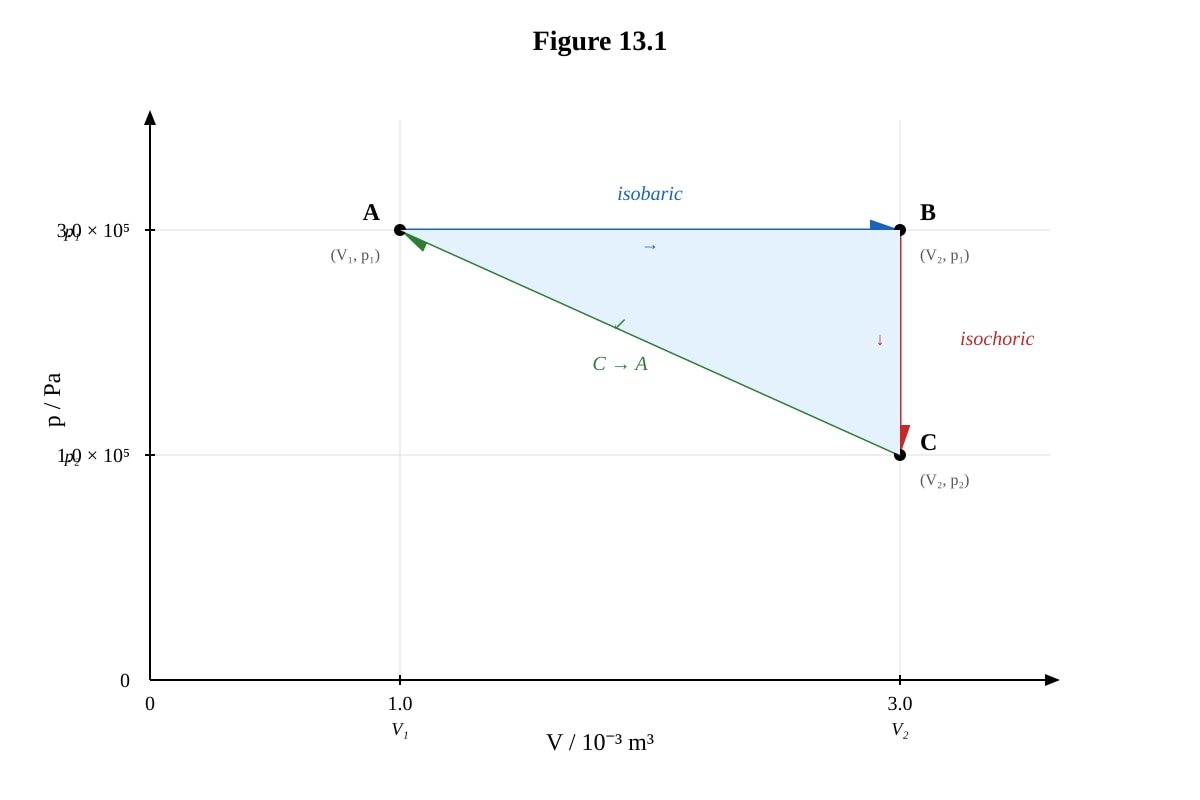
13. An ideal gas undergoes the cyclic process ABCA shown in the pp-VV diagram below.

<image_placeholder> id: Q13-fig1 type: diagram linked_question: Q13 description: A p-V diagram showing a triangular cyclic process ABCA. Point A is at (V1, p1), Point B is at (V2, p1) where V2 > V1 (isobaric expansion A→B), Point C is at (V2, p2) where p2 < p1 (isochoric pressure decrease B→C), and the process C→A returns diagonally to the starting point (compression with decreasing volume and increasing pressure). labels: x-axis: "V (m³)", y-axis: "p (Pa)", Points A, B, C labelled. Process A→B labelled "isobaric", B→C labelled "isochoric", C→A labelled. V1 and V2 marked on x-axis, p1 and p2 marked on y-axis. values: V1 = 1.0 × 10⁻³ m³, V2 = 3.0 × 10⁻³ m³, p1 = 3.0 × 10⁵ Pa, p2 = 1.0 × 10⁵ Pa must_show: Closed triangular cycle on p-V axes, all three points labelled, axes with units, arrows showing direction A→B→C→A. </image_placeholder>

(a) State the work done by the gas during process A → B. Show your working. [2]

(b) State the work done on the gas during process B → C. Explain your answer. [1]

(c) Calculate the net work done by the gas during the complete cycle ABCA. [2]


14. A cup of hot coffee cools from 85 °C to 65 °C in 8 minutes when the room temperature is 22 °C. Use Newton's law of cooling to estimate how much longer it will take for the coffee to cool from 65 °C to 45 °C. State any assumptions you make. [3]


Section C: Free Response and Data Interpretation (Questions 15–20) [20 marks]


15. A student carries out an experiment to determine the specific latent heat of vaporisation of water using an electrical heater.

The following data is recorded:

QuantityValue
Mass of water evaporated48.5 g
Power of heater150 W
Time heater is on1260 s
Initial temperature of water100 °C

(a) Calculate the total energy supplied by the heater. [1]

(b) Calculate an experimental value for the specific latent heat of vaporisation of water. [2]

(c) The accepted value is 2.3×10⁶ J kg12.3 \times 10^6 \text{ J kg}^{-1}. Calculate the percentage error in the student's result. [2]

(d) Suggest one reason why the experimental value differs from the accepted value. [1]


16. A fixed mass of ideal gas is taken through the process shown below. The gas starts at state X with pressure 2.0×10⁵ Pa2.0 \times 10^5 \text{ Pa} and volume 1.0×10³ m31.0 \times 10^{-3} \text{ m}^3 at a temperature of 300 K. It is heated at constant pressure to state Y where the volume is 3.0×10³ m33.0 \times 10^{-3} \text{ m}^3.

(a) Using the ideal gas equation, determine the temperature of the gas at state Y. [3]

(b) Calculate the work done by the gas during the expansion from X to Y. [2]

(c) The internal energy of the gas increases by 800 J during this process. Use the first law of thermodynamics to calculate the heat transferred to the gas. [2]


17. Two identical containers A and B contain different ideal gases at the same temperature and pressure. Container A holds nitrogen (N2N_2, molar mass 28 g mol1^{-1}) and container B holds helium (He, molar mass 4 g mol1^{-1}).

(a) Compare the r.m.s. speed of the molecules in container A with that of container B. Show your reasoning. [3]

(b) Explain, in terms of molecular kinetic energy, why both gases have the same internal energy per mole at the same temperature. [2]


18. A thermos flask contains 0.30 kg of coffee at 90 °C. The flask has a lid of area 5.0×10³ m25.0 \times 10^{-3} \text{ m}^2 and the rate of heat loss through the lid is measured to be 1.2 W.

(a) Calculate the initial rate at which the temperature of the coffee decreases. The specific heat capacity of coffee is approximately 4.2×10³ J kg1 K14.2 \times 10^3 \text{ J kg}^{-1} \text{ K}^{-1}. [3]

(b) State two features of a thermos flask that reduce heat loss, and explain how each feature works. [2]


19. The graph below shows how the temperature of 0.50 kg of a substance changes as it is heated at a constant rate of 600 W.

<image_placeholder> id: Q19-fig1 type: graph linked_question: Q19 description: A temperature (°C) vs time (s) graph for a substance heated at constant rate. The graph starts at 20 °C, rises linearly to 80 °C over 400 s (solid phase heating), stays constant at 80 °C from t = 400 s to t = 1200 s (melting/phase change), then rises linearly again from 80 °C after t = 1200 s (liquid phase heating). labels: y-axis: "Temperature (°C)", x-axis: "Time (s)", horizontal plateau at 80 °C between t = 400 s and t = 1200 s, initial temperature at 20 °C. values: T_initial = 20 °C, T_melting = 80 °C, t_start_melt = 400 s, t_end_melt = 1200 s, heating rate = 600 W, mass = 0.50 kg must_show: Two rising linear segments connected by a horizontal plateau at 80 °C. Axes clearly labelled with units. Key time points (400 s, 1200 s) and temperature values (20 °C, 80 °C) marked. </image_placeholder>

(a) Calculate the specific heat capacity of the substance in its solid state. [2]

(b) Calculate the specific latent heat of fusion of the substance. [2]

(c) Explain why the temperature remains constant during the phase change from solid to liquid, even though energy is being continuously supplied. [2]


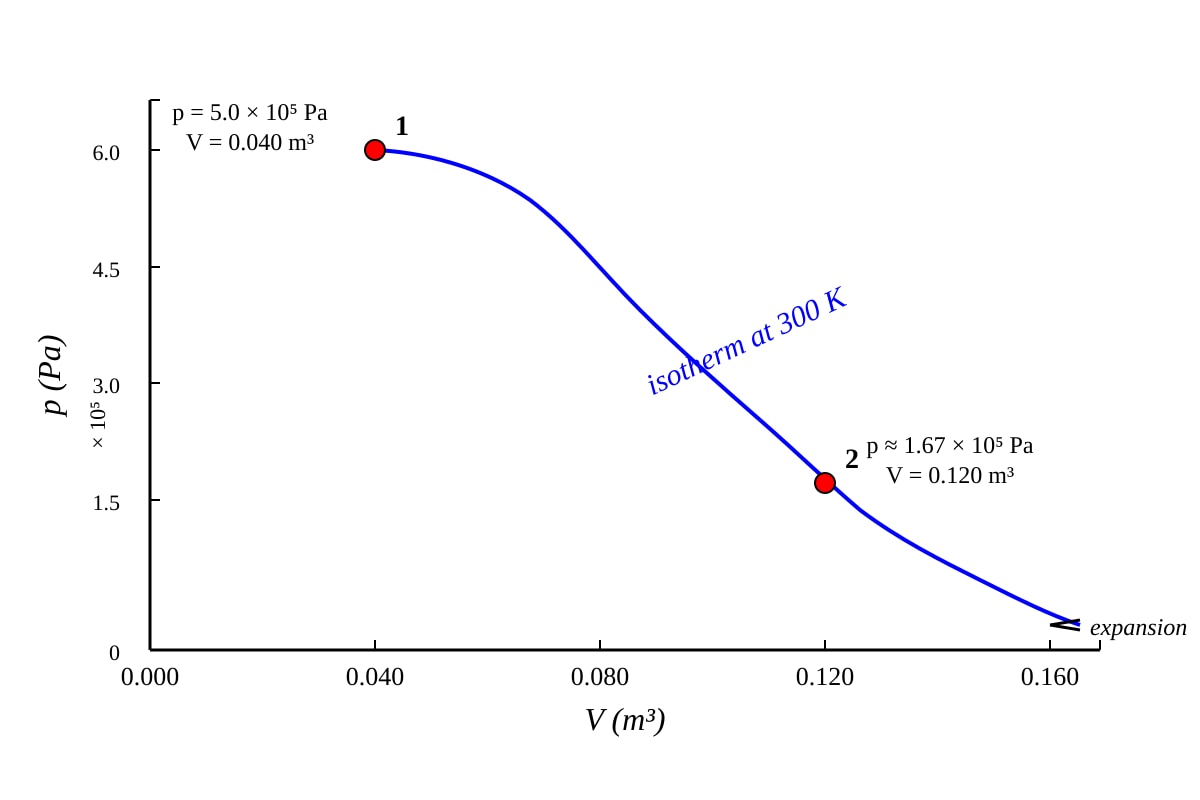
20. A gas cylinder contains 0.040 m³ of an ideal gas at a pressure of 5.0×10⁵ Pa5.0 \times 10^5 \text{ Pa} and a temperature of 27 °C.

(a) Calculate the number of moles of gas in the cylinder. The molar gas constant R=8.31 J mol1 K1R = 8.31 \text{ J mol}^{-1} \text{ K}^{-1}. [3]

(b) The gas is allowed to expand isothermally until its volume is 0.120 m³. Calculate the new pressure. [2]

(c) Sketch the process on a pp-VV diagram. Label the initial and final states. Indicate the shape of the curve. [2]

<image_placeholder> id: Q20-fig1 type: graph linked_question: Q20 description: A p-V diagram showing an isothermal expansion curve. The x-axis is volume V (m³), the y-axis is pressure p (Pa). A hyperbolic curve (isotherm) is drawn from point 1 at (0.040, 5.0 × 10⁵) to point 2 at (0.120, ~1.67 × 10⁵). The curve is a smooth decreasing convex curve typical of pV = constant. labels: x-axis: "V (m³)", y-axis: "p (Pa)", Point 1 labelled at V = 0.040 m³, p = 5.0 × 10⁵ Pa, Point 2 labelled at V = 0.120 m³, p ≈ 1.67 × 10⁵ Pa. Curve labelled "isotherm at 300 K". values: V1 = 0.040 m³, p1 = 5.0 × 10⁵ Pa, V2 = 0.120 m³, p2 ≈ 1.67 × 10⁵ Pa must_show: Smooth hyperbolic isotherm curve, two labelled points, axes with units, arrow showing expansion direction. </image_placeholder>


END OF QUIZ

Answers

<!-- TuitionGoWhere generation metadata: stage=3-0; model=openrouter/owl-alpha; model_label=Owl Alpha; generated=2026-06-06; Sources: Stage 2-1 real exam-derived templates and Stage 2-2 exam-enriched syllabus. -->

A-Level Physics H1 Quiz - Thermal Physics: Answer Key


Section A: Multiple Choice

1. Answer: C

[1 mark]

Explanation: Internal energy of a system is the total energy of all its molecules, comprising both the random kinetic energy (due to molecular motion) and the intermolecular potential energy (due to forces between molecules). Option A is incorrect because internal energy also depends on potential energy, not just temperature. Option B is incorrect because internal energy can also change via work done on or by the system (first law of thermodynamics). Option D is incorrect because for an ideal gas undergoing an isothermal process, internal energy depends only on temperature, so it remains constant.

Common trap: Students often confuse internal energy with thermal energy alone, forgetting the potential energy component.


2. Answer: C

[1 mark]

Explanation: In an isothermal process, the temperature remains constant. For an ideal gas, internal energy depends only on temperature, so ΔU=0\Delta U = 0. By the first law of thermodynamics, ΔU=Q+W\Delta U = Q + W (using the sign convention where WW is work done on the gas), so Q=WQ = -W. This means the work done on the gas equals the heat lost by the gas. Option A is incorrect because ΔU=0\Delta U = 0 for isothermal processes. Option B is incorrect because temperature is constant by definition. Option D is incorrect because compressing a gas (decreasing volume) at constant temperature increases pressure (Boyle's law: pV=constantpV = \text{constant}).


3. Answer: B

[1 mark]

Explanation: Specific heat capacity is defined as the energy required to raise the temperature of 1 kg of a substance by 1 K (or equivalently 1 °C). Option A is incorrect because it does not specify a mass of 1 kg. Option C describes specific latent heat, not specific heat capacity. Option D uses 1 g instead of 1 kg, which would give a value 1000 times too small.

Common trap: Confusing specific heat capacity with specific latent heat. Specific heat capacity relates to temperature change within a phase; specific latent heat relates to phase change at constant temperature.


4. Answer: A

[1 mark]

Explanation: By conservation of energy, the heat lost by the hot copper block equals the heat gained by the cooler water. The copper cools from 100 °C to the final temperature TT, so heat lost = mcopper×ccopper×(100T)m_{\text{copper}} \times c_{\text{copper}} \times (100 - T). The water warms from 20 °C to TT, so heat gained = mwater×cwater×(T20)m_{\text{water}} \times c_{\text{water}} \times (T - 20). Setting heat lost = heat gained gives option A.

Common trap: Getting the temperature difference direction wrong. The temperature change must always be (higher − lower) for the magnitude, and the signs must be consistent: heat lost (positive magnitude) = heat gained (positive magnitude).


5. Answer: B

[1 mark]

Explanation: The energy required for a phase change is given by Q=mLQ = mL, where mm is the mass and LL is the specific latent heat of vaporisation.

Q=0.25×2.3×106=5.75×10⁵ JQ = 0.25 \times 2.3 \times 10^6 = 5.75 \times 10^5 \text{ J}

Common trap: Forgetting that during vaporisation, the temperature does not change — all the energy goes into breaking intermolecular bonds, not raising temperature.


Section B: Short Answer and Structured Questions

6.

(a) Specific heat capacity is defined as the energy required to raise the temperature of 1 kg of a substance by 1 K (or 1 °C).

[2 marks]

  • [B1] for "energy required to raise the temperature"
  • [B1] for "of 1 kg of the substance by 1 K"

Teaching note: The word "specific" in physics always means "per unit mass." The SI unit is J kg⁻¹ K⁻¹.

(b) Specific latent heat of fusion is defined as the energy required to change 1 kg of a substance from solid to liquid at constant temperature (at its melting point).

[2 marks]

  • [B1] for "energy required to change state from solid to liquid"
  • [B1] for "of 1 kg at constant temperature"

Teaching note: "Latent" means hidden — the energy goes into breaking intermolecular bonds rather than raising temperature. "Fusion" means melting.


7. First law of thermodynamics:

The first law of thermodynamics states that the change in internal energy of a system is equal to the heat supplied to the system plus the work done on the system.

ΔU=Q+W\Delta U = Q + W

where:

  • ΔU\Delta U = change in internal energy of the system (J)
  • QQ = heat supplied to the system (J) — positive when heat enters the system
  • WW = work done on the system (J) — positive when work is done on the system (compression)

[3 marks]

  • [B1] for correct statement of the law in words
  • [B1] for correct equation
  • [B1] for defining all symbols with correct units

Teaching note: This is essentially the law of conservation of energy applied to thermodynamic systems. Some textbooks use the convention ΔU=QW\Delta U = Q - W where WW is work done by the system. Both are correct as long as the sign convention is stated clearly. The H1 syllabus uses ΔU=Q+W\Delta U = Q + W where WW is work done on the gas.


8. When a gas is compressed rapidly, there is no time for heat to be exchanged with the surroundings (adiabatic process, Q=0Q = 0). Work is done on the gas (W>0W > 0). By the first law, ΔU=Q+W=0+W=W\Delta U = Q + W = 0 + W = W, so the internal energy of the gas increases. Since internal energy of an ideal gas is the total random kinetic energy of its molecules, the average kinetic energy of the molecules increases. The average kinetic energy is proportional to temperature (KE=32kT\langle KE \rangle = \frac{3}{2} kT), so the temperature of the gas increases.

[3 marks]

  • [B1] for stating that work is done on the gas / adiabatic process
  • [B1] for linking increased internal energy to increased molecular kinetic energy
  • [B1] for linking increased kinetic energy to increased temperature

Common trap: Students may say "friction heats the gas" — this is not the correct explanation at the molecular level. The correct explanation is that work done on the gas increases the kinetic energy of the molecules.


9.

(a) Energy supplied by heater:

E=P×t=480×500=240000 J=2.4×10⁵ JE = P \times t = 480 \times 500 = 240\,000 \text{ J} = 2.4 \times 10^5 \text{ J}

[2 marks]

  • [M1] for using E=PtE = Pt
  • [A1] for correct answer with unit

(b) Using E=mcΔTE = mc\Delta T:

c=EmΔT=2400000.8×(8525)=2400000.8×60=24000048=5000 J kg1 °C1c = \frac{E}{m \Delta T} = \frac{240\,000}{0.8 \times (85 - 25)} = \frac{240\,000}{0.8 \times 60} = \frac{240\,000}{48} = 5000 \text{ J kg}^{-1} \text{ °C}^{-1}

The specific heat capacity of the metal is 5000 J kg1 K15000 \text{ J kg}^{-1} \text{ K}^{-1}.

[2 marks]

  • [M1] for correct substitution into c=E/(mΔT)c = E / (m \Delta T)
  • [A1] for correct answer with unit

Teaching note: This is a standard calorimetry calculation. The specific heat capacity tells us how much energy is needed to raise 1 kg of the substance by 1 K. A higher specific heat capacity means the substance requires more energy to change its temperature.


10.

EvaporationBoiling
TemperatureOccurs at any temperatureOccurs only at the boiling point
LocationOccurs only at the surface of the liquidOccurs throughout the entire liquid (and at the surface)

[2 marks]

  • [B1] for each correct difference (any two valid differences)

Other acceptable differences:

  • Evaporation is a slow process; boiling is rapid/vigorous.
  • Evaporation causes cooling of the liquid; boiling does not (temperature remains constant).
  • Evaporation does not require an external heat source at a specific temperature; boiling requires the liquid to reach its boiling point.

11.

(a) When the gas is heated at constant volume, the temperature increases. According to the kinetic molecular model, the average kinetic energy of the gas molecules increases, so the molecules move faster. Faster molecules collide with the walls of the container more frequently and with greater force. Since the area of the walls is constant (fixed volume), the increased rate of change of momentum per unit area results in an increase in pressure.

[2 marks]

  • [B1] for linking increased temperature to increased molecular speed/kinetic energy
  • [B1] for linking increased molecular collisions (frequency and/or force) to increased pressure

(b) The graph should be a straight line with positive slope, extrapolating to T=273 °CT = -273 \text{ °C} (i.e., 0 K) on the temperature axis. This is because at constant volume, p/T=constantp/T = \text{constant} (Gay-Lussac's law), so pp is directly proportional to TT in Kelvin. When converted to °C, the line crosses the axis at −273 °C.

[2 marks]

  • [B1] for straight line with positive slope
  • [B1] for x-intercept at approximately −273 °C

Teaching note: The graph of pp vs TT (in °C) is a straight line that extrapolates to absolute zero. This is how the concept of absolute zero was historically determined.


12.

(a) Energy to melt the ice:

Q=mL=2.0×3.4×105=6.8×10⁵ JQ = mL = 2.0 \times 3.4 \times 10^5 = 6.8 \times 10^5 \text{ J}

[2 marks]

  • [M1] for using Q=mLQ = mL
  • [A1] for correct answer with unit

(b) During melting, the energy supplied is used to break the intermolecular bonds that hold the ice molecules in their fixed lattice structure, converting the solid into a liquid. This energy increases the potential energy of the molecules, not their kinetic energy. Since temperature is a measure of the average kinetic energy of the molecules, and the kinetic energy does not change during the phase transition, the temperature remains constant at 0 °C.

[2 marks]

  • [B1] for stating that energy is used to break intermolecular bonds
  • [B1] for linking constant kinetic energy to constant temperature

Common trap: Students often think that supplying energy must always increase temperature. During a phase change, the energy goes into changing the potential energy (breaking bonds), not the kinetic energy.


13.

(a) Work done by the gas during A → B (isobaric expansion):

W=p×ΔV=p1×(V2V1)=3.0×105×(3.0×1031.0×103)W = p \times \Delta V = p_1 \times (V_2 - V_1) = 3.0 \times 10^5 \times (3.0 \times 10^{-3} - 1.0 \times 10^{-3}) W=3.0×105×2.0×103=600 JW = 3.0 \times 10^5 \times 2.0 \times 10^{-3} = 600 \text{ J}

[2 marks]

  • [M1] for using W=pΔVW = p \Delta V with correct values
  • [A1] for correct answer (600 J)

(b) The work done on the gas during B → C is zero. This is because process B → C is isochoric (constant volume), so ΔV=0\Delta V = 0. Since W=pΔV=0W = p \Delta V = 0, no work is done.

[1 mark]

  • [B1] for stating zero work and giving the correct reason (constant volume)

(c) Net work done during the complete cycle ABCA:

The net work done equals the area enclosed by the cycle on the pp-VV diagram.

Area of triangle = 12×base×height=12×(V2V1)×(p1p2)\frac{1}{2} \times \text{base} \times \text{height} = \frac{1}{2} \times (V_2 - V_1) \times (p_1 - p_2)

Wnet=12×(3.0×1031.0×103)×(3.0×1051.0×105)W_{\text{net}} = \frac{1}{2} \times (3.0 \times 10^{-3} - 1.0 \times 10^{-3}) \times (3.0 \times 10^5 - 1.0 \times 10^5) Wnet=12×2.0×103×2.0×105=12×400=200 JW_{\text{net}} = \frac{1}{2} \times 2.0 \times 10^{-3} \times 2.0 \times 10^5 = \frac{1}{2} \times 400 = 200 \text{ J}

[2 marks]

  • [M1] for calculating the area of the triangle (or equivalent method)
  • [A1] for correct answer (200 J)

Teaching note: For any cyclic process on a pp-VV diagram, the net work done by the gas equals the area enclosed by the cycle. If the cycle is traversed clockwise, the net work is done by the gas (positive). If anticlockwise, net work is done on the gas (negative).


14. Newton's law of cooling states that the rate of cooling is proportional to the temperature difference between the object and its surroundings:

dTdt(TTroom)\frac{dT}{dt} \propto -(T - T_{\text{room}})

For the first interval (85 °C → 65 °C):

  • Average temperature difference = (8522)+(6522)2=63+432=53 °C\frac{(85-22) + (65-22)}{2} = \frac{63 + 43}{2} = 53 \text{ °C}
  • Rate of cooling = 85658=2.5 °C min1\frac{85 - 65}{8} = 2.5 \text{ °C min}^{-1}

For the second interval (65 °C → 45 °C):

  • Average temperature difference = (6522)+(4522)2=43+232=33 °C\frac{(65-22) + (45-22)}{2} = \frac{43 + 23}{2} = 33 \text{ °C}

Since rate of cooling ∝ average temperature difference:

Rate2Rate1=3353\frac{\text{Rate}_2}{\text{Rate}_1} = \frac{33}{53}

Rate2=2.5×3353=1.56 °C min1\text{Rate}_2 = 2.5 \times \frac{33}{53} = 1.56 \text{ °C min}^{-1}

Time for second interval:

t=65451.56=201.5612.8 mint = \frac{65 - 45}{1.56} = \frac{20}{1.56} \approx 12.8 \text{ min}

It will take approximately 12.8 minutes (or about 13 minutes) to cool from 65 °C to 45 °C.

Assumptions:

  • Newton's law of cooling applies (valid for small temperature differences or when the cooling mechanism remains the same).
  • The room temperature remains constant at 22 °C.
  • The cooling conditions (e.g., surface area, emissivity) remain the same.

[3 marks]

  • [M1] for applying Newton's law of cooling (comparing rates and temperature differences)
  • [M1] for correct calculation of time
  • [A1] for final answer (~12.8 min or 13 min)
  • Assumptions stated (implicit in the method)

Teaching note: The cooling takes longer for the second interval because the temperature difference between the coffee and the room is smaller, so the rate of heat loss is lower.


Section C: Free Response and Data Interpretation

15.

(a) Energy supplied:

E=Pt=150×1260=1.89×10⁵ JE = Pt = 150 \times 1260 = 1.89 \times 10^5 \text{ J}

[1 mark]

(b) This energy is used to vaporise 48.5 g = 0.0485 kg of water at 100 °C:

L=Em=1.89×1050.0485=3.90×10⁶ J kg1L = \frac{E}{m} = \frac{1.89 \times 10^5}{0.0485} = 3.90 \times 10^6 \text{ J kg}^{-1}

[2 marks]

  • [M1] for using L=E/mL = E/m with correct mass conversion
  • [A1] for correct answer

(c) Percentage error:

% error=3.90×1062.3×1062.3×106×100%=1.60×1062.3×106×100%=69.6%\% \text{ error} = \frac{|3.90 \times 10^6 - 2.3 \times 10^6|}{2.3 \times 10^6} \times 100\% = \frac{1.60 \times 10^6}{2.3 \times 10^6} \times 100\% = 69.6\%

[2 marks]

  • [M1] for correct substitution into percentage error formula
  • [A1] for correct answer (~70% or 69.6%)

(d) The experimental value is much higher than the accepted value. One possible reason: not all the energy from the heater went into vaporising the water — some energy was lost to the surroundings (e.g., heating the container, air convection losses, radiation).

[1 mark]

  • [B1] for any valid reason (heat loss to surroundings, energy absorbed by container, incomplete insulation, etc.)

Teaching note: In calorimetry experiments, the experimental value of specific latent heat is almost always higher than the accepted value because some energy is inevitably lost to the surroundings. This means not all the electrical energy goes into the phase change.


16.

(a) Using the ideal gas law at constant pressure (Charles's law): V1T1=V2T2\frac{V_1}{T_1} = \frac{V_2}{T_2}

T2=T1×V2V1=300×3.0×1031.0×103=300×3=900 KT_2 = T_1 \times \frac{V_2}{V_1} = 300 \times \frac{3.0 \times 10^{-3}}{1.0 \times 10^{-3}} = 300 \times 3 = 900 \text{ K}

[3 marks]

  • [M1] for using Charles's law or ideal gas equation
  • [M1] for correct substitution
  • [A1] for correct answer (900 K)

(b) Work done by the gas during isobaric expansion:

W=pΔV=2.0×105×(3.0×1031.0×103)=2.0×105×2.0×103=400 JW = p \Delta V = 2.0 \times 10^5 \times (3.0 \times 10^{-3} - 1.0 \times 10^{-3}) = 2.0 \times 10^5 \times 2.0 \times 10^{-3} = 400 \text{ J}

[2 marks]

  • [M1] for using W=pΔVW = p \Delta V
  • [A1] for correct answer (400 J)

(c) Using the first law of thermodynamics: ΔU=Q+Won gas\Delta U = Q + W_{\text{on gas}}

Note: Won gas=Wby gas=400 JW_{\text{on gas}} = -W_{\text{by gas}} = -400 \text{ J} (work done on the gas is negative since the gas expands)

800=Q+(400)800 = Q + (-400) Q=800+400=1200 JQ = 800 + 400 = 1200 \text{ J}

The heat transferred to the gas is 1200 J.

[2 marks]

  • [M1] for applying the first law correctly with correct sign convention
  • [A1] for correct answer (1200 J)

Teaching note: The sign convention is critical here. If using ΔU=Q+W\Delta U = Q + W where WW is work done on the gas, then W=400W = -400 J (the gas does work, so work is done by the gas, meaning negative work done on the gas). The heat input must supply both the increase in internal energy AND the energy for the gas to do work.


17.

(a) The r.m.s. speed of gas molecules is given by:

crms=3kTm=3RTMc_{\text{rms}} = \sqrt{\frac{3kT}{m}} = \sqrt{\frac{3RT}{M}}

where mm is the mass of one molecule and MM is the molar mass.

At the same temperature:

crms, Hecrms, N2=MN2MHe=284=72.65\frac{c_{\text{rms, He}}}{c_{\text{rms, N}_2}} = \sqrt{\frac{M_{\text{N}_2}}{M_{\text{He}}}} = \sqrt{\frac{28}{4}} = \sqrt{7} \approx 2.65

The r.m.s. speed of helium molecules is approximately 2.65 times that of nitrogen molecules. Helium molecules are lighter, so they move faster at the same temperature.

[3 marks]

  • [M1] for using the r.m.s. speed formula
  • [M1] for setting up the ratio correctly
  • [A1] for correct numerical answer (~2.65 times faster)

(b) The average translational kinetic energy of a molecule is 32kT\frac{3}{2}kT, which depends only on temperature, not on the type or mass of the molecule. Since both gases are at the same temperature, each molecule has the same average kinetic energy. For one mole of any ideal gas, the total internal energy (for a monatomic gas: U=32RTU = \frac{3}{2}RT; for diatomic: U=52RTU = \frac{5}{2}RT) depends on temperature and the number of degrees of freedom. However, per mole at the same temperature, the translational kinetic energy contribution (32RT\frac{3}{2}RT) is the same for both gases.

[2 marks]

  • [B1] for stating that average molecular KE depends only on temperature (32kT\frac{3}{2}kT)
  • [B1] for concluding that both gases have the same internal energy per mole (at the same temperature, the translational KE per mole is 32RT\frac{3}{2}RT for both)

Note: Strictly, nitrogen is diatomic and helium is monatomic, so their total internal energies per mole differ (52RT\frac{5}{2}RT vs 32RT\frac{3}{2}RT). However, the question asks about internal energy in terms of molecular kinetic energy, and the translational KE per mole is the same. Award marks for the reasoning about 32kT\frac{3}{2}kT.


18.

(a) The rate of heat loss is related to the rate of temperature change by:

P=mcdTdtP = mc \frac{dT}{dt}

dTdt=Pmc=1.20.30×4.2×103=1.21260=9.52×10⁴ K s1\frac{dT}{dt} = \frac{P}{mc} = \frac{1.2}{0.30 \times 4.2 \times 10^3} = \frac{1.2}{1260} = 9.52 \times 10^{-4} \text{ K s}^{-1}

The initial rate of temperature decrease is approximately 9.5×10⁴ K s19.5 \times 10^{-4} \text{ K s}^{-1} (or about 0.057 K min10.057 \text{ K min}^{-1}).

[3 marks]

  • [M1] for using P=mcdTdtP = mc \frac{dT}{dt}
  • [M1] for correct substitution
  • [A1] for correct answer with unit

(b) Two features of a thermos flask:

  1. Vacuum between double walls: Eliminates conduction and convection, as there are no molecules to transfer energy through the gap.
  2. Silvered/reflective surfaces on the inner walls: Reduces heat loss by radiation, as the reflective surfaces reflect infrared radiation back into the flask.

[2 marks]

  • [B1] for each valid feature with correct explanation

Other acceptable features:

  • Insulated stopper/lid — reduces conduction and convection through the top
  • Plastic/cork supports — poor thermal conductors, minimise conduction between walls

19.

(a) During the solid phase (0 to 400 s), the temperature rises from 20 °C to 80 °C.

Energy supplied: E=Pt=600×400=240000 JE = Pt = 600 \times 400 = 240\,000 \text{ J}

c=EmΔT=2400000.50×(8020)=2400000.50×60=24000030=8000 J kg1 K1c = \frac{E}{m \Delta T} = \frac{240\,000}{0.50 \times (80 - 20)} = \frac{240\,000}{0.50 \times 60} = \frac{240\,000}{30} = 8000 \text{ J kg}^{-1} \text{ K}^{-1}

[2 marks]

  • [M1] for correct method
  • [A1] for correct answer (8000 J kg⁻¹ K⁻¹)

(b) During melting (400 s to 1200 s), the time for the phase change is 1200400=800 s1200 - 400 = 800 \text{ s}.

Energy supplied during melting: E=600×800=480000 JE = 600 \times 800 = 480\,000 \text{ J}

L=Em=4800000.50=9.6×10⁵ J kg1L = \frac{E}{m} = \frac{480\,000}{0.50} = 9.6 \times 10^5 \text{ J kg}^{-1}

[2 marks]

  • [M1] for correct method
  • [A1] for correct answer (9.6×1059.6 \times 10^5 J kg⁻¹)

(c) During the phase change from solid to liquid, the energy supplied is used to overcome the intermolecular bonds that hold the molecules in a fixed, ordered arrangement in the solid. This energy increases the potential energy of the molecules rather than their kinetic energy. Since temperature is a measure of the average kinetic energy of the molecules, and the kinetic energy does not increase during the phase change, the temperature remains constant at the melting point (80 °C).

[2 marks]

  • [B1] for stating that energy is used to break intermolecular bonds / increase potential energy
  • [B1] for linking constant kinetic energy to constant temperature

20.

(a) Using the ideal gas equation pV=nRTpV = nRT:

First convert temperature to Kelvin: T=27+273=300 KT = 27 + 273 = 300 \text{ K}

n=pVRT=5.0×105×0.0408.31×300=200002493=8.02 moln = \frac{pV}{RT} = \frac{5.0 \times 10^5 \times 0.040}{8.31 \times 300} = \frac{20\,000}{2493} = 8.02 \text{ mol}

[3 marks]

  • [M1] for converting temperature to Kelvin
  • [M1] for correct substitution into n=pV/(RT)n = pV/(RT)
  • [A1] for correct answer (~8.0 mol)

(b) For an isothermal process, p1V1=p2V2p_1 V_1 = p_2 V_2 (Boyle's law):

p2=p1V1V2=5.0×105×0.0400.120=200000.120=1.67×10⁵ Pap_2 = \frac{p_1 V_1}{V_2} = \frac{5.0 \times 10^5 \times 0.040}{0.120} = \frac{20\,000}{0.120} = 1.67 \times 10^5 \text{ Pa}

[2 marks]

  • [M1] for using Boyle's law
  • [A1] for correct answer (1.67×1051.67 \times 10^5 Pa)

(c) The pp-VV diagram should show a smooth hyperbolic curve (isotherm) decreasing from point 1 (V=0.040 m3V = 0.040 \text{ m}^3, p=5.0×10⁵ Pap = 5.0 \times 10^5 \text{ Pa}) to point 2 (V=0.120 m3V = 0.120 \text{ m}^3, p=1.67×10⁵ Pap = 1.67 \times 10^5 \text{ Pa}). The curve should be convex, showing that pressure decreases as volume increases. An arrow should indicate the direction of the process (expansion).

[2 marks]

  • [B1] for correct hyperbolic shape
  • [B1] for correct end points and direction

Teaching note: An isotherm on a pp-VV diagram is a rectangular hyperbola (p1/Vp \propto 1/V). Higher temperature isotherms lie further from the origin.


END OF ANSWER KEY

Mark Summary:

SectionQuestionsMarks
A: MCQ1–510
B: Short Answer/Structured6–1420
C: Free Response/Data15–2020
Total20 questions50