From Real Exams Quiz
A Level H1 Physics Thermal Physics Quiz
Free A Level H1 Physics Thermal Physics quiz, HY3 Exam version, with questions, answers, and A Level-style practice for Singapore students.
These static practice materials are generated from the site's syllabus and paper-generation workflow, with source and model context shown so students and parents can evaluate the material before use.
Questions
A-Level Physics H1 Quiz - Thermal Physics
Name: ___________________________
Class: ___________________________
Date: ___________________________
Score: _______ / 40
Duration: 50 minutes
Total Marks: 40
Topic: Thermal Physics
Instructions:
- Answer all 20 questions.
- Show your working clearly for calculation questions.
- Use the provided space to write your answers.
- Marks for each question are shown in brackets [ ].
Section A: Definitions and Concepts (Questions 1–5)
1. State what is meant by thermal equilibrium. [1]
2. Define specific heat capacity. [2]
3. A metal block and a wooden block are both at 20 °C. Explain why the metal block feels colder to touch than the wooden block although both are at the same temperature. [2]
4. State the principle of conservation of energy as applied to heating. [1]
5. Define latent heat of vaporisation. [2]
Section B: Calculations (Questions 6–12)
6. Calculate the heat energy required to raise the temperature of 0.50 kg of water from 20 °C to 100 °C. Specific heat capacity of water = 4200 J kg⁻¹ °C⁻¹. [2]
7. A 2.0 kg aluminium block (specific heat capacity = 900 J kg⁻¹ °C⁻¹) cools from 80 °C to 30 °C. Calculate the heat lost. [2]
8. An electric heater supplies 500 W of power to 1.0 kg of oil. The temperature rises from 25 °C to 45 °C in 4.0 minutes. Calculate the specific heat capacity of the oil. [3]
9. 0.20 kg of ice at 0 °C is converted completely to water at 0 °C. The latent heat of fusion of ice is 3.34 × 10⁵ J kg⁻¹. Calculate the energy absorbed. [2]
10. A substance of mass 0.40 kg undergoes boiling at constant temperature. It absorbs 1.20 × 10⁵ J. Determine the latent heat of vaporisation. [2]
11. A 1.5 kg copper block (c = 390 J kg⁻¹ °C⁻¹) at 100 °C is placed into 2.0 kg of water at 20 °C in a container of negligible heat capacity. Calculate the final equilibrium temperature. [3]
12. A heating coil rated 240 V, 0.50 A is used to heat 0.30 kg of water. Assuming all electrical energy becomes heat, calculate the temperature rise in 2.0 minutes. (c_water = 4200 J kg⁻¹ °C⁻¹) [3]
Section C: Data Interpretation and Structured Response (Questions 13–20)
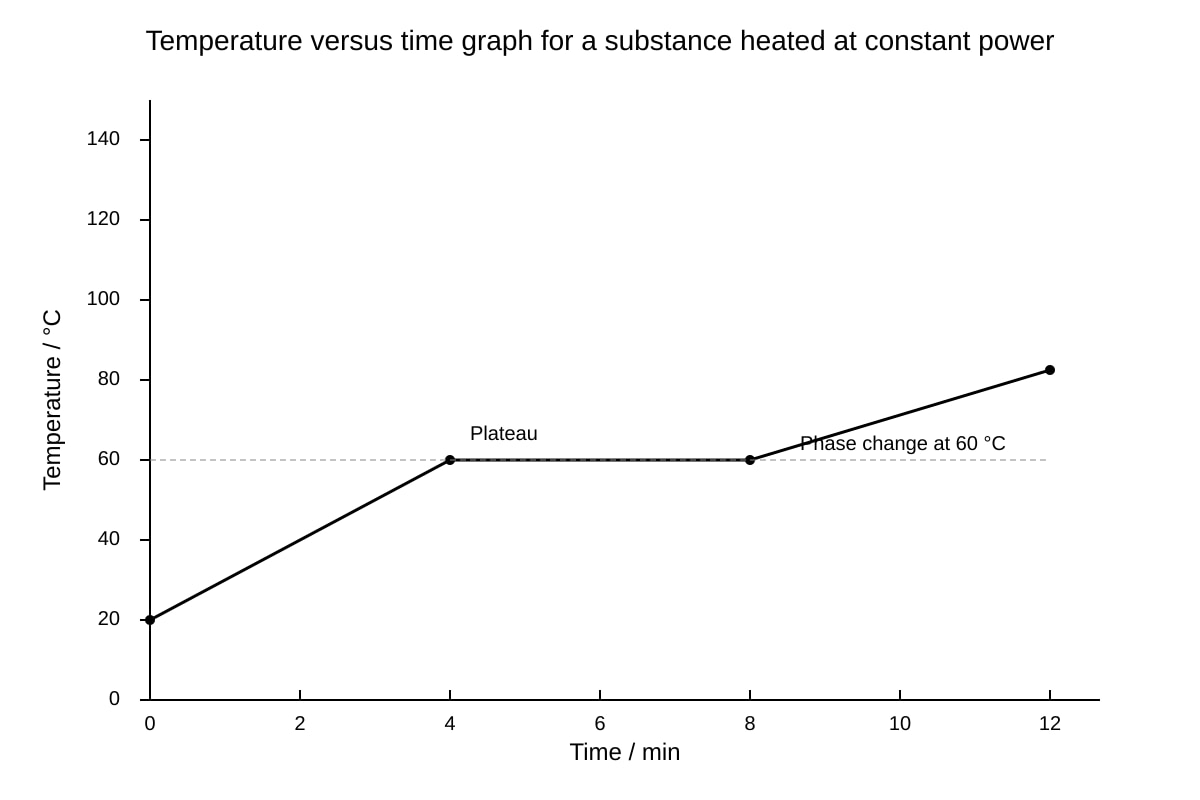
13. The graph below shows the temperature of a substance as it is heated at a constant rate.
Image pending generation: graph for Q13.
(a) State the temperature at which the substance is undergoing a change of state. [1]
(b) Explain why the graph is horizontal during the plateau. [2]
14. Describe an experiment to determine the specific heat capacity of a liquid using an electrical method. Include the measurements needed. [4]
15. A student claims: "When water boils, its temperature increases rapidly because a lot of heat is supplied." Explain why this statement is incorrect. [2]
16. The table shows masses and temperature changes for four metals each given the same heat energy.
| Metal | Mass (kg) | ΔT (°C) | c (J kg⁻¹ °C⁻¹) |
|---|---|---|---|
| A | 0.10 | 10 | 400 |
| B | 0.20 | 5 | 400 |
| C | 0.10 | 20 | 200 |
| D | 0.40 | 5 | 200 |
(a) Calculate the heat energy supplied to Metal A. [1]
(b) State which metal received the same heat energy as A. Show your reasoning. [2]
17. A room contains air at 25 °C. A steel spoon and a plastic spoon are both at 25 °C. Explain, using the concept of thermal conductivity, why the steel spoon feels cooler. [2]
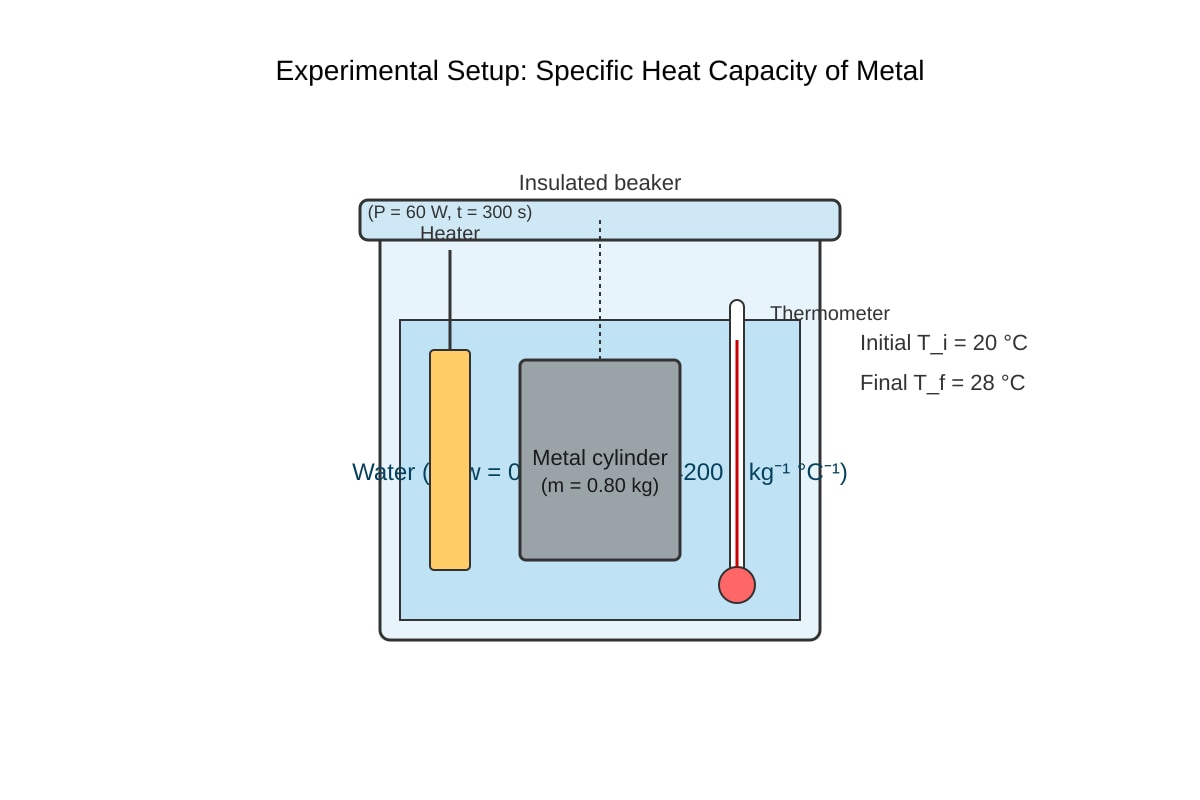
18.
Image pending generation: experimental_setup for Q18.
Using the setup above, calculate the specific heat capacity of the metal cylinder. [3]
19. State two assumptions made when using the method of mixtures to find specific heat capacity. [2]
20. A sample of 0.10 kg of a liquid is cooled from 50 °C to 30 °C, releasing 4200 J. A second sample of the same liquid of mass 0.20 kg is cooled from 60 °C to 20 °C. Calculate the heat released by the second sample. [3]
Answers
A-Level Physics H1 Quiz - Thermal Physics (Answer Key)
Total Marks: 40
Topic: Thermal Physics
Section A: Definitions and Concepts
Q1 [1 mark]
Thermal equilibrium is the state when two or more bodies in thermal contact have the same temperature and there is no net flow of heat between them.
Teaching note: Heat flows from higher to lower temperature. At equilibrium, temperatures equalise and heat transfer stops.
Q2 [2 marks]
Specific heat capacity is the amount of heat energy required to raise the temperature of 1 kg of a substance by 1 °C (or 1 K).
Marking: [B1] definition of per unit mass; [B1] per unit temperature rise.
Teaching note: Formula: c=mΔTQ.
Q3 [2 marks]
Metal has higher thermal conductivity than wood [B1]. It conducts heat away from the hand faster, making it feel colder [B1].
Teaching note: Both are at same temperature; sensation is due to rate of heat transfer, not temperature difference.
Q4 [1 mark]
Energy supplied as heat = energy gained by substance (assuming no losses). Total energy is conserved.
Q5 [2 marks]
Latent heat of vaporisation is the heat energy required to change 1 kg of a substance from liquid to vapour at constant temperature.
Marking: [B1] change of state liquid→vapour; [B1] per unit mass at constant T.
Section B: Calculations
Q6 [2 marks]
Q=mcΔT=0.50×4200×(100−20)=0.50×4200×80=168000 J = 1.68×10⁵ J.
Marking: [M1] correct formula; [A1] correct value.
Teaching note: ΔT = 80 °C.
Q7 [2 marks]
Q=mcΔT=2.0×900×(80−30)=2.0×900×50=90000 J = 9.0×10⁴ J lost.
Marking: [M1] formula; [A1] answer.
Q8 [3 marks]
Energy supplied: E=Pt=500×(4.0×60)=500×240=120000 J.
ΔT=45−25=20 °C.
c=mΔTE=1.0×20120000=6000 J kg⁻¹ °C⁻¹.
Marking: [M1] E = Pt; [M1] substitution; [A1] c = 6000.
Q9 [2 marks]
Q=mL=0.20×3.34×105=6.68×10⁴ J.
Marking: [M1] formula; [A1] answer.
Q10 [2 marks]
L=mQ=0.401.20×105=3.00×10⁵ J kg⁻¹.
Marking: [M1] formula; [A1] answer.
Q11 [3 marks]
Heat lost by Cu = heat gained by water:
1.5×390×(100−T)=2.0×4200×(T−20)
585(100−T)=8400(T−20)
58500−585T=8400T−168000
226500=8985T
T=25.2 °C.
Marking: [M1] equating heats; [M1] algebra; [A1] T = 25.2 °C.
Q12 [3 marks]
Electrical energy: E=VIt=240×0.50×120=14400 J.
ΔT=mcE=0.30×420014400=126014400=11.4 °C.
Marking: [M1] E = VIt; [M1] ΔT formula; [A1] 11.4 °C.
Section C: Data Interpretation and Structured Response
Q13 [3 marks]
(a) 60 °C [1]
(b) During plateau, heat energy is used for latent heat of fusion/vaporisation (state change) not to raise temperature [B1]; temperature stays constant until phase change complete [B1].
Q14 [4 marks]
- Use insulated beaker with liquid of known mass m. [B1]
- Immersed heater of known power P, stir, record initial T_i. [B1]
- Heat for time t, record final T_f. [B1]
- Calculate c=m(Tf−Ti)Pt, assuming no losses. [B1]
Teaching note: Measurements: m, P, t, T_i, T_f.
Q15 [2 marks]
Incorrect because during boiling temperature remains constant [B1]; supplied heat is latent heat for state change, not temperature rise [B1].
Q16 [3 marks]
(a) QA=mcΔT=0.10×400×10=400 J [1]
(b) Metal B: 0.20×400×5=400 J [B1]; same as A [B1].
Q17 [2 marks]
Steel has higher thermal conductivity [B1]; draws heat from skin faster so feels cooler [B1].
Q18 [3 marks]
Heat to water: Qw=mwcwΔT=0.50×4200×(28−20)=0.50×4200×8=16800 J.
Electrical energy: E=Pt=60×300=18000 J.
Heat to metal: Qm=18000−16800=1200 J.
c=mΔTQm=0.80×81200=187.5 J kg⁻¹ °C⁻¹.
Marking: [M1] water heat; [M1] metal heat; [A1] c = 187.5.
Q19 [2 marks]
- No heat loss to surroundings / container. [B1]
- Substances uniformly mixed / same final temperature. [B1]
Q20 [3 marks]
For first: c=0.10×204200=2100 J kg⁻¹ °C⁻¹.
Second: Q=0.20×2100×(60−20)=0.20×2100×40=16800 J.
Marking: [M1] find c; [M1] use for second; [A1] 16800 J.
Free quiz and exam paper access
Enter your details to view this paper
Your access is remembered on this device.