From Real Exams Quiz

A Level H1 Physics Modern Physics Quiz

Free Exam-Derived Owl Alpha A Level H1 Physics Modern Physics quiz with questions and answers for Singapore students. This page is rendered as a direct URL so the questions and answers can be discovered without pressing in-page buttons.

These static practice materials are generated from the site's syllabus and paper-generation workflow, with source and model context shown so students and parents can evaluate the material before use.

A Level H1 Physics From Real Exams Generated by Owl Alpha Updated 2026-06-07

Questions

<!-- TuitionGoWhere generation metadata: stage=3-0; model=openrouter/owl-alpha; model_label=Owl Alpha; generated=2026-06-06; Sources: Stage 2-1 real exam-derived templates and Stage 2-2 exam-enriched syllabus. -->

A-Level Physics H1 Quiz - Modern Physics

Name: ________________________________________
Class: ________________________________________
Date: ________________________________________
Score: ____ / 50

Duration: 60 minutes
Total Marks: 50


Instructions:

  • Answer ALL questions.
  • Show all working clearly for calculation questions. Marks are awarded for correct method even if the final answer is incorrect.
  • Include units in your final answers where appropriate.
  • The number of marks available for each question is shown in brackets, e.g. [2].
  • You may use a calculator.

Section A: Multiple Choice Questions (Questions 1–5) [10 marks]

For each question, choose the most appropriate answer (A, B, C, or D).


1. A radioactive sample has an initial activity of 640 Bq. After 3 half-lives, what is the activity of the sample? [2]

A. 80 Bq
B. 160 Bq
C. 213 Bq
D. 320 Bq


2. In a nuclear reaction, the total number of nucleons before and after the reaction is conserved. Which of the following equations correctly represents alpha decay of uranium-238? [2]

A. 92238U90234Th+24He^{238}_{92}\text{U} \rightarrow ^{234}_{90}\text{Th} + ^{4}_{2}\text{He}
B. 92238U93238Np+10e^{238}_{92}\text{U} \rightarrow ^{238}_{93}\text{Np} + ^{0}_{-1}\text{e}
C. 92238U91234Pa+24He^{238}_{92}\text{U} \rightarrow ^{234}_{91}\text{Pa} + ^{4}_{2}\text{He}
D. 92238U90238Th+20He^{238}_{92}\text{U} \rightarrow ^{238}_{90}\text{Th} + ^{0}_{2}\text{He}


3. Which of the following statements about nuclear binding energy is correct? [2]

A. Binding energy is the energy required to remove an electron from an atom.
B. The greater the binding energy per nucleon, the less stable the nucleus.
C. Nuclear fusion of light nuclei releases energy because the products have a greater binding energy per nucleon than the reactants.
D. Nuclear fission of heavy nuclei absorbs energy because the products have a smaller binding energy per nucleon than the reactants.


4. A radioactive isotope has a half-life of 8.0 days. What fraction of the original sample remains after 24 days? [2]

A. 12\frac{1}{2}
B. 14\frac{1}{4}
C. 18\frac{1}{8}
D. 116\frac{1}{16}


5. Which of the following is NOT a property of gamma radiation? [2]

A. It is an electromagnetic wave.
B. It has no mass.
C. It is deflected by electric fields.
D. It has no charge.


Section B: Structured Questions (Questions 6–15) [25 marks]


6. State what is meant by the binding energy of a nucleus. [2]

...............................................................................................................................
...............................................................................................................................
...............................................................................................................................


7. Define the term half-life of a radioactive substance. [2]

...............................................................................................................................
...............................................................................................................................
...............................................................................................................................


8. A sample of a radioactive isotope contains 3.0×10183.0 \times 10^{18} atoms. The decay constant of the isotope is 2.0×1052.0 \times 10^{-5} s1^{-1}.

(a) Calculate the initial activity of the sample. [2]

Working:

...............................................................................................................................
...............................................................................................................................
...............................................................................................................................
...............................................................................................................................

Answer: ................................................

(b) Calculate the half-life of the isotope in seconds. [2]

Working:

...............................................................................................................................
...............................................................................................................................
...............................................................................................................................
...............................................................................................................................

Answer: ................................................


9. Figure 1 below shows a radioactive decay series.

<image_placeholder> id: Q9-fig1 type: diagram linked_question: Q9 description: A radioactive decay series starting from radium-226 (Ra-226, Z=88). Ra-226 undergoes alpha decay to radon-222 (Rn-222, Z=86). Rn-222 undergoes alpha decay to polonium-218 (Po-218, Z=84). Po-218 undergoes alpha decay to lead-214 (Pb-214, Z=82). Arrows between each nuclide should be labelled with the type of radiation emitted (alpha). labels: Ra-226 (Z=88), Rn-222 (Z=86), Po-218 (Z=84), Pb-214 (Z=82), alpha decay arrows values: A: 226→222→218→214; Z: 88→86→84→82 must_show: Each nuclide with mass number and atomic number clearly labelled, arrows showing direction of decay, alpha symbol (α) on each arrow </image_placeholder>

(a) State the change in mass number and atomic number when a nucleus emits an alpha particle. [2]

Mass number: ................................................

Atomic number: ................................................

(b) Using the decay series shown, determine the number of alpha particles emitted when one Ra-226 nucleus decays to Pb-214. [1]

Answer: ................................................


10. Explain why gamma radiation is more penetrating than alpha radiation. In your answer, refer to the nature of each type of radiation and how they interact with matter. [3]

...............................................................................................................................
...............................................................................................................................
...............................................................................................................................
...............................................................................................................................
...............................................................................................................................
...............................................................................................................................
...............................................................................................................................


11. The isotope carbon-14 (614C^{14}_{6}\text{C}) undergoes beta-minus decay.

(a) Write a nuclear equation for this decay. [2]

................................................................................................................................

(b) State what happens inside the nucleus during beta-minus decay. [2]

...............................................................................................................................
...............................................................................................................................
...............................................................................................................................


12. A student measures the count rate of a radioactive sample over time. The results are shown in the table below.

Time / sCount rate / s1^{-1}
0400
20283
40200
60141
80100
10071

(a) On Figure 2, plot a graph of count rate against time. [3]

<image_placeholder> id: Q12-fig2 type: graph linked_question: Q12 description: A blank graph with count rate (s^-1) on the y-axis ranging from 0 to 450, and time (s) on the x-axis ranging from 0 to 120. Grid lines at intervals of 20 s on x-axis and 50 s^-1 on y-axis. Axes are labelled with quantity and unit. labels: y-axis: "Count rate / s⁻¹", x-axis: "Time / s" values: y-axis range: 0–450, x-axis range: 0–120 must_show: Clearly labelled axes with units, appropriate linear scale with grid lines, space for student to plot points and draw a smooth curve </image>

(b) Use your graph to determine the half-life of the sample. Show clearly how you obtained your answer. [2]

Working:

...............................................................................................................................
...............................................................................................................................
...............................................................................................................................
...............................................................................................................................

Answer: ................................................


13. Distinguish between nuclear fission and nuclear fusion. In your answer, state one example of each and indicate whether energy is released or absorbed. [3]

...............................................................................................................................
...............................................................................................................................
...............................................................................................................................
...............................................................................................................................
...............................................................................................................................
...............................................................................................................................
...............................................................................................................................


14. The binding energy per nucleon for deuterium (12H^{2}_{1}\text{H}) is 1.11 MeV, and for helium-4 (24He^{4}_{2}\text{He}) it is 7.07 MeV.

(a) Calculate the total binding energy of the helium-4 nucleus. [2]

Working:

...............................................................................................................................
...............................................................................................................................
...............................................................................................................................

Answer: ................................................

(b) Explain, using the data above, why energy is released when two deuterium nuclei fuse to form a helium-4 nucleus. [2]

...............................................................................................................................
...............................................................................................................................
...............................................................................................................................
...............................................................................................................................


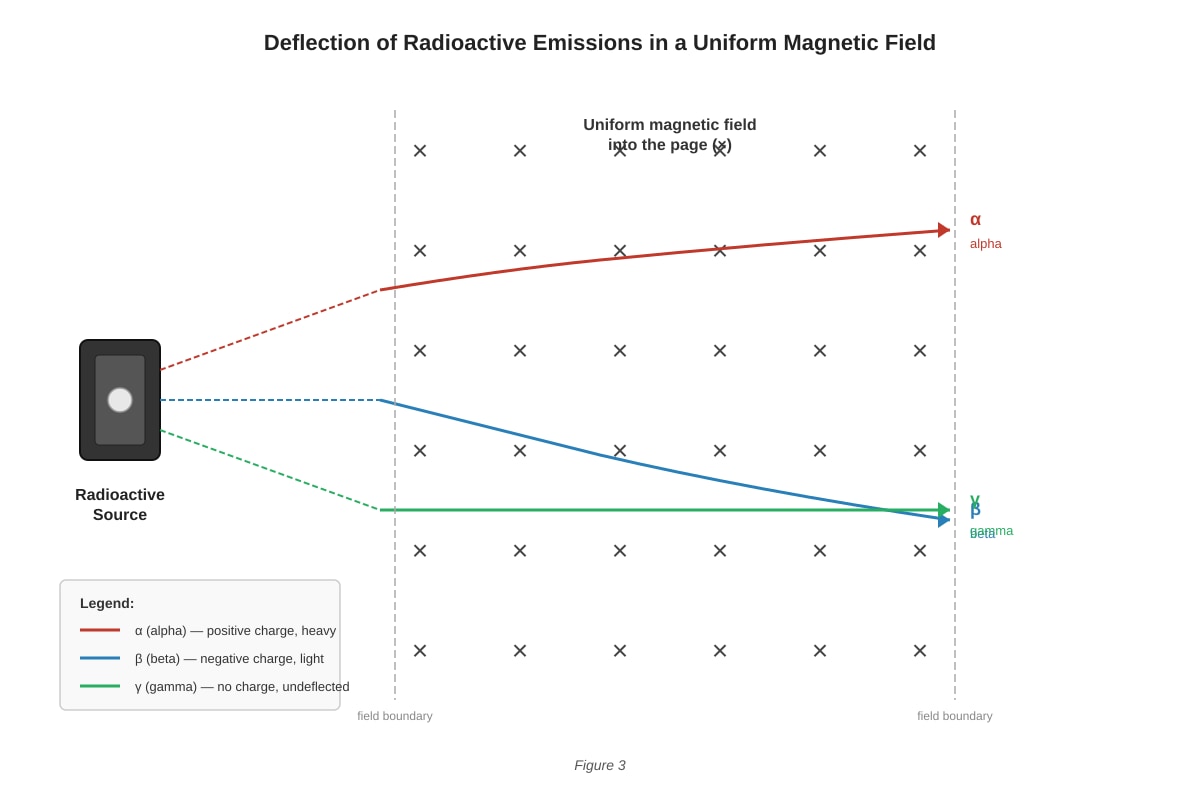
15. A radioactive source emits alpha, beta, and gamma radiation. The radiation passes through a magnetic field directed into the page, as shown in Figure 3.

<image_placeholder> id: Q15-fig3 type: diagram linked_question: Q15 description: A diagram showing a radioactive source emitting three types of radiation (alpha, beta, gamma) travelling to the right. A uniform magnetic field is directed into the page (represented by crosses ×). Three paths are shown: one deflecting upwards (alpha), one deflecting downwards (beta), and one continuing straight (gamma). The paths should be clearly separated. labels: Radioactive source on left, magnetic field into page (× symbols), three paths labelled alpha, beta, gamma values: Alpha deflects one way (positive charge, heavy), beta deflects opposite way (negative charge, light), gamma undeflected (no charge) must_show: Source, magnetic field direction (into page), three distinct paths with correct deflection directions, labels for each radiation type </image_placeholder>

(a) On Figure 3, label which path corresponds to each type of radiation. [2]

(b) Explain your reasoning for the path taken by beta radiation. [2]

...............................................................................................................................
...............................................................................................................................
...............................................................................................................................
...............................................................................................................................


Section C: Free Response Questions (Questions 16–20) [15 marks]


16. A radioactive isotope X has a half-life of 12 hours. A sample initially contains N0N_0 atoms of isotope X.

(a) Derive an expression for the number of atoms NN remaining after time tt. [2]

Working:

...............................................................................................................................
...............................................................................................................................
...............................................................................................................................
...............................................................................................................................

(b) Calculate the time taken for the number of atoms to decrease to 132\frac{1}{32} of the original amount. [3]

Working:

...............................................................................................................................
...............................................................................................................................
...............................................................................................................................
...............................................................................................................................
...............................................................................................................................

Answer: ................................................


17. Figure 4 shows the binding energy per nucleon plotted against mass number for some stable nuclei.

<image_placeholder> id: Q17-fig4 type: graph linked_question: Q17 description: A graph of binding energy per nucleon (MeV) on the y-axis versus mass number A on the x-axis. The curve starts near zero at low A, rises steeply to a peak around A=56 (iron-56) at approximately 8.8 MeV, then gradually decreases for higher mass numbers. Key points: deuterium (A=2) at about 1.1 MeV, helium-4 (A=4) at about 7.1 MeV, iron-56 (A=56) at about 8.8 MeV, uranium-238 (A=238) at about 7.5 MeV. labels: y-axis: "Binding energy per nucleon / MeV", x-axis: "Mass number A" values: Peak at A=56, ~8.8 MeV; He-4 at A=4, ~7.1 MeV; U-238 at A=238, ~7.5 MeV; H-2 at A=2, ~1.1 MeV must_show: Smooth curve with clearly labelled peak region, axes with units, key nuclides labelled at their positions on the curve </image>

(a) Using Figure 4, state the mass number of the most stable element. Explain your reasoning. [2]

...............................................................................................................................
...............................................................................................................................
...............................................................................................................................

(b) Explain why energy is released when a heavy nucleus such as uranium-235 undergoes fission. Refer to Figure 4 in your answer. [3]

...............................................................................................................................
...............................................................................................................................
...............................................................................................................................
...............................................................................................................................
...............................................................................................................................
...............................................................................................................................

(c) Explain why energy is released when light nuclei such as hydrogen isotopes undergo fusion. Refer to Figure 4 in your answer. [2]

...............................................................................................................................
...............................................................................................................................
...............................................................................................................................
...............................................................................................................................
...............................................................................................................................


18. A sample of radioactive iodine-131 (53131I^{131}_{53}\text{I}) has an initial activity of 4.8×1064.8 \times 10^{6} Bq. The half-life of iodine-131 is 8.0 days.

(a) Calculate the decay constant of iodine-131 in s1^{-1}. [3]

Working:

...............................................................................................................................
...............................................................................................................................
...............................................................................................................................
...............................................................................................................................
...............................................................................................................................

Answer: ................................................

(b) Calculate the initial number of iodine-131 atoms in the sample. [3]

Working:

...............................................................................................................................
...............................................................................................................................
...............................................................................................................................
...............................................................................................................................
...............................................................................................................................

Answer: ................................................

(c) Determine the activity of the sample after 24 days. [2]

Working:

...............................................................................................................................
...............................................................................................................................
...............................................................................................................................
...............................................................................................................................

Answer: ................................................


19. A nuclear power station uses uranium-235 as fuel. In one of the reactions, a slow neutron is absorbed by a uranium-235 nucleus, which then undergoes fission to produce barium-141, krypton-92, and some neutrons.

(a) Write a balanced nuclear equation for this fission reaction. [3]

................................................................................................................................

(b) Explain why the neutrons released must be slowed down (moderated) to sustain a chain reaction. [2]

...............................................................................................................................
...............................................................................................................................
...............................................................................................................................
...............................................................................................................................


20. Discuss the safety precautions that must be taken when handling radioactive materials. Your answer should include at least three specific precautions and explain the physics behind each one. [4]

...............................................................................................................................
...............................................................................................................................
...............................................................................................................................
...............................................................................................................................
...............................................................................................................................
...............................................................................................................................
...............................................................................................................................
...............................................................................................................................
...............................................................................................................................
...............................................................................................................................


END OF QUIZ

Answers

<!-- TuitionGoWhere generation metadata: stage=3-0; model=openrouter/owl-alpha; model_label=Owl Alpha; generated=2026-06-06; Sources: Stage 2-1 real exam-derived templates and Stage 2-2 exam-enriched syllabus. -->

A-Level Physics H1 Quiz - Modern Physics

Answer Key


Section A: Multiple Choice Questions

1. A. 80 Bq [2]

Teaching Notes:
After each half-life, the activity is halved. After 1 half-life: 640/2=320640/2 = 320 Bq. After 2 half-lives: 320/2=160320/2 = 160 Bq. After 3 half-lives: 160/2=80160/2 = 80 Bq. Alternatively, A=A0(12)n=640×(12)3=640×18=80A = A_0 \left(\frac{1}{2}\right)^n = 640 \times \left(\frac{1}{2}\right)^3 = 640 \times \frac{1}{8} = 80 Bq.

Common Mistake: Students may divide by 3 instead of halving three times, giving 213 Bq (option C).


2. A. 92238U90234Th+24He^{238}_{92}\text{U} \rightarrow ^{234}_{90}\text{Th} + ^{4}_{2}\text{He} [2]

Teaching Notes:
In alpha decay, the parent nucleus emits an alpha particle (24He^4_2\text{He}), so the mass number decreases by 4 and the atomic number decreases by 2. Conservation of mass number: 238=234+4238 = 234 + 4 ✓. Conservation of charge: 92=90+292 = 90 + 2 ✓. Option A is the only one that satisfies both conservation laws with a correct alpha particle.

Common Mistake: Option C has the wrong atomic number for the daughter nucleus (Pa has Z=91, not 90).


3. C. Nuclear fusion of light nuclei releases energy because the products have a greater binding energy per nucleon than the reactants. [2]

Teaching Notes:
Binding energy is the energy required to completely separate all nucleons in a nucleus. A greater binding energy per nucleon means the nucleus is more stable. In fusion of light nuclei, the product nuclei lie higher on the binding energy per nucleon curve (closer to the peak at iron-56), so energy is released. Option A describes ionisation energy, not binding energy. Option B is incorrect because greater binding energy per nucleon means more stable. Option D is incorrect because fission releases energy.


4. C. 18\frac{1}{8} [2]

Teaching Notes:
Number of half-lives elapsed: n=248.0=3n = \frac{24}{8.0} = 3. Fraction remaining =(12)3=18= \left(\frac{1}{2}\right)^3 = \frac{1}{8}.

Common Mistake: Students may calculate 1381 - \frac{3}{8} or confuse fraction remaining with fraction decayed.


5. C. It is deflected by electric fields. [2]

Teaching Notes:
Gamma radiation is electromagnetic radiation — it has no mass and no charge. Therefore it is not deflected by electric or magnetic fields. Alpha radiation (positively charged, massive) and beta radiation (negatively charged, light) are deflected by electric fields, but gamma is not.


Section B: Structured Questions

6. [2]

Answer:
The binding energy of a nucleus is the energy required to completely separate all the nucleons (protons and neutrons) in the nucleus. [1] It is equivalent to the energy released when the nucleus is formed from its individual nucleons. [1]

Marking Notes:

  • [B1] for stating it is the energy needed to separate all nucleons (or break apart the nucleus completely).
  • [B1] for mentioning it equals the energy released during nucleus formation, or linking it to the mass defect via E=mc2E = mc^2.

7. [2]

Answer:
The half-life of a radioactive substance is the time taken for half of the radioactive nuclei in a sample to decay. [1] Equivalently, it is the time taken for the activity (or count rate) of the sample to decrease to half of its initial value. [1]

Marking Notes:

  • [B1] for "time for half the nuclei to decay" or equivalent.
  • [B1] for the alternative definition involving activity/count rate, or for stating it is constant for a given isotope.

8.

(a) [2]

Working:
Activity A=λNA = \lambda N
A=2.0×105×3.0×1018A = 2.0 \times 10^{-5} \times 3.0 \times 10^{18}
A=6.0×10¹³A = 6.0 \times 10^{13} Bq

Answer: 6.0×10136.0 \times 10^{13} Bq

Marking Notes:

  • [M1] for correct formula A=λNA = \lambda N.
  • [A1] for correct answer with unit.

(b) [2]

Working:
T1/2=ln2λ=0.6932.0×105T_{1/2} = \frac{\ln 2}{\lambda} = \frac{0.693}{2.0 \times 10^{-5}}
T1/2=3.5×104T_{1/2} = 3.5 \times 10^{4} s (to 2 s.f.)

Answer: 3.5×1043.5 \times 10^{4} s

Marking Notes:

  • [M1] for correct formula T1/2=ln2λT_{1/2} = \frac{\ln 2}{\lambda} or T1/2=0.693λT_{1/2} = \frac{0.693}{\lambda}.
  • [A1] for correct answer with unit.

9.

(a) [2]

Answer:
Mass number decreases by 4. [1]
Atomic number decreases by 2. [1]

(b) [1]

Answer: 3 alpha particles

Working:
Change in mass number: 226214=12226 - 214 = 12. Number of alpha particles =124=3= \frac{12}{4} = 3.

Marking Notes:

  • [B1] for each correct change in (a).
  • [B1] for correct answer in (b). Accept answer derived from mass number change or by counting arrows in the diagram.

10. [3]

Answer:
Alpha radiation consists of helium nuclei (24He^4_2\text{He}), which are massive and carry a positive charge. [1] Because of their relatively large mass and charge, alpha particles interact strongly with matter through ionisation, losing energy rapidly and being stopped by a few centimetres of air or a sheet of paper. [1] Gamma radiation is electromagnetic radiation with no charge and no mass. It interacts with matter much less readily (mainly through photoelectric effect, Compton scattering, and pair production), so it is far more penetrating and requires thick lead or concrete to significantly reduce its intensity. [1]

Marking Notes:

  • [B1] for describing the nature of alpha radiation (helium nuclei, charged, massive).
  • [1] for explaining strong interaction/ionisation leading to low penetration.
  • [1] for explaining gamma's nature (EM wave, no charge) and weak interaction leading to high penetration.

11.

(a) [2]

Answer:
614C714N+10e+νˉe^{14}_{6}\text{C} \rightarrow ^{14}_{7}\text{N} + ^{0}_{-1}\text{e} + \bar{\nu}_e

Marking Notes:

  • [M1] for correct daughter nucleus (N-14, Z=7).
  • [A1] for correct beta particle (10e^0_{-1}\text{e}) and correct balancing. Accept with or without antineutrino.

(b) [2]

Answer:
Inside the nucleus, a neutron is converted into a proton. [1] An electron (the beta particle) and an antineutrino are emitted. [1]

Marking Notes:

  • [B1] for neutron → proton conversion.
  • [B1] for emission of electron and antineutrino.

12.

(a) [3]

Marking Notes:

  • [M1] for plotting at least 4 points correctly to within half a small square.
  • [M1] for drawing a smooth curve of best fit (not a series of straight lines).
  • [A1] for correct general shape showing exponential decay.

(b) [2]

Working:
Initial count rate = 400 s1^{-1}. Half of this = 200 s1^{-1}. From the graph, the time when count rate = 200 s1^{-1} is 40 s. [1] Therefore, half-life = 40 s. [1]

Answer: 40 s

Marking Notes:

  • [M1] for showing correct method on graph (finding time for count rate to halve).
  • [A1] for answer in range 38–42 s.

Alternative method: Students may use two successive half-lives: from 400 → 200 (40 s) and 200 → 100 (another 40 s), confirming T1/2=40T_{1/2} = 40 s.


13. [3]

Answer:
Nuclear fission is the splitting of a heavy nucleus into two or more lighter nuclei. [1] For example, uranium-235 undergoes fission when it absorbs a neutron, producing lighter fragments and releasing energy. [1] Nuclear fusion is the joining of two light nuclei to form a heavier nucleus. For example, hydrogen isotopes fuse in the Sun to form helium, releasing energy. [1] Both processes release energy.

Marking Notes:

  • [B1] for correct definition of fission.
  • [B1] for correct definition of fusion (with or without example).
  • [B1] for stating that energy is released in both processes.

14.

(a) [2]

Working:
Total binding energy = binding energy per nucleon × number of nucleons
=7.07×4=28.3= 7.07 \times 4 = 28.3 MeV

Answer: 28.3 MeV

Marking Notes:

  • [M1] for multiplying binding energy per nucleon by 4.
  • [A1] for correct answer.

(b) [2]

Answer:
Total binding energy of two deuterium nuclei =2×(1.11×2)=4.44= 2 \times (1.11 \times 2) = 4.44 MeV. [1] The binding energy of the helium-4 nucleus produced is 28.3 MeV, which is much greater. The increase in binding energy means the product nucleus is more stable, and the excess energy (28.3 − 4.44 = 23.86 MeV) is released. [1]

Marking Notes:

  • [M1] for calculating total binding energy of reactants and comparing to products.
  • [B1] for explaining that the increase in binding energy per nucleon means energy is released.

15.

(a) [2]

Answer:

  • Path deflecting in one direction (e.g., upwards): alpha radiation [1]
  • Path deflecting in the opposite direction (e.g., downwards): beta radiation [1]
  • Straight, undeflected path: gamma radiation

Marking Notes:
Alpha is positively charged and deflects one way; beta is negatively charged and deflects the opposite way (by Fleming's left-hand rule). Gamma has no charge and is undeflected.

(b) [2]

Answer:
Beta radiation consists of fast-moving electrons, which carry a negative charge. [1] When a charged particle moves through a magnetic field, it experiences a force perpendicular to both its velocity and the field direction (Fleming's left-hand rule, noting the current direction is opposite to electron motion). This causes the beta particles to follow a curved path. [1]

Marking Notes:

  • [B1] for identifying beta as negatively charged electrons.
  • [B1] for explaining the force on a charged particle in a magnetic field causing deflection.

Section C: Free Response Questions

16.

(a) [2]

Working:
The decay law is N=N0(12)t/T1/2N = N_0 \left(\frac{1}{2}\right)^{t/T_{1/2}} [1]
Substituting T1/2=12T_{1/2} = 12 hours:
N=N0(12)t/12N = N_0 \left(\frac{1}{2}\right)^{t/12} where tt is in hours. [1]

Answer: N=N0(12)t/12N = N_0 \left(\frac{1}{2}\right)^{t/12}

Marking Notes:

  • [M1] for correct general decay formula.
  • [A1] for correct substitution of half-life.

(b) [3]

Working:
NN0=132=(12)5\frac{N}{N_0} = \frac{1}{32} = \left(\frac{1}{2}\right)^5 [1]
So the number of half-lives n=5n = 5. [1]
Time taken =5×12=60= 5 \times 12 = 60 hours. [1]

Answer: 60 hours

Marking Notes:

  • [M1] for recognising 132=(12)5\frac{1}{32} = \left(\frac{1}{2}\right)^5.
  • [M1] for determining n=5n = 5 half-lives.
  • [A1] for correct final answer with unit.

17.

(a) [2]

Answer:
The most stable element has mass number 56 (iron-56). [1] This is because the binding energy per nucleon is maximum at this point on the curve, meaning the nucleus is most tightly bound and therefore most stable. [1]

Marking Notes:

  • [B1] for identifying mass number 56.
  • [B1] for linking maximum binding energy per nucleon to maximum stability.

(b) [3]

Answer:
When a heavy nucleus such as uranium-235 (A ≈ 238) undergoes fission, it splits into two or more lighter nuclei with mass numbers around 56–140. [1] From Figure 4, these product nuclei have a higher binding energy per nucleon than the original uranium nucleus (the curve rises from ~7.5 MeV at A=238 to ~8.5 MeV for the fission fragments). [1] The increase in binding energy per nucleon means the products are more stable, and the difference in binding energy is released as kinetic energy of the fission products and as radiation. [1]

Marking Notes:

  • [B1] for describing the fission process (heavy nucleus splits into lighter fragments).
  • [B1] for referring to the graph to show products have higher binding energy per nucleon.
  • [B1] for explaining that the increase in binding energy means energy is released.

(c) [2]

Answer:
When light nuclei such as hydrogen isotopes (A = 2, 3) undergo fusion, they combine to form a heavier nucleus such as helium-4 (A = 4). [1] From Figure 4, the binding energy per nucleon increases sharply from ~1.1 MeV at A=2 to ~7.1 MeV at A=4. This large increase in binding energy per nucleon means the product is much more stable, and the excess energy is released. [1]

Marking Notes:

  • [B1] for describing fusion of light nuclei and referring to the graph.
  • [B1] for explaining the increase in binding energy per nucleon leads to energy release.

18.

(a) [3]

Working:
λ=ln2T1/2\lambda = \frac{\ln 2}{T_{1/2}} [1]
T1/2=8.0×24×3600=691200T_{1/2} = 8.0 \times 24 \times 3600 = 691\,200 s
λ=0.693691200=1.0×10⁶\lambda = \frac{0.693}{691\,200} = 1.0 \times 10^{-6} s1^{-1} [1]

Answer: 1.0×1061.0 \times 10^{-6} s1^{-1}

Marking Notes:

  • [M1] for correct formula.
  • [M1] for correct conversion of half-life to seconds.
  • [A1] for correct answer.

(b) [3]

Working:
A=λN0A = \lambda N_0, so N0=AλN_0 = \frac{A}{\lambda} [1]
N0=4.8×1061.0×106N_0 = \frac{4.8 \times 10^{6}}{1.0 \times 10^{-6}} [1]
N0=4.8×10¹²N_0 = 4.8 \times 10^{12} atoms [1]

Answer: 4.8×10124.8 \times 10^{12} atoms

Marking Notes:

  • [M1] for rearranging A=λNA = \lambda N correctly.
  • [M1] for correct substitution.
  • [A1] for correct answer.

(c) [2]

Working:
Number of half-lives: n=248.0=3n = \frac{24}{8.0} = 3 [1]
A=A0(12)3=4.8×106×18=6.0×10⁵A = A_0 \left(\frac{1}{2}\right)^3 = 4.8 \times 10^{6} \times \frac{1}{8} = 6.0 \times 10^{5} Bq [1]

Answer: 6.0×1056.0 \times 10^{5} Bq

Marking Notes:

  • [M1] for calculating number of half-lives and applying decay formula.
  • [A1] for correct answer.

19.

(a) [3]

Answer:
92235U+01n56141Ba+3692Kr+301n^{235}_{92}\text{U} + ^{1}_{0}\text{n} \rightarrow ^{141}_{56}\text{Ba} + ^{92}_{36}\text{Kr} + 3\,^{1}_{0}\text{n} [3]

Marking Notes:

  • [M1] for including the neutron on the reactant side.
  • [M1] for correct barium-141 and krypton-92 on the product side.
  • [A1] for correct number of neutrons (3) to balance the equation.
    Check: Mass number: 235+1=236=141+92+3(1)=236235 + 1 = 236 = 141 + 92 + 3(1) = 236
    Atomic number: 92+0=92=56+36+0=9292 + 0 = 92 = 56 + 36 + 0 = 92

(b) [2]

Answer:
Uranium-235 is more likely to undergo fission when it absorbs a slow (thermal) neutron than a fast neutron. [1] The neutrons released from fission are fast-moving. If they are not slowed down by a moderator (such as water or graphite), they are less likely to be absorbed by other uranium-235 nuclei, and the chain reaction will not be sustained. [1]

Marking Notes:

  • [B1] for stating that slow neutrons are more effective at causing fission in U-235.
  • [B1] for explaining that moderation slows fast neutrons to sustain the chain reaction.

20. [4]

Answer (any 3 of the following, well-explained):

  1. Use of shielding (e.g., lead or concrete): Alpha, beta, and gamma radiation have different penetrating powers. Lead and concrete provide dense shielding that absorbs or attenuates gamma and beta radiation, reducing the dose received by the handler. [1 mark for precaution + 1 mark for physics explanation, up to 2 marks for this point if fully explained]

  2. Keeping distance from the source: The intensity of radiation follows an inverse square law with distance — doubling the distance reduces the intensity to one quarter. Using tongs or remote handling equipment maximises the distance between the source and the handler, minimising exposure. [1+1]

  3. Limiting exposure time: The total radiation dose received is proportional to the exposure time. By minimising the time spent near the source, the total absorbed dose is reduced. [1+1]

  4. Using protective clothing/gloves: Alpha and beta radiation can cause damage to skin and tissue on contact. Protective clothing prevents contamination of the skin and reduces direct exposure to these types of radiation. [1+1]

  5. Storing sources in lead containers when not in use: Lead is dense and has a high atomic number, making it effective at absorbing gamma radiation. Storing sources in lead containers minimises background radiation exposure to personnel. [1+1]

Marking Notes:

  • Award [1] for each valid precaution and [1] for a correct physics-based explanation, up to a maximum of 4 marks.
  • Students need at least 3 well-explained precautions for full marks.

END OF ANSWER KEY