From Real Exams Quiz
A Level H1 Physics Modern Physics Quiz
Free A Level H1 Physics Modern Physics quiz, HY3 Exam version, with questions, answers, and A Level-style practice for Singapore students.
These static practice materials are generated from the site's syllabus and paper-generation workflow, with source and model context shown so students and parents can evaluate the material before use.
Questions
A-Level Physics H1 Quiz - Modern Physics
Name: ___________________________
Class: ___________________________
Date: ___________________________
Score: _______ / 40
Duration: 60 minutes
Total Marks: 40
Topic: Modern Physics (Nuclear Physics)
Instructions:
- Answer all 20 questions.
- Show your working clearly for calculation questions.
- Use the provided data sheet if needed: c=3.00×10⁸ m s−1, u=1.66×10⁻²⁷ kg, e=1.60×10⁻¹⁹ C.
- Section A: Short Answer (1–5)
- Section B: Calculation (6–12)
- Section C: Structured & Data-Based (13–20)
Section A: Short Answer (1–5)
1. State what is meant by the term nuclide. [1]
2. Define mass defect of a nucleus. [1]
3. Write the nuclear equation for the alpha decay of 88226Ra. [1]
4. State the principle of radioactive decay and how half-life is defined. [2]
5. What is meant by binding energy of a nucleus? [1]
Section B: Calculation (6–12)
6. A sample contains 4.0×10²⁰ atoms of a radioactive isotope with decay constant λ=2.5×10⁻⁶ s−1. Calculate the initial activity of the sample. [2]
7. The half-life of a substance is 12 hours. A sample initially has N0=8.0×10¹⁸ atoms. Calculate the number of atoms remaining after 36 hours. [2]
8. The mass of a proton is 1.00728 u and a neutron is 1.00867 u. The measured mass of a 12H (deuterium) nucleus is 2.01355 u. Calculate the mass defect in kg. [3]
9. Using E=Δmc2, calculate the binding energy of deuterium in J, given Δm=0.00240 u. [2]
10. A radioactive source has activity A=1.2×10⁸ Bq and decay constant λ=4.0×10⁻⁹ s−1. Determine the number of undecayed nuclei present. [2]
11. The binding energy per nucleon of 2656Fe is 8.79 MeV. Calculate the total binding energy in MeV and in J. (1 eV=1.60×10⁻¹⁹ J) [3]
12. Carbon-14 has half-life 5730 years. A sample shows activity 25% of its original. Calculate the age of the sample in years. [2]
Section C: Structured & Data-Based (13–20)
13. (a) State two differences between alpha and beta decay. [2]
(b) Explain why gamma emission does not change the mass number. [1]
14. A nucleus ZAX undergoes beta-minus decay. Write the general form of the decay equation and state what happens to Z and A. [2]
15. The table shows count rates from a radioactive source over time.
| Time (min) | Count rate (s⁻¹) |
|---|---|
| 0 | 800 |
| 2 | 400 |
| 4 | 200 |
| 6 | 100 |
(a) Determine the half-life from the table. [1]
(b) Calculate the decay constant λ in min⁻¹. [2]
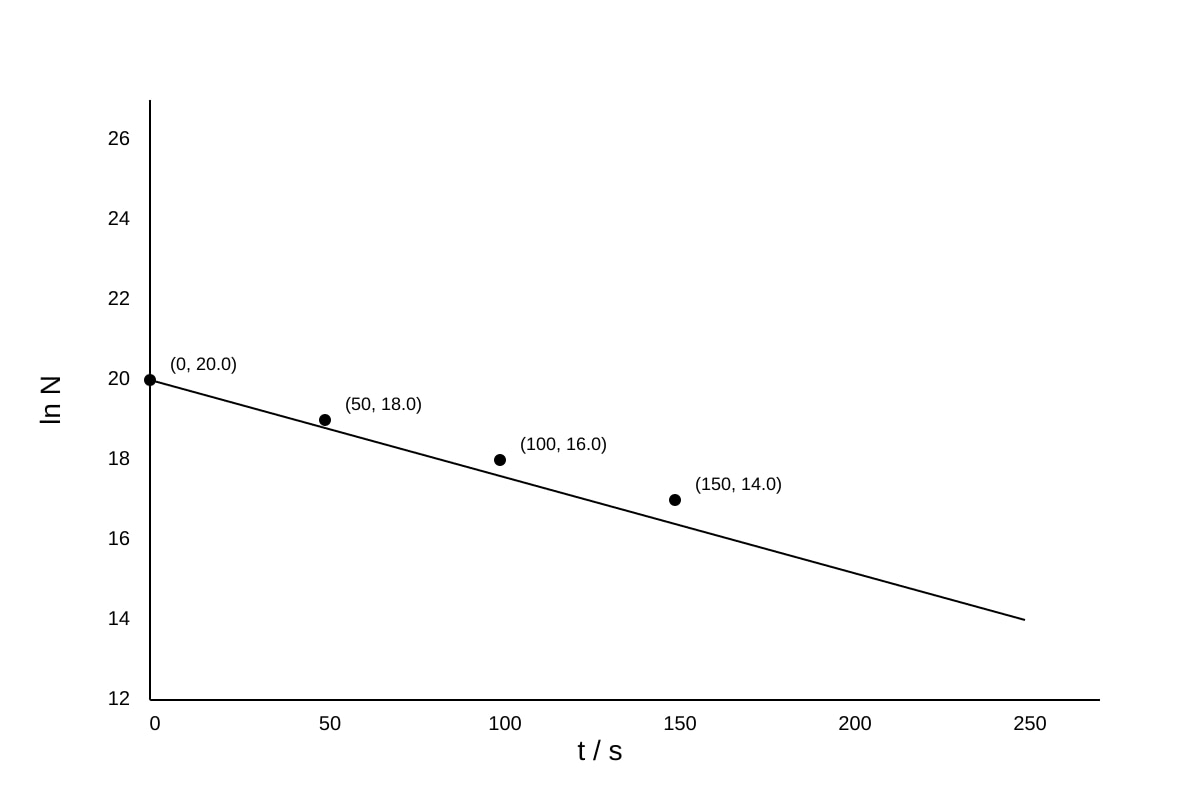
16.
Image pending generation: graph for Q16.
Using the graph, (a) find the gradient; (b) hence determine the decay constant λ; (c) state the initial number N0. [3]
17. A reactor converts mass to energy at rate P=500 MW. Calculate the mass converted per day using E=mc2. [3]
18. (a) Define activity of a radioactive sample. [1]
(b) The activity drops from A0 to A0/4 in 20 days. Find the half-life. [2]
19. Compare fission and fusion in terms of binding energy per nucleon and energy release. [3]
20. A sample of 53131I (half-life 8.0 days) has initial mass 0.20 mg. (a) Calculate initial number of nuclei. (b) Activity after 16 days. [4]
Answers
A-Level Physics H1 Quiz - Modern Physics (Answers)
Total Marks: 40
Section A
1. [1] A nuclide is a species of atom characterised by its number of protons and neutrons (nucleon number A and proton number Z).
Teaching note: Use "specific nucleus with given Z and A". Common mistake: calling it just "atom".
2. [1] Mass defect is the difference between the sum of masses of free constituent nucleons and the actual mass of the bound nucleus.
Δm=Zmp+(A−Z)mn−mnucleus
3. [1] 88226Ra→ 86222Rn+ 24α
Check: A: 226→222+4, Z: 88→86+2.
4. [2] Radioactive decay: random and spontaneous; nucleus decays independently. Half-life: time for half the undecayed nuclei (or activity) to decay. [1+1]
5. [1] Binding energy = minimum energy required to separate nucleus into its constituent protons and neutrons.
Section B
6. [2] A=λN=(2.5×10⁻⁶)(4.0×10²⁰)=1.0×10¹⁵ Bq. [M1 for formula, A1 answer]
7. [2] 36 h = 3 half-lives. N=N0(1/2)3=8.0×1018/8=1.0×1018. [M1: 3 half-lives, A1]
8. [3] Sum = 1.00728+1.00867=2.01595 u. Defect = 2.01595−2.01355=0.00240 u. In kg: 0.00240×1.66×10−27=3.98×10⁻³⁰ kg. [M1 sum, M1 diff, A1 kg]
9. [2] Δm=0.00240×1.66×10−27=3.98×10⁻³⁰ kg. E=mc2=(3.98×10⁻³⁰)(3.00×10⁸)2=3.59×10⁻¹³ J. [M1 mass, A1 energy]
10. [2] N=A/λ=(1.2×108)/(4.0×10−9)=3.0×1016. [M1 formula, A1]
11. [3] Total BE = 56×8.79=492.2 MeV. In J: 492.2×106×1.60×10−19=7.88×10⁻¹¹ J. [M1 MeV, M1 J, A1]
12. [2] 25% = (1/2)2 → 2 half-lives. Age = 2×5730=11460 years. [M1 factor, A1]
Section C
13. [3] (a) Alpha: helium nucleus 24He, high ionisation, low penetration; Beta: electron, lower ionisation, higher penetration. [1+1] (b) Gamma is photon, no mass/charge change. [1]
14. [2] ZAX→ Z+1AY+ −10e+νˉ. Z increases by 1, A unchanged. [1 eq, 1 statement]
15. [3] (a) Half-life = 2 min (800→400). [1] (b) λ=ln2/T1/2=0.693/2=0.347 min−1. [M1, A1]
16. [3] (a) Gradient = (14−20)/(150−0)=−0.040 s−1. [1] (b) λ=−grad=0.040 s−1. [1] (c) At t=0, ln N = 20 → N0=e20=4.85×10⁸. [1]
Graph must show straight line, negative slope.
17. [3] Energy/day = 500×106×86400=4.32×10¹³ J. m=E/c2=4.32×1013/9×1016=4.8×10−4 kg. [M1 E, M1 m, A1]
18. [3] (a) Activity = number of decays per unit time, A=λN. [1] (b) A0/4 = 2 half-lives → T1/2=10 days. [M1, A1]
19. [3] Fission: heavy nucleus splits, moves toward higher BE/nucleon (mid-mass), releases energy. Fusion: light nuclei join, also to higher BE/nucleon, releases energy. [1+1+1]
20. [4] (a) N0=m/u=0.20×10−6/1.66×10−27=1.20×1020 (using u as nucleon mass approx; or molar mass method). (b) 16 d = 2 half-lives, A=A0/4, A0=λN0, λ=ln2/(8×86400)=1.00×10−6 s−1, A=(1.00×10−6×1.20×1020)/4=3.0×1013 Bq. [M1 N0, M1 λ, M1 A0, A1]
Free quiz and exam paper access
Enter your details to view this paper
Your access is remembered on this device.