From Real Exams Quiz
A Level H1 Physics Mechanics Quiz
Free A Level H1 Physics Mechanics quiz, LongCat Exam version, with questions, answers, and A Level-style practice for Singapore students.
These static practice materials are generated from the site's syllabus and paper-generation workflow, with source and model context shown so students and parents can evaluate the material before use.
Questions
Free quiz and exam paper access
Enter your details to view this paper
Your access is remembered on this device.
Answers
A-Level Physics H1 Quiz - Mechanics: Answer Key
Section A: Short Answer & Conceptual Questions
1. State the principle of conservation of linear momentum. [2]
Answer: The total momentum of a closed/isolated system remains constant, provided that no external forces act on the system.
Marking:
- [B1] For stating that total momentum remains constant / total momentum before = total momentum after.
- [B1] For stating the condition: no external forces / closed or isolated system.
Teaching notes: Conservation of linear momentum is one of the most fundamental principles in mechanics. A "closed system" means no mass enters or leaves, and "no external forces" means the net force from outside the system is zero. Internal forces between objects within the system can change individual momenta, but the total stays the same. Students often forget to state the condition about no external forces — this is essential for full marks.
2. Distinguish between a scalar quantity and a vector quantity, giving one example of each. [2]
Answer:
- A scalar quantity has magnitude only (no direction). Example: mass, speed, energy, time.
- A vector quantity has both magnitude and direction. Example: velocity, force, displacement, acceleration.
Marking:
- [B1] For correct distinction (magnitude only vs. magnitude and direction).
- [B1] For one correct example of each.
Teaching notes: Scalars are fully described by a number and a unit. Vectors require a direction as well. A common confusion is between speed (scalar) and velocity (vector). Speed tells you how fast; velocity tells you how fast and in what direction.
3. A ball is thrown vertically upwards. At the highest point of its trajectory, state the magnitude of:
(a) its velocity; [1]
Answer: Zero (0 m s⁻¹)
Teaching notes: At the highest point, the ball momentarily stops before reversing direction. The velocity is instantaneously zero. Students sometimes confuse this with acceleration.
(b) its acceleration. [1]
Answer: (or , directed downwards)
Teaching notes: The acceleration due to gravity acts throughout the motion — on the way up, at the top, and on the way down. It is always directed towards the centre of the Earth (downwards), assuming air resistance is negligible. This is a very common misconception: students often think acceleration is zero at the top because velocity is zero.
4. Define the term work done by a constant force. [2]
Answer: Work done by a constant force is the product of the magnitude of the force and the displacement of the object in the direction of the force.
where is the magnitude of the force, is the displacement, and is the angle between the force and the displacement.
Marking:
- [B1] For stating work = force × displacement (in the direction of the force).
- [B1] For including the condition that it is the component of force in the direction of displacement (or equivalent wording).
Teaching notes: Work is a scalar quantity measured in joules (J). If the force is perpendicular to the displacement, no work is done by that force. If the force opposes the displacement (e.g., friction), the work done by that force is negative.
5. State Newton's first law of motion. [2]
Answer: An object at rest remains at rest, and an object in uniform motion continues in uniform motion in a straight line, unless acted upon by a resultant (net) external force.
Marking:
- [B1] For stating that an object remains at rest or in uniform motion.
- [B1] For stating the condition: unless acted upon by a resultant/net external force.
Teaching notes: Newton's first law is also called the law of inertia. The key concept is that a resultant (unbalanced) force is required to change the state of motion of an object. If the net force is zero, the object's velocity does not change. Students must mention "resultant" or "net" force — saying just "force" is insufficient because balanced forces can act without changing motion.
Section B: Structured & Calculation Questions
6. A car of mass 1200 kg travelling at 25 m s⁻¹ is brought to rest in 8.0 s.
(a) Calculate the deceleration of the car. [2]
Answer: Using :
Magnitude of deceleration = (to 2 s.f.)
Marking:
- [M1] Correct substitution into .
- [A1] Correct answer with unit.
Teaching notes: Deceleration is the magnitude of negative acceleration. The negative sign indicates the acceleration is opposite to the direction of motion. Always define your positive direction first.
(b) Calculate the braking force required. [2]
Answer: Using Newton's second law, :
The braking force is (or 3750 N).
Marking:
- [M1] Correct use of with the magnitude of acceleration from (a).
- [A1] Correct answer with unit.
Teaching notes: The braking force acts opposite to the direction of motion. Since we are asked for the magnitude, we use the magnitude of the deceleration.
7. A 0.50 kg trolley A moves at 3.0 m s⁻¹ on a frictionless horizontal track and collides with a stationary trolley B of mass 1.5 kg. After the collision, the two trolleys stick together and move as one.
(a) Calculate the total momentum of the system before the collision. [2]
Answer:
Marking:
- [M1] Correct substitution into momentum formula.
- [A1] Correct answer with unit.
(b) Determine the common velocity of the two trolleys after the collision. [2]
Answer: By conservation of momentum:
Marking:
- [M1] Correct use of conservation of momentum with combined mass.
- [A1] Correct answer with unit.
(c) State whether this collision is elastic or inelastic. Justify your answer by comparing the total kinetic energy before and after the collision. [3]
Answer: This collision is inelastic.
Kinetic energy before collision:
Kinetic energy after collision:
Since (0.5625 J < 2.25 J), kinetic energy is not conserved, so the collision is inelastic.
Marking:
- [B1] Correctly stating "inelastic".
- [M1] Correct calculation of KE before collision.
- [M1/A1] Correct calculation of KE after and valid comparison showing KE is lost.
Teaching notes: In a perfectly inelastic collision (objects stick together), kinetic energy is always lost — it is converted to other forms such as heat, sound, and deformation energy. Momentum is always conserved in collisions (as long as no external forces act), but kinetic energy is only conserved in elastic collisions.
8. A projectile is launched from ground level at an angle of 30° above the horizontal with an initial speed of 40 m s⁻¹. Assume air resistance is negligible and take .
(a) Calculate the horizontal component of the initial velocity. [1]
Answer:
(b) Calculate the vertical component of the initial velocity. [1]
Answer:
(c) Calculate the time taken to reach the maximum height. [2]
Answer: At maximum height, vertical velocity :
Marking:
- [M1] Correct use of with .
- [A1] Correct answer with unit.
(d) Calculate the horizontal range of the projectile. [3]
Answer: Total time of flight =
Horizontal range:
Marking:
- [M1] Correct calculation of total time of flight (or use of ).
- [M1] Correct use of .
- [A1] Correct final answer.
Teaching notes: Projectile motion problems are solved by treating horizontal and vertical components independently. Horizontally, there is no acceleration (constant velocity). Vertically, acceleration is downwards. The time of flight is determined entirely by the vertical motion. For a projectile landing at the same vertical level it was launched from, the range formula can also be used directly.
9. A crane lifts a load of 800 kg vertically upwards at a constant speed of 2.0 m s⁻¹.
(a) Calculate the tension in the cable. [2]
Answer: Since the speed is constant, acceleration = 0. By Newton's first law, the resultant force is zero:
Marking:
- [M1] Recognition that tension equals weight (constant velocity → equilibrium).
- [A1] Correct answer with unit.
Teaching notes: Constant velocity means zero acceleration, which means zero resultant force. The tension exactly balances the weight. Students sometimes mistakenly add a "force for motion" — but Newton's first law tells us no net force is needed to maintain constant velocity.
(b) Calculate the power output of the crane. [2]
Answer:
Marking:
- [M1] Correct use of (or with ).
- [A1] Correct answer with unit.
Teaching notes: Power is the rate of doing work. When a force moves an object at constant velocity, . This is derived from .
10. A 60 kg student stands in a lift. The lift accelerates upwards at 1.5 m s⁻². Take .
(a) Draw a free-body diagram showing all the forces acting on the student. Label the forces clearly. [2]
Answer: The free-body diagram should show:
- A rectangular block representing the student.
- A downward arrow labelled (weight = N).
- An upward arrow labelled (normal reaction force from the floor), drawn longer than the weight arrow (since the lift accelerates upward, ).
Marking:
- [B1] Correct forces shown (weight down, normal reaction up).
- [B1] Correct relative lengths (N > mg) and clear labels.
Expected visual features for image_placeholder Q10-fig1: A box (student) with two vertical arrows: a shorter downward arrow labelled "Weight, N" and a longer upward arrow labelled "Normal reaction, ". The upward arrow must be visibly longer to indicate net upward force.
(b) Calculate the apparent weight of the student (i.e. the normal reaction force). [2]
Answer: Applying Newton's second law (taking upward as positive):
Marking:
- [M1] Correct equation: (or equivalent).
- [A1] Correct answer with unit.
Teaching notes: Apparent weight is the normal force exerted by the surface on the person. When the lift accelerates upward, the apparent weight is greater than the true weight — the person feels heavier. When the lift accelerates downward, the apparent weight is less. In free fall (), apparent weight is zero (weightlessness).
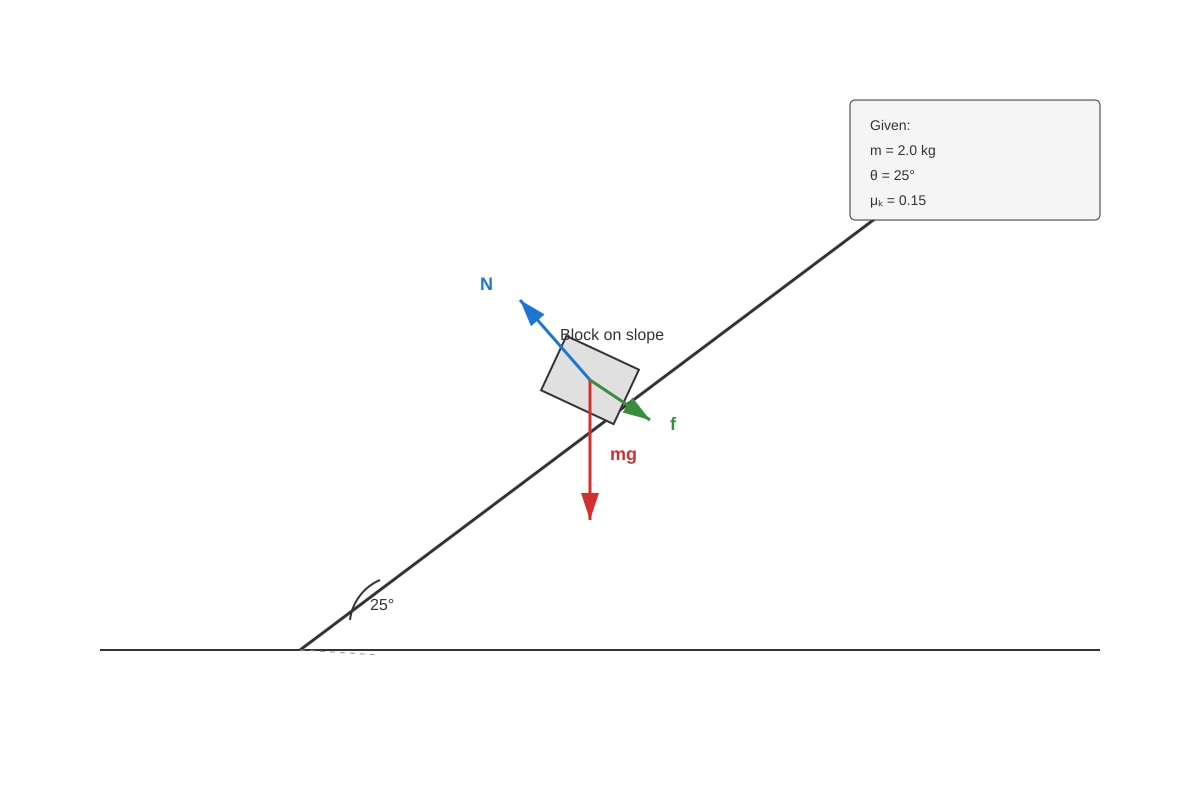
11. A 2.0 kg block slides down a rough inclined plane that makes an angle of 25° with the horizontal. The coefficient of kinetic friction between the block and the plane is 0.15. Take .
(a) Calculate the component of the weight acting parallel to the slope. [2]
Answer:
Marking:
- [M1] Correct use of .
- [A1] Correct answer with unit.
(b) Calculate the frictional force acting on the block. [2]
Answer: Normal reaction: N
Frictional force: N
Marking:
- [M1] Correct calculation of normal reaction using .
- [A1] Correct frictional force with unit.
(c) Determine the acceleration of the block down the slope. [2]
Answer: Net force down the slope:
Acceleration:
Marking:
- [M1] Correct net force (component of weight minus friction).
- [A1] Correct acceleration with unit.
Teaching notes: On an inclined plane, the weight is resolved into two components: parallel to the slope (driving the motion) and perpendicular to the slope (balanced by the normal reaction). Friction always opposes the direction of motion (or tendency of motion). Students must remember that the normal reaction on an inclined plane is , not simply .
12. A 0.25 kg ball is attached to a string of length 0.80 m and swung in a vertical circle at a constant speed of 4.0 m s⁻¹.
(a) Calculate the centripetal acceleration of the ball. [2]
Answer:
Marking:
- [M1] Correct substitution into .
- [A1] Correct answer with unit.
(b) Calculate the tension in the string when the ball is at the lowest point of the circle. [3]
Answer: At the lowest point, the tension acts upward and the weight acts downward. The net force towards the centre (upward) provides the centripetal force:
Marking:
- [M1] Correct equation: .
- [M1] Correct substitution of all values.
- [A1] Correct answer with unit.
Teaching notes: At the lowest point of a vertical circle, both the tension and the centripetal force point towards the centre (upward). The tension must overcome the weight AND provide the centripetal force, so . At the highest point, the tension would be (weight assists the centripetal force). This is a common exam question — students must carefully consider the direction of each force relative to the centre of the circle.
13. A motor lifts a 50 kg object from the ground to a height of 12 m in 15 s.
(a) Calculate the gain in gravitational potential energy of the object. [2]
Answer:
Marking:
- [M1] Correct substitution into .
- [A1] Correct answer with unit.
(b) Calculate the minimum power required by the motor. [2]
Answer:
Marking:
- [M1] Correct use of with work = gain in GPE.
- [A1] Correct answer with unit.
(c) In practice, the motor must supply more power than your answer in (b). Suggest one reason for this. [1]
Answer: Energy is lost due to work done against friction in the motor / pulley system / air resistance. OR: Some energy is converted to thermal energy (heat) in the motor due to electrical resistance. OR: The motor has less than 100% efficiency.
Marking:
- [B1] Any valid reason involving energy loss or inefficiency.
Teaching notes: The calculation in (b) gives the useful power output (the rate of gain in GPE). In reality, motors are not 100% efficient — some input energy is wasted as heat due to friction in moving parts and electrical resistance in the motor coils.
14. A 4.0 kg object moving at 6.0 m s⁻¹ on a smooth horizontal surface collides with a stationary 2.0 kg object. After the collision, the 4.0 kg object continues to move in the same direction at 2.0 m s⁻¹.
(a) Using the principle of conservation of momentum, calculate the velocity of the 2.0 kg object after the collision. [3]
Answer: Conservation of momentum:
Marking:
- [M1] Correct conservation of momentum equation with all terms.
- [M1] Correct substitution of values.
- [A1] Correct answer with unit and direction (same direction as initial motion).
(b) Show that this collision is inelastic by calculating the total kinetic energy before and after the collision. [3]
Answer: Kinetic energy before:
Kinetic energy after:
Wait — let me recheck: J. The kinetic energies are equal, so this collision is actually elastic.
Let me recalculate carefully:
- J
- J
The collision is elastic since kinetic energy is conserved.
Revised Answer: The collision is elastic because the total kinetic energy before the collision (72.0 J) equals the total kinetic energy after the collision (72.0 J).
Marking:
- [M1] Correct calculation of KE before.
- [M1] Correct calculation of KE after.
- [A1] Correct conclusion that KE is conserved → elastic collision.
Teaching notes: This is a good example of why students should always check their calculations. The question asked to "show it is inelastic," but the numbers actually show an elastic collision. In an exam, if the numbers show KE is conserved, the correct physics answer is that the collision is elastic. Students should not force a conclusion that contradicts their calculation. (Note: In a real exam, the question setter would ensure the numbers lead to the stated conclusion. This question tests whether students can correctly apply the physics.)
15. A car of mass 1000 kg travels around a horizontal circular bend of radius 50 m at a constant speed of 20 m s⁻¹.
(a) Calculate the centripetal acceleration of the car. [2]
Answer:
Marking:
- [M1] Correct substitution into .
- [A1] Correct answer with unit.
(b) Calculate the centripetal force required to keep the car moving in the circle. [2]
Answer:
Marking:
- [M1] Correct use of with centripetal acceleration.
- [A1] Correct answer with unit.
(c) Name the physical force that provides the centripetal force in this situation. [1]
Answer: Friction (between the tyres and the road).
Marking:
- [B1] Friction / static friction.
Teaching notes: Centripetal force is not a new type of force — it is the name given to the net force directed towards the centre of a circular path. In different situations, it can be provided by tension (ball on a string), gravity (planetary orbits), friction (car on a road), or normal force (banked curves). On a flat road, static friction between the tyres and the road provides the centripetal force. If the road is icy (low friction), the car cannot turn effectively.
Section C: Data Interpretation & Application
16. Velocity-time graph analysis.
(a) Determine the acceleration of the car during the first 8.0 s. [2]
Answer: Acceleration = gradient of v-t graph:
Marking:
- [M1] Correct use of gradient = acceleration.
- [A1] Correct answer with unit.
(b) Calculate the total distance travelled by the car in the 20 s interval. [3]
Answer: Distance = area under the v-t graph.
The graph forms a trapezium (or can be split into a triangle + rectangle + triangle):
- Triangle (0–8 s): Area = m
- Rectangle (8–14 s): Area = m
- Triangle (14–20 s): Area = m
Total distance = m
Marking:
- [M1] Correct identification of areas (or use of trapezium area formula).
- [M1] Correct calculation of each area.
- [A1] Correct total.
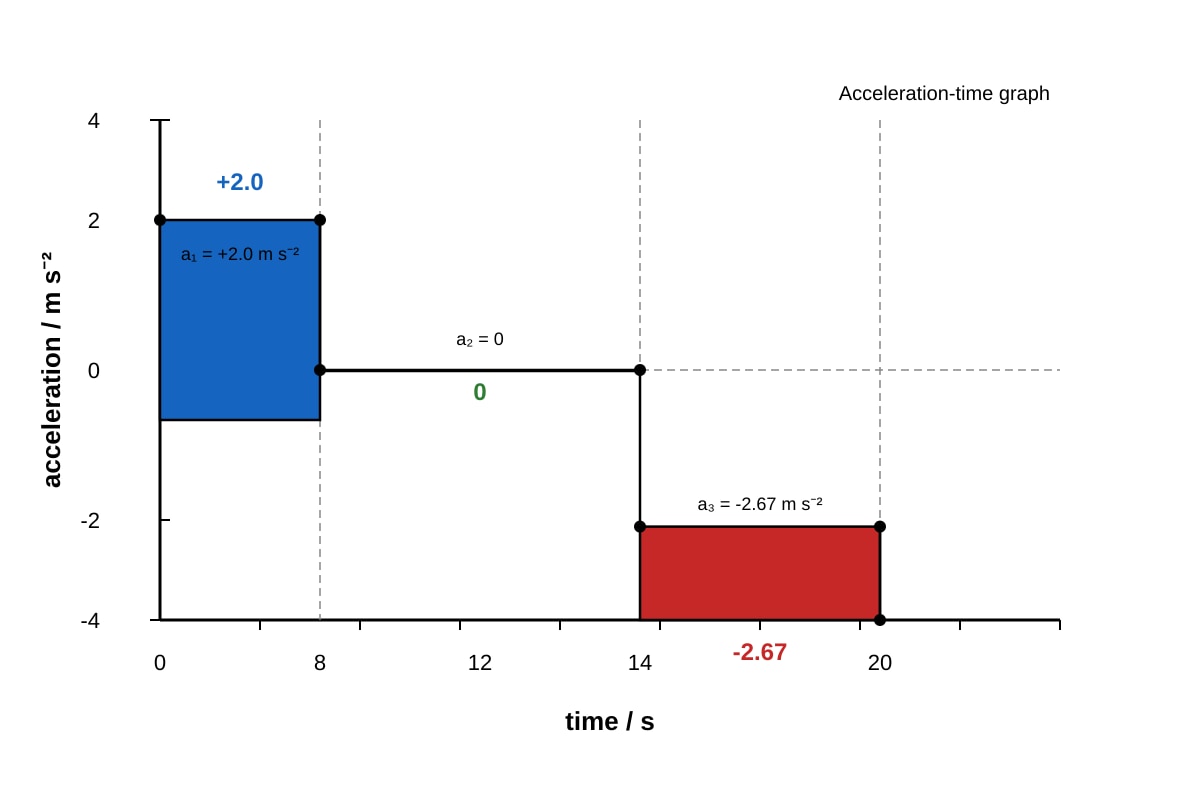
(c) Sketch the corresponding acceleration-time graph. [3]
Answer:
- From to s: m s⁻² (constant positive)
- From to s: m s⁻² (constant velocity)
- From to s: m s⁻² (constant negative)
Marking:
- [B1] Correct value and sign for first segment (+2.0 m s⁻²).
- [B1] Correct value for second segment (0).
- [B1] Correct value and sign for third segment (−2.67 m s⁻²).
Expected visual features for image_placeholder Q16-fig2: Three horizontal line segments: first at m s⁻² from to s, second at from to s, third at m s⁻² from to s. Axes clearly labelled with units.
17. A 70 kg athlete performs a vertical jump. The athlete's centre of mass rises by 0.45 m during the upward push-off phase. Take .
(a) Calculate the minimum take-off speed required for the athlete's centre of mass to reach a maximum height of 0.80 m above the ground. [3]
Answer: After leaving the ground, the athlete decelerates under gravity. Using with at max height, , m:
Marking:
- [M1] Correct kinematic equation chosen.
- [M1] Correct substitution with , , m.
- [A1] Correct answer with unit.
(b) Using the work-energy principle, calculate the average upward force exerted by the ground on the athlete during the push-off phase. [3]
Answer: During push-off, two forces do work on the athlete: the upward normal force (from the ground) and the downward weight .
The athlete starts from rest and reaches take-off speed m s⁻¹ over a displacement of m.
Using the work-energy theorem:
Marking:
- [M1] Correct work-energy equation: .
- [M1] Correct substitution of all values.
- [A1] Correct answer with unit.
Teaching notes: The work-energy principle states that the net work done on an object equals its change in kinetic energy. During push-off, the net upward force is , and this net force acts over the push-off distance. The athlete starts from rest (or near-rest) and leaves the ground at the take-off speed calculated in part (a).
18. Two ice skaters, A and B, are initially at rest on a frictionless horizontal ice surface. Skater A has a mass of 55 kg and skater B has a mass of 70 kg. Skater A pushes skater B so that skater B moves off at 2.4 m s⁻¹.
(a) Using the principle of conservation of momentum, calculate the velocity of skater A after the push. [3]
Answer: Initial total momentum = 0 (both at rest).
By conservation of momentum:
The negative sign indicates skater A moves in the opposite direction to skater B.
Speed of skater A = m s⁻¹ (opposite direction to B).
Marking:
- [M1] Correct conservation of momentum equation with initial momentum = 0.
- [M1] Correct substitution.
- [A1] Correct magnitude and direction (or correct signed answer with direction stated).
(b) State the direction in which skater A moves relative to skater B. [1]
Answer: Skater A moves in the opposite direction to skater B.
Marking:
- [B1] Opposite direction (or equivalent wording).
(c) Calculate the total kinetic energy of the system after the push. [2]
Answer:
Marking:
- [M1] Correct calculation of both KE terms.
- [A1] Correct total with unit.
Teaching notes: This is a recoil problem. The initial momentum is zero, so the two skaters must move in opposite directions with momenta that cancel. The kinetic energy after the push comes from the chemical energy in the muscles of skater A — this is not an elastic process. Momentum is conserved (always, in the absence of external forces), but kinetic energy is not conserved here because the push involves internal energy conversion.
19. A small sphere is released from rest at the top of a smooth curved track and moves along the track. The vertical height of the starting point above the lowest point of the track is 3.0 m. Take .
(a) Using the principle of conservation of energy, calculate the speed of the sphere at the lowest point of the track. [3]
Answer: Taking the lowest point as the reference level (h = 0):
At the top: , At the bottom: ,
By conservation of mechanical energy (track is smooth, so no friction):
Marking:
- [M1] Correct energy conservation equation: .
- [M1] Correct substitution.
- [A1] Correct answer with unit.
(b) Explain why the shape of the track does not affect the final speed at the lowest point, assuming the track is smooth. [2]
Answer: Since the track is smooth, there is no friction, so mechanical energy is conserved. The loss in gravitational potential energy () depends only on the vertical height difference, not on the path taken. This loss in GPE is entirely converted to kinetic energy (). Since depends only on and , the final speed is independent of the shape of the track.
Marking:
- [B1] For stating that mechanical energy is conserved (no friction).
- [B1] For explaining that GPE loss depends only on vertical height, not path/shape.
Teaching notes: This is a classic energy conservation result. The speed at the bottom depends only on the vertical drop, not on whether the track is straight, curved, or even a loop (as long as it's smooth). This is analogous to the independence of path for gravitational potential energy. If friction were present, the shape would matter because a longer path would mean more energy lost to friction.
20. A 1500 kg car travelling at 30 m s⁻¹ collides head-on with a rigid wall and comes to rest. The crumple zone of the car allows the car to decelerate over a distance of 0.75 m.
(a) Calculate the deceleration of the car during the collision. [3]
Answer: Using with , m s⁻¹, m:
Magnitude of deceleration = m s⁻¹.
Marking:
- [M1] Correct kinematic equation chosen.
- [M1] Correct substitution.
- [A1] Correct answer with unit.
(b) Calculate the average force exerted on the car during the collision. [2]
Answer:
Marking:
- [M1] Correct use of .
- [A1] Correct answer with unit.
(c) Explain how the crumple zone helps to reduce the risk of injury to the driver, with reference to a relevant physics principle. [2]
Answer: The crumple zone increases the distance (and therefore the time) over which the car decelerates. By the impulse-momentum theorem (), for a given change in momentum, increasing the time of collision reduces the average force experienced by the driver. A smaller force means less risk of injury.
Marking:
- [B1] For stating that the crumple zone increases the time/distance of deceleration.
- [B1] For linking this to reduced force using the impulse-momentum theorem ( or ).
Teaching notes: The impulse-momentum theorem is key here: . The change in momentum is fixed (the car goes from 30 m s⁻¹ to 0), so increasing decreases . Without a crumple zone, the car would stop almost instantaneously, producing an enormous force. The crumple zone extends the stopping distance from perhaps a few centimetres to 0.75 m or more, dramatically reducing the force on the occupants.
END OF ANSWER KEY