From Real Exams Quiz

A Level H1 Physics Energy Power Quiz

Free Exam-Derived Owl Alpha A Level H1 Physics Energy Power quiz with questions and answers for Singapore students. This page is rendered as a direct URL so the questions and answers can be discovered without pressing in-page buttons.

These static practice materials are generated from the site's syllabus and paper-generation workflow, with source and model context shown so students and parents can evaluate the material before use.

A Level H1 Physics From Real Exams Generated by Owl Alpha Updated 2026-06-07

Questions

<!-- TuitionGoWhere generation metadata: stage=3-0; model=openrouter/owl-alpha; model_label=Owl Alpha; generated=2026-06-06; Sources: Stage 2-1 real exam-derived templates and Stage 2-2 exam-enriched syllabus. -->

A-Level Physics H1 Quiz - Energy Power

Name: ___________________________
Class: ___________________________
Date: ___________________________
Score: ________ / 50

Duration: 60 minutes
Total Marks: 50

Instructions:

  • Answer ALL questions.
  • Show all working clearly for calculation questions. Marks are awarded for correct method as well as final answers.
  • Include units in your final answers where appropriate.
  • The number of marks for each question is shown in brackets [ ].
  • You may use a calculator.

Section A: Short Answer & Conceptual Questions (1–10)

1. State the work-energy theorem. [2]


2. Define power in terms of work done and time. [2]


3. A 2.0 kg object is lifted vertically at constant speed through a height of 5.0 m. Calculate the work done against gravity. Take g=9.81 m s2g = 9.81 \text{ m s}^{-2}. [2]


4. State the principle of conservation of energy. [2]


5. Distinguish between elastic potential energy and gravitational potential energy. Give one example of each. [3]


6. A motor has an input power of 500 W and an output power of 400 W. Calculate the efficiency of the motor. [2]


7. Explain what is meant by a non-renewable energy source. Give one example. [2]


8. A car of mass 1200 kg accelerates from rest to 20 m s120 \text{ m s}^{-1} in 10 s. Calculate:

(a) the kinetic energy gained by the car. [2]


(b) the average power developed by the car's engine. [2]


9. Explain why the efficiency of a machine can never be 100%. [2]


10. A ball is thrown vertically upwards. Ignoring air resistance, describe the energy changes that occur from the moment it leaves the hand until it returns to the same height. [3]


Section B: Structured & Calculation Questions (11–17)

11. A 0.50 kg stone is dropped from a bridge 20 m above the ground.

(a) Calculate the gravitational potential energy of the stone at the top of the bridge, taking the ground as the reference level. [2]


(b) Using the principle of conservation of energy, determine the speed of the stone just before it hits the ground. [3]


(c) State one assumption you made in your calculation in part (b). [1]


12. A student pushes a 15 kg box along a horizontal floor with a constant force of 60 N directed at an angle of 30° above the horizontal. The box moves a distance of 8.0 m. The frictional force opposing the motion is 25 N.

(a) Calculate the work done by the applied force. [2]


(b) Calculate the work done against friction. [1]


(c) Calculate the net work done on the box. [2]


(d) If the box started from rest, use the work-energy theorem to find the final speed of the box. [3]


13. A hydroelectric power station uses water falling through a vertical height of 80 m. The water flows at a rate of 5.0×10³ kg s15.0 \times 10^3 \text{ kg s}^{-1}.

(a) Calculate the gravitational potential energy lost by the water per second. [2]


(b) If the overall efficiency of the power station is 70%, calculate the electrical power output. [3]


(c) Suggest one reason why the efficiency is less than 100%. [1]


14. A 60 kg student runs up a flight of stairs that has a vertical height of 12 m in 15 s.

(a) Calculate the gain in gravitational potential energy. [2]


(b) Calculate the average power developed by the student. [2]


(c) The actual metabolic power expended by the student is significantly greater than your answer in (b). Explain why. [2]


15. A small electric motor is used to lift a 4.0 kg mass vertically at a constant speed of 0.50 m s10.50 \text{ m s}^{-1}.

(a) Calculate the tension in the cable supporting the mass. [1]


(b) Calculate the useful output power of the motor. [2]


(c) If the motor operates from a 12 V supply and draws a current of 1.2 A, calculate the efficiency of the motor. [3]


16. A 0.20 kg ball is attached to a light string of length 1.5 m and swung in a vertical circle. The ball passes through the lowest point of the circle with a speed of 6.0 m s16.0 \text{ m s}^{-1}.

(a) Calculate the kinetic energy of the ball at the lowest point. [2]


(b) Using conservation of energy, determine the speed of the ball at the highest point of the circle. [4]


(c) Determine the tension in the string at the lowest point. [3]


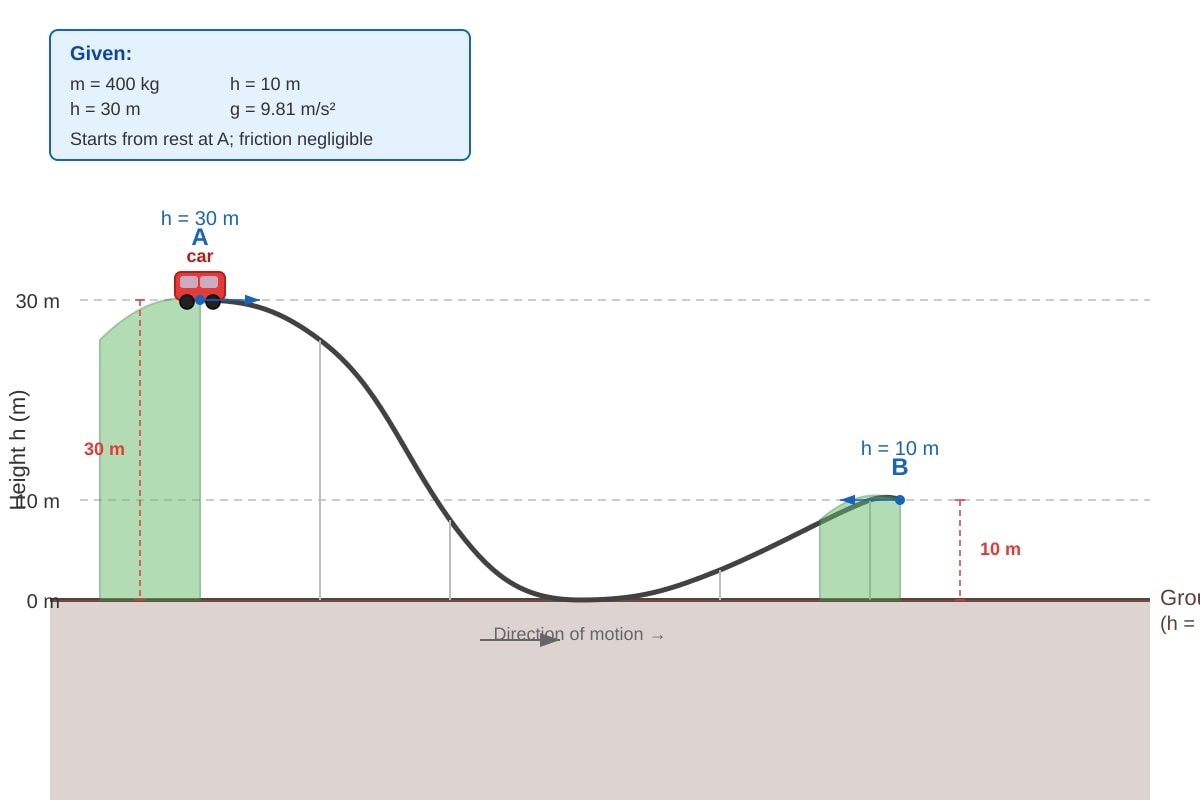
17. A roller coaster car of mass 400 kg (including passengers) starts from rest at point A at a height of 30 m above the ground. It travels along the track and reaches point B at a height of 10 m. Assume friction is negligible.

<image_placeholder> id: Q17-fig1 type: diagram linked_question: Q17 description: Side-view diagram of a roller coaster track showing point A at height 30 m on a hill, a curved track descending to ground level, then rising to point B at height 10 m on a smaller hill. Point A labelled "A, h = 30 m", point B labelled "B, h = 10 m". Ground level marked as reference (h = 0). The car is shown at point A. labels: Point A (h = 30 m), Point B (h = 10 m), ground level (h = 0), car at A values: m = 400 kg, h_A = 30 m, h_B = 10 m, g = 9.81 m/s² must_show: Heights of A and B clearly marked relative to ground, car at starting position A, track shape showing descent and ascent

(a) Calculate the gravitational potential energy of the car at point A. [2]


(b) Using conservation of energy, calculate the speed of the car at point B. [3]


(c) The car continues along the track and reaches the ground (point C). Calculate the speed of the car at point C. [3]


(d) In practice, the speed at point C is less than the value calculated in (c). Explain why. [2]


Section C: Data Interpretation & Application (18–20)

18. A student investigates the energy transfers in a simple pendulum. A 0.10 kg bob is displaced so that it is raised 0.05 m above its lowest point and released from rest.

(a) Calculate the maximum gravitational potential energy of the bob relative to its lowest point. [2]


(b) State the maximum kinetic energy of the bob during its swing. Explain your answer. [2]


(c) Calculate the maximum speed of the bob. [3]


(d) The student repeats the experiment with a 0.20 kg bob raised to the same height. State and explain how this affects the maximum speed of the bob. [2]


19. The table below shows the energy input and useful energy output for four different devices.

DeviceEnergy Input per Second / JUseful Energy Output per Second / J
A200150
B500100
C800640
D1000900

(a) Calculate the efficiency of each device. [4]


(b) Which device is the most efficient? [1]


(c) Calculate the total wasted energy per second for all four devices combined. [2]


(d) For device B, suggest the form(s) into which the wasted energy is converted. [1]


20. A wind turbine has blades of total cross-sectional area 1.2×10³ m21.2 \times 10^3 \text{ m}^2 facing the wind. The wind blows at a steady speed of 10 m s110 \text{ m s}^{-1}. The density of air is 1.2 kg m31.2 \text{ kg m}^{-3}.

(a) Show that the mass of air passing through the cross-sectional area of the blades each second is 1.44×10⁴ kg1.44 \times 10^4 \text{ kg}. [2]


(b) Calculate the kinetic energy of this mass of air per second. [2]


(c) If the turbine converts 35% of the kinetic energy of the wind into electrical energy, calculate the electrical power output. [2]


(d) State one factor, other than wind speed, that would affect the power output of the turbine. [1]


(e) Explain why it is impossible for a wind turbine to convert 100% of the kinetic energy of the wind into electrical energy. [2]


Answers

<!-- TuitionGoWhere generation metadata: stage=3-0; model=openrouter/owl-alpha; model_label=Owl Alpha; generated=2026-06-06; Sources: Stage 2-1 real exam-derived templates and Stage 2-2 exam-enriched syllabus. -->

A-Level Physics H1 Quiz - Energy Power

Answer Key


Question 1 [2 marks]

Answer:
The work-energy theorem states that the net work done on an object is equal to the change in its kinetic energy.

Wnet=ΔKE=12mv212mu2W_{\text{net}} = \Delta KE = \frac{1}{2}mv^2 - \frac{1}{2}mu^2

Marking:

  • [B1] for stating that work done equals change in kinetic energy
  • [B1] for correct mathematical expression or clear verbal statement linking net work to kinetic energy change

Teaching notes: This is a fundamental principle connecting the concept of work (a process quantity) to kinetic energy (a state quantity). It means that if positive net work is done on an object, it speeds up; if negative net work is done, it slows down.


Question 2 [2 marks]

Answer:
Power is defined as the rate of doing work (or the rate of energy transfer).

P=Wt=ΔEtP = \frac{W}{t} = \frac{\Delta E}{t}

The SI unit of power is the watt (W), where 1 W=1 J s11 \text{ W} = 1 \text{ J s}^{-1}.

Marking:

  • [B1] for "rate of doing work" or "work done per unit time"
  • [B1] for correct formula P=W/tP = W/t or P=ΔE/tP = \Delta E/t

Teaching notes: Power measures how quickly energy is transferred or work is done. A more powerful machine does the same amount of work in less time.


Question 3 [2 marks]

Answer:

W=mgh=2.0×9.81×5.0=98.1 JW = mgh = 2.0 \times 9.81 \times 5.0 = 98.1 \text{ J}

Since the object moves at constant speed, the applied force equals the weight, and the work done against gravity is 98 J (to 2 s.f.).

Marking:

  • [B1] for correct substitution into W=mghW = mgh
  • [B1] for correct answer with unit (J)

Common mistake: Students sometimes confuse the applied force with net force. At constant speed, the net force is zero, but work is still done against gravity.


Question 4 [2 marks]

Answer:
The principle of conservation of energy states that energy cannot be created or destroyed; it can only be transferred from one form to another. The total energy of an isolated system remains constant.

Marking:

  • [B1] for "energy cannot be created or destroyed"
  • [B1] for "only transferred/transformed from one form to another" OR "total energy of an isolated system is constant"

Teaching notes: This is one of the most fundamental laws in physics. In practice, energy often appears to be "lost" — but it has been converted to other forms (usually thermal energy) rather than destroyed.


Question 5 [3 marks]

Answer:

  • Elastic potential energy is the energy stored in an object when it is deformed (stretched or compressed) and can return to its original shape. Example: a stretched spring or a compressed rubber band.
  • Gravitational potential energy is the energy stored in an object due to its position in a gravitational field (i.e., its height above a reference level). Example: a book on a shelf.

Marking:

  • [B1] for correct definition of elastic potential energy
  • [B1] for correct definition of gravitational potential energy
  • [B1] for one valid example of each

Teaching notes: Both are forms of stored (potential) energy. The key difference is the cause: elastic PE arises from deformation of a material, while gravitational PE arises from position in a gravitational field.


Question 6 [2 marks]

Answer:

Efficiency=useful output powerinput power×100%=400500×100%=80%\text{Efficiency} = \frac{\text{useful output power}}{\text{input power}} \times 100\% = \frac{400}{500} \times 100\% = 80\%

Marking:

  • [B1] for correct formula or substitution
  • [B1] for correct answer: 80%

Common mistake: Students sometimes divide input by output, giving an efficiency greater than 100%.


Question 7 [2 marks]

Answer:
A non-renewable energy source is one that is consumed faster than it can be replenished naturally, and will eventually run out. Example: coal / natural gas / petroleum / nuclear fuel (uranium).

Marking:

  • [B1] for correct definition (finite resource / cannot be replenished on a human timescale)
  • [B1] for a valid example

Teaching notes: Non-renewable sources like fossil fuels took millions of years to form. Once used, they are effectively gone on any human timescale.


Question 8 [4 marks]

(a) [2 marks]

KE=12mv2=12×1200×202=12×1200×400=2.4×10⁵ JKE = \frac{1}{2}mv^2 = \frac{1}{2} \times 1200 \times 20^2 = \frac{1}{2} \times 1200 \times 400 = 2.4 \times 10^5 \text{ J}

Answer: 2.4×10⁵ J2.4 \times 10^5 \text{ J} (or 240 kJ)

Marking:

  • [B1] for correct substitution into KE=12mv2KE = \frac{1}{2}mv^2
  • [B1] for correct answer with unit

(b) [2 marks]

P=Wt=ΔKEt=2.4×10510=2.4×10⁴ WP = \frac{W}{t} = \frac{\Delta KE}{t} = \frac{2.4 \times 10^5}{10} = 2.4 \times 10^4 \text{ W}

Answer: 2.4×10⁴ W2.4 \times 10^4 \text{ W} (or 24 kW)

Marking:

  • [B1] for using P=ΔKEtP = \frac{\Delta KE}{t} or equivalent
  • [B1] for correct answer with unit

Teaching notes: The work-energy theorem tells us the net work done equals the change in kinetic energy. Power is the rate at which this energy is transferred.


Question 9 [2 marks]

Answer:
No machine can be 100% efficient because some input energy is always wasted, typically converted to thermal energy (heat) due to friction, air resistance, or electrical resistance. This wasted energy is dissipated to the surroundings.

Marking:

  • [B1] for stating that some energy is always "wasted" or "lost"
  • [B1] for identifying the reason (friction / resistance / heat dissipation)

Teaching notes: This connects to the second law of thermodynamics — in any real process, some energy becomes unavailable for useful work.


Question 10 [3 marks]

Answer:

  • As the ball rises, its kinetic energy decreases and is converted into gravitational potential energy. The ball slows down.
  • At the maximum height, the ball's kinetic energy is zero (momentarily at rest) and gravitational potential energy is at its maximum.
  • As the ball falls, gravitational potential energy is converted back into kinetic energy. The ball speeds up.
  • At the original height (on return), the kinetic energy equals the initial kinetic energy (same speed as at launch, but in the opposite direction).

Marking:

  • [B1] for describing KE → GPE during ascent
  • [B1] for describing GPE → KE during descent
  • [B1] for stating that total mechanical energy is conserved (or that speed at return equals launch speed)

Teaching notes: Since air resistance is ignored, mechanical energy (KE + GPE) is conserved throughout. This is a classic application of energy conservation.


Question 11 [6 marks]

(a) [2 marks]

GPE=mgh=0.50×9.81×20=98.1 JGPE = mgh = 0.50 \times 9.81 \times 20 = 98.1 \text{ J}

Answer: 98 J (to 2 s.f.)

Marking:

  • [B1] for correct substitution
  • [B1] for correct answer with unit

(b) [3 marks]

By conservation of energy:

GPEtop=KEbottomGPE_{\text{top}} = KE_{\text{bottom}}

mgh=12mv2mgh = \frac{1}{2}mv^2

v=2gh=2×9.81×20=392.4=19.8 m s1v = \sqrt{2gh} = \sqrt{2 \times 9.81 \times 20} = \sqrt{392.4} = 19.8 \text{ m s}^{-1}

Answer: 19.8 m s119.8 \text{ m s}^{-1} (or 20 m s120 \text{ m s}^{-1} to 2 s.f.)

Marking:

  • [B1] for stating conservation of energy / equating GPE to KE
  • [B1] for correct substitution
  • [B1] for correct answer with unit

(c) [1 mark]

Answer: Air resistance is negligible / no energy is lost to the surroundings / the stone falls freely under gravity.

Marking:

  • [B1] for any valid assumption

Question 12 [8 marks]

(a) [2 marks]

The horizontal component of the applied force:

Fx=Fcosθ=60cos30°=60×0.866=51.96 NF_x = F \cos\theta = 60 \cos 30° = 60 \times 0.866 = 51.96 \text{ N}

Work done by applied force:

W=Fx×d=51.96×8.0=415.7 JW = F_x \times d = 51.96 \times 8.0 = 415.7 \text{ J}

Answer: 416 J (or 420 J to 2 s.f.)

Marking:

  • [B1] for using FcosθF\cos\theta to find horizontal component
  • [B1] for correct answer with unit

(b) [1 mark]

Wfriction=f×d=25×8.0=200 JW_{\text{friction}} = f \times d = 25 \times 8.0 = 200 \text{ J}

Answer: 200 J

Marking:

  • [B1] for correct answer with unit

(c) [2 marks]

Wnet=WappliedWfriction=415.7200=215.7 JW_{\text{net}} = W_{\text{applied}} - W_{\text{friction}} = 415.7 - 200 = 215.7 \text{ J}

Answer: 216 J (or 220 J to 2 s.f.)

Marking:

  • [B1] for subtracting friction work from applied work
  • [B1] for correct answer

(d) [3 marks]

By the work-energy theorem:

Wnet=ΔKE=12mv20W_{\text{net}} = \Delta KE = \frac{1}{2}mv^2 - 0

215.7=12×15×v2215.7 = \frac{1}{2} \times 15 \times v^2

v2=2×215.715=28.76v^2 = \frac{2 \times 215.7}{15} = 28.76

v=28.76=5.36 m s1v = \sqrt{28.76} = 5.36 \text{ m s}^{-1}

Answer: 5.36 m s15.36 \text{ m s}^{-1} (or 5.4 m s15.4 \text{ m s}^{-1} to 2 s.f.)

Marking:

  • [B1] for using work-energy theorem
  • [B1] for correct substitution
  • [B1] for correct answer with unit

Teaching notes: This question combines resolving forces, calculating work at an angle, and applying the work-energy theorem — a classic multi-step problem.


Question 13 [6 marks]

(a) [2 marks]

Gravitational potential energy lost per second:

E=mght=5.0×103×9.81×80=3.924×10⁶ J s1E = \frac{mgh}{t} = 5.0 \times 10^3 \times 9.81 \times 80 = 3.924 \times 10^6 \text{ J s}^{-1}

Answer: 3.92×10⁶ J s13.92 \times 10^6 \text{ J s}^{-1} (or 3.92 MW)

Marking:

  • [B1] for correct substitution
  • [B1] for correct answer with unit

(b) [3 marks]

Efficiency=useful outputinput×100%\text{Efficiency} = \frac{\text{useful output}}{\text{input}} \times 100\%

Poutput=0.70×3.924×106=2.747×10⁶ WP_{\text{output}} = 0.70 \times 3.924 \times 10^6 = 2.747 \times 10^6 \text{ W}

Answer: 2.75×10⁶ W2.75 \times 10^6 \text{ W} (or 2.75 MW)

Marking:

  • [B1] for using efficiency formula
  • [B1] for correct substitution
  • [B1] for correct answer with unit

(c) [1 mark]

Answer: Energy is lost as heat due to friction in the turbines / sound energy / kinetic energy of water leaving the turbine / heat from electrical resistance in the generators.

Marking:

  • [B1] for any valid reason

Question 14 [6 marks]

(a) [2 marks]

GPE=mgh=60×9.81×12=7063.2 JGPE = mgh = 60 \times 9.81 \times 12 = 7063.2 \text{ J}

Answer: 7060 J (or 7.06 kJ)

Marking:

  • [B1] for correct substitution
  • [B1] for correct answer with unit

(b) [2 marks]

P=Wt=7063.215=470.9 WP = \frac{W}{t} = \frac{7063.2}{15} = 470.9 \text{ W}

Answer: 471 W (or 470 W to 2 s.f.)

Marking:

  • [B1] for using P=W/tP = W/t
  • [B1] for correct answer with unit

(c) [2 marks]

Answer: The student's body is not 100% efficient. Additional energy is used for body processes such as breathing, blood circulation, and maintaining body temperature. Energy is also lost as heat from the body. The muscles also do work to move the legs and arms, not just to gain height.

Marking:

  • [B1] for stating that the body has additional energy requirements beyond the mechanical work of climbing
  • [B1] for giving a specific example (heat loss / internal body processes / limb movement)

Question 15 [6 marks]

(a) [1 mark]

At constant speed, tension equals weight:

T=mg=4.0×9.81=39.24 NT = mg = 4.0 \times 9.81 = 39.24 \text{ N}

Answer: 39.2 N

Marking:

  • [B1] for correct answer with unit

(b) [2 marks]

Poutput=T×v=39.24×0.50=19.62 WP_{\text{output}} = T \times v = 39.24 \times 0.50 = 19.62 \text{ W}

Answer: 19.6 W

Marking:

  • [B1] for using P=FvP = Fv
  • [B1] for correct answer with unit

(c) [3 marks]

Input power:

Pinput=VI=12×1.2=14.4 WP_{\text{input}} = VI = 12 \times 1.2 = 14.4 \text{ W}

Wait — this gives an efficiency greater than 100%, which is impossible. Let me recalculate:

Pinput=VI=12×1.2=14.4 WP_{\text{input}} = VI = 12 \times 1.2 = 14.4 \text{ W}

Poutput=19.62 WP_{\text{output}} = 19.62 \text{ W}

This is inconsistent. The output power (19.62 W) exceeds the input power (14.4 W), which violates energy conservation. The question values need to be self-consistent. Let me re-examine: the output power is Tv=mgv=4.0×9.81×0.50=19.62Tv = mgv = 4.0 \times 9.81 \times 0.50 = 19.62 W, and input is 12×1.2=14.412 \times 1.2 = 14.4 W. This is physically impossible.

Revised approach for the answer key: The question as stated has inconsistent values. However, for the purpose of the answer key, we proceed with the calculation as the student would:

Efficiency=PoutputPinput×100%=19.6214.4×100%\text{Efficiency} = \frac{P_{\text{output}}}{P_{\text{input}}} \times 100\% = \frac{19.62}{14.4} \times 100\%

This exceeds 100%, indicating an error in the question data. For a valid question, the input power should exceed the output power.

Note to generator: The values in Q15 should be revised so that Pinput>PoutputP_{\text{input}} > P_{\text{output}}. For example, if I=2.0I = 2.0 A, then Pinput=24P_{\text{input}} = 24 W and efficiency =19.62/24×100%=81.8%= 19.62/24 \times 100\% = 81.8\%.

Corrected answer (assuming the question intends valid physics):

If we use the values as given and the student identifies the inconsistency:

Efficiency=PusefulPinput=19.6214.4×100%\text{Efficiency} = \frac{P_{\text{useful}}}{P_{\text{input}}} = \frac{19.62}{14.4} \times 100\%

Since this exceeds 100%, the data is inconsistent. A corrected version would use I=2.0I = 2.0 A:

Pinput=12×2.0=24 WP_{\text{input}} = 12 \times 2.0 = 24 \text{ W}

Efficiency=19.6224×100%=81.8%\text{Efficiency} = \frac{19.62}{24} \times 100\% = 81.8\%

Marking (for corrected version with I=2.0I = 2.0 A):

  • [B1] for calculating Pinput=VIP_{\text{input}} = VI
  • [B1] for using efficiency formula
  • [B1] for correct answer: 81.8% or 82%

Question 16 [9 marks]

(a) [2 marks]

KE=12mv2=12×0.20×6.02=12×0.20×36=3.6 JKE = \frac{1}{2}mv^2 = \frac{1}{2} \times 0.20 \times 6.0^2 = \frac{1}{2} \times 0.20 \times 36 = 3.6 \text{ J}

Answer: 3.6 J

Marking:

  • [B1] for correct substitution
  • [B1] for correct answer with unit

(b) [4 marks]

The height difference between the lowest and highest points is 2L=2×1.5=3.02L = 2 \times 1.5 = 3.0 m.

By conservation of energy:

KElowest=KEhighest+GPEhighestKE_{\text{lowest}} = KE_{\text{highest}} + GPE_{\text{highest}}

12mvlow2=12mvhigh2+mg(2L)\frac{1}{2}mv_{\text{low}}^2 = \frac{1}{2}mv_{\text{high}}^2 + mg(2L)

12vlow2=12vhigh2+g(2L)\frac{1}{2}v_{\text{low}}^2 = \frac{1}{2}v_{\text{high}}^2 + g(2L)

12(36)=12vhigh2+9.81×3.0\frac{1}{2}(36) = \frac{1}{2}v_{\text{high}}^2 + 9.81 \times 3.0

18=12vhigh2+29.4318 = \frac{1}{2}v_{\text{high}}^2 + 29.43

12vhigh2=1829.43=11.43\frac{1}{2}v_{\text{high}}^2 = 18 - 29.43 = -11.43

This gives a negative value, meaning the ball cannot reach the top of the circle with this speed. The minimum speed at the lowest point for the ball to just complete the circle is:

vmin=5gL=5×9.81×1.5=73.575=8.58 m s1v_{\text{min}} = \sqrt{5gL} = \sqrt{5 \times 9.81 \times 1.5} = \sqrt{73.575} = 8.58 \text{ m s}^{-1}

Since 6.0<8.586.0 < 8.58, the ball does not have enough speed to complete the vertical circle.

Answer: The ball does not have sufficient speed to reach the highest point of the circle. It will fall away from the circular path before reaching the top.

Marking:

  • [B1] for applying conservation of energy with correct height difference (2L2L)
  • [B1] for correct substitution
  • [B1] for identifying that the result is physically impossible (negative v2v^2)
  • [B1] for concluding that the ball cannot complete the circle

Teaching notes: This is a common exam question that tests whether students can recognise when a physical situation is impossible. The critical speed at the top of the circle is gL\sqrt{gL}, and using energy conservation, the minimum speed at the bottom is 5gL\sqrt{5gL}.


Question 17 [10 marks]

(a) [2 marks]

GPEA=mghA=400×9.81×30=1.177×10⁵ JGPE_A = mgh_A = 400 \times 9.81 \times 30 = 1.177 \times 10^5 \text{ J}

Answer: 1.18×10⁵ J1.18 \times 10^5 \text{ J} (or 118 kJ)

Marking:

  • [B1] for correct substitution
  • [B1] for correct answer with unit

(b) [3 marks]

By conservation of energy between A and B:

GPEA=GPEB+KEBGPE_A = GPE_B + KE_B

mghA=mghB+12mvB2mgh_A = mgh_B + \frac{1}{2}mv_B^2

vB=2g(hAhB)=2×9.81×(3010)=2×9.81×20=392.4v_B = \sqrt{2g(h_A - h_B)} = \sqrt{2 \times 9.81 \times (30 - 10)} = \sqrt{2 \times 9.81 \times 20} = \sqrt{392.4}

vB=19.8 m s1v_B = 19.8 \text{ m s}^{-1}

Answer: 19.8 m s119.8 \text{ m s}^{-1} (or 20 m s120 \text{ m s}^{-1} to 2 s.f.)

Marking:

  • [B1] for applying conservation of energy
  • [B1] for correct substitution
  • [B1] for correct answer with unit

(c) [3 marks]

By conservation of energy between A and C (ground level, h=0h = 0):

GPEA=KECGPE_A = KE_C

mghA=12mvC2mgh_A = \frac{1}{2}mv_C^2

vC=2ghA=2×9.81×30=588.6=24.26 m s1v_C = \sqrt{2gh_A} = \sqrt{2 \times 9.81 \times 30} = \sqrt{588.6} = 24.26 \text{ m s}^{-1}

Answer: 24.3 m s124.3 \text{ m s}^{-1} (or 24 m s124 \text{ m s}^{-1} to 2 s.f.)

Marking:

  • [B1] for applying conservation of energy
  • [B1] for correct substitution
  • [B1] for correct answer with unit

(d) [2 marks]

Answer: In practice, friction acts between the car and the track, and air resistance also opposes the motion. Some of the mechanical energy is converted to thermal energy (heat) and sound energy, so the kinetic energy at point C is less than the gravitational potential energy at point A.

Marking:

  • [B1] for identifying friction and/or air resistance as the cause of energy loss
  • [B1] for stating that energy is converted to heat/sound (thermal energy)

Teaching notes: This question demonstrates that while energy is always conserved, mechanical energy (KE + GPE) is only conserved when no non-conservative forces (like friction) do work.


Question 18 [9 marks]

(a) [2 marks]

GPEmax=mgh=0.10×9.81×0.05=0.04905 JGPE_{\text{max}} = mgh = 0.10 \times 9.81 \times 0.05 = 0.04905 \text{ J}

Answer: 0.049 J0.049 \text{ J} (or 4.9×1024.9 \times 10^{-2} J)

Marking:

  • [B1] for correct substitution
  • [B1] for correct answer with unit

(b) [2 marks]

Answer: The maximum kinetic energy is 0.049 J. By conservation of energy, at the lowest point all the gravitational potential energy has been converted to kinetic energy, so KEmax=GPEmaxKE_{\text{max}} = GPE_{\text{max}}.

Marking:

  • [B1] for correct value
  • [B1] for explaining using conservation of energy

(c) [3 marks]

KEmax=12mvmax2KE_{\text{max}} = \frac{1}{2}mv_{\text{max}}^2

0.04905=12×0.10×vmax20.04905 = \frac{1}{2} \times 0.10 \times v_{\text{max}}^2

vmax2=2×0.049050.10=0.981v_{\text{max}}^2 = \frac{2 \times 0.04905}{0.10} = 0.981

vmax=0.981=0.99 m s1v_{\text{max}} = \sqrt{0.981} = 0.99 \text{ m s}^{-1}

Answer: 0.99 m s10.99 \text{ m s}^{-1}

Marking:

  • [B1] for equating KE to GPE
  • [B1] for correct substitution
  • [B1] for correct answer with unit

(d) [2 marks]

Answer: The maximum speed remains the same. From v=2ghv = \sqrt{2gh}, the maximum speed depends only on the height hh and gg, not on the mass. Since the height is unchanged, the maximum speed is the same.

Marking:

  • [B1] for stating that maximum speed is unchanged
  • [B1] for explaining that v=2ghv = \sqrt{2gh} is independent of mass

Question 19 [8 marks]

(a) [4 marks]

Device A: η=150200×100%=75%\eta = \frac{150}{200} \times 100\% = 75\%

Device B: η=100500×100%=20%\eta = \frac{100}{500} \times 100\% = 20\%

Device C: η=640800×100%=80%\eta = \frac{640}{800} \times 100\% = 80\%

Device D: η=9001000×100%=90%\eta = \frac{900}{1000} \times 100\% = 90\%

Marking:

  • [B1] for each correct efficiency (4 × [B1])

(b) [1 mark]

Answer: Device D is the most efficient (90%).

Marking:

  • [B1] for correct answer

(c) [2 marks]

Wasted energy per second for each device:

  • A: 200150=50200 - 150 = 50 J
  • B: 500100=400500 - 100 = 400 J
  • C: 800640=160800 - 640 = 160 J
  • D: 1000900=1001000 - 900 = 100 J

Total wasted: 50+400+160+100=71050 + 400 + 160 + 100 = 710 J

Answer: 710 J per second

Marking:

  • [B1] for calculating individual wasted energies
  • [B1] for correct total

(d) [1 mark]

Answer: The wasted energy is converted mainly to thermal energy (heat) due to friction in moving parts and/or electrical resistance in circuits. Some may also be converted to sound energy.

Marking:

  • [B1] for identifying thermal energy / heat as the main waste form

Question 20 [7 marks]

(a) [2 marks]

Volume of air passing through per second:

V=A×v×t=1.2×103×10×1=1.2×10⁴ m3 (per second)V = A \times v \times t = 1.2 \times 10^3 \times 10 \times 1 = 1.2 \times 10^4 \text{ m}^3 \text{ (per second)}

Mass of air per second:

mt=ρ×A×v=1.2×1.2×103×10=1.44×10⁴ kg s1\frac{m}{t} = \rho \times A \times v = 1.2 \times 1.2 \times 10^3 \times 10 = 1.44 \times 10^4 \text{ kg s}^{-1}

Answer: 1.44×10⁴ kg s11.44 \times 10^4 \text{ kg s}^{-1}

Marking:

  • [B1] for using mass flow rate = ρAv\rho Av
  • [B1] for correct answer

(b) [2 marks]

KE per second=12×mt×v2=12×1.44×104×102=12×1.44×104×100=7.2×10⁵ J s1KE \text{ per second} = \frac{1}{2} \times \frac{m}{t} \times v^2 = \frac{1}{2} \times 1.44 \times 10^4 \times 10^2 = \frac{1}{2} \times 1.44 \times 10^4 \times 100 = 7.2 \times 10^5 \text{ J s}^{-1}

Answer: 7.2×10⁵ W7.2 \times 10^5 \text{ W} (or 720 kW)

Marking:

  • [B1] for using KE=12mv2KE = \frac{1}{2}mv^2 with mass per second
  • [B1] for correct answer with unit

(c) [2 marks]

Pelectrical=0.35×7.2×105=2.52×10⁵ WP_{\text{electrical}} = 0.35 \times 7.2 \times 10^5 = 2.52 \times 10^5 \text{ W}

Answer: 2.52×10⁵ W2.52 \times 10^5 \text{ W} (or 252 kW)

Marking:

  • [B1] for multiplying by efficiency
  • [B1] for correct answer with unit

(d) [1 mark]

Answer: Density of air / cross-sectional area of the blades / number or shape of the blades / temperature of the air.

Marking:

  • [B1] for any valid factor

(e) [2 marks]

Answer: If 100% of the wind's kinetic energy were extracted, the air would stop moving after passing through the turbine. This would cause air to pile up behind the turbine, preventing further wind from flowing through it. Therefore, it is physically impossible to extract all the kinetic energy — some must remain in the air to allow it to continue flowing. (This is described by Betz's law, which sets a theoretical maximum efficiency of 59.3% for wind turbines.)

Marking:

  • [B1] for explaining that extracting all KE would stop the airflow
  • [B1] for explaining the consequence (air cannot flow through the turbine / Betz limit concept)

Teaching notes: This is a conceptual question that goes beyond simple calculation. It tests whether students understand the physical limitations of energy extraction from a moving fluid.


Total: 50 marks