From Real Exams Quiz
A Level H1 Physics Energy Power Quiz
Free A Level H1 Physics Energy Power quiz, HY3 Exam version, with questions, answers, and A Level-style practice for Singapore students.
These static practice materials are generated from the site's syllabus and paper-generation workflow, with source and model context shown so students and parents can evaluate the material before use.
Questions
A-Level Physics H1 Quiz - Energy Power
Name: ___________________________
Class: ___________________________
Date: ___________________________
Score: ___________ / 40
Duration: 60 minutes
Total Marks: 40
Instructions:
- Answer all 20 questions.
- Show your working clearly for calculation questions.
- Use the provided spaces for your answers.
- Section A: Short Answer (Q1–5), Section B: Calculation (Q6–13), Section C: Structured & Data-Based (Q14–20).
Section A: Short Answer (1–5)
1. State the principle of conservation of energy. [2]
2. Define power in terms of energy transfer. [2]
3. Write down the expression for kinetic energy in terms of mass m and speed v. [1]
4. A device has an efficiency of 0.40. State what this means in terms of energy input and useful output. [2]
5. State the work done by a constant force F acting through a displacement s in the direction of the force. [1]
Section B: Calculation (6–13)
6. A block of mass 4.0 kg slides down a frictionless slope from rest and reaches a speed of 6.0 m s−1 at the bottom. Calculate its kinetic energy at the bottom. [2]
7. A crane lifts a load of weight 800 N vertically through 12 m in 20 s. Calculate the useful power output of the crane. [3]
8. A electric heater uses 2.0 kJ of electrical energy and delivers 1.5 kJ as useful heat. Calculate its efficiency as a percentage. [2]
9. A car of mass 1000 kg accelerates from 10 m s−1 to 20 m s−1. Calculate the increase in its kinetic energy. [3]
10. A pump transfers 500 kg of water to a height of 8.0 m in 10 s. Given g=9.8 N kg−1, calculate the minimum power required. [3]
11. A spring of spring constant k=200 N m−1 is stretched by 0.10 m. Calculate the elastic potential energy stored. [2]
12. A machine has an input power of 1.2 kW and an efficiency of 25%. Calculate the useful output power in watts. [2]
13. A ball of mass 0.50 kg is dropped from a height of 20 m. Using g=9.8 N kg−1, calculate the kinetic energy just before impact (assuming no air resistance). [3]
Section C: Structured & Data-Based (14–20)
14. (a) Define gravitational potential energy. [2]
(b) A 5.0 kg mass is raised by 4.0 m. Calculate the increase in gravitational potential energy (g=9.8 N kg−1). [2]
15. A student claims: "In a closed system, kinetic energy is always conserved." Explain why this statement is not correct, using the concept of energy conservation. [3]
16. The table below shows energy input and useful output for three devices.
| Device | Input (J) | Useful Output (J) |
|---|---|---|
| X | 100 | 40 |
| Y | 200 | 90 |
| Z | 150 | 75 |
Calculate the efficiency of each device and state which is most efficient. [4]
17. A wind turbine generates 3.0 kW of electrical power from a wind energy input of 15 kW.
(a) Calculate the efficiency. [2]
(b) Suggest one reason why the efficiency is less than 100%. [1]
18.
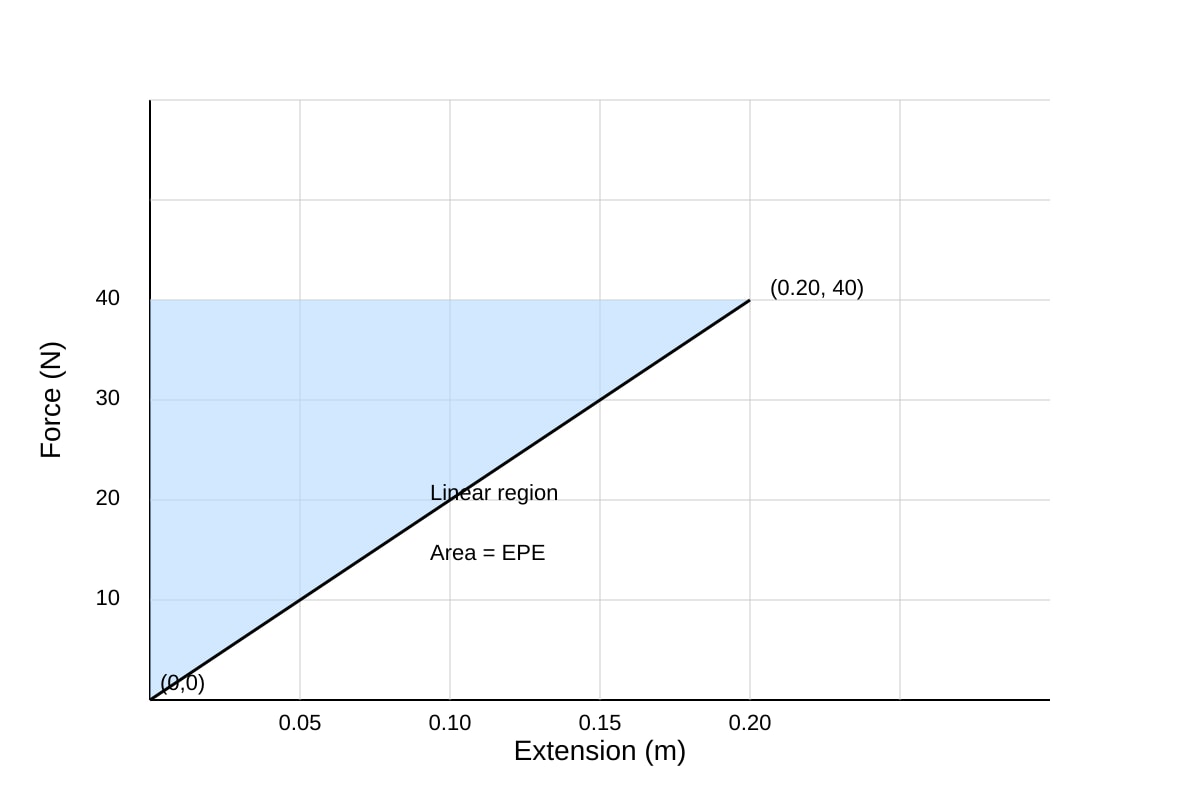
Image pending generation: graph for Q18.
The graph shows the force-extension relationship for a spring. Determine the elastic potential energy stored when the extension is 0.20 m using the graph. [3]
19. A hydroelectric plant uses water falling through 50 m. In one second, 2.0×10⁴ kg of water passes through.
(a) Calculate the gravitational potential energy lost per second (g=9.8 N kg−1). [2]
(b) If the plant converts 80% of this to electrical power, calculate the output power. [2]
20. (a) State the work-energy theorem. [2]
(b) A constant force of 50 N pushes a box 4.0 m in the direction of the force. Calculate the work done. [1]
(c) If the box started from rest and has mass 10 kg, find its final speed. [3]
Answers
A-Level Physics H1 Quiz - Energy Power (Answers)
Total Marks: 40
Topic: Energy & Power
Section A: Short Answer
1. [2 marks]
Principle of conservation of energy: Energy cannot be created or destroyed; it can only be transferred from one store to another or transformed from one form to another. Total energy of an isolated system is constant.
Marking: [B1] total energy constant / not created destroyed; [B1] transferred/transformed between forms.
2. [2 marks]
Power is the rate of energy transfer (or rate of doing work). P=tE where E is energy transferred and t is time.
Marking: [B1] rate of energy transfer; [B1] P=E/t or equivalent.
3. [1 mark]
Ek=21mv2
4. [2 marks]
Efficiency 0.40 means that 40% of the input energy is converted to useful output energy; 60% is wasted (e.g. as heat).
Marking: [B1] 40% input becomes useful; [B1] rest wasted.
5. [1 mark]
W=Fs (or W=F×s)
Section B: Calculation
6. [2 marks]
Ek=21mv2=21(4.0)(6.0)2=21×4.0×36=72 J
M1 substitution, A1 answer 72 J.
7. [3 marks]
Work done = Fs=800×12=9600 J
Power = tW=209600=480 W
M1 work, M1 power formula, A1 480 W.
8. [2 marks]
Efficiency = inputuseful×100%=2.01.5×100%=75%
M1 ratio, A1 75%.
9. [3 marks]
ΔEk=21m(vf2−vi2)=21(1000)(202−102)=500(400−100)=500×300=1.5×10⁵ J
M1 formula, M1 substitution, A1 1.5×10⁵ J.
10. [3 marks]
Weight = mg=500×9.8=4900 N
Work = mgh=4900×8.0=39200 J
Power = 1039200=3920 W
M1 weight, M1 work, A1 3920 W (or 3.92 kW).
11. [2 marks]
E=21kx2=21(200)(0.10)2=100×0.01=1.0 J
M1 sub, A1 1.0 J.
12. [2 marks]
Output = 0.25×1200 W=300 W
M1 conversion 1.2 kW = 1200 W; A1 300 W.
13. [3 marks]
Loss in GPE = gain in KE: mgh=0.50×9.8×20=98 J
M1 formula, M1 sub, A1 98 J.
Section C: Structured & Data-Based
14. [4 marks]
(a) [2] Gravitational potential energy is the energy stored in an object due to its position in a gravitational field. Ep=mgh.
(b) [2] ΔEp=mgh=5.0×9.8×4.0=196 J.
Marking: (a) [B1] definition, [B1] formula; (b) [M1] sub, [A1] 196 J.
15. [3 marks]
Conservation of energy states total energy is conserved, not specifically kinetic. In inelastic collisions, kinetic energy converts to thermal/sound. A closed system can have KE not conserved while total energy is.
Marking: [B1] total not KE conserved; [B1] example transformation; [B1] closed system total constant.
16. [4 marks]
X: 40/100=0.40 (40%)
Y: 90/200=0.45 (45%)
Z: 75/150=0.50 (50%)
Most efficient: Z.
Marking: [M1] each ratio (max 3), [A1] Z identified.
17. [3 marks]
(a) [2] Eff = 3.0/15×100=20%.
(b) [1] Some wind energy not captured / friction / turbulence.
Marking: (a) [M1] calc, [A1] 20%; (b) [B1] valid reason.
18. [3 marks]
Area under graph = 21×0.20×40=4.0 J.
Marking: [M1] triangle area, [A1] 4.0 J, [B1] from graph shaded.
19. [4 marks]
(a) [2] GPE lost/s = mgh=(2.0×10⁴)(9.8)(50)=9.8×10⁶ J s−1=9.8 MW.
(b) [2] Output = 0.80×9.8×106=7.84×10⁶ W.
Marking: (a) [M1] calc, [A1]; (b) [M1] 80%, [A1].
20. [6 marks]
(a) [2] Work-energy theorem: net work done on object equals change in its kinetic energy.
(b) [1] W=50×4.0=200 J.
(c) [3] 21mv2=200⇒v2=10400=40⇒v=6.32 m s−1.
Marking: (a) [B1]×2; (b) [A1]; (c) [M1] formula, [M1] solve, [A1] 6.32.
Free quiz and exam paper access
Enter your details to view this paper
Your access is remembered on this device.