From Real Exams Quiz
A Level H1 Physics Electricity Magnetism Quiz
Free A Level H1 Physics Electricity Magnetism quiz, HY3 Exam version, with questions, answers, and A Level-style practice for Singapore students.
These static practice materials are generated from the site's syllabus and paper-generation workflow, with source and model context shown so students and parents can evaluate the material before use.
Questions
A-Level Physics H1 Quiz - Electricity Magnetism
Name: ___________________________
Class: ___________________________
Date: ___________________________
Score: _______ / 40
Duration: 60 minutes
Total Marks: 40
Topic: Electricity & Magnetism (Currents, Circuits, Electromagnetism)
Instructions:
- Answer all 20 questions.
- Show your working clearly for calculation questions.
- Use the provided space below each question.
- SI units should be used unless stated otherwise.
Section A: Currents and Circuits (Questions 1–8)
1. A copper wire carries a current of 3.0 A. The charge carrier density is 8.5×1028 m−3 and the cross-sectional area is 1.0×10⁻⁶ m2. Calculate the drift velocity of electrons. (Charge of electron e=1.6×10⁻¹⁹ C) [3]
2. State the difference between electromotive force (e.m.f.) and potential difference (p.d.). [2]
3. A resistor has a current–voltage (I–V) characteristic that is a straight line through the origin. What can you conclude about its resistance? [1]
4. Two resistors of 4 Ω and 6 Ω are connected in parallel. Calculate the effective resistance. [2]
5. A potential divider consists of a 9.0 V battery and two resistors R1=300 Ω and R2=600 Ω in series. Determine the output voltage across R2. [2]
6. A battery of e.m.f. 12 V and internal resistance 1.0 Ω is connected to a 5.0 Ω resistor. Calculate the terminal p.d. of the battery. [3]
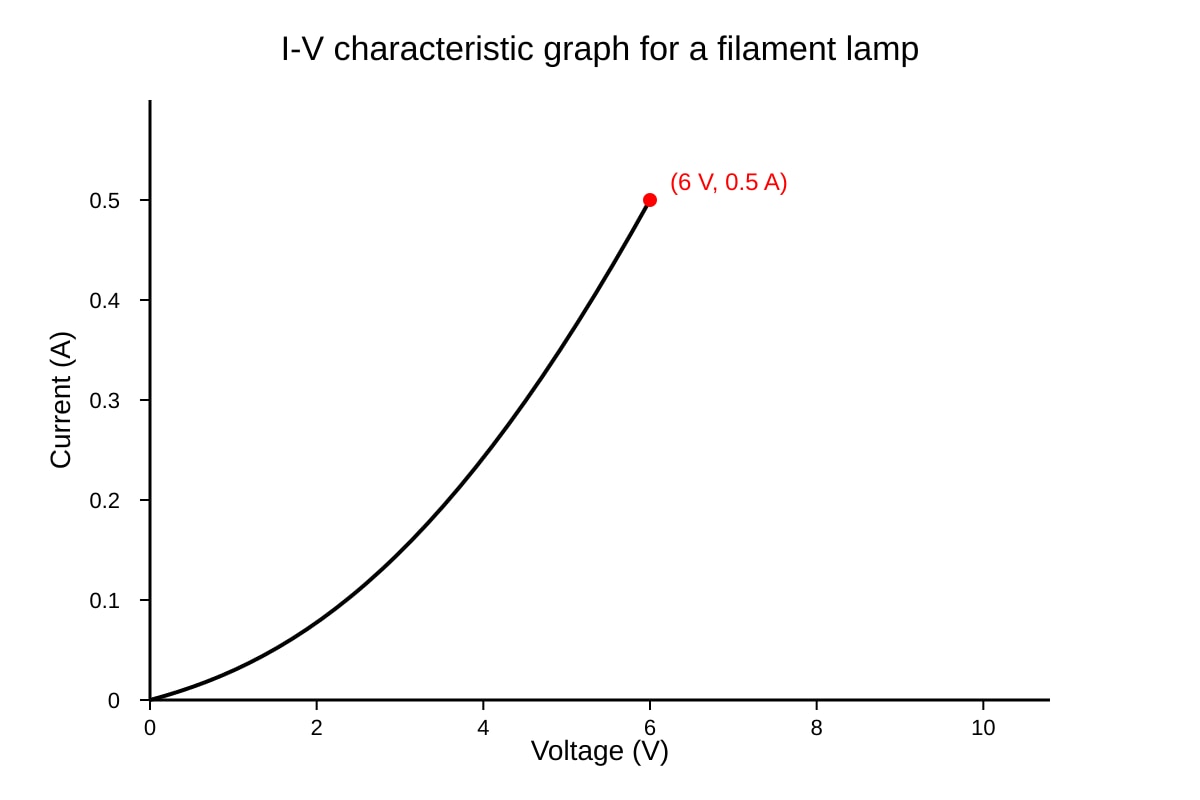
7.
Image pending generation: graph for Q7.
Using the graph, determine the resistance of the lamp at 6.0 V. [2]
8. Explain why the resistance of the filament lamp in Q7 increases with voltage. [2]
Section B: Electromagnetism (Questions 9–15)
9. Sketch the magnetic field pattern around a long straight wire carrying a current upwards. Indicate the direction of the field lines. [2]
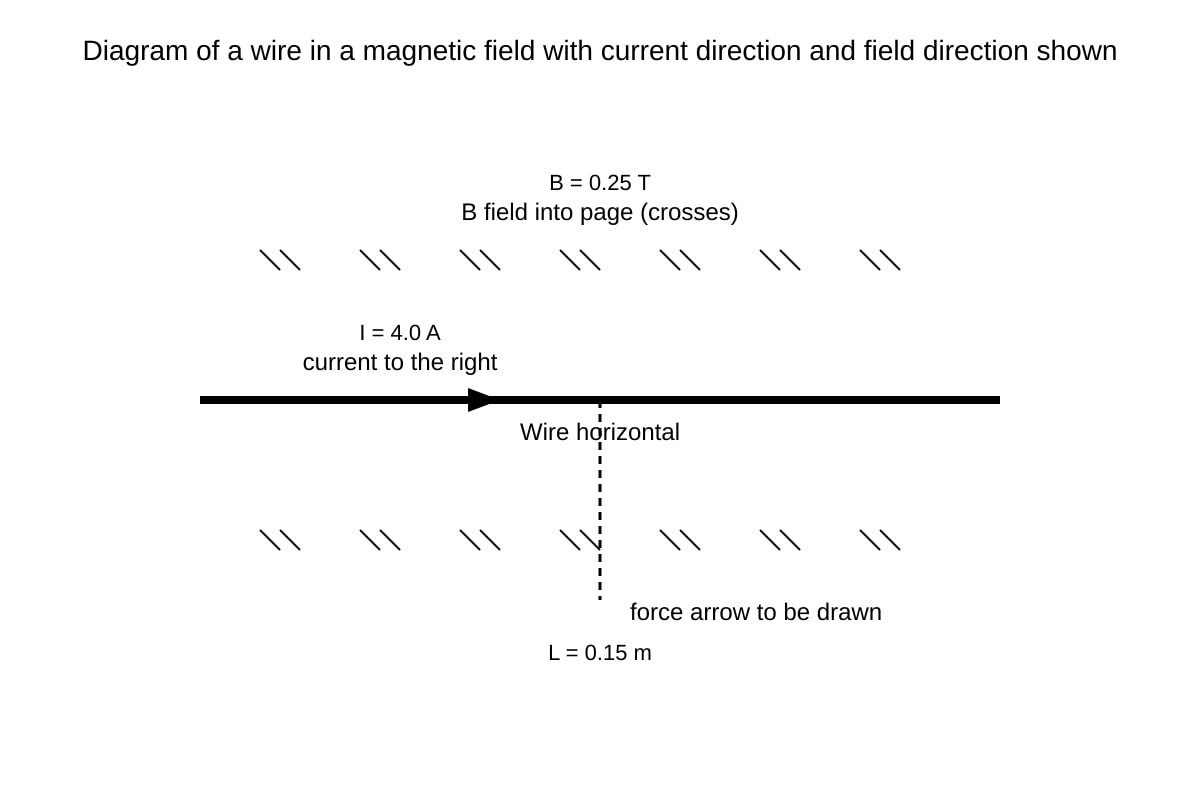
10. A horizontal wire of length 0.20 m carries a current of 5.0 A perpendicular to a uniform magnetic field of 0.10 T. Calculate the magnetic force on the wire. [2]
11.
Image pending generation: diagram for Q11.
Using Fleming’s left-hand rule, state the direction of the force on the wire. [1]
12. A charged particle of charge +2.0×10⁻⁶ C moves at 3.0×10³ m s−1 perpendicular to a magnetic field of 0.40 T. Calculate the magnetic force on the particle. [2]
13. Two parallel wires X and Y carry currents in the same direction. Draw arrows on a diagram to show the forces between them. [1]
14. A velocity selector uses perpendicular electric field E=2.0×10³ N C−1 and magnetic field B=0.050 T. Calculate the speed of particles that pass through undeflected. [2]
15. Explain how a velocity selector works and why only particles of a specific speed are undeflected. [3]
Section C: Data-Based and Structured (Questions 16–20)
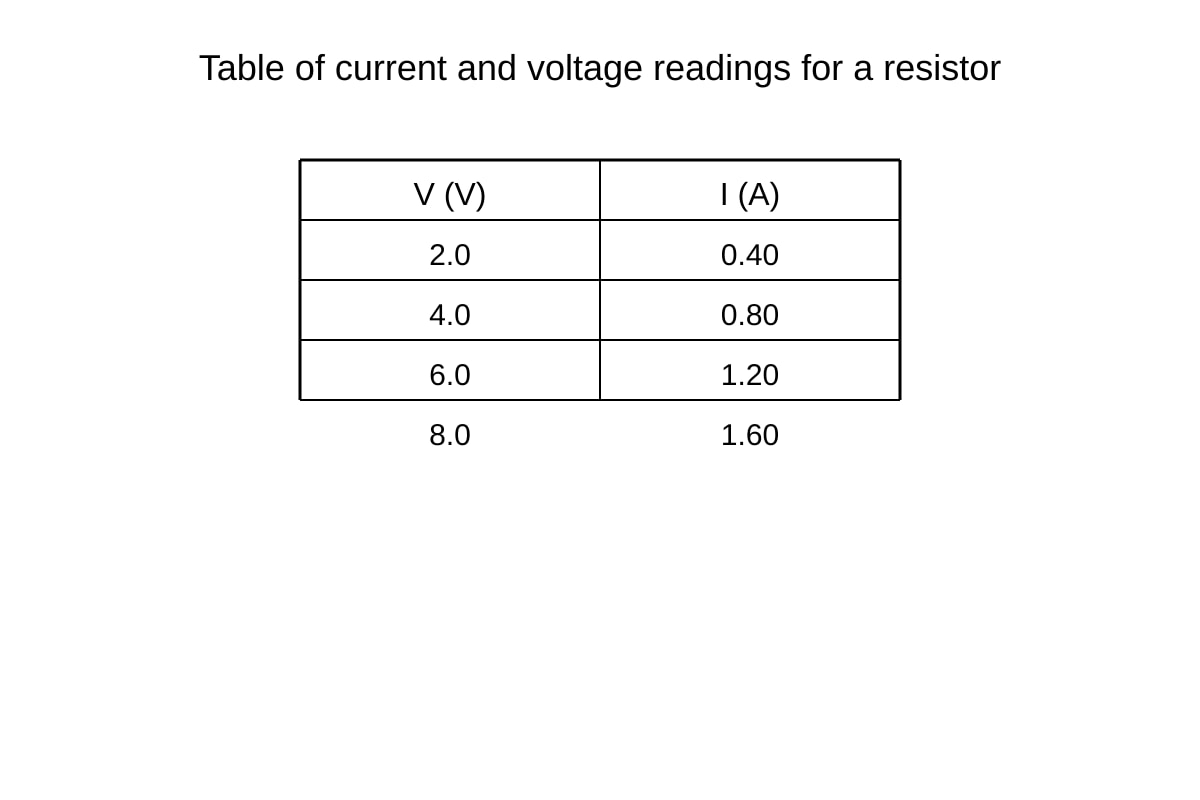
16.
Image pending generation: table for Q16.
Using the table, plot a graph of I against V and determine the resistance. [3]
17. A circuit contains a 12 V battery, internal resistance 0.5 Ω, and two external resistors 2.0 Ω and 4.0 Ω in parallel. Calculate the current from the battery. [4]
18. A solenoid has n=500 turns per metre and carries current 2.0 A. Using μ0=4π×10−7 T m A−1, calculate the magnetic field inside. [2]
19. Describe the magnetic field pattern inside a current-carrying solenoid and compare it with a bar magnet. [3]
20. A wire of length 0.50 m in a 0.30 T field carries 2.0 A at 30∘ to the field. Calculate the force and state the direction relative to the wire and field. [3]
Answers
A-Level Physics H1 Quiz - Electricity Magnetism (Answers)
Total Marks: 40
Section A: Answers 1–8
Q1. [3 marks]
Formula: I=nAve
v=nAeI=(8.5×1028)(1.0×10⁻⁶)(1.6×10⁻¹⁹)3.0
v=1.36×1043.0=2.21×10⁻⁴ m s−1
Mark breakdown: M1 formula, M1 substitution, A1 answer 2.2×10⁻⁴ m s−1.
Teaching: Drift velocity is slow because electron density is huge. Common mistake: wrong power of 10.
Q2. [2 marks]
e.m.f. is the energy per unit charge supplied by a source (e.g. battery) [B1]. p.d. is the energy per unit charge converted to other forms across a component [B1].
Teaching: e.m.f. drives current; p.d. is drop across load.
Q3. [1 mark]
Resistance is constant (ohmic). [1]
Teaching: Straight line through origin means V∝I, so R=V/I constant.
Q4. [2 marks]
R1=41+61=125⇒R=2.4 Ω [M1, A1]
Teaching: Parallel resistors reduce total resistance.
Q5. [2 marks]
Vout=9.0×300+600600=6.0 V [M1, A1]
Teaching: Potential divider splits voltage in ratio of resistances.
Q6. [3 marks]
I=1.0+5.012=2.0 A [M1]
Terminal p.d. =IR=2.0×5.0=10.0 V [M1, A1]
Teaching: Internal resistance causes loss Ir=2.0 V.
Q7. [2 marks]
R=IV=0.506.0=12 Ω [M1, A1]
Teaching: Read from graph at given point.
Q8. [2 marks]
As voltage rises, temperature of filament increases [B1], causing lattice ion vibration increasing collisions with electrons, raising resistance [B1].
Teaching: Non-ohmic due to heating.
Section B: Answers 9–15
Q9. [2 marks]
Concentric circles around wire [B1]; direction given by right-hand grip rule (anticlockwise viewed from top) [B1].
Teaching: Current up → field anticlockwise.
Q10. [2 marks]
F=BIL=0.10×5.0×0.20=0.10 N [M1, A1]
Teaching: Max force when perpendicular.
Q11. [1 mark]
Force is upwards (out of page plane, using FLHR: Field into page, Current right → Force up). [1]
Q12. [2 marks]
F=BQv=0.40×2.0×10−6×3.0×103=2.4×10⁻³ N [M1, A1]
Q13. [1 mark]
Arrows showing attraction (towards each other). [1]
Q14. [2 marks]
v=BE=0.0502.0×103=4.0×10⁴ m s−1 [M1, A1]
Q15. [3 marks]
Electric force qE and magnetic force Bqv oppose [B1]. For undeflected, qE=Bqv so v=E/B [B1]. Only this speed balances both [B1].
Section C: Answers 16–20
Q16. [3 marks]
Graph: I vs V straight line [B1]; slope = 0.20 A/V so R=1/0.20=5.0 Ω [M1, A1].
Q17. [4 marks]
Parallel Rext=2+42×4=1.33 Ω [M1]
Total R=1.33+0.5=1.83 Ω [M1]
I=12/1.83=6.55 A [A1]
Teaching: Show parallel then add internal. [A1 for method]
Q18. [2 marks]
B=μ0nI=4π×10−7×500×2.0=1.26×10⁻³ T [M1, A1]
Q19. [3 marks]
Uniform field inside solenoid [B1]; like bar magnet with N and S ends [B1]; outside weak, inside strong parallel lines [B1].
Q20. [3 marks]
F=BILsin30∘=0.30×2.0×0.50×0.5=0.15 N [M1, A1]
Direction perpendicular to both wire and field by FLHR [B1].
Free quiz and exam paper access
Enter your details to view this paper
Your access is remembered on this device.