AI Generated Exam Paper

A Level H1 Physics Practice Paper 5

Free AI-Generated Owl Alpha A Level H1 Physics Practice Paper 5 practice paper with questions and answers for Singapore students. This page is rendered as a direct URL so the questions and answers can be discovered without pressing in-page buttons.

These static practice materials are generated from the site's syllabus and paper-generation workflow, with source and model context shown so students and parents can evaluate the material before use.

A Level H1 Physics AI Generated Generated by Owl Alpha Updated 2026-06-07

Questions

<!-- TuitionGoWhere generation metadata: stage=5-2; model=openrouter/owl-alpha; model_label=Owl Alpha; generated=2026-06-06; Sources: Stage 4-0 LLM templates, syllabus context, and Stage 2 evidence where available. -->

TuitionGoWhere Practice Paper - Physics H1 A-Level

TuitionGoWhere Practice Paper (AI)

Subject: Physics H1 Level: A-Level Paper: Practice Paper — Mechanics Duration: 1 hour 30 minutes Total Marks: 60 Name: ___________________________ Class: ___________________________ Date: ___________________________


Instructions

  • Answer all questions in the spaces provided.
  • Show all working clearly. Marks are awarded for correct reasoning and method, not only for final answers.
  • Where calculations are required, state the formula used, show substitution, and give the final answer with appropriate units.
  • The number of marks for each question or part-question is shown in brackets [ ].
  • You may use a calculator.
  • This paper consists of Section A and Section B.

Section A: Short Answer & Structured Questions (30 marks)


Question 1 [2 marks]

State the principle of conservation of linear momentum. Include the condition under which it applies.


Question 2 [2 marks]

A car accelerates uniformly from rest to 25 m s125 \text{ m s}^{-1} in 8.0 s8.0 \text{ s}.

(a) Calculate the acceleration of the car. [1]


(b) Calculate the distance travelled by the car during this time. [1]


Question 3 [3 marks]

A ball is projected horizontally at 12 m s112 \text{ m s}^{-1} from the top of a cliff 45 m45 \text{ m} high. Assume air resistance is negligible and take g=9.81 m s2g = 9.81 \text{ m s}^{-2}.

(a) Calculate the time taken for the ball to reach the ground. [1]


(b) Calculate the horizontal distance from the base of the cliff where the ball lands. [1]


(c) State the effect on the time of flight if the horizontal projection speed is doubled. Justify your answer. [1]


Question 4 [3 marks]

<image_placeholder> id: Q4-fig1 type: diagram linked_question: Q4 description: Free-body diagram of a block of mass 5.0 kg resting on a rough inclined plane at angle 30° to the horizontal. The block is held in equilibrium by a force F acting parallel to the slope and upwards. Three forces are visible: weight W acting vertically downwards from the centre of the block, normal reaction R perpendicular to the surface of the plane, and applied force F parallel to the slope pointing up the plane. Friction f is shown acting down the slope (opposing motion up the plane). The angle of inclination 30° is labelled between the plane and the horizontal. labels: W (weight), R (normal reaction), F (applied force, up the slope), f (friction, down the slope), 30° angle values: mass = 5.0 kg, angle = 30°, g = 9.81 m/s² must_show: All four forces with correct directions, 30° angle clearly labelled, block on inclined plane, horizontal reference line </image_placeholder>

Figure above shows a block of mass 5.0 kg5.0 \text{ kg} held in equilibrium on a rough plane inclined at 30°30° to the horizontal by a force FF acting parallel to the slope. Take g=9.81 m s2g = 9.81 \text{ m s}^{-2}.

(a) Calculate the component of the weight acting down the slope. [1]


(b) If the block is on the verge of sliding down the plane, and the frictional force is 8.0 N8.0 \text{ N}, calculate the magnitude of FF. [2]


Question 5 [3 marks]

A 0.50 kg0.50 \text{ kg} trolley A moves at 4.0 m s14.0 \text{ m s}^{-1} on a frictionless horizontal track and collides with a stationary trolley B of mass 1.5 kg1.5 \text{ kg}. After the collision, the two trolleys stick together.

(a) Using the principle of conservation of linear momentum, calculate the common velocity of the trolleys after the collision. [2]


(b) Determine whether kinetic energy is conserved in this collision. Show your reasoning. [1]


Question 6 [2 marks]

Define the term impulse of a force. State its SI unit.


Question 7 [3 marks]

A 60 kg60 \text{ kg} student stands in a lift.

(a) Calculate the weight of the student. [1]


(b) The lift accelerates upwards at 1.5 m s21.5 \text{ m s}^{-2}. Calculate the normal contact force exerted by the lift floor on the student. [2]


Question 8 [2 marks]

Distinguish between scalar and vector quantities. Give one example of each.


Question 9 [3 marks]

A stone is thrown vertically upwards with an initial speed of 20 m s120 \text{ m s}^{-1}. Take g=9.81 m s2g = 9.81 \text{ m s}^{-2} and ignore air resistance.

(a) Calculate the maximum height reached by the stone. [2]


(b) Calculate the total time the stone is in the air before returning to the thrower's hand. [1]


Question 10 [3 marks]

<image_placeholder> id: Q10-fig1 type: graph linked_question: Q10 description: A velocity-time graph for a particle moving along a straight horizontal line. The graph has three segments: (1) From t=0 to t=4 s, velocity increases linearly from 0 to 12 m/s (constant positive acceleration). (2) From t=4 to t=10 s, velocity remains constant at 12 m/s (zero acceleration). (3) From t=10 to t=14 s, velocity decreases linearly from 12 m/s to 0 m/s (constant negative acceleration). Axes are labelled: velocity / m s⁻¹ (vertical) and time / s (horizontal). Key points: (0,0), (4,12), (10,12), (14,0). labels: velocity / m s⁻¹, time / s, key coordinates (0,0), (4,12), (10,12), (14,0) values: v_max = 12 m/s, t_accel = 4 s, t_constant = 6 s, t_decel = 4 s, total time = 14 s must_show: Three clearly distinguishable linear segments, axis labels with units, all four key coordinates labelled, grid lines optional </image_placeholder>

The velocity-time graph above shows the motion of a particle along a straight line.

(a) Calculate the acceleration of the particle during the first 4.0 s4.0 \text{ s}. [1]


(b) Calculate the total distance travelled by the particle in 14.0 s14.0 \text{ s}. [2]


Question 11 [2 marks]

State Newton's first law of motion.


Question 12 [2 marks]

A force of 15 N15 \text{ N} acts on an object and displaces it by 3.0 m3.0 \text{ m} in the direction of the force. Calculate the work done by the force.


Section B: Extended Response & Application (30 marks)


Question 13 [8 marks]

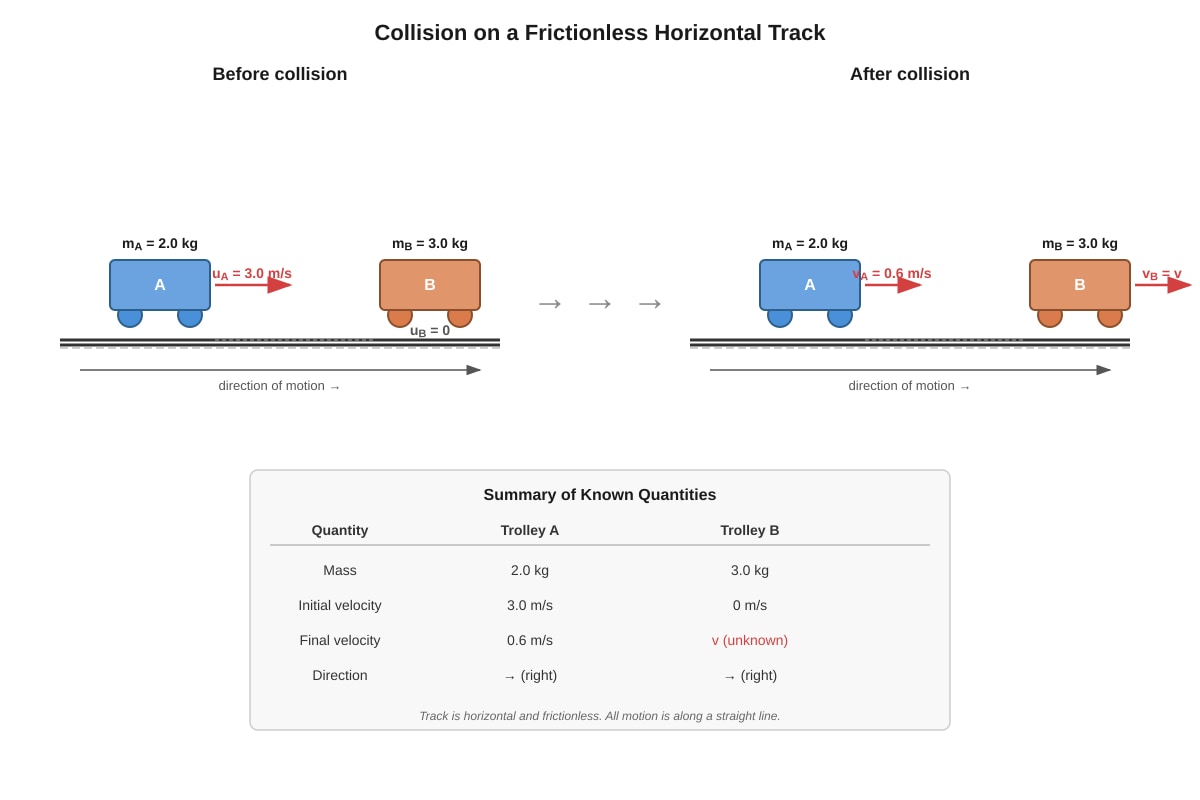
<image_placeholder> id: Q13-fig1 type: diagram linked_question: Q13 description: A diagram showing a collision experiment setup on a horizontal frictionless track. Two trolleys are shown: Trolley A (mass 2.0 kg) moving to the right with velocity 3.0 m/s towards Trolley B (mass 3.0 kg) which is stationary. A horizontal track is shown with direction arrows. After the collision (shown in a second frame to the right), Trolley A moves to the right at 0.6 m/s and Trolley B moves to the right at unknown velocity v. Both frames labelled "Before collision" and "After collision". labels: m_A = 2.0 kg, m_B = 3.0 kg, u_A = 3.0 m/s, u_B = 0, v_A = 0.6 m/s, v_B = v (unknown), direction arrows showing rightward motion values: m_A = 2.0 kg, m_B = 3.0 kg, u_A = 3.0 m/s, u_B = 0 m/s, v_A = 0.6 m/s must_show: Two frames (before/after), all mass and velocity values labelled, direction of motion clearly indicated, horizontal track </image_placeholder>

A 2.0 kg2.0 \text{ kg} trolley A moves at 3.0 m s13.0 \text{ m s}^{-1} on a frictionless horizontal track and collides with a stationary 3.0 kg3.0 \text{ kg} trolley B. After the collision, trolley A continues to move in the same direction at 0.6 m s10.6 \text{ m s}^{-1}.

(a) Using the principle of conservation of linear momentum, calculate the velocity of trolley B after the collision. [3]


(b) Calculate the total kinetic energy before and after the collision. [3]


(c) Explain whether the collision is elastic or inelastic. Justify your answer. [2]


Question 14 [7 marks]

A 70 kg70 \text{ kg} firefighter slides down a vertical pole from rest. The pole is 12 m12 \text{ m} long. The firefighter reaches the ground with a speed of 4.0 m s14.0 \text{ m s}^{-1}. Take g=9.81 m s2g = 9.81 \text{ m s}^{-2}.

(a) Using the principle of conservation of energy, calculate the total work done against friction during the slide. [4]


(b) Calculate the average frictional force acting on the firefighter during the slide. [2]


(c) State one assumption you made in your calculation. [1]


Question 15 [8 marks]

A ball of mass 0.20 kg0.20 \text{ kg} is projected from ground level at an angle of 35°35° above the horizontal with an initial speed of 30 m s130 \text{ m s}^{-1}. Assume air resistance is negligible and take g=9.81 m s2g = 9.81 \text{ m s}^{-2}.

(a) Resolve the initial velocity into horizontal and vertical components. [2]


(b) Calculate the maximum height reached by the ball above ground level. [3]


(c) Calculate the horizontal range of the projectile. [3]


Question 16 [7 marks]

<image_placeholder> id: Q16-fig1 type: diagram linked_question: Q16 description: A diagram showing two forces acting on a particle at a point. Force F₁ = 40 N acts horizontally to the right. Force F₂ = 30 N acts vertically upwards. The angle between the two forces is 90°. The resultant force R is shown as the diagonal of the rectangle formed by F₁ and F₂, acting at angle θ above the horizontal. The particle is shown as a dot at the origin. labels: F₁ = 40 N (horizontal, right), F₂ = 30 N (vertical, up), R (resultant), θ (angle of resultant above horizontal) values: F₁ = 40 N, F₂ = 30 N must_show: Two perpendicular forces with labels and values, resultant force as diagonal, angle θ labelled between resultant and horizontal, particle at intersection point </image_placeholder>

Two forces, F1=40 NF_1 = 40 \text{ N} acting horizontally and F2=30 NF_2 = 30 \text{ N} acting vertically, act on a particle.

(a) By calculation or scale drawing, determine the magnitude of the resultant force. [3]


(b) Determine the angle the resultant force makes with the horizontal. [2]


(c) A third force is now applied to the particle so that the particle is in equilibrium. State the magnitude and direction of this third force. [2]


End of Paper


Section A Total: 30 marks Section B Total: 30 marks Total: 60 marks

Answers

<!-- TuitionGoWhere generation metadata: stage=5-2; model=openrouter/owl-alpha; model_label=Owl Alpha; generated=2026-06-06; Sources: Stage 4-0 LLM templates, syllabus context, and Stage 2 evidence where available. -->

TuitionGoWhere Practice Paper — Physics H1 A-Level

Answer Key & Marking Scheme — Mechanics


Section A: Short Answer & Structured Questions


Question 1 [2 marks]

Answer:

The principle of conservation of linear momentum states that the total momentum of a closed (isolated) system remains constant, provided that no external forces act on the system.

Equivalently: the total momentum before an interaction equals the total momentum after the interaction.

Marking:

  • [B1] For stating that total momentum remains constant / is conserved
  • [B1] For stating the condition: no external forces / closed system / isolated system

Teaching note: A "closed system" means no mass enters or leaves, and "no external forces" means the net external force is zero. Students often forget the condition — momentum is only conserved when the system is isolated from external net forces.


Question 2 [2 marks]

(a) [1]

Using a=vuta = \frac{v - u}{t}:

a=2508.0=3.1253.1 m s2a = \frac{25 - 0}{8.0} = 3.125 \approx 3.1 \text{ m s}^{-2}

Answer: a=3.1 m s2a = 3.1 \text{ m s}^{-2}

(b) [1]

Using s=ut+12at2s = ut + \frac{1}{2}at^2:

s=0+12(3.125)(8.0)2=12(3.125)(64)=100 ms = 0 + \frac{1}{2}(3.125)(8.0)^2 = \frac{1}{2}(3.125)(64) = 100 \text{ m}

Or using average velocity: s=u+v2×t=0+252×8.0=100 ms = \frac{u + v}{2} \times t = \frac{0 + 25}{2} \times 8.0 = 100 \text{ m}

Answer: s=100 ms = 100 \text{ m}

Marking:

  • (a) [1] Correct answer with unit
  • (b) [1] Correct answer with unit

Question 3 [3 marks]

(a) [1]

Vertical motion: sy=12gt2s_y = \frac{1}{2}gt^2

45=12(9.81)t245 = \frac{1}{2}(9.81)t^2

t2=909.81=9.174t^2 = \frac{90}{9.81} = 9.174

t=3.03 st = 3.03 \text{ s}

Answer: t=3.0 st = 3.0 \text{ s} (to 2 s.f.)

(b) [1]

Horizontal motion: sx=vx×t=12×3.03=36.36 ms_x = v_x \times t = 12 \times 3.03 = 36.36 \text{ m}

Answer: sx=36 ms_x = 36 \text{ m} (to 2 s.f.)

(c) [1]

The time of flight remains the same. The time of flight depends only on the vertical motion (height and gravitational acceleration). Changing the horizontal speed does not affect the vertical component of motion, so the time to fall is unchanged.

Marking:

  • (a) [1] Correct time
  • (b) [1] Correct horizontal distance
  • (c) [1] States "unchanged" or "same" with correct justification linking to independence of vertical and horizontal motion

Question 4 [3 marks]

(a) [1]

Component of weight down the slope:

W=mgsinθ=5.0×9.81×sin30°=5.0×9.81×0.5=24.525 NW_{\parallel} = mg\sin\theta = 5.0 \times 9.81 \times \sin 30° = 5.0 \times 9.81 \times 0.5 = 24.525 \text{ N}

Answer: W=24.5 N25 NW_{\parallel} = 24.5 \text{ N} \approx 25 \text{ N}

(b) [2]

For equilibrium, forces parallel to the slope balance. The block is on the verge of sliding down, so friction acts up the slope (opposing the impending motion).

Taking down the slope as positive:

W=F+fW_{\parallel} = F + f

24.525=F+8.024.525 = F + 8.0

F=24.5258.0=16.525 NF = 24.525 - 8.0 = 16.525 \text{ N}

Answer: F=16.5 N17 NF = 16.5 \text{ N} \approx 17 \text{ N}

Marking:

  • (a) [1] Correct calculation of mgsinθmg\sin\theta with answer
  • (b) [1] Correct equation setting up force balance along the slope
  • (b) [1] Correct answer with unit

Common mistake: Students may add friction to the weight component instead of subtracting, getting F=32.5 NF = 32.5 \text{ N}. The direction of friction must be determined from the direction of impending motion.


Question 5 [3 marks]

(a) [2]

Conservation of momentum:

mAuA+mBuB=(mA+mB)vm_A u_A + m_B u_B = (m_A + m_B)v

(0.50)(4.0)+(1.5)(0)=(0.50+1.5)v(0.50)(4.0) + (1.5)(0) = (0.50 + 1.5)v

2.0=2.0v2.0 = 2.0v

v=1.0 m s1v = 1.0 \text{ m s}^{-1}

Answer: v=1.0 m s1v = 1.0 \text{ m s}^{-1}

(b) [1]

Kinetic energy before collision:

KEbefore=12(0.50)(4.0)2=12(0.50)(16)=4.0 JKE_{\text{before}} = \frac{1}{2}(0.50)(4.0)^2 = \frac{1}{2}(0.50)(16) = 4.0 \text{ J}

Kinetic energy after collision:

KEafter=12(2.0)(1.0)2=1.0 JKE_{\text{after}} = \frac{1}{2}(2.0)(1.0)^2 = 1.0 \text{ J}

Since KEafter<KEbeforeKE_{\text{after}} < KE_{\text{before}}, kinetic energy is not conserved. This is an inelastic collision (specifically, a perfectly inelastic collision since the objects stick together).

Answer: KE is not conserved; KEbefore=4.0 JKE_{\text{before}} = 4.0 \text{ J}, KEafter=1.0 JKE_{\text{after}} = 1.0 \text{ J}

Marking:

  • (a) [1] Correct substitution into conservation of momentum equation
  • (a) [1] Correct answer
  • (b) [1] Correct comparison showing KE is not conserved (both values calculated or clear statement)

Question 6 [2 marks]

Answer:

The impulse of a force is defined as the product of the force and the time for which it acts. Equivalently, impulse equals the change in momentum of the object.

Impulse=F×Δt=Δp\text{Impulse} = F \times \Delta t = \Delta p

SI unit: newton-second (N s\text{N s}) or equivalently kg m s1\text{kg m s}^{-1}

Marking:

  • [B1] Correct definition (force × time or change in momentum)
  • [B1] Correct SI unit

Question 7 [3 marks]

(a) [1]

W=mg=60×9.81=588.6 NW = mg = 60 \times 9.81 = 588.6 \text{ N}

Answer: W=589 N590 NW = 589 \text{ N} \approx 590 \text{ N}

(b) [2]

Applying Newton's second law (upward positive):

Rmg=maR - mg = ma

R=m(g+a)=60×(9.81+1.5)=60×11.31=678.6 NR = m(g + a) = 60 \times (9.81 + 1.5) = 60 \times 11.31 = 678.6 \text{ N}

Answer: R=679 N680 NR = 679 \text{ N} \approx 680 \text{ N}

Marking:

  • (a) [1] Correct weight
  • (b) [1] Correct equation (Newton's second law applied correctly)
  • (b) [1] Correct answer with unit

Teaching note: When the lift accelerates upward, the normal force exceeds the weight — this is why you feel heavier in an accelerating lift. The normal force is what a scale would read as your "apparent weight."


Question 8 [2 marks]

Answer:

A scalar quantity has magnitude only (no direction). Example: mass, speed, energy, time, temperature.

A vector quantity has both magnitude and direction. Example: velocity, force, displacement, acceleration, momentum.

Marking:

  • [B1] Correct distinction (magnitude only vs. magnitude and direction)
  • [B1] One correct example of each

Question 9 [3 marks]

(a) [2]

At maximum height, v=0v = 0.

Using v2=u22gsv^2 = u^2 - 2gs:

0=(20)22(9.81)s0 = (20)^2 - 2(9.81)s

s=40019.62=20.39 ms = \frac{400}{19.62} = 20.39 \text{ m}

Answer: s=20.4 m20 ms = 20.4 \text{ m} \approx 20 \text{ m} (to 2 s.f.)

(b) [1]

Using v=ugtv = u - gt for the upward journey:

0=209.81tup0 = 20 - 9.81t_{\text{up}}

tup=209.81=2.039 st_{\text{up}} = \frac{20}{9.81} = 2.039 \text{ s}

Total time = 2×tup=4.078 s2 \times t_{\text{up}} = 4.078 \text{ s}

Answer: t=4.1 st = 4.1 \text{ s} (to 2 s.f.)

Marking:

  • (a) [1] Correct equation used
  • (a) [1] Correct answer
  • (b) [1] Correct total time (must be double the time to reach max height)

Common mistake: Students may only calculate the time to reach maximum height and forget to double it for the total flight time.


Question 10 [3 marks]

(a) [1]

Acceleration = gradient of velocity-time graph during first segment:

a=ΔvΔt=1204.00=3.0 m s2a = \frac{\Delta v}{\Delta t} = \frac{12 - 0}{4.0 - 0} = 3.0 \text{ m s}^{-2}

Answer: a=3.0 m s2a = 3.0 \text{ m s}^{-2}

(b) [2]

Total distance = area under the velocity-time graph.

The graph forms a trapezium:

Area=12(ttotal+tconstant)×vmax\text{Area} = \frac{1}{2}(t_{\text{total}} + t_{\text{constant}}) \times v_{\text{max}}

More precisely, the area consists of:

  • Triangle (0–4 s): 12×4×12=24 m\frac{1}{2} \times 4 \times 12 = 24 \text{ m}
  • Rectangle (4–10 s): 6×12=72 m6 \times 12 = 72 \text{ m}
  • Triangle (10–14 s): 12×4×12=24 m\frac{1}{2} \times 4 \times 12 = 24 \text{ m}

Total distance = 24+72+24=120 m24 + 72 + 24 = 120 \text{ m}

Answer: Total distance = 120 m120 \text{ m}

Marking:

  • (a) [1] Correct gradient calculation
  • (b) [1] Correct method (area under graph, split into shapes or trapezium formula)
  • (b) [1] Correct answer

Question 11 [2 marks]

Answer:

Newton's first law of motion states that an object remains at rest or continues to move at a constant velocity unless acted upon by a resultant (net) external force.

Marking:

  • [B1] For stating object remains at rest or moves with constant velocity
  • [B1] For stating "unless acted upon by a resultant force" or equivalent

Question 12 [2 marks]

Answer:

Work done = Force × displacement (in the direction of the force):

W=F×s=15×3.0=45 JW = F \times s = 15 \times 3.0 = 45 \text{ J}

Answer: W=45 JW = 45 \text{ J}

Marking:

  • [1] Correct formula or method
  • [1] Correct answer with unit

Section B: Extended Response & Application


Question 13 [8 marks]

(a) [3]

Conservation of momentum:

mAuA+mBuB=mAvA+mBvBm_A u_A + m_B u_B = m_A v_A + m_B v_B

(2.0)(3.0)+(3.0)(0)=(2.0)(0.6)+(3.0)vB(2.0)(3.0) + (3.0)(0) = (2.0)(0.6) + (3.0)v_B

6.0=1.2+3.0vB6.0 = 1.2 + 3.0v_B

3.0vB=4.83.0v_B = 4.8

vB=1.6 m s1v_B = 1.6 \text{ m s}^{-1}

Answer: vB=1.6 m s1v_B = 1.6 \text{ m s}^{-1} in the original direction of motion

(b) [3]

Kinetic energy before collision:

KEbefore=12mAuA2+12mBuB2=12(2.0)(3.0)2+0=9.0 JKE_{\text{before}} = \frac{1}{2}m_A u_A^2 + \frac{1}{2}m_B u_B^2 = \frac{1}{2}(2.0)(3.0)^2 + 0 = 9.0 \text{ J}

Kinetic energy after collision:

KEafter=12mAvA2+12mBvB2KE_{\text{after}} = \frac{1}{2}m_A v_A^2 + \frac{1}{2}m_B v_B^2

=12(2.0)(0.6)2+12(3.0)(1.6)2= \frac{1}{2}(2.0)(0.6)^2 + \frac{1}{2}(3.0)(1.6)^2

=0.36+3.84=4.2 J= 0.36 + 3.84 = 4.2 \text{ J}

Answer: KEbefore=9.0 JKE_{\text{before}} = 9.0 \text{ J}, KEafter=4.2 JKE_{\text{after}} = 4.2 \text{ J}

(c) [2]

The collision is inelastic because kinetic energy is not conserved (9.0 J4.2 J9.0 \text{ J} \neq 4.2 \text{ J}). Kinetic energy has decreased, meaning some energy has been converted to other forms (such as thermal energy, sound, or deformation energy).

Marking:

  • (a) [1] Correct substitution into conservation of momentum
  • (a) [1] Correct algebra/solving
  • (a) [1] Correct answer with unit and direction
  • (b) [1] Correct KEbeforeKE_{\text{before}} calculation
  • (b) [1] Correct KEafterKE_{\text{after}} calculation
  • (b) [1] Both values stated clearly
  • (c) [1] States "inelastic"
  • (c) [1] Justifies with reference to KE values not being equal

Question 14 [7 marks]

(a) [4]

Loss in gravitational potential energy:

ΔPE=mgh=70×9.81×12=8240.4 J\Delta PE = mgh = 70 \times 9.81 \times 12 = 8240.4 \text{ J}

Gain in kinetic energy:

ΔKE=12mv2=12(70)(4.0)2=560 J\Delta KE = \frac{1}{2}mv^2 = \frac{1}{2}(70)(4.0)^2 = 560 \text{ J}

By conservation of energy:

mgh=12mv2+Wfrictionmgh = \frac{1}{2}mv^2 + W_{\text{friction}}

Wfriction=mgh12mv2=8240.4560=7680.4 JW_{\text{friction}} = mgh - \frac{1}{2}mv^2 = 8240.4 - 560 = 7680.4 \text{ J}

Answer: Work done against friction = 7680 J7.7×103 J7680 \text{ J} \approx 7.7 \times 10^3 \text{ J}

(b) [2]

Wfriction=f×dW_{\text{friction}} = f \times d

f=Wfrictiond=7680.412=640 Nf = \frac{W_{\text{friction}}}{d} = \frac{7680.4}{12} = 640 \text{ N}

Answer: Average frictional force = 640 N640 \text{ N}

(c) [1]

Any one of:

  • Air resistance is negligible
  • The frictional force is constant throughout the slide
  • The firefighter slides from rest (initial KE = 0)

Marking:

  • (a) [1] Correct calculation of ΔPE\Delta PE
  • (a) [1] Correct calculation of ΔKE\Delta KE
  • (a) [1] Correct energy conservation equation
  • (a) [1] Correct answer
  • (b) [1] Correct use of W=FdW = Fd
  • (b) [1] Correct answer
  • (c) [1] Any valid assumption

Question 15 [8 marks]

(a) [2]

Horizontal component:

vx=vcosθ=30cos35°=30×0.8192=24.57 m s1v_x = v\cos\theta = 30\cos 35° = 30 \times 0.8192 = 24.57 \text{ m s}^{-1}

Vertical component:

vy=vsinθ=30sin35°=30×0.5736=17.21 m s1v_y = v\sin\theta = 30\sin 35° = 30 \times 0.5736 = 17.21 \text{ m s}^{-1}

Answer: vx=24.6 m s1v_x = 24.6 \text{ m s}^{-1}, vy=17.2 m s1v_y = 17.2 \text{ m s}^{-1}

(b) [3]

At maximum height, vertical velocity = 0.

Using vy2=uy22gHv_y^2 = u_y^2 - 2gH:

0=(17.21)22(9.81)H0 = (17.21)^2 - 2(9.81)H

H=(17.21)22×9.81=296.219.62=15.1 mH = \frac{(17.21)^2}{2 \times 9.81} = \frac{296.2}{19.62} = 15.1 \text{ m}

Answer: Maximum height = 15.1 m15.1 \text{ m}

(c) [3]

Time of flight:

T=2uyg=2×17.219.81=3.509 sT = \frac{2u_y}{g} = \frac{2 \times 17.21}{9.81} = 3.509 \text{ s}

Horizontal range:

R=vx×T=24.57×3.509=86.2 mR = v_x \times T = 24.57 \times 3.509 = 86.2 \text{ m}

Answer: Range = 86.2 m86.2 \text{ m}

Marking:

  • (a) [1] Correct vxv_x
  • (a) [1] Correct vyv_y
  • (b) [1] Correct equation
  • (b) [1] Correct substitution
  • (b) [1] Correct answer
  • (c) [1] Correct time of flight
  • (c) [1] Correct use of range = vx×Tv_x \times T
  • (c) [1] Correct answer

Teaching note: Projectile motion problems rely on the independence of horizontal and vertical motion. The horizontal component has zero acceleration (constant velocity), while the vertical component has constant acceleration gg downward.


Question 16 [7 marks]

(a) [3]

Since the forces are perpendicular, the magnitude of the resultant is found using Pythagoras' theorem:

R=F12+F22=402+302=1600+900=2500=50 NR = \sqrt{F_1^2 + F_2^2} = \sqrt{40^2 + 30^2} = \sqrt{1600 + 900} = \sqrt{2500} = 50 \text{ N}

Answer: R=50 NR = 50 \text{ N}

(b) [2]

tanθ=F2F1=3040=0.75\tan\theta = \frac{F_2}{F_1} = \frac{30}{40} = 0.75

θ=tan1(0.75)=36.9°\theta = \tan^{-1}(0.75) = 36.9°

Answer: θ=36.9°\theta = 36.9° above the horizontal

(c) [2]

For equilibrium, the third force must be equal in magnitude and opposite in direction to the resultant.

Magnitude: 50 N50 \text{ N}

Direction: 36.9°36.9° below the horizontal (i.e., at angle 180°+36.9°=216.9°180° + 36.9° = 216.9° from the positive horizontal axis, or equivalently 36.9°36.9° south of west if F1F_1 is east and F2F_2 is north).

Answer: 50 N50 \text{ N} at 36.9°36.9° below the horizontal (opposite to the resultant direction)

Marking:

  • (a) [1] Correct use of Pythagoras
  • (a) [1] Correct substitution
  • (a) [1] Correct answer
  • (b) [1] Correct use of trigonometry
  • (b) [1] Correct angle
  • (c) [1] Correct magnitude (50 N)
  • (c) [1] Correct direction (opposite to resultant)

Section A Total: 30 marks Section B Total: 30 marks Total: 60 marks