AI Generated Exam Paper
A Level H1 Physics Practice Paper 5
Free A Level H1 Physics Practice Paper 5, HY3 AI version, with questions, answers, and A Level-style practice for Singapore students.
These static practice materials are generated from the site's syllabus and paper-generation workflow, with source and model context shown so students and parents can evaluate the material before use.
Questions
TuitionGoWhere Practice Paper - Physics H1 A-Level
TuitionGoWhere Practice Paper (AI) — Version 5
Subject: Physics H1
Level: A-Level
Paper: Practice Paper (Topic: Mechanics)
Duration: 1 hour 15 minutes
Total Marks: 60
Name: ________________________
Class: ________________________
Date: ________________________
Instructions:
- This practice paper contains 20 questions on Mechanics (Topics 3–7 of H1 Physics 8867).
- Answer all questions in the spaces provided.
- Show all working clearly. Use SI units and appropriate notation.
- A prepared student should complete this within the stated duration with a short review buffer.
- This is syllabus-first AI-generated content (Version 5 of 5); it is not derived from official past-year papers.
Section A: Kinematics & Dynamics (Questions 1–7) — 21 marks
Section B: Forces, Moments & Equilibrium (Questions 8–13) — 18 marks
Section C: Energy, Momentum & Circular Motion (Questions 14–20) — 21 marks
Section A: Kinematics & Dynamics (21 marks)
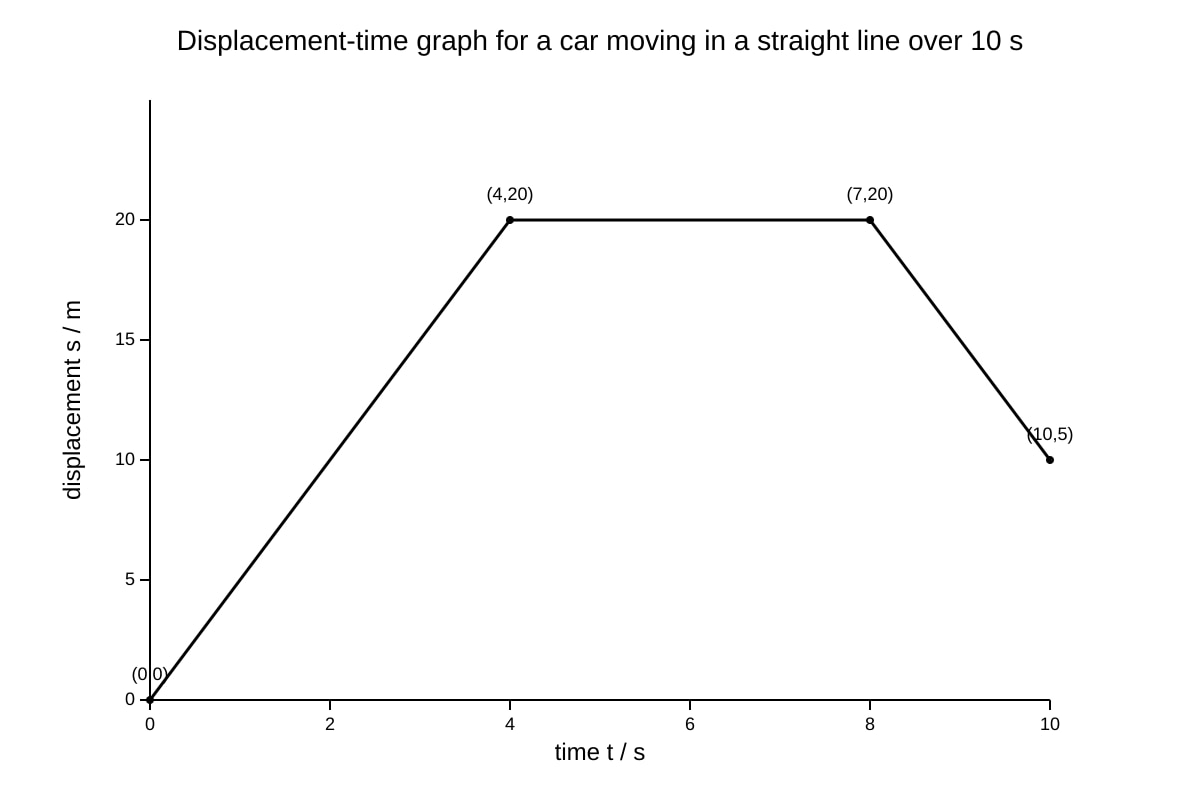
1. A car travels along a straight road. Its displacement–time graph is shown below.
Image pending generation: graph for Q1.
State the velocity of the car between t=4 s and t=7 s. [1]
2. Define displacement. [2]
3. A ball is released from rest and falls freely. Using g=9.8 m s−2, calculate the distance fallen after 3.0 s. [2]
4. A train accelerates uniformly from 10 m s−1 to 25 m s−1 in 30 s. Determine the acceleration. [2]
5. Sketch a velocity–time graph for an object moving with constant negative acceleration from an initial positive velocity. [2]
6. A resultant force of 12 N acts on a 4.0 kg mass. Calculate the acceleration produced. [2]
7. State Newton’s first law of motion. [2]
Section B: Forces, Moments & Equilibrium (18 marks)
8. A uniform rod AB of length 2.0 m and weight 40 N is pivoted at A. A force of 20 N is applied at B perpendicular to the rod. Calculate the moment of the 20 N force about A. [2]
9. The rod in Q8 is now in equilibrium with a supporting force at C, 0.50 m from A. Calculate the magnitude of the supporting force at C. [3]
10. A block rests on a horizontal surface. Draw a free-body diagram showing all forces acting on the block. [2]
11. State Hooke’s law. [2]
12. A spring of original length 0.20 m extends to 0.26 m when a load of 6.0 N is hung. Calculate the spring constant k. [2]
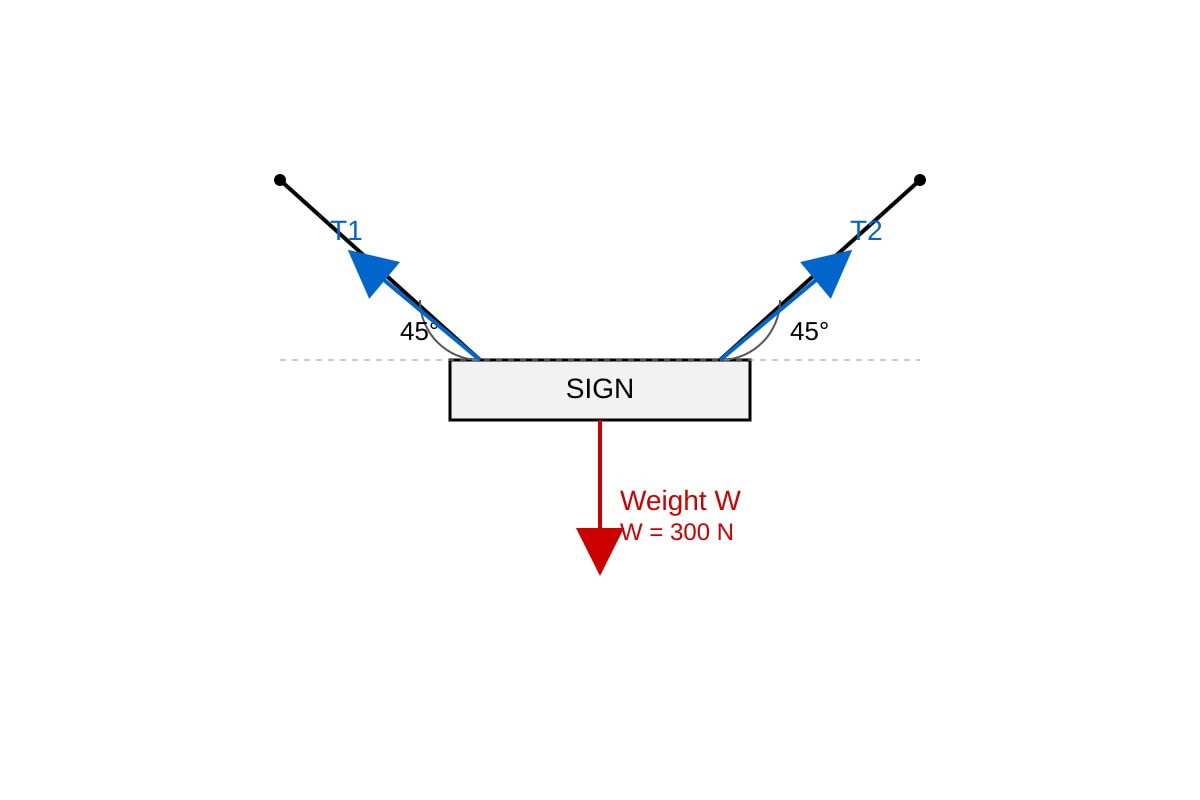
13. Two cables support a sign of weight 300 N. The cables are symmetrical and make 45∘ to the horizontal.
Image pending generation: diagram for Q13.
Calculate the tension in each cable. [3]
Section C: Energy, Momentum & Circular Motion (21 marks)
14. A 2.0 kg object moves at 5.0 m s−1. Calculate its kinetic energy. [2]
15. State the principle of conservation of linear momentum. [2]
16. A 3.0 kg trolley moving at 4.0 m s−1 collides with a stationary 1.0 kg trolley. They stick together. Calculate their common final velocity. [3]
17. A projectile is fired horizontally at 15 m s−1 from a cliff 20 m high. Calculate the time taken to reach the ground. [2]
18. For the projectile in Q17, calculate the horizontal distance travelled before landing. [2]
19. A mass of 0.50 kg is whirled in a horizontal circle of radius 1.2 m at 2.0 rev s−1. Calculate the centripetal force. [3]
20. A satellite orbits Earth at constant speed in a circular path. Explain why it is accelerating even though its speed is constant. [2]
End of Practice Paper — Total Marks: 60
Answers
TuitionGoWhere Practice Paper — Answer Key (Version 5)
Subject: Physics H1 | Level: A-Level | Topic: Mechanics | Total Marks: 60
Section A: Kinematics & Dynamics
Q1. [1 mark]
Velocity = gradient of displacement–time graph. From t=4 to t=7, displacement constant at 20 m → gradient = 0.
Answer: 0 m s−1 (or stationary).
Teaching note: Horizontal line on s–t graph means no change in position → zero velocity.
Q2. [2 marks]
Answer: Displacement is the distance moved in a specified direction from a fixed reference point (or: shortest vector from initial to final position).
Marks: [B1] distance/magnitude, [B1] direction / vector nature.
Common trap: Stating “distance” only (no direction) loses 1 mark.
Q3. [2 marks]
Use s=ut+21gt2, u=0:
s=0+21(9.8)(3.0)2=4.9×9=44.1 m.
Answer: 44.1 m.
Marks: [M1] correct formula, [A1] answer with unit.
Q4. [2 marks]
a=tv−u=3025−10=0.50 m s−2.
Answer: 0.50 m s−2.
Marks: [M1] substitution, [A1] answer.
Q5. [2 marks]
Answer: Straight line with positive intercept on v-axis, negative slope, crossing time-axis to negative v. Axes labelled v, t.
Marks: [B1] correct negative slope, [B1] labelled axes / correct shape.
Q6. [2 marks]
F=ma⇒a=F/m=12/4.0=3.0 m s−2.
Answer: 3.0 m s−2.
Marks: [M1] formula, [A1] answer.
Q7. [2 marks]
Answer: A body remains at rest or continues to move with constant velocity unless acted upon by a resultant external force.
Marks: [B1] rest or uniform motion, [B1] unless resultant force.
Section B: Forces, Moments & Equilibrium
Q8. [2 marks]
Moment = F×d=20×2.0=40 N m.
Answer: 40 N m.
Marks: [M1] formula, [A1] answer.
Q9. [3 marks]
Taking moments about A: FC×0.50=40×1.0 (weight at centre).
FC=40/0.50=80 N.
Answer: 80 N.
Marks: [M1] moment eq about A, [M1] correct use of 1.0 m arm for weight, [A1] answer.
Note: Rod weight acts at midpoint (1.0 m from A).
Q10. [2 marks]
Answer: Downward weight W, upward normal reaction R. Arrows from centre, equal length.
Marks: [B1] weight down, [B1] normal up.
Q11. [2 marks]
Answer: Extension of a spring is directly proportional to the applied load, provided limit of proportionality is not exceeded.
Marks: [B1] proportional to load, [B1] condition / F=kx.
Q12. [2 marks]
Extension x=0.26−0.20=0.06 m.
k=F/x=6.0/0.06=100 N m−1.
Answer: 100 N m−1.
Marks: [M1] extension, [A1] k.
Q13. [3 marks]
Vertical equilibrium: 2Tsin45∘=300.
T=300/(2×0.707)=212 N.
Answer: 212 N (or 210 N).
Marks: [M1] vertical components, [M1] equation, [A1] answer.
Section C: Energy, Momentum & Circular Motion
Q14. [2 marks]
Ek=21mv2=0.5×2.0×5.02=25 J.
Answer: 25 J.
Marks: [M1] formula, [A1] answer.
Q15. [2 marks]
Answer: In a closed system with no external force, total linear momentum is conserved (constant).
Marks: [B1] closed/system no ext force, [B1] total momentum constant.
Q16. [3 marks]
m1u1+m2u2=(m1+m2)v
3.0(4.0)+1.0(0)=4.0v⇒v=12/4=3.0 m s−1.
Answer: 3.0 m s−1.
Marks: [M1] momentum conservation, [M1] substitution, [A1] answer.
Q17. [2 marks]
s=21gt2⇒20=4.9t2⇒t=4.08=2.02 s.
Answer: 2.0 s.
Marks: [M1] formula, [A1] answer.
Q18. [2 marks]
Horizontal: x=ut=15×2.02=30.3 m.
Answer: 30 m.
Marks: [M1] use t from Q17, [A1] answer.
Q19. [3 marks]
ω=2πf=2π(2.0)=12.57 rad s−1.
F=mω2r=0.50×(12.57)2×1.2=94.9 N.
Answer: 95 N.
Marks: [M1] angular speed, [M1] centripetal formula, [A1] answer.
Q20. [2 marks]
Answer: Direction of velocity changes continuously; acceleration is towards centre (centripetal), so velocity vector changes.
Marks: [B1] direction changes, [B1] centripetal acceleration.
Free quiz and exam paper access
Enter your details to view this paper
Your access is remembered on this device.