AI Generated Exam Paper

A Level H1 Physics Practice Paper 5

Free AI-Generated DeepSeek V4 Pro A Level H1 Physics Practice Paper 5 practice paper with questions and answers for Singapore students. This page is rendered as a direct URL so the questions and answers can be discovered without pressing in-page buttons.

These static practice materials are generated from the site's syllabus and paper-generation workflow, with source and model context shown so students and parents can evaluate the material before use.

A Level H1 Physics AI Generated Generated by DeepSeek V4 Pro Updated 2026-06-03

Questions

<!-- TuitionGoWhere generation metadata: stage=5-2; model=deepseek/deepseek-v4-pro; model_label=DeepSeek V4 Pro; generated=2026-05-28; Sources: Stage 4-0 LLM templates, syllabus context, and Stage 2 evidence where available. -->

TuitionGoWhere Practice Paper - Physics H1 A-Level

TuitionGoWhere Practice Paper (AI)

Subject: Physics H1 (8867) Level: A-Level Paper: Practice Paper – Mechanics Version: 5 of 5 Duration: 1 hour 30 minutes Total Marks: 60

Name: _________________________ Class: _________________________ Date: _________________________


Instructions to Candidates

  1. This paper consists of 20 questions covering the Mechanics topic.
  2. Answer all questions in the spaces provided.
  3. The number of marks is given in brackets [ ] at the end of each question or part question.
  4. You are advised to show all working clearly, including formulae and substitutions.
  5. Take g = 9.81 m s⁻² unless otherwise stated.
  6. Non-programmable calculators may be used.
  7. The total time suggested for this paper is 1 hour 30 minutes.

Section A: Kinematics and Dynamics (Questions 1–5)

Total: 15 marks

1. A car accelerates uniformly from rest to 25.0 m s⁻¹ in 8.0 s along a straight road.

(a) Calculate the acceleration of the car. [2]

(b) Determine the distance travelled by the car during this 8.0 s period. [2]


2. A stone is projected vertically upwards from ground level with an initial speed of 20.0 m s⁻¹. Air resistance is negligible.

(a) Calculate the maximum height reached by the stone. [2]

(b) Determine the total time for which the stone is in the air before returning to ground level. [2]


3. A ball is thrown horizontally from the top of a vertical cliff 45.0 m high. The ball lands in the sea at a horizontal distance of 60.0 m from the base of the cliff.

(a) Calculate the time taken for the ball to reach the sea. [2]

(b) Determine the initial horizontal speed of the ball. [1]


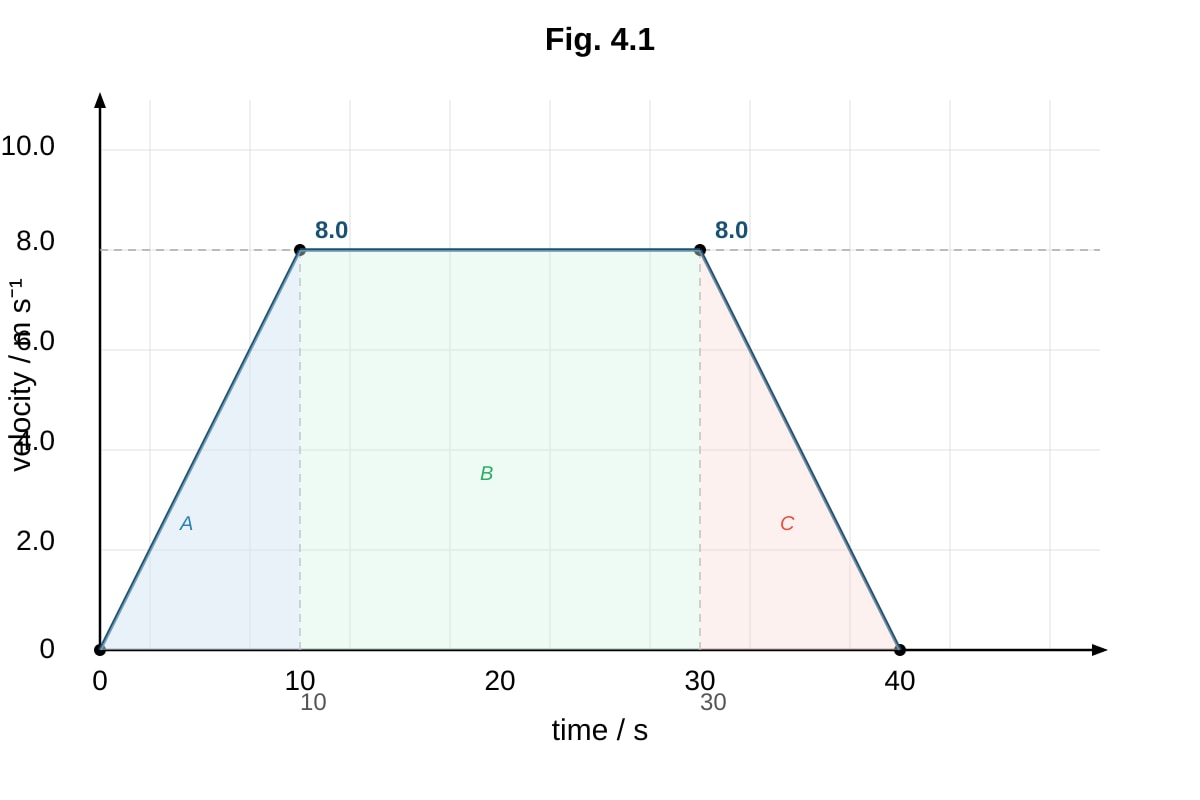
4. The velocity–time graph below represents the motion of a cyclist travelling along a straight road.

[Graph description: From t = 0 to t = 10 s, velocity increases uniformly from 0 to 8.0 m s⁻¹. From t = 10 s to t = 30 s, velocity remains constant at 8.0 m s⁻¹. From t = 30 s to t = 40 s, velocity decreases uniformly to 0.]

(a) Describe the motion of the cyclist during the first 10 s. [1]

(b) Calculate the total distance travelled by the cyclist in 40 s. [3]


5. A block of mass 5.0 kg is pulled along a rough horizontal surface by a force of 30 N applied at an angle of 30° above the horizontal. The coefficient of kinetic friction between the block and the surface is 0.25.

(a) Draw a free-body diagram showing all forces acting on the block. [2]

(b) Calculate the normal reaction force exerted by the surface on the block. [2]

(c) Determine the acceleration of the block. [3]


Section B: Forces, Momentum, and Energy (Questions 6–15)

Total: 30 marks

6. State the principle of conservation of linear momentum. [2]


7. A trolley A of mass 2.0 kg moves at 3.0 m s⁻¹ to the right on a frictionless track. It collides with a stationary trolley B of mass 1.0 kg. After the collision, trolley A moves at 1.0 m s⁻¹ to the right.

(a) Calculate the velocity of trolley B after the collision. [2]

(b) Determine whether the collision is elastic or inelastic. Show your working. [3]


8. A tennis ball of mass 0.058 kg strikes a wall at 25 m s⁻¹ and rebounds at 18 m s⁻¹ in the opposite direction. The contact time with the wall is 0.040 s.

(a) Calculate the change in momentum of the ball. [2]

(b) Determine the average force exerted by the wall on the ball. [2]


9. A uniform plank AB of length 4.0 m and weight 200 N rests horizontally on two supports at points P and Q. P is 0.50 m from end A, and Q is 1.0 m from end B. A person of weight 600 N stands at end A.

(a) Draw a diagram showing all forces acting on the plank. [2]

(b) By taking moments about P, calculate the reaction force at Q. [3]

(c) Determine the reaction force at P. [1]


10. A crate of mass 50 kg is pulled up a rough slope inclined at 20° to the horizontal by a force of 400 N applied parallel to the slope. The coefficient of kinetic friction between the crate and the slope is 0.30.

(a) Calculate the component of the crate's weight acting down the slope. [2]

(b) Determine the friction force acting on the crate. [2]

(c) Calculate the acceleration of the crate up the slope. [3]


11. A roller coaster car of mass 400 kg passes point A at a speed of 5.0 m s⁻¹. Point A is 25 m above ground level. The car travels down a frictionless track to point B, which is 8.0 m above ground level.

(a) Calculate the kinetic energy of the car at point A. [1]

(b) Using energy considerations, determine the speed of the car at point B. [3]


12. An electric motor lifts a load of mass 120 kg vertically upwards at a constant speed of 0.50 m s⁻¹. The motor operates at 240 V and has an efficiency of 75%.

(a) Calculate the useful mechanical power output of the motor. [2]

(b) Determine the current drawn by the motor. [2]


13. A ball of mass 0.15 kg is dropped from rest and falls vertically. Air resistance is not negligible.

(a) Sketch a graph of velocity against time for the ball from the moment it is released until it reaches terminal velocity. Label the terminal velocity on your graph. [2]

(b) Explain the shape of your graph in terms of the forces acting on the ball. [2]


14. A spring of spring constant 500 N m⁻¹ is compressed by 0.12 m and used to launch a 0.050 kg ball horizontally from a height of 1.5 m above the ground. Assume no energy losses.

(a) Calculate the elastic potential energy stored in the compressed spring. [1]

(b) Determine the horizontal distance travelled by the ball before it hits the ground. [4]


15. Two ice skaters, A (mass 60 kg) and B (mass 45 kg), are initially at rest on a frictionless ice rink. Skater A pushes skater B, and they move apart. Skater B moves away at 2.5 m s⁻¹.

(a) Calculate the velocity of skater A after the push. [2]

(b) Determine the total kinetic energy of the system after the push. [2]


Section C: Integrated and Applied Mechanics (Questions 16–20)

Total: 15 marks

16. A car of mass 1200 kg travels at 20 m s⁻¹ around a circular bend of radius 80 m on a horizontal road.

(a) Calculate the centripetal acceleration of the car. [1]

(b) Determine the minimum coefficient of friction between the tyres and the road required to prevent skidding. [2]


17. A pendulum bob of mass 0.20 kg is released from rest when the string makes an angle of 30° with the vertical. The length of the string is 1.2 m.

(a) Calculate the vertical height through which the bob falls to reach its lowest point. [2]

(b) Determine the speed of the bob at its lowest point. [2]

(c) Calculate the tension in the string when the bob is at its lowest point. [2]


18. A conveyor belt moves at a constant speed of 1.5 m s⁻¹. Sand falls vertically onto the belt at a rate of 20 kg s⁻¹.

(a) Calculate the rate of change of momentum of the sand in the horizontal direction. [2]

(b) Determine the additional horizontal force required to keep the belt moving at constant speed. [1]


19. A satellite of mass 500 kg orbits the Earth in a circular orbit at a height of 400 km above the Earth's surface.

Given: Mass of Earth = 6.0 × 10²⁴ kg, Radius of Earth = 6.4 × 10⁶ m, G = 6.67 × 10⁻¹¹ N m² kg⁻².

(a) Calculate the gravitational force acting on the satellite. [2]

(b) Determine the orbital speed of the satellite. [2]

(c) Calculate the period of the satellite's orbit. [1]


20. A student investigates the motion of a ball rolling down an inclined plane. The plane is 2.0 m long and inclined at 15° to the horizontal. The ball is released from rest at the top. Assume the ball rolls without slipping and friction is negligible.

(a) Calculate the acceleration of the ball down the plane. [2]

(b) Determine the speed of the ball at the bottom of the plane. [2]

(c) The student repeats the experiment with a plane inclined at 30°. Without calculation, state and explain how the speed at the bottom would compare to that in part (b). [2]


END OF PAPER


This practice paper was generated by TuitionGoWhere AI. It is designed for practice purposes and is not derived from any specific past examination paper.

Answers

<!-- TuitionGoWhere generation metadata: stage=5-2; model=deepseek/deepseek-v4-pro; model_label=DeepSeek V4 Pro; generated=2026-05-28; Sources: Stage 4-0 LLM templates, syllabus context, and Stage 2 evidence where available. -->

TuitionGoWhere Practice Paper - Physics H1 A-Level

Answer Key and Marking Scheme

Paper: Practice Paper – Mechanics Version: 5 of 5 Total Marks: 60


Section A: Kinematics and Dynamics (Questions 1–5)

Question 1

(a) [2 marks]

  • a = (v − u) / t = (25.0 − 0) / 8.0 [M1]
  • a = 3.13 m s⁻² [A1]

(b) [2 marks]

  • s = ut + ½at² = 0 + ½ × 3.125 × (8.0)² [M1]
  • s = 100 m [A1]
  • Alternative: s = ½(u + v)t = ½(0 + 25.0) × 8.0 = 100 m

Question 2

(a) [2 marks]

  • v² = u² + 2as → 0 = (20.0)² + 2(−9.81)s [M1]
  • s = (20.0)² / (2 × 9.81) = 20.4 m [A1]

(b) [2 marks]

  • Time to max height: v = u + at → 0 = 20.0 − 9.81t → t = 2.04 s [M1]
  • Total time = 2 × 2.04 = 4.08 s [A1]
  • Alternative: s = 0 = ut − ½gt² → 0 = 20.0t − 4.905t² → t = 0 or t = 4.08 s

Question 3

(a) [2 marks]

  • Vertical: s = ut + ½at² → 45.0 = 0 + ½(9.81)t² [M1]
  • t = √(90.0/9.81) = 3.03 s [A1]

(b) [1 mark]

  • Horizontal: s = ut → 60.0 = u × 3.03 [M1]
  • u = 19.8 m s⁻¹ [A1]
  • Note: Award [1] for correct answer with working.

Question 4

(a) [1 mark]

  • The cyclist accelerates uniformly from rest to 8.0 m s⁻¹. [A1]

(b) [3 marks]

  • Distance = area under v–t graph [M1]
  • Area = ½ × 10 × 8.0 + 20 × 8.0 + ½ × 10 × 8.0 [M1]
  • = 40 + 160 + 40 = 240 m [A1]

Question 5

(a) [2 marks]

  • Diagram showing: weight (49.05 N down), normal reaction (N up), applied force (30 N at 30° above horizontal), friction (f left) [B1]
  • All forces correctly labelled with directions [B1]

(b) [2 marks]

  • Vertical equilibrium: N + 30 sin 30° = mg [M1]
  • N + 15 = 5.0 × 9.81 = 49.05
  • N = 34.05 N ≈ 34.1 N [A1]

(c) [3 marks]

  • Horizontal component of applied force = 30 cos 30° = 26.0 N [M1]
  • Friction f = μN = 0.25 × 34.05 = 8.51 N [M1]
  • Net force = 26.0 − 8.51 = 17.49 N
  • a = F/m = 17.49/5.0 = 3.50 m s⁻² [A1]

Section B: Forces, Momentum, and Energy (Questions 6–15)

Question 6

[2 marks]

  • The total momentum of a closed/isolated system remains constant [B1]
  • provided no external resultant force acts on the system [B1]
  • Accept: In the absence of external forces, total momentum before collision = total momentum after collision.

Question 7

(a) [2 marks]

  • m₁u₁ + m₂u₂ = m₁v₁ + m₂v₂ → 2.0(3.0) + 0 = 2.0(1.0) + 1.0(v_B) [M1]
  • 6.0 = 2.0 + v_B → v_B = 4.0 m s⁻¹ to the right [A1]

(b) [3 marks]

  • Initial KE = ½(2.0)(3.0)² = 9.0 J [M1]
  • Final KE = ½(2.0)(1.0)² + ½(1.0)(4.0)² = 1.0 + 8.0 = 9.0 J [M1]
  • KE is conserved → collision is elastic [A1]

Question 8

(a) [2 marks]

  • Taking direction towards wall as positive:
  • Δp = m(v − u) = 0.058(−18 − 25) [M1]
  • Δp = 0.058 × (−43) = −2.49 kg m s⁻¹
  • Magnitude of change in momentum = 2.49 kg m s⁻¹ [A1]

(b) [2 marks]

  • F = Δp / Δt = 2.494 / 0.040 [M1]
  • F = 62.4 N (away from wall) [A1]

Question 9

(a) [2 marks]

  • Diagram showing: weight of plank (200 N at centre, 2.0 m from A), weight of person (600 N at A), reaction at P (R_P up), reaction at Q (R_Q up) [B1]
  • All forces and distances correctly labelled [B1]

(b) [3 marks]

  • Taking moments about P (clockwise positive):
  • 200 × (2.0 − 0.50) + 600 × 0.50 = R_Q × (4.0 − 0.50 − 1.0) [M1]
  • 200 × 1.5 + 300 = R_Q × 2.5 [M1]
  • 300 + 300 = 2.5 R_Q → R_Q = 240 N [A1]

(c) [1 mark]

  • Vertical equilibrium: R_P + R_Q = 200 + 600 [M1]
  • R_P + 240 = 800 → R_P = 560 N [A1]

Question 10

(a) [2 marks]

  • Weight = mg = 50 × 9.81 = 490.5 N [M1]
  • Component down slope = mg sin 20° = 490.5 × sin 20° = 168 N [A1]

(b) [2 marks]

  • Normal reaction N = mg cos 20° = 490.5 × cos 20° = 461 N [M1]
  • Friction f = μN = 0.30 × 461 = 138 N [A1]

(c) [3 marks]

  • Net force up slope = 400 − 168 − 138 = 94 N [M1]
  • a = F/m = 94/50 [M1]
  • a = 1.88 m s⁻² [A1]

Question 11

(a) [1 mark]

  • KE_A = ½mv² = ½ × 400 × (5.0)² = 5000 J [A1]

(b) [3 marks]

  • Loss in GPE = mg(h_A − h_B) = 400 × 9.81 × (25 − 8) = 66,708 J [M1]
  • Gain in KE = Loss in GPE → KE_B = KE_A + 66,708 = 71,708 J [M1]
  • ½mv_B² = 71,708 → v_B = √(2 × 71,708 / 400) = √358.54 = 18.9 m s⁻¹ [A1]

Question 12

(a) [2 marks]

  • Weight = mg = 120 × 9.81 = 1177.2 N [M1]
  • P_useful = Fv = 1177.2 × 0.50 = 589 W [A1]

(b) [2 marks]

  • Efficiency = P_useful / P_input → 0.75 = 589 / P_input [M1]
  • P_input = 589 / 0.75 = 785 W
  • P_input = VI → 785 = 240 × I → I = 3.27 A [A1]

Question 13

(a) [2 marks]

  • Graph starting at origin, increasing with decreasing gradient [B1]
  • Approaching and labelled horizontal line at terminal velocity [B1]

(b) [2 marks]

  • Initially, weight > air resistance → net downward force → acceleration [B1]
  • As speed increases, air resistance increases → net force decreases → acceleration decreases. When air resistance = weight, net force = 0 → constant terminal velocity [B1]

Question 14

(a) [1 mark]

  • EPE = ½kx² = ½ × 500 × (0.12)² = 3.6 J [A1]

(b) [4 marks]

  • KE of ball = EPE = 3.6 J → ½mv² = 3.6 → v = √(7.2/0.050) = 12.0 m s⁻¹ [M1]
  • Time to fall 1.5 m: s = ½gt² → 1.5 = ½(9.81)t² → t = √(3.0/9.81) = 0.553 s [M1]
  • Horizontal distance = vt = 12.0 × 0.553 [M1]
  • = 6.64 m [A1]

Question 15

(a) [2 marks]

  • Conservation of momentum: 0 = m_A v_A + m_B v_B [M1]
  • 0 = 60v_A + 45(2.5) → v_A = −112.5/60 = −1.875 m s⁻¹
  • Velocity of A = 1.88 m s⁻¹ in opposite direction to B [A1]

(b) [2 marks]

  • KE = ½m_A v_A² + ½m_B v_B² [M1]
  • = ½(60)(1.875)² + ½(45)(2.5)² = 105.5 + 140.6 = 246 J [A1]

Section C: Integrated and Applied Mechanics (Questions 16–20)

Question 16

(a) [1 mark]

  • a = v²/r = (20)²/80 = 5.0 m s⁻² [A1]

(b) [2 marks]

  • Centripetal force = friction: mv²/r = μmg [M1]
  • μ = v²/(rg) = (20)²/(80 × 9.81) = 400/784.8 = 0.510 [A1]

Question 17

(a) [2 marks]

  • Vertical drop = L − L cos 30° = 1.2(1 − cos 30°) [M1]
  • = 1.2(1 − 0.866) = 1.2 × 0.134 = 0.161 m [A1]

(b) [2 marks]

  • Loss in GPE = Gain in KE: mgh = ½mv² [M1]
  • v = √(2gh) = √(2 × 9.81 × 0.161) = √3.16 = 1.78 m s⁻¹ [A1]

(c) [2 marks]

  • At lowest point: T − mg = mv²/L [M1]
  • T = mg + mv²/L = 0.20 × 9.81 + 0.20 × (1.78)²/1.2
  • = 1.962 + 0.528 = 2.49 N [A1]

Question 18

(a) [2 marks]

  • Mass per second = 20 kg s⁻¹; velocity change = 1.5 m s⁻¹ (from 0 to 1.5 horizontally) [M1]
  • Rate of change of momentum = (Δm/Δt) × v = 20 × 1.5 = 30 N [A1]

(b) [1 mark]

  • Force = rate of change of momentum = 30 N [A1]

Question 19

(a) [2 marks]

  • r = 6.4 × 10⁶ + 4.0 × 10⁵ = 6.8 × 10⁶ m [M1]
  • F = GMm/r² = (6.67 × 10⁻¹¹ × 6.0 × 10²⁴ × 500) / (6.8 × 10⁶)²
  • = (2.001 × 10¹⁷) / (4.624 × 10¹³) = 4330 N [A1]

(b) [2 marks]

  • Gravitational force provides centripetal force: GMm/r² = mv²/r [M1]
  • v = √(GM/r) = √(6.67 × 10⁻¹¹ × 6.0 × 10²⁴ / 6.8 × 10⁶)
  • = √(4.002 × 10¹⁴ / 6.8 × 10⁶) = √(5.885 × 10⁷) = 7.67 × 10³ m s⁻¹ [A1]

(c) [1 mark]

  • T = 2πr/v = 2π × 6.8 × 10⁶ / 7.67 × 10³ = 5570 s ≈ 92.8 min [A1]

Question 20

(a) [2 marks]

  • a = g sin θ = 9.81 × sin 15° [M1]
  • = 9.81 × 0.259 = 2.54 m s⁻² [A1]

(b) [2 marks]

  • v² = u² + 2as = 0 + 2 × 2.54 × 2.0 [M1]
  • v = √10.16 = 3.19 m s⁻¹ [A1]

(c) [2 marks]

  • The speed would be greater [B1]
  • Because sin 30° > sin 15°, so acceleration is larger (a = g sin θ). With greater acceleration over the same distance, the final speed is greater (v² = 2as). [B1]

END OF MARKING SCHEME


This answer key was generated by TuitionGoWhere AI for practice purposes.