AI Generated Exam Paper

A Level H1 Physics Practice Paper 4

Free AI-Generated Owl Alpha A Level H1 Physics Practice Paper 4 practice paper with questions and answers for Singapore students. This page is rendered as a direct URL so the questions and answers can be discovered without pressing in-page buttons.

These static practice materials are generated from the site's syllabus and paper-generation workflow, with source and model context shown so students and parents can evaluate the material before use.

A Level H1 Physics AI Generated Generated by Owl Alpha Updated 2026-06-07

Questions

<!-- TuitionGoWhere generation metadata: stage=5-2; model=openrouter/owl-alpha; model_label=Owl Alpha; generated=2026-06-06; Sources: Stage 4-0 LLM templates, syllabus context, and Stage 2 evidence where available. -->

TuitionGoWhere Practice Paper - Physics H1 A-Level

TuitionGoWhere Practice Paper (AI)

Subject: Physics H1
Level: A-Level
Paper: Practice Paper — Mechanics Focus
Version: 4 of 5
Duration: 1 hour 30 minutes
Total Marks: 60

Name: ___________________________
Class: ___________________________
Date: ___________________________


Instructions

  • Answer all questions in the spaces provided.
  • The number of marks for each question or part-question is shown in brackets [ ].
  • Assume g=9.81 m s2g = 9.81 \text{ m s}^{-2} unless otherwise stated.
  • Show all working clearly. Credit is given for correct reasoning and method even if the final answer is incorrect.
  • Non-programmable calculators may be used.
  • Where required, give answers to an appropriate number of significant figures (usually 2 or 3 s.f.).

Section A: Multiple Choice [10 marks]

Questions 1–10: Choose the single best answer.


1. A car accelerates uniformly from rest at 2.5 m s22.5 \text{ m s}^{-2} for 8.0 s. What is its final speed?

A. 5.0 m s15.0 \text{ m s}^{-1}
B. 10.0 m s110.0 \text{ m s}^{-1}
C. 20.0 m s120.0 \text{ m s}^{-1}
D. 40.0 m s140.0 \text{ m s}^{-1}

[1]


2. Which of the following is a vector quantity?

A. Energy
B. Power
C. Speed
D. Momentum

[1]


3. A ball is thrown horizontally from the top of a cliff at 15 m s115 \text{ m s}^{-1}. Ignoring air resistance, which statement about its motion is correct?

A. Its horizontal acceleration increases.
B. Its vertical acceleration is zero.
C. Its horizontal velocity remains constant.
D. Its vertical velocity remains constant.

[1]


4. A 0.50 kg ball moving at 6.0 m s16.0 \text{ m s}^{-1} collides with a stationary 1.5 kg ball. After the collision, the two balls stick together. What is their common velocity?

A. 1.0 m s11.0 \text{ m s}^{-1}
B. 1.5 m s11.5 \text{ m s}^{-1}
C. 2.0 m s12.0 \text{ m s}^{-1}
D. 3.0 m s13.0 \text{ m s}^{-1}

[1]


5. A force of 20 N acts on an object and moves it 5.0 m in the direction of the force. The work done by the force is:

A. 4.0 J
B. 25 J
C. 100 J
D. 200 J

[1]


6. A 2.0 kg block slides down a frictionless inclined plane from a height of 3.0 m. What is its speed at the bottom? (g=9.81 m s2g = 9.81 \text{ m s}^{-2})

A. 5.4 m s15.4 \text{ m s}^{-1}
B. 7.7 m s17.7 \text{ m s}^{-1}
C. 9.8 m s19.8 \text{ m s}^{-1}
D. 12.0 m s112.0 \text{ m s}^{-1}

[1]


7. A uniform beam of weight 60 N is supported at both ends. A 40 N load is placed at the midpoint of the beam. What is the reaction force at each support?

A. 20 N
B. 30 N
C. 50 N
D. 100 N

[1]


8. Which statement best describes Newton's Third Law of Motion?

A. An object at rest stays at rest unless acted on by a net force.
B. The net force on an object equals its mass times its acceleration.
C. When object A exerts a force on object B, object B exerts an equal and opposite force on object A.
D. The acceleration of an object is inversely proportional to its mass.

[1]


9. A projectile is launched at an angle of 30°30° above the horizontal with an initial speed of 40 m s140 \text{ m s}^{-1}. What is the horizontal component of its initial velocity?

A. 20.0 m s120.0 \text{ m s}^{-1}
B. 23.1 m s123.1 \text{ m s}^{-1}
C. 34.6 m s134.6 \text{ m s}^{-1}
D. 40.0 m s140.0 \text{ m s}^{-1}

[1]


10. A 70 kg student stands in a lift that is accelerating upwards at 1.5 m s21.5 \text{ m s}^{-2}. What is the normal contact force exerted by the lift floor on the student? (g=9.81 m s2g = 9.81 \text{ m s}^{-2})

A. 582 N
B. 687 N
C. 792 N
D. 805 N

[1]


Section B: Structured Questions [30 marks]


11. Kinematics [6 marks]

(a) Define acceleration. [1]

(b) A car travelling at 25 m s125 \text{ m s}^{-1} brakes uniformly and comes to rest in 10 s.

    (i) Calculate the deceleration of the car. [2]

    (ii) Calculate the distance travelled by the car during braking. [3]


12. Newton's Laws and Dynamics [7 marks]

(a) State Newton's Second Law of Motion. [1]

(b) A 1200 kg car moves along a horizontal road. The engine provides a forward driving force of 3600 N. The total resistive force acting on the car is 1200 N.

    (i) Calculate the acceleration of the car. [2]

    (ii) The car starts from rest. Calculate its speed after 6.0 s. [2]

    (iii) Calculate the distance travelled by the car in the first 6.0 s. [2]


13. Conservation of Momentum [8 marks]

(a) State the principle of conservation of linear momentum. [2]

(b) A 3.0 kg trolley A moves at 4.0 m s14.0 \text{ m s}^{-1} on a frictionless horizontal track and collides with a stationary 2.0 kg trolley B. After the collision, the two trolleys stick together and move as one.

    (i) Calculate the common velocity of the trolleys after the collision. [3]

    (ii) Calculate the kinetic energy lost during the collision. [3]


14. Work, Energy and Power [9 marks]

(a) Define work done by a force. [1]

(b) A 5.0 kg block is pulled along a rough horizontal surface by a constant horizontal force of 40 N. The block moves a distance of 8.0 m. The frictional force between the block and the surface is 15 N.

    (i) Calculate the work done by the applied force. [1]

    (ii) Calculate the work done against friction. [1]

    (iii) Using the work-energy principle, calculate the final speed of the block if it started from rest. [3]

(c) The applied force acts for 4.0 s. Calculate the average power delivered by the applied force. [3]


Section C: Free Response [20 marks]


15. Projectile Motion [10 marks]

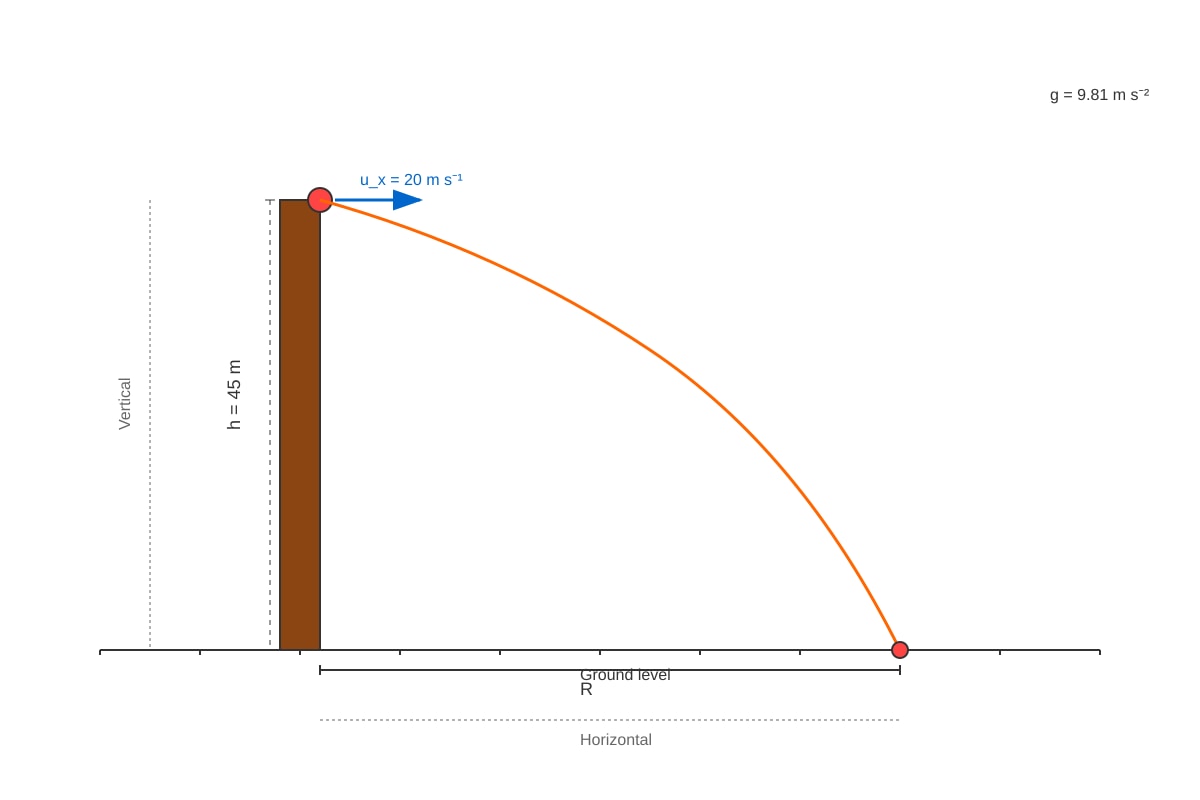
A ball is projected horizontally from the top of a tower of height 45 m with an initial horizontal speed of 20 m s120 \text{ m s}^{-1}. Air resistance is negligible. (g=9.81 m s1g = 9.81 \text{ m s}^{-1})

<image_placeholder> id: Q15-fig1 type: diagram linked_question: Q15 description: Side-view diagram of a tower of height 45 m. A ball is shown at the top of the tower with a horizontal arrow indicating initial velocity 20 m s⁻¹ to the right. The ball follows a parabolic trajectory to the ground. The horizontal distance from the base of the tower to the landing point is labelled as R (range). Vertical axis shows height h = 45 m. labels: Tower height h = 45 m, initial horizontal velocity u_x = 20 m s⁻¹, parabolic trajectory, range R, ground level values: h = 45 m, u_x = 20 m s⁻¹, g = 9.81 m s⁻² must_show: Tower with labelled height, horizontal velocity arrow at top, curved parabolic path to ground, horizontal range R marked at base </image_placeholder>

(a) Explain why the horizontal component of the ball's velocity remains constant during its flight. [2]

(b) Calculate the time taken for the ball to reach the ground. [3]

(c) Calculate the horizontal range RR of the ball. [2]

(d) Calculate the speed of the ball just before it hits the ground. [3]


16. Forces and Equilibrium [10 marks]

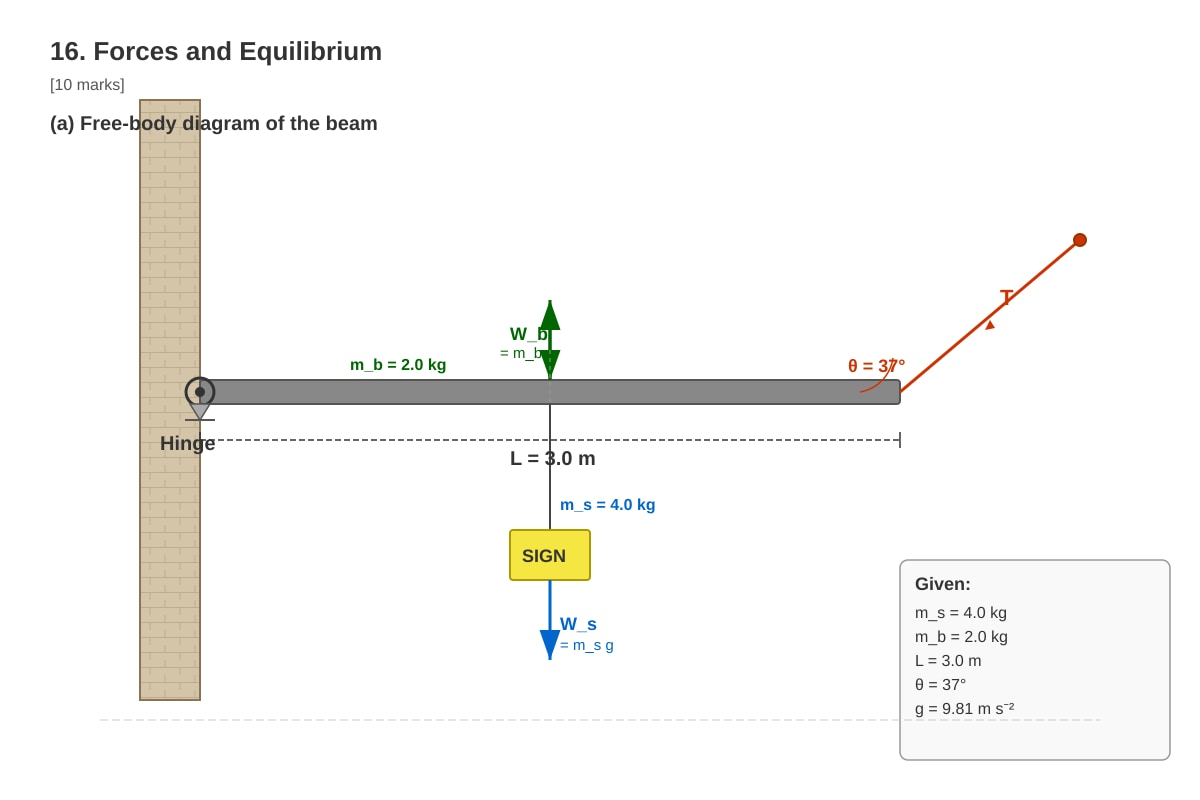
A 4.0 kg sign is suspended from a horizontal, uniform beam of mass 2.0 kg and length 3.0 m. The beam is hinged to a vertical wall at one end and supported by a cable attached to the other end of the beam, making an angle of 37°37° with the beam. The sign is hung at the midpoint of the beam.

<image_placeholder> id: Q16-fig1 type: diagram linked_question: Q16 description: A horizontal beam of length 3.0 m is hinged to a vertical wall on the left end. A cable is attached to the right end of the beam, angled upward at 37° to the horizontal (or to the beam). A sign of mass 4.0 kg hangs from the midpoint of the beam. The beam has mass 2.0 kg (uniform, so weight acts at midpoint). The wall hinge provides reaction forces. Tension T acts along the cable. labels: Beam length L = 3.0 m, beam mass m_b = 2.0 kg, sign mass m_s = 4.0 kg, cable angle θ = 37° to beam/horizontal, hinge at left end, cable at right end, sign at midpoint, weight of beam W_b = m_b g at midpoint, weight of sign W_s = m_s g at midpoint, tension T along cable values: m_b = 2.0 kg, m_s = 4.0 kg, L = 3.0 m, θ = 37°, g = 9.81 m s⁻² must_show: Wall on left, horizontal beam extending right, hinge symbol at left end, cable from right end angled up at 37°, sign hanging from midpoint, all labels clearly shown </image_placeholder>

(a) Draw a free-body diagram for the beam, showing all forces acting on it. Label each force clearly. [3]

(b) By taking moments about the hinge, calculate the tension TT in the cable. [4]

(c) Calculate the magnitude of the reaction force at the hinge. [3]


End of Paper

Total Marks: 60
Section A: 10 marks | Section B: 30 marks | Section C: 20 marks

Answers

<!-- TuitionGoWhere generation metadata: stage=5-2; model=openrouter/owl-alpha; model_label=Owl Alpha; generated=2026-06-06; Sources: Stage 4-0 LLM templates, syllabus context, and Stage 2 evidence where available. -->

TuitionGoWhere Practice Paper — Physics H1 A-Level

Answer Key — Mechanics Focus (Version 4 of 5)


Section A: Multiple Choice

1. C. 20.0 m s120.0 \text{ m s}^{-1} [1]
Explanation: Using v=u+atv = u + at, where u=0u = 0, a=2.5 m s2a = 2.5 \text{ m s}^{-2}, t=8.0 st = 8.0 \text{ s}:
v=0+(2.5)(8.0)=20.0 m s1v = 0 + (2.5)(8.0) = 20.0 \text{ m s}^{-1}.
Common mistake: Forgetting the car starts from rest (u=0u = 0).


2. D. Momentum [1]
Explanation: Momentum (p=mv\mathbf{p} = m\mathbf{v}) has both magnitude and direction, making it a vector. Energy, power, and speed are scalars — they have magnitude only.


3. C. Its horizontal velocity remains constant. [1]
Explanation: In projectile motion (ignoring air resistance), there is no horizontal force, so horizontal velocity is constant. The vertical motion is accelerated by gravity (a=ga = g downward), so vertical velocity increases.
Common mistake: Thinking the horizontal component changes because the path is curved.


4. B. 1.5 m s11.5 \text{ m s}^{-1} [1]
Explanation: Conservation of momentum: m1u1+m2u2=(m1+m2)vm_1 u_1 + m_2 u_2 = (m_1 + m_2)v
(0.50)(6.0)+(1.5)(0)=(0.50+1.5)v(0.50)(6.0) + (1.5)(0) = (0.50 + 1.5)v
3.0=2.0v3.0 = 2.0v
v=1.5 m s1v = 1.5 \text{ m s}^{-1}.


5. C. 100 J [1]
Explanation: Work done =F×d=20×5.0=100 J= F \times d = 20 \times 5.0 = 100 \text{ J}.
Work is done when a force moves an object in the direction of the force.


6. B. 7.7 m s17.7 \text{ m s}^{-1} [1]
Explanation: Using conservation of energy: mgh=12mv2mgh = \frac{1}{2}mv^2, so v=2ghv = \sqrt{2gh}
v=2×9.81×3.0=58.86=7.677.7 m s1v = \sqrt{2 \times 9.81 \times 3.0} = \sqrt{58.86} = 7.67 \approx 7.7 \text{ m s}^{-1} (2 s.f.).


7. C. 50 N [1]
Explanation: Total downward force =60+40=100 N= 60 + 40 = 100 \text{ N}. By symmetry (load at midpoint, beam uniform), each support carries half: 100/2=50 N100 / 2 = 50 \text{ N}.


8. C. When object A exerts a force on object B, object B exerts an equal and opposite force on object A. [1]
Explanation: Newton's Third Law states that forces come in equal and opposite pairs acting on different objects. Option A is Newton's First Law; Option B is Newton's Second Law.


9. C. 34.6 m s134.6 \text{ m s}^{-1} [1]
Explanation: Horizontal component: ux=ucosθ=40cos30°=40×0.866=34.6 m s1u_x = u \cos\theta = 40 \cos 30° = 40 \times 0.866 = 34.6 \text{ m s}^{-1}.
Common mistake: Using sin\sin instead of cos\cos for the horizontal component.


10. C. 792 N [1]
Explanation: Using Newton's Second Law: Rmg=maR - mg = ma, so R=m(g+a)R = m(g + a)
R=70(9.81+1.5)=70×11.31=791.7792 NR = 70(9.81 + 1.5) = 70 \times 11.31 = 791.7 \approx 792 \text{ N} (3 s.f.).
The normal force exceeds the student's weight because the lift accelerates upward.


Section B: Structured Questions


11. Kinematics [6 marks]

(a) Acceleration is defined as the rate of change of velocity with respect to time. [1]
Marking: Accept "change in velocity per unit time" or equivalent. Must convey rate of change.

(b)(i) Using a=vuta = \frac{v - u}{t}:
a=02510=2.5 m s2a = \frac{0 - 25}{10} = -2.5 \text{ m s}^{-2}
Deceleration =2.5 m s2= 2.5 \text{ m s}^{-2} [2]
Marking: [1] for correct formula/substitution, [1] for correct answer with unit. Accept magnitude for deceleration.

(b)(ii) Using s=(u+v)2×ts = \frac{(u + v)}{2} \times t:
s=(25+0)2×10=125 ms = \frac{(25 + 0)}{2} \times 10 = 125 \text{ m} [3]
Marking: [1] for correct formula, [1] for correct substitution, [1] for correct answer with unit.
Alternative: s=ut+12at2=25(10)+12(2.5)(100)=250125=125 ms = ut + \frac{1}{2}at^2 = 25(10) + \frac{1}{2}(-2.5)(100) = 250 - 125 = 125 \text{ m}.
Common mistake: Forgetting that final velocity is zero, or sign error on acceleration.


12. Newton's Laws and Dynamics [7 marks]

(a) Newton's Second Law: The net force acting on an object is equal to the rate of change of its momentum (or, for constant mass, F=maF = ma). [1]
Marking: Must mention net/resultant force and acceleration (or rate of change of momentum).

(b)(i) Net force =36001200=2400 N= 3600 - 1200 = 2400 \text{ N}
a=Fm=24001200=2.0 m s2a = \frac{F}{m} = \frac{2400}{1200} = 2.0 \text{ m s}^{-2} [2]
Marking: [1] for net force, [1] for acceleration with unit.

(b)(ii) Using v=u+atv = u + at:
v=0+(2.0)(6.0)=12.0 m s1v = 0 + (2.0)(6.0) = 12.0 \text{ m s}^{-1} [2]
Marking: [1] for formula/substitution, [1] for correct answer.

(b)(iii) Using s=ut+12at2s = ut + \frac{1}{2}at^2:
s=0+12(2.0)(6.0)2=36.0 ms = 0 + \frac{1}{2}(2.0)(6.0)^2 = 36.0 \text{ m} [2]
Marking: [1] for formula/substitution, [1] for correct answer with unit.


13. Conservation of Momentum [8 marks]

(a) The principle of conservation of linear momentum states that the total momentum of a system remains constant (is conserved) provided no external forces act on the system (i.e., in a closed/isolated system). [2]
Marking: [1] for stating total momentum before = total momentum after (or momentum is conserved). [1] for mentioning the condition of no external forces / closed system.

(b)(i) Conservation of momentum:
mAuA+mBuB=(mA+mB)vm_A u_A + m_B u_B = (m_A + m_B)v
(3.0)(4.0)+(2.0)(0)=(3.0+2.0)v(3.0)(4.0) + (2.0)(0) = (3.0 + 2.0)v
12.0=5.0v12.0 = 5.0v
v=2.4 m s1v = 2.4 \text{ m s}^{-1} [3]
Marking: [1] for correct equation, [1] for correct substitution, [1] for correct answer with unit.

(b)(ii) Initial kinetic energy:
KEi=12(3.0)(4.0)2+0=24.0 JKE_i = \frac{1}{2}(3.0)(4.0)^2 + 0 = 24.0 \text{ J}

Final kinetic energy:
KEf=12(5.0)(2.4)2=12(5.0)(5.76)=14.4 JKE_f = \frac{1}{2}(5.0)(2.4)^2 = \frac{1}{2}(5.0)(5.76) = 14.4 \text{ J}

Kinetic energy lost:
ΔKE=24.014.4=9.6 J\Delta KE = 24.0 - 14.4 = 9.6 \text{ J} [3]
Marking: [1] for initial KE, [1] for final KE, [1] for energy lost with unit.
Teaching note: In a perfectly inelastic collision (objects stick together), kinetic energy is always lost. Momentum is conserved but kinetic energy is not — the lost KE is converted to heat, sound, and deformation energy.


14. Work, Energy and Power [9 marks]

(a) Work done by a force is defined as the product of the force and the displacement in the direction of the force (W=FdcosθW = Fd\cos\theta). [1]
Marking: Must mention force and displacement/distance in the direction of force.

(b)(i) Work done by applied force:
W=Fd=40×8.0=320 JW = Fd = 40 \times 8.0 = 320 \text{ J} [1]

(b)(ii) Work done against friction:
Wf=f×d=15×8.0=120 JW_f = f \times d = 15 \times 8.0 = 120 \text{ J} [1]

(b)(iii) Net work done on block =320120=200 J= 320 - 120 = 200 \text{ J}

By the work-energy principle: Net work =ΔKE= \Delta KE
200=12(5.0)v20200 = \frac{1}{2}(5.0)v^2 - 0
v2=200×25.0=80v^2 = \frac{200 \times 2}{5.0} = 80
v=80=8.948.9 m s1v = \sqrt{80} = 8.94 \approx 8.9 \text{ m s}^{-1} (2 s.f.) [3]
Marking: [1] for net work, [1] for applying work-energy principle, [1] for correct answer.

(c) Average power =Work done by applied forcetime=3204.0=80 W= \frac{\text{Work done by applied force}}{\text{time}} = \frac{320}{4.0} = 80 \text{ W} [3]
Marking: [1] for using work = 320 J, [1] for correct formula, [1] for correct answer with unit.
Alternative: Power =F×vavg=40×8.942179 W= F \times v_{avg} = 40 \times \frac{8.94}{2} \approx 179 \text{ W} would be incorrect here since the question asks for average power over the 4.0 s interval, and P=W/tP = W/t is the appropriate method.
Note: P=FvP = Fv gives instantaneous power; P=W/tP = W/t gives average power.


Section C: Free Response


15. Projectile Motion [10 marks]

Visual reference: Q15-fig1 — Tower of height 45 m, ball projected horizontally at 20 m s⁻¹, parabolic trajectory to ground. The diagram must show the tower, horizontal velocity arrow, parabolic path, and horizontal range R.

(a) The horizontal component of velocity remains constant because there is no horizontal force acting on the ball (air resistance is negligible). By Newton's First Law, an object continues at constant velocity unless acted on by a net force. Gravity acts vertically, so it does not affect the horizontal motion. [2]
Marking: [1] for stating no horizontal force / no air resistance, [1] for linking to Newton's First Law or explaining the consequence.

(b) Using vertical motion: h=12gt2h = \frac{1}{2}gt^2 (since initial vertical velocity uy=0u_y = 0)
45=12(9.81)t245 = \frac{1}{2}(9.81)t^2
t2=45×29.81=909.81=9.174t^2 = \frac{45 \times 2}{9.81} = \frac{90}{9.81} = 9.174
t=9.174=3.033.0 st = \sqrt{9.174} = 3.03 \approx 3.0 \text{ s} (2 s.f.) [3]
Marking: [1] for correct equation, [1] for correct substitution, [1] for correct answer with unit.

(c) Horizontal range: R=ux×t=20×3.03=60.661 mR = u_x \times t = 20 \times 3.03 = 60.6 \approx 61 \text{ m} (2 s.f.) [2]
Marking: [1] for using R=uxtR = u_x t, [1] for correct answer with unit.

(d) Vertical velocity just before impact:
vy=gt=9.81×3.03=29.7 m s1v_y = gt = 9.81 \times 3.03 = 29.7 \text{ m s}^{-1}

Horizontal velocity: vx=20 m s1v_x = 20 \text{ m s}^{-1} (constant)

Resultant speed:
v=vx2+vy2=202+29.72=400+882.1=1282.1=35.836 m s1v = \sqrt{v_x^2 + v_y^2} = \sqrt{20^2 + 29.7^2} = \sqrt{400 + 882.1} = \sqrt{1282.1} = 35.8 \approx 36 \text{ m s}^{-1} (2 s.f.) [3]
Marking: [1] for vyv_y calculation, [1] for using Pythagoras to combine components, [1] for correct final speed with unit.
Common mistake: Adding vxv_x and vyv_y directly instead of using Pythagoras.


16. Forces and Equilibrium [10 marks]

Visual reference: Q16-fig1 — Horizontal beam (3.0 m, 2.0 kg) hinged at left end to wall, cable at right end at 37° above horizontal, 4.0 kg sign at midpoint. All forces labelled: tension T along cable, weight of beam (19.62 N) at midpoint, weight of sign (39.24 N) at midpoint, hinge reaction (R_x, R_y).

(a) Free-body diagram should show: [3]

  • Weight of beam Wb=2.0×9.81=19.62 NW_b = 2.0 \times 9.81 = 19.62 \text{ N} acting downward at the midpoint (1.5 m from hinge)
  • Weight of sign Ws=4.0×9.81=39.24 NW_s = 4.0 \times 9.81 = 39.24 \text{ N} acting downward at the midpoint (1.5 m from hinge)
  • Tension TT in the cable, acting at the right end (3.0 m from hinge), at 37°37° above the horizontal
  • Reaction force at the hinge, with horizontal component RxR_x and vertical component RyR_y

Marking: [1] for each correctly labelled force (3 forces minimum: two weights + tension). [1] for correct positions/directions. Deduct for missing labels or incorrect directions.

(b) Taking moments about the hinge (anticlockwise positive):

Clockwise moments (weights):
Wb×1.5+Ws×1.5=(19.62)(1.5)+(39.24)(1.5)=29.43+58.86=88.29 NmW_b \times 1.5 + W_s \times 1.5 = (19.62)(1.5) + (39.24)(1.5) = 29.43 + 58.86 = 88.29 \text{ Nm}

Anticlockwise moment (tension):
The vertical component of tension provides the restoring moment. The perpendicular distance from hinge to line of action of TT is Lsin(37°)L \sin(37°) vertically, or equivalently:
Tsin(37°)×3.0T \sin(37°) \times 3.0 (vertical component of T × perpendicular distance along beam)

For equilibrium: Sum of moments = 0
Tsin(37°)×3.0=88.29T \sin(37°) \times 3.0 = 88.29
T×0.6018×3.0=88.29T \times 0.6018 \times 3.0 = 88.29
T×1.805=88.29T \times 1.805 = 88.29
T=88.291.805=48.949 NT = \frac{88.29}{1.805} = 48.9 \approx 49 \text{ N} (2 s.f.) [4]
Marking: [1] for correct moment equation, [1] for correct weight values, [1] for correct trigonometric resolution of T, [1] for correct answer with unit.

(c) Resolving forces horizontally:
Rx=Tcos(37°)=48.9×0.7986=39.1 NR_x = T \cos(37°) = 48.9 \times 0.7986 = 39.1 \text{ N}

Resolving forces vertically:
Ry+Tsin(37°)=Wb+WsR_y + T \sin(37°) = W_b + W_s
Ry+(48.9)(0.6018)=19.62+39.24R_y + (48.9)(0.6018) = 19.62 + 39.24
Ry+29.43=58.86R_y + 29.43 = 58.86
Ry=29.43 NR_y = 29.43 \text{ N}

Magnitude of hinge reaction:
R=Rx2+Ry2=39.12+29.432=1528.8+866.1=2394.9=48.949 NR = \sqrt{R_x^2 + R_y^2} = \sqrt{39.1^2 + 29.43^2} = \sqrt{1528.8 + 866.1} = \sqrt{2394.9} = 48.9 \approx 49 \text{ N} (2 s.f.) [3]
Marking: [1] for horizontal resolution, [1] for vertical resolution, [1] for correct magnitude with unit.
Note: The reaction force at the hinge is approximately equal in magnitude to the tension but acts in a different direction. This is a good check for students.


End of Answer Key

Marks Summary:
Section A: Q1–Q10 = 10 × 1 = 10 marks
Section B: Q11 = 6, Q12 = 7, Q13 = 8, Q14 = 9 = 30 marks
Section C: Q15 = 10, Q16 = 10 = 20 marks
Total: 60 marks