AI Generated Exam Paper
A Level H1 Physics Practice Paper 4
Free A Level H1 Physics Practice Paper 4, HY3 AI version, with questions, answers, and A Level-style practice for Singapore students.
These static practice materials are generated from the site's syllabus and paper-generation workflow, with source and model context shown so students and parents can evaluate the material before use.
Questions
TuitionGoWhere Practice Paper - Physics H1 A-Level
TuitionGoWhere Practice Paper (AI) — Version 4 of 5
Subject: Physics H1
Level: A-Level
Paper: Practice Paper (Topic: Mechanics)
Duration: 1 hour 15 minutes
Total Marks: 60
Name: ________________________
Class: ________________________
Date: ________________________
Instructions:
- This practice paper contains 20 questions on the topic of Mechanics (Syllabus 8867, Section II).
- Answer all questions in the spaces provided.
- Show all working clearly. Use SI units and appropriate notation.
- Marks for each question are shown in brackets.
- The total marks are 60 and must be completed within 1 hour 15 minutes.
Section A: Foundations of Mechanics (Questions 1–7) — 21 marks
1. [2] State the principle of conservation of linear momentum.
2. [2] Write down, in terms of mass m and velocity v: (a) the linear momentum p; (b) the kinetic energy Ek.
(a) _________________________
(b) _________________________
3. [3] A drone has a horizontal momentum of 12 N⋅s and kinetic energy of 24 J. Calculate its mass and speed.
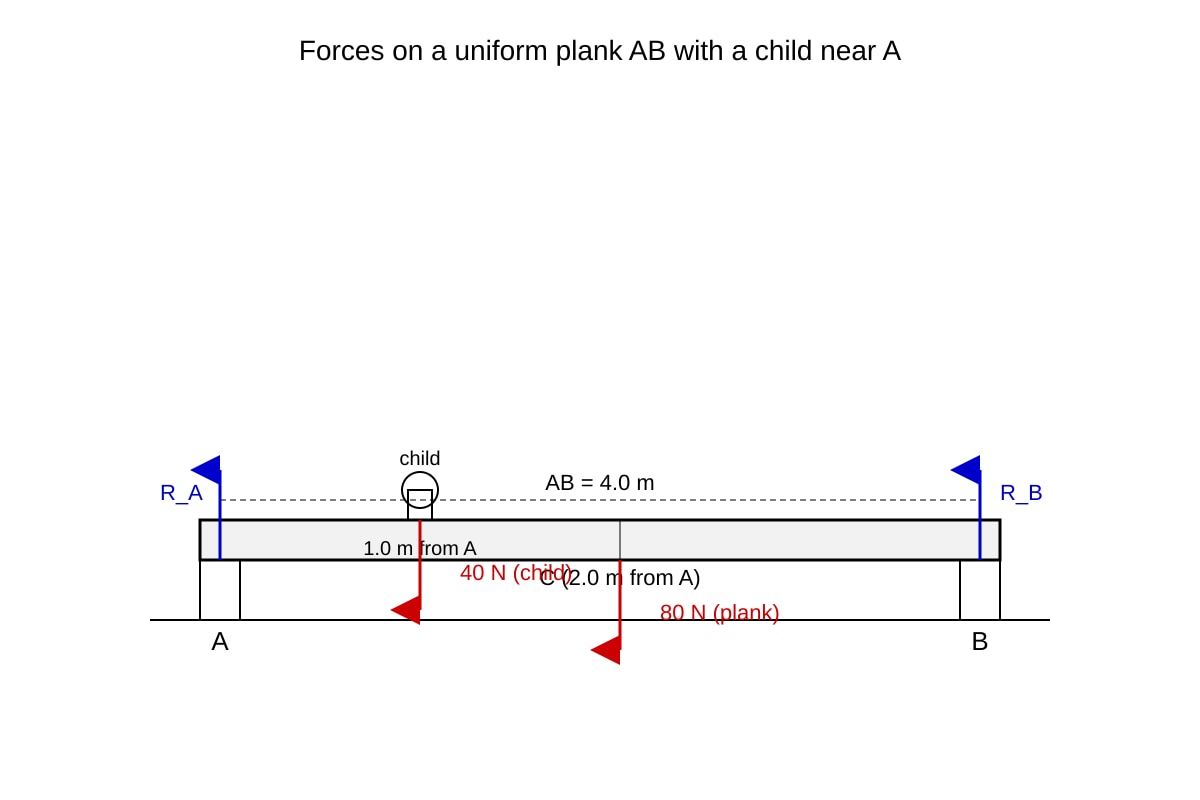
4. [3] A uniform plank AB of length 4.0 m and weight 80 N rests on two supports at A and B. A child of weight 40 N stands 1.0 m from A. Draw and label all forces acting on the plank.
Image pending generation: diagram for Q4.
5. [3] For the plank in Q4, calculate the reaction force at support B.
6. [4] A block of mass 5.0 kg is pulled along a horizontal surface by a force of 20 N at 30∘ above the horizontal. The frictional force is 4.0 N. Calculate the acceleration of the block.
7. [4] A car of mass 1000 kg travelling at 20 m s−1 is brought to rest in 5.0 s by a constant braking force. Calculate the magnitude of the braking force and the distance travelled during braking.
Section B: Motion and Collisions (Questions 8–14) — 21 marks
8. [3] A ball is thrown horizontally from a cliff of height 45 m with speed 15 m s−1. Calculate the time taken to reach the ground and the horizontal distance travelled.
9. [4] A projectile is launched at 37∘ above the horizontal with initial speed 25 m s−1. Calculate the maximum height reached. (Use g=9.8 m s−2.)
10. [4] A 2.0 kg trolley moving at 3.0 m s−1 collides with a stationary 1.5 kg trolley. They stick together. Calculate their common final velocity and the kinetic energy lost.
11. [3] Two identical carts of mass 1.0 kg move towards each other at 2.0 m s−1 each. After an elastic collision, they rebound. State the final velocity of each cart and explain why kinetic energy is conserved.
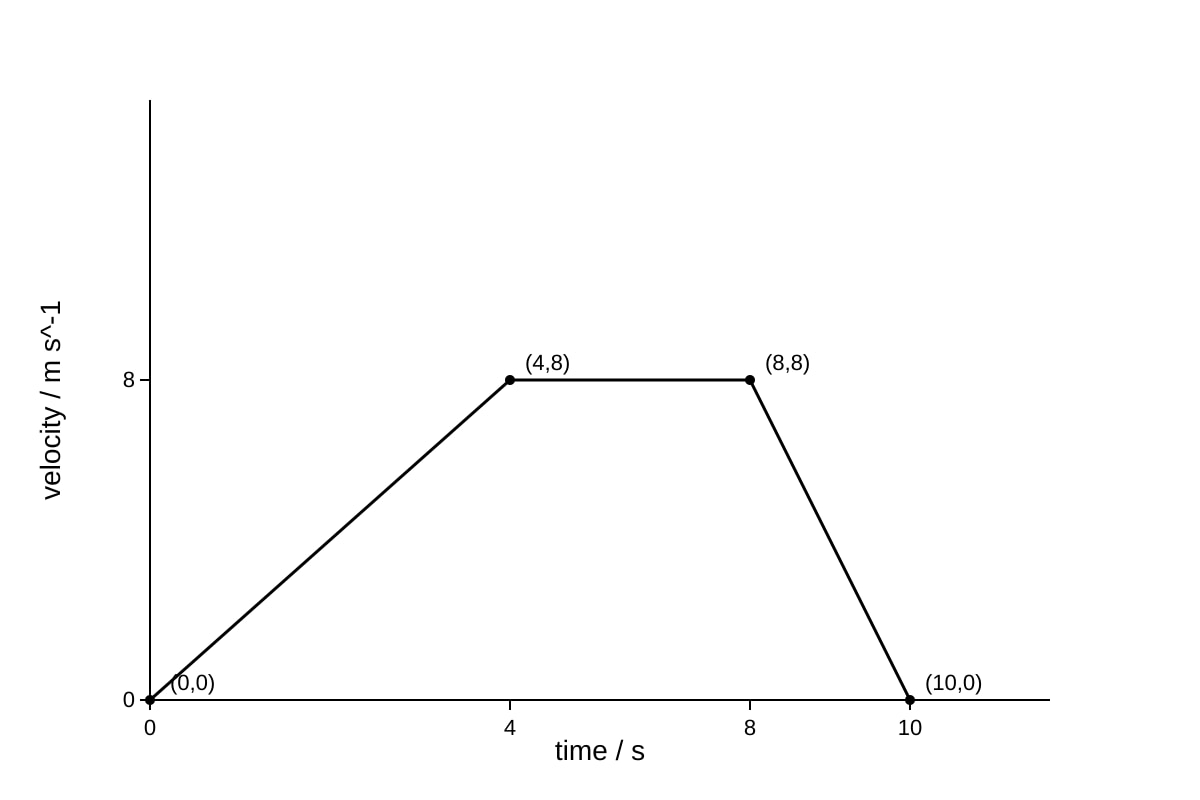
12. [3] The graph below shows the velocity–time graph for a particle.
Image pending generation: graph for Q12.
Calculate the total displacement of the particle.
13. [2] Define the term "impulse" and state its unit.
14. [2] A force–time graph for a collision has a rectangular shape of height 50 N and width 0.10 s. Calculate the impulse delivered.
Section C: Circular Motion and Gravitation (Questions 15–20) — 18 marks
15. [3] A mass of 0.50 kg is whirled in a horizontal circle of radius 0.80 m at constant speed 4.0 m s−1. Calculate the centripetal force acting on it.
16. [3] A satellite orbits Earth at a height where gravitational field strength is 6.0 N kg−1. If its mass is 200 kg, calculate the gravitational force on it.
17. [3] Explain why a passenger in a turning car feels pushed outward, with reference to Newton's first law.
18. [3] A geostationary satellite has an orbital period of 24 hours. State one characteristic of its orbit and explain its use in communications.
19. [2] Write the equation for centripetal acceleration in terms of speed v and radius r.
20. [1] State the direction of the centripetal force on a planet in circular orbit around the Sun.
End of Practice Paper
Total Marks: 60
Answers
TuitionGoWhere Practice Paper — Answer Key (Version 4)
Subject: Physics H1
Level: A-Level
Topic: Mechanics
Total Marks: 60
Section A: Foundations of Mechanics (Q1–7) — 21 marks
Q1 [2 marks]
Teaching note: Conservation of linear momentum applies to a closed system (no net external force).
- In a closed (or isolated) system, the total linear momentum remains constant. [B1]
- This holds provided no external resultant force acts on the system. [B1]
Common trap: Omitting "closed system" or confusing with energy conservation.
Q2 [2 marks]
(a) p=mv [B1]
(b) Ek=21mv2 [B1]
Teaching note: Momentum is vector, kinetic energy is scalar; do not forget the 21.
Q3 [3 marks]
Given: p=12 N⋅s, Ek=24 J.
p=mv⇒v=p/m [M1]
Ek=21mv2=2mp2⇒m=2Ekp2 [M1]
m=2×24122=48144=3.0 kg [A1]
v=3.012=4.0 m s−1
Answer: mass = 3.0 kg, speed = 4.0 m s−1.
Q4 [3 marks]
Teaching note: For equilibrium, show all downward weights and upward reactions.
Expected diagram (see Q4-fig1):
- Weight of plank 80 N downward at centre (2.0 m from A)
- Child weight 40 N downward at 1.0 m from A
- Reaction RA upward at A, RB upward at B
[M1 for plank weight at centre, M1 for child weight, M1 for two reactions]
Marking: 3 marks for fully labelled correct forces.
Q5 [3 marks]
Take moments about A:
RB×4.0=80×2.0+40×1.0 [M1]
RB×4.0=160+40=200 [M1]
RB=50 N [A1]
Answer: 50 N.
Q6 [4 marks]
Horizontal component of pull: Fx=20cos30∘=17.3 N [M1]
Net horizontal force: Fnet=17.3−4.0=13.3 N [M1]
a=Fnet/m=13.3/5.0=2.66 m s−2 [M1]
Answer: 2.7 m s−2 (2 s.f.) [A1]
Note: Vertical forces balance, not needed for acceleration.
Q7 [4 marks]
Using v=u+at: 0=20+a(5.0)⇒a=−4.0 m s−2 [M1]
Braking force F=ma=1000×4.0=4000 N [M1]
Distance s=ut+21at2=20(5.0)+21(−4.0)(5.0)2=100−50=50 m [M1]
Answer: Force = 4000 N, distance = 50 m [A1]
Section B: Motion and Collisions (Q8–14) — 21 marks
Q8 [3 marks]
Vertical: s=21gt2⇒45=21(9.8)t2 [M1]
t=90/9.8=3.03 s [A1]
Horizontal: x=vt=15×3.03=45.5 m [M1]
Answer: time = 3.0 s, distance = 45 m (3 s.f.)
Q9 [4 marks]
uy=25sin37∘=15.0 m s−1 [M1]
At max height vy=0: 0=uy2−2gh [M1]
h=2×9.815.02=19.6225=11.5 m [M1]
Answer: 11.5 m [A1]
Q10 [4 marks]
Momentum: 2.0(3.0)+1.5(0)=(2.0+1.5)v⇒6.0=3.5v [M1]
v=1.71 m s−1 [A1]
KE initial: 21(2.0)(3.0)2=9.0 J [M1]
KE final: 21(3.5)(1.71)2=5.1 J; lost = 9.0−5.1=3.9 J [A1]
Answer: v=1.7 m s−1, KE lost = 3.9 J.
Q11 [3 marks]
Elastic collision, equal masses, opposite equal speeds → exchange velocities. [B1]
Each rebounds at 2.0 m s−1 opposite direction. [B1]
Kinetic energy conserved because collision is elastic by statement. [B1]
Answer: velocities −2.0 and +2.0 m s−1 (relative), KE conserved.
Q12 [3 marks]
Area under graph = displacement.
Segment 1: 21(4)(8)=16 m [M1]
Segment 2: 4×8=32 m [M1]
Segment 3: 21(2)(8)=8 m; total = 56 m [M1]
Answer: 56 m.
Q13 [2 marks]
Impulse = change in momentum (= force × time). [B1]
Unit: N·s (or kg·m·s⁻¹). [B1]
Q14 [2 marks]
Impulse = area = 50×0.10=5.0 N⋅s [A1+A1]
Answer: 5.0 N⋅s.
Section C: Circular Motion and Gravitation (Q15–20) — 18 marks
Q15 [3 marks]
Fc=rmv2=0.800.50×4.02 [M1]
=0.800.50×16=10 N [M1+A1]
Answer: 10 N.
Q16 [3 marks]
F=mg=200×6.0=1200 N [M1+M1+A1]
Answer: 1200 N.
Q17 [3 marks]
Newton's first law: object continues in straight line unless acted on by force. [B1]
Car turns, passenger tends to continue straight (inertia). [B1]
Feels "pushed outward" due to absence of centripetal force on passenger's body relative to car. [B1]
Q18 [3 marks]
Orbit directly above equator, period = 24 h (fixed above point). [B1]
Used for fixed dish communications as satellite appears stationary. [B1+B1]
Q19 [2 marks]
ac=rv2 [2]
Q20 [1 mark]
Towards the centre (towards Sun). [1]
Total Marks: 60 — marking scheme complete.
Free quiz and exam paper access
Enter your details to view this paper
Your access is remembered on this device.