AI Generated Exam Paper
A Level H1 Physics Practice Paper 4
Free A Level H1 Physics Practice Paper 4, DeepSeek AI version, with questions, answers, and A Level-style practice for Singapore students.
These static practice materials are generated from the site's syllabus and paper-generation workflow, with source and model context shown so students and parents can evaluate the material before use.
Questions
Free quiz and exam paper access
Enter your details to view this paper
Your access is remembered on this device.
Answers
TuitionGoWhere Practice Paper - Physics H1 A-Level
Answer Key and Marking Scheme
Paper: Practice Paper 4 Total Marks: 80
Section A: Structured Questions (50 marks)
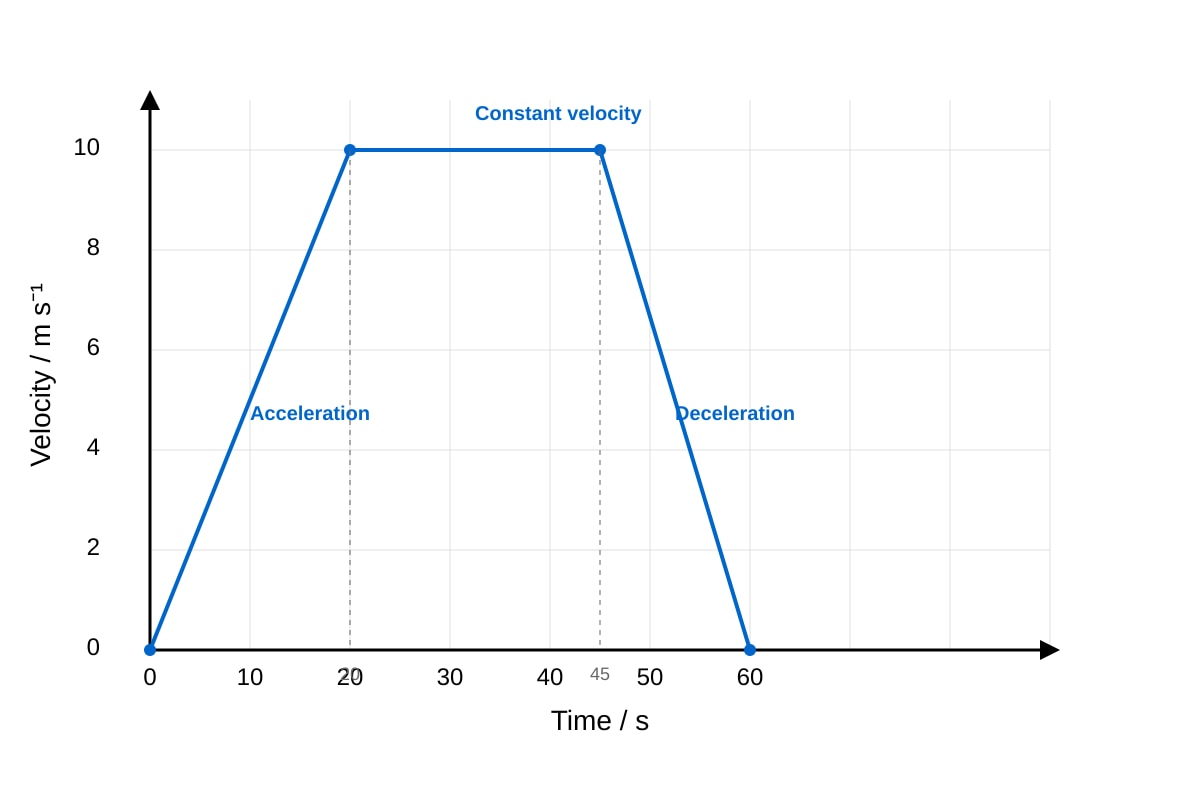
Question 1: Kinematics – Motion Graphs
(a) Describe the motion of the cyclist during the first 20 seconds. [1]
Answer: The cyclist accelerates uniformly from rest. / The cyclist moves with constant acceleration.
Marking: [B1] for "uniform/constant acceleration" or equivalent.
(b) Calculate the acceleration of the cyclist during the first 20 seconds. [2]
Answer: a = (v − u) / t = (10 − 0) / 20 = 0.50 m s⁻²
Marking: [M1] for correct substitution into a = (v − u)/t; [A1] for correct answer with unit.
(c) Determine the total distance travelled by the cyclist during the 60-second journey. [3]
Answer: Distance = area under velocity-time graph Area 1 (0–20 s): ½ × 20 × 10 = 100 m Area 2 (20–45 s): 25 × 10 = 250 m Area 3 (45–60 s): ½ × 15 × 10 = 75 m Total distance = 100 + 250 + 75 = 425 m
Marking: [M1] for recognising distance = area under v-t graph; [M1] for correct calculation of at least two areas; [A1] for correct total distance with unit.
(d) On the axes below, sketch the corresponding acceleration-time graph for the entire 60-second journey. Label the axes with appropriate values. [3]
Answer:
- t = 0 to 20 s: a = +0.50 m s⁻² (horizontal line)
- t = 20 to 45 s: a = 0 (horizontal line on time axis)
- t = 45 to 60 s: a = (0 − 10)/(60 − 45) = −0.67 m s⁻² (horizontal line)
Marking: [B1] for correct positive acceleration segment; [B1] for correct zero acceleration segment; [B1] for correct negative acceleration segment with values labelled.
Question 2: Forces – Equilibrium
(a) Draw a diagram showing all the forces acting on the beam. Label each force clearly with its magnitude where known. [3]
Answer: Forces:
- Weight of beam: 300 N downward at centre (2.0 m from A)
- Load: 500 N downward at 0.80 m from A
- Reaction at P (R_P): upward at end A
- Reaction at Q (R_Q): upward at 3.0 m from A (since Q is 1.0 m from end B, and beam is 4.0 m long)
Marking: [B1] for weight at centre; [B1] for load at correct position; [B1] for both reaction forces at correct positions with upward direction.
(b) By taking moments about a suitable point, calculate the reaction force at support P. [3]
Answer: Taking moments about Q (3.0 m from A): Clockwise moments = Anticlockwise moments R_P × 3.0 = (500 × 2.2) + (300 × 1.0) R_P × 3.0 = 1100 + 300 = 1400 R_P = 467 N ≈ 470 N
Marking: [M1] for correct moment equation about any point; [M1] for correct distances; [A1] for correct answer with unit.
(c) Calculate the reaction force at support Q. [1]
Answer: ΣF_y = 0: R_P + R_Q = 300 + 500 R_Q = 800 − 467 = 333 N ≈ 330 N
Marking: [A1] for correct answer with unit (ecf from (b)).
(d) The load is now moved towards end B. State and explain what happens to the reaction force at support P as the load moves. [2]
Answer: The reaction force at P decreases. As the load moves towards B (further from P), its moment about Q increases. To maintain equilibrium, the moment of R_P about Q must decrease, so R_P decreases. / The load's weight is increasingly supported by Q rather than P.
Marking: [B1] for stating R_P decreases; [B1] for correct explanation in terms of moments or load distribution.
Question 3: Dynamics – Connected Bodies
(a) Draw free-body diagrams for both blocks, showing and labelling all forces acting on each. [3]
Answer: Block X (on table):
- Weight (m_X g) downward
- Normal reaction (N) upward
- Tension (T) to the right
- Friction (f) to the left
Block Y (hanging):
- Weight (m_Y g) downward
- Tension (T) upward
Marking: [B1] for correct forces on X; [B1] for correct forces on Y; [B1] for correct directions and labels.
(b) Write equations of motion for both blocks. [2]
Answer: For block X: T − f = m_X a, where f = μN = μm_X g For block Y: m_Y g − T = m_Y a
Marking: [B1] for each correct equation.
(c) Calculate the acceleration of the system. [3]
Answer: f = μm_X g = 0.25 × 4.0 × 9.81 = 9.81 N From equations: T − 9.81 = 4.0a ... (1) 2.5 × 9.81 − T = 2.5a → 24.525 − T = 2.5a ... (2) Adding (1) and (2): 24.525 − 9.81 = 6.5a 14.715 = 6.5a a = 2.26 m s⁻² ≈ 2.3 m s⁻²
Marking: [M1] for correct friction calculation; [M1] for correct method of solving simultaneous equations; [A1] for correct answer with unit.
(d) Calculate the tension in the string. [2]
Answer: From (2): T = 24.525 − 2.5(2.26) = 24.525 − 5.65 = 18.9 N ≈ 19 N Or from (1): T = 4.0(2.26) + 9.81 = 9.04 + 9.81 = 18.9 N
Marking: [M1] for correct substitution; [A1] for correct answer with unit.
Question 4: Work, Energy, and Power
(a) Show that the component of the weight of the package parallel to the slope is approximately 62 N. [2]
Answer: Weight component parallel to slope = mg sin θ = 15.0 × 9.81 × sin 25° = 15.0 × 9.81 × 0.4226 = 62.2 N ≈ 62 N
Marking: [M1] for correct formula mg sin θ; [A1] for correct calculation showing approximately 62 N.
(b) Calculate the magnitude of the frictional force acting on the package. [2]
Answer: Normal reaction N = mg cos θ = 15.0 × 9.81 × cos 25° = 15.0 × 9.81 × 0.9063 = 133.4 N Frictional force f = μN = 0.30 × 133.4 = 40.0 N
Marking: [M1] for correct normal reaction calculation; [A1] for correct frictional force with unit.
(c) Determine the tension in the cable. [2]
Answer: Since package moves at constant speed, net force = 0. T = mg sin θ + f = 62.2 + 40.0 = 102.2 N ≈ 102 N
Marking: [M1] for recognising equilibrium condition; [A1] for correct answer with unit.
(d) Calculate the power required to pull the package up the slope at this constant speed. [2]
Answer: P = Fv = T × v = 102.2 × 0.80 = 81.8 W ≈ 82 W
Marking: [M1] for correct formula P = Fv; [A1] for correct answer with unit.
(e) The cable suddenly breaks when the package is 5.0 m up the slope. Calculate the distance the package slides back down the slope before coming to rest, assuming the frictional force remains constant. [3]
Answer: When cable breaks, forces down slope: mg sin θ + f = 62.2 + 40.0 = 102.2 N Deceleration up slope: a = F/m = 102.2/15.0 = 6.81 m s⁻² Initial speed = 0.80 m s⁻¹ (up slope) Using v² = u² + 2as: 0 = (0.80)² + 2(−6.81)s s = 0.64/(2 × 6.81) = 0.047 m (up slope before stopping) Then slides down: net force down = mg sin θ − f = 62.2 − 40.0 = 22.2 N Acceleration down = 22.2/15.0 = 1.48 m s⁻² Distance from stop point back to original position = 0.047 m Using energy: Work done against friction = loss in PE f × d = mgh, where h = d sin 25° 40.0 × d = 15.0 × 9.81 × d × sin 25° 40.0d = 62.2d → This shows the package will not slide back down as friction > component of weight down slope. Actually: The package slides up 0.047 m, stops, and remains at rest because mg sin θ (62.2 N) < f_max (40.0 N)? No, 62.2 > 40.0, so it slides down. Distance down slope: Loss in PE = Work against friction mg(s sin 25°) = f × s (where s is distance down from stop point) But the package starts 5.047 m up the slope. Energy at stop point: KE = 0, PE = mgh = 15.0 × 9.81 × 5.047 × sin 25° = 15.0 × 9.81 × 5.047 × 0.4226 = 313.8 J When it slides down distance x: PE lost = mg(x sin 25°) = 62.2x Work against friction = fx = 40.0x Net energy converted to KE: (62.2 − 40.0)x = 22.2x At bottom: 22.2x = 313.8 → x = 14.1 m But slope is only 5.047 m long, so package reaches bottom with KE remaining.
Revised approach: The package slides down the entire remaining slope (5.047 m) and continues beyond? No, it reaches the bottom. Distance down slope = 5.047 m (back to starting point) + continues? The question asks for distance before coming to rest. If it reaches the bottom, it would continue on level ground. Actually, the package was 5.0 m up when cable broke, then moved up 0.047 m, so total height = 5.047 × sin 25° = 2.13 m above base. Energy at top: PE = mgh = 15.0 × 9.81 × 2.13 = 313.4 J Sliding down distance s: Work against friction = 40.0s PE converted = mg(s sin 25°) = 62.2s Net KE gained = 22.2s When s = 5.047 m (bottom of slope): KE = 22.2 × 5.047 = 112 J Speed at bottom = √(2 × 112/15.0) = 3.86 m s⁻¹ On horizontal ground: friction = μmg = 0.30 × 15.0 × 9.81 = 44.1 N Deceleration = 44.1/15.0 = 2.94 m s⁻² Distance on ground: v² = u² + 2as → 0 = (3.86)² + 2(−2.94)d → d = 14.9/5.88 = 2.53 m Total distance = 5.047 + 2.53 = 7.58 m ≈ 7.6 m
Marking: [M1] for correct energy or force analysis; [M1] for recognising two stages (slope and horizontal); [A1] for correct total distance with unit. Accept alternative valid approaches.
Question 5: Momentum and Collisions
(a) State the principle of conservation of linear momentum. [2]
Answer: The total momentum of a closed/isolated system remains constant, provided no external forces act on the system. / In a closed system, the total momentum before a collision equals the total momentum after the collision.
Marking: [B1] for "total momentum constant" or "momentum before = momentum after"; [B1] for "closed system" or "no external forces" condition.
(b) Calculate the velocity of trolley B after the collision. [2]
Answer: m_A u_A + m_B u_B = m_A v_A + m_B v_B (2.0 × 3.0) + (1.5 × 0) = (2.0 × 1.2) + (1.5 × v_B) 6.0 = 2.4 + 1.5v_B v_B = 3.6/1.5 = 2.4 m s⁻¹ to the right
Marking: [M1] for correct conservation of momentum equation; [A1] for correct answer with direction.
(c) Determine whether the collision is elastic or inelastic. Show your working clearly. [3]
Answer: Initial KE = ½ × 2.0 × (3.0)² + 0 = 9.0 J Final KE = ½ × 2.0 × (1.2)² + ½ × 1.5 × (2.4)² = 1.44 + 4.32 = 5.76 J KE is not conserved (9.0 J → 5.76 J), therefore the collision is inelastic.
Marking: [M1] for correct initial KE; [M1] for correct final KE; [A1] for correct conclusion with justification.
(d) Calculate the impulse experienced by trolley B during the collision. [2]
Answer: Impulse = change in momentum of B = m_B(v_B − u_B) = 1.5 × (2.4 − 0) = 3.6 N s to the right
Marking: [M1] for correct formula or method; [A1] for correct answer with unit and direction.
Section B: Free Response Questions (30 marks)
Question 6: Projectile Motion and Energy
(a) Calculate the initial horizontal and vertical components of the ball's velocity. [2]
Answer: u_x = u cos θ = 28.0 × cos 35° = 28.0 × 0.8192 = 22.9 m s⁻¹ u_y = u sin θ = 28.0 × sin 35° = 28.0 × 0.5736 = 16.1 m s⁻¹
Marking: [A1] for each correct component with unit.
(b) Determine the maximum height reached by the ball. [3]
Answer: At maximum height, v_y = 0. v_y² = u_y² + 2a_y s → 0 = (16.1)² + 2(−9.81)h h = (16.1)²/(2 × 9.81) = 259.2/19.62 = 13.2 m
Marking: [M1] for recognising v_y = 0 at max height; [M1] for correct equation; [A1] for correct answer with unit.
(c) Calculate the total time of flight of the ball. [2]
Answer: Time to reach max height: v_y = u_y + a_y t → 0 = 16.1 − 9.81t → t = 1.64 s Total time of flight = 2 × 1.64 = 3.28 s ≈ 3.3 s Alternatively: s_y = u_y t + ½a_y t² → 0 = 16.1t − 4.905t² → t = 16.1/4.905 = 3.28 s
Marking: [M1] for correct method; [A1] for correct answer with unit.
(d) Determine the horizontal range of the ball. [2]
Answer: Range = u_x × total time = 22.9 × 3.28 = 75.1 m ≈ 75 m
Marking: [M1] for correct formula; [A1] for correct answer with unit.
(e) Using energy considerations, calculate the speed of the ball when it is at a height of 8.0 m above the ground. [3]
Answer: By conservation of energy: ½mu² = ½mv² + mgh ½v² = ½u² − gh v² = u² − 2gh = (28.0)² − 2 × 9.81 × 8.0 = 784 − 156.96 = 627.04 v = √627.04 = 25.0 m s⁻¹
Marking: [M1] for correct energy equation; [M1] for correct substitution; [A1] for correct answer with unit.
(f) A second golf ball of greater mass is struck with the same initial speed and angle. State and explain whether the horizontal range would be different. [3]
Answer: The horizontal range would be the same. The acceleration due to gravity is independent of mass, so both the horizontal and vertical motions are identical for any mass. From kinematic equations, range = (u² sin 2θ)/g, which does not depend on mass. Air resistance is neglected in this analysis.
Marking: [B1] for stating range is the same; [B2] for correct explanation referencing independence of mass in projectile motion equations (max 2 marks for explanation).
Question 7: Forces and Equilibrium – Ladder Problem
(a) Draw a diagram showing all the forces acting on the ladder. [3]
Answer: Forces:
- Weight of ladder (W_L = 250 N): downward at centre (2.5 m from foot)
- Weight of person (W_P = 700 N): downward at 3.5 m from foot
- Reaction at wall (R_W): horizontal, acting away from wall at top of ladder (wall is smooth, so no vertical component)
- Reaction at ground (R_G): resolved into normal component (N) upward and friction (f) horizontal towards wall
Marking: [B1] for weights at correct positions; [B1] for wall reaction (horizontal only); [B1] for ground reaction with both components.
(b) State two conditions necessary for the ladder to be in equilibrium. [2]
Answer:
- The resultant force in any direction is zero (ΣF = 0).
- The resultant moment about any point is zero (ΣM = 0).
Marking: [B1] for each condition correctly stated.
(c) By taking moments about the foot of the ladder, calculate the reaction force exerted by the wall on the ladder. [4]
Answer: Taking moments about foot of ladder: Clockwise moments = Anticlockwise moments R_W × (5.0 sin 60°) = (250 × 2.5 cos 60°) + (700 × 3.5 cos 60°) R_W × 4.330 = (250 × 2.5 × 0.5) + (700 × 3.5 × 0.5) R_W × 4.330 = 312.5 + 1225 = 1537.5 R_W = 1537.5/4.330 = 355 N
Marking: [M1] for correct perpendicular distances; [M1] for correct moment equation; [M1] for correct substitution; [A1] for correct answer with unit.
(d) Calculate the magnitude and direction of the reaction force exerted by the ground on the ladder. [4]
Answer: Vertically: N = W_L + W_P = 250 + 700 = 950 N Horizontally: f = R_W = 355 N Magnitude of R_G = √(N² + f²) = √(950² + 355²) = √(902,500 + 126,025) = √1,028,525 = 1014 N ≈ 1010 N Direction: θ = tan⁻¹(N/f) = tan⁻¹(950/355) = 69.5° above the horizontal Or angle with vertical: tan⁻¹(f/N) = tan⁻¹(355/950) = 20.5°
Marking: [M1] for correct vertical equilibrium; [M1] for correct horizontal equilibrium; [M1] for correct magnitude calculation; [A1] for correct magnitude and direction with units.
(e) Explain why the ladder is more likely to slip if the person climbs higher. [2]
Answer: As the person climbs higher, their moment about the foot of the ladder increases. This requires a larger reaction force from the wall to maintain rotational equilibrium. The increased wall reaction requires increased friction at the ground. If the required friction exceeds the maximum static friction (μN), the ladder will slip.
Marking: [B1] for linking higher position to increased moment/wall reaction; [B1] for linking increased wall reaction to increased friction requirement and slip condition.
Question 8: Momentum and Energy in Collisions
(a) Explain why momentum is conserved during the collision but kinetic energy is not. [3]
Answer: Momentum is conserved because the bullet and block form an isolated system during the very short collision time, and no external horizontal forces act (string is vertical during impact). Kinetic energy is not conserved because the collision is perfectly inelastic (bullet embeds in block). Some kinetic energy is converted to internal energy (heat, sound, and work done in deforming the block and bullet).
Marking: [B1] for momentum conservation explanation; [B1] for identifying inelastic collision; [B1] for explaining energy conversion.
(b) Calculate the vertical height through which the block rises. [3]
Answer: Length of string L = 2.00 m, angle θ = 40° Height risen h = L − L cos θ = L(1 − cos θ) = 2.00(1 − cos 40°) = 2.00(1 − 0.7660) = 2.00 × 0.2340 = 0.468 m
Marking: [M1] for correct geometric relationship; [M1] for correct substitution; [A1] for correct answer with unit.
(c) Determine the speed of the block (with bullet embedded) immediately after the collision. [3]
Answer: By conservation of energy for the swing: ½(m + M)v² = (m + M)gh v = √(2gh) = √(2 × 9.81 × 0.468) = √9.182 = 3.03 m s⁻¹
Marking: [M1] for correct energy equation; [M1] for correct substitution; [A1] for correct answer with unit.
(d) Calculate the speed of the bullet just before it strikes the block. [3]
Answer: By conservation of momentum during collision: m_bullet × u = (m_bullet + m_block) × v 0.0250 × u = (0.0250 + 1.20) × 3.03 0.0250u = 1.225 × 3.03 = 3.712 u = 3.712/0.0250 = 148.5 m s⁻¹ ≈ 149 m s⁻¹
Marking: [M1] for correct momentum equation; [M1] for correct substitution; [A1] for correct answer with unit.
(e) Calculate the kinetic energy lost during the collision and explain where this energy has gone. [3]
Answer: Initial KE = ½ × 0.0250 × (148.5)² = 0.0125 × 22,052 = 275.7 J Final KE = ½ × 1.225 × (3.03)² = 0.6125 × 9.181 = 5.62 J KE lost = 275.7 − 5.62 = 270.1 J ≈ 270 J
The lost kinetic energy is converted to:
- Internal/thermal energy (heating of bullet and block)
- Sound energy
- Work done in permanently deforming the block and bullet
Marking: [M1] for correct initial KE; [M1] for correct final KE and subtraction; [A1] for correct energy lost with valid explanation of energy conversion.
END OF ANSWER KEY
TuitionGoWhere Practice Paper – Version 4 This answer key accompanies the AI-generated practice paper based on the H1 Physics syllabus (8867).