AI Generated Exam Paper
A Level H1 Physics Practice Paper 3
Free AI-Generated Owl Alpha A Level H1 Physics Practice Paper 3 practice paper with questions and answers for Singapore students. This page is rendered as a direct URL so the questions and answers can be discovered without pressing in-page buttons.
These static practice materials are generated from the site's syllabus and paper-generation workflow, with source and model context shown so students and parents can evaluate the material before use.
Questions
TuitionGoWhere Practice Paper - Physics H1 A-Level
TuitionGoWhere Practice Paper (AI)
Subject: Physics H1 Level: A-Level Paper: Practice Paper — Mechanics Duration: 1 hour 30 minutes Total Marks: 60 Name: ___________________________ Class: ___________________________ Date: ___________________________
Instructions
- Answer all questions.
- Write your answers in the spaces provided.
- The number of marks for each question is shown in brackets, e.g. [2].
- Unless otherwise stated, numerical answers should be given to an appropriate number of significant figures.
- Essential working must be shown for calculation questions. Answers without working may not receive full credit.
- Where diagrams are referenced, all necessary data for answering the question is provided in the question text or within the image placeholder description.
Section A: Multiple Choice [15 marks]
Questions 1–15 are multiple-choice questions. Each question is worth 1 mark. Choose the one best answer for each question.
1. A ball is thrown vertically upwards. At the highest point of its trajectory, which of the following is correct?
A. Velocity is zero and acceleration is zero. B. Velocity is zero and acceleration is downwards. C. Velocity is maximum and acceleration is zero. D. Velocity is maximum and acceleration is downwards.
2. A car accelerates uniformly from rest at for 8.0 s. What distance does it travel in this time?
A. 10 m B. 20 m C. 80 m D. 160 m
3. A 3.0 kg object moving at 4.0 m/s collides with a stationary 6.0 kg object. After the collision, the two objects stick together. What is their common velocity?
A. 0.67 m/s B. 1.3 m/s C. 2.0 m/s D. 4.0 m/s
4. Which of the following is a vector quantity?
A. Kinetic energy B. Power C. Momentum D. Work
5. A force of 12 N acts on an object and displaces it 5.0 m in the direction of the force. The work done by the force is:
A. 2.4 J B. 17 J C. 60 J D. 120 J
6. A projectile is launched horizontally from a cliff at 15 m/s. Ignoring air resistance, which statement about its motion is true?
A. Its horizontal velocity increases. B. Its vertical acceleration decreases. C. Its horizontal velocity remains constant. D. Its vertical velocity remains constant.
7. A 0.50 kg ball strikes a wall at 10 m/s and rebounds at 8.0 m/s. What is the magnitude of the change in momentum of the ball?
A. 1.0 kg m/s B. 5.0 kg m/s C. 9.0 kg m/s D. 18 kg m/s
8. A uniform beam of weight 40 N is supported at both ends. If a 20 N load is placed at the midpoint of the beam, what is the reaction force at each support?
A. 10 N B. 20 N C. 30 N D. 40 N
9. A car of mass 1200 kg travels at a constant speed of 25 m/s around a horizontal circular track of radius 50 m. What is the net force acting on the car?
A. 600 N B. 15 000 N C. 30 000 N D. 0 N
10. An object of mass 2.0 kg is lifted vertically at constant velocity through a height of 3.0 m. The gain in gravitational potential energy is: (Take )
A. 6.0 J B. 19.6 J C. 58.8 J D. 60 J
11. A 4.0 kg block slides down a frictionless inclined plane from a height of 2.0 m. What is its speed at the bottom? (Take )
A. 4.4 m/s B. 6.3 m/s C. 8.8 m/s D. 19.6 m/s
12. A force is applied to an object at an angle of 60° to the horizontal. If the horizontal component of the force is 15 N, what is the magnitude of ?
A. 7.5 N B. 17.3 N C. 30 N D. 60 N
13. Two forces of 8 N and 6 N act on a point at right angles to each other. The magnitude of the resultant force is:
A. 2 N B. 10 N C. 14 N D. 48 N
14. A machine has an efficiency of 75%. If the total energy input is 800 J, the useful energy output is:
A. 200 J B. 400 J C. 600 J D. 1067 J
15. A 1.5 kg ball is dropped from a height of 10 m. Just before it hits the ground, its kinetic energy is: (Take , ignore air resistance)
A. 15 J B. 73.5 J C. 147 J D. 294 J
Section B: Structured Questions [30 marks]
Answer all questions. Show all working clearly.
16. (Kinematics — Equations of Motion) [5 marks]
A car starts from rest and accelerates uniformly at along a straight road for 10 s. It then travels at constant velocity for 20 s before decelerating uniformly to rest in 5.0 s.
(a) Calculate the maximum velocity reached by the car. [2]
(b) Calculate the total distance travelled by the car during the entire journey. [3]
17. (Dynamics — Newton's Second Law) [5 blocks]
A 5.0 kg box is pulled along a horizontal floor by a rope that makes an angle of 30° above the horizontal. The tension in the rope is 40 N. The frictional force acting on the box is 10 N.
(a) Calculate the horizontal component of the tension. [1]
(b) Calculate the net horizontal force acting on the box. [1]
(c) Calculate the acceleration of the box. [2]
(d) If the box starts from rest, calculate the distance it travels in the first 4.0 s. [1]
18. (Momentum — Conservation and Collisions) [6 marks]
A 0.020 kg bullet is fired horizontally into a stationary wooden block of mass 2.0 kg resting on a smooth horizontal surface. The bullet becomes embedded in the block. After the collision, the block (with the bullet inside) moves at 0.50 m/s.
(a) State the principle of conservation of linear momentum. [1]
(b) Using conservation of momentum, calculate the speed of the bullet just before it hits the block. [3]
(c) Determine whether this collision is elastic or inelastic. Show your reasoning by comparing kinetic energies before and after the collision. [2]
19. (Forces — Equilibrium and Free-Body Diagrams) [6 marks]
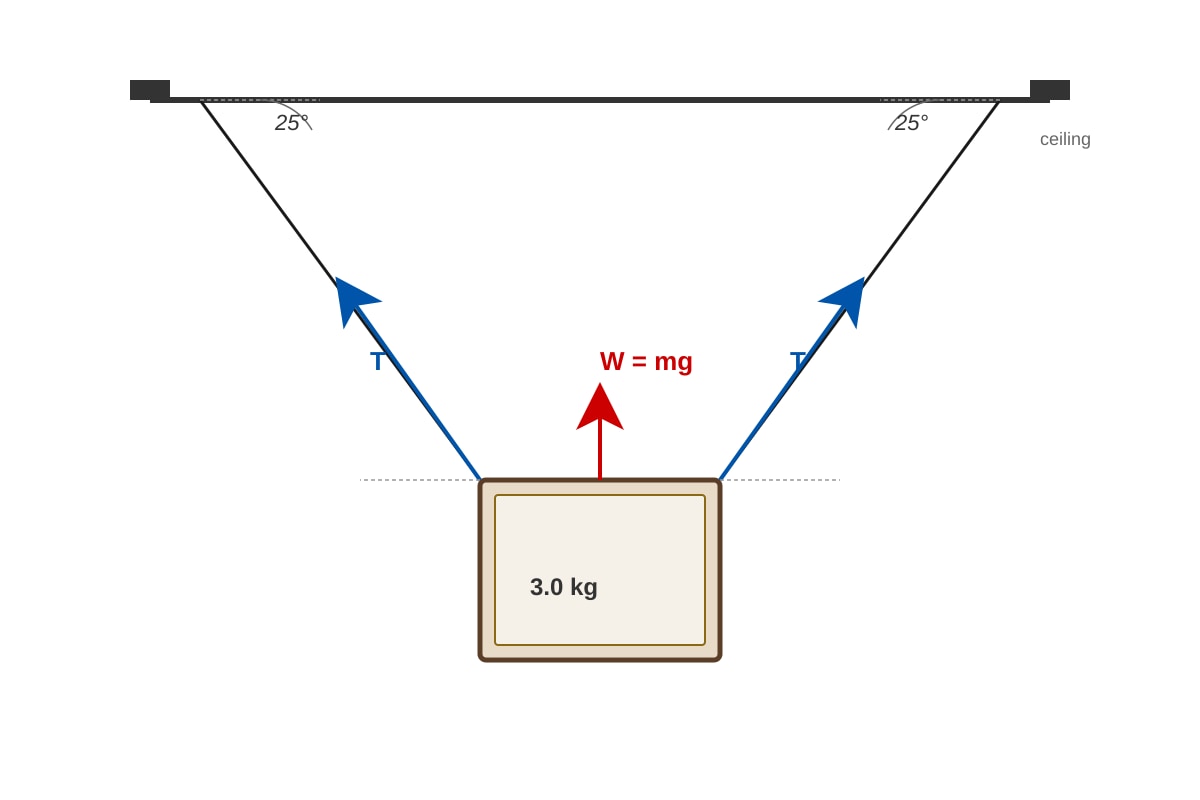
A 3.0 kg picture frame is suspended symmetrically by two identical strings, each making an angle of 25° with the horizontal.
<image_placeholder> id: Q19-fig1 type: diagram linked_question: Q19 description: A picture frame suspended by two strings from a horizontal ceiling. The frame hangs below the two attachment points. Each string makes an angle of 25° with the horizontal. The weight of the frame (W = mg) acts vertically downward from the centre of the frame. Tension T acts along each string, directed away from the frame toward the ceiling attachment points. labels: T (tension in each string), 25° (angle each string makes with horizontal), W = mg (weight of frame acting downward), 3.0 kg (mass of frame) values: mass = 3.0 kg, angle = 25°, g = 9.8 m/s² must_show: Both strings at 25° to horizontal, weight arrow downward from centre, tension arrows along strings, angle labels, mass label </image_placeholder>
(a) Draw a free-body diagram showing all the forces acting on the picture frame. [2]
(b) By resolving forces vertically, show that the tension in each string is given by:
where . [2]
(c) Calculate the tension in each string. [2]
20. (Work, Energy and Power) [8 marks]
A 60 kg student runs up a flight of stairs that has a vertical height of 12 m.
(a) Calculate the gain in gravitational potential energy of the student. [2]
(b) The student takes 15 s to climb the stairs. Calculate the average power developed by the student. [2]
(c) In reality, the student's muscles must do more work than the gain in gravitational potential energy. Explain why. [2]
(d) A motorised stair-climbing wheelchair is designed to carry a total mass of 100 kg (person + wheelchair) up the same flight of stairs in 25 s. The motor has an efficiency of 65%. Calculate the electrical power input required by the motor. [2]
Section C: Data-Based / Extended Response [15 marks]
Answer all questions. Show all working clearly.
21. (Projectile Motion — Data Interpretation) [7 marks]
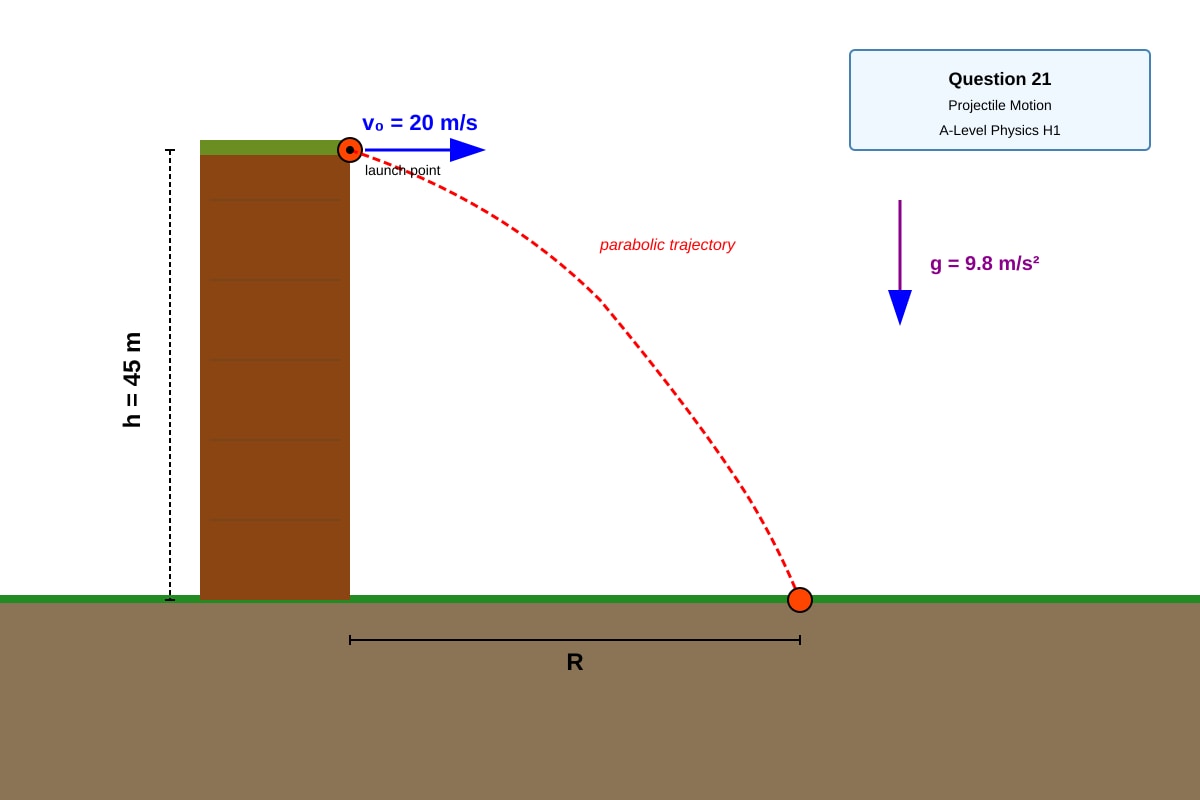
A ball is projected horizontally from the top of a cliff with an initial horizontal speed of 20 m/s. The cliff is 45 m high. Air resistance is negligible. Take .
<image_placeholder> id: Q21-fig1 type: diagram linked_question: Q21 description: A cliff of height 45 m with the ground below. A ball is shown at the top of the cliff with an initial horizontal velocity arrow (v₀ = 20 m/s) pointing to the right. The parabolic trajectory of the ball is shown curving downward from the cliff top to the ground. The horizontal distance from the base of the cliff to where the ball lands is labelled as R (range). The vertical height of the cliff is labelled as h = 45 m. labels: v₀ = 20 m/s (initial horizontal velocity), h = 45 m (cliff height), R (horizontal range), g = 9.8 m/s² (downward), parabolic trajectory curve values: v₀ = 20 m/s, h = 45 m, g = 9.8 m/s² must_show: Cliff with height labelled, horizontal velocity arrow at top, parabolic path, range R labelled, ground level, vertical dimension 45 m </image_placeholder>
(a) Calculate the time taken for the ball to reach the ground. [2]
(b) Calculate the horizontal distance from the base of the cliff to where the ball lands. [2]
(c) Calculate the speed of the ball just before it hits the ground. [3]
22. (Energy and Momentum — Multi-Concept Synthesis) [8 marks]
A 4.0 kg trolley A moves at 6.0 m/s on a smooth horizontal track and collides with a stationary 2.0 kg trolley B. After the collision, trolley A continues to move in the same direction at 2.0 m/s.
(a) Using conservation of momentum, calculate the velocity of trolley B after the collision. [3]
(b) Calculate the total kinetic energy before the collision and the total kinetic energy after the collision. [3]
(c) State whether the collision is elastic or inelastic. Justify your answer. [1]
(d) If the collision lasts for 0.050 s, calculate the average force exerted on trolley B during the collision. [1]
Answers
TuitionGoWhere Practice Paper — Physics H1 A-Level
Answer Key — Practice Paper: Mechanics
Section A: Multiple Choice
1. B [1]
- At the highest point, the ball momentarily stops (velocity = 0), but gravity still acts downward, so acceleration = downwards.
- Common mistake: Choosing A — students often assume zero velocity means zero acceleration. Acceleration is due to gravity and is constant throughout the motion.
2. C [1]
- Using : m.
- Common mistake: Using m (this gives distance only for constant velocity, not acceleration from rest).
3. B [1]
- Conservation of momentum:
- , so m/s (to 2 s.f.).
- Common mistake: Forgetting that the second object is stationary (initial velocity = 0).
4. C [1]
- Momentum () has both magnitude and direction, making it a vector. Kinetic energy, power, and work are all scalars.
- Teaching note: Vectors require both magnitude and direction to be fully described. Scalars are described by magnitude alone.
5. C [1]
- Work done: J.
- Work is done when a force causes displacement in the direction of the force.
6. C [1]
- In projectile motion (ignoring air resistance), there is no horizontal force, so horizontal velocity remains constant. Vertically, the ball accelerates at downward.
- This is a fundamental principle of projectile motion: horizontal and vertical motions are independent.
7. C [1]
- Taking the initial direction as positive: kg m/s.
- Magnitude of change in momentum = 9.0 kg m/s.
- Common mistake: Students may calculate kg m/s, forgetting that the ball reverses direction (velocity sign changes).
8. C [1]
- Total downward force = weight of beam + load = N.
- By symmetry, each support carries half: N.
- Teaching note: For a uniform load at the midpoint of a symmetrically supported beam, reactions are equal.
9. B [1]
- The car is moving in a circle, so there must be a centripetal force: N.
- Common mistake: Choosing D — students may confuse "constant speed" with "no net force." A change in direction requires a net force (centripetal force).
10. C [1]
- Gain in GPE: J.
- Rounded to 2 s.f. = 60 J (option D). However, 58.8 J is option C. Since the data is given to 2 s.f., the answer should be 59 J or 60 J. Option C (58.8 J) is the exact calculation and is the best answer here.
- Note: Accept C (58.8 J) as the precise answer.
11. B [1]
- Using conservation of energy: , so m/s ≈ 6.3 m/s.
- Common mistake: Using without first finding , or using with incorrect values.
12. C [1]
- Horizontal component: , so N.
- Teaching note: When a force is applied at an angle, use cosine for the component adjacent to the angle (horizontal) and sine for the component opposite the angle (vertical).
13. B [1]
- For perpendicular forces: N.
- This is a classic 3-4-5 triangle scaled by factor 2 (6-8-10).
14. C [1]
- Efficiency = , so useful output = J.
- Common mistake: Calculating J (this gives the wasted energy, not the useful output).
15. C [1]
- By conservation of energy: J.
- Teaching note: When air resistance is ignored, all gravitational potential energy converts to kinetic energy.
Section B: Structured Questions
16. (Kinematics) [5 marks]
(a) [2 marks]
- Using : m/s.
- [B1] for correct formula/substitution, [B1] for correct answer with unit.
(b) [3 marks]
- Phase 1 (acceleration): m.
- Phase 2 (constant velocity): m.
- Phase 3 (deceleration): Using average velocity: m.
- Total distance: m.
- [B1] for distance in phase 1, [B1] for distance in phase 2, [B1] for distance in phase 3 and total.
- Alternative for phase 3: where , giving m.
17. (Dynamics — Newton's Second Law) [5 marks]
(a) [1 mark]
- Horizontal component: N ≈ 35 N.
- [B1] for correct answer.
(b) [1 mark]
- Net horizontal force: N ≈ 25 N.
- [B1] for correct answer.
(c) [2 marks]
- Using Newton's second law: , so m/s² ≈ 4.9 m/s².
- [B1] for correct formula/substitution, [B1] for correct answer.
(d) [1 mark]
- Using : m ≈ 39 m.
- [B1] for correct answer.
18. (Momentum — Conservation and Collisions) [6 marks]
(a) [1 mark]
- The principle of conservation of linear momentum states that the total momentum of a system remains constant (is conserved) provided no external forces act on the system (i.e., in a closed/isolated system).
- [B1] for a complete statement including the "no external forces" or "closed system" condition.
(b) [3 marks]
- Let be the initial speed of the bullet.
- Conservation of momentum:
- m/s ≈ 51 m/s (to 2 s.f.).
- [B1] for correct conservation of momentum equation, [B1] for correct substitution, [B1] for correct answer with unit.
(c) [2 marks]
- KE before collision: J.
- KE after collision: J.
- Since KE before (25.5 J) >> KE after (0.253 J), kinetic energy is not conserved, so the collision is inelastic.
- [B1] for calculating both kinetic energies, [B1] for correct conclusion with justification.
- Note: This is a perfectly inelastic collision (maximum KE loss) because the objects stick together.
19. (Forces — Equilibrium) [6 marks]
(a) [2 marks]
- Free-body diagram should show:
- Weight acting vertically downward from the centre of the frame.
- Two tension forces , each acting along a string, directed upward and outward at 25° above the horizontal.
- [B1] for correct forces shown (weight + two tensions), [B1] for correct directions and angles.
(b) [2 marks]
- For vertical equilibrium, the net vertical force is zero:
- Upward components: (the vertical component of each tension is since the angle is measured from the horizontal).
- Downward force: .
- Setting net force to zero: .
- Therefore: .
- [B1] for correct vertical force balance equation, [B1] for correct rearrangement to show the required expression.
(c) [2 marks]
- N ≈ 35 N.
- [B1] for correct substitution, [B1] for correct answer with unit.
- Common mistake: Using instead of — since the angle is with the horizontal, the vertical component uses sine.
20. (Work, Energy and Power) [8 marks]
(a) [2 marks]
- J ≈ 7100 J (to 2 s.f.) or 7.1 kJ.
- [B1] for correct formula/substitution, [B1] for correct answer with unit.
(b) [2 marks]
- Average power: W ≈ 470 W.
- [B1] for correct formula/substitution, [B1] for correct answer with unit.
(c) [2 marks]
- The student's muscles must also do work to:
- Overcome friction between shoes and stairs.
- Increase the kinetic energy of the student's limbs (internal energy changes).
- Overcome air resistance (small effect).
- Some energy is lost as heat in the muscles (metabolic inefficiency).
- [B1] for any two valid reasons, [B1] for clear explanation.
- Key concept: The total work done by muscles = gain in GPE + work against friction + heat losses + other energy transfers.
(d) [2 marks]
- Useful power output: W.
- Efficiency = , so W ≈ 720 W.
- [B1] for calculating useful power, [B1] for applying efficiency to find input power.
Section C: Data-Based / Extended Response
21. (Projectile Motion) [7 marks]
(a) [2 marks]
- Vertical motion: (initial vertical velocity = 0).
- s ≈ 3.0 s.
- [B1] for correct equation, [B1] for correct answer.
(b) [2 marks]
- Horizontal distance: m ≈ 61 m.
- [B1] for correct formula, [B1] for correct answer.
(c) [3 marks]
- Horizontal velocity remains constant: m/s.
- Vertical velocity just before impact: m/s.
- Resultant speed: m/s ≈ 36 m/s.
- [B1] for calculating vertical component, [B1] for using Pythagoras' theorem, [B1] for correct final answer.
- Teaching note: The final speed is found by combining horizontal and vertical components using Pythagoras, since they are perpendicular.
22. (Energy and Momentum — Multi-Concept Synthesis) [8 marks]
(a) [3 marks]
- Conservation of momentum:
- m/s.
- [B1] for correct conservation of momentum equation, [B1] for correct substitution, [B1] for correct answer with unit.
(b) [3 marks]
- KE before: J.
- KE after: J.
- [B1] for KE before, [B1] for KE after, [B1] for correct values.
(c) [1 mark]
- Since total kinetic energy before (72 J) = total kinetic energy after (72 J), the collision is elastic.
- [B1] for correct conclusion with justification.
(d) [1 mark]
- Using the impulse-momentum theorem on trolley B:
- N.
- [B1] for correct answer with unit.
- Teaching note: The impulse-momentum theorem states that the impulse (force × time) equals the change in momentum. This is derived from Newton's second law.