AI Generated Exam Paper
A Level H1 Physics Practice Paper 3
Free A Level H1 Physics Practice Paper 3, HY3 AI version, with questions, answers, and A Level-style practice for Singapore students.
These static practice materials are generated from the site's syllabus and paper-generation workflow, with source and model context shown so students and parents can evaluate the material before use.
Questions
TuitionGoWhere Practice Paper - Physics H1 A-Level
TuitionGoWhere Practice Paper (AI) — Version 3 of 5
Subject: Physics H1
Level: A-Level
Paper: Practice Paper (Topic: Mechanics)
Duration: 1 hour 15 minutes
Total Marks: 60
Name: ________________________
Class: ________________________
Date: ________________________
Instructions:
- This practice paper contains 20 questions on the topic of Mechanics.
- Answer all questions in the spaces provided.
- Show all working clearly. Use SI units and appropriate notation.
- Marks for each question are shown in brackets.
- The total marks for this paper are 60.
Section A: Foundations of Mechanics (Questions 1–7) [21 marks]
1. State the principle of conservation of linear momentum. [2]
2. Write down, in terms of mass m and velocity v: (a) the linear momentum p; [1] (b) the kinetic energy Ek. [1]
(a) _________________________
(b) _________________________
3. A drone has a horizontal momentum of 12 N⋅s and kinetic energy of 24 J. Calculate its mass and speed. [3]
4. A block of mass 4.0 kg is pulled along a horizontal surface by a force of 20 N at 30∘ above the horizontal. The frictional force is 5.0 N. Calculate the acceleration of the block. [3]
5. Define the term work done by a constant force. [2]
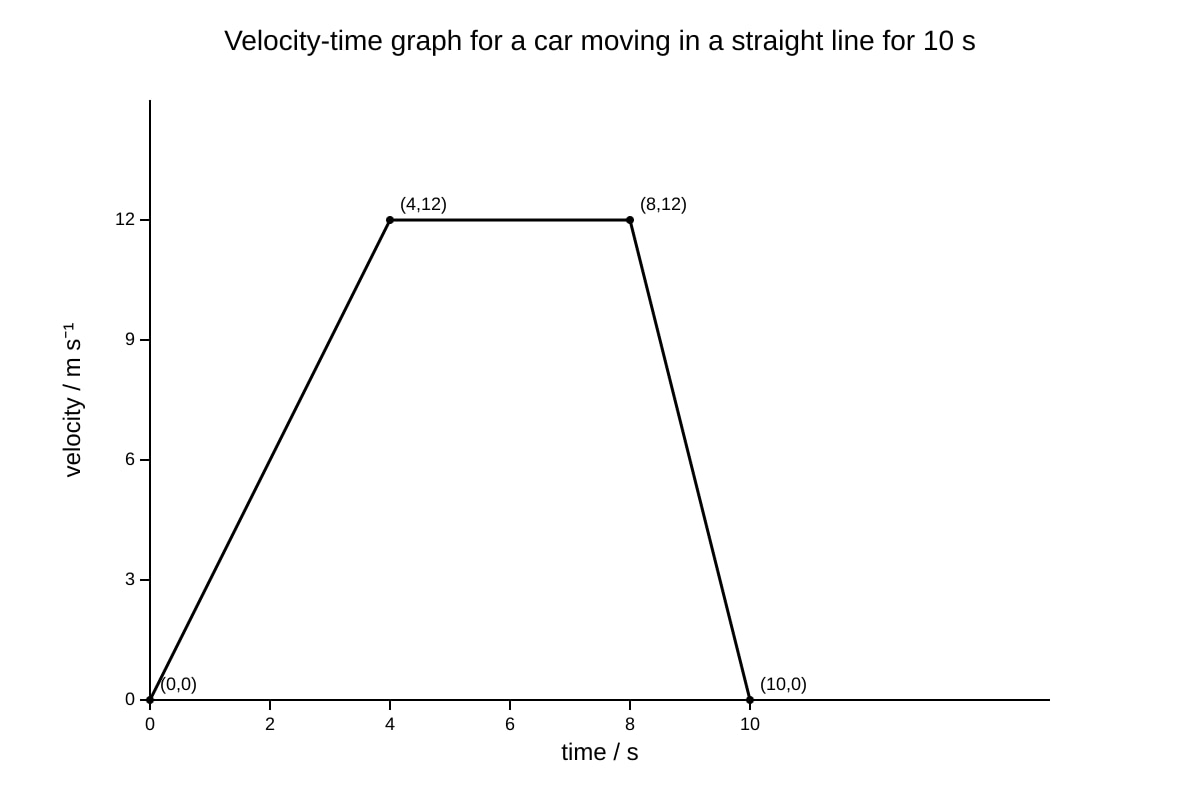
6.
Image pending generation: graph for Q6.
The graph shows the velocity of a car over 10 s. Determine: (a) the acceleration during the first 4 s; [2] (b) the total distance travelled. [2]
(a) _________________________
(b) _________________________
7. A uniform plank AB of length 5.0 m and weight 300 N rests on two supports at A and B. A boy of weight 500 N stands 2.0 m from A. Draw a labelled diagram showing all forces acting on the plank. [3]
Section B: Dynamics and Equilibrium (Questions 8–14) [21 marks]
8. Two trolleys of masses 2.0 kg and 3.0 kg move towards each other with speeds 4.0 m s−1 and 2.0 m s−1 respectively. They stick together after collision. Calculate their common velocity. [4]
9. A 4.0 m uniform beam weighing 200 N rests on supports at 1.0 m and 3.0 m from the left end. A 150 N load is placed 0.5 m from the left end. Find the reaction at each support. [5]
10. Explain why a moving object in a state of dynamic equilibrium has zero net force acting on it. [2]
11. A ball is thrown at 30∘ above the horizontal with speed 20 m s−1. Calculate the maximum height reached. [4]
12. A projectile is launched horizontally from a cliff of height 45 m with speed 15 m s−1. Calculate the time taken to reach the ground and the horizontal range. [4]
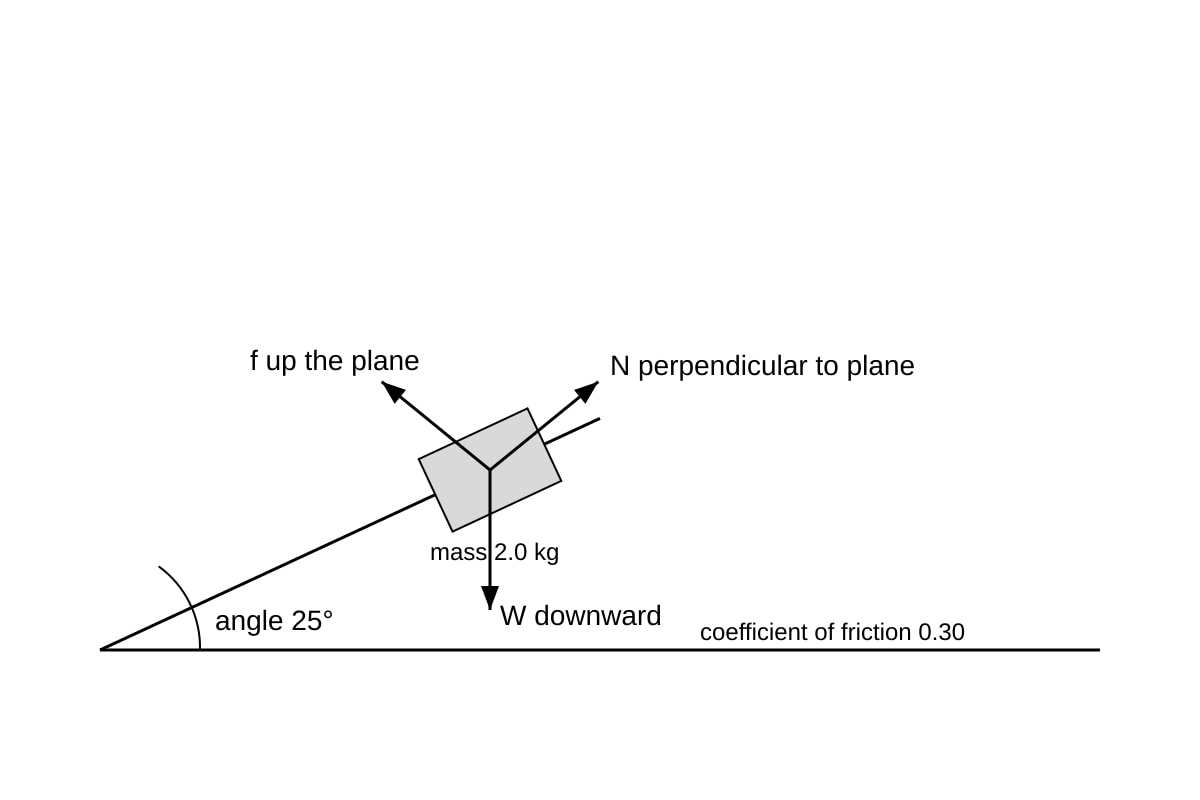
13.
Image pending generation: diagram for Q13.
The block of mass 2.0 kg is on a 25∘ incline with μ=0.30. Calculate the frictional force and state if it moves. [4]
14. State Newton's second law of motion and express it as an equation. [2]
Section C: Energy and Circular Motion (Questions 15–20) [18 marks]
15. A 0.50 kg ball is dropped from 8.0 m. Calculate its speed just before impact using energy conservation. [3]
16. A car engine delivers 40 kW and moves at constant 20 m s−1. Calculate the resistive force. [2]
17. A mass of 1.2 kg is whirled in a horizontal circle of radius 0.80 m at 4.0 rev s−1. Calculate the centripetal force. [4]
18. A satellite orbits Earth at radius 7.0×10⁶ m with speed 7.5×10³ m s−1. Calculate its centripetal acceleration. [2]
19. Describe the difference between an elastic and an inelastic collision in terms of kinetic energy. [2]
20. A 2.0 kg trolley at 3.0 m s−1 collides with a stationary 1.5 kg trolley and they stick. Show that kinetic energy is not conserved. [5]
Answers
TuitionGoWhere Practice Paper — Answer Key (Version 3)
Subject: Physics H1
Level: A-Level
Topic: Mechanics
Total Marks: 60
Section A: Foundations of Mechanics (Q1–7) — 21 marks
Q1. [2]
Teaching note: Conservation of linear momentum applies to a closed system.
Answer: In a closed (isolated) system, the total linear momentum remains constant (momentum before = momentum after) provided no external net force acts. [B1 for constant total momentum, B1 for no external force / closed system]
Q2. [2 total: 1+1]
(a) p=mv [1]
(b) Ek=21mv2 [1]
Common trap: Omitting 21 in kinetic energy.
Q3. [3]
Given p=12 N⋅s, Ek=24 J.
p=mv⇒v=p/m [M1]
Ek=21mv2=2mp2⇒m=2Ekp2 [M1]
m=2×24122=48144=3.0 kg [A1]
v=12/3.0=4.0 m s−1 [A1]
Marks: M1+M1+A1+A1 (3 counted as method+answer).
Q4. [3]
Horizontal component of pull: Fx=20cos30∘=17.3 N [M1]
Net force: Fnet=17.3−5.0=12.3 N [M1]
a=Fnet/m=12.3/4.0=3.1 m s−2 [A1]
Q5. [2]
Work done by a constant force = product of force component in direction of displacement and the displacement. [B1] W=Fscosθ or F×d in direction. [B1]
Q6. [4 total: 2+2]
(a) Acceleration = gradient = 12/4=3.0 m s−2 [2]
(b) Distance = area: triangle (½×4×12=24) + rect (4×12=48) + triangle (½×2×12=12) = 84 m [2]
Q7. [3]
Forces: weight of plank 300 N at centre (2.5 m from A), boy 500 N at 2.0 m from A, upward reactions at A and B. [B1 each force correctly placed, B1 for labels] (Diagram expected from placeholder.)
Section B: Dynamics and Equilibrium (Q8–14) — 21 marks
Q8. [4]
Take right as positive: pi=2.0(4.0)+3.0(−2.0)=8−6=2.0 kg m s−1 [M2]
(2.0+3.0)v=2.0⇒v=0.40 m s−1 right [A2]
Q9. [5]
Moments about left support (at 1.0 m): R2×2.0=200(1.0)+150(0.5) [M2]
R2=(200+75)/2=137.5 N [A1]
ΣFy=0:R1+137.5=350⇒R1=212.5 N [M1+A1]
Q10. [2]
Dynamic equilibrium: object moves at constant velocity. Newton's first law: if net force zero, velocity constant. [B1] Hence acceleration zero, net force zero. [B1]
Q11. [4]
uy=20sin30∘=10 m s−1 [M1]
At max height vy=0: 0=102−2(9.8)h [M1]
h=100/19.6=5.1 m [A2]
Q12. [4]
Vertical: 45=21(9.8)t2⇒t=90/9.8=3.03 s [M2]
Range =15×3.03=45.5 m [A2]
Q13. [4]
W=mg=19.6 N; component down plane =19.6sin25∘=8.28 N [M1]
Normal N=19.6cos25∘=17.8 N [M1]
Max friction =μN=0.30×17.8=5.34 N [M1]
Since 8.28>5.34, block moves down. [A1]
Q14. [2]
Rate of change of momentum proportional to net force: F=ma or F=dp/dt. [B1+B1]
Section C: Energy and Circular Motion (Q15–20) — 18 marks
Q15. [3]
mgh=21mv2⇒v=2gh [M1]
v=2×9.8×8.0=156.8=12.5 m s−1 [A2]
Q16. [2]
P=Fv⇒F=P/v=40000/20=2000 N [2]
Q17. [4]
ω=2πf=2π×4.0=25.1 rad s−1 [M1]
v=ωr=25.1×0.80=20.1 m s−1 [M1]
F=mv2/r=1.2×20.12/0.80=605 N [A2]
Q18. [2]
a=v2/r=(7.5×103)2/(7.0×106)=8.0 m s−2 [2]
Q19. [2]
Elastic: total KE conserved. [B1] Inelastic: total KE not conserved (some lost as heat/sound). [B1]
Q20. [5]
Initial KE: 21(2.0)(3.0)2=9.0 J [M1]
Final v: 2.0(3.0)=3.5v⇒v=1.71 m s−1 [M1]
Final KE: 21(3.5)(1.71)2=5.1 J [M1]
9.0=5.1, so not conserved. [A2]
Free quiz and exam paper access
Enter your details to view this paper
Your access is remembered on this device.